Showing posts with label Dow Jones. Show all posts

Thursday, June 11, 2020

Dow plunges more than 1,800 points


Dow plunges more than 1,800 points as rising COVID-19 cases roil Wall Street 


By Sylvan Lane - 06/11/20 04:07 PM EDT


Stocks plummeted Thursday as the emergence of new coronavirus hotspots and a caution from the Federal Reserve chairman shook Wall Street after months of steady gains.

The Dow Jones Industrial Average closed with a loss of 1,861 points, plunging 6.9 percent for its worst day of losses since March. The S&P 500 index closed with a loss of 5.9 percent, and the Nasdaq composite sunk 5.3 percent on the day.

All three major U.S. stock indexes closed with their steepest single-day losses since crashing in March amid the beginning of lockdowns imposed to slow the spread of COVID-19. Thursday’s losses come after more than two months of steady recovery toward the record highs seen before the pandemic derailed the economy.

Despite the loss of more than 21 million jobs and the deaths of more than 110,000 Americans due to the coronavirus, investors had gradually upped their bets on a quick economic recovery through April and May as states began loosening business closures and travel restrictions.

The surprise addition of 2.5 million jobs in May, according to the Labor Department, also fueled hopes for a quicker than expected rebound from a recession of unprecedented scale and speed.

But Thursday’s abrupt reversal comes as states across the U.S. see spiking COVID-19 cases and diminishing hospital capacity to handle a new wave of infections.

Week-over-week case counts are rising in half of all U.S. states, and only 16 states plus the District of Columbia have seen their total case counts decline for two consecutive weeks.

North Carolina, California, Mississippi and Arkansas are all facing record levels of hospitalizations, and the virus appears to be quickly spreading in Houston, Phoenix, South Carolina and Missouri.

Some market experts also attribute Thursday’s losses to Fed Chairman Jerome Powell’s Wednesday prediction of a “long road” to recovery.

During a Wednesday press conference, Powell said that while the U.S. may see significant job growth in coming months as people return to their jobs," the country is "still going to face, probably, an extended period where it will be difficult for many people to find work."

“What we’re trying to do is create an environment in which they have the best chance either to go back to their old job or to get a new job,” he continued.

President Trump, who frequently lashes out at the Fed when markets turn south, blasted the Fed for underestimating how quickly the U.S. economy could recover and how soon a COVID-19 vaccine would be available.

“The Federal Reserve is wrong so often. I see the numbers also, and do MUCH better than they do. We will have a very good Third Quarter, a great Fourth Quarter, and one of our best ever years in 2021. We will also soon have a Vaccine & Therapeutics/Cure. That’s my opinion. WATCH!" Trump tweeted.

On The Money: Dow plunges more than 1,800 points as rising COVID-19...
Stocks plunge amid concerns over rising coronavirus cases

Trump's top economic advisor Larry Kudlow also criticized Powell, urging the Fed chief to ease up on the dour forecasts

"I do think Mr. Powell could lighten up a little when he has these press offerings. You know, a smile now and then, a little bit of optimism," Kudlow said on Fox Business Network.

"I'll talk with him and we'll have some media training at some point.


Thursday, October 11, 2018

Dow drops 545 points as stock market slide continues


By Kevin Dugan


October 11, 2018 | 4:23pm | Updated


AP


see also 


Dow plunges more than 800 points as tech stocks take beating


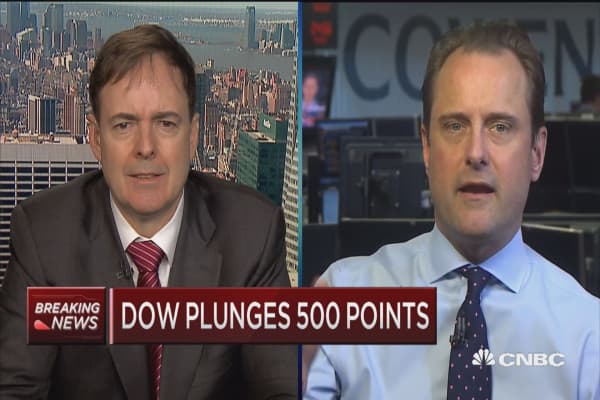
Carnage on Wall Street deepened on Thursday, with the Dow plunging more than 500 points as fears grew that rising trade tensions and interest rates could put a cap on economic growth.

The Dow’s drop — which came on the heels of a day-earlier tumble of 831 points, the worst since February — came despite muted inflation data on Thursday morning. While stocks had initially peeked into positive territory on the news, a brutal selloff resumed in the late afternoon.

The blue-chip index slid as much as 699 points before ending the session down 545.91 points, or 2.13 percent, at 25,052.83. The S&P 500, a broader index of US stocks, ended the day down 2 percent, or 57 points, to 2,728.37.

Both indexes have fallen more than 5 percent the past two days.

The Nasdaq, which had fallen the most on Wednesday — a whopping 4.1 percent as Facebook, Apple, Amazon, Alphabet and Netflix all got hammered — was off the least, down 1.1 percent, to 6,964.03.

The volatile day came President Trump lambasted the Federal Reserve as “loco” for raising rates, and as investors gird themselves for other central banks around the world also start to tighten credit markets.

“This is a 10-year trend that’s now reversing,” Jack Ablin, chief investment officer at Cresset Wealth Advisors, told The Post. “So while President Trump blames the Fed for yesterday’s woes, he didn’t give them the credit for interest rates below fair value for 10 years.”

On Thursday, Trump continued to hammer on the Fed, saying he was “disappointed” in the central bank’s chairman, Jay Powell, for raising rates.

Investors, who expect one more interest rate hike this year in December, are also concerned about the European Central Bank, which is phasing out its $30 billion a month accommodative program this year.

“Most of this move has nothing to do with the Fed,” Ablin said. “It has more to do with the European Central Bank. They’re ending their [bond buying program] in about a month or so.”


Saturday, February 03, 2018

Dow plummets 666 points, capping worst week in 2 years


Dow plummets 666 points, capping worst week in 2 years

  • Friday marked the first time since June 2016 that the Dow fell at least 500 points.
  • The major indexes posted their worst weekly performance in two years
  • The benchmark 10-year yield rose to 2.85 percent.


Published 4:49 AM ET Fri, 2 Feb 2018 Updated 11 Hours Ago CNBC.com


Trading Nation: Dow plunges 500 plus points 13 Hours Ago | 03:48


U.S. stocks fell sharply on Friday after a stronger-than-expected jobs report sent interest rates higher.

The Dow Jones industrial average dropped 665.75 points to close at 25,520.96, capping off the index's sixth-largest points decline ever. The 30-stock index also fell below 26,000. Friday also marked the first time since June 2016 that the Dow fell at least 500 points.

The S&P 500 fell 2.1 percent and finished at 2,762.13, with energy as the worst-performing sector. The Nasdaq composite plunged 1.96 percent to 7,240.95 as a decline in Apple and Alphabet offset a strong gain in Amazon shares.

The Dow posted its worst day since June 2016. The S&P 500 and Nasdaq had their biggest one-day fall since September 2016 and August 2017, respectively.

"The key for the market today is rising interest rates," said Mike Baele, managing director at U.S. Bank Wealth Management. "The old adage is: 'Bull markets don't die of old age, they are killed by higher interest rates.' That looms large."

The U.S. economy added 200,000 jobs in January, according to the Bureau of Labor Statistics. Economists polled by Reuters expected growth of 180,000. Wages, meanwhile, rose 2.9 percent on an annualized basis.

The report sent interest rates higher. The benchmark 10-year yield rose to 2.85 percent on the back of the report, hitting a four-year high. Investors have been jittery about the recent rise in interest rates, worrying they may be rising too fast.

On Friday, the 30-year yield rose its highest level since March.


Monday, August 24, 2015


Dow Jones Industrial Average Plummets, Global Stocks Take 'Black Monday' Plunge On 'Great Fall Of China'
By Jessica Menton @JessicaMenton j.menton@ibtimes.com on August 24 2015 9:33 AM EDT
Share on facebook
26
Share on twitter
26
Share on linkedin

Share on google_plusone_share
More Sharing Services

1


Traders work on the floor of the New York Stock Exchange August 21, 2015. Reuters/Brendan McDermid


U.S stocks plunged Monday, with the Dow Jones Industrial Average plummeting more than 1,000 points following a global stock sell-off across European and Asian markets as fears escalated about China’s slowing economy. All three major indexes are on course for one of their worst opens since the financial crisis of 2008.

The sharp U.S. stock downturn was anticipated after futures pointed to Monday mayhem. Dow futures plunged more than 800 points before the U.S. markets opened, as fears of a major Chinese economic downturn escalated across global markets. European markets extended losses in afternoon trade Monday, with the pan-European Stoxx 600 index down nearly 5 percent. Japan’s Nikkei 225 index dropped 4.6 percent to finish at its lowest closing level since February 23. China’s benchmark Shanghai Composite recorded its biggest one-day percentage loss since 2007, closing down 8.5 percent, dubbed “Black Monday” by China’s state media.

The Dow Jones Industrial Average (INDEXDJX:.DJI) tumbled 1,089 points, or 6 percent, to 15,370.33. The S&P 500 index (INDEXSP:.INX) lost more than 100 points, or 5 percent, to 1,867.01. And the Nasdaq composite (INDEXNASDAQ:.IXIC) dropped 412 points, or nearly 9 percent, to 4,292.14.

The stock rout began with China's posting of numbers that showed factory production in the world’s second-largest economy shrank in August at its fastest rate in more than six years. The numbers fuel concerns that China’s sudden slowing will have far-reaching effects around the world.

All 10 sectors in the S&P 500 traded lower, led by a more than 6 percent decline in consumer staples and technology stocks. Healthcare and consumer discretionary stocks dropped more than 5 percent.

Meanwhile, all 30 stocks in the Dow traded sharply lower, led by a 5 percent decline from The Coca-Cola Co. (NYSE:KO), while Cisco Systems Inc. (NASDAQ:CSCO) and McDonald's Corporation (NYSE:MCD) lost more than 4 percent.

The yield on the U.S. 10-year Treasury slid further Monday to 1.97 percent from 2.045 percent Friday amid growing uncertainty about global economic growth. When investor confidence is low, the price on the 10-year goes up as there is more demand for Treasurys as a safe investment, and yields subsequently fall.

The U.S. dollar fell against major currencies amid growing uncertainty of whether the U.S. Federal Reserve may wait even longer than planned after September to raise interest rates.

U.S. oil prices extended losses Monday, tumbling 4 percent to trade below $30 after tallying an eighth straight weekly decline last week, the longest weekly losing streak in nearly 30 years. U.S. crude oil has lost around 17 percent from its opening price at the start of the month.

West Texas Intermediate crude, the benchmark for U.S. oil prices, fell 4 percent to $38.69 per barrel for October delivery on the New York Mercantile Exchange. On the London ICE Futures Exchange, Brent crude, the global benchmark for oil prices, dropped nearly 3.5 percent to $43.87.


.

Thursday, August 20, 2015

Stocks Fall Sharply on Growth Worries


News: Dow Jones


08/20/15 02:45 PM EDT
By Dan Strumpf


Growth worries rattled stock markets from China to Germany and the U.S., with the Dow industrials on course for their lowest finish of the year.

The latest catalyst to pull shares lower was the Federal Reserve, which on Wednesday released July meeting minutes showing that some central-bank officials harbored doubts about the health of the global economy. That further spooked investors who were already unnerved by the economic and financial turmoil in China and a renewed plunge in crude-oil prices.

The Dow Jones Industrial Average fell 243 points, or 1.4%, to 17106, sending the blue chips on pace to close at their lowest level since mid-December.

"People are worried about the Fed," said Rick Fier, director of execution services at Conifer Securities. "People want the Fed raising rates [in response to] the economy getting better."

Wednesday's Fed minutes showed officials are divided on when to raise interest rates, seen as a possibility as soon as September. Some Fed officials pointed to slowing growth in China's once-booming economy as a reason for caution.

The losses in the U.S. come on the heels of declines in Asia and Europe. The Shanghai Composite dropped 3.4% and stocks in Hong Kong and Taiwan fell into bear-market territory. France's CAC-40 declined 2.1% and Germany's DAX lost 2.3%.

Ultralow interest rates have helped spur a rally in stocks since the financial crisis, which has prompted investors to monitor closely the Fed's timeline for rate increases. At the same time, if the Fed decides to delay raising interest rates on growth concerns, that could weigh on the outlook for corporate profits and stock gains.

The S&P 500 lost 1.3% and the Nasdaq Composite fell 2%. Higher-growth corners of the market that have run up this year, including health-care and consumer-discretionary stocks, took the biggest hit. Health shares in the S&P 500 shed 1.2%, while consumer-discretionary stocks gave up 1.9%.

Investors flocked to haven assets. Gold futures added 1.9% to $1149.40 an ounce. Treasury prices rose, pushing the 10-year yield down to 2.096% from 2.129% on Wednesday.

The lack of guidance from the Fed minutes on when a rate increase could come has left investors parsing economic data for clues. Initial jobless claims rose 4,000 to 277,000 in the week ended Aug. 15, the Labor Department said Thursday. The level remained historically low, suggesting the labor market continues to improve.

"If the Fed does not raise rates in September, does the market therefore assume that growth is too slow?" said Ernie Cecilia, chief investment officer at Bryn Mawr Trust.

On Thursday, oil prices reversed direction after plumbing fresh six-year lows in intraday trading. Crude-oil futures rose 0.5% to $41 a barrel. Lower energy prices have curbed inflation, complicating the Fed's decision to raise rates.

In corporate news, L Brands Inc. said earnings rose 7.5% on continued sales growth and stronger margins in the latest quarter. Shares gained 2.1%.

Valeant Pharmaceuticals International Inc. shares fell 1%. The company said Thursday it will pay $1 billion for Sprout Pharmaceuticals Inc., which just won approval to sell the first drug that aims to boost a woman's libido. The Wall Street Journal reported the deal talks late Wednesday.

Shares of several large media companies fell sharply after analysts at Bernstein downgraded Walt Disney Co. and Time Warner Inc. Those stocks fell 5% and 3.7%, respectively. Viacom Inc. lost 4.2%.

Write to Dan Strumpf at daniel.strumpf@wsj.com


(END) Dow Jones Newswires

August 20, 2015 14:45 ET (18:45 GMT)


Source: http://www.morningstar.com/news/dow-jones/TDJNDN_201508209589/stocks-fall-sharply-on-growth-worries.html

.

Wednesday, July 08, 2015

Dow ends down 261 as NYSE shutdown stuns markets


David Carrig and Adam Shell, USA TODAY4:48 p.m. EDT July 8, 2015


July 8 -- The NYSE says it experienced technical issues that affected symbols. Bloomberg's Julie Hyman reports on "Bloomberg Markets." Bloomberg


(Photo: Spencer Platt, Getty Images)


Losses in U.S. stocks following a global sell-off Wednesday accelerated when trading at the New York Stock Exchange suddenly halted for unknown technical reasons.

The Dow Jones industrial average was already off 177 points when at 11:32 a.m. ET trading in all securities on the NYSE stopped. Trading on the exchange resumed about 3:10 p.m.

Well into the 3½-hour shutdown came the release of the latest Fed minutes, which gave investors another opportunity to second-guess when the central bank will raise rates.

The Dow ended down 261 points, or 1.5% to 17,515.42. The Standard & Poor's 500index shed 1.7%, to 2046.69, while the Nasdaq composite index lost 1.8%, to 4909.76.

3½-HOUR SHUTDOWN: NYSE resumes trading

It's only Wednesday, but it's already been a tough week for investors around the world. Europe and Asia investors, especially, have confronted the longer-term issues of Greece's debt problem and a cratering market for China stocks.


USA TODAY

Fed officials worried about Greek crisis last month


Amid the NYSE shutdown, the exchange issued a statement saying: "We're currently experiencing a technical issue that we're working to resolve as quickly as possible. We will be providing further updates as soon as we can, and are doing our utmost to produce a swift resolution, communicate thoroughly and transparently, and ensure a timely and orderly market re-open."

It still wasn't clear after the 4 p.m. close what the nature of the tech issue was.

Even with the NYSE shut down, stock losses accelerated with the Dow's loss exceeding 200 points in afternoon trading. The outage didn't affect other markets including the Nasdaq Stock Market. In fact, trading in NYSE-listed stocks was still occurring on other exchanges, including the Nasdaq.

"There are 11 other stock exchanges," says Sal Arnuk, trader at Themis Trading. "The good news is there's redundancy in the system and stocks are continuing to trade." Arnuk says the other exchanges are handling the trading "fluidly and smooth."

In an increasingly electronic, automated market, market glitches — despite the uncertainty that results — are just part of the new investing landscaping, says Savena Mostowfi, head of U.S. equities research at TABB Group, a firm that specializes in market structure.

"System glitches are the new norm," she told USA TODAY.

Mostowfi lauded the NYSE's decision to shut trading down when it discovered a technical problem.

"It was a smart decision rather than create mass confusion," she says, noting that investors would rather not be in limbo, wondering what the status of their trades are.

And while the U.S. exchange system has gotten increasingly fragmented with 11 different exchanges, which is often a criticism, today the ability of investors to seamlessly move their trading to other exchanges is a sign the system "works," says Mostowfi. The fact that the stock market did not go into freefall despite the outage at the NYSE was "reflective of how seamless the transition was for brokers to go from one trading venue to another."

Stocks had been lower all morning as investors were confronted with a major sell-off in Asian markets, uncertainty over the future of Greece and the eurozone and the upcoming release of the Fed minutes.

Wall Street followed Asian markets lower as Hong Kong's Hang Seng index plunged as much as 8% before closing down 5.8% and China's Shanghai Composite sank 5.9%. Japan's Nikkei 225 index lost 3.1% to close at 19,737.64.


USA TODAY

China's dramatic stock plunge continues


The sell-off in China came despite measures announced by the Chinese government Wednesday to halt the stock slide including telling state-owned companies to buy shares, raising the amount of equities insurance companies can hold and promising more credit to finance trading.

Chinese stocks are now down more than 30% since early June.


A woman rubs her face as she stands at a computer terminal in a stock brokerage house in Nantong in eastern China's Jiangsu province on July 8, 2015. (Photo: AP)


The lack of progress on Greek debt talks also added to investor angst. Greece submitted a request to the European Union for aid on Wednesday, and must present a detailed new economic reform proposals to justify fresh lending by international creditors by Thursday. EU leaders have also give Greece a Sunday deadline to make a deal of face bankruptcy.


USA TODAY

Greece submits aid request; still to send full plan


European stocks were higher Wednesday after four straight days of declines. Hopes that Greece will eventually submit a proposal and spur talks that will lead to a deal helped stop the recent European drop. Germany's DAX index was up 0.7% and France's CAC 40 added 0.8%.

RATES: Will Fed plans be upended by global tumult?

Contributing: Jane Onyanga-Omara, Matt Krantz


Source: http://www.usatoday.com/story/money/markets/2015/07/08/stocks-wednesday/29856201/
.
.

Monday, June 24, 2013

Sell, sell, sell on Wall Street Monday as Dow drops as much as 1.7%


12:25 pm by Deborah Bacal


As of just about noon ET, the Dow was down 239 points to 14,560, after hitting a day low of 14,551.27, while the Nasdaq shed 61 points to 3,296, and the S&P 500 lost 31 points to 1,561.

U.S. markets embarked on another sharp slide Monday as Shanghai stocks plummeted 5.3%, the worst percentage fall since 2009, on growing fears over a liquidity crunch in China, the world’s second-largest economy.

As of just about noon ET, the Dow was down 239 points to 14,560, after hitting a day low of 14,551.27, while the Nasdaq shed 61 points to 3,296, and the S&P 500 lost 31 points to 1,561.

In China, the Shanghai Composite index (SHA:CN:SHCOMP) plunged 5.3% to 1,963.24 as banking stocks slid on fears Beijing officials could be unwilling to ease the liquidity crunch, with the country's central bank saying that the nation's banks need to control liquidity better. On top of this, Goldman Sachs also downgraded its GDP growth forecasts for China to 7.4% and 7.7% for 2013 and 2014, respectively, down from 7.8% and 8.4%, previously.

In the U.S. Monday, the economic calendar was relatively quiet, with data kicking off on Tuesday, in a week set to be dominated by durable goods, new home sales, consumer confidence, pending home sales, and Chicago PMI, amid a heavy raft of Fed speakers that starts later today with Richard Fisher. Investors were thus left to focus Monday on China's dire straits, with the drama taking its toll on commodities, for which the country is a major consumer.

The sell-off today comes after a major rout for markets last week in the U.S. The Dow lost 1.8% last week after the Fed suggested that its bond buying could be slowed later this year with an eventual halt to the policy in the middle of 2014, while the Nasdaq finished down 1.9% and the S&P 500 lost 2.1%.

In corporate news Monday, Boeing (NYSE:BA) led the decliners in the Dow, falling almost 3% after its 787 Dreamliner nightmare continues, this time grounding one of its planes flown by United Airlines due to a brake problem. The jet, traveling from Houston to Denver, had to make an emergency landing, and returned to Texas.

In other news, Tenet Healthcare (NYSE:THC) has agreed to acquire Vanguard Health (NYSE:VHS) for about $1.63 billion, or $21 per share in cash - a 70% premium to Vanguard's closing price on Friday. Shares of Vanguard surged almost 69%.

Elsewhere, Vodafone (NASDAQ:VOD) shares edged down in the U.S. after it said it has agreed to acquire Kabel Deutschland (KBDHY.OB) for 7.7 billion euros in what will be the U.K. operator's largest acquisition since its entry into India in 2007.

Shares of Apple (NASDAQ:AAPL) lost 3.3% Monday after Jefferies cut its price target on the iPhone developer to $405 from $420 previously on the possibility of the company slowing iPhone production.

Meanwhile, according to a report in the Wall Street Journal, Google (NASDAQ:GOOG) has confirmed that the Federal Trade Commission is carrying out an antitrust review on its purchase of Waze, given Google's dominant position in the online/mobile maps market. Shares of Google shed 1.7% on Monday.

Commodities

Gold futures fell a further $12 to $1,280 an ounce Monday after closing down more than 6% last week, with Goldman Sachs also cutting its outlook on gold prices today for this year and next on an improving U.S. economy. The bank now expects gold to end the year at $1,300 a troy ounce, a 9.4% drop from its previous forecast, while it now sees the yellow metal finishing 2014 at $1,050 an ounce, a decline of 17.3% from its prior outlook.

Crude for July delivery lost 2 cents to $93.65 a barrel.

Europe

European markets finished sharply lower today with shares in France leading the region. The CAC 40 finished down 1.71% while Britain's FTSE 100 was off 1.42% and Germany's DAX fell lower by 1.24%.


.

Wednesday, November 14, 2012

Wall Street drops on deficit, Middle East concerns


Related News

Obama says tax hike will have to come first in "fiscal cliff" deal
5:48pm EST
World stocks drop on fiscal mess, oil up on Mideast woe
5:41pm EST
U.S. stocks slip on fiscal cliff woes; euro weakens
Tue, Nov 13 2012
Microsoft leads Wall Street lower, but retailers gain
Tue, Nov 13 2012
Euro slips vs yen, dollar on Greece, Spain concerns
Tue, Nov 13 2012

Analysis & Opinion

Japan shuns fiscal cliff, wont escape growth funk
The economy needs a ‘unity Cabinet’

Related Topics

Investing Simplified »


Related Video

Trading at Noon: Facebook makes friends as lockup expires
3:58pm EST


By Rodrigo Campos

NEW YORK | Wed Nov 14, 2012 5:58pm EST

(Reuters) - Stocks slid on Wednesday with declines accelerating after President Barack Obama set up a drawn-out fight over the fiscal cliff when he stuck to his pledge to raise taxes on the wealthy, and as violence increased in the Middle East.

Obama, in his first press conference since re-election, held to his position that marginal tax rates will have to rise to tackle the nation's deficits.

With talks over solving the U.S. "fiscal cliff" in early stages, investors are reacting to the uncertainty by shedding positions.

"I think we will have a last-minute cliffhanger solution," said Michael Cheah, portfolio manager at SunAmerica Asset Management in Jersey City, New Jersey, about a deal to avoid the so-called cliff.

"In the meantime, the market is going to get punched every day."

Without a deal, a series of mandated tax hikes and spending cuts will start to take effect early next year that could push the U.S. economy into a recession.

Taxes on capital gains and dividends could rise as part of the negotiations, pushing investors to sell this year and pay lower taxes on their gains.

Adding to the selling pressure, Israel launched a major offensive against Palestinian militants in Gaza, killing the military commander of Hamas in an air strike and threatening an invasion of the enclave. Egypt said it recalled its ambassador from Israel in response.

"We know Europe's in trouble, China's slowing down ... and now you've got the Middle East flaring up again. It's all hitting at once, and obviously, the market is taking a 'sell first, ask questions later' approach," said Ryan Detrick, senior technical strategist at Schaeffer's Investment Research in Cincinnati.

Industrial shares led the decline, dragged lower in part by a 1 percent spike in crude prices after the Israeli offensive on Gaza. The S&P industrial sector index .GSPI fell 2.5 percent.

Wall Street had opened higher after Dow component Cisco Systems Inc (CSCO.O) reported first-quarter earnings and revenue late Tuesday that beat expectations, driving its stock up 4.8 percent to $17.66. But the positive momentum was short-lived.

The Dow Jones industrial average .DJI fell 185.23 points, or 1.45 percent, to 12,570.95 at the close. The S&P 500 .SPX dropped 19.04 points, or 1.39 percent, to 1,355.49. The Nasdaq Composite .IXIC lost 37.08 points, or 1.29 percent, to 2,846.81.

Both the Dow industrials and the Nasdaq ended at their lowest levels since late June.

The S&P 500 has fallen 5.1 percent in the six sessions since election night. Wednesday marked the benchmark index's lowest close since July 25.

The Russell 2000 .RUT tumbled 2 percent. The Dow Jones Transportation average .DJT slid 2.6 percent. FedEx Corp (FDX.N) shares dropped 3.7 percent to $87.12. Bank of America (BAC.N) shares lost 3.6 percent to $8.99.

In contrast, Facebook (FB.O) shares jumped 12.6 percent to $22.36 as investors were relieved that expiring trading restrictions on a huge block of shares did not trigger an immediate wave of insider selling.

Teen clothing retailer Abercrombie & Fitch Co (ANF.N) jumped 34.4 percent to $41.92 after the company reported unexpectedly improved third-quarter results and a full-year outlook that exceeded Wall Street's forecasts.

About 7.53 billion shares changed hands on the New York Stock Exchange, the Nasdaq and NYSE MKT, more than the daily average so far this year of about 6.51 billion shares.

On the NYSE, decliners outnumbered advancers by a ratio of almost 9 to 1. On the Nasdaq, about four stocks fell for every one that rose.

(Reporting by Rodrigo Campos; Additional reporting by Steven C. Johnson and Leah Schnurr; Editing by Jan Paschal)


.

Wednesday, May 16, 2012

Spanish Bank Costs May Be Expensive But Manageable - Irish Minister

May 16, 2012, 6:29 a.m. ET


DUBLIN (Dow Jones)--The problems of Spain's banks will be resolved, but the recapitalization bill could be "expensive", Irish Finance Minister Michael Noonan said Wednesday.

"There is an awful lot of concern about the Spanish banking system but the new Spanish government is dealing with it quickly," he said. "My sense is there will be recapitalization requirements made which will be an expensive enough project, but I think it's relatively do-able."

Talking at a Bloomberg investment conference, the finance minister said parallels had been drawn between Irish and Spanish banks because the lenders in both countries had loaned large amounts to construction.

Turning to Greece, he said there is no pressure from the European Union on Greece to leave the euro. But it was now in Greece's "own hands" to decide its future, he said, characterizing the country's current problems a crisis for its democracy, not one of its economic system.

"It's not guaranteed that Greece is going to leave the euro," he said.

Ireland is immune from Greek market turmoil because the economic ties between the countries were weak, Noonan added.

-By Eamon Quinn, Dow Jones Newswires, +35 31 676 2189; eamon.quinn@dowjones.com


Wednesday, May 09, 2012

US stocks fall as Europe doubts bubble to surface

Specialists Patrick King, left, and Christopher Carella work on the floor of the New York Stock Exchange Tuesday, May 8, 2012. Stocks appear to be headed to open lower with Dow Jones industrial futures down 0.3 percent and S&P 500 futures down 0.5 percent. (AP Photo/Richard Drew)

Fear of European debt is once again playing havoc with Wall Street.

Stocks pitched down Wednesday in the United States as borrowing rates climbed for Spain and Italy, a sign that investors are losing confidence in those countries' finances.

Spain's 10-year borrowing rate leapt to 6.06 percent from 5.70 percent early Tuesday. Many fear that Spain, strangled by high unemployment and a real estate collapse, could be the next nation to require financial rescue.

The Dow Jones industrial average was down as much as 184 points before recovering about half of the loss. Still, the average has fallen for six consecutive days, its longest losing streak since last summer.

The Dow soared 2,624 points, or 25 percent, from Oct. 3 through May 1 as European leaders appeared to get a handle on the debt crisis. Last fall, nations that use the euro agreed to enforce budget discipline across the region.

Since May 1, when the Dow closed at a four-year high, worries about Europe have resurfaced. In elections on Sunday, Greek and French voters ousted leaders who had imposed tough spending cuts to soothe investors.

In the six losing days that ended Wednesday, the Dow gave back 444 points — one-sixth of the points it gained during its eight-month rally. The Dow closed down 97.03 points, or 0.8 percent, at 12,835.06.

Greece, without a government since Sunday's elections, appears increasingly likely to exit the euro currency union or be forced out. The resulting uncertainty could cause turmoil throughout global markets.

The spring decline has become a motif on Wall Street. In 2010 and 2011, the Dow climbed in the first three months of the year, then flat-lined or lost ground as events overseas overshadowed modest economic growth in the U.S.

The market today is tame compared with last summer, when the Dow routinely swung by hundreds of points a day.

But the atmosphere is starting to resemble last year's as traders sell anything deemed risky based on the latest headlines from Europe, said Peter Tchir, who trades a range of investments for his hedge fund TF Market Advisors.

"The concern in Spain is at such a high level that people trade the indexes or big futures contracts and are less discriminating about what risk they're taking on," he said.

On Wednesday, prices fell for commodities such as energy, copper and silver that are needed to sustain broad economic growth but are less valuable when the economy is weaker and demand wanes.

Benchmark crude oil, which sold for about $110 per barrel earlier this year, fell below $100 last week and kept sliding. It closed below $97 Wednesday on the New York Mercantile Exchange, continuing its longest decline since last July.

Commodity prices also were under pressure because the dollar rose against the euro, sending the euro down as low as $1.2910, its lowest point since Jan. 23. Commodities are traded in dollars, so a strong dollar makes them appear more expensive to investors who hold foreign currencies.

European stocks are having one of their worst weeks in months. London's FTSE 100 index is down 2.2 percent this week, its worst performance since December. Stocks in Athens are down 10.8 percent, the most since August.

Cash flowed into ultra-safe investments such as U.S. Treasurys, pushing the yield on the 10-year note as low as 1.80 percent, near a seven-month low. The yield finished the day at 1.84 percent as stocks moved off their earlier lows.

One reason that demand for Treasurys is increasing: As Europe deteriorates and hiring in the U.S. slows, traders believe that the Federal Reserve is more likely to engage in another round of bond-buying to juice the economy.

Bond-buying by the Fed lowers bond yields, pushing more cash into stocks and commodities. When traders expect the Fed to act, they buy bonds to take advantage of the extra demand that the Fed's buying will create.

Economic indicators and corporate earnings in the U.S. continue to signal recovery, albeit a choppy one. The government said after trading began that U.S. wholesale stockpiles grew in March at their slowest pace in four months, a sign demand is too weak for companies to ramp up production.

The Standard & Poor's 500 index and Nasdaq composite average both closed well above their lows for the day. The S&P fell 9.14 points, or 0.7 percent, to 1,354.58. The Nasdaq dropped 11.56, or 0.4 percent, to 2,934.71.

Tchir expects the market to grow more volatile as traders track deadlines for indebted European nations to repay bond investors or raise cash. For investors who benefited from the recent rally, he said, "I think it's time to take money off the table." There's too much of a disconnect between the Dow's recent four-year high and European markets that are scraping three-year lows, he said.

European stocks rose into the close, recovering some earlier losses. Indexes in France and London closed down less than 1 percent after steep losses earlier.

In corporate news:

— Chiquita Brands plunged 28.9 percent after the banana purveyor reported first-quarter earnings that were far below the expectations of Wall Street analysts.

— Macy's lost 3.8 percent after the department store chain made an earnings forecast that fell below Wall Street projections.

— Walt Disney Co. rose 1.6 percent, the most of the 30 stocks in the Dow, after the whimsy-production conglomerate said its fiscal second-quarter earnings outpaced expectations.

Daniel Wagner can be reached at www.twitter.com/wagnerreports.


Source

.

Friday, September 09, 2011

Stocks plunge as Europe nears 'tipping point'

By Hibah Yousuf
September 9, 2011: 1:09 PM ET


NEW YORK (CNNMoney) -- A sell-off in U.S. stocks accelerated Friday afternoon, as bad news out of Europe kept piling on.
Just before the opening bell, the European Central Bank announced that executive board member Juergen Stark was stepping down. Analysts say Stark is leaving amid disagreements over the ECB's bond-buying program.
The Dow Jones industrial average (INDU) dropped 324 points, or 2.9%. The S&P 500 (SPX) slumped 33 points, or 2.8%, and the Nasdaq composite (COMP) lost 61 points, or 2.4%.
"There's a lot of nervousness that Greece could default this weekend, and Greek bonds yields keep rising," said Joe Saluzzi, co-head of equity trading at Themis Trading.
Reports said Germany is preparing to shore up its banks to protect them against a Greek default. If Greece's bonds become worthless, that can trigger capital-requirement problems, and a lot of major banks could go under, Saluzzi said.
"The financial contagion could be pretty bad, so investors are getting out now and waiting to see how all of this will shake out," he added.

Europe turmoil deepens as ECB official departs

Investors were on edge following the surprise announcement of Stark's resignation.
"Stark has been a fairly vocal critic over the ECB's bond purchasing program," said Michael Hewson, analyst at CMC Markets in London. "His resignation highlights the political paralysis at the heart of Europe, and the debt crisis is approaching a tipping point."
Stark's departure along with Bank of Italy Gov. Mario Draghi taking over from ECB President Jean-Claude Trichet in November (Trichet is retiring) raises questions about how the region will handle its ongoing sovereign debt problems.

Bearish bets are on the rise

"A big part of the European debt crisis has been the lack of coherent response from European officials," said Kathy Jones, fixed income strategist at Charles Schwab. "It always seems like they're behind the curve, with too little too late, and all the changes in leadership in the middle of a crisis increases the uncertainty."
Stocks in Europe took a dive following the news and ended sharply lower. Britain's FTSE (FTSE) 100 shed 2.4%, the DAX (DAX) in Germany slipped 4.1% and France's CAC (CAC) 40 fell 3.2%.
The euro slid to a nearly 7-month low against the dollar, trading at around $1.36. The greenback, a traditional safe haven, also gained strength against the Japanese yen and British pound.

The euro's meltdown

As investors searched for safety, they fled risky investments like stocks and oil and rushed into U.S. Treasuries and gold. The 10-year yield fell near record lows to 1.92% from 1.99% late Thursday, and gold prices added $10.20, or 0.6% to $1,867.70.
The VIX (VIX), Wall Street's fear gauge, shot up 18% to sit about 40. A VIX reading higher than 30 is considered a sign that investors are getting worried.
Economy: Investors also digested President Obama's stimulus plan, in which he promises to boost hiring and provide a jolt to the stalled economy, if it becomes law. Mixing $253 billion in tax cuts and $194 billion in new spending, the total bill for the plan is $447 billion.
"We know what's been promised, and the size of it is encouraging. But the big question is whether or not it will get passed, and what that process will look like," said Jones. "Nobody wants to relive this summer's debate over the debt ceiling."

Bernanke to Congress: Don't sacrifice recovery

Investors also continued to mull over also Federal Reserve Chairman Ben Bernanke's speech delivered Thursday afternoon. Stocks ended sharply lower Thursday, as investors signaled disappointment that the Fed chief didn't offer any new solutions to the nation's economic slowdown.
Meanwhile, wholesale inventories rose 0.8% in July. Economists were expecting the figure to increase 0.7% after rising 0.6% in June.
Companies: McDonald's (MCD, Fortune 500) stock fell 4%, leading the declines on the Dow. The fast-food chain's same-store sales for August fell short of analysts' expectations.
Retailer Lululemon Athletica (LULU) beat expectations, reporting quarterly earnings of 26 cents per share. But its shares dropped 5.7% on weak guidance.

Kroger (KR, Fortune 500) topped estimates with a profit of $281 million for the second quarter, and the supermarket chain also reiterated its full-year guidance. But Kroger's stock fell 6.5% as the company's costs continued to rise and cut into profit margins.
Shares of Bank of America (BAC, Fortune 500) slipped 0.6%, after a Wall Street Journal report said the bank may increase layoffs to 40,000 from the 30,000 job cuts previously reported.
World markets: Rapidly rising prices in China finally started to slow, giving some relief to consumers in the world's second-largest economy. China's Consumer Price Index showed prices rose 6.2% over the 12 months ending in August.
Asian markets ended lower. The Shanghai Composite (SHCOMP) edged lower 0.05%, the Hang Seng in Hong Kong (HSI) slid 0.23% and Japan's Nikkei (N225) dropped 0.63%. To top of page

Wednesday, August 10, 2011

Wicked Wednesday on Wall Street

Photo (Courtesy) http://nation.foxnews.com/dow/2011/08/10/fear-rushes-back-dow-plummets-520-points

As the old saying goes: "Here we go again."

This jobless recovery is looking more and more like the misnomer that it is. No jobs, no recovery!

Today, the Dow Jones Industrial dropped 520 points. The Dow had also dropped 635 points two days ago, on Monday; Previously, the Dow had also closed 513 points lower on Friday 8/5/11. That's a total of 1668 points loss within 4 days of trading on Wall Street.
I know that's a bunch of bad news for less that a week; But look at the bright side, at least we got Rahm Emanuel as Mayor of Chicago.

Here's the story:

US stocks plummet over 4pc

From correspondents in New York
From: AFP
August 11, 20117:09AM


US stocks plummeted over four per cent today, more than wiping out the gains of yesterday's rebound as European debt troubles and worries of a new US recession kept investors nervous.

The Dow Jones Industrial Average was down 519.83 points (4.62 per cent) to 10,719.94 at closing, compared to its 430-point gain yesterday.

The broader S&P 500 fell 51.77 points (4.42 per cent) to 1120.76, while the tech-heavy Nasdaq lost 101.47 (4.09 per cent) to 2381.05.

The drop came after much steeper falls on European bourses, spurred by worries of possible problems with Greece's new bailout deal and a rumoured ratings downgrade of France and/or French banks.

Bank shares led the drop in the US markets, amid speculation that they faced more pressure to stop parking money with the central bank and begin lending.

Source
.

Monday, August 08, 2011

Dow falls 635 points in 6th-worst loss


The sell-off is prompted by S&P's downgrade of US debt and worries about Europe's financial system. Fannie Mae and Freddie Mac are downgraded as well. Gold finishes above $1,700; oil drops below $84. Bank of America falls 20%.

By Charley Blaine on Mon, Aug 8, 2011 12:28 PM

Updated: 6:20 p.m. ET

The Great Sell-Off of 2011 became the Great Rout of 2011 as worries about European debt problems and the impact of Standard & Poor's downgrade of U.S. debt on domestic and global growth combined to push stocks to their biggest one-day losses since December 2008.

The Dow Jones Industrial Average ($INDU) suffered a loss of 635 points, or 5.5%, to 10,810, its sixth-worst point loss ever. And that was actually a decent performance, relatively speaking.

The Standard & Poor's 500 Index ($INX) was off 6.7%, and the Nasdaq Composite Index ($COMPX) fell nearly 7%. Stocks in Asian and Europe also slumped.

Read more ...
.

Thursday, May 06, 2010

Dow Plunges Most Since 1987 Before Paring Losses; Euro Tumbles


May 06, 2010, 3:26 PM EDT


By Michael P. Regan and Rita Nazareth

May 6 (Bloomberg) -- The Dow Jones Industrial Average posted its biggest intraday loss since the market crash of 1987, the euro slid to a 14-month low and yields on Greek, Spanish and Italian bonds surged on concern European leaders aren’t doing enough to stem the region’s debt crisis. U.S. Treasuries rallied.

“It’s panic selling,” said Burt White, chief investment officer at LPL Financial in Boston, which oversees $379 billion. “There’s concern that the European situation might cool down global growth and freeze the credit markets.”

The Dow lost as much as 998.5 points, or 9.2 percent, before paring its loss to 383.17 points at 3:17 p.m. in New York. The Standard & Poor’s 500 Index fell as much as 8.6 percent, its biggest plunge since December 2008, before trimming its decline to 3.6 percent.

European Central Bank President Jean-Claude Trichet held interest rates steady at a record low of 1 percent today and said the bank didn’t discuss whether to purchase government bonds to stem the region’s debt crisis, defying market speculation that he would take such measures. The euro maintained losses even as Greece’s parliament approved austerity measures demanded by the European Union and International Monetary Fund as a condition of its 110 billion ($140 billion) bailout.

Market ‘Horrified’

“The ECB can fix this instantly by doing what the Fed has done -- instantly providing liquidity by buying bad fixed-income instruments and paying cash in U.S. dollars,” said David Kovacs, head of quantitative strategies at Turner Investment Partners in Berwyn, Pennsylvania, which manages $18 billion. “The reason the market is horrified now is Trichet said it’s not even being discussed. Smart investors are basically selling risk assets.”

The MSCI Asia Pacific Index today joined the MSCI World Index and the Stoxx 600 Index in erasing its advance for 2010. The Dow and S&P 500 briefly erased their yearly gains before paring losses.

Bank of America Corp., General Electric Co. and Boeing Co. tumbled more than 5 percent to lead declines in the Dow Jones Industrial Average as the 30-stock gauge.

The benchmark index for U.S. stock options surged as much as 62 percent, the most since February 2007, to 40.26. The VIX, as the Chicago Board Options Exchange Volatility Index is known, measures the cost of using options as insurance against declines in the Standard & Poor’s 500 Index.

Treasury Yields

Yields on the benchmark 10-year Treasury note plunged 14 basis points to 3.398 percent on demand for assets considered the most safe. The Dollar Index, which measures the currency against six major trading partners, jumped as much as 1.4 percent.

Yields on Fannie Mae and Freddie Mac mortgage securities that guide U.S. home-loan rates jumped the most relative to Treasuries in almost a year as investors flocked to the safety of U.S. government notes on concern Europe’s leaders aren’t doing enough to halt their debt crisis.

Spreads on Fannie Mae’s current-coupon 30-year fixed-rate mortgage bonds widened about 0.1 percentage point to 0.89 percentage point more than 10-year Treasuries as of 2:45 p.m. in New York, the biggest jump since May 27, according to data compiled by Bloomberg.

The gap touched a record low of 0.59 percentage point on March 29 as the Federal Reserve that month completed its purchases of $1.25 trillion of agency mortgage bonds.

“Fear is taking over, and images of Greek mobs aren’t helping,” said Larry Peruzzi, equity trader at Cabrera Capital Markets in Boston, Massachusetts, referring to televised images of demonstrations against austerity measures in Athens. “Buyers are stepping aside and disregarding fundamentals.”

--With assistance from Mark Gilbert and Keith Jenkins in London, Simon Kennedy in Paris, Simone Meier in Dublin, John Detrixhe, Elizabeth Stanton, Inyoung Hwang and Michael Tsang and Mark Shenk in New York and Pham-Duy Nguyen in Seattle. Editors: Chris Nagi, Dan Hauck.

To contact the reporters on this story: Michael P. Regan in New York at Mregan12@bloomberg.net; Rita Nazareth in New York at rnazareth@bloomberg.net.

To contact the editor responsible for this story: Chris Nagi at chrisnagi@bloomberg.net.

.

.