Showing posts with label Eclipse. Show all posts
Showing posts with label Eclipse. Show all posts
Thursday, August 27, 2026
Thursday, August 13, 2026
Wednesday, August 12, 2026
Total solar eclipse Aug. 12, 2026 live updates
Follow our live coverage of the total solar eclipse 2026 as we count down to eclipse day with the latest news, expert insight and updates before bringing you live reports from Greenland and Spain.
By Daisy Dobrijevic
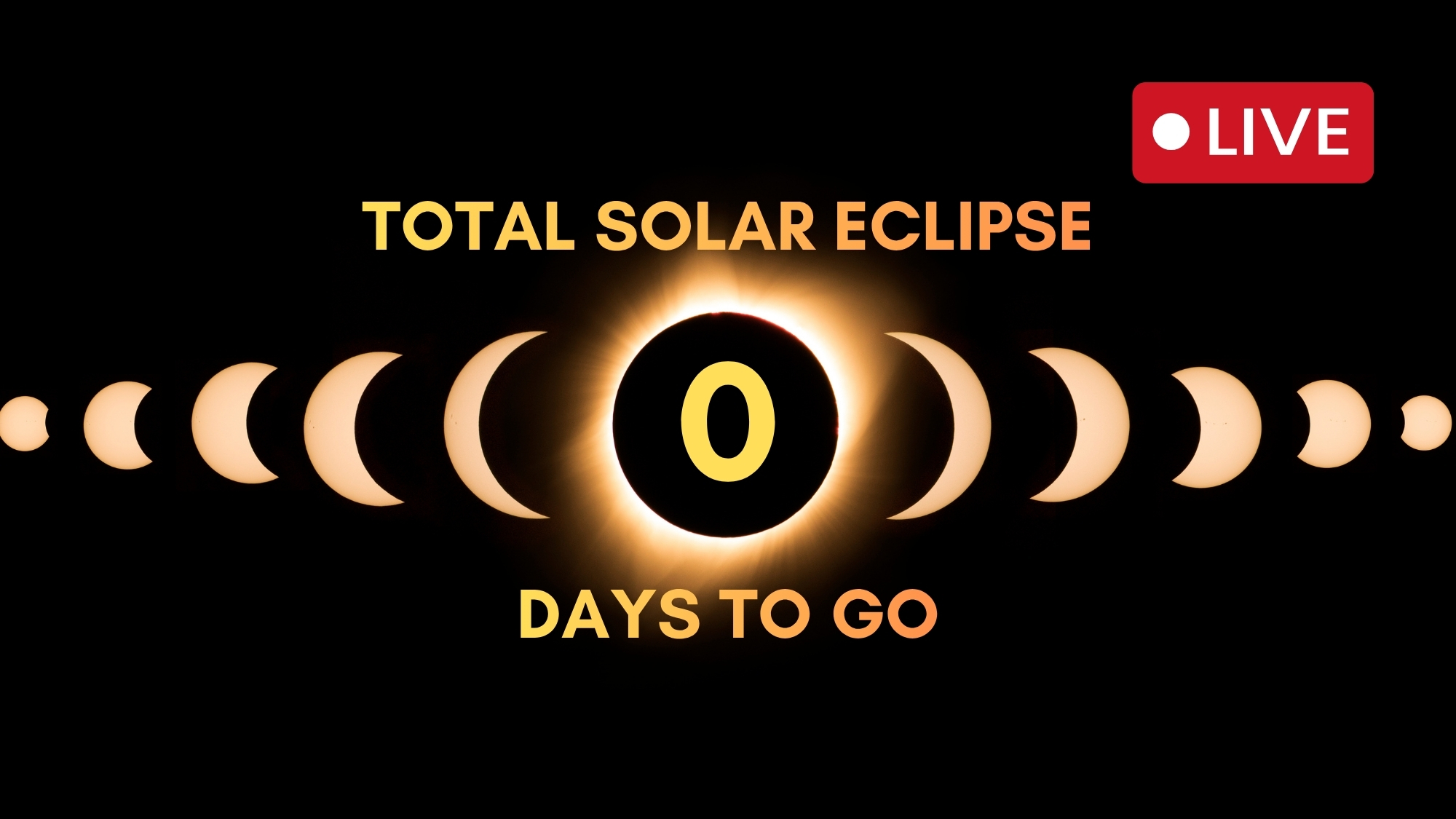
Today, Aug. 12, a total solar eclipse will darken the sky for millions of people. (Image credit: © Created in Canva Pro)
Today, Aug. 12, 2026, Europe will experience its first total solar eclipse since 1999, as the moon's shadow sweeps across Greenland, Iceland, northern Spain and the Balearic Islands.
Along the narrow path of totality, day will briefly turn to twilight as the moon completely covers the sun, revealing its elusive outer atmosphere — the corona. Meanwhile, millions more skywatchers across much of Europe, as well as parts of northeastern United States and eastern Canada, will witness a partial solar eclipse as the moon appears to take a bite out of the sun.
Live reporting from the path of totality
We'll be following the eclipse from two locations along the path of totality.
Our skywatching editor Daisy Dobrijevic is currently aboard HX Expeditions' MS Spitsbergen exploring Greenland's dramatic coast. She'll be aiming to witness totality from Scoresby Sund, the world's largest and longest fjord system. Dobrijevic is hoping for more eclipse luck than last time, when unfortunately, totality was a total bust, but not for the reason you may think.
Monday, September 08, 2025
Sunday, September 07, 2025
Thursday, March 13, 2025
Saturday, April 06, 2024
Saturday, March 23, 2024
Saturday, October 14, 2023
Tuesday, January 30, 2018
Tuesday, July 21, 2009
Excitement, Fear Precede Solar Eclipse

Superstitions Surround Rare Event in Asia
By MICHAEL CASEY,
AP
posted: 6 MINUTES AGO
By MICHAEL CASEY,
AP
posted: 6 MINUTES AGO
BANGKOK (July 20) -- Millions of people across Asia will witness the longest total solar eclipse that will happen this century, as vast swaths of India and China, the entire city of Shanghai and southern Japanese islands are plunged into darkness Wednesday for about five minutes.
Streams of amateur stargazers and scientists are traveling long distances to witness the once-in-a-lifetime event.
Streams of amateur stargazers and scientists are traveling long distances to witness the once-in-a-lifetime event.
Astronomers hope the eclipse will unlock clues about the sun, while an astrologer in Myanmar predicts it could usher in chaos. Some in India are advising pregnant relatives to stay indoors to follow a centuries-old tradition of avoiding the sun's invisible rays.
The eclipse will appear first at dawn in India's Gulf of Khambhat just north of the metropolis of Mumbai.
It will move east across India, Nepal, Myanmar, Bangladesh, Bhutan and China before hitting the Pacific. The eclipse will cross some southern Japanese islands and be last visible from land at Nikumaroro Island in the South Pacific nation of Kiribati. Elsewhere, a partial eclipse will be visible in much of Asia.
For astronomers, it will be a chance for a prolonged view of the sun's corona, a white ring 600,000 miles from the sun's surface. The previous total eclipse, in August 2008, was two minutes and 27 seconds. This one will last 6 minutes and 39 seconds at its maximum point.
Solar scientist Lucie Green is aboard an American cruise ship heading for that point near the Japanese island of Iwo Jima, where the axis of the moon's shadow will pass closest to earth.
Passengers paid $2,599 to $3,643 for the cruise run by Mayhugh Travel Inc., a California company that specializes in astronomy vacations, according to the company's Web site.
"The corona has a temperature of 2 million degrees but we don't know why it is so hot," said Green of University College London. "What we are going to look for are waves in the corona. ... The waves might be producing the energy that heats the corona. That would mean we understand another piece of the science of the sun."
Scientists are hoping data from the eclipse will help explain solar flares and other structures of the sun and why they erupt, said Alphonse C. Sterling, a NASA astrophysicist who will be following the eclipse in China.
"We'll have to wait a few hundred years for another opportunity to observe a solar eclipse that lasts this long, so it's a very special opportunity," said Shao Zhenyi, an astronomer at the Shanghai Astronomical Observatory.
Man has been recording solar eclipses for 4,000 years, and even today they inspire a combination of fear, fascination and wonder.
One astrologer in Myanmar, also known as Burma, predicted in a magazine that the eclipse would trigger wars, instability and natural disasters for the next several months.
Liang Wei is among more than 40 members of a Chinese solar eclipse fan club traveling to Shanghai to see the event.
"Even though I'm not a scientist, it's an experience I've waited all my life for," said the 29-year-old Guangzhou native, who works at a lighting company and operates an online fan site for eclipse enthusiasts.
In India, hundreds of scientists are gathering in the village of Taregna in Bihar state. One team, led by Dr R.K. Sinha of Patna University, will study bird behavior.
"The researchers will observe whether they suddenly move back to their nests, sound differently and behave in an unusual manner due to sudden darkness," he said.
A travel agency in India is running a charter flight to watch the eclipse by air.
Some families have advised pregnant relatives to confine themselves to curtained rooms, following long-held fears that the invisible rays would harm the fetus and the baby born with disfigurations, birthmarks or a congenital defect.
"I've been told to lie straight on the bed with my eyes open and to chant prayers and verses from the Hindu holy texts during the eclipse," said Sonya Chadha, a New Delhi accountant who is seven months pregnant and plans to take the day off. "If even a tiny sliver of light falls on me, it could harm my child."
In Japan, where the last total eclipse happened in 1963, people are flocking to the small southern island of Yakushima, which is holding a a two-day festival with fireworks, dancing, grilled squid and cotton candy. The island's 180 hotels are fully booked. A partial eclipse will be visible in Tokyo.
—
Associated Press writers Nirmala George in New Delhi; Indrajit Singh in Patna, India; Shino Yuasa in Tokyo; Aye Aye Win in Yangon, Myanmar and Chi-Chi Zhang in Beijing contributed to this report.
.
.


Monday, February 09, 2009
Avid sky-gazers assemble for lunar eclipse

Avid sky-gazers assemble for lunar eclipse
Press Trust of India
Monday, February 09, 2009, (New Delhi)
Avid sky-gazers who had assembled at vantage positions across the country on Monday watched this year's first and "deepest" penumbral lunar eclipse.
Parts of western and southern India witnessed the eclipse when the moon was rising while the rest of the country saw the total duration of the eclipse, NGO Science Popularisation Association of Communicators and Educators (SPACE) Director C B Devgun said.
Eastern Canada and US, however, missed the eclipse, while people in Alaska, Hawaii, Australia and East Asia saw the entire eclipse, he said.
A lunar eclipse occurs when the earth is in a direct line between the sun and the moon and the shadow of the earth falls on the Moon, Devgun said, adding a penumbral lunar eclipse occurs when moon passes through penumbra, the lighter part of the earth's shadow.
The lighter part of Earth's shadow is called the "penumbra" and the totally dark part is called the "umbra".
Subscribe to:
Posts (Atom)