Showing posts with label rerum novarum. Show all posts

Monday, July 06, 2026

The young Catholic elite poised to take over MAGA


Source images: Getty© Source images: Getty


Story by Nate Weisberg

On a muggy Saturday evening in May, 30 young men and a few women, all Christian and mostly Catholic, filed into a 19th-century redbrick building on Capitol Hill, part of Hillsdale College’s Washington, D.C., campus. The occasion was the monthly meeting of the Cicero Society, a parliamentary debating club committed, according to its terse website, to “developing excellence, preserving the Western intellectual tradition, and forming young leaders” — which in Washington is usually code for conservative job placement.

Despite the oppressive humidity, tweed jackets were the outfit of choice. The young men carried themselves like people twice their age or perhaps from a different era. One even had a cane, though it was hard to tell whether this was an accessory or a necessity. The setting was equally fusty. The debate was held beneath a large painting of the signing of the Constitution. Nearby were relics from the days of the Founding Fathers: an original copy of Thomas Paine’s American Crisis No. 1, a first edition of The Federalist.

Some of the society’s formal members, several of whom are political appointees in the Trump administration, wore pins on their jackets depicting the society’s crest, a quill pen crossing a sword. Others, pinless, worked the room, hoping to make a good impression. Some would later give floor speeches responding to the evening’s resolution, the main route to being accepted as a full member. The few women present weren’t auditioning quite as strenuously, perhaps because they were less eager to be admitted to what is, in essence, a fraternity.

After cocktails, guests settled into their chairs. I was handed a laminated guide: no one to speak unless recognized by the chairman; members to refer to one another as “the gentleman” or “the lady”; approval and disapproval to be expressed through “pounding of feet and hisses,” which, the guide explained, promoted “a lively atmosphere.” The session then began with a recounting of the minutes of the previous month’s debate, “Did William F. Buckley Jr. Fail?” Buckley, the founder of National Review, is best understood here as a stand-in for the kind of overpolite, free-market conservatism the Ciceronians reject. The chairman recalled that a young man of Indian descent had earlier “confessed to the society that, in many ways, Buckley was the reason he was there.” (An internship at National Review brought him to the U.S. from Canada.)

The room hissed.

It would be easy, from this alone, to mistake Cicero for a bunch of nativist trolls. But the society is more interesting than its casual cruelties, which did not, in any case, seem to offend the Indian immigrant in question, who is one of the members. Founded in 2020 by Ivy League conservative Christians, Cicero once attracted a more mixed crowd. A woman involved with the society since its early years told me that, at its height in 2021, the gender ratio was more balanced. Then, she said, “the normal people left and the weirder people came.” Talk about Groypers and incels spooked the women. Late last year, the Harvard Crimson reported that a Harvard debate society called the John Adams Society, a feeder for Cicero, had stopped allowing women to participate altogether; Cicero has not gone that far, she told me, but some members would like it to. The rules hardened. “The people who really love Robert’s Rules started having a little too much fun,” she added. The group’s politics also shifted, becoming a magnet for young New Right devotees who felt history moving their way as Donald Trump returned to the White House. Some members, another woman involved with the society told me, are hoping for it to become a staffing network-in-waiting for a future J.D. Vance administration.

Monday, May 25, 2026

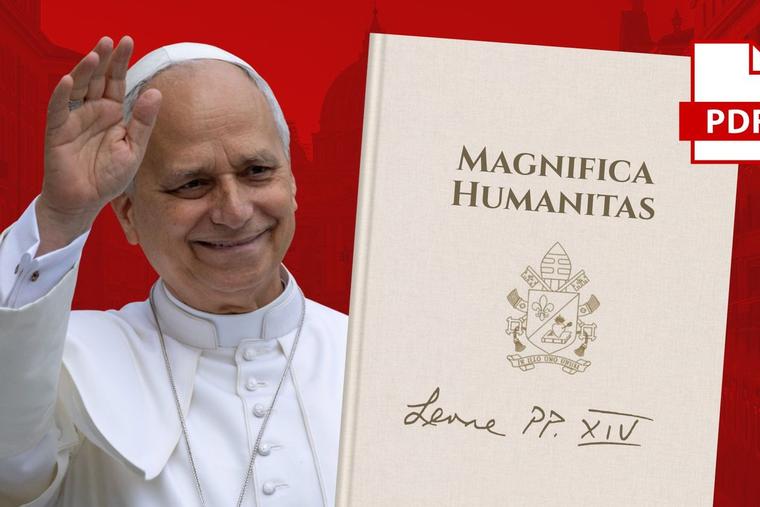
Full Text of ‘Magnifica Humanitas’: Read Pope Leo XIV’s First Encyclical

Pope Leo XIV’s first encyclical sets out the Church’s social teaching for the age of artificial intelligence. Read the complete document below.


Pope Leo XIV alongside a picture of his new encyclical released May, 25, 2026. (photo: EWTN News)


EWTN News Staff Vatican May 25, 2026


Pope Leo XIV signed Magnifica Humanitas, the first encyclical of his pontificate, on May 15, 2026.

The document was formally released by the Holy See on May 25, 2026.

The encyclical develops the Churchʼs social teaching in light of artificial intelligence, situating new questions of human dignity, labor, and the common good within the tradition that runs from Rerum Novarum through Centesimus Annus and Laudato Si'.

Read the full encyclical as a PDF below.

Magnifica Humanitas Full Text English Version


Saturday, May 16, 2026

From Rerum Novarum to Today: Pope Leo XIV Prepares to Add His Voice to the Church’s Social Teaching


Hannah Brockhaus
via EWTN
15.05.26


Pope Leo XIV presides over the Prayer Vigil for Peace in St. Peter’s Basilica on April 11, 2026. (photo: Simone Risoluti / Vatican Media)

During his recent apostolic trip to Cameroon, the Pope called on Catholic university students from central Africa to be ‘pioneers of a new humanism in the context of the digital revolution.’

With the publication of his first encyclical just around the corner, Pope Leo XIV is poised to add his voice to the Church’s tradition of social teaching, reflecting on what it means to be human in the midst of a digital revolution.

According to reports, the encyclical — a papal letter to the Church — will be called Magnifica Humanitas, Latin for “Magnificent Humanity.” It is expected to present the Pope’s moral guidance on how to approach artificial intelligence.

As Leo himself indicated in the first days of his pontificate, he will follow in the steps of his predecessor and namesake, Pope Leo XIII, whose encyclical Rerum Novarum, “Of New Things,” is widely considered the first in a long line of social encyclicals produced in the modern era of the papacy.

Catholic social teaching from the late 19th century to today is the Church’s attempt “to articulate itself in constantly new and evolving conditions,” said Anna Rowlands, a theologian and professor of Catholic social thought at Durham University in the United Kingdom.

Saturday, November 01, 2025

Faith and Justice: Fr Jeyaraj brings together over 130 years of Jesuit involvement in social justice


30 Oct 2025

When Fr Xavier Jeyaraj, the former Secretary for Social Justice and Ecology, set out to compile a volume that detailed the commitment of the Society of Jesus to social justice, his aim was simple: gather some key documents that showed how the Jesuits responded to the struggles of the world. This idea, which sprouted during the 2019 jubilee of the Social Justice and Ecology Secretariat (SJES) at the General Curia, has now taken the shape of a two-volume, over-1500-page collection – the most complete record of how the Jesuits have been involved in social justice since 1891.

The volumes are titled A Journey of Faith Promoting Justice (1891-2024). Volume one brings together relevant Complementary Norms of the Constitutions of the Society from 1996 where references to social apostolate were formally included. Alongside these are the Decrees of various General Congregations of the Society of Jesus.

Also included in volume one are letters from Superior Generals of the Society that are relevant to social justice, beginning with Wlodimir Ledóchowski and continuing through Arturo Sosa. Some of these texts were previously available only in Latin, and about 20 of them have now been translated into English for the first time, thanks to Alex Dewitt, a Jesuit scholastic from Canada, and many others acknowledged in the volume who helped in translating from other languages.

Monday, May 12, 2025

RERUM NOVARUM - Pope Leo XIII to Pope Leo XIV - The Trades Unions (THE I...

Rerum Novarum and Sunday Rest


41. From this follows the obligation of the cessation from work and labor on Sundays and certain holy days. The rest from labor is not to be understood as mere giving way to idleness; much less must it be an occasion for spending money and for vicious indulgence, as many would have it to be; but it should be rest from labor, hallowed by religion. Rest (combined with religious observances) disposes man to forget for a while the business of his everyday life, to turn his thoughts to things heavenly, and to the worship which he so strictly owes to the eternal Godhead. It is this, above all, which is the reason arid motive of Sunday rest; a rest sanctioned by God's great law of the Ancient Covenant-"Remember thou keep holy the Sabbath day,"(31) and taught to the world by His own mysterious "rest" after the creation of man: "He rested on the seventh day from all His work which He had done."(32)

References:

31). Exod.20:8.
32). Gen. 2:2.

Thursday, October 25, 2018

Vatican Cardinal: Pope Francis Has ‘Natural Sympathy’ For Communists


"Francis may have natural sympathy for Communists"


Vatican Pool / Contributor / Getty Images


ByPAUL BOIS
@PAULBOIS39
October 25, 2018
7.2k views


If the acceptance of a hammer/sickle crucifix was not enough to convince people that Pope Francis has a soft place in his heart for communists, then perhaps his recent deal with the Chinese government will.

In a recent move seen by many as a capitulation, the Vatican under Pope Francis gave the communist, anti-Christian Chinese government a prominent role in selecting bishops, even though only the Pope can select bishops. The move hearkens back to the late-Middle Ages and the Renaissance, where political figures in certain countries played prominent roles in the selection of the Church hierarchy. At least then, however, the motives were nationalistic and not all appointees complied with the state (see St. Thomas Becket); in China, the motives are purely for political control.

Writing in The New York Times, Cardinal Joseph Zen of Hong Kong says flatly that "The Pope Doesn’t Understand China" and that he capitulates to the oppressive government due to a "natural sympathy" for communists because he views them as a persecuted class.

"Francis may have natural sympathy for Communists because for him, they are the persecuted," Zen writes. "He doesn’t know them as the persecutors they become once in power, like the Communists in China."

Zen makes no concessions to the deal inked by Pope Francis and declares it a colossal misstep. Given Pope Francis' track record of showing sympathy toward communist priests (he celebrated one in Bolivia) while dishing out flippant statements like "the communists stole our flag," Cardinal Zen makes a fair point when he accuses the Holy Father of "not understanding communism."

Wednesday, October 18, 2017

Rerum Novarum - Catholic Social Teaching


Rerum Novarum - Catholic Social Teaching


Jo Mama

Published on Feb 12, 2012

This is a short clip from a longer video entitled "For the Others" which discusses the Catholic Church's stand on Social Justice over the years and the implementation of it by the Jesuits.


Tuesday, August 05, 2014

Intellectual Dishonesty and Roman Catholic Apologetics


John W. Robbins

If you do not have Adobe Acrobat installed on your system please click here on Adobe Acrobat Reader to download.

Download the E-Book version of this review.

Download the Kindle version of this review.


This essay is taken from Dr. Robbins’ latest book, Ecclesiastical Megalomania: The Economic and Political Thought of the Roman Catholic Church (Trinity, 1999). Dr. Robbins earned his Ph.D. in Philosophy and Political Theory from The Johns Hopkins University.


Despite the Roman Catholic Church’s strident and sustained crusade against political freedom and capitalism that has now lasted for more than a century, a small but influential group of American Roman Catholic economists has begun to argue that the Roman Catholic Church now favors capitalism. Not only does the Roman Church-State favor capitalism now, according to these apologists for Rome, it has always favored capitalism, we are told.1 The opposite impression-the impression that the Roman Church-State was anti-capitalist-was allegedly created by progressive leftists’’ who engaged in a selective reading’’2 of the papal encyclicals. Among these revisionist Roman Catholic apologists are Robert Sirico, a Paulist priest who is also the president of the Acton Institute in Grand Rapids, Michigan; and Michael Novak, a fellow of the American Enterprise Institute in Washington, D. C.3

Sirico argued, for example, that John Paul II’s encyclical issued in commemoration of the hundredth anniversary of Rerum Novarum in 1991, Centesimus Annus, represents a dramatic development in the encyclical tradition in favor of the free economy.’’ More than any other church document,’’ Sirico wrote, this latest one celebrates the creativity of entrepreneurs and the virtues required for productivity.’’ Sirico asserted, The pope affirms both the practical and moral legitimacy of profit, entrepreneurship, appropriate self-interest, productivity, and a stable currency.’’ Furthermore, Centesimus Annus is not only a repudiation of the entire collectivist agenda, root and branch,....but [also] the warmest embrace of the free economy since the Scholastics.’’ Centesimus Annus evidences the greatest depth of economic understanding and the most deliberate (and least critical) embrace of the system of free exchange on the part of the Catholic teaching authority in 100 years, and possibly since the Middle Ages.....’’ [T]his encyclical constitutes the epitaph for liberation and collectivist movements in terms of any official ecclesiastical legitimacy.’’ It is an uncompromising rejection of collectivism in its Marxist, Communist, socialist, and even welfare-statist manifestations.

Now these are certainly dramatic claims for Centesimus Annus. One would expect such sweeping claims indicating dramatic and almost revolutionary developments in Roman Catholic social thought to be supported by many quotations from the encyclical itself. Unfortunately, Sirico quoted only one complete sentence and one sentence fragment from the encyclical, a document of approximately 28,000 words. The sole complete sentence reads as follows:

By intervening directly and depriving society of its responsibility the social assistance state leads to a loss of human energies and an inordinate increase of public agencies, which are more dominated by bureaucratic ways of thinking than by concern for serving their clients, and which are accompanied by an enormous increase in spending.

The partial sentence Sirico quoted is a solitary reference to some of the virtues that compose the work ethic: diligence, industriousness, prudence in taking reasonable risks, reliability and fidelity in interpersonal relationships, as well as courage in carrying out decisions which are difficult and painful but necessary, both for the overall working of a business and in meeting possible setbacks. Any reader of Sirico’s essay who actually reads the 1991 papal encyclical will be disappointed, for virtually all of the claims that Sirico made are not supported by the statements of the encyclical itself.

Of course, some of Sirico’s claims may be true. For example, when Sirico wrote that Centesimus Annus evidences the greatest depth of economic understanding....on the part of Catholic teaching authority in 100 years,’’ he may very well have been correct. Our survey of the teaching of official Roman Church-State social thought as expressed in the papal encyclicals and conciliar constitutions turned up little or no evidence of economic understanding. Instead, the Roman Church-State has shrilly denounced the market, self-interest, and capitalism on ethical grounds, and made sustained demands for government intervention to protect the common good’’ and promote social justice.’’ Sirico’s statement turns on a comparison between Centesimus Annus and previous encyclicals, so if the latest papal encyclical is less candid and forthright about, or less strident in, its criticism of capitalism, it might appear in a somewhat favorable light. And if the pope praises some of the economic virtues,’’ even though the praise is almost 500 years after Luther and Calvin, perhaps it is a sign of hope for economically conservative Roman Catholics like Mr. Sirico, who seem to be embarrassed by a Church-State that has been one of the world’s longest and strongest proponents of anti-capitalist ideas.

Sirico claimed that more than any other church document this latest one [Centesimus Annus] celebrates the creativity of entrepreneurs and the virtue required for productivity.’’ This writer has not read all church documents, and neither, one supposes, has Mr. Sirico. In his essay Sirico discussed only one previous church document, Rerum Novarum, and furnished us with a creative misreading of that encyclical as well.4 But despite his best efforts, Rerum Novarum is so obviously an anti-capitalist document that Sirico is finally embarrassed by it. His desire to find something of economic value in the papal encyclicals seems to betray him into making statements that he cannot support. The many official Roman Church documents that this writer has read express the Roman Church-State’s long-standing hatred for capitalism on moral grounds, a hatred that has now been clearly expressed by the Magisterium for over a century. P. T. Bauer accurately called these papal encyclicals incompetent,’’ immoral,’’ and envy exalted.5


The Meaning of Rerum Novarum and Centesimus Annus

If Sirico’s reading of Centesimus Annus is so misleading, what exactly did John Paul II say in the encyclical? Since Centesimus Annus was issued in commemoration of Rerum Novarum, the pope began by praising Rerum Novarum as an immortal document,’’ and continued: the vital energies rising from that root have not been spent with the passing of the years, but rather have increased even more.’’ Continuing his praise for Rerum Novarum for several paragraphs, John Paul II asserted that the validity of this teaching has already been pointed out in two Encyclicals published during my Pontificate: Laborem Exercens....and Sollicitudo Rei Socialis.....’’ John Paul II proposed a re-reading’’ of Rerum Novarum to discover anew the richness of the fundamental principles which it formulated.....’’ What are those fundamental principles? John Paul II, echoing Leo XIII a century before him, began with a quasi-Marxist analysis of capitalism. Please keep in mind that the quotations that follow are from the encyclical that Sirico and Novak have described as the most pro-capitalist document the Roman Church-State has ever written:

4.2 In the sphere of economics....new structures for the production of consumer goods had progressively taken shape [during the eighteenth and nineteenth centuries]. A new form of property had appeared-capital; and a new form of labor-labor for wages, characterized by high rates of production which lacked due regard for sex, age or family situation, and were determined solely by efficiency, with a view to increasing profits.

4.3 In this way labor became a commodity to be freely bought and sold on the market, its price determined by the law of supply and demand, without taking into account the bare minimum required for the support of the individual and his family. Moreover, the worker was not even sure of being able to sell his own commodity,’’ continually threatened as he was by unemployment, which, in the absence of any kind of social security, meant the specter of death by starvation.

4.4 The result of this transformation was a society divided into two classes, separated by a deep chasm’’ [Rerum Novarum, 132]..... Thus the prevailing political theory of the time [the nineteenth century] sought to promote total economic freedom by appropriate laws, or, conversely, by a deliberate lack of any intervention.....

5.2 The Pope [Leo XIII] and the [Roman] Church....were confronted....by a society which was torn by a conflict all the more harsh and inhumane because it knew no rule or regulation. It was the conflict between capital and labor.....

5.3 In the face of a conflict which set man against man, almost as if they were wolves,’’ a conflict between the extremes of mere physical survival on the one side and opulence on the other, the Pope [Leo XIII] did not hesitate to intervene by virtue of his apostolic office....

5.4 In this way, Pope Leo XIII, in the footsteps of his Predecessors, created a lasting paradigm for the Church.....

6.1 With the intention of shedding light on the conflict which had arisen between capital and labor, Pope Leo XIII affirmed the fundamental rights of workers..... it may truly be said that it is only by the labor of the working-men that States grow rich.’’

6.2 Another important principle is undoubtedly that of the right to private property.....’’ The Pope is well aware that private property is not an absolute value, nor does he fail to proclaim the necessary complementary principles, such as the universal destination of the earth’s goods.

8.1 The Pope [Leo XIII] immediately adds another right which the worker has as a person. This is the right to a just wage,’’ which cannot be left to the free consent of the parties.....’’ This concept of relations between employers and employees, purely pragmatic and inspired by a thoroughgoing individualism, is severely censured in the Encyclical.....

8.2 A workingman’s wages should be sufficient to enable him to support himself, his wife and his children. If through necessity or fear of a worse evil the workman accepts harder conditions because an employer or contractor will afford no better, he is made the victim of force and injustice.’’

8.3 Would that these words, written at a time when what has been called unbridled capitalism’’ was pressing forward, should not have to be repeated today with the same severity.....

This re-reading of Rerum Novarum by John Paul II preserved the Marxist flavor of the encyclical-an unsophisticated labor theory of value, the economic class structure of society, and the class struggle-and endorsed it. Leo XIII in 1891 and John Paul II in 1991 adopted a quasi-Marxist view of capitalism. Both John Paul II and Leo XIII also endorsed the fundamental principle of the universal destination of goods,’’ which holds that need makes all goods, both natural and manufactured, common, and that those who own goods must surrender them to those in need, or their goods will be rightfully taken from them by either the needy or by the public authorities.6 To say of Rerum Novarum, as Sirico did, that it provides one of the most finely honed defenses of the free market and private property order in the annals of Catholic, indeed Christian, social thought....’’7 is preposterous.

Later in Centesimus Annus, John Paul II endorsed the slogan of liberation theology: the preferential option for the poor,’’ and wrote, more ominously, that The Pope does not, of course, intend to condemn every possible form of social conflict..... The [1981] Encyclical Laborem Exercens, moreover, clearly recognized the positive role of conflict when it takes the form of a ‘struggle for social justice.....’ ‘’ These statements make Sirico’s claim that Centesimus Annus constitutes the epitaph for liberation and collectivist movements in terms of any official ecclesiastical legitimacy false. Centesimus Annus includes a hardly veiled endorsement of liberation theology, and John Paul II endorsed liberation theology several times in other documents, as we have already seen. Liberation theology has continued to receive endorsement from the Roman Magisterium during the past twenty years, that is, during the reign of John Paul II.

Section 15 of Centesimus Annus endorsed all sorts of government intervention, and concluded with this paragraph:

The Encyclical [Rerum Novarum] and the related social teaching of the Church had far reaching influence in the years bridging the nineteenth and twentieth centuries. This influence is evident in the numerous reforms which were introduced in the areas of social security, pensions, health insurance and compensation in the case of accidents, within the framework of greater respect for the rights of workers.

What was that far-reaching influence of Rerum Novarum to which John Paul II referred? In Europe Rerum Novarum granted the moral authority and the political support of the Roman Church-State and Roman Catholic voters to the rising tide of statism in all its forms except atheistic Communism: socialism, fascism8, and Nazism. In the United States, it fueled the rise of the labor union movement9, the Progressive movement, and interventionism. Aaron I. Abell, Professor of History at the University of Notre Dame, sketched the influence of Rerum Novarum in the United States.10

In 1917 the hierarchy of the Roman Church-State in the United States formed the National Catholic War Council, the predecessor of the National Conference of Catholic Bishops. In 1919 the Council’s Administrative Committee issued a plan for social reconstruction, written by John Augustus Ryan, a Jesuit. The plan, following the proposals of Ryan’s 1908 book, A Living Wage, advocated social insurance against unemployment, sickness, invalidity, and old age; a federal child labor law; legal enforcement of labor’s right to organize; public housing for the working classes; graduated taxes on inheritances, incomes, and excess profits; stringent regulation of public utility rates; government competition with monopolies; worker participation in business management, and so forth. When Franklin Roosevelt was elected President in 1932, he asked Monsignor Ryan to join his administration, which Ryan did.

Fifty-four years ago Abell pointed out that A social view of property....served as the entering wedge for much contemporary and future American Catholic participation in social reform.11 Sirico asserted, contrary to the evidence, that this interpretation of Rerum Novarum has over-emphasized the social view of property. This reflects a bias [in the interpreters] against individualism and self-interest.....’’12 But, as we have seen, the bias against individualism and self-interest is the bias of the Roman Church-State, demonstrated through many quotations from papal encyclicals. Sirico’s alleged conspiracy of leftwing interpreters who have twisted the pope’s finely honed defense of private property’’ and capitalism into an endorsement of interventionism and social reform is a fantasy. It would be difficult to over-emphasize the bias of the Roman Church-State against private property, self-interest, and capitalism.

Furthermore, that bias continues to be expressed by the Roman Church-State, even in the very encyclical that Sirico told us is an endorsement of capitalism. After admitting that the modern business economy has positive aspects,13 the pope wrote:

Many other people, while not completely marginalized, live in situations in which the struggle for a bare minimum is uppermost. These are situations in which the rules of the earliest period of capitalism still flourish in conditions of ruthlessness’’ in no way inferior to the darkest moments of the first phase of industrialization..... The human inadequacies of capitalism and the resulting domination of things over people are far from disappearing.

Furthermore, John Paul II wrote,

It is right to speak of a struggle against an economic system, if the latter is understood as a method of upholding the absolute predominance of capital, the possession of the means of production and of the land..... In the struggle against such a system, what is being proposed as an alternative is not the socialist system, which in fact turns out to be State capitalism, but rather a society of free work..... Such a society is not directed against the market, but demands that the market be appropriately controlled by the forces of society and the State.....

Furthermore,

....it is unacceptable to say that the defeat of so-called Real Socialism leaves capitalism as the only model of economic organization. ....if by capitalism is meant a system in which freedom in the economic sector is not circumscribed within a strong juridical framework which places it at the service of human freedom in its totality....then the reply [to the question, Is capitalism the model for the Third World?] is certainly negative.

Building on the interventions that are already in place, the Roman Church-State wants more:

It is the task of the State to provide for the defense and preservation of common goods such as the natural and human environments, which cannot be safeguarded simply by market forces. Just as in the time of primitive capitalism the State had the duty of defending the basic rights of workers, so now, with the new capitalism, the State and all of society have the duty of defending those collective goods.....

Contrary to what Sirico alleged, there seem to be only two sentences in the entire encyclical that might appear to lend any support to the market economy. One, as we have seen, is a mild criticism of bureaucratic ways of thinking and spending, which Sirico quoted. The other sentence, which Sirico did not quote, endorsed the modern business economy only on grounds of efficiency, not morality, as Sirico claimed, and the pope immediately qualified it:

It would appear that, on the level of individual nations and of international relations, the free market is the most efficient instrument for utilizing resources and effectively responding to needs. But this is true only for those needs which are solvent’’ insofar as they are endowed with purchasing power, and for those resources which are marketable’’ insofar as they are capable of obtaining a satisfactory price. But there are many human needs which find no place on the market. It is a strict duty of justice and truth not to allow fundamental human needs to remain unsatisfied and not to allow those burdened by such needs to perish.

Sirico provided neither quotations-nor even any citations-to support his sweeping assertion that the encyclical gave a moral endorsement of profit, self-interest, and a stable currency. This writer has found no such statements in the encyclical either. Therefore, I am forced to conclude that Sirico’s assertion of a moral endorsement of capitalism by the Roman Church-State in Centesimus Annus is false. Perhaps Sirico was confused by John Paul II’s reference to certain character traits as virtues,’’ namely industriousness, diligence, prudence, courage, and reliability, but endorsement of these character traits does not constitute an endorsement of profit, self-interest, and a stable currency, let alone capitalism. John Paul II tentatively (It would appear’’) praised only the efficiency of the free market, and he did so only after the Communist systems of Europe had collapsed. But even that tentative praise was immediately weakened and qualified, and the paragraph concluded with the pope asserting, on moral grounds, the duty of the State not to allow fundamental human needs to remain unsatisfied,’’ as they would in a free market, even a market already regulated by government. This one tentative sentence about the efficiency of the market was buried in the middle of a document that repeatedly condemned real (early unbridled, and primitive) capitalism and repeatedly re-affirmed the Roman Church-State’s commitment to her fundamental social principles of the universal destination of goods, the primacy of need, and government regulation and control of the economy.

One can sympathize with a Roman Catholic who is embarrassed by the fact that his allegedly infallible Church has preached collectivism and condemned capitalism on moral grounds for more than a century. One can even understand such a Roman Catholic’s desire to reinterpret any phrase from the pen of his infallible leader that might be made to favor capitalism and freedom. But neither our sympathy nor his embarrassment is an excuse for misrepresenting Centesimus Annus as a moral endorsement of capitalism. Sirico’s claim that Centesimus Annus is a repudiation of the entire collectivist agenda, root and branch’’ has no support in the text itself.14


  1. Michael Novak explained that ìone key point of this inquiry [his book] has been to show that the Catholic tradition also carries within it a powerful ethic of capitalism-indeed a fuller and deeper ethic than was available to the first Puritansî (The Catholic Ethic and the Spirit of Capitalism, New York: The Free Press, 1993, 232). On the other hand, Novak also wrote that ìMost assuredly, Centesimus Annus is no libertarian document-and precisely that, to many of us, is its beauty..... I want to stress that Centesimus Annus gives encouragement to social democrats and others of the moderate left....î (138).
  2. Sirico, ìCatholicism’s Developing Social Teaching,’’ The Freeman, December 1991, 467. Sirico himself seemed to be of two minds on this question, for he also referred to the ìleft-wing trendî in Catholic social tradition (471).
  3. Novak’s book was written ìIn homage to Pope John Paul II,î and, as one might expect from such a dedication, it is largely Roman Catholic propaganda.
  4. Sirico noted that his interpretation of Rerum Novarum is ìnot a prevalent one today. It [Sirico’s interpretation] comes from a view of the world as expressed by classical liberals.’’ Unfortunately for Sirico’s interpretation, Leo XIII did not share the classical liberal view of the world, and Rerum Novarum itself rails against classical liberalism. To claim, therefore, as Sirico did, that Rerum Novarum lends itself to such an analysis is to misrepresent the encyclical (Sirico, ìCatholicism’s Developing Social Teaching,’’ 466).
  5. Peter T. (Lord) Bauer, ìEcclesiastical Economics Is Envy Exalted,î This World, Winter-Spring, 1982, 56-69.
  6. ìWhile the Pope proclaimed the right to private ownership, he affirmed with equal clarity that the ‘use’ of goods, while marked by freedom, is subordinated to their original common destination as created goods’’ (John Paul II, Centesimus Annus [1991], 30.2).
  7. Sirico, ìCatholicism’s Developing Social Teaching,’’ 474.
  8. The Roman Catholic scholar Karl Otmar von Aretin noted that ìThe papacy’s denial of the modern world, and in particular of democracy which guaranteed the freedom of the individual, favoured the emergence of fascist regimes in the 1920sî (The Papacy and the Modern World, Roland Hill, translator. New York: McGraw Hill Book Company, 1970, 8).
  9. Sirico admitted that ìRerum Novarum became the springboard for the burgeoning labor movement in America and Europe’’ and that ìTo the [social] reformer’s [sic] mind, Leo’s encyclical gave them the support and recognition they needed to carry out their program’’ (Sirico, ìCatholicism’s Developing Social Teaching,’’ 467).
  10. Abell, ìThe Reception of Leo XIII’s Labor Encyclical in America, 1891-1919,’’ The Review of Politics, October 1945. Abell’s American Catholicism and Social Action: A Search for Social Justice, 1865-1950, is a detailed account of the social and political activities of both Roman Catholic laymen and officials in the United States.
  11. Abell, ìThe Reception of Leo XIII’s Labor Encyclical in America, 1891-1919,’’ The Review of Politics, October 1945, 471.
  12. Sirico, ìCatholicism’s Developing Social Teaching,’’ 467.
  13. No doubt the ìpositive aspects’’ of the modern economy, though not listed by the pope, include the many government interventions in business and the economy long advocated by the Vatican. Such intervention seems to be the reason John Paul II distinguished between ìearly,î ìunbridled,î and ìprimitiveî capitalism, and the ìmodern business economy.î
  14. Nineteenth century Roman Catholic historian Lord Acton’s comments about the Roman Catholic apologists of his day are timeless. He wrote a letter to Dollinger explaining that his reading of history had convinced him that a common vice is ìto defend one’s cause by unfair or illicit means.î Acton had studied, with ìinfinite credulity and trustî the most eminent Roman Catholic writers of his day. But he found that what they told him was ìon many decisive questions, false.î Acton came ìvery slowly and reluctantly indeed to the conclusion that they were dishonest.î A special reason for their dishonesty was ìthe desire to keep up the credit of authority in the [Roman] Church.î The Roman Catholic scholars ignored moral standards in their study of history, because ìit is impossible honestly to apply a moral standard to history without discrediting the [Roman] Church in her collective action.î In order that ìmen might believe the Pope, it was resolved to make them believe that vice is virtue and falsehood truth.î This defect was not due to ignorance or incompetence. Acton found it in ìthe ablest, in the most learned, in the most plausible and imposing menî he knew. These men ìwho were outwardly defenders of religion,î were actually ìadvocates of deceit and murder.î The ìgreat point was that these men justified things to which in the past the papacy stood committed. They wished men to think that those things had not happened, or that they were good. They preached falsehood and murderî (quoted in Hugh MacDougall, The Acton-Newman Relations, New York: Fordham University Press, 1962, 141-142).


The Trinity Foundation hereby grants permission to all readers to download, print, and distribute on paper or electronically any of its Reviews, provided that each reprint bear our copyright notice, current addresses, and telephone numbers, and provided that all such reproductions are distributed to the public without charge. The Reviews may not be sold or issued in book form, CD-ROM form, or microfiche.


Copyright © 1998-2011 The Trinity Foundation
Post Office 68, Unicoi, Tennessee 37692
Phone: 423.743.0199 Fax: 423.743.2005 - See more at: http://www.trinityfoundation.org/journal.php?id=131#sthash.g4N7iHNd.dpuf


.

Saturday, May 10, 2014

Pope Francis Calls For 'Legitimate Redistribution' Of Wealth To The Poor


AP | by NICOLE WINFIELD
Posted: 05/09/2014 8:35 am EDT
Updated: 05/09/2014 12:59 pm EDT


VATICAN CITY (AP) - Pope Francis called Friday for governments to redistribute wealth to the poor in a new spirit of generosity to help curb the "economy of exclusion" that is taking hold today.

Francis made the appeal during a speech to U.N. Secretary-General Ban Ki-moon and the heads of major U.N. agencies who are meeting in Rome this week.

Latin America's first pope has frequently lashed out at the injustices of capitalism and the global economic system that excludes so much of humanity.

On Friday, Francis called for the United Nations to promote a "worldwide ethical mobilization" of solidarity with the poor in a new spirit of generosity.

He said a more equal form of economic progress can be had through "the legitimate redistribution of economic benefits by the state, as well as indispensable cooperation between the private sector and civil society."

Francis had a similar message to the World Economic Forum in January and in h is apostolic exhortation "The Joy of the Gospel." That document, which denounced trickle-down economic theories as unproven and naive, provoked criticism in the U.S. that he was Marxist.

Francis has denied he's Marxist, and spent years in Argentina battling Marxist excesses of liberation theology. But he has said from the outset that he wants a church that "is poor and for the poor" and ministers to the most marginal of society.

On Friday, he urged the U.N. to promote development goals that attack the root causes of poverty and hunger, protect the environment and ensure "dignified" labor for all.

"Specifically, this involves challenging all forms of injustices and resisting the economy of exclusion, the throwaway culture and the culture of death which nowadays sadly risk becoming passively accepted," he said.

Source
.

Saturday, March 10, 2012

Corporate Social Responsibility and the tradition of Catholic Social Thought

#147 - March 2012

The recent report of the European Commission on Corporate Social Responsibility resonates with the innovative postulates of ‘Caritas in Veritate’.


unknownFor the Christian identity in the Modern World the emergence of Christian Social Thought has been of crucial importance. Its innovative character, which is largely forgotten today can be remembered with a quick glance on the first Papal Encyclical ‘Rerum Novarum’ of Pope Leo XIII. 1891 or even the reminiscence of it in the second Social Encyclical ‘Quadragesimo Anno’ 1931. Industrialization was the most radical socio-economic transformation in the history of mankind. Philosophers like Nietzsche and Marx questioned the role of Christian values in an unprecedented way. In this situation the Christian Social movement essentially extended Christian ethics beyond a mere individual virtue based doctrine into a ‘social teaching’ - calling for adequate rules and regulations within a ‘just’ social order.


In a way, we live in a very similar situation today. With Globalization and the emergence of the ‘post-national constellation’ (J. Habermas) the cultural samples and institutional solutions of the 20th century are again at stake. Will today’s Christians show the same cultural creativity and learn to express the Western Christian tradition in an up-to-date way? The recent social Encyclical ‘of Pope Benedict XVI (2009) pushes us into this direction. ‘Caritas in Veritate’ criticizes a widespread ideological dualism between market and state and calls for a new culture of Civic responsibility. Therefore, the document also addresses business leaders, costumers and investors. Like in the 19th century, when Entrepreneurs like Léon Harmel from France and Franz Brandts from Germany played an important role for the emergence of Catholic Social Thought, business practise will again be crucial.


The recent report of the European Commission on Corporate Social Responsibility resonates with the innovative postulates of ‘Caritas in Veritate’. It is not the commission’s first report on CSR but rather extends a number of trailblazing documents from 2001 as well as 2006. These reports – like a series of international activities including the Foundation of the Global Compact 1999/ 2000, the proclamation of the Millennium Development Goals etc. – are based on the assumption that Governments alone will no longer be able to secure basic public goods on a global scale. Based on recent Scientific literature the commission pledges for a advanced concept of CSR: this is not only orientated towards operational savings but calls for a ‘strategic implementation’ by the development of innovative goods, services and business models creating values for costumers, employees and shareholders. The reflection on cooperatives and mutual trusts seems to represent an explicit allusion to ‘Caritas in veritate’, here. This holds also true for the paper’s foundation in a subsidiary structure, which perceives it as the main task of political entities not to substitute or dominate but to support and nurture the Social Responsibility of Companies. According to the report, not Government but companies as well as unions and civil society should find new ways to walk the talk on Corporate Responsibility; consumers and investors are called to reward these activities, media to report on them.


What becomes obvious here is a really innovative concept of the modern social fabric. In many ways this can be perceived as a continuation of Catholic Social Thought, which impacted the Western market economies in the 20th centuries. The EU commission announces a series of instruments and procedures to strengthen the awareness and the role of Corporate Reponsibility in the interplay of the social actors and groups: Multi-Stakeholder-Forums, a code of conduct for self-regulation and co-regulatory arrangements, integration of Social and environmental criteria into public procurement, the obligation for banks to inform about their social and ecologic criteria etc. Transparency of information, competence-building in companies and social environment as well as hand-outs and platforms are the most important instruments of the commission to spread the word of CSR. Christian managers and associations – like the the global entrepreneurial associationUNIAPAC, which published their own paper on CSR already some years ago, the Papal commission ‘Justice and Peace’ etc. - should actively observe this process bringing in a genuine Christian perspective.


Prof. Dr. André Habisch

Scientific consultant of the Bund Katholischer Unternehmer in Germany and teaches business ethics at the Catholic University Eichstaett-Ingolstadt (Germany)


Source
.

Tuesday, December 20, 2011

Response: 33 Catholic Bishops 'Illegal Alien Remarks' is Sedition!


The email below is in response to this video:  http://www.youtube.com/watch?v=21jwNee1ynU&feature=channel_video_title


Subject:Re: 33 Catholic Bishops 'Illegal Alien Remarks' is Sedition! - Alex Jones Tuesday Edition 1/2
Date:Thu, 15 Dec 2011 12:01:10 -0600
From:Tom Friess 
To:XXXX


XXXXXX,

If Alex Jones only knew how involved the Vatican is in, not only Mexican immigration, but the Ford Foundation and both the Democratic AND Republican parties and all the other things he mentioned, maybe he'd have spent more time putting all the blame on Rome where it belongs instead of cluttering our minds as though Rome were only a small part of it. Rome is behind gun control (both political parties), taking away the right to own private property (Rerum Novarum), Gardasil (sterilization of young girls), the union of church and state to establish a state religion of Roman Catholicism (Counter Reformation, Vatican Council II), creating a total police state (hierarchical Roman Catholic government just like Nazi Germany, the Patriot Act, Romeland Security), destruction of free speech (no one may criticize the Pope or the king), destroying U.S. national sovereignty (UN control, CFR), bankrupting the country through the Vatican bankers (Rothschilds) who own the Federal Reserve, redistribution of U.S. wealth (Caritas in Veritate), destruction of the middle class to make it a two class system just like all other Catholic countries, and on and on and on.

Did Alex ever once mention that 98% of Mexicans are Roman Catholic? He mentioned that they all vote "Democratic". But in reality, Catholics vote for Catholic candidates for BOTH political parties. And that's exactly why neither party will finger ROME! Precious few dare to put the finger on Rome fearing charges of "bigotry" and "hatred" and "religious persecution". But what is the end in view here in America? A total Roman Catholic Church/State and government sponsored INQUISITION. But by the time America wakes up and finds the courage to call the Pope "Antichrist," it will be too late.

On Inquisition Update, I put the focus where it belongs. ROME! If Alex Jesuit Jones ever mentions Rome, he then covers it up with so much other stuff that everybody forgets he even mentioned Rome. People in our camp notice that Rome is merely an occasional side issue with Jones. We believe that his occasional mention of Rome is merely to silence some of his critics in our camp and to draw listeners out of our camp. But America will never understand what really ails our country until we begin to comprehend it in terms of the "Counter Reformation." The target in this country is Protestantism, the Bible, Liberty in Christ, and the ascendency of the Biblical Antichrist, the Pope of Rome. The endgame is the complete destruction of Biblical Christianity (true Bible Protestantism) and a total Roman Catholic superstate and a full blown concordat with Rome. The New World Order is only the Old World Order revived on a global scale. It is a global Roman Empire and the king of kings and the lord of lords is the Papacy. Alex Jones wouldn't dare suggest it. I do every single day.

Listen to Inquisition Update M-F at 10 AM Central on www.firstamendmentradio.com

Tom Friess
Inquisition Update

Saturday, September 24, 2011

Social Justice and Rerum Novarum used for the Redistribution of Wealth


Uploaded by on May 20, 2010

Are 'Catholic social teachings' something new. I certainly cannot locate this in old theology anywhere. Has progressive movement just perverted the Catholic denomination to suit the needs of a Marxists agenda? The progressives got a grasp on Catholicism in the late 1800's The Catholic Church was ordained with this Marxist philosophy in 1891. "Promotion of human dignity through just distribution of wealth." ~ Pope Leo XIII May 15, 1891. This is about year after the progressive movement took hold in the United States. This school of thought came from a publication called Rerum Novarum. It is often referenced today in the move to a new world order

.