Showing posts with label WALL ST.. Show all posts

Monday, October 05, 2026

End of the Road | How Money Became Worthless | What Comes Next? | 4K

 End of the Road | How Money Became Worthless | What Comes Next? | 4K

Moconomy

Oct 4, 2026

End Of The Road: How Money Became Worthless - Wall Street is being occupied. Europe is collapsing in on itself. Around the world, people are consumed by fear and anger, and one question is on everyone's lips: Is the financial crisis over, or are we headed towards economic disaster? End of the Road is a documentary that chronicles the global financial collapse.

End Of The Road: How Money Became Worthless (2012)

Director: Tim Delmastro

Writers: Jason Spencer, Tim Delmastro

Stars: Adam Fergusson, G. Edward Griffin, Mike Maloney

Genre: Documentary

Country: Australia

Language: English

Release Date: 18 August 2012 (USA) 

Also Known As: Χρήμα χωρίς αξία 

Filming Locations: USA

Monday, October 07, 2024

Wall Street falters on rising yields, geopolitical risks


By Lisa Pauline Mattackal and Pranav Kashyap

October 7, 202412:23 PM EDT
Updated 4 min ago


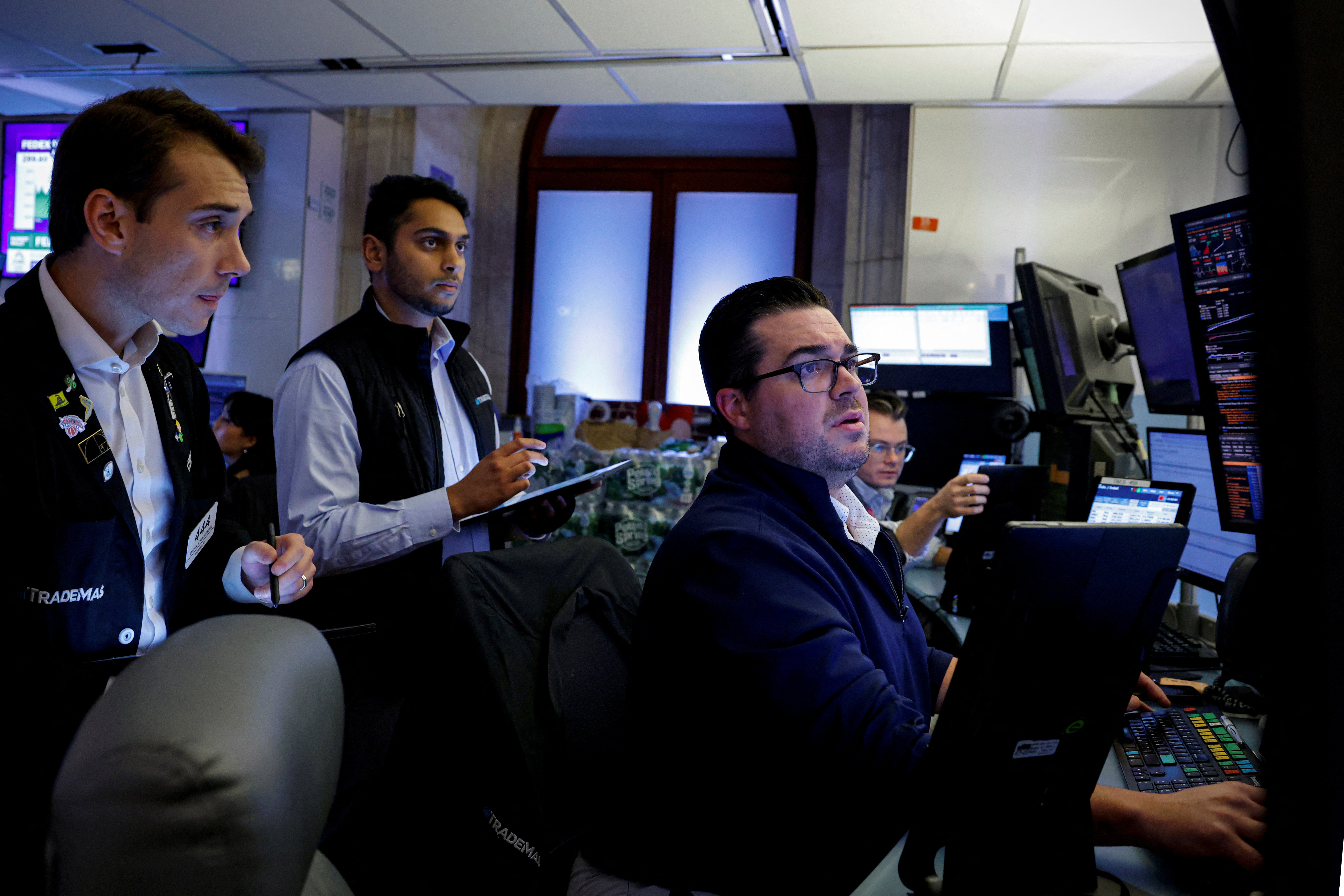
Traders work on the floor at the New York Stock Exchange (NYSE) in New York City, U.S., September 19, 2024. REUTERS/Brendan McDermid/File Photo

Summary Companies
  • CBOE Volatility index hits over one-month high
  • Pfizer gains on report Starboard Value takes $1 bln stake in co
  • Oil stocks track crude prices higher
  • Indexes down: Dow 0.5%, S&P 500 0.3%, Nasdaq 0.4%
Oct 7 (Reuters) - U.S. stock indexes fell on Monday, pressured by rising Treasury yields as markets recalibrated expectations for the Federal Reserve rate cuts, while rising conflict in the Middle East kept traders on the sidelines.

Tuesday, February 06, 2018

Robots in Finance Bring New Risks to Stability, Regulators Warn


Robots in Finance Bring New Risks to Stability, Regulators Warn

By
Silla Brush
@sabrushMore stories by Silla Brush

‎November‎ ‎1‎, ‎2017‎ ‎11‎:‎00‎ ‎AM‎ ‎EDT

Financial Stability Board issues paper on AI, machine learning
Firms are rapidly adopting artificial intelligence, FSB says


Robots Are Coming for Jobs on Wall Street

Banks and hedge funds that rely on artificial intelligence threaten to inject risks into the financial system that could exacerbate a future crisis, according to global regulators.

The financial industry’s rush to adopt AI raises the potential that firms will become overly dependent on technologies that herd them toward the same view of risks and could “amplify financial shocks,” according to a study published on Wednesday by the Financial Stability Board, a panel of regulators that includes the U.S. Federal Reserve and European Central Bank.

“AI and machine learning applications show substantial promise if their specific risks are properly managed,” the FSB said in a report that called for additional monitoring and testing of robotic technologies designed to lessen human involvement. “Taken as a group, universal banks’ vulnerability to systemic shocks may grow if they increasingly depend on similar algorithms or data streams.”

The FSB, headed by Bank of England Governor Mark Carney, said that many of the technologies are being designed and tested in a period of low volatility in financial markets, and, as a result, “may not suggest optimal actions in a significant economic downturn or in a financial crisis.”

Artificial intelligence is a branch of computer science that aims to imbue machines with aspects of reasoning. The term now includes machine learning, which is the ability for computers to learn by ingesting data, and natural language processing -- the ability to read or produce text.

Read More: How to Survive Wall Street’s Robot Revolution

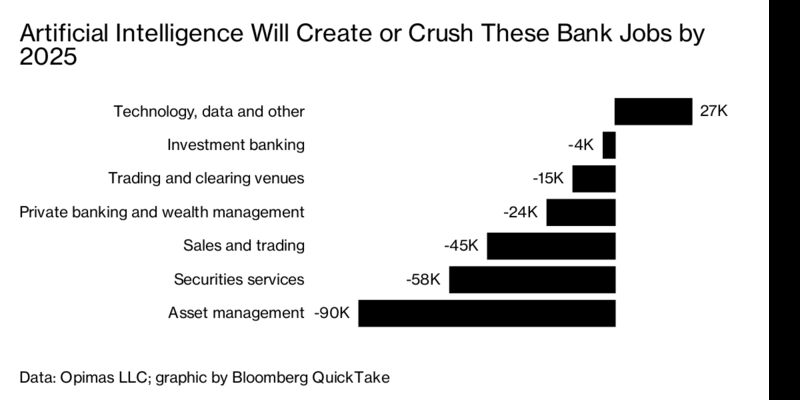
The world’s biggest banks and hedge funds are embracing the tools, driven by the availability of major new sources of data that can be analyzed quickly with computer power and at the same time a desire to cut costs and employment levels. Management consultant Opimas LLC estimated in March that AI would result in a cut of 230,000 workers at financial firms worldwide by 2025, with the hardest hit being 90,000 people in asset management.


Firms are using AI and machine learning to assess the credit quality of borrowers, price insurance contracts, automate interactions with clients and estimate the risk of trading positions, the FSB said. Hedge funds relying purely on AI and machine learning technologies are growing rapidly and have about $10 billion in assets under management, the FSB said, citing an estimate from a unnamed financial firm.


The FSB said technology’s potential to cut costs and drive new profits is even creating an “arms race” among firms to demonstrate their use of AI.

In the process, firms may be relying on a small number of third-party technological developers and services. If those were to fail, the effect would ripple across the wider financial system and contribute to major disruptions at large financial firms at the same time.

“These risks may become more important in the future if AI and machine learning are used for ‘mission-critical’ applications of financial institutions,” the FSB said. “Moreover, advanced optimization techniques and predictable patterns in the behavior of automated trading strategies could be used by insiders or by cyber-criminals to manipulate market prices.”

— With assistance by Edward Robinson


Thursday, April 07, 2016

US stocks slump broadly, led by banks


Marley Jay, Ap Markets Writer


Updated 2:17 pm, Thursday, April 7, 2016


This July 9, 2015 photo shows a Wall Street sign near the New York Stock Exchange in New York. Stock markets turned lower in European trading on Thursday, April 7, 2016 as a rebound in oil prices ran out of ... more Photo: Seth Wenig, AP


US stocks slump broadly, led by banks


NEW YORK (AP) — U.S. stocks are sinking toward their biggest loss in two months Thursday as banks and technology companies skid. Bond yields are falling and the dollar continues to weaken compared to the Japanese yen. Stocks are on pace to fall for the third day this week.

KEEPING SCORE: The Dow Jones industrial average fell 227 points, or 1.3 percent, to 17,488 as of 3:01 p.m. Eastern time. The Standard & Poor's 500 index shed 32 points, or 1.6 percent, to 2,034. The Nasdaq composite index lost 88 points, or 1.8 percent, to 4,832.


BROAD SLUMP: All 10 industrial sectors of the S&P 500 traded lower. Financial companies took some of the largest losses. Goldman Sachs slid $5.19, or 3.3 percent, to $150 and Citigroup lost $1.87, or 4.5 percent, to $39.99 while JPMorgan Chase dipped $1.73, or 3 percent, to $57.08.

Scott Wren, senior global equity strategist for Wells Fargo's Investment Institute, said banks are struggling because interest rates remain low and economic growth is sluggish.

WHERE TO: Stocks have gradually lost momentum over the last few weeks after a furious rally that wiped out most of their losses from early 2016. Wren said stocks are rising and falling based on how investors expect the global economy to do.


"People are worried about growth today," he said. "It's the same fears that have been kind of going back and forth in the market for a year or more."

LOSING: eBay led tech stocks lower as it fell $1.41, or 5.5 percent, to $24.02 and Apple gave up $2.40, or 2.2 percent, to $108.56. Telecommunications companies continued to struggle and Verizon fell $1.58, or 2.9 percent, to $51.94.

WYNN-ING: Wynn Resorts jumped $8.77, or 9.8 percent, to $98.32 after the hotel and casino company proposed a new development. Wynn said it wants to build a recreational lake and hotel behind its Wynn Las Vegas property.


ENERGY: Benchmark U.S. crude fell 49 cents, or 1.3 percent, to $37.26 per barrel in New York. Brent crude, used to price international oils, dropped 41 cents to $39.43 a barrel in London.

BONDS, CURRENCIES: U.S. government bond prices rose. The yield on the 10-year U.S. Treasury note fell to 1.69 percent from 1.76 percent. The dollar continued to weaken against the yen, falling to 108.37 from 109.62 yen. The dollar is at its lowest price compared to the yen in almost a year and a half. The euro declined to $1.1364 from $1.1410.

TAP THE BRAKES: Used car dealership chain CarMax reported strong fourth-quarter results, but its stock lost $4.47, or 8.4 percent, to $48.82. The company said it faced a tougher sales environment in the second half of the fiscal year.

RETAIL RESULTS: Wholesale club operator Costco declined after the company disclosed its March sales. Its stock fell $5.18, or 3.3 percent, to $151.59. Retailer Ollie's Bargain Hunting Outlet Holdings traded higher after it announced solid quarterly results. The stock climbed $2.23, or 9.8 percent, to $24.93.

METALS: The price of gold rose $13.70 or 1.1 percent, to settle at $1,237.50 an ounce and silver gained 10 cents to $15.16 an ounce. Copper plunged seven cents, or 3.1 percent, to $2.08 a pound.

OTHER ENERGY TRADING: Wholesale gasoline fell 1 cent to $1.38 a gallon. Heating oil slipped 1 cent to $1.13 a gallon. Natural gas rose 11 cents, or 5.6 percent, to $2.02 per 1,000 cubic feet.

GOOD FIT: HanesBrands said it will buy Champion Europe. HanesBrands owns Champion and the deal gives it control of a company that owned the Champion trademark in Europe as well as the Middle East and Africa. It recently made a similar deal in Japan unit as well. The underwear, T-shirt and sock maker's stock added 54 cents, or 2 percent, to $27.64.

EAT UP: ConAgra Foods added 50 cents to $45.93. The maker of Chef Boyardee, Hebrew National hot dogs and other packaged foods reported third-quarter profit and sales were stronger than expected.

UNEMPLOTMENT AID: Applications for unemployment benefits fell slightly last week, according to the Labor Department. That shows employers aren't slashing jobs even though there are signs economic growth is weak.

OVERSEAS: Germany's DAX fell 1 percent and the CAC-40 in France shed 0.9 percent. Britain's FTSE 100 lost 0.4 percent. In Tokyo, the Nikkei 225 advanced 0.2 percent and Hong Kong's Hang Seng added 0.3 percent. Seoul's Kospi added 0.1 percent.

___

AP Markets Writer Marley Jay can be reached at http://twitter.com/MarleyJayAP His work can be found at http://bigstory.ap.org/journalist/marley-jay


Source
.

Saturday, January 16, 2016

Wall Street Bleeding: Oil, Fears Spur Manic Depressive Bear Market in US


© AP Photo/ Jin Lee

12:33 16.01.2016(updated 13:30 16.01.2016) 


US stocks have crashed 8% since the beginning of 2016 and are expected to fall further, with any improvements expected no earlier than in the second half of 2016.


Kristian Rouz — During the first two weeks of 2016, the US financial markets performed worse than most pessimistic previous forecasts would suggest.

Stocks across most sectors were decimated as global oil prices continued their fall below the $30/bbl threshold, while concerns over mainland China’s economic prospects weighed on expectations of global growth, hitting the US-based multinational corporations in turn. International headwinds intensified after the European stock markets on Friday dropped to 20% below their April 2015 highs.


© PIXABAY
The Emperors Clothes: World Rushes to De-Dollarize Oil Trade Before US Economy Crashes and Burns

By now, stock markets across the globe have lost over $14 trln since June, and despite Wall Street performing better during the period, now it might be time the US stocks officially entered bear market.


Meanwhile, most investors, while being generally pessimistic of further market movements, do not see the 2008 scenario unraveling again due to a healthier real economy and stricter governmental regulations.

US stocks have been retreating in the first two weeks of 2016, currently averaging at 12% (S&P 500) below their May records highs (posting a massive 8% slide in just past two weeks). Yet, it is hardly the right time to buy, as US stocks might plunge an additional 10% to 15% from where they are now as key market components, equity value, credit and commodities are all poised to go down.

“It comes down to one basic fear, which is the global economy,” Russ Koesterich, of wealth management firm BlackRock Inc. said. “What people are afraid of is this isn’t investors overreacting, but reflects a fundamental deterioration in growth.”

The current decline in stocks follows December’s meltdown in the US junk bond market with Third Avenue mutual fund suspending payments that month. The entire situation is largely attributed to the decline in the US shale oil industry, short on revenues and investment amidst the ever-declining crude prices.

The US mining and oil sectors are among the worst performers thus far, however, as fuel prices are closely linked to the global growth outlook, largely dependent on the mainland China situation, the downward trend might reverse as well. That said, there is hardly a financial crisis in the US, as macro fundamentals are relatively strong, and it is only the market dumping the once overpriced assets.

The main sources of moderate optimism come from the understanding of fundamentals. The consumer sector, driving the lion’s share of the US economy, might accelerate as households increase spending the money they save on cheaper petrol. The Federal Reserve might opt to postpone further tightening or even roll rates back to their accommodative near-zero levels.


© FLICKR/ PIETER VAN MARION
'Age of Crude Oil Over' as China Develops Alternative Energy Sources
Oil prices might swing back up as the current underinvestment in the oil industry might turn the lingering oil oversupply into a deficit by at least second half of 2016, as observed by Goldman Sachs.


Underlining the increased risk to market stability, high-yielding bonds (or junk bonds) slid in value, with average yield rising from 5.7% in early 2014 to their current 9.1%, according to Barclay’s data.

Meanwhile, the US stock market earnings are in a recession, having dropped 4.7% in Q4, a second consecutive quarter of decline. Current expectations place stock profits for all S&P-listed enterprises at zero. Even though profit growth is expected at 7.5% in 2016, the current reading was revised down from 10.3% as estimated in October.

The stocks slide will negatively affect the US inflation index, thus marring the overall US growth prospects. Moreover, the current stocks rout indicates a decline in Federal Reserve policy efficiency: even though the December hike in rates and pessimistic data might have been a coincidence, many market participants might think otherwise.


Source

.

Monday, August 24, 2015

Wall Street Invokes Obscure Rule to Prevent Crash


Joshua Krause 

August 24th, 2015


After taking several major hits on the stock market last week, Wall Street had every reason to believe that Monday would be a bloodbath. They’re currently doing everything in their power to prevent the panic selling that was expected to occur as soon as the stock market reopened.

The first thing that the New York Stock Exchange did today, was invoke the obscure “rule 48″ which is designed to stabilize volatile markets before they open. Rule 48 essentially suspends “the requirement that stock prices be announced at the market open.” The rule has existed since 2007, and has only been applied on two separate occasions. So far, this measure has only been moderately successful. Nasdaq immediately fell by 378 points on the opening bell, while the Dow fell by 1000 points. Both markets have recovered but are still fluctuating heavily.

But that’s not the only stop-gap measure being implemented. If the S&P 500 falls by 7% before 3:25 PM Eastern Time, then thousands of companies on the NY Stock Exchange and the Nasdaq will stop trading for 15 minutes. If the S&P 500 plunges by 20% at any point, the entire stock market will be shut down for the rest of the day. Much like a casino, when the house is losing, all bets are off.

.

Wednesday, July 08, 2015

Dow ends down 261 as NYSE shutdown stuns markets


David Carrig and Adam Shell, USA TODAY4:48 p.m. EDT July 8, 2015


July 8 -- The NYSE says it experienced technical issues that affected symbols. Bloomberg's Julie Hyman reports on "Bloomberg Markets." Bloomberg


(Photo: Spencer Platt, Getty Images)


Losses in U.S. stocks following a global sell-off Wednesday accelerated when trading at the New York Stock Exchange suddenly halted for unknown technical reasons.

The Dow Jones industrial average was already off 177 points when at 11:32 a.m. ET trading in all securities on the NYSE stopped. Trading on the exchange resumed about 3:10 p.m.

Well into the 3½-hour shutdown came the release of the latest Fed minutes, which gave investors another opportunity to second-guess when the central bank will raise rates.

The Dow ended down 261 points, or 1.5% to 17,515.42. The Standard & Poor's 500index shed 1.7%, to 2046.69, while the Nasdaq composite index lost 1.8%, to 4909.76.

3½-HOUR SHUTDOWN: NYSE resumes trading

It's only Wednesday, but it's already been a tough week for investors around the world. Europe and Asia investors, especially, have confronted the longer-term issues of Greece's debt problem and a cratering market for China stocks.


USA TODAY

Fed officials worried about Greek crisis last month


Amid the NYSE shutdown, the exchange issued a statement saying: "We're currently experiencing a technical issue that we're working to resolve as quickly as possible. We will be providing further updates as soon as we can, and are doing our utmost to produce a swift resolution, communicate thoroughly and transparently, and ensure a timely and orderly market re-open."

It still wasn't clear after the 4 p.m. close what the nature of the tech issue was.

Even with the NYSE shut down, stock losses accelerated with the Dow's loss exceeding 200 points in afternoon trading. The outage didn't affect other markets including the Nasdaq Stock Market. In fact, trading in NYSE-listed stocks was still occurring on other exchanges, including the Nasdaq.

"There are 11 other stock exchanges," says Sal Arnuk, trader at Themis Trading. "The good news is there's redundancy in the system and stocks are continuing to trade." Arnuk says the other exchanges are handling the trading "fluidly and smooth."

In an increasingly electronic, automated market, market glitches — despite the uncertainty that results — are just part of the new investing landscaping, says Savena Mostowfi, head of U.S. equities research at TABB Group, a firm that specializes in market structure.

"System glitches are the new norm," she told USA TODAY.

Mostowfi lauded the NYSE's decision to shut trading down when it discovered a technical problem.

"It was a smart decision rather than create mass confusion," she says, noting that investors would rather not be in limbo, wondering what the status of their trades are.

And while the U.S. exchange system has gotten increasingly fragmented with 11 different exchanges, which is often a criticism, today the ability of investors to seamlessly move their trading to other exchanges is a sign the system "works," says Mostowfi. The fact that the stock market did not go into freefall despite the outage at the NYSE was "reflective of how seamless the transition was for brokers to go from one trading venue to another."

Stocks had been lower all morning as investors were confronted with a major sell-off in Asian markets, uncertainty over the future of Greece and the eurozone and the upcoming release of the Fed minutes.

Wall Street followed Asian markets lower as Hong Kong's Hang Seng index plunged as much as 8% before closing down 5.8% and China's Shanghai Composite sank 5.9%. Japan's Nikkei 225 index lost 3.1% to close at 19,737.64.


USA TODAY

China's dramatic stock plunge continues


The sell-off in China came despite measures announced by the Chinese government Wednesday to halt the stock slide including telling state-owned companies to buy shares, raising the amount of equities insurance companies can hold and promising more credit to finance trading.

Chinese stocks are now down more than 30% since early June.


A woman rubs her face as she stands at a computer terminal in a stock brokerage house in Nantong in eastern China's Jiangsu province on July 8, 2015. (Photo: AP)


The lack of progress on Greek debt talks also added to investor angst. Greece submitted a request to the European Union for aid on Wednesday, and must present a detailed new economic reform proposals to justify fresh lending by international creditors by Thursday. EU leaders have also give Greece a Sunday deadline to make a deal of face bankruptcy.


USA TODAY

Greece submits aid request; still to send full plan


European stocks were higher Wednesday after four straight days of declines. Hopes that Greece will eventually submit a proposal and spur talks that will lead to a deal helped stop the recent European drop. Germany's DAX index was up 0.7% and France's CAC 40 added 0.8%.

RATES: Will Fed plans be upended by global tumult?

Contributing: Jane Onyanga-Omara, Matt Krantz


Source: http://www.usatoday.com/story/money/markets/2015/07/08/stocks-wednesday/29856201/
.
.

Monday, December 15, 2014

Stocks slide, extending decline, as oil slumps


Street signs mark the corner of Broadway and Wall Street, in New York's Financial District. (Richard Drew / Associated Press)
ASSOCIATED PRESS

"What you're seeing is a correction that's long overdue"


U.S. stocks are closing lower, extending losses from last week.


The price of crude oil continued to drop Monday, and Russia's ruble plunged to a record low against the dollar.

The Dow Jones industrial average fell 100 points, or 0.6 percent, to 17,180.

The Standard & Poor's 500 index fell 12 points, or 0.6 percent, to 1,989. The Nasdaq composite lost 48 points, or 1 percent, to 4,605.


Russia's ruble plunged 13 percent against the dollar. The falling price of oil, which is the chief source of Russian exports and tax revenue, has weighed heavily on the currency.

The price of U.S. benchmark crude oil sank $1.90, or 3.3 percent, to $55.91 a barrel. Oil has fallen by nearly half since June.


Source
.

Monday, September 01, 2014

Wall Street Admits That A Cyberattack Could Crash Our Banking System At Any Time

Cyberattack - Public Domain

Wall Street banks are getting hit by cyber attacks every single minute of every single day. It is a massive onslaught that is not highly publicized because the bankers do not want to alarm the public. But as you will see below, one big Wall Street bank is spending 250 million dollars a year just by themselves to combat this growing problem. The truth is that our financial system is not nearly as stable as most Americans think that it is. We have become more dependent on technology than ever before, and that comes with a potentially huge downside. An electromagnetic pulse weapon or an incredibly massive cyberattack could conceivably take down part or all of our banking system at any time.  
(Read More....).
.

Thursday, March 13, 2014

Wall Street tumbles as Ukraine tensions rise, China slows


By Angela Moon

NEW YORK Thu Mar 13, 2014 4:56pm EDT


Traders work on the floor of the New York Stock Exchange March 11, 2014.
Credit: Reuters/Brendan McDermid


Related Topics

Russia »


(Reuters) - U.S. stocks tumbled on Thursday, with the Dow and the S&P 500 suffering their worst day since early February, on rising concerns over Ukraine and Russia and new signs of a slowdown in China.

Selling accelerated in afternoon trading after Russia launched military exercises near its border with Ukraine, showing no sign of backing down in its plans to annex its neighbor's Crimea region despite a stronger-than-expected push for sanctions from the EU and the United States.

In an unusually robust and emotionally worded speech, German Chancellor Angela Merkel warned of "catastrophe" unless Russia changes course.

The CBOE Volatility index VIX .VIX, Wall Street's so-called fear gauge, jumped more than 12 percent to 16.22. The index usually moves inversely to the S&P 500. A key emerging market exchange-traded fund, iShares MSCI Emerging Markets ETF (EEM.P), fell 1.8 percent to $38.19.

"(Ukraine headlines) are certainly going to be the catalyst but there is more under the surface," said Paul Mendelsohn, chief investment strategist at Windham Financial Services in Charlotte, Vermont.

"There is no military solution to this. All it is, is positioning - and let's be realistic, these Chinese numbers last night were not good."

China's economy slowed markedly in the first two months of the year, as growth in investment, retail sales and factory output all fell to multi-year lows.

The S&P 500 broke below its 10-day and 14-day moving averages, which were acting as short-term technical support levels. It also broke below the 1,850 level.

The Dow Jones industrial average .DJI fell 231.19 points or 1.41 percent, to 16,108.89, the S&P 500 .SPX lost 21.86 points or 1.17 percent, to 1,846.34 and the Nasdaq Composite .IXIC dropped 62.912 points or 1.46 percent, to 4,260.42.

Economically-sensitive sectors such as industrials .SPLRCI, down 1.5 percent, and technology .SPLRCT, down 1.6 percent, fared the worst. General Electric (GE.N) fell 1.6 percent to $25.34; Apple Inc (AAPL.O) lost 1.1 percent to $530.65.

Earlier, gains were supported by better-than-expected weekly initial jobless claims and retail sales data for February, although the prior month of retail sales was revised lower.

Import prices increased 0.9 percent last month, their biggest rise in a year as petroleum soared, but there was little sign of a broad pick-up in imported inflation.

About 7.5 billion shares traded on U.S. exchanges, according to BATS Global Markets, above the 6.8 billion daily average so far this month.

(Editing by Nick Zieminski)


Source
.
.,

Monday, March 03, 2014

What Wall Street is watching in Ukraine crisis


Adam Shell, USA TODAY 1:39 p.m. EST March 3, 2014

Wall Street has a new worry: the escalating conflict between the Ukraine and Russia. Here are five things investors are watching.


(Photo: Richard Drew, AP)


Story Highlights
Wall Street is watching to see if political crisis turns into economic one
Key question is if hostilities result in full-fledged war
European economy at risk due to close proximity to hot spot

Geopolitical risk, saber rattling and war talk are not new to Wall Street.

The stock market survived the Cold War, European conflicts in Kosovo and Georgia, recent U.S. wars in the Middle East, and current political upheaval in places like Syria and Egypt.

The Standard & Poor's 500 stock index, if you recall, closed at yet another all-time high Friday, and the world hasn't been a terribly friendly place at times during the march higher.

History also shows that market shocks caused by war, terrorism and other fear-rattling events tend to be short-lived.

U.S. STOCKS: How markets are doing

FUNDS: Investments to watch in Ukraine crisis

5 WAYS: Ukraine unrest affects global economy

In 14 shocks dating back to the attack on Pearl Harbor in December 1941, the median one-day decline has been 2.4%. And the shocks, which also include the Sept. 11 terror attacks and the 1962 Cuban missile crisis, lasted just eight days, with total losses of 7.4%, data from S&P Capital IQ show. The market recouped its losses 14 days later.

So what's Wall Street watching now as the conflict in Ukraine heats up after Russia's military move into Crimea, the southern Russian-speaking part of the Ukraine.

Here are five things to watch:

1. Will political crisis bleed into economic crisis?

While Russia's troop movements into Crimea are unnerving and cause an initial knee-jerk reaction to sell risky assets, the ultimate question is whether the impact causes major economic headwinds in Europe, the U.S. and the rest of the globe.

Strict trade sanctions on the Russians, for example, could cause Russia to pull back on all energy exports to Europe, which could cause harm to Europe's economy, which could then spread to the U.S.

But for now, Wall Street doesn't view the conflict as a major economic event, despite a 2% jump in oil prices and stock market weakness around the globe.

"It appears that the markets -- at least for now -- are recognizing that problems in Ukraine provide significantly greater geopolitical risk than economic and market risk to the U.S. at this time," says John Stoltzfus, a market strategist at Oppenheimer.

2. Will hostilities morph into actual war?

"Stating the obvious, the key is fighting," says Andy Busch, a market strategist and editor of The Busch Update. "So far, there hasn't been much if any. I don't think the Ukraine has the money to fight a war at this point despite Russian troops on their soil. I expect the standoff to remain with a tense 'war of nerves' between Moscow and Kiev, keeping the markets in a 'risk-off' mode."

3. Will talk of Cold War redux spook investors?

The underlying fear in the Russia v. Ukraine faceoff is that it will somehow morph into a USA v. Russia-style return to a new Cold War. But that's probably an overblown risk, Tobias Levkovich, chief U.S. equity strategist at Citigroup, told clients in a report.

"A return to the Russian / U.S. Cold War days seems to be too pessimistic of a perspective," Levkovich wrote.

4. Will shock take toll on risk-taking. Markets hate uncertainty. And a conflict that involves Russia and is occurring in a key economic part of the globe like Europe could cool risk-taking until tensions ease, says Craig Johnson, a techncial market analyst at Piper Jaffray.

Investors may be unwilling to pay up for stocks, which could cause stock valuations to come in a bit, putting downward pressure on stocks prices.

"A further escalation of the present crisis could lead to an excuse for investors to take some money off the table," says Johnson.

5. Will Europe's economy take lethal hit?

The eurozone is emerging from recession and can't afford an economic shock. But economic sanctions against Russia to force it to withdraw from Crimea could hurt Europe.

Says Busch: "This has the potential to spill over into trade sanctions and Russia pulling back on all energy exports to Europe. Therefore, the end-game is how bad will this hurt Europe?"


A pro-Russian man wearing the Russian national flag on Monday walks past General Staff Headquarters of the Ukrainian Navy as unidentified gunmen stand outside in Sevastopol, Ukraine.(Photo: Andrew Lubimov, AP)


Source
.

Thursday, February 20, 2014

Soros betting against stocks? Not likely


 By Patrick M. Sheridan @CNNMoneyInvest
February 19, 2014: 2:20 PM ET


George Soros increased his position in an investment that would profit if stocks fall. But it may simply be a smart hedge.


NEW YORK (CNNMoney)
Hedge fund heavyweight George Soros appears to be making a billion dollar bet against the stock market. But looks can be deceiving.

Tongues have been wagging on Wall Street since Soros Fund Management revealed in a quarterly filing with the Securities and Exchange Commission Friday that his fund owned 7 million "puts" on the S&P 500 (SPY) exchange traded fund in the fourth quarter. Puts are essentially a bet that the price of an asset will go down. The total value of the "puts" as of the filing date was $1.3 billion.

Soros first bought the position last year as the S&P 500 was on its way to setting a series of new record highs. So if Soros is boosting the size of an investment that many short sellers and other market bears use, then that should be big news to make investors worried about where are stocks going, right? Not necessarily.

According to one investment expert, the move may be nothing more than a standard hedging practice for Soros, whose total portfolio is worth about $11.7 billion. Insider Monkey research director Ian Dogan noted that even though the size of the S&P 500 put position increased by a whopping 150%, this may be normal given that Soros also increased his overall long position on the market by $2 billion.

Related: Soros and other hedge fund bailed on gold in 2013

To that end, Friday's filing also revealed that Soros added to stakes in several well-known stocks, such as Apple (AAPL, Fortune 500), General Motors (GM, Fortune 500), JPMorgan Chase (JPM, Fortune 500) and Dish Network (DISH, Fortune 500), in the fourth quarter.

Another thing to remember is that the latest filing is a snapshot of what the fund held as of the end of December. We won't know what Soros has bought or sold in the first quarter until sometime in May when his firm is required to file its latest quarterly update.

A Soros representative declined to comment on the filing. But with his history of big bets, it's understandable why some investors are curious.

A little more than 20 years ago Soros made his most famous investment. He shorted the British pound and pocketed a billion dollars in the process.

Source
.
.

Monday, June 24, 2013

Sell, sell, sell on Wall Street Monday as Dow drops as much as 1.7%


12:25 pm by Deborah Bacal


As of just about noon ET, the Dow was down 239 points to 14,560, after hitting a day low of 14,551.27, while the Nasdaq shed 61 points to 3,296, and the S&P 500 lost 31 points to 1,561.

U.S. markets embarked on another sharp slide Monday as Shanghai stocks plummeted 5.3%, the worst percentage fall since 2009, on growing fears over a liquidity crunch in China, the world’s second-largest economy.

As of just about noon ET, the Dow was down 239 points to 14,560, after hitting a day low of 14,551.27, while the Nasdaq shed 61 points to 3,296, and the S&P 500 lost 31 points to 1,561.

In China, the Shanghai Composite index (SHA:CN:SHCOMP) plunged 5.3% to 1,963.24 as banking stocks slid on fears Beijing officials could be unwilling to ease the liquidity crunch, with the country's central bank saying that the nation's banks need to control liquidity better. On top of this, Goldman Sachs also downgraded its GDP growth forecasts for China to 7.4% and 7.7% for 2013 and 2014, respectively, down from 7.8% and 8.4%, previously.

In the U.S. Monday, the economic calendar was relatively quiet, with data kicking off on Tuesday, in a week set to be dominated by durable goods, new home sales, consumer confidence, pending home sales, and Chicago PMI, amid a heavy raft of Fed speakers that starts later today with Richard Fisher. Investors were thus left to focus Monday on China's dire straits, with the drama taking its toll on commodities, for which the country is a major consumer.

The sell-off today comes after a major rout for markets last week in the U.S. The Dow lost 1.8% last week after the Fed suggested that its bond buying could be slowed later this year with an eventual halt to the policy in the middle of 2014, while the Nasdaq finished down 1.9% and the S&P 500 lost 2.1%.

In corporate news Monday, Boeing (NYSE:BA) led the decliners in the Dow, falling almost 3% after its 787 Dreamliner nightmare continues, this time grounding one of its planes flown by United Airlines due to a brake problem. The jet, traveling from Houston to Denver, had to make an emergency landing, and returned to Texas.

In other news, Tenet Healthcare (NYSE:THC) has agreed to acquire Vanguard Health (NYSE:VHS) for about $1.63 billion, or $21 per share in cash - a 70% premium to Vanguard's closing price on Friday. Shares of Vanguard surged almost 69%.

Elsewhere, Vodafone (NASDAQ:VOD) shares edged down in the U.S. after it said it has agreed to acquire Kabel Deutschland (KBDHY.OB) for 7.7 billion euros in what will be the U.K. operator's largest acquisition since its entry into India in 2007.

Shares of Apple (NASDAQ:AAPL) lost 3.3% Monday after Jefferies cut its price target on the iPhone developer to $405 from $420 previously on the possibility of the company slowing iPhone production.

Meanwhile, according to a report in the Wall Street Journal, Google (NASDAQ:GOOG) has confirmed that the Federal Trade Commission is carrying out an antitrust review on its purchase of Waze, given Google's dominant position in the online/mobile maps market. Shares of Google shed 1.7% on Monday.

Commodities

Gold futures fell a further $12 to $1,280 an ounce Monday after closing down more than 6% last week, with Goldman Sachs also cutting its outlook on gold prices today for this year and next on an improving U.S. economy. The bank now expects gold to end the year at $1,300 a troy ounce, a 9.4% drop from its previous forecast, while it now sees the yellow metal finishing 2014 at $1,050 an ounce, a decline of 17.3% from its prior outlook.

Crude for July delivery lost 2 cents to $93.65 a barrel.

Europe

European markets finished sharply lower today with shares in France leading the region. The CAC 40 finished down 1.71% while Britain's FTSE 100 was off 1.42% and Germany's DAX fell lower by 1.24%.


.

Thursday, May 23, 2013

Wall Street tries to buck global sell-off

MAY 23, 2013


BY BEN ROONEY, CNN


A wave of selling hit Wall Street early Thursday as markets tumbled from Tokyo to London, but the U.S. stock losses ebbed in early trading.

The Dow Jones industrial average fell 0.3%, the S&P 500 slid 0.5%, and the Nasdaq sank 0.4%

The declines were modest compared with overseas markets.

Japan was by far the hardest hit. The Nikkei sunk 7.3%. Stocks in Shanghai, Hong Kong, Syndey and Singapore also fell. European markets were all down 2% or more.

The global sell-off was triggered by worse-than-expected Chinese data that showed manufacturing slowed for the first time in seven months, and the latest minutes from the U.S. Federal Reserve's monetary policy meeting.

"We fear that this may get very ugly, very quickly," wrote Dennis Gartman, editor and publisher of daily financial newsletter The Gartman Letter. He said the big move lower in Japanese stocks could set the stage for a further fall of 7% to 10%.

U.S. stocks erased an early rally Wednesday as investors faced mixed messages from the Federal Reserve about when its bond buying program might end.

Economic bright spots: the Department of Labor reported that initial claims for unemployment benefits fell to 340,000 last week, down from 363,000 the week before.

Separately, new home sales rose 2.3% in April compared with the month prior, according to government data.

Eye on retail: Shares of Ralph Lauren slumped after the retailer failed to meet lowered revenue forecasts, even as earnings jumped 35%.

Gap and Sears Holdings are up after the bell.

Shares of Hewlett-Packard surged about 11% after the PC-maker reported quarterly earnings that beat estimates.

Shares of Tesla nudged higher, a day after the electric car maker announced that it had repaid a $465 million loan from the government nearly a decade before it was scheduled to do so.


.

Tuesday, January 08, 2013

The four business gangs that run the US


December 31, 2012


Ross Gittins
The Sydney Morning Herald's Economics Editor


Illustration: Michael Mucci.

IF YOU'VE ever suspected politics is increasingly being run in the interests of big business, I have news: Jeffrey Sachs, a highly respected economist from Columbia University, agrees with you - at least in respect of the United States.

In his book, The Price of Civilisation, he says the US economy is caught in a feedback loop. ''Corporate wealth translates into political power through campaign financing, corporate lobbying and the revolving door of jobs between government and industry; and political power translates into further wealth through tax cuts, deregulation and sweetheart contracts between government and industry. Wealth begets power, and power begets wealth,'' he says.

Sachs says four key sectors of US business exemplify this feedback loop and the takeover of political power in America by the ''corporatocracy''.

First is the well-known military-industrial complex. ''As [President] Eisenhower famously warned in his farewell address in January 1961, the linkage of the military and private industry created a political power so pervasive that America has been condemned to militarisation, useless wars and fiscal waste on a scale of many tens of trillions of dollars since then,'' he says.

Second is the Wall Street-Washington complex, which has steered the financial system towards control by a few politically powerful Wall Street firms, notably Goldman Sachs, JPMorgan Chase, Citigroup, Morgan Stanley and a handful of other financial firms.

These days, almost every US Treasury secretary - Republican or Democrat - comes from Wall Street and goes back there when his term ends. The close ties between Wall Street and Washington ''paved the way for the 2008 financial crisis and the mega-bailouts that followed, through reckless deregulation followed by an almost complete lack of oversight by government''.

Third is the Big Oil-transport-military complex, which has put the US on the trajectory of heavy oil-imports dependence and a deepening military trap in the Middle East, he says.

''Since the days of John D. Rockefeller and the Standard Oil Trust a century ago, Big Oil has loomed large in American politics and foreign policy. Big Oil teamed up with the automobile industry to steer America away from mass transit and towards gas-guzzling vehicles driving on a nationally financed highway system.''

Big Oil has consistently and successfully fought the intrusion of competition from non-oil energy sources, including nuclear, wind and solar power.

It has been at the side of the Pentagon in making sure that America defends the sea-lanes to the Persian Gulf, in effect ensuring a $US100 billion-plus annual subsidy for a fuel that is otherwise dangerous for national security, Sachs says.

''And Big Oil has played a notorious role in the fight to keep climate change off the US agenda. Exxon-Mobil, Koch Industries and others in the sector have underwritten a generation of anti-scientific propaganda to confuse the American people.''

Fourth is the healthcare industry, America's largest industry, absorbing no less than 17 per cent of US gross domestic product.

''The key to understanding this sector is to note that the government partners with industry to reimburse costs with little systematic oversight and control,'' Sachs says. ''Pharmaceutical firms set sky-high prices protected by patent rights; Medicare [for the aged] and Medicaid [for the poor] and private insurers reimburse doctors and hospitals on a cost-plus basis; and the American Medical Association restricts the supply of new doctors through the control of placements at medical schools.

''The result of this pseudo-market system is sky-high costs, large profits for the private healthcare sector, and no political will to reform.''

Now do you see why the industry put so much effort into persuading America's punters that Obamacare was rank socialism? They didn't succeed in blocking it, but the compromised program doesn't do enough to stop the US being the last rich country in the world without universal healthcare.

It's worth noting that, despite its front-running cost, America's healthcare system doesn't leave Americans with particularly good health - not as good as ours, for instance. This conundrum is easily explained: America has the highest-paid doctors.

Sachs says the main thing to remember about the corporatocracy is that it looks after its own. ''There is absolutely no economic crisis in corporate America.

''Consider the pulse of the corporate sector as opposed to the pulse of the employees working in it: corporate profits in 2010 were at an all-time high, chief executive salaries in 2010 rebounded strongly from the financial crisis, Wall Street compensation in 2010 was at an all-time high, several Wall Street firms paid civil penalties for financial abuses, but no senior banker faced any criminal charges, and there were no adverse regulatory measures that would lead to a loss of profits in finance, health care, military supplies and energy,'' he says.

The 30-year achievement of the corporatocracy has been the creation of America's rich and super-rich classes, he says. And we can now see their tools of trade.

''It began with globalisation, which pushed up capital income while pushing down wages. These changes were magnified by the tax cuts at the top, which left more take-home pay and the ability to accumulate greater wealth through higher net-of-tax returns to saving.''

Chief executives then helped themselves to their own slice of the corporate sector ownership through outlandish awards of stock options by friendly and often handpicked compensation committees, while the Securities and Exchange Commission looked the other way. It's not all that hard to do when both political parties are standing in line to do your bidding, Sachs concludes.

Fortunately, things aren't nearly so bad in Australia. But it will require vigilance to stop them sliding further in that direction.

Twitter: @1Ross Gittins


Source 

.

Thursday, November 29, 2012

Shadow Banking

NOVEMBER 28, 2012


How Wall Street "Privatized" Money Creation


by MIKE WHITNEY


Regulators are worried about the explosive growth of shadow banking, and they should be. Shadow banks were at the heart of the last financial crisis and they’ll be at the heart of the next financial crisis as well. There’s no doubt about it. It’s simply impossible to maintain a system where unregulated, non-bank financial institutions are able to create their own money (credit) without oversight or supervision. The money they create–via off-balance sheets operations, securitization, repo or other unmonitored mega-leveraging activities–feeds into the economy, creates artificial demand, lowers unemployment, and fuels growth. But when the cycle slams into reverse (and debts are no longer serviced on time), then thinly-capitalised shadow banks begin to default one-by-one, creating a daisy-chain of counterparty bankruptcies that push stocks into a nosedive while the economy slips into a long-term slump.

Sound familiar?

The reason the global economy is still in a shambles a full 5 years after Lehman Brothers collapsed, is because this deeply-flawed system –which had previously generated 40 percent of the credit in the US economy–was still in rebuilding-mode. But now, according to a new report by the Financial Stability Board, shadow banking has made a comeback and is bigger than ever. The FSB found that assets held by shadow banks have swollen to $67 trillion, a sum that’s nearly as large as global GDP ($69.97 trillion) and greater than the $62 trillion that was in the system prior to the Crash of ’08. The more shadow banking grows, the greater the probability of another financial crisis.

So what is shadow banking and how does it work?

Here’s how Investopedia defines the term:


“The financial intermediaries involved in facilitating the creation of credit across the global financial system, but whose members are not subject to regulatory oversight. The shadow banking system also refers to unregulated activities by regulated institutions.

Examples of intermediaries not subject to regulation include hedge funds, unlisted derivatives and other unlisted instruments. Examples of unregulated activities by regulated institutions include credit default swaps.

The shadow banking system has escaped regulation primarily because it did not accept traditional bank deposits. As a result, many of the institutions and instruments were able to employ higher market, credit and liquidity risks, and did not have capital requirements commensurate with those risks. Subsequent to the subprime meltdown in 2008, the activities of the shadow banking system came under increasing scrutiny and regulations.” (Investopedia)

Shadow banking may have “come under increasing scrutiny”, but not a damn thing has been done to fix the problems. The banks and their lobbyists have beaten back all the sensible reforms that would have made the system safer. Instead, we’re back at Square 1, where credit is expanding in leaps and bounds by–what Pimco’s Paul McCulley called–”a whole alphabet soup of levered up non-bank investment conduits, vehicles and structures”. What we are seeing, in essence, is the privatizing of money creation. Privately-owned financial institutions of every stripe are increasing the amount of credit in the system even though the underlying collateral they’re using may be dodgy and even though they may not have sufficient capital to honor claims if there’s a run on the system.

Let’s explain: When a bank issues a mortgage, it is required to hold a certain amount of capital against the loan in case of default. But if the bank securitizes the mortgage, that is, it chops the mortgage up into tranches, pools it with other mortgages, and sells it as a bond (mortgage backed security), then the bank is no longer required to hold capital against the asset. In other words, the bank has created money (credit) out of thin air. This is the ultimate goal of banking, to maximize profits off zilch capital.

So how is this different than counterfeiting?

There’s no difference at all. The banks are creating “near money” or what Marx called “fictitious capital” without sufficient resources, without supervision, and without any regard for the damage they may inflict on the real economy when their ponzi-scam blows up. What matters is profits, everything else is secondary.

We live in an economy where the Central Bank no longer controls the money supply. Interest rates only play small part in this new paradigm where risk-oriented speculators can boost broad money by many orders of magnitude by merely increasing their debt levels. This new phenom has intensified systemic instability and caused incalculable harm to the real economy. Keep in mind, that ground zero in the financial crisis was a shadow bank called The Reserve Primary Fund. That’s where the trouble really began.

In 2008, the Reserve Primary Fund (which had lent Lehman $785 million and received short-term notes called commercial paper) was unable to keep up with the withdrawals of clients who were concerned about the fund’s financial health. The sudden erosion of trust triggered a run on the money markets which sent equities plunging. Here’s how Bloomberg sums it up:


“On Tuesday, Sept. 16, the run on Reserve Primary continued. Between the time of Lehman’s Chapter 11 announcement and 3 p.m. on Tuesday, investors asked for $39.9 billion, more than half of the fund’s assets, according to Crane Data.

“Reserve’s trustees instructed employees to sell the Lehman debt, according to the SEC.

“They couldn’t find a buyer.

“At 4 p.m., the trustees determined that the $785 million investment was worth nothing. With all the withdrawals from the fund, the value of a single share dipped to 97 cents.

“Legg Mason, Janus Capital Group Inc., Northern Trust Corp., Evergreen and Bank of America Corp.’s Columbia Management investment unit were all able to inject cash into their funds to shore up losses or buy assets from them. Putnam closed its Prime Money Market Fund on Sept. 18 and later sold its assets to Pittsburgh-based Federated Investors.

“At least 20 money fund managers were forced to seek financial support or sell holdings to maintain their $1 net asset value, according to documents on the SEC Web Site.” (“Sleep-At-Night-Money Lost in Lehman Lesson Missing $63 Billion”, Bloomberg)

The news that Primary Reserve had “broken the buck” sparked a panic that quickly spread to markets across the world sending stocks into freefall. Primary Reserve was the proximate cause of the financial crisis and the global crash, not subprime mortgages and not Lehman Brothers. This fact is obfuscated by the media to conceal the inherent dangers of the shadow system, a system that is just as rickety and crisis-prone today as it was in September 2008.

Although there are ways to make shadow banking safer, the banks and their lobbyists have resisted any change to the current system. Recently, the banks delivered a stunning defeat to Securities and Exchange Commission chairwoman Mary Schapiro who had been pushing for minor changes to money market accounts that would have made this critical area of the shadow system safer and less susceptible to bank runs. Schapiro’s drubbing at the hands of an all-powerful financial services industry sent shockwaves through Washington where even diehard friends of Wall Street –like Ben Bernanke and Treasury Secretary Timothy Geithner–sat up and took notice. They have since joined the fight to implement modest regulations on an out-of-control money market system which threatens to crash the financial system for the second time in less than a decade.

Keep in mind, that the changes Geithner, Bernanke and Schapiro seek are meager by any standard. They would involve “a floating net asset value, or share price, instead of their current fixed price,” or more capital to back up the investments in the money market fund (just 3 percent) in case there’s a panic and investors want to withdraw their money quickly. That sounds reasonable, doesn’t it? Even so, the banks have rejected any change at all. They believe they have the right to decieve investors about the risks involved in keeping their money in uninsured money market accounts. They don’t think they should have to keep enough capital on hand to cover withdrawals in the event of a bank run. They’ve decided that profits outweigh social responsibility or systemic stability.

So far, Wall Street has fended off all attempts at regulatory reform. The banks and their allies in Congress have made mincemeat of Dodd Frank, the reform bill that was supposed to prevent another financial crisis. Here’s how Matt Taibbi summed it up in a recent article in Rolling Stone:


“At 2,300 pages, the new law ostensibly rewrote the rules for Wall Street. It was going to put an end to predatory lending in the mortgage markets, crack down on hidden fees and penalties in credit contracts, and create a powerful new Consumer Financial Protection Bureau to safeguard ordinary consumers. Big banks would be banned from gambling with taxpayer money, and a new set of rules would limit speculators from making the kind of crazy-ass bets that cause wild spikes in the price of food and energy. There would be no more AIGs, and the world would never again face a financial apocalypse when a bank like Lehman Brothers went bankrupt.

Most importantly, even if any of that fiendish crap ever did happen again, Dodd-Frank guaranteed we wouldn’t be expected to pay for it. “The American people will never again be asked to foot the bill for Wall Street’s mistakes,” Obama promised. “There will be no more taxpayer-funded bailouts. Period.”

Two years later, Dodd-Frank is groaning on its deathbed. The giant reform bill turned out to be like the fish reeled in by Hemingway’s Old Man – no sooner caught than set upon by sharks that strip it to nothing long before it ever reaches the shore.” (“How Wall Street Killed Financial Reform”, Matt Taibbi, Rolling Stone)

Congress, the White House and the SEC are all responsible for fragile state of the financial system and for the fact that shadow banking has not been brought under regulatory oversight. This mess should have been cleaned up a long time ago, instead, shadow banking is experiencing a growth-spurt, adding trillions to money supply and pushing the system closer to disaster. It’s shocking.

MIKE WHITNEY lives in Washington state. He is a contributor to Hopeless: Barack Obama and the Politics of Illusion (AK Press). Hopeless is also available in a Kindle edition. He can be reached at fergiewhitney@msn.com.


.

Wednesday, November 07, 2012

Post-election market falls, "fiscal cliff" looms


Related News

Wall Street gains as U.S. votes, euro steady
Tue, Nov 6 2012
Markets want clear decision from presidential vote
Tue, Nov 6 2012
Gold rises, tracks equities; U.S. election eyed
Tue, Nov 6 2012
Wall Street rises in thin trade day before election
Mon, Nov 5 2012
Wall Street flat, dollar firm day before U.S. election
Mon, Nov 5 2012

Analysis & Opinion

The biggest winner in U.S. election: Mr. Uncertainty
Delegitimization of Obama begins

Related Topics

Investing Simplified »


Related Video

Wall Street votes thumbs up
Tue, Nov 6 2012
Breakingviews: Wall St gets a thump

By Caroline Valetkevitch

NEW YORK | Wed Nov 7, 2012 12:55pm EST

(Reuters) - Stocks fell more than 2 percent on Wednesday, putting the S&P 500 on track for its biggest drop since June, as investors shifted their focus to a looming fiscal showdown in Congress after President Barack Obama's re-election.

Energy, healthcare and the banking sectors were among the hardest hit after Obama defeated Republican Mitt Romney, whose policy positions favored those industries. Defense shares also plunged.

Adding to the weaker sentiment were renewed worries about economic troubles in Europe, a key market for many U.S. companies. The euro zone economy will barely grow next year but pick up in 2014, the European Commission said. The region's economy would grow only 0.1 percent in 2013 after a bigger than previously forecast contraction this year.

"Traders on the floor are thinking, before the election President Obama wasn't able to resolve the fiscal cliff so what makes you think he's going to be able to do it after the election? That's the big issue right now," said Todd Schoenberger, managing principal at the BlackBay Group in New York.

The Dow Jones industrial average .DJI was down 329.86 points, or 2.49 percent, at 12,915.82. The Standard & Poor's 500 Index .SPX was down 36.03 points, or 2.52 percent, at 1,392.36. The Nasdaq Composite Index.IXIC was down 76.72 points, or 2.55 percent, at 2,935.21. The S&P 500 also below the key 1,400 level for the first time since September 4.

Wednesday's drop is a reversal from the prior session's gains when voting was under way. Defense and energy shares were among the market leaders that day.

"The market is telling us that it was pricing in the potential for a Romney victory, based upon the rally over the past few days," said Phil Orlando, chief market strategist for equities at Federated Investors Inc of Pittsburgh.

On Wednesday, an index of defense shares .DFX was down 3.8 percent, its biggest one-day drop in a year. Shares of United Technologies (UTX.N) were down 3.5 percent at $77.14.

Washington must next focus on some $600 billion in spending cuts and tax increases due to kick in next year that could derail the economic recovery, hence the "fiscal cliff" nickname.

Among sectors, the S&P energy index dropped .GSPE more than 3 percent as investors fears companies in the sector will likely see more regulation in Obama's second term, with less access to federal lands and water.

Other decliners in the energy area included Arch Coal (ACI.N) down 13.3 percent at $7.50 and Alpha Natural Resources (ANR.N) off 12.8 percent at $8.39.

Healthcare stocks also fell, as President Obama's re-election rules out the possibility of a wholesale repeal of his healthcare reform law, but questions remain as to what parts of the domestic policy will be implemented. The S&P health care index .GSPA lost 2.5 percent.

The S&P financial index .GSPF was down 3.1 percent.

(This version of the story has been corrected to change "presidential" to "president" in fourth paragraph)

(Additional reporting by Chuck Mikolajczak; Editing by Kenneth Barry)

.

Friday, August 31, 2012

Fed to Crash Markets Before Launching QE3

Posted by on Aug 29, 2012

Desperate to print Wiemar-style to fight off the most viscous Kondratiev Winter on record, Federal Reserve Chairman Ben Bernanke may not satisfy ‘inflation trade’ onlookers at the close of his Jackson Hole speech scheduled Friday. He may, instead, merely allow months of anticipatory front-running of stocks do the work of propping up asset prices for him.

And if investors don’t get the ‘all-systems go’ at Jackson Hole, there’s always the FOMC meeting of Sept. 12 & 13 to get the good news. That’s when market volatility could move off the charts, maybe extreme volatility to the downside, according some Wall Street analysts.

“With the equity market pricing in a significant chance of QE3, stock prices are no longer as useful a signal to Fed officials. Should the Fed disappoint at its September policy meeting, the risk of a stock sell-off is high,” Bank of America Merrill Lynch analysts wrote in a note to clients, Aug. 21.


Read more: http://www.beaconequity.com/fed-to-crash-markets-before-launching-qe3-2012-08-29/#ixzz258pUwDd5

.