Showing posts with label Sudan. Show all posts

Saturday, November 17, 2018

Jesuit priest who led teacher training center killed in South Sudan


Catholic News Service


Nov 16, 2018 CONTRIBUTOR


Father Victor Luke Odhiambo, 62, a Jesuit priest from Kenya, was killed Nov. 14 when armed men stormed a church compound where he lived in central South Sudan, said John Madol, Gok state information minister. The priest had been the director of a Catholic Church-run training center for teachers. (Credit: CNS photo/courtesy East Africa Province.)


NAIROBI, Kenya - A Jesuit priest from Kenya was reported killed in central South Sudan, according to local media.

Father Victor Luke Odhiambo, 62, died Nov. 14 when armed men stormed a church compound where he lived, said John Madol, Gok state information minister.

The priest had been the director of a Catholic Church-run training center for teachers.

Madol told Radio Tamazuj that a motive for the killing remained unclear.

“One person has been arrested and in custody. He will tell us who the other people involved,” he said.

In response, the Gok state officials declared three days of mourning in memory of Father Odhiambo.

About 37 percent of the South Sudan population is Catholic while most people are Christian.

The priest’s body was transferred to the Diocese of Rumbek for repatriation to Kenya.


The death was the second of a Kenyan clergyman ministering in South Sudan in the past two years. In June 2017, a Protestant minister was murdered in the capital of Juba by a young man who accused him of preaching too loudly during morning prayers.


Tuesday, August 12, 2014

US to provide South Sudan with $180M in food aid


By JULIE PACE 23 minutes ago


Related Stories
South Sudan food crisis worst in the world: UN AFP
South Sudan's rebels a no-show at peace talks Associated Press
UN evacuates staff, aid workers in South Sudan AFP
South Sudan warring sides to resume talks AFP
UN warns of world inaction as South Sudan famine looms AFP

EDGARTOWN, Mass. (AP) — The United States is providing $180 million in emergency aid to address a food crisis in South Sudan.

White House National Security Adviser Susan Rice says the people of South Sudan face the worst food shortage in the world. She blamed the suffering of the South Sudanese on their leaders' inability to put the people's interests ahead of their own.

The money for the food aid is coming from USAID, as well as a Department of Agriculture trust.

The White House says the U.S. has already provided South Sudan with more than $456 million in humanitarian aid, but more is needed because of the threat of famine.


.


Saturday, August 02, 2014

Freed Sudanese Christian Woman Meriam Ibrahim Arrives In US


Meriam Ibrahim and her husband Daniel Wani after arriving in the US. Photograph: Charles Krupa/AP

Photo (Courtesy) http://www.theguardian.com/world/2014/aug/01/meriam-ibrahim-arrives-in-us


After Escaping Death Sentence for 'Apostasy,' Ready to Make Home in New Hampshire

Vatican City, August 01, 2014 (Zenit.org) Staff Reporter

The Christian Sudanese woman who faced a death sentence for not renouncing her faith is finally safe in the United States.

Meriam Ibrahim arrived in the U.S. on Thursday with her family, reported Catholic World News.

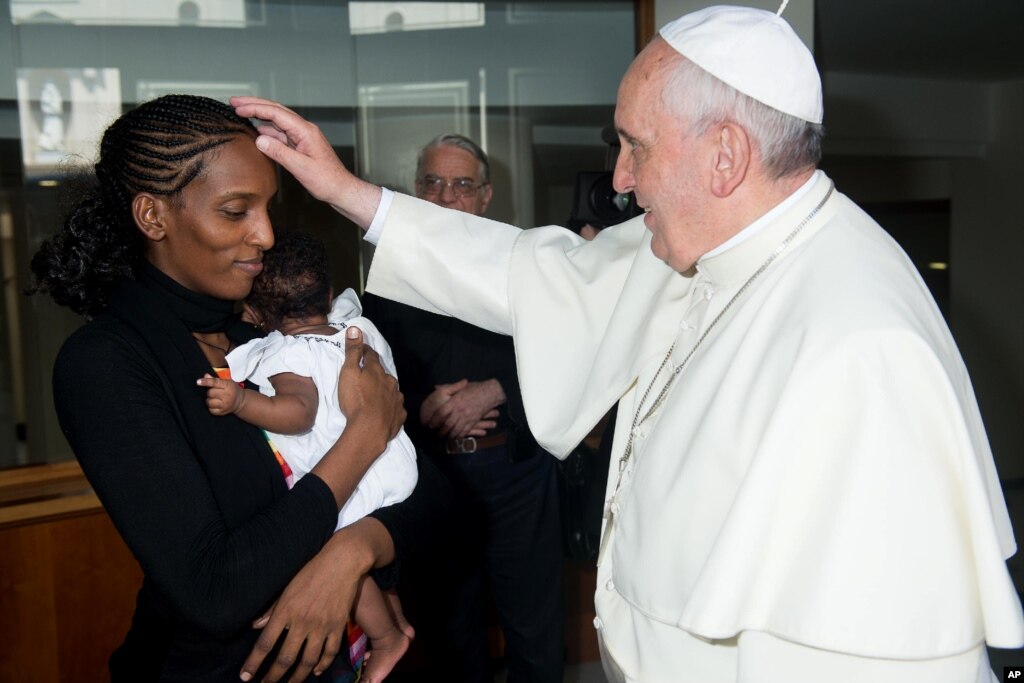
Earlier this week, Meriam, 27, her husband, Daniel Wani, and her two young children, Martin, 18 months old, and Maya, born two months ago in prison, met with Pope Francis in Rome

The Italian government and the Vatican negotiated to release her.

She came to Rome with her family July 24 in a government plane, their last stop before flying to the States, to settle in New Hampshire. Her husband is a U.S. citizen.

Ms. Ibrahim faced a death sentence in Sudan because she refused to renounce her Christian faith.

The Holy Father, who met with her and the family at the Vatican the day they arrived in Rome, praised the Sudanese woman for her “courageous witness to perseverance in the faith.”

At the same encounter, she and her family thanked the Holy Father for his support and for that of the Church, specifically for the prayers.

(August 01, 2014) © Innovative Media Inc.

.

Thursday, July 24, 2014

Christian Woman on Death Row Leaves Sudan, Meets Pope


In this photo provided by the Vatican newspaper L'Osservatore Romano, Pope Francis meets Meriam Ibrahim, from Sudan, with her daughter Maya in her arms, at the Vatican, July 24, 2014.


RELATED ARTICLES
Sudanese Woman Sentenced to Death for Apostasy Gives BirthSudan Denies Re-arresting Released Christian WomanSudan Frees Woman Sentenced to Death for Refusing to Give Up Christian Faith


VOA News

Last updated on: July 24, 2014 10:00 AM


A woman who received a death sentence in Sudan for refusing to recant her Christian faith flew into Rome on an Italian government plane on Thursday and hours later met the Pope.

Meriam Yahya Ibrahim walked off the aircraft cradling her baby and was greeted by Italian prime minister Matteo Renzi, saying it was a "day of celebration".


Italy’s vice minister for foreign affairs, Lapo Pistelli, left, greets Mariam Yahya Ibrahim and her family arriving from Sudan in Rome July 24, 2014.

Soon afterwards, Ibrahim, her husband and two children had a private meeting with Pope Francis in the Vatican.

"The Pope thanked her for her witness to faith,'' Vatican spokesman Father Federico Lombardi said.

The meeting, which lasted around half an hour, was intended as a "sign of closeness and solidarity for all those who suffer for their faith,'' he added.

What led to departure

There were no details on what led up to the 27-year-old's departure after a month in limbo in Khartoum, but a senior Sudanese official said it had been cleared by the government.

Italy joined with the United States in helping to free Ibrahim, and the country's vice minister of foreign affairs accompanied her on the flight from Khartoum.

In May, she received the death sentence on a conviction of apostasy. The conviction stemmed from a Sudanese law stating children of Muslim fathers are considered Muslim.

Ibrahim was born to a Christian mother and a Muslim father. She was brought up as a Christian after her father left the family.

Adultery charges

A court also sentenced Ibrahim to 100 lashes on charges of adultery for marrying Daniel Wani, who is a Christian. Under Sudanese law, marriage between Muslims and non-Muslims is not permitted.

In June, a Sudanese court overturned Ibrahim's conviction. She was released from prison but was detained by Sudanese authorities when her family tried to board a flight leaving the country. Officials questioned the authenticity of her travel documents.

The family then took refuge at the U.S. Embassy in Sudan. Ibrahim's husband, Wani, is a U.S. citizen.

Italian officials say the family plans to travel to the U.S. within a few days.

Some information for this report provided by Reuters


Source
.

Monday, May 19, 2014

Verdict not final for Sudanese sentenced to death for her Christianity, official says


By Faith Karimi and Yousuf Basil, CNN

updated 10:33 PM EDT, Sun May 18, 2014


Husband: All I can do is pray


STORY HIGHLIGHTS
Meriam Yehya Ibrahim considers herself Christian, but a court says she's Muslim
A Khartoum court convicted her of apostasy, or the renunciation of faith
The court also found her guilty of adultery for being married to a Christian


(CNN) -- As outrage grows over a Sudanese woman sentenced to death for refusing to renounce her Christianity, the government defended the verdict, but said it's only preliminary.

A Khartoum court last week convicted Meriam Yehya Ibrahim, 27, of apostasy, or the renunciation of faith.

Ibrahim, who is eight months pregnant, is a Christian, her husband said. But the court considers her a Muslim.

"I'm so frustrated. I don't know what to do," said her husband, Daniel Wani. "I'm just praying."

100 lashes

The court also convicted her of adultery and sentenced her to 100 lashes because her marriage to a Christian man is considered void under Sharia law.

Wani is American, Ibrahim's lawyer Mohamed Jar Elnabi told CNN.

The attorney said he'll file an appeal within a few days.

Sudanese parliament speaker Fatih Izz Al-Deen said the verdict is not final and is in the hands of the judiciary.

The verdict will go through all the judicial stages to reach the constitutional court, the speaker told Um Derman radio station. His comments were cited Friday by the official Sudanese News Agency.

Ibrahim says she was born to a Sudanese Muslim father and an Ethiopian Orthodox mother. Her father left when she was age 6, and she was raised by her mother as a Christian.

However, the lawyer representing Ibrahim's family said Sunday that the mother is a devout Muslim.

The court had warned Ibrahim to renounce her Christianity by Thursday, but she held firm to her beliefs.

But the parliament speaker said that claims she was raised as non-Muslim are untrue.

She is a Muslim raised in an Islamic environment and her brother, a Muslim, filed the complaint against her, according to Izz Al-Deen.

The complaint alleges she went missing for several years and her family was shocked to find out she married a Christian, according to her lawyer.

However, because her father was Muslim, the courts considered her one too, which would mean her marriage to a non-Muslim man is void.

Attempts to contact Sudan's justice minister and foreign affairs minister were unsuccessful.

Pregnant with toddler in prison

Ibrahim's husband is struggling to survive.

He uses a wheelchair and "totally depends on her for all details of his life," said Jar Elnabi, her lawyer.

In addition to her pregnancy, the couple's 20-month-old toddler is with her in prison, and he is getting regular ailments due to lack of hygiene and the presence of bugs, the lawyer said.

She's having a difficult pregnancy, and a request to send her to a private hospital was denied, the lawyer said.

There also is the question of the timing of a potential execution.

In past cases involving pregnant or nursing women, the Sudanese government waited until the mother weaned her child before executing any sentence, said Christian Solidarity Worldwide spokeswoman Kiri Kankhwende.

Worldwide condemnation

Rights groups and foreign embassies worldwide condemned the verdict.

"The fact that a woman could be sentenced to death for her religious choice, and to flogging for being married to a man of an allegedly different religion, is abhorrent and should never be even considered," said Manar Idriss, Amnesty International's Sudan researcher.

Katherine Perks with the African Centre for Justice and Peace Studies said the verdict goes against Sudan's "own constitution and commitments made under regional and international law."

Foreign embassies in Khartoum, including those of the United States, United Kingdom and Canada, urged the government to reverse course.

CNN's Catherine Shoichet, Christabelle Fombu, Mohammed Tawfeeq and Mohammed Osman contributed to this report.

Source
.

Tuesday, May 06, 2014

VICE News Daily: Beyond The Headlines - May, 6 2014


Published on May 6, 2014

The VICE News Capsule is a news roundup that looks beyond the headlines. Today: Nigerian Islamist group Boko Haram threatens to 'sell' more than 200 abducted schoolgirls, South Sudan's government and rebels fight for key territory despite plans for new peace talks, the U.S. Supreme Court passes up another chance to define the breadth of the Second Amendment right to gun bear arms, and hundreds of thousands march to urge the Brazilian government to better protect the LGBT community.

Subscribe to VICE News here: http://bit.ly/Subscribe-to-VICE-News

NIGERIA
Boko Haram Threatens to 'Sell' Kidnapped Schoolgirls
The Islamist group releases a video message offering a grim view of what's planned for the more than 200 girls.

SOUTH SUDAN
Government Recaptures Territory from Rebels
U.S. Secretary of State John Kerry is threatening sanctions and 'other consequences' if rebels don't agree to join peace talks.

U.S.A.
Supreme Court Refuses to Rule on Guns in Public
Court turns away a case dealing with New Jersey state restrictions on gun ownership.

BRAZIL
World's Biggest Gay Pride Parade Held in Sao Paulo
Activists urge legislation criminalizing discrimination against the LGBT community.

Check out the VICE News beta for more: http://vicenews.com

Follow VICE News here:
Facebook: https://www.facebook.com/vicenews
Twitter: https://twitter.com/vicenews
Tumblr: http://vicenews.tumblr.com/
.
.

Tuesday, January 07, 2014

Crises in Africa Continue


NewsFrom CNS, Staff and other sources
Ongoing violence in South Sudan and Central African Republic


Women and children stand near their destroyed house in a village in Bossangoa, Central African Republic


United Nations peacekeepers and officials struggled to contain two ongoing crises in Africa as the New Year began. As the world’s newest nation South Sudan sank deeper into a de facto civil war, peace talks to end the sudden conflict began in Ethiopia. Meanwhile in the neighboring Central African Republic tensions continued to simmer between majority Christians and minority Muslims.

In South Sudan, at least 1,000 people have died and 200,000 people have been displaced as a result of weeks of often intense fighting between political supporters of President Salva Kiir and South Sudan’s ousted vice president Riek Machar. The violence, which flared out of a political struggle between the two leaders within the Sudan People’s Liberation Movement, has ignited ethnic tensions between the supporters of both men. President Kiir is a member of the South Sudan’s Dinka tribe and Machar is a member of the Nuer tribe. President Kiir has declared a state of emergency for the areas that have fallen under rebel control, including the central city, Bor.

Both groups have sent delegations to Ethiopia for peace talks. The leading U.N. official in South Sudan, Hilde Johnson, urged leaders to bring the situation “back from the brink.”

As the violence in South Sudan escalates and tens of thousands of civilians take refuge in U.N. compounds around the country, children are in grave danger, according to a report from UNICEF. “An estimated 81,000 civilians have fled their homes, the majority of them women and children, but we believe that with the situation changing so rapidly the actual numbers are likely to be higher,” UNICEF’s Representative in South Sudan, Iyorlumun Uhaa, said.

“We are especially worried about those in and around Bor, in Jonglei State, where the fighting has recently been heaviest. There are desperate shortages of food and clean water at the U.N. compound there and the lack of sanitation facilities poses a high risk of disease. Children, always among the most vulnerable in conflict, are spending their days without shelter in the intense heat and sun and sleeping in the open during the cold nights,” he said.

Although the intense fighting is making it difficult to reach civilians sheltering in the U.N. compound in Bor, aid is being delivered to the two U.N. compounds in Juba, where an estimated 20,000 people have taken refuge.

The United Nations was also busy attempting to restore the peace in the Central African Republic. Despite the intervention of French and African troops, the situation in the Central African Republic, remains precarious. "The Central African Republic remains on the verge of a war with religious aspects" warned Mgr. Dieudonné Nzapalainga, Archbishop of Bangui, and Omar Kobine Layama, Imam of the Central African capital, in a joint appeal.

"Nearly half the population desperately need aid, and about 40,000 people have taken refuge at Bangui airport where they are living without shelter or toilet facilities," report the two religious leaders said. They called on the United Nations to deploy a peacekeeping force "with the utmost urgency.”

Persistent violence in C.A.R. between Christian militias and the mainly Muslim Seleka rebel group that overthrew President François Bozizé in March has forced one-fifth of the population to flee their homes. According to the most recent U.N. estimates, the number of internally displaced people in Bangui alone has risen to some 513,000 people—half the capital city’s residents—since Dec. 5. U.N. sources say the security situation remains tense with serious risks of deterioration in and outside Bangui and serious consequences for humanitarian assessments and response. Armed groups continue to launch targeted attacks, including against international security forces.

UNICEF reports that in the ongoing violence that has gripped Bangui attacks against children have sunk to a vicious new low, with at least two children beheaded, and one of them mutilated. “We are witnessing unprecedented levels of violence against children. More and more children are being recruited into armed groups, and they are also being directly targeted in atrocious revenge attacks,” said Souleymane Diabate, UNICEF Representative in C.A.R.

UNICEF and partners have verified the killings of at least 16 children and injuries among 60. Diabate said that armed elements were accountable for taking specific measures to provide this crucial protection to children. These included: Clear directives by those in positions of authority within armed forces and groups to halt grave violations against children, including that children not be recruited into the fighting, nor targeted; the immediate release of children associated with armed forces and groups and their protection from reprisals; transit centers set up for the release and reintegration of children must also be protected from attacks; prohibiting attacks against health and education personnel, and the use of civilian spaces such as schools and hospitals for military purposes; allowing safe, unhindered passage of impartial humanitarian assistance.

"The situation is very chaotic and worsening all the time," said Msgr. Cyriaque Gbate Doumalo, secretary-general of the Catholic bishops' conference. "All our churches and parishes are inundated with displaced people… Whole districts of Bangui are deserted, while even those in the relative safety of Catholic centers are living in total fear," he said.

Msgr. Doumalo said that 12,000 more displaced civilians had sought refuge in Bangui's major seminary, while the bishops' conference secretariat was sheltering 600 people, half of them children. He said many children had been abandoned when their parents were killed or fled and were now without food and clothing and "at the mercy of armed groups."

Bishop Nestor-Desire Nongo Aziagbia of Bossangoa urged the deployment of more U.N. forces. "We need a bigger peacekeeping mission here; the present force is plainly unable to cope or play an effective role," the bishop said. "Without this, things are certain to get difficult. Unless the huge quantities of guns now in popular circulation are collected, people will continue killing each other."


Source
.

Friday, October 21, 2011

Jesuit Discusses New Responsibilities of South Sudan

In August, Jesuit Father David Hollenbach, conducted a workshop for leaders of the Catholic community of South Sudan in the national capital of Juba and addressed South Sudan’s Parliament on the role of moral values in shaping the institutions of the world newest country. In his article for America Magazine about the experience, Fr. Hollenbach reflected on the sizable Catholic population in South Sudan, and as the civil war lasted for such a long time, it weakened the social life with the Church left as one of the few functioning bodies in their society.

“The Catholic community in South Sudan especially shares the responsibility to help shape the life of the new country. Because of this important role, Catholic Relief Services and an association of women’s and men’s religious orders named Solidarity with South Sudan invited me to conduct a week-long workshop in August for church leaders. I was asked to speak about how the Catholic understanding of social justice and peace could contribute to the development of the new country. It was a humbling privilege. What follows sketches some of the suggestions I made, moving from the foundational principle of Catholic social thought to several more practical recommendations…”

1. The protection of the human dignity of every person, which requires active participation in the life of society, is the core responsibility in all social interactions, and protection of the most basic requirements of human dignity is the particular responsibility of the new government of South Sudan.

2. The people of South Sudan should be helped to become active citizens through civic education that teaches them how to work together for the common good of all.

3. Citizens should hold government officials accountable for using the power bestowed on them to serve the common good of all, and the capacity of citizens to hold officials accountable should be strengthened.

4. Every person is to be treated with reverence and respect, independent of ethnicity, race, or religion; tribalism is a serious threat to attaining the justice and peace that independence promises and must be resisted.

5. National unity depends on justice in the distribution of land.

6. National unity depends on justice in the distribution of the proceeds from the extraction of natural resources such as oil.

Click below to listen to an interview with Fr. Hollenbach on Radio Bakhita, the leading FM station in Juba, South Sudan.


Source