Showing posts with label Disruptions. Show all posts

Thursday, October 08, 2026

They Trained to Protect Immigrants From ICE. Now They’re Prepping to Defend the Midterm Elections.

ICE-watchers-turned-poll-watchers are preparing for the worst, as the Trump administration hints at potential strategies to disrupt the midterm elections.


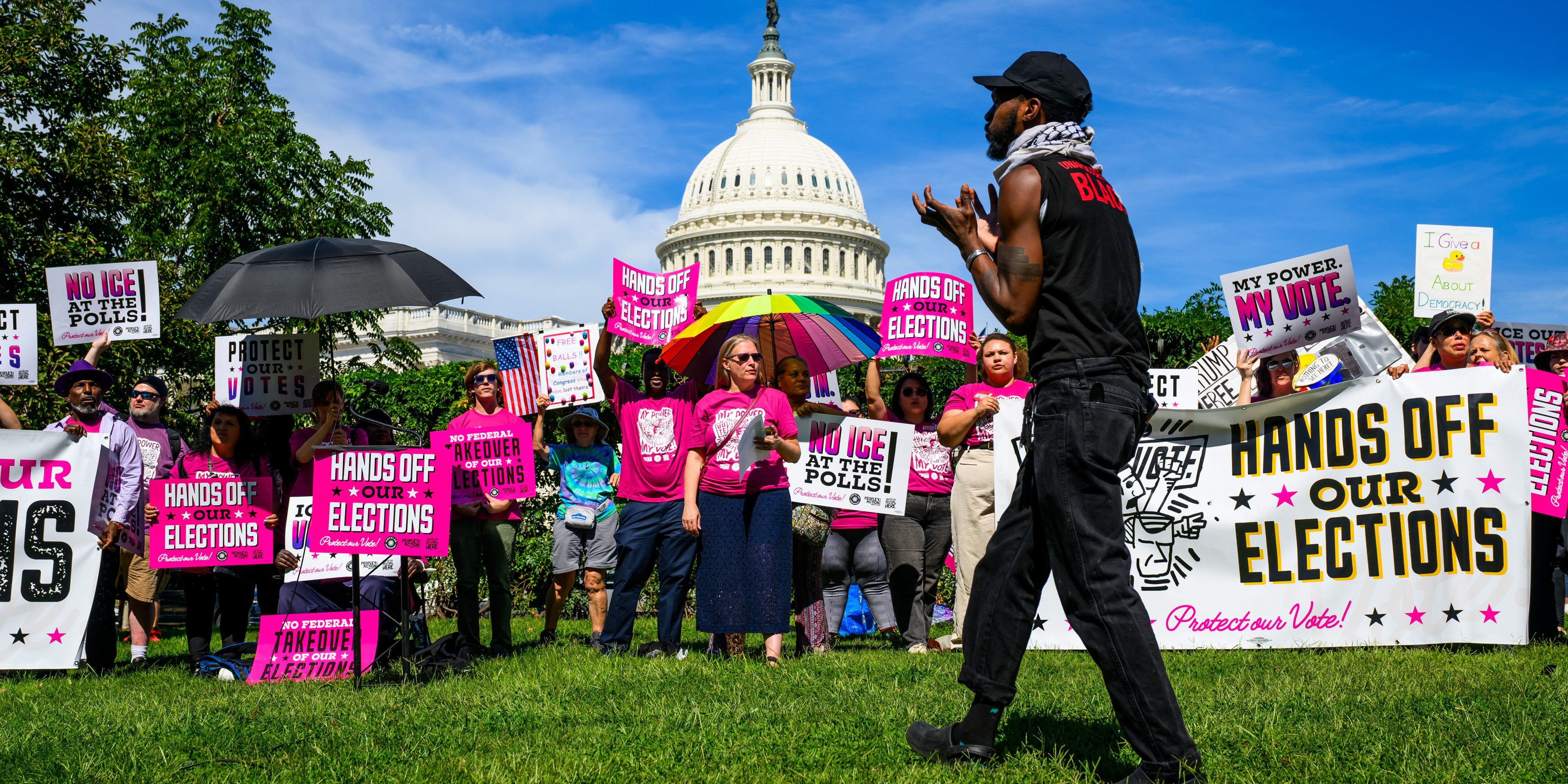
Demonstrators at a voting rights rally outside the Capitol in Washington on Sept. 15, 2026, a day after the Supreme Court rejected implementing the Trump administration’s new restrictions on mail-in voting. Photo: Pete Kiehart/Bloomberg via Getty Images


Jessica Washington

September 22 2026, 12:00 p.m. ET


ICE watchers across the country who watched federal agents shoot people in the streets and fought to drive ICE from their cities are turning their new skills against the next authoritarian threat from the Trump administration: election interference.

Volunteers who showed up a few months ago asking, “Where do I buy a whistle?” are now trained and committed members of an “ICE Watch” movement, said Zach Mueller, whose anti-authoritarian group States at the Core started hosting trainings earlier this year. “They’re not in the normal cast of characters that have been showing up to rallies over the last several decades,” said Mueller. Now, they’re planning to fan out to their local polling places and defend their neighbors’ rights to vote.

The ICE-watchers-turned-poll-watchers are preparing for the worst despite a temporary win the voting rights movement secured last week, when the Supreme Court upheld a decision to block a Trump administration rule that would have let the U.S. Postal Service refuse to deliver ballots from states that don’t share their voter rolls with the federal government, among other new constraints, which advocates warned would lead to chaos and uncounted votes. While that plan was foiled for the midterms, other electoral threats abound.


“There are 100 different scenarios that you can run through,” said Ezra Levin, co-founder of Indivisible. “Could be ICE at the polls, could be Trump getting every Republican to swear to sabotage the results … Could be something after the fact, seizing ballot boxes or refusing to acknowledge the results. Who knows?”

Tuesday, May 05, 2026

DISRUPTION


Volume 45 Issue Five May 2026

Last Trumpet Ministries ∙ PO Box 806 ∙ Beaver Dam, WI 53916

Phone: 920-887-2626 Internet: http://www.lasttrumpetministries.org

“For if the trumpet give an uncertain sound, who shall prepare himself to the battle?” I Cor. 14:8


“In thee, O LORD, do I put my trust: let me never be put to confusion.” - Psalm 71:1

As we enter May 2026, the United States is still at war with Iran. The events surrounding this conflict have taken many twists and turns in recent weeks. Although the fighting itself has quieted, there remains great uncertainty about when, or if, it might resume. Nevertheless, the consequences of this war are being felt around the world and threaten to disrupt everyday life in unprecedented ways. In this edition of the Last Trumpet, we will look back at these recent events and consider their potential implications for the future.

A Close Call

As April began, the coalition between the United States and Israel was heavily involved in combat operations against Iran. From the start of the war, coalition forces have mostly imposed their will over Iranian territory without significant resistance. However, on April 3, 2026, an American F-15E fighter jet was shot down over Iranian territory. The two crew members onboard were forced to eject from the plane, leading to the dire possibility of American soldiers falling into the hands of the Iranian regime. For the first time since the war began, American forces would set foot on Iranian soil to conduct two daring rescue missions in a high-stakes race against time. (1)

The pilot was located and found within hours, but the whereabouts of the weapons systems officer remained a mystery. (2) To pinpoint his location, the U.S. military enlisted the help of the Central Intelligence Agency (CIA). The CIA used its secret technology to locate the missing soldier who had been stuck behind enemy lines for more than 24 hours. “This was the ultimate needle in a haystack, but in this case it was a brave American soul inside a mountain crevice, invisible but for CIA’s capabilities,” an unnamed U.S. official told Axios. (3)

The search was conducted with great urgency. Not only were the Americans looking for the soldier, but so too were the Iranians. “This brave warrior was behind enemy lines in the treacherous mountains of Iran, being hunted down by our enemies, who were getting closer and closer by the hour,” wrote American President Donald Trump. (4)

In an effort to find the American soldier before he could be rescued, Iran’s Islamic Revolutionary Guard Corps offered a reward of about $66,000 to any Iranian citizen who could locate him. (5) This is a tremendous amount of money for an Iranian citizen, and many were no doubt highly motivated to find the missing airman.

With the soldier safely recovered, Trump recounted some of the details of the rescue mission to Axios. He explained that the military aircraft had been hit by a shoulder-fired missile. “They got lucky,” Trump admitted. He then explained that American officials were worried at first that the soldier had already been captured by the Iranians because of an unusual final radio message. “God is good,” the airman said as he ejected from the aircraft. “What he said on the radio sounded like something a Muslim would say,” Trump opined. However, those who knew the soldier told officials the man was religious, and so they moved forward with a rescue mission involving two hundred soldiers. (6) Had Iran been successful in its endeavors to locate the airman, it could have changed the trajectory of the war. Capturing the soldier would have given the regime leverage in negotiations and could have easily resulted in the American being imprisoned, tortured, or killed. Thankfully, he was rescued before Iran got their hands on him. God is good, indeed.

Sunday, March 01, 2026

YouTube I Experiencing Service Issues


YouTube is currently experiencing intermittent service disruptions, causing videos not to load, playback errors, and accessibility issues for some users.

Current Issues
Many users are reporting problems with videos not loading, error messages like "This content isn't available," and difficulties accessing the platform on both web browsers and apps. Some users have noted that the issues are browser-specific, with videos sometimes working in incognito mode or on alternative browsers like Firefox. Others report problems with uploading videos, frozen view counts, and slow or interrupted playback.

Downdetector+3

Scope of the Outage
The disruptions appear to be intermittent and geographically widespread, affecting multiple regions worldwide. Real-time outage maps show clusters of reports in major cities, indicating that the problem is not limited to a single location. Users may experience delays, intermittent service interruptions, or complete inability to access content during this period.

Is The Service Down?+1

Possible Causes
While YouTube has not officially confirmed the cause, the issues could be related to server-side problems, platform updates, or temporary technical glitches. Some users have found that disabling ad blockers or switching browsers temporarily resolves playback issues.

Downdetector+1

What You Can DoTry a different browser or device to see if the issue persists.
Clear your browser cache and cookies to resolve loading errors.
Check your internet connection or switch networks if videos buffer slowly.
Log out and back into your Google account if you encounter login or upload issues.
Monitor real-time outage maps on sites like Downdetector or StatusGator for updates.

2

YouTube is actively being monitored for these disruptions, and updates are expected as the platform works to resolve the issues. Users are advised to be patient and try temporary workarounds until the service stabilizes.


Friday, February 06, 2026

The left’s path to permanent power


Minnesota shows the progressive formula in action and what happens when it is challenged

Politics
by Joe Rigney
Post Date:
February 3, 2026


Activists hand out flyers to motorists at a blockade set up to deter ICE vehicles in Minneapolis on Sunday.Associated Press / Photo by Alex Brandon


What is going on in Minnesota? Why has the state whose unofficial slogan is “Minnesota Nice” erupted (again) into a frenzy of protests, demonstrations, and violent clashes with law enforcement? In the midst of the chaos, it’s important for Christians to keep their eye on the ball.

Begin with the left’s unconstrained vision of society. As Thomas Sowell famously argued, the left is utopian; they believe that human beings are perfectible through the idealized use of power by anointed elites, whose good intentions more than compensate for any destruction that their policies actually cause. From progressivism to socialism to communism, the left is united by this “vision of the anointed,” and they are willing to unleash revolutionary zeal in order to accomplish it. The chaos of 2020—from COVID tyranny to the George Floyd riots—was rooted in this revolutionary vision of utopian justice.

This vision is fundamentally godless and inhuman (even when baptized by the platitudes of progressive Christians). From abortion-on-demand to the celebration of sexual deviancy, from soft-on-crime policies to wealth redistribution, the left is at war with Nature and Nature’s God, treating His moral boundaries as shackles to their unbridled passions. And thankfully, most Americans recoil from it when they actually encounter it, as evidenced by the mass exodus from blue states in recent years.

In the face of resistance to progressive governance, the left has settled on a three-pronged path to permanent political power.

Tuesday, October 07, 2025

Thousands of Passengers Grounded in Seattle, Pittsburgh, Orlando, Boston, and Minneapolis...


Thousands of Passengers Grounded in Seattle, Pittsburgh, Orlando, Boston, and Minneapolis as US Faces New Travel Disruptions with 70 Flights Canceled and 5000 Delays Affecting Delta, Cape Air, United, Breeze, American Airlines and More

Published on October 6, 2025


US faces 70 flight cancellations and 5,000 delays due to operational issues, grounding passengers in Seattle, Pittsburgh, Orlando, Boston, and Minneapolis, with disruptions impacting Delta, Cape Air, United, Breeze, and American Airlines. These widespread travel issues were primarily caused by operational challenges, weather conditions, and other unexpected factors, leading to significant inconvenience for travelers. Passengers were left stranded or forced to rearrange their travel plans as both domestic and international flights faced extensive delays. Major hubs such as Seattle, Boston, and Minneapolis saw a large number of affected travelers, highlighting the ongoing challenges in the air travel sector.

Cancellation By Airline

The United States saw a total of 5,018 flight delays and 70 cancellations, impacting both domestic and international flights. These disruptions caused significant inconvenience for travelers across various airports. Airlines and passengers faced challenges due to operational issues, weather conditions, or other factors. Travelers are advised to stay updated with their airlines for real-time information and alternative arrangements to minimize further disruption.

Monday, August 25, 2025

Gorsuch and Kavanaugh warn lower court judges in Trump cases

By
John Fritze
Updated 11 hr ago


Neil Gorsuch and Brett Kavanaugh during the ...

In Donald Trump’s long-running feud with federal judges, the president has found some support in an unlikely place: the nation’s highest court.

A growing sense of frustration with some lower courts — articulated in terms that at times sound similar to Trump’s own rhetoric — has crept into a series of opinions this summer from the Supreme Court’s conservative justices as they juggle a flood of emergency cases dealing with Trump’s second term.

“Lower court judges may sometimes disagree with this court’s decisions, but they are never free to defy them,” Justice Neil Gorsuch admonished in an opinion last week tied to the court’s decision to allow Trump to cancel nearly $800 million in research grants.

The rebuke, which was joined by Justice Brett Kavanaugh, flipped the narrative that it is Trump who has pushed legal boundaries with his flurry of executive orders and support for impeaching judges who rule against him. A wave of legal conservatives took to social media to tout Gorsuch’s warning.

“This is now the third time in a matter of weeks this court has had to intercede in a case ‘squarely controlled’ by one of its precedents,” wrote Gorsuch, who was Trump’s first nominee to the high court. (Kavanaugh was Trump’s second.) “When this court issues a decision, it constitutes a precedent that commands respect in lower courts.”

Other conservatives have been just as harsh this year. Justice Samuel Alito in March accused a federal judge in another case involving a Trump policy as committing an “act of judicial hubris” and “self-aggrandizement of its jurisdiction.”

The Supreme Court has been consistently siding with Trump on the emergency docket for months, including in high-profile cases dealing with immigration, spending and the leadership of independent agencies. And Trump has won even in cases in which there are serious arguments that his administration defied a lower court, said Steve Vladeck, CNN Supreme Court analyst and professor at Georgetown University Law Center.

Wednesday, May 01, 2013

A handful of arrests as May Day protesters return to downtown


May 1, 2013 at 10:26 AM

Posted by Mike Carter


Flash bangs explode in a crowd near 5th and Olive at about 8:15 in downtown Seattle. (Photo by Bettina Hansen / The Seattle Times)

UPDATE AT 8:22 P.M.: Capt. Chris Fowler, the incident commander, said police are deploying pepper spray canisters to disperse the crowd.

“It’s a safety issue,” Fowler said.

Crowd continues to head east on Olive, toward Capitol Hill.

UPDATE AT 8:12 P.M.: Police are now herding protesters east on Olive Way. Police using flash-bangs to move the crowd. Objects, including a skateboard, are being thrown at police.

Police continue to use pepper spray to clear the crowd.


Flash bangs between police and protestors go off at 5th and Olive around 8:00. (Photo by Bettina Hansen / The Seattle Times)

UPDATE AT 8:06 P.M.: Seattle police say they plan to give the official order to clear the streets. Things could reach a head soon.

UPDATE AT 7:59 P.M. Police are making more arrests at Olive, between Fourth and Fifth. Police are also using pepper spray for the first time.

UPDATE AT 7:54 P.M.: The two men taken into custody were apparently assaulting a TV cameraman, police say. One was reportedly on a pogo stick (the protester, not the cameraman).

UPDATE AT 7:48 P.M.: Seattle police are making a couple of arrests at Fourth and Pine.


Police work to divert a crowd of protesters around 7:45 in Westlake Park in downtown Seattle. (Photo by Bettina Hansen / The Seattle Times)

UPDATE AT 7:35 P.M.: The crowd has come full circle. They’re now at Westlake Park, where the “festivities” began this morning.

Still no arrests.

UPDATE AT 7:28 P.M.: Police say some are throwing metal pipes and other objects at windows.


Police create a barrier with their bicycles as protesters deploy smoke and march downtown near Sixth Ave. and Pike St. downtown. (Photo by Bettina Hansen / The Seattle Times)

UPDATE AT 7:25 P.M.: Group now at Sixth and Pike and Niketown, epicenter of last year’s violence when self-proclaimed anarchists — some wearing Nikes — broke windows. Heavy police presence there today.

Someone set off a flare.

UPDATE AT 7:20 P.M.: Crowd heading west on Pike over the freeway.

Police say the broken window was at Sun Liquor. A police source says demonstrators may have taken bottles.


Protesters head West on Pike Street. (Photo by Bettina Hansen / The Seattle Times)


A sizable contingent of police follow demonstrators on bike. (Photo by Dean Rutz / the Seattle Times)

UPDATE AT 7:12 P.M.: Even the superheroes got hosed with Silly String. Oh, the humanity.

Crowd continues to march toward downtown, although the marchers don’t seem to know where they’re going.

A window was reportedly broken at East Pike and Belmont. Still no word of arrests.

UPDATE AT 7:01 P.M.: The group has now stopped at Pine and Broadway. Heavy police presence.

Many in the crowd are unhappy with the media. A KING-TV reporter was doused with Silly String.

UPDATE AT 6:56 P.M: Marchers have left SCCC and are heading west along East Pine toward Broadway, possibly in a route that will take them downtown. Police say some in the crowd appear to be lighting flares or some type of smoke devices.

Someone set off firecrackers.

Thus far, no arrests.

UPDATE AT 5:33 P.M.: The rally at the federal building is breaking up and many people are making their way up Capitol Hill for what’s labeled an “anti-capitalist” rally and march.

It’s set to begin at 6 p.m. at Seattle Central Community College.The route of that march is unclear as organizers did not obtain a permit from the city, according to Seattle police. It was during last year’s anti-capitalist march that dozens of protesters wielding sticks, hammers and rocks went on a noontime rampage.

A large group of Seattle police bicycle officers were seen heading up to Seattle Central CC a short time ago.

Seattle police say there have been no arrests.


Thousands of demonstrators rally at the federal building in downtown Seattle for the 13th Annual May Day March for Workers and Immigrant Rights. (Photo by Steve Ringman / The Seattle Times)

UPDATE AT 4:58 P.M.: Marchers are beginning to arrive at the federal building in downtown Seattle. The march is several blocks long so it will take some time for all to reach their destination.

Things are still peaceful, although some members of the crowd — generally people with bandannas over their faces — are taunting some police. The officers are not reacting.

No arrests.

The highlight of the march was covered by this SPD Tweet: “Brief disturbance earlier at 5th & Jackson between superheroes & clowns. Everything’s under control.”


Police line S King St. as the 13th Annual May Day March for Workers and Immigrant Rights passes at about 3:45 Wednesday afternoon. (Photo by Steve Ringman / The Seattle Times)

UPDATE AT 3:25 P.M.: In what may be the first sign of potential trouble, Seattle police say they have recovered rocks and bricks possibly placed in advance of today’s May Day events. Police say the objects were recovered in the East and West precincts.

Meanwhile, police are lining the route as marchers may their way to downtown. Still peaceful.


Read rome

.
.

Monday, April 30, 2012

Occupy Wall Street Plans Global Disruption of 'Status Quo'

Monday, 30 Apr 2012 11:07 AM

Occupy Wall Street demonstrators, whose anti-greed message spread worldwide during an eight-week encampment in Lower Manhattan last year, plan marches across the globe Tuesday calling attention to what they say are abuses of power and wealth.

Organizers say they hope the coordinated events will mark a spring resurgence of the movement after a quiet winter. Calls for a general strike with no work, no school, no banking and no shopping have sprung up on websites in Toronto, Barcelona, London, Kuala Lumpur and Sydney, among hundreds of cities in North America, Europe and Asia.

In New York, Occupy Wall Street will join scores of labor organizations observing May 1, traditionally recognized as International Workers’ Day. They plan marches from Union Square to Lower Manhattan and a “pop-up occupation” of Bryant Park on Sixth Avenue, across the street from Bank of America’s Corp.’s 55-story tower.

“We call upon people to refrain from shopping, walk out of class, take the day off of work and other creative forms of resistance disrupting the status quo,” organizers said in an April 26 e-mail.

Occupy groups across the U.S. have protested economic disparity, decrying high foreclosure and unemployment rates that hurt average Americans while bankers and financial executives received bonuses and taxpayer-funded bailouts. In the past six months, similar groups, using social media and other tools, have sprung up in Europe, Asia and Latin America.

Pooling Resources

The Occupy movement in New York has relied on demonstrations and marches around the city since Nov. 15, when police ousted hundreds of protesters from their headquarters in Zuccotti Park near Wall Street, where they had camped since Sept. 17.

Banks have pooled resources and cooperated to gather intelligence after learning of plans to picket 99 institutions and companies, followed by what organizers have described as an 8 p.m. “radical after-party” in an undetermined Financial District location.

“If the banks anticipate outrage from everyday citizens, it’s revealing of their own guilt,” said Shane Patrick, a member of the Occupy Wall Street press team. “If they hadn’t been participating in maneuvers that sent the economy into the ditch, we wouldn’t even be having this conversation.”

Police Prepared

New York police can handle picketers, according to Paul Browne, the department’s chief spokesman.

“We’re experienced at accommodating lawful protests and responding appropriately to anyone who engages in unlawful activity, and we’re prepared to do both,” he said in an interview.

About 2,100 Occupy Wall Street protesters in New York have been arrested since the demonstrations began, said Bill Dobbs, a member of the group’s media-relations team.

Organizers describe the May Day events as a coming together of the Occupy movement, with activists also calling for more open immigration laws, expanded labor rights and cheaper financing for higher education. Financial institutions remain a primary target of the protests.

“Four years after the financial crisis, not a single of the too-big-to-fail banks is smaller; in fact, they all continue to grow in size and risk,” the group’s press office said in an April 26 e-mail.

Planning Since January

Five banks — JPMorgan Chase & Co., Bank of America, Citigroup Inc., Wells Fargo & Co., and Goldman Sachs Group Inc. — together held $8.5 trillion in assets at the end of 2011, equal to 56 percent of the U.S. economy, compared with 43 percent in 2006, according to central bankers at the Federal Reserve.

Occupy Wall Street began planning for May Day in January, meeting in churches and union halls with a decision-making system that avoids a single leader. Instead, participants rely on group “break-out” sessions in which clusters discuss such tasks as crowd-building, logistics and communications.

About 150 attended an April 25 meeting at the Greenwich Village headquarters of the Amalgamated Clothing & Textile Workers Union, making last-minute preparations for how to deploy legal and medical help; site selection for picketing; purchasing, production and distribution of protest signs; and how to talk to reporters.

The meeting convened inside the union hall basement, where attendees arranged chairs in a circle as three facilitators asked each of the assembled to identify themselves by first name and gender — he, she or they. Most appeared under age 30, though gray-haired baby boomers also participated. One of the older attendees pulled a ski mask over his head to protest the presence of a photographer from Tokyo.

Raging Musicians

Tuesday, beginning at 8 a.m. in Bryant Park, scheduled events include teach-ins, art performances and a staging area for “direct action and civil disobedience,” such as bank blockades.

Tom Morello, of the Grammy Award-winning rock band Rage Against the Machine, along with 1,000 other guitar-playing musicians will accompany a march to Union Square at 2 p.m., according to the maydaynyc.org website. That will be followed by a “unity rally” at Union Square at 4 p.m.; a march from there to Wall Street at 5:30 p.m.; and a walk to a staging area for “evening actions,” which organizers at the April 25 meeting said would be the so-called after-party.

Golden Gate Bridge

Occupy-related events are planned in 115 cities throughout the U.S., from college towns such as Amherst, Massachusetts, and Ann Arbor, Michigan, to Los Angeles, Houston, Chicago and Philadelphia.

In San Francisco, demonstrators intend to hold a rally at the toll plaza of the Golden Gate Bridge from 7 a.m. to 10 a.m. local time that “will result in the shutdown,” according to their website.

Across the bay in Oakland, protesters said they intend morning marches on banks and the Chamber of Commerce, followed by an afternoon rally and a march downtown.

“We’re looking forward to vigorously asserting our constitutional right to protest and giving a loud outcry about Wall Street and greed,” Dobbs said. “We’re hoping this will make a splash. We hope it will bring a lot of more people into the Occupy movement.”


.
Friday, November 18, 2011

Pentagon seeks flexibility in case of ‘doomsday’

For weeks, Defense Secretary Leon Panetta has been urging the supercommittee to do what it takes to avoid the threat of sequestration and spare the Pentagon from further cuts.

But what if the panel fails?

Sequestration, which Panetta has described as a “doomsday” mechanism, would mean across-the-board cuts beginning in fiscal 2013 under existing statute. But even if it comes to that — and there’s plenty of reason to think it won’t — the Pentagon wants some flexibility in applying the roughly $500 billion in further cuts over the next 10 years.

“If Congress agrees by vote, we would have the flexibility to apply sequester cuts as the administration recommends,” Panetta wrote recently in a fact sheet sent to the chairman of the Senate Armed Services Committee, Sen. Carl Levin (D-Mich.), and the panel”s ranking Republican, Sen. John McCain (R-Ariz.).

“Even with flexibility,” Panetta was quick to add, “cuts of this magnitude would be highly disruptive.”

Republicans have made clear that they will seek to protect the Defense Department from cuts if sequestration fails. Among other efforts, McCain and Sen. Lindsey Graham (S.C.) have drafted a bill that would try to offset some of the reductions by cutting congressional pay and imposing 5 percent across-the-board cuts to other federal spending.

In his fact sheet, Panetta said that for fiscal 2013, when the cuts would take effect, the reductions would delay production and raise the procurement costs for the F-35 Joint Strike Fighter, the Army’s new ground combat vehicle and Navy ships and aircraft. In addition, civilian employees would have to be furloughed for a month or more and training by all services would be curtailed.

While funds that pay for overseas military operations in Afghanistan, Iraq and elsewhere are not affected by sequestration, Panetta said the disruptions caused in the core Pentagon budget by late approval of contracts and perhaps payrolls “would have adverse effect on our ability to support the Afghan war.”

By | 04:19 PM ET, 11/17/2011


Source

Thursday, November 17, 2011

Protesters Clash With Police in Lower Manhattan

James Estrin/The New York Times
A group of Occupy Wall Street supporters took a subway to an evening rally in Foley Square. More Photos »
By CARA BUCKLEY
Published: November 17, 2011

Nearly a thousand protesters took to the streets of Lower Manhattan on Thursday, clashing with the police and tossing aside metal barricades to converge again on Zuccotti Park after failing in an attempt to shut down the New York Stock Exchange.

Organized weeks ago, the so-called day of action came two days after the police cleared the Occupy Wall Street encampment from Zuccotti Park in an early-morning raid. Removed from the park that had become their de facto headquarters, protesters looked to Thursday — two months to the day after the demonstrations began — to gauge the support and mettle that the movement still retained.

“We failed to close the stock exchange, but we took back our park,” said Adam Farooqui, 25, of Queens. “That was a real victory.”

By Thursday afternoon, about 175 people had been arrested, many after rough confrontations with the police.

After staging protests near the stock exchange, protesters returned to Zuccotti Park, which had been surrounded by police barricades, with one or two entrances monitored by police officers, as well as by private security officers working for Brookfield Properties, the park’s owner.

But protesters tossed aside the barricades and rushed in as officers tried to keep them out, with some officers shoving demonstrators and throwing punches.

On Thursday afternoon, the police led a man with a bloodied face from the park. Onlookers said the man had flicked the hat off a police officer’s head and rushed into the crowd. He was later apprehended by the police, and, according to a witness, Jo Robin, 29, from New Orleans, he was beaten.

The police said the hand of an officer was badly cut by a shard of glass wielded by a protester near Zuccotti Park. The police said that the injured officer would probably require 20 stitches and that the officer’s attacker was in custody.

Four other officers were being evaluated at a hospital for possible injuries after an acidic liquid of some sort was thrown at them.

At a Midtown gathering of business leaders on Thursday, Mayor Michael R. Bloomberg indicated that he empathized with the demonstrators’ grievances, saying the protests were a dire sign of the public’s economic fears.

“The public is getting scared,” he said. “They don’t know what to do, and they’re going to strike out. They just know the system isn’t working, and they don’t want to wait around.”

The mayor later visited Bellevue Hospital Center, along with the police commissioner, Raymond W. Kelly, to visit officers wounded in the clashes.

Protesters began gathering at 7 a.m. on lower Broadway across from Zuccotti Park. By 7:30, the crowd had swelled to hundreds, and protesters walked south on Broadway toward Wall Street, only to be quickly met by metal barricades and thick cordons of police.

Over the next three hours, the protesters wound their way through the heart of the financial district, breaking off into groups, and were repeatedly met by the police. At one point, the protesters engulfed police vehicles, forcing them to halt, and broke police lines, only to be pushed back by metal barricades and swinging batons.

The morning was marked by increasingly tense standoffs. Shortly before 10 a.m., a large group of people dancing and chanting at the corner of Broad Street and Beaver Street was rushed by the police, who began throwing people to the ground.

Though some traders appeared to have a hard time getting to work, the stock exchange opened for trading as usual at 9:30 a.m.

Protesters planned to demonstrate later on Thursday at subway stations throughout the city, and to reconvene in Foley Square in Manhattan — where protesters expect to meet up with representatives from a dozen unions — and march across Lower Manhattan bridges.

Reporting was contributed by Matt Flegenheimer, Rob Harris, Colin Moynihan, Kate Taylor


Arrests Made As OWS Protesters Take Part In "Day Of Action"

UPDATED 1:39 PM

Arrests Made As OWS Protesters Take Part In "Day Of Action"

By: NY1 News

More than 100 people have been arrested as Occupy Wall Street protesters take part in what's being called a "Day of Action" today, featuring rallies and marches throughout the city to mark two months since the start of the movement.

Several hundred protesters made their way from Zuccotti Park to the New York Stock Exchange before the 9:30 a.m. opening bell.

Barricades were set up by the New York City Police Department to control the crowds, and only people with stock exchange ID's were being let past a certain point.

Arrests Made As OWS Protesters Take Part In "Day Of Action"

Police say four officers were taken to an area hospital after demonstrators threw an unknown liquid at them.

The injuries are not said to be serious.

At one point the protesters' presence wreaked havoc on many living in and around Wall Street as well as those trying to get to work.

"I think they need to take into consideration those that were supporting them as well. I think they're just being really selfish right now," said one Wall Street worker.

Protesters though say they are still working to get their message out.

"I'm concerned about Wall Street bankers ruining our country, ruining our economy, buying off our politicians," said one protester.

"I don't care about their crying that they can't get to work and steal more," said another.

Later today, a student protest is planned in Union Square at 2 p.m. followed by an occupation of the city's subway system at 3 p.m.

Demonstrators say they're planning to meet at 16 subway stops and transportation hubs in each of the boroughs, sharing stories with straphangers.

At 5 p.m., protesters will gather along with several labor unions at Foley Square for a rally to demand jobs.

The city says it is preparing for a huge number of protestors, perhaps in the tens of thousands.

From there, the group is expected to march to the Brooklyn Bridge.

Meantime, one demonstrator is awaiting arraignment on charges of making a terrorist threat after posting a video threatening to attack Macy's in Herald Square.

Police say Nkrumah Tinsely, 29, was arrested Wednesday at Zuccotti Park after a video was posted online in which he said, “In a few days, you're gonna see what a Molotov cocktail does to Macy's."

Tinsley also said he was going to, "burn down the city."

Police say it wasn't clear if the Bronx man had the ability to make a bomb.

Tinsley was also arrested last month for allegedly assaulting a police officer during an Occupy Wall Street protest.

"Day of Action" Schedule

"Shut Down Wall Street" — 7:00 a.m.
Protesters will gather at Liberty Square to "confront Wall Street."

"Occupy The Subways" — 3:00 p.m.
Protesters will gather at subway stations across the five boroughs and rally on trains.

• Bronx
- Fordham Rd
- 3rd Ave, 138th Street
- 163rd and Southern Blvd
- 161st and River - Yankee Stadium

• Brooklyn
- Broadway Junction
- Borough Hall
- 301 Grove Street
- St Jose Patron Church,185 Suydam St, Bushwick

• Queens
- Jackson Heights/Roosevelt Ave.
- Jamaica Center/Parsons/Archer
- 92-10 Roosevelt Avenue, Jackson Heights

• Manhattan
- 125th St. A,B,C,D
- Union Sq. ("Mass student strike")
- 23rd St and 8th Ave

• Staten Island
- St. George, Staten Island Ferry Terminal
- 479 Port Richmond Avenue, Port Richmond

"Take the Square" — 5:00 p.m.
"Tens of thousands" of protesters will gather at Foley Square.


Source

Authorities foil NY protest bid to shut Wall Street

Thu Nov 17, 2011 12:41pm EST

* Occupy Wall Street day of action follows park eviction

* Heavy security around New York Stock Exchange, Wall St (Updates with new quote, action in Los Angeles, Dallas and Berkeley, California, in paragraph 8, 11 and 22)

By Chris Francescani and Sharon Reich

NEW YORK, Nov 17 (Reuters) - Hundreds of people protesting against economic inequality marched in New York's financial district on Thursday and there were minor skirmishes with police, but authorities thwarted their bid to shut down Wall Street.

Police barricaded the narrow streets around the New York Stock Exchange and used batons to push protesters onto the sidewalk as they marched through the area during the morning rush hour to prevent financial workers getting to their desks.

Protesters banged drums and yelled "We are the 99 percent" -- referring to their contention that the U.S. political system benefits only the richest 1 percent. Some chanted at police: "You're sexy, you're blue, now take off that riot suit."

"I feel like this is a beautiful moment to take back our streets," said Rachel Falcone, 27, from Brooklyn. "We need to prove we can exist anywhere. It's gone beyond a single neighborhood, it's really an idea."

About 75 people were arrested, police said, but by 11 a.m. (1600 GMT) protesters had returned to nearby Zuccotti Park, which had been the two-month-old Occupy Wall Street movement's camp headquarters before police evicted them from the space on Tuesday.

The New York Stock Exchange opened on time and was operating normally.

The turnout for the march on Wall Street, which kicked off a day of action in New York and elsewhere in the United States, fell short of expectations by a spokesman for the protesters and city officials for tens of thousands of people.

"We certainly want to see more people mobilize and show up," said Occupy Wall Street spokesman Jeff Smith. "It was a fantastic turnout, we occupied corners and intersections all over downtown."

Protesters are also planning to take their protest to 16 subway hubs later on Thursday, then return to City Hall for a rally before marching across the Brooklyn Bridge. Last month, more than 700 people were arrested during a similar march across the bridge after some protesters blocked traffic.

The support of labor unions and liberal group Moveon.org could boost numbers at the New York City Hall rally.

In Los Angeles, hundreds of protesters and union members marched through the city's financial district chanting "Whose streets? Our streets" in solidarity with Occupy Wall Street, while in Dallas more than a dozen people were arrested when police shut down their six-week-old camp near City Hall.

'GET A JOB'

New York taxi driver Mike Tupea, a Romanian immigrant, said his car was stuck amid the protesters for 40 minutes.

"I have to make a living. I pay $100 for 12 hours for this cab. I am losing money every minute," he said. "I have all my sympathies for this movement but let me do my living, let working people make a living."

The Occupy Wall Street movement was born on Sept. 17, when protesters set up camp in Zuccotti Park, and sparked solidarity rallies and occupations of public spaces across the United States. It has also re-energized similar movements elsewhere in the world.

Peter Cohen, 47, an anthropologist from New York, wore a suit for the protest in a bid to improve the movement's image.

"I have a job and (the suit) on because I'm tired of the way this movement has been characterized as a fringe movement," said Cohen. "I'm not looking for money, I'm not looking for a job, I'm not a professional activist, just a normal citizen."

Protesters say they are upset that billions of dollars in bailouts given to banks during the recession allowed a return to huge profits while average Americans have had no relief from high unemployment and a struggling economy.

They also say the richest 1 percent of Americans do not pay their fair share of taxes.

As he tried to get to his financial district office, Paul Layton, a trial lawyer, said he hoped "that through (the protesters) efforts they can convince government to regulate the financial industry."

Derek Tabacco was not happy as he tried to get to the offices of his financial technology company and was carrying a sign with a message for the protesters that read "Get a job."

The clearing of the Occupy camp in New York followed evictions in Atlanta, Portland and Salt Lake City. Unlike action in Oakland, California, where police used tear gas and stun grenades, most protesters left voluntarily.

Before dawn on Thursday, police cleared away a protest camp from a plaza at the University of California, Berkeley, where 5,000 people had gathered on Tuesday night.

Megyn Norbut, from Brooklyn, said she holds down three jobs and that she joined the protest on Thursday "because we got kicked out of Zuccotti and we need to show that this is a mental and spiritual movement, not a physical movement."

"It's not about the park," said Norbut, 23. (Writing by Michelle Nichols; editing by Doina Chiacu and Mohammad Zargham)


Source


Occupy Wall Street's Day of Disruption Begins


video platformvideo managementvideo solutionsvideo player

By RICHARD ESPOSITO, ALAN FARNHAM and SUSANNA KIM (@skimm )
Nov. 17, 2011

New York City activists, angry at having been evicted from their encampment, began a "Day of Action" Thursday in an attempt to disrupt the New York Stock Exchange and transit in the city. Police arrested about 100 Occupy Wall Street protesters by mid-day for actions like obstructing traffic and resisting arrests, officials say.

One protester who was arrested threw a liquid that stung, possibly vinegar, in the faces of officers, said police.

Protest organizers claim today's events, falling on the two-month anniversary of the Occupy movement, will be their biggest yet. A New York City deputy mayor said yesterday that officials are bracing for the possibility that thousands may try to clog subways and bridges. Occupy protesters in other US cities are also planning disruptions.

"Otherwise it was orderly, with employees and residents using IDs to enter Wall St in vicinity of the exchange," said one senior New York City official, after the NYSE opened without incident. At nearby Zuccotti Park, police in riot gear held back a crowd of several hundred protesters.

Christopher Guerra, who formerly worked at the "information desk" at Zuccotti Park before protesters were evicted, gathered with others near the stock exchange.

"I say we shut the whole country down," Guerra said.

The group in a news release announced it would rally near the New York Stock Exchange, then head to subways and march over the Brooklyn Bridge. "Resist austerity. Rebuild the economy. Reclaim our democracy," the group wrote.

"The protesters are calling for a massive event aimed at disrupting major parts of the city," New York Deputy Mayor Howard Wolfson said in a news conference. "We will be prepared for that."

Amid reports that protesters would don suits and try to infiltrate the financial district, New York police this morning were asking people going to the Wall Street area to show company IDs indicating they belong there, WABC-TV reported.

Mayor Bloomberg told an audience of business leaders this morning that the protests are a dire sign of the public's economic fears.

"We're coming to a point where Occupy Wall Street is just the beginning, the Tea Party is just the beginning," he said. "The public is getting scared. They don't know what to do, and they're going to strike out, and they don't know where."

Amid arrests and scattered violence, Occupy groups around the country have been evicted in recent days from campsites in Portland, Oregon; Denver, Oakland, New York, St. Louis and other cities. Meantime, the movement's system for self-governance has been evolving, and its character has grown "more militant" in the words of Adbusters, the Canadian magazine and activist organization that originally gave rise to Occupy.

Adbusters reports the change in self-governance occurred in late October, when the "structure working group" of OWS's General Assembly pushed through a "modified spokes council model" that lays the foundation for a far larger, even global spokescouncil.

"We are beginning to see," says an Adbusters member, "how the Occupy movement will elevate itself into an international force."

In the U.S., its support from organized labor is increasing, as is its willingness to engage in violence, manifested by property damage in Oakland and other cities.

Meantime, a recent survey of OWS members by Hector R. Cordero-Guzman, Ph.D, of the School of Public Affairs at New York's Baruch College, sheds new light on who they are: Young (64.2 percent are under 34), well educated, white (81.3 percent) and male (67 percent). Only half are employed full-time. Over 70 percent say they are independents politically, 27 percent are Democrats, 2.5 percent are Republicans.

Experts, taking these developments and others into account, predict varying futures for Occupy.

Vincent Schiavone, founder and chairman of ListenLogic, a company that monitors social and business trends by analyzing everything from social network chatter to the content of religious sermons, doesn't see OWS going away anytime soon. To the contrary, he says, its presence on social media is "very much growing."

More people are joining—students especially. "There's increased activity on campus." He sees an increased sophistication in how OWS communicates: "They had live blogging of Tuesday night's New York City police action, minute by minute."

There are other ways, says Schiavone, that the OWS of today differs from what the movement was a month ago: There's an increased truculence, he says, as illustrated by protesters' signs making such threats as "Rich, beware. Your days are numbered."

"The words and images are darker, more violent. You see protesters covering their faces now, which they didn't do before." There's more talk of revolution. Increasingly, he says, the targets are conservative political figures. Just yesterday, for example, Herman Cain canceled an appearance in Iowa when his campaign learned that Occupy protesters had targeted it.

He finds it curious that Occupy Oakland chose the Port of Oakland as the prime focus for its general strike, since neither the port nor the shipping industry had figured previously as an Occupy villain. Why didn't they go after some big bank, say, or some other financial target? Schiavone believes the choice is proof of organized labor's increasing involvement in and support of the movement. Unions who support OWS now include the UAW, the SEIU, the AFL-CIO and the Teamsters.

Since Occupy's encampments are only one manifestation of the movement's strength, he doesn't see the loss of them—whether to police actions or winter and weather-related abandonment—as relevant. "It's sustainable without the encampments," he said. What's more significant, he thinks, is the growing number of people involved in the movement online around the world. "Physical encampments, it's true, may be shrinking. But the 'online' encampment, you could say, is growing dramatically."

The most surprising prediction may belong to John Friedman, a senior columnist for Dow Jones' MarketWatch, who sees ad agencies, marketing companies, and other stalwarts of mainstream U.S. business figuring out ways to make money off the very protesters now vowing to pull down the establishment. "It wouldn't surprise me," Friedman says, "to see some shrewd marketing professional on Madison Avenue hungrily eyeing the commercial potential of the rallies."

Farfetched? Not at all, he argues, pointing to how advertisers managed in the early '70s to co-opt the symbols, dress and music of '60s counter-culture radicals. In what he calls a "grotesque premonition," he imagines a future where "breathless New York City tour guides will lead groups to visit the demonstrators.

Remember when tourists flocked in the 1960s to the hippie Haight-Ashbury to 'see the freaks'?"

ABC News' Mark Crudele and Alyssa Newcomb contributed to this report.


Source