Showing posts with label WATER. Show all posts

Wednesday, October 21, 2026

MEXICO IN CHAOS: Guadalajara Palace Set on Fire Over Brown Tap Water

Riot Watch

Oct 20, 2026  #Mexico #Guadalajara #MexicoProtests

Mexico in chaos: the doors of Guadalajara's 18th-century Government Palace set on fire, Molotov cocktails at the Jalisco state Congress, and riot police who this time barely stepped in. The fuse was not a cartel, it was brown, foul-smelling tap water in one of Mexico's biggest cities. What happened at Sunday's "mega march for water", what's in the water, the tear gas crackdown one week earlier, who the masked men were, and why the US Embassy is watching.

AS OF: Tuesday, Oct 20, 2026, 3:30 PM Central European time (9:30 AM ET / 7:30 AM in Guadalajara). Figures are provisional; this is a developing story.

CHAPTERS

0:00 Guadalajara erupts

0:53 Sunday: the march that burned

3:25 Brown water from the tap

5:40 Tear gas at Casa Jalisco

7:10 Who were the masked men?

9:14 Why America is watching

10:32 What comes next

Wednesday, October 07, 2026

The Breach The FEDS Missed for Nine Months


By Worldview Report, 06 October, 2026


Defense One reported this week that a Pentagon personnel breach and a separate FBI breach are raising the same old question: can the federal government even tell when it has been broken into?

The answer, on the evidence, is not for months.

Between October 2025 and July 16, 2026, unauthorized users reached a file-sharing system at the Defense Manpower Data Center. That office holds the personnel records the military and other agencies use. The files were not encrypted. They included Social Security numbers, and, depending on the person, names, dates of birth, contact information, and military job specialties. A defense official later put the exposure at about 2.76 million living people and another 294,000 who are deceased. Roughly three million records. Nine months of access. The flaw was patched after it was found. Affected people were offered a year of credit monitoring. That is the government’s idea of a response.

At the same time, the FBI is dealing with a separate intrusion claimed by the cybercrime group ShinyHunters. Reporting tied to that breach says sensitive records of personnel in intelligence and surveillance roles were exposed. No public evidence has linked the two intrusions. Both, though, hand an adversary a map of who works where, what they do, and how to impersonate them.

Nitay Milner of the data-security firm ORION put the real point in one sentence: three million people may be the headline, but months of unauthorized access to highly sensitive data going undetected is the warning. He is right. And he is describing the Pentagon and the FBI, not a county clerk’s office.

If the institutions charged with national defense cannot see a stranger in their own personnel files for the better part of a year, the country should stop pretending those same institutions are ready for a deliberate strike on the systems that keep daily life running.

Start with the banks. A payments system does not have to be destroyed to be crippled. It has to be distrusted. Freeze clearing. Corrupt account records. Knock out the networks that move payroll, card authorizations, and wire transfers. Households do not keep weeks of cash. Businesses do not keep weeks of operating money in a drawer. A serious disruption in the financial pipes is a disruption in food, fuel, and medicine within days, because those things are bought, not stockpiled, by most families.

Water treatment is worse, because it is quieter. In 2021 an intruder reached the controls of a plant in Oldsmar, Florida, and tried to raise the level of sodium hydroxide in the drinking water to a dangerous concentration. An operator noticed and reversed it. That was one plant, one attempt, caught by a person at a screen. There are thousands of water systems in this country. Many of them run on aging equipment, remote access, and a staff of a few people. A coordinated campaign does not need to poison a city. It needs to force plants offline, or force operators to stop trusting their own readings. Boil-water orders and tanker trucks are a local fix. They are not a national one.

The electric grid is the system everything else sits on. Pumps, card readers, traffic lights, cell towers, refineries, hospitals after the generators run down. Federal agencies have already warned that Chinese state-sponsored actors, tracked publicly as Volt Typhoon, have burrowed into American critical-infrastructure networks, not only to steal files but to be in position. Pre-positioned access is the point. The attacker does not have to win on the day of the strike. He has to be inside before the day arrives. Colonial Pipeline in 2021 showed what one ransomware hit on one fuel operator can do to the East Coast. That was crime. A state campaign against generation and transmission would not be solved by paying a bitcoin demand and restarting a billing server.

Then the FAA. In January 2023 the Notice to Air Missions system failed and flights across the country stopped. The government later blamed a damaged database file and a failure to follow procedure, not a hack. Remember that. The nation’s airspace was grounded by a file error and a bad process. If a clerical failure can halt departures, a deliberate attack on flight-data, radar-adjacent, or airline operational systems does not have to be exotic to produce the same picture: aircraft on the ground, crews out of position, cargo not moving. The FAA has spent years trying to modernize systems that still carry the habits of another era. Modernization is not the same thing as resilience under attack.

Here is the part official Washington will not say plainly. In a real strike on banks, water, power, and aviation at once, the federal government will not arrive with restoration crews in the first week. It will arrive with press conferences. The Pentagon could not see unauthorized users in a file share for nine months. The FBI is notifying its own people that criminal hackers reached personnel data tied to intelligence work. Treasury disclosed in 2024 that Chinese state-sponsored hackers had reached unclassified documents through a remote-support tool. The federal courts and the Congressional Budget Office have had their own intrusions. These are the scorecards of the institutions that would be asked to coordinate a national recovery.

Recovery from a grid event is measured in weeks for the hard-hit regions, and longer where large transformers or specialized control equipment are destroyed. Those are not items on a warehouse shelf. Water systems come back plant by plant. Banks come back when ledgers can be trusted again, which is a different problem from flipping a switch. Air travel comes back last, because it depends on power, communications, fuel, and confidence at the same time.

So the practical truth is this. If critical infrastructure is disrupted at scale, Americans will be on their own for weeks, and in the worst pockets for months. The household that has assumed the state will keep the lights on, the water safe, the card reader live, and the airport open is making a bet the recent record does not support. The government that cannot detect a nine-month breach of military personnel files is not a government prepared to win the first day of a real infrastructure war. It is a government that will learn it has been hit the same way it learned this time. Late.


Saturday, August 15, 2026

Hackers Are Coming for Your Tap Water


A flurry of recent cyberattacks shows a new battleground for which local authorities are ill-prepared.


RAQUEL NATALICCHIO|HOUSTON CHRONICLE|GETTY IMAGES
A water tower is seen through a canopy of trees in Sugar Land, Texas.


By Olivier Knox
|
Aug. 11, 2026, at 4:00 p.m.

Our water is under attack.

Last week, the Clayton County Water Authority in Georgia announced it was investigating a cyberattack that disrupted its operations “as utilities nationwide are facing a growing number of cyber threats targeting critical infrastructure.”

The intrusion led to reduced water pressure in some areas, prompting CCWA to issue a boil-water advisory. Service was restored “within hours,” and the boil advisory was lifted after testing showed the water was safe to drink, it said.

Welcome to a relatively new national security cyber battleground. You’ve seen cyberattacks on businesses and the federal government before. But now it looks like malicious actors have turned their attention to the life-sustaining substance that comes out of your tap.

This Just Happened In Puerto Rico And People Are Getting Scared

Saturday, May 02, 2026

This Is the First Thing You Should Do When You Wake Up, Says a Cleveland Clinic Gastroenterologist


Kristine Gasbarre Qaderi

Thu, April 30, 2026 at 7:02 AM EDT


This Is the First Thing You Should Do When You Wake Up, Says a Cleveland Clinic Gastroenterologist 
(Tanja Ivanova/Getty Images)


Research has shown that the majority of people regard morning as the happiest time of day. It can be a space for calm, routine, and self-care before work, school, and chores start tugging at your attention.

On a similar note, an overwhelming number of Americans fuel their day with coffee—but Cleveland Clinic gastroenterology doctor, Adrienna Jirik, MD, says there’s a beverage that should precede even that uplifting caffeination: water.

We lose hydration during our sleep, Dr. Jirik explains, primarily due to a fascinating process: our system releases moisture as we breathe. She explains that in a typical eight-hour night’s sleep, “you would lose about 300 to 400 cc of water.” That’s equivalent to between approximately 10 and 14 ounces. “People have lots of [gastrointestinal] water loss,” Dr. Jirik says, referring to the subtle process as “insensible losses.”

Sweating can factor in, too, and of course the body’s release of fluid through urination. So, Dr. Jirik tells patients to drink “at least a cup of water when you wake up in the morning.”

The Cleveland Clinic adds that replenishing hydration can also stave off urinary tract infections, ignite metabolism, and improve digestion.

If you’re one of those people who just doesn’t love the taste of plain water, Dr. Jirik says seltzer water or even juice is fine—or, if you’re watching sugar intake, a splash of juice in a glass of water can make it more appealing.

Lemon water is also one way to wake up with a little flavor that also can help the liver’s natural cleansing function, while electrolyte products, such as Liquid I.V., contain minerals such as sodium and potassium that help the body actually absorb that helpful hydration.


Tuesday, November 26, 2024

Earth tilted 31.5 inches, study finds. So whose fault is that? Humans, of course.


The pumping of groundwater could affect the climate and make sea levels rise, according to a study.


Julia Gomez
USA TODAY

Earth tilted, but it had nothing to do with weird space phenomena and everything to do with how people are pumping groundwater and shipping it across the planet, a study found.

The findings of a study from June 2023 are making headlines on Monday, over a year after it was published.

The study found that the Earth tilted over two dozen inches in 17 years, but the cause isn't a mysterious asteroid impact, the sun's gravity or solar flares.

The planet continuing to tilt is because humans are pumping and moving an obscene amount of groundwater across the planet and redistributing it, according to the study's press release.

"Our study shows that among climate-related causes, the redistribution of groundwater actually has the largest impact on the drift of the rotational pole," said Ki-Weon Seo, the geophysicist with Seoul National University who led the study, in a statement.

The movement of this water is also resulting in sea levels rising.

Fact check:Misleading data used to claim sea levels down in Sydney and across globe

How much did the Earth tilt?

From 1993 to 2010, the earth is believed to have tilted 31.5 inches east, according to the study, which was published by Geophysical Research Letters.

This is because of how much groundwater was pumped out of the planet.

Get the Israel-Hamas War newsletter in your inbox.

Doesn't the Earth already have a tilt?

It does! While the tilt did already exist before, the study analyzed why the tilt increased further in the 17-year time span.

It's believed that when the Earth was young, "something big," about the size of the planet Mars, known as "Theia," hit it, according to NASA. The impact was so massive that it threw our planet off its center.

That is why the North and South Poles will never be perfectly straight and will always be on an axis.

It's also thought that this impact is what led to the creation of our moon.


Why is the Earth's tilt important?

The Earth's tilt is the reason for the seasons, stated NASA. So spring, summer, winter and fall would not exist without it.

"Throughout the year, different parts of Earth receive the Sun's most direct rays," NASA's website stated. "So, when the North Pole tilts toward the Sun, it's summer in the Northern Hemisphere. And when the South Pole tilts toward the Sun, it's winter in the Northern Hemisphere."

The tilt is also why the southern and northern hemisphere will never experience the same season at the same time. Meaning that when it's summer in Australia, it's winter in the U.S., according to Arizona State University.

While the shifting tilt won't affect the seasons, it could impact climate, Surendra Adhikari, a research scientist from the Jet Propulsion Laboratory, said in a statement. Adhikari was not involved in the 2023 study.


How much water was redistributed?

Using climate models, scientists previously estimated that 2,150 gigatons of groundwater, about .24 inches of sea level rise, was pumped and redistributed during the time period the study looked at.

One gigaton alone equals a billion metric tons or 2.2 trillion pounds, according to NASA.

To give an estimate on how grand the measurement of the water is, imagine if every person in the world stepped on a scale at the same time. The entire human population would weigh around 632 billion pounds, according to Huff Post.

One gigaton of the water that was distributed weighs more than three times the weight of every person on Earth combined.


'Unexplained cause:' How did researchers discover the effects of moving groundwater?

In the study, "researchers modeled the observed changes in the drift of Earth’s rotational pole and the movement of water," the press release stated. "First, with only ice sheets and glaciers considered, and then adding in different scenarios of groundwater redistribution."

The model only reflected what was happening to Earth's tilt when researchers took groundwater redistribution into account, according to the press release. Without those calculations, the model's tilt was off by 31 inches.

In the 17 years that were analyzed, researchers found that the tilt drifted 1.7 inches each year.

It wasn't until 2016 that researchers discovered water's ability to change the planet's rotation, according to the press release. Adhikari is the researcher who published the study on how water distribution affected Earth.

However, the exact way groundwater affected the planet was not explored until this study began.

“I’m very glad to find the unexplained cause of the rotation pole drift,” Seo said in a statement. “On the other hand, as a resident of Earth and a father, I’m concerned and surprised to see that pumping groundwater is another source of sea-level rise.”


Thursday, March 22, 2018

World cannot take water for granted, say UN officials at launch of global decade for action


UNICEF/Parelkar
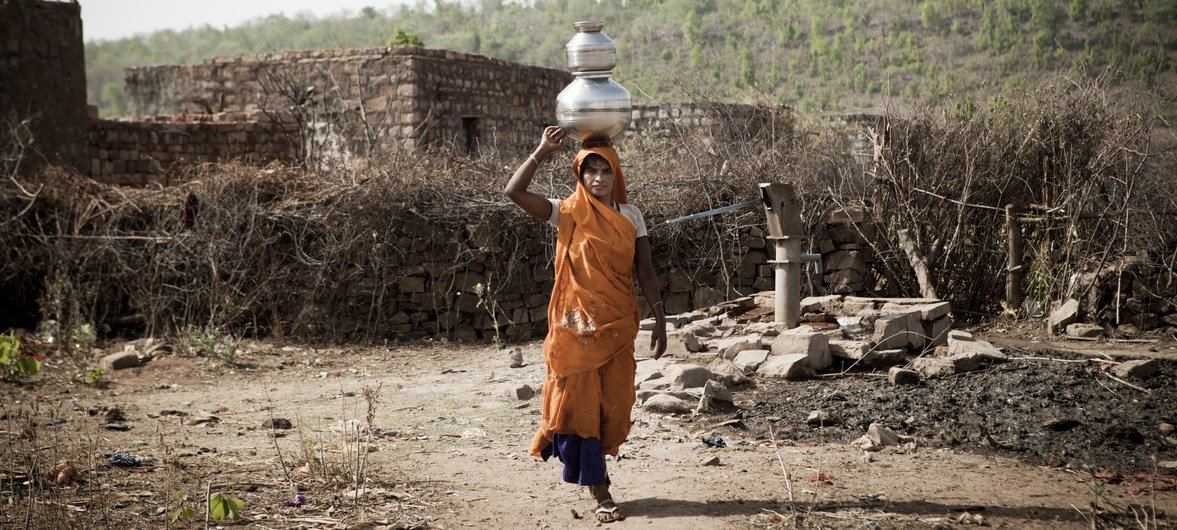
A woman in rural India carries containers of water to her home. Women in developing countries have to spend a lot of time fetching water due to lack of infrastructure. The decade for action on water aims to address this and other problems.

22 March 2018
SDGs


The United Nations on Thursday launched a 10-year water action plan that seeks to forge new partnerships, improve cooperation and strengthen capacity to implement the 2030 Agenda for Sustainable Development.

Most directly linked to Sustainable Development Goal 6, safe water and adequate sanitation are indispensable for healthy ecosystems, reducing poverty, and achieving inclusive growth, social well-being and sustainable livelihoods – the targets for many of the 17 Goals.

However, growing demands, poor management and climate change have increased water stresses and scarcity of water is a major problem in many parts of the world.

Furthermore, more than two billion people worldwide lack access to safe water and over 4.5 billion to adequate sanitation services, warned UN Secretary-General António Guterres.

“By 2050 at least one in four people will live in a country where the lack of fresh water will be chronic or recurrent,” he said, speaking at the launch of the International Decade for Action: Water for Sustainable Development, 2018-2028.

“Quite simply, water is a matter of life and death. Our bodies, […] our cities, our industries and our agriculture all depend on it.”

Stressing that water cannot be taken for granted, the UN chief said that while solutions and technologies to improve water management exist, these are often not accessible to all. In many cases, end up perpetrating inequity within and among countries.

“As with most development challenges, women and girls suffer disproportionately. For example, women and girls in low-income countries spend some 40 billion hours a year collecting water,” he stressed.

Addressing these and other challenges needs a comprehensive approach to water supply, sanitation, water management and disaster risk reduction, said the UN chief, highlighting that aligning existing water and sanitation programmes and projects with the 2030 Agenda will also be vital.

Also crucial is the political will for strengthened cooperation and partnerships, he added.

Tuesday, August 12, 2014

Russia sends big aid convoy to Ukraine, West sounds warnings


By By Dmitry Zhdannikov and Pavel Polityuk 3 hours ago


A Russian convoy of trucks carrying humanitarian aid for Ukraine sets off from near Moscow in this still image taken from video August 12, 2014.
CREDIT: REUTERS/REUTERS TV


By Dmitry Zhdannikov and Pavel Polityuk


Related Stories
Russia sending aid convoy to Ukraine despite Western warnings of 'invasion pretext' Reuters
Ukraine: Russia aid can enter with Red Cross role Associated Press
Russian 'humanitarian' convoy on way to east Ukraine AFP
Ukraine sets terms for Russian aid as convoy heads to border AFP
Russian aid convoy will be accompanied by OSCE inside Ukraine: mediator Reuters

MOSCOW/KIEV (Reuters) - A Russian convoy carrying food, water and other aid set off on Tuesday for eastern Ukraine, where government forces are closing in on pro-Russian rebels, but Kiev said it would not allow the vehicles to cross onto its territory.

Kiev and Western governments warned Moscow against any attempt to turn the operation into a military intervention by stealth in a region facing a humanitarian crisis after four months of warfare.

"This cargo will be reloaded onto other transport vehicles (at the border) by the Red Cross," Ukrainian presidential aide Valery Chaly said.

"We will not allow any escort by the emergencies ministry of Russia or by the military (onto Ukrainian territory). Everything will be under the control of the Ukrainian side," he told journalists.

Russian media said the column of 280 trucks had left from near Moscow and it would take a couple of days for it to make the 1,000 km (620 mile) journey to Ukraine's eastern regions where rebel fighters seek union with Russia.

Western countries believe that Russian President Vladimir Putin, who has whipped up nationalist fervor in Russia through the state-controlled media since annexing Crimea in March, might be spurred to fresh action since separatists in their main redoubt of Donetsk are now encircled by Kiev government forces.

Rossiya 24 TV showed a 3-km long line of containers and trucks loaded with crates of water stretched along a road with workers in a light summer wear of shorts and shirts loading sacks of aid. A Russian orthodox priest marched across a line of trucks, spraying them with holy water before they left.


A Russian convoy of trucks carrying humanitarian aid for Ukraine sets off from near Moscow in this s …

"It has all been agreed with Ukraine," Business FM radio quoted Putin's spokesman, Dmitry Peskov, as saying of an operation publicized with fanfare on Russian TV channels.

The U.S., French and Australian governments voiced concern that Russia, sole international supporter of rebels in Ukraine's Russian-speaking east, could use the humanitarian deliveries to carry out a covert operation to help fighters who appear to be on the verge of defeat.

With Ukraine reporting Russia has massed 45,000 troops on its border, NATO said on Monday that there was a "high probability" Moscow might now intervene militarily in Ukraine.

Itar-Tass news agency said the convoy was carrying 2,000 tons of humanitarian aid. It included 400 tons of cereals, 100 tons of sugar, 62 tons of baby food, 54 tons of medical equipment and medicine, 12,000 sleeping bags and 69 generators of various sizes.

BITTER FIGHTING

Thousands of people are believed to be short of water, electricity and medical aid in Donetsk and in the border town of Luhansk due to bitter fighting, involving air strikes and missile attacks.

U.N. agencies say well over 1,000 people have been killed, including government forces, rebels and civilians, in the conflict in which a Malaysian airliner was downed on July 17 with the deaths of all 298 people on board.


A Russian convoy of trucks carrying humanitarian aid for Ukraine sets off from near Moscow in this s …

Kiev and its Western allies say Russia, which opposes the new leadership's pro-Western policies, has been funneling tanks, missiles and other heavy weapons to the rebels for months. Moscow denies this.

Suspicious of Russian intentions, Ukrainian President Petro Poroshenko has said Ukraine will allow Russian aid into the country only as part of an international relief mission, under the auspices of the International Committee of Red Cross (ICRC) and involving the United States, European Union and other states.

In Geneva, an ICRC spokesperson said: "We still need clarification, details on the content (of the convoy) and type of transportation and storage needed."

With the humanitarian crisis growing by the day in eastern Ukraine, the Kremlin might welcome the opportunity to garner sympathy if the Russian convoy arrives at the border and is turned away by the Ukrainians.

A former Ukrainian president, Leonid Kuchma, who has been involved in tentative mediation with the rebels said on Tuesday the convoy would travel down through north-eastern Ukraine to Luhansk under an Organization for Security and Cooperation in Europe (OSCE) escort.

"TRANSPARENT ARTIFICE"

Speaking in Sydney on Tuesday, U.S. Secretary of State John Kerry said: "Our hope is that in the next days and weeks, we can find a way for President Poroshenko and Ukraine to be able to work with the Russians to provide the humanitarian assistance necessary in the east."

Australian Foreign Minister Julie Bishop told reporters: "Any intervention by Russia into Ukraine under the guise of an humanitarian crisis would be seen for the transparent artifice that it is and Australia would condemn (it) in the strongest possible terms."

In Paris, French Foreign Minister Laurent Fabius said: "Wemust be extremely careful because this (the convoy) could be a cover for the Russians to install themselves near Lugansk and Donetsk and put us before a done deed."

"This (convoy) is only possible, only justifiable, if the Red Cross authorizes it," he told France Info Radio.

U.S. President Barack Obama said on Monday that any Russian intervention without Kiev's consent would be unacceptable and violate international law.

European Commission President Jose Manuel Barroso also warned on Monday "against any unilateral military actions in Ukraine, under any pretext, including humanitarian".


(Additional reporting by Natalia Zinets in Kiev, Stephanie Ulmer-Nebehay in Geneva and Polina Devitt in Moscow; Writing by Richard Balmforth)


.

Friday, May 17, 2013

7 Caught Trespassing At Quabbin Reservoir; Patrols Stepped Up Across State


May 14, 2013 9:55 PM


BELCHERTOWN (CBS) – Shortly after midnight Tuesday, seven people were caught trespassing at the Quabbin Reservoir.

State Police say the five men and two women are from Pakistan, Saudi Arabia, and Singapore, and “cited their education and career interests” for being in the area. The men told police they were chemical engineers and recent college graduates.

Update: No Connection To Criminal Groups


The Quabbin, in Belchertown, is one of the country’s largest man-made public water supplies. Boston’s drinking water comes from the Quabbin and the Wachusett Reservoirs.

State Police say there were no warrants or advisories on any of the individuals and “there was no evidence that the seven were committing any crime beyond the trespassing.”

Related: MWRA: Quabbin Reservoir Water Safe

All seven were allowed to leave and will be summonsed to court for trespassing. The FBI is investigating and routine checks of public water supplies have been increased following the incident.

The seven individuals currently live in Amherst, Cambridge, Sunderland, Northampton and New York City. Police have not released their names because a court date has not been set.


.

Thursday, November 24, 2011

Can God furnish a table in the wilderness?


Psalm 78

1Give ear, O my people, to my law: incline your ears to the words of my mouth.

2I will open my mouth in a parable: I will utter dark sayings of old:

3Which we have heard and known, and our fathers have told us.

4We will not hide them from their children, shewing to the generation to come the praises of the LORD, and his strength, and his wonderful works that he hath done.

5For he established a testimony in Jacob, and appointed a law in Israel, which he commanded our fathers, that they should make them known to their children:

6That the generation to come might know them, even the children which should be born; who should arise and declare them to their children:

7That they might set their hope in God, and not forget the works of God, but keep his commandments:

8And might not be as their fathers, a stubborn and rebellious generation; a generation that set not their heart aright, and whose spirit was not stedfast with God.

9The children of Ephraim, being armed, and carrying bows, turned back in the day of battle.

10They kept not the covenant of God, and refused to walk in his law;

11And forgat his works, and his wonders that he had shewed them.

12Marvellous things did he in the sight of their fathers, in the land of Egypt, in the field of Zoan.

13He divided the sea, and caused them to pass through; and he made the waters to stand as an heap.

14In the daytime also he led them with a cloud, and all the night with a light of fire.

15He clave the rocks in the wilderness, and gave them drink as out of the great depths.

16He brought streams also out of the rock, and caused waters to run down like rivers.

17And they sinned yet more against him by provoking the most High in the wilderness.

18And they tempted God in their heart by asking meat for their lust.

19Yea, they spake against God; they said, Can God furnish a table in the wilderness?

20Behold, he smote the rock, that the waters gushed out, and the streams overflowed; can he give bread also? can he provide flesh for his people?

21Therefore the LORD heard this, and was wroth: so a fire was kindled against Jacob, and anger also came up against Israel;

22Because they believed not in God, and trusted not in his salvation:

23Though he had commanded the clouds from above, and opened the doors of heaven,

24And had rained down manna upon them to eat, and had given them of the corn of heaven.

25Man did eat angels' food: he sent them meat to the full.

26He caused an east wind to blow in the heaven: and by his power he brought in the south wind.

27He rained flesh also upon them as dust, and feathered fowls like as the sand of the sea:

28And he let it fall in the midst of their camp, round about their habitations.

29So they did eat, and were well filled: for he gave them their own desire;

30They were not estranged from their lust. But while their meat was yet in their mouths,

31The wrath of God came upon them, and slew the fattest of them, and smote down the chosen men of Israel.

32For all this they sinned still, and believed not for his wondrous works.

33Therefore their days did he consume in vanity, and their years in trouble.

34When he slew them, then they sought him: and they returned and enquired early after God.

35And they remembered that God was their rock, and the high God their redeemer.

36Nevertheless they did flatter him with their mouth, and they lied unto him with their tongues.

37For their heart was not right with him, neither were they stedfast in his covenant.

38But he, being full of compassion, forgave their iniquity, and destroyed them not: yea, many a time turned he his anger away, and did not stir up all his wrath.

39For he remembered that they were but flesh; a wind that passeth away, and cometh not again.

40How oft did they provoke him in the wilderness, and grieve him in the desert!

41Yea, they turned back and tempted God, and limited the Holy One of Israel.

42They remembered not his hand, nor the day when he delivered them from the enemy.

43How he had wrought his signs in Egypt, and his wonders in the field of Zoan.

44And had turned their rivers into blood; and their floods, that they could not drink.

45He sent divers sorts of flies among them, which devoured them; and frogs, which destroyed them.

46He gave also their increase unto the caterpiller, and their labour unto the locust.

47He destroyed their vines with hail, and their sycomore trees with frost.

48He gave up their cattle also to the hail, and their flocks to hot thunderbolts.

49He cast upon them the fierceness of his anger, wrath, and indignation, and trouble, by sending evil angels among them.

50He made a way to his anger; he spared not their soul from death, but gave their life over to the pestilence;

51And smote all the firstborn in Egypt; the chief of their strength in the tabernacles of Ham:

52But made his own people to go forth like sheep, and guided them in the wilderness like a flock.

53And he led them on safely, so that they feared not: but the sea overwhelmed their enemies.

54And he brought them to the border of his sanctuary, even to this mountain, which his right hand had purchased.

55He cast out the heathen also before them, and divided them an inheritance by line, and made the tribes of Israel to dwell in their tents.

56Yet they tempted and provoked the most high God, and kept not his testimonies:

57But turned back, and dealt unfaithfully like their fathers: they were turned aside like a deceitful bow.

58For they provoked him to anger with their high places, and moved him to jealousy with their graven images.

59When God heard this, he was wroth, and greatly abhorred Israel:

60So that he forsook the tabernacle of Shiloh, the tent which he placed among men;

61And delivered his strength into captivity, and his glory into the enemy's hand.

62He gave his people over also unto the sword; and was wroth with his inheritance.

63The fire consumed their young men; and their maidens were not given to marriage.

64Their priests fell by the sword; and their widows made no lamentation.

65Then the LORD awaked as one out of sleep, and like a mighty man that shouteth by reason of wine.

66And he smote his enemies in the hinder parts: he put them to a perpetual reproach.

67Moreover he refused the tabernacle of Joseph, and chose not the tribe of Ephraim:

68But chose the tribe of Judah, the mount Zion which he loved.

69And he built his sanctuary like high palaces, like the earth which he hath established for ever.

70He chose David also his servant, and took him from the sheepfolds:

71From following the ewes great with young he brought him to feed Jacob his people, and Israel his inheritance.

72So he fed them according to the integrity of his heart; and guided them by the skilfulness of his hands.

Saturday, November 12, 2011

Tuesday, August 30, 2011

Helicopters rush food, water to cut-off Vt. towns

By JOHN CURRAN, Associated Press

Tuesday, August 30, 2011


Polina Yamshchikov / AP
Emergency crews keep people at a safe distance from the Quechee Covered Bridge in Lebanon, N.H., as it flooded with water from the Ottauquechee River Sunday, Aug. 28, 2011. A weakened but dangerous Tropical Storm Irene dumped up to half a foot of rain in places, flooded roads, knocked down trees and left more than 165,000 New Hampshire homes and businesses on the dark before blowing out of the state on Sunday.


(08-30) 17:18 PDT Newfane, Vt. (AP) --

National Guard helicopters rushed food and water Tuesday to a dozen cut-off Vermont towns after the rainy remnants of Hurricane Irene washed out roads and bridges in a deluge that took many people in the landlocked New England state by surprise.

"As soon as we can get help, we need help," Liam McKinley said by cellphone from a mountain above flood-stricken Rochester, Vt.

Up to 11 inches of rain from the weekend storm turned placid streams into churning, brown torrents that knocked homes off their foundations, flattened trees and took giant bites out of the asphalt across the countryside. At least three people died in Vermont.

"I think that people are still a little shell-shocked right now. There's just a lot of disbelief on people's faces. It came through so quickly, and there's so much damage," Gail Devine, director of the Woodstock Recreation Center, said as volunteers moved furniture out of the flooded basement and shoveled out thick mud that filled the center's two swimming pools.

As crews raced to repair the roads, the National Guard began flying in supplies to the towns of Cavendish, Granville, Hancock, Killington-Mendon, Marlboro, Pittsfield, Plymouth, Rochester, Stockbridge, Strafford, Stratton and Wardsboro. The Guard also used heavy-duty vehicles to bring relief to flood-stricken communities still reachable by road.

The cut-off towns ranged in population from under 200 (Stratton) to nearly 1,400 (Cavendish).

"If it's a life-and-death situation, where someone needs to be Medevac-ed or taken to a hospital, we would get a helicopter there to airlift them out, if we could get close to them. A lot of these areas are mountainous areas where there may not be a place to land," said Mark Bosma, a spokesman for Vermont Emergency Management.

There were no immediate reports of anyone in dire condition being rescued by helicopter.

But it took a relay operation involving two ambulances and an all-terrain vehicle to take a Killington woman in respiratory distress to a hospital in Rutland, about 13 miles away, after floodwaters severed the road between the two communities, Rutland Regional Medical Center President Tom Hubner said. The patient, whose name was not released, was doing fine, he said.

In Rochester, where telephones were out and damage was severe, people could be seen from helicopters standing in line outside a grocery store. McKinley said the town's restaurants and a supermarket were giving food away rather than let it spoil, and townspeople were helping each other.

"We've been fine so far. The worst part is not being able to communicate with the rest of the state and know when people are coming in," he said.

He said government agencies did a good job of warning people about the storm. "But here in Vermont, I think we just didn't expect it and didn't prepare for it," he said. "I thought, how could it happen here?"

Wendy Pratt, another of the few townspeople able to communicate with the outside world, posted an update on Facebook using a generator and a satellite Internet connection. She sketched a picture of both devastation and New England neighborliness.

"People have lost their homes, their belongings, businesses ... the cemetery was flooded and caskets were lost down the river. So many areas of complete devastation," Pratt wrote. "In town there is no cell service or internet service - all phones in town are out. We had a big town meeting at the church at 4 this afternoon to get any updates."

"Mac's opened up at 5 and gave perishables away to anyone who came," she added. "The Huntington House put on a big, free community dinner tonight."

Access to Rochester and Stratton by road was restored later in the day, officials said.

All together, the storm has been blamed for at least 42 deaths in 12 states. More than 2.5 million people from North Carolina to Maine were still without electricity Tuesday, three days after the hurricane churned up the Eastern Seaboard.

While all eyes were on the coast as Irene swirled northward, some of the worst destruction took place well inland, away from the storm's most punishing winds. In Vermont, Gov. Peter Shumlin called it the worst flooding in a century. Small towns in upstate New York — especially in the Catskills and the Adirondacks — were also besieged by floodwaters.

In Pittsfield, Vt., newlyweds Marc Leibowitz and Janina Stegmeyer of New York City were stranded Sunday along with members of the wedding party and dozens of their guests after floodwaters swamped the couple's honeymoon cottage. The honeymooners narrowly escaped in a four-wheel-drive rental car just before a bridge behind them collapsed.

More than a dozen of the 60 or so guests were airlifted out by private helicopters on Tuesday.

Michael Ricci of Woodstock, Vt., spent the day clearing debris from his backyard along the Ottauquechee River. What had been a meticulously mowed, sloping grass lawn and gorgeous flower beds was now a muddy expanse littered with debris, including wooden boards, propane tanks and a deer hunting target.

"The things we saw go down the river were just incredible," he said. "Sheds, picnic tables, propane tanks, furnaces, refrigerators. We weren't prepared for that. We had prepared for wind and what we ended up with was more water than I could possibly, possibly have imagined." He said the water in the yard was almost up to the house, or about 15 to 20 feet above normal.

He added: "The force of it was beyond our comprehension."

Vermont emergency officials and the National Weather Service warned before the storm about the potential for heavy rain and flooding. On Thursday, Shumlin recommended stocking up on enough food, water and other supplies to last three days.

On Tuesday, the governor defended his state's decision not to undertake extensive evacuations before the storm arrived, noting that it was too hard to predict which communities in a rugged place like Vermont would get hit.

"You'd have to evacuate the entire state," he said.

Gerald and Evangeline Monroe of Quechee, Vt., agreed with the governor and said they had no complaints about the way authorities handled the crisis.

Gerald Monroe noted that some homes on one side of the river through his town were damaged, while those on the opposite banks 100 yards away were unscathed.

His wife said city-dwellers may see a weather report and know it applies to their entire metropolitan area. "But when you live in Vermont, there are lots of little microclimates and every village is different." she said. "I think our authorities were fine."

Approximately 260 roads in Vermont were closed because of storm damage, along with about 30 highway bridges. Vermont Deputy Transportation Secretary Sue Minter said the infrastructure damage was in the hundreds of millions of dollars.

Relief supplies arrived at Vermont's National Guard headquarters early Tuesday in a convoy of 30 trucks from the Federal Emergency Management Agency. Accompanied by Shumlin, FEMA administrator Craig Fugate toured the state by helicopter Tuesday to survey the damage.

Meanwhile, in North Carolina, where Irene blew ashore along the Outer Banks on Saturday before heading for New York and New England, Gov. Beverly Perdue said the hurricane destroyed more than 1,100 homes and caused at least $70 million in damage.

Airlines said it would be days before the thousands of passengers stranded by Irene find their way home. Amtrak service was still out Tuesday between Philadelphia and New York because of flooding in Trenton. Commuter train service between New Jersey and New York City resumed Tuesday, except for one line that was still dealing with flooding.

Homeland Security Secretary Janet Napolitano said at news conference in North Carolina that she was unaware of anything federal authorities should have done differently in Vermont. She said FEMA and its state counterpart worked closely together, and she noted that after the state agency operations center got flooded out, it moved into FEMA's quarters.

William "Breck" Bowden, an expert on Vermont's watershed at the University of Vermont, attributed the disaster to a combination of factors: The soil was wet, Vermont's steep hills quickly fed the rainfall into streams, and the storm dumped a huge amount of water.

"There was plenty of warning being given about the coming storm by the meteorological community and the news media," he said. "The real issues are the enormous damage to our infrastructure. That's nothing an evacuation could have done anything about."

___

Contributing to this report were Associated Press writers Holly Ramer in Woodstock, Vt., Wilson Ring and Dave Gram in Montpelier, and Michael Gormley in Albany, N.Y.

Source: http://www.sfgate.com/cgi-bin/article.cgi?f=/n/a/2011/08/27/national/a002503D36.DTL&ao=all#ixzz1WZPOkajk
.

Thursday, August 12, 2010

Mystery: Thousands of dead fish line Jersey shore

Thousands of dead fish line Jersey shore
Thursday, August 12, 2010

MIDDLE TWP., N.J. - August 12, 2010 (WPVI) -- Dead, rotting fish for miles covered the beaches of Middle Township, Cape May County.

Officials so far remain mystified over the major wash-up of fish along the Delaware Bay in Cape May County. The investigation is ongoing, but already there is at least one theory by scientists on what may have happened to those fish.

Experts at Rutgers University theorize that the fish were killed by the excessive heat that depleted the oxygen levels in the water.

Investigators will be back out on Thursday to continue the search for an official cause.

The fish, juvenile menhaden, also known as peanut bunker, were washed up on miles of shoreline from the Villas section of Lower Township to Pierce's Point in Middle Twp.

"I've never seen anything like this," said Kristin Bongard of The Villas.

"I have to say hundreds when I first saw them and then it became thousands, and they were floating," added Jeanette Nefaro.

"Just rows and rows of dead fish all the way as far as you can see," said Judy Thompson. "Yesterday they were in the water, they were jumping up, you could see them and there were porpoises out here, I guess they were feeding on them."

Residents say the fish began washing up on shore early Wednesday morning creating a foul smell as they baked in the hot sun.

By early evening, the high tide had washed away most of the dead fish leaving behind a thin line of them along the shoreline.

The state of New Jersey has sent extra conservationists to Cape May County to assess the impact on the beaches. Officials hope to know more Thursday.

Watch video: http://abclocal.go.com/wpvi/video?id=7605437


Source: http://abclocal.go.com/wpvi/story?section=news/local&id=7605606 .
.