Showing posts with label Belgique. Show all posts
Showing posts with label Belgique. Show all posts
Tuesday, October 13, 2026
Friday, October 09, 2026
Wednesday, October 09, 2024
Pope Francis tells Jesuits: ‘Do Not Be Afraid’
'Do Not Be Afraid'c
c
Pope Francis Meets with Jesuits in Belgium

byAntonio Spadaro, SJ
October 8, 2024

© Antonio Spadaro
On the afternoon of Saturday, September 28, 2024, Pope Francis left the campus of the Catholic University of Louvain and arrived, around 6:15 p.m., at the Collège Saint-Michel, a Catholic school run by the Society of Jesus, located in Etterbeek, Brussels. There he met with about 150 Jesuits who reside in Belgium, Luxembourg and the Netherlands. With them were the provincial of the Francophone Western European Province, Fr. Thierry Dobbelstein, and the superior of the Netherlands region, Fr. Marc Desmet. Jesuit Cardinal Michael Czerny, prefect of the Dicastery for Integral Human Development, was also present. The pope began:
Good evening, everyone! I have been here twice before, and it is good to return. I must tell you the truth: I once committed a theft here. I came to celebrate Mass and saw some papers that intrigued me. They were handouts from lessons on the Book of Job. That year in Argentina I was supposed to teach classes specifically on Job. I flipped through the pages, and they impressed me. Those notes remained with me!
Tuesday, June 03, 2014
G7 Summit in Brussels, 4 – 5 June 2014: Background note and facts about the EU's role and actions

European Commission
MEMO
Brussels, 3 June 2014
The Brussels G7 Summit will take place on 4-5 June. At their meeting in The Hague on 24 March, the G7 at leaders' level (Canada, France, Germany, Italy, Japan, the United Kingdom, the President of the European Council and the President of the European Commission decided not to participate in the planned G8 Summit in Sochi (Russia) as a reaction to the Russian Federation's violation of Ukraine's sovereignty and territorial integrity. Instead, they decided to meet in Brussels in the G7 format on the same days.
The Brussels G7 Summit will be hosted by the European Union. The European Union is represented by European Council President Herman Van Rompuy and European Commission President Jose Manuel Barroso.
At the Brussels Summit, Leaders will discuss the situation in Ukraine and the relations with Russia as well as other foreign policy issues, the global economy, energy, climate change and development.
1. Foreign policy
As the first topic, the G7 leaders are expected to discuss foreign policy challenges at their working dinner on the evening of 4 June. The leaders will focus their discussions on Ukraine and Russia but they may also address the latest developments on other foreign policy issues.
In the last months and following the outbreak of the Ukraine crisis, the G7 leaders have issued several declarations condemning the Russian Federation's clear violation of the sovereignty and territorial integrity of Ukraine (see statement of 3 March), condemning the illegal referendum and the illegal attempt by Russia to annex Crimea in contravention of international law and specific international obligations (see The Hague Declaration following the G7 meeting on 24 March) and expressing their deep concern at the continued efforts by separatists backed by Russia to destabilise eastern Ukraine (see statement of 26 April).
At the Brussels G7 Summit leaders are expected to discuss the latest developments following the presidential elections held in Ukraine on 25 May. They will discuss the continued work to support Ukraine's economic and political reforms as well as their continued readiness to intensify targeted sanctions and to impose further costs on Russia should events so require.
Role of the EU: In response to Russian actions so far, the EU has cancelled the next EU-Russia summit and member states' regular bilateral summits with Russia have also been annulled. Negotiations on visa matters and a new agreement with Russia have been suspended. The EU has also targeted 61 persons responsible for actions that threaten or undermine the territorial integrity, sovereignty and independence of Ukraine with asset freezes and bans from entering the EU. Two confiscated entities in Crimea and Sevastopol are also subject to an asset freeze.
At the same time the EU continues to roll out a €11 billion support package to Ukraine including a €1.6 billion of Macro-financial assistance to contribute to covering Ukraine's urgent balance-of-payments needs (of which the first €100 million were paid out on 20 May) and a €365m state-building contract to help the country's transition and boost the role of civil society, promoting democratic reforms and inclusive socio-economic development.
On 21 March the political chapters of the EU-Ukraine Association Agreement were signed. The EU remains committed to signing the full agreement including the deep and comprehensive free trade area. Even ahead of the signature of the provisions on free trade, temporary EU trade preferences for Ukraine apply since 23 April. More information on the EU support for Ukraine:
http://europa.eu/rapid/press-release_MEMO-14-279_en.htm
2. Global economy
The first working session of the second day, Thursday 5 June, is on the global economic outlook. The discussions are expected to focus on the improved prospect of global growth and how to tackle the remaining serious challenges such as high unemployment. Leaders will also address trade issues including the active and ambitious trade agenda of the G7 members with a number of bilateral, plurilateral and multilateral negotiations ongoing.
Supporting growth and jobs remains the key priority for the G7 members and the recovery is strengthening/continuing. Leaders are expected to call for continued and sustained growth in order to bring down unemployment, particularly among young people and the long term unemployed. Structural reforms, as well as completing key aspects of core financial reforms, such as building resilient financial institutions and ending too-big-to-fail, remain important in order to achieve this common objective.
Role of the EU: The economic and financial situation in the euro area has stabilised since last summer thanks to the determined and comprehensive crisis response by the EU. There are genuine signs that a more lasting recovery is now taking place in the EU and the euro area. GDP is expected to grow by 1.6% in the EU this year, before speeding up to 2% in 2015. Unemployment rates have stopped increasing since mid-2013 in most of the EU while remaining, however, at unacceptably high levels.
Leaders are expected to also address and reaffirm their commitment to tackling tax avoidance, including through the G20/OECD Base Erosion and Profit Shifting Action Plan, and tax evasion, where the aim is to focus on the rapid implementation of the new single global standard for automatic exchange of tax information.
Role of the EU: thanks to its experience and pioneering role on tax transparency and tax good governance the EU and its member states play a central role in fora like the G7/G8, the G20 and the OECD to ensure fairness and transparency in taxation at global level. More on the EU's policy to fight tax fraud and tax avoidance: http://ec.europa.eu/taxation_customs/taxation/tax_fraud_evasion/index_en.htm
Under the trade and investment umbrella, leaders are expected to reconfirm their commitment to fight protectionism. The leaders will also take stock of the WTO negotiations and prioritise the swift implementation of the Bali package and continue the current Aid for Trade commitments.
Role of the EU: Together, the European Union's 28 members account for 19% of world imports and exports. Trade remains an important driver for growth and jobs. That is why it is a key priority for the EU to open up more market opportunities for European business by negotiating new Free Trade Agreements with key partners, in particular the G7 members Canada, Japan and the United States). If the EU was to complete all its current free trade talks tomorrow, it could add 2.2% to the EU's GDP or €275 billion. In terms of employment, these agreements could generate 2.2 million new jobs or additional 1% of the EU total workforce.
EU trade policy aims to working to:
create a global system for fair and open trade, through active support to the agreements and obligations overseen by the WTO; the focus is on implementing the Bali Trade Facilitation Agreement and on developing a future WTO work programme.
further open up markets with key partner countries – cf. the ongoing trade negotiations with the USA (Transatlantic Trade and Investment Partnership), , Canada (Comprehensive Economic and Trade Agreement), Japan (Free Trade Agreement) and China (EU-China Investment Agreement). Free Trade Agreements were recently concluded with Singapore and are under negotiation with Malaysia and Vietnam. Various Deep and Comprehensive Free Trade Agreements are concluded or are under negotiation with several countries in the EU's Southern and Eastern Neighbourhood, including Ukraine;
lift barriers, open markets and ensure that trade is fair;
ensure that trade is a force for sustainable development, opening EU markets to all imports from the world's poorest countries and supporting developing countries to build the capacity to take advantage of trade.
More info and key figures on EU trade policy on http://ec.europa.eu/trade/
3. Energy and climate change
The discussions on energy and climate change at the second working session on Thursday 5 June will be two-fold.
First, leaders will discuss energy security in light of the Ukraine crisis and building on the Rome G7 energy initiative for energy security agreed by the G7 energy ministers on 6 May (see statement of 6 May). Leaders will be looking at identifying and implementing concrete domestic policies separately and together to build a more competitive, diversified, resilient and low-carbon energy system. Focus will be put on diversification of routes and sources, upgrading of energy infrastructure, development of indigenous resources and energy efficiency, while reducing greenhouse gas emissions. Clean technology is another important element to this.
Role of the EU: The EU has continuously sought to improve the energy security of its Member States through a variety of policies and actions. Most recently, in response to the crisis in Ukraine and the request by the European Council, the European Commission has tabled a European Energy Security Strategy (see the press release and the MEMO) as a basis for further discussion with Heads of States and Governments at the June European Council. The G7 Energy summit (Rome 5-6 May 2014) has built upon the Commission’s efforts to develop energy emergency plans for winter 2014-2015 at regional level, to exchange best practices for assessing energy security vulnerabilities, for IEA to prepare options for individual and collective actions of G7 in the field of gas security, and to supply technical assistance and facilitate exchanges with Ukraine and other European countries seeking to develop indigenous hydrocarbons, renewables and improve energy efficiency.
On climate change, leaders are expected to reaffirm their commitment to limit effectively the increase in global temperature below 2°C above pre-industrial levels and express their strong determination to adopt in 2015 a global agreement, ahead of the Climate Summit of the United Nations General Assembly in September and the upcoming COP2015 in Paris.
Role of the EU: the EU continues to pioneer global climate action thanks to its ambitious and legally binding framework. It remains fully committed to a multilateral legally binding approach to tackling climate change and to reshape the global climate agenda, working towards the UN climate conferences in Lima in 2014 and in Paris in 2015. The EU is on track with its domestic preparations on an ambitious 2030 climate and energy framework. The European Heads of State and Government agreed to take final decision on this as quickly as possible, and no later than October 2014, which means that the EU would be ready for the first quarter of 2015 at the latest.
Significant financial resources are mobilised to help developing countries deal adequately with climate change, with substantial co-benefits in terms of energy security. For example, the EU has allocated 400 million EUR to promote access to sustainable energy for all (SE4ALL) in Africa, building on the ACP-EU Energy Facility and the EU-Africa Infrastructure Trust Fund.
The European Union is the largest contributor of climate finance to developing countries and the world's biggest aid donor, collectively providing more than half of global official development assistance (ODA). The EU and its Member States pledged €7.2 billion in "fast start" climate finance over 2010-2012, almost one-third of the total pledged by developed countries. Despite difficult economic circumstances, the EU met and even surpassed its commitment by providing €7.34 bn in fast start finance. This money is being spent on concrete climate actions in developing countries.
Climate change is being increasingly integrated into the EU's broader development strategy. 20% of the resources dedicated to international development aid from the new multiannual financial framework of the EU as well as 20% of the 11th European Development Fund for the period 2014-2020 are to be allocated to climate-relevant actions.
More info on 2030 climate and energy goals for a competitive, secure and low-carbon EU economy.
4. Development
Finally, the Thursday 5 June working lunch will be devoted to development issues with a view to taking stock of progress and reconfirming previous G7 commitments, such as the Muskoka initiative on maternal, new-born and child health, the GAVI alliance (global alliance for vaccines and immunization), the New Alliance for Food Security and Nutrition, the Deauville Partnership, tax evasion and illicit flows of finance.
Role of the EU: Despite the economic and financial context in Europe, the EU remains the biggest donor in the world – more than half of global development aid is provided by Europeans: Over the last ten years, the EU and its Member States have committed around 45 billion euro per year to development aid. This support has paid off: since 2004, the EU has contributed to the enrolment of more than 13 million boys and girls at school, to the vaccination of around 18 million children and to providing more than 70 million people with access to water around the world.
Food security remains in the centre of the EU's development policy. Since 2013, the EU has stepped up its efforts to fight against world hunger, food insecurity and malnutrition, with a new policy framework that delivers on the EU's commitment to help partner countries reduce stunting amongst children under five years of age by at least 10% (7 million) by 2025. Under-nutrition will also be contained through investment in rural development, sustainable agriculture, public health, water and sanitation, social protection and education.
On 20 May, the EU announced that it will provide €25 million per year in the period 2014-2020 to fund vaccines and immunisation programmes worldwide through the GAVI alliance – more than double than previously committed. Since 2003, the European Commission has committed over €83 million to the GAVI Alliance, coming in part from the Development Co-operation Instrument (DCI) and in part from the European Development Fund (EDF). Thanks to donors like the EU, close to half a billion children have been immunised since 2000, resulting in 6 million lives saved.
The leaders will also discuss the post-2015 agenda aiming at completing unfinished business of the Millennium Development Goals. This would include a focus on eradications of extreme poverty, promoting development and on balancing environmental, economic and social dimensions of sustainable development, including climate change.
Role of the EU: the Millennium Development Goals (MDGs) remain at the core of EU development policy and actions. The EU has implemented the 1 billion euro MDG initiative, launched at the 2010 MDG summit, targeting the most off-track MDGs: hunger, maternal health, child mortality and access to water and sanitation. The EU supports nearly 70 actions in 46 countries, with a focus on Least Developed Countries.
On 2 June 2014, the European Commission adopted a Communication to contribute to the EU position in international negotiations on Sustainable Development Goals (SDGs), as the follow-up to the Millennium Development Goals (MDGs). The proposal calls for tackling issues of global concern such as poverty, inequality, health, food security, education, gender equality, water and sanitation, sustainable energy, decent work, inclusive and sustainable growth, sustainable consumption and production, biodiversity, land degradation and sea and oceans. It will now be discussed by Council of Ministers and the European Parliament and the outcome will guide the EU's position in the negotiations at UN level.
5. The EU as G7/G8 member
The European Union is a full member in G7/G8 Summits and is represented by the President of the European Council and the President of the European Commission.
In 1977, representatives of the then European Community began participating in the London Summit. The first G7 summit was held two years earlier, in 1975 in Rambouillet (France). Originally, the EU had a limited role to those areas in which it had exclusive competences, but the EU’s role has grown with time. The European Commission was gradually included in all political discussions on the summit agenda and took part in all summit working sessions, as of the Ottawa Summit (1981). Commission President Barroso, who attended the G8 for the first time in Gleneagles in 2005, is participating for the 10th time, while Council President Van Rompuy has been attending the G8/G7 since the entry into force of the Lisbon Treaty (2009).
The Commission and the European Council have all the responsibilities of membership. The Summit Communiqué is politically binding for all G7 members.
The Presidency will continue in its rotation to Germany in 2015 (Summit 4-5 May 2015), Japan in 2016, Italy in 2017, Canada in 2018, France in 2019, and the USA in 2020.
Useful links
G7 2014 section on President Van Rompuy's website:
http://www.european-council.europa.eu/g7brussels
G7/G8/G20 section on President Barroso's website:
http://ec.europa.eu/commission_2010-2014/president/g20/index_en.htm
President Van Rompuy on Twitter and on Facebook
President Barroso on Twitter
Full video coverage of the G7 will be available for download in broadcast quality from the Council TV newsroom www.eucouncil.tv, and live events will be broadcast on Europe by Satellite (http://ec.europa.eu/avservices/ebs/schedule.cfm ) Photos covering the event will be available for download in high resolution from the Council Photo Library http://www.consilium.europa.eu/photo and the European Commission's audiovisual services (http://ec.europa.eu/avservices/photo/index.cfm
Source
.
Wednesday, February 26, 2014
‘What’s the Use of Keeping this Baby Alive?’ Belgian Lawmakers Legalize Euthanasia for Children
February 23, 2014
By: Garrett Haley

BELGIUM – Lawmakers in Belgium recently approved a measure that will allow doctors to euthanize children of all ages.
As previously reported, the Belgian Senate overwhelmingly approved a child euthanization bill in December, sending it to the lower legislative house. This month, the lower house voted 86-44 in favor of the measure, despite some international criticism. Belgium’s King Philippe is expected to sign the bill into law.
Once the new measure is enacted, terminally ill children will have the option to end their lives via lethal injection. As long as children understand what euthanasia is and have approval from parents and doctors, they will be free to choose assisted suicide.
Belgium, a predominantly secular country, first sanctioned euthanasia for adults in 2002. Now, the small European nation will become only the second country in the world—along with the Netherlands—to allow child euthanization.
Supporters of the child euthanization measure argue that terminally ill individuals should be allowed to die, regardless of age.
“This [bill] is an act of humanity that allows the doctor to make the most humane course of action for his patient,” Philippe Mahoux, a senator who sponsored the legislation, told The New York Times. “What is scandalous is the suffering of sick children when they are going to die.”
Linda van Roy is a mother from Belgium who supports the new euthanization measures. Two years ago, her 10-month-old daughter slowly died from a terminal disease, and she wishes she could have ended her baby’s life more quickly.
Connect with Christian News
“That whole period of sedation, you always need to give more and more medication, and you start asking questions,” van Roy told CNN. “And you say, ‘What’s the use of keeping this baby alive?’ ”
“We want for those children to be able to talk about euthanasia and to ask those questions and if they really want to say, ‘Stop, this is it, I don’t want it anymore,’ that they can have a choice,” she added.
However, many people voiced opposition to the euthanasia bill, stating that children should never be asked whether or not they want to intentionally end their lives.
“The law says adolescents cannot make important decisions on economic or emotional issues, but suddenly they’ve become able to decide that someone should make them die,” observed Andre-Joseph Leonard, an archbishop in Belgium.
American businessman and former presidential candidate Steve Forbes likewise expressed concern about the Belgian measure, opining that it exemplifies the “slippery slope” of euthanasia.
“We are on the malignantly slippery slope to becoming a society like that envisioned by Nazi Germany, one in which ‘undesirables’ are disposed of like used tissue,” Forbes wrote in a recent column. “The Holocaust and other Nazi atrocities sidetracked the eugenics movement. But now it’s making a comeback in new garb—we want to kill only to reduce suffering.”
“As euthanasia becomes more accepted—and we become more numb to the horror of murdering people like this—we’ll descend to the next abomination: pressuring the sick to discontinue treatment for a likely fatal illness in the name of ‘saving scarce resources’ for people who have more years ahead of them,” he suggested.
“The true mark of a civilization is in how it treats its most vulnerable members,” Forbes concluded.
Photo: BBC
Source
.
Thursday, January 02, 2014
The Family in the 21st Century
Save the date : The Family in the 21st Century
With the European elections on the horizon the Secretariat of COMECE and the Team of the Chapel for Europe cordially invite you to the Series of Conferences
EUROPE - POLITICS – AND BEYOND
to be held in the
Chapel of the Resurrection – Chapel for Europe

4th Conference: "The Family in the 21st Century"
Tuesday 7 January 2014 19:00
There is a wide consensus within Europe that the nuclear family is the basic building block of a healthy and prosperous society. A wide range of social change has challenged this view.
In the light of the changing profile of the family in Europe, Breda O’Brien, Columnist at The Irish Times, will explore the constitutive elements of the family and its relationship to society at large.
On Tuesday 7 January 2014 at 19:00,
“The Family in the 21st Century” at the Chapel for Europe

More information and registration:http://www.comece.eu/conferences
Source
.
Monday, December 30, 2013
CONFERENCE on Work-free Sundays and Decent Work
Conference on Work-free Sundays and Decent Work
CONFRERENCE CONFERENCE
on Work-free Sundays and Decent Work
Tuesday 21 January 2014 at the EU Parliament (Brussels)

on Work-free Sundays and Decent Work
Tuesday 21 January 2014 at the EU Parliament (Brussels)
The objective of this conference is to highlight the paramount importance a work-free Sunday and decent working hours for citizens throughout Europe and is not necessarily to be set against economic competitiveness. All people in the European Union should be entitled to benefit from work-free Sundays and decent working hours.
For a couple of years now, the socio-economic crisis has been overshadowing European Union policy making. The situation in many Member States is critical: political instability is increasing and social balances are at risk. Europe is facing many challenges such as demographic change, unemployment especially among young people, poverty and social exclusion. Austerity, further liberalisation and flexibility are very often seen as key solutions for getting out of the crisis. Social protection and social rights seem to be put aside. However, employment and the creation of jobs and economic competitiveness in Europe are the main requirements for overcoming the crisis. But what kind of jobs do we need in Europe? Can competitiveness and decent work and a common weekly rest day go hand in hand, and under what conditions? We believe: Competitiveness needs innovation, innovation needs creativity and creativity needs recreation!
2013 is the European Year of Citizens. Sunday protection strengthens the social cohesion of our societies. It therefore represents a precious achievement which should be recognised as a pillar of the European Social and Economic Model. We believe that today, legislation and practices in place at the EU and Member State levels need to be more protective of the health, safety, dignity of everyone and should more attentively promote the balance between family and private life and work.
The Members of Parliament Evelyn Regner (S&D) and Thomas Mann (EPP)
and
The European Sunday Alliance
and
The European Sunday Alliance
Invite you to
The Second European Conference on the Protection of a Work-free Sunday and Decent Work
2014-2019: WORK-FREE SUNDAYS AND DECENT WORK IN THE EU
What can the Members of the European Parliament do to promote the idea?
Date: Tuesday 21 January 2013
Time: 9:00 to 17:15
Venue: European Parliament, Brussels, Room PHS 7C050
- 1st SESSION: Decent work and work-free Sundays in times of crisis
- 2nd SESSION: Balancing family and private life and work - towards a happy and healthy life
- 3rd SESSION: How a work-free Sunday enables citizens´ participation and voluntary engagement
PLEASE REGISTER HERE :
Data required for an access badge to the EU Parliament
Conference on Work-free Sundays and Decent Work 21.01.2014,
Source
.
.
Tuesday, February 19, 2013
The growing crisis in Europe

Join a discussion with high-level EU Officials and Civil Society experts about the future direction of the EU's response to the crisis!
Together, we will explore the deepening levels of social distress in Europe and will assess the adequacy of the EU's mechanisms and policy responses to date - including the Europe 2020 Strategy's European Semester and the EU's austerity approach through the Stabilisation Mechanisms.
Download the agenda (Draft version).
When: 21 February 2013
Where: European Economic and Social Committee, Room VM3, 2nd floor, Van Maerlant Building, rue Van Maerlant 2, 1040 Brussels
Note: Please note that, for security reasons, your ID will be required to access the building
.
Saturday, October 09, 2010
At Europe’s Helm, a Steady Hand With Little Pomp
 Gael Turine for The New York Times
“I had a very important task in Belgium. I felt I was the only one capable of finding a solution. There are moments you’re irreplaceable and others you can die and be replaced the next day.” Herman Van Rompuy
By STEVEN ERLANGER and STEPHEN CASTLE
Published: October 8, 2010
WHEN a visit to the United Nations was canceled abruptly last month, the European Union’s new president, Herman Van Rompuy, headed instead for somewhere he says he feels really at home: Affligem Abbey, a Benedictine monastery in the countryside here, founded in 1062.
Mr. Van Rompuy spent a day in a simple room, attending services and eating in a cavernous hall where monks listen to readings from a library of 70,000 books. And he also likes the beer, one of Belgium’s most famous, now brewed under license from the monks.
...
A Roman Catholic, Mr. Van Rompuy often seems to be fighting to conquer the sin of pride — in his manner, his dress (he favors brown) and his lack of affectation. But it is a struggle he sometimes loses. He is a man who feels inferior, it can be said, to few, and he is convinced that the modest and back-room fashion in which he is guiding Europe — and quietly expanding his influence — is the only possible way to do it.
A Roman Catholic, Mr. Van Rompuy often seems to be fighting to conquer the sin of pride — in his manner, his dress (he favors brown) and his lack of affectation. But it is a struggle he sometimes loses. He is a man who feels inferior, it can be said, to few, and he is convinced that the modest and back-room fashion in which he is guiding Europe — and quietly expanding his influence — is the only possible way to do it.
.
Tuesday, September 14, 2010
Pope pained by Belgian child sex scandal
By the CNN Wire Staff
September 13, 2010 5:18 p.m. EDT

"We want to commit ourselves to giving the maximum support for the victims," he said. "We must listen to their questions in order to restore their dignity and help heal the suffering they have endured."
The commission said it received about 500 reports from alleged victims, about 60 percent of them from males.
It cited 320 alleged abusers, of whom 102 were known to have been clergy members from 29 congregations.
Thirteen of the alleged victims committed suicide, it said.
"We can say that not a single congregation escaped sexual abuse of minors by one or more of its members," the Commission on Church-Related Sexual Abuse Complaints said Friday.
"The stories they contain and suffering make us shudder," Leonard said.
Linda Opdebeeck told CNN that her abuse as a Belgian schoolgirl did not begin immediately.
"He had a little room at school, and when you had a problem, you could go to him," she said. "He was very charismatic; he was very friendly. I was alone. I didn't have brothers or sisters. I was an only child. I was fat, and I was lonely. So I went to him in his little room, and he listened to me, and I had a nice feeling. But a year later, he started to abuse me."
But Opdebeeck, now in her 40s, said she felt unable to tell anyone else what was going on.
"I knew I had to be silent because he was a friend of my parents," she said. "What could I say? He was always saying that I had to shut up or something bad would happen to me."
Years later, she confronted him but found little satisfaction. "There were three men at the table, and he was just telling that he didn't remember any more, and it wasn't so bad, and I had to feel pity because he was old," she said. "It seems to me that the victims are the abusers and the abusers are the victims when you hear them speaking about 'Just forgive us and continue your life.' "
The abuse, she said, has had an impact on her faith. "I try to separate my faith and the church, but it's very hard," she said. "Perhaps there is a God, but then he has nothing to do with all the men there. No. The church is finished."
In last week's report, investigators had information about when the abuse started for 233 of the alleged victims. Forty-eight were 12; one was 2; five were 4; eight were 5; seven were 6; ten were 7.
Of the 230 alleged victims about whom investigators said they had reliable information, more than 70 percent are currently between the ages of 40 and 70, it said. Ten percent are 31 to 40.
Four alleged victims are 20 to 30 years of age, and one is younger than 20, it said.
At the other end of the scale, five alleged victims are aged between 80 and 90 years old, and one is older than 90.
Belgian police raided Catholic Church headquarters in the country this year and questioned a cardinal over allegations of a cover-up by the church.
Belgian police questioned Gotfried Danneels, the country's former Catholic archbishop, for about 10 hours over accusations he knew of sexual abuse in the church but failed to stop it, the Belgian prosecutor's office said in July.
Danneels was being considered a witness but could become a suspect, prosecutor's spokesman Joseph Colain said.
Danneels, who was questioned July 5, could be interrogated again as the investigation continues, Colain said.
Danneels was archbishop of Belgium for more than 30 years before he stepped down in January.
Belgian police raided the national headquarters of the Catholic Church in June over allegations of child abuse, prompting an angry response from Pope Benedict XVI and other church leaders.
Investigators seized archdiocese archives covering 25 years as well as personal computers and other personal possessions, said Fernand Keuleneer, a lawyer for the archdiocese.
Police raided Danneels' private residence and the headquarters of the Catholic Church in Belgium as a meeting of bishops was taking place.
They detained the bishops and other church employees -- even the cook -- for about nine hours, the Rev. Eric De Beukelaer said.
Members of a Belgian church commission that helps sexual abuse victims resigned en masse to protest the raid a week after it took place, said De Beukelaer, a spokesman for the Mechelen-Brussels Archdiocese.
The commission worked with people who have been abused by clergy members, said the spokesman.
The Belgian Prosecutor's Office said in July that it is investigating death threats against witnesses and magistrates involved in clergy child abuse cases.
The Vatican criticized the raids but reaffirmed its "strong condemnation of any sinful and criminal abuse of minors by members of the church."
It cited "the need to repair and confront such acts in conformity with the law and teachings of the Gospels."
The Catholic Church is facing allegations that clergy members abused children in at least half a dozen countries, including the pope's native Germany, as well as Belgium, Ireland, Austria, the Netherlands and the United States.
CNN's Alex Felton and Atika Shubert contributed to this report.
September 13, 2010 5:18 p.m. EDT
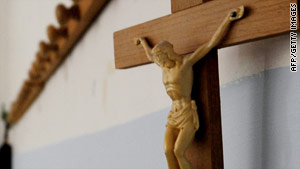
Belgium's Catholic Church released a report detailing hundreds of assertions of abuse of children by clergy.
(CNN) -- A Vatican spokesman said Monday that Pope Benedict XVI feels much pain after revelations that members of the clergy were involved in widespread sexual abuse of children from the 1950s through the 1980s in Belgium.
"The publishing of this report is a new cause of pain for us, for the victims," Father Federico Lombardi said.
The announcement came after leaders of the church in Belgium said Catholic priests who abused children should tell their superiors.
"We want to repeat this call with force," said Bishop Johan Bonny, the bishop of Antwerp. "It is to everyone's advantage that the abuser in a pastoral relationship communicates this fact to his superior" or to a new "center for investigation, healing and reconciliation," which he announced Monday.
The church has identified four experts to start preparatory work on the center, he said, but he did not name them.
Belgian church officials will begin interviews Tuesday as a follow-up to a church-backed investigation that detailed hundreds of assertions of sexual abuse of children by clergy and others working for the church from the 1950s into the late 1980s. It was led by Dr. Peter Adriaenssens, who is both a church investigator and a psychiatrist.
"From the mistakes of the past, we wish to take the necessary lessons," said Archbishop Andre-Joseph Leonard, the head of the Catholic Church in Belgium. "In the interviews that will be conducted from tomorrow, we will consider the relevant reflexions and proposals of Professor Adriaenssens."
The process will take time, because "it is impossible to try to resolve these traumatic experiences too quickly," Leonard said.
It is to everyone's advantage that the abuser in a pastoral relationship communicates this fact to his superior.
--Bishop Johan Bonny
"We want to commit ourselves to giving the maximum support for the victims," he said. "We must listen to their questions in order to restore their dignity and help heal the suffering they have endured."
The commission said it received about 500 reports from alleged victims, about 60 percent of them from males.
It cited 320 alleged abusers, of whom 102 were known to have been clergy members from 29 congregations.
Thirteen of the alleged victims committed suicide, it said.
"We can say that not a single congregation escaped sexual abuse of minors by one or more of its members," the Commission on Church-Related Sexual Abuse Complaints said Friday.
"The stories they contain and suffering make us shudder," Leonard said.
Linda Opdebeeck told CNN that her abuse as a Belgian schoolgirl did not begin immediately.
"He had a little room at school, and when you had a problem, you could go to him," she said. "He was very charismatic; he was very friendly. I was alone. I didn't have brothers or sisters. I was an only child. I was fat, and I was lonely. So I went to him in his little room, and he listened to me, and I had a nice feeling. But a year later, he started to abuse me."
But Opdebeeck, now in her 40s, said she felt unable to tell anyone else what was going on.
"I knew I had to be silent because he was a friend of my parents," she said. "What could I say? He was always saying that I had to shut up or something bad would happen to me."
Years later, she confronted him but found little satisfaction. "There were three men at the table, and he was just telling that he didn't remember any more, and it wasn't so bad, and I had to feel pity because he was old," she said. "It seems to me that the victims are the abusers and the abusers are the victims when you hear them speaking about 'Just forgive us and continue your life.' "
The abuse, she said, has had an impact on her faith. "I try to separate my faith and the church, but it's very hard," she said. "Perhaps there is a God, but then he has nothing to do with all the men there. No. The church is finished."
In last week's report, investigators had information about when the abuse started for 233 of the alleged victims. Forty-eight were 12; one was 2; five were 4; eight were 5; seven were 6; ten were 7.
Of the 230 alleged victims about whom investigators said they had reliable information, more than 70 percent are currently between the ages of 40 and 70, it said. Ten percent are 31 to 40.
Four alleged victims are 20 to 30 years of age, and one is younger than 20, it said.
At the other end of the scale, five alleged victims are aged between 80 and 90 years old, and one is older than 90.
Belgian police raided Catholic Church headquarters in the country this year and questioned a cardinal over allegations of a cover-up by the church.
Belgian police questioned Gotfried Danneels, the country's former Catholic archbishop, for about 10 hours over accusations he knew of sexual abuse in the church but failed to stop it, the Belgian prosecutor's office said in July.
Danneels was being considered a witness but could become a suspect, prosecutor's spokesman Joseph Colain said.
Danneels, who was questioned July 5, could be interrogated again as the investigation continues, Colain said.
Danneels was archbishop of Belgium for more than 30 years before he stepped down in January.
Belgian police raided the national headquarters of the Catholic Church in June over allegations of child abuse, prompting an angry response from Pope Benedict XVI and other church leaders.
Investigators seized archdiocese archives covering 25 years as well as personal computers and other personal possessions, said Fernand Keuleneer, a lawyer for the archdiocese.
Police raided Danneels' private residence and the headquarters of the Catholic Church in Belgium as a meeting of bishops was taking place.
They detained the bishops and other church employees -- even the cook -- for about nine hours, the Rev. Eric De Beukelaer said.
Members of a Belgian church commission that helps sexual abuse victims resigned en masse to protest the raid a week after it took place, said De Beukelaer, a spokesman for the Mechelen-Brussels Archdiocese.
The commission worked with people who have been abused by clergy members, said the spokesman.
The Belgian Prosecutor's Office said in July that it is investigating death threats against witnesses and magistrates involved in clergy child abuse cases.
The Vatican criticized the raids but reaffirmed its "strong condemnation of any sinful and criminal abuse of minors by members of the church."
It cited "the need to repair and confront such acts in conformity with the law and teachings of the Gospels."
The Catholic Church is facing allegations that clergy members abused children in at least half a dozen countries, including the pope's native Germany, as well as Belgium, Ireland, Austria, the Netherlands and the United States.
CNN's Alex Felton and Atika Shubert contributed to this report.
.
.
.
Wednesday, November 25, 2009
Meet the President of Europe
Herman Van Rompuy
Meet the President of Europe
From the desk of Paul Belien on Fri, 2009-11-20 09:32
Herman Van Rompuy. Get used to the name. He is the first President of the European Union, which with the ratification of the Treaty of Lisbon by all the 27 EU member states in early November was transformed into a genuine United States of Europe.
The President of Europe has not been elected; he was appointed in a secret meeting of the heads of government of the 27 EU member states. They chose one of their own. Herman Van Rompuy was the Prime Minister of Belgium. I knew him when he was just setting out, reluctantly, on his political career.
To understand Herman, one must know something about Belgium, a tiny country in Western Europe, and the prototype of the EU. Belgians do not exist as a nation. Belgium is an artificial state, constructed by the international powers in 1830 as a political compromise and experiment. The country consists of 6 million Dutch, living in Flanders, the northern half of the country, and 4 million French, living in Wallonia, the southern half. The Belgian Dutch, called Flemings, would have preferred to stay part of the Netherlands, as they were until 1830, while the Belgian French, called Walloons, would have preferred to join France. Instead, they were forced to live together in one state.
Belgians do not like their state. They despise it. They say it represents nothing. There are no Belgian patriots, because no-one is willing to die for a flag which does not represent anything. Because Belgium represents nothing, multicultural ideologues love Belgium. They say that without patriotism, there would be no wars and the world would be a better place. As John Lennon sang “Imagine there’s no countries, it isn’t hard to do, nothing to kill or die for, and no religion too.”
In 1957, Belgian politicians stood at the cradle of the European Union. Their aim was to turn the whole of Europe into a Greater Belgium, so that wars between the nations of Europe would no longer be possible as there would no longer be nations, the latter all having been incorporated into an artificial superstate.
A closer look at Belgium, the laboratory of Europe, shows, however, that the country lacks more than patriotism. It also lacks democracy, respect for the rule of law, and political morality. In 1985, in his book De Afwezige Meerderheid (The Absent Majority) the late Flemish philosopher Lode Claes (1913-1997) argued that without identity and a sense of genuine nationhood, there can also be no democracy and no morality.
One of the people who were deeply influenced by Dr. Claes’s thesis was a young politician named Herman Van Rompuy. In the mid-1980s, Van Rompuy, a conservative Catholic, born in 1947, was active in the youth section of the Flemish Christian-Democrat Party. He wrote books and articles about the importance of traditional values, the role of religion, the protection of the unborn life, the Christian roots of Europe and the need to preserve them. The undemocratic and immoral nature of Belgian politics repulsed him and led to a sort of crisis of conscience. Lode Claes, who was near to retiring, offered Herman the opportunity of succeeding him as the director of Trends, a Belgian financial-economic weekly magazine. It is in this context that I made Herman’s acquaintance. He invited me for lunch one day to ask whether, if he accepted the offer to enter journalism, I would be willing to join him. It was then that he told me that he was considering leaving politics and was weighing the options for the professional life he would pursue.
I am not sure what happened next, however. Maybe word had reached the leadership of the Christian Democrat Party that Herman, a brilliant economist and intellectual, was considering leaving politics; perhaps they made him an offer he could not refuse. Herman remained in politics. He was made a Senator and entered government as a junior minister. In 1988, he became the party leader of the governing Christian-Democrats.
Our paths crossed at intervals until 1990, when the Belgian Parliament voted a very liberal abortion bill. The Belgian King Baudouin (1930-1993), a devout Catholic who suffered from the fact that he and his wife could not have any children, had told friends that he would “rather abdicate than sign the bill.” The Belgian politicians, convinced that the King was bluffing, did not want the Belgian people to know about the King’s objections to the bill. I wrote about this on the op-ed pages of The Wall Street Journal and was subsequently reprimanded by the Belgian newspaper I worked for, following an angry telephone call from the then Belgian Prime Minister, a Christian-Democrat, to my editor, who was this Prime Minister’s former spokesman. I was no longer allowed to write about Belgian affairs for foreign newspapers.
In April 1990, the King did in fact abdicate over the abortion issue, and the Christian-Democrat Party, led by Herman Van Rompuy, who had always prided himself on being a good Catholic, had one of Europe’s most liberal abortion bills signed by the college of ministers, a procedure provided by the Belgian Constitution for situations when there is no King. Then they had the King voted back on the throne the following day. I wrote about the whole affair in a critical follow-up article for The Wall Street Journal and was subsequently fired by my newspaper “for grievous misconduct”. A few weeks later, I met Herman at the wedding of a mutual friend. I approached him for a chat. I could see he felt very uncomfortable. He avoided eye contact and broke off the conversation as soon as he could. We have not spoken since.
Herman’s political career continued. He became Belgium’s Budget Minister and Deputy Prime Minister, Speaker of the Chamber of Representatives and finally Prime Minister. He kept publishing intellectual and intelligent books, but instead of defending the concept of the good, he now defended the concept of “the lesser evil.” And he began to write haiku.
Two years ago, Belgium faced its deepest political crisis ever. The country was on the verge of collapse following a 2003 ruling by its Supreme Court that the existing electoral district of Brussels-Halle-Vilvoorde (BHV), encompassing both the bilingual capital Brussels and the surrounding Dutch-speaking countryside of Halle-Vilvoorde, was unconstitutional and that Parliament should remedy the situation. The ruling came in response to a complaint that the BHV district was unconstitutional and should be divided into a bilingual electoral district Brussels and a Dutch-language electoral district Halle-Vilvoorde. This complaint had been lodged by… Herman Van Rompuy, a Flemish inhabitant of the Halle-Vilvoorde district.
In 2003, however, the Christian-Democrats were not in government and Herman was a leader of the opposition. His complaint was intended to cause political problems for Belgium’s Liberal government, which refused to divide the BHV district because the French-speaking parties in the government refused to accept the verdict of the Supreme Court. The Flemish Christian-Democrats went to the June 2007 general elections with as their major theme the promise that, once in government, they would split BHV. Herman campaigned on the issue, his party won the elections and became Flanders’ largest party.
Belgium’s political crisis dragged on from June until December 2007 because it proved impossible to put together a government consisting of sufficient Dutch-speaking (Flemish) and French-speaking (Walloon) politicians. The Flemings demanded that BHV be split, as instructed by the Supreme Court; the Walloons refused to do so. Ultimately, the Flemish Christian-Democrats gave in, reneged on their promise to their voters, and agreed to join a government without BHV being split. Worse still, the new government has more French-speaking than Dutch-speaking ministers, and does not have the support of the majority of the Flemings in Parliament, although the Flemings make up a 60% majority of the Belgian population. Herman became the Speaker of the Parliament. In this position he had to prevent Parliament, and the Flemish representatives there, from voting a bill to split BHV. He succeeded in this, by using all kinds of tricks. One day he even had the locks of the plenary meeting room changed so that Parliament could not convene to vote on the issue. On another occasion, he did not show up in his office for a whole week to avoid opening a letter demanding him to table the matter. His tactics worked. In December 2008, when the Belgian Prime Minister had to resign in the wake of a financial scandal, Herman became the new leader of the predominantly French-speaking government which does not represent the majority of Belgium’s ethnic majority group. During the past 11 months, he has skillfully managed to postpone any parliamentary vote on the BHV matter, thereby prolonging a situation which the Supreme Court, responding to Herman's own complaint in 2003, has ruled to be unconstitutional.
Now, Herman has moved on to lead Europe. Like Belgium, the European Union is an undemocratic institution, which needs shrewd leaders who are capable of renouncing everything they once believed in and who know how to impose decisions on the people against the will of the people. Never mind democracy, morality or the rule of law, our betters know what is good for us more than we do. And Herman is now one of our betters. He has come a long way since the days when he was disgusted with Belgian-style politics.
Herman is like Saruman, the wise wizard in Tolkien’s Lord of the Rings, who went over to the other side. He used to care about the things we cared about. But no longer. He has built himself a high tower from where he rules over all of us.
.
.
...
........
Apart from his fondness for haikus, and his giggle-inducing name, it's hard to think of anything interesting to say about Herman Van Rompuy, the first president of the European Council. In fact, the whole point of the Belgian's election was the avoidance of color and interest: they were looking for a low-profile eurocrat with a record of patiently building relationships, one whose focus was internal rather than external. As the Economist points out: "For all his merits, Mr Van Rompuy’s main experience of an international dispute as prime minister is the Belgo-Dutch row over the dredging of the River Scheldt."
.
But one interesting thing about Mr Van Rompuy is his Catholicism, about which he makes no bones. He was educated (drumroll, s'il vous plaît) by Jesuits in Brussels, went onto the Catholic University of Leuven, and in the 1980s wrote a book about Christendom as a modern idea. He is, in short, a bearer of the torch first lit by the Catholic architects of European unity --  De Gasperi, Schuman, Adenauer -- who, like Van Rompuy, were all Christian Democrats for whom faith and Europe went together.
 De Gasperi, Schuman, Adenauer -- who, like Van Rompuy, were all Christian Democrats for whom faith and Europe went together.
In 2004, when he was an opposition deputy, Van Rompuy objected to Turkey joining the EU in terms very similar to those used by the then Cardinal Ratzinger (h/t to Tom Heneghan at Reuters, who puts the two quotes side by side): namely that Turkey's Islamic character would dilute the Christian character of the EU.
That kind of talk makes me queasy. But I am impressed by a speech (in French) Van Rompuy gave on Caritas in Veritate which he carries on his website. It shows a sophisticated grasp of Catholic social doctrine.
Dull he may be, but I for one am delighted that at the heart of the European Union is a politician who can write (my trans):
According to [Catholic] social doctrine, the political community is at the service of the civil society from which it is born. Civil society represents the sum total of the goods, cultural or relational, which are relatively independent of politics and the economy. The state should make sure that the legal framework allows the social actors (societies, associations, organisations, and so on) to carry out their activities in total freedom; it should be ready to intervene, only if needed and in conformity with the principle of subsidiarity, in order that the interaction between freedom of association and the democratic way leads in the direction of the common good."
.
Herman Van Rompuy, we salute you.
Herman Van Rompuy, we salute you.
.
.
Source: http://www.americamagazine.org/blog/entry.cfm?blog_id=2&id=56071594-3048-741E-7370118875922051
.
P.S. Bolds and Highlights added; America Magazine is "the" Jesuit magazine in the U.S.
.


Thursday, September 17, 2009
EU leaders' pre-G20 summit in Brussels

Thomson Reuters
HIGHLIGHTS-EU leaders' pre-G20 summit in Brussels
09.17.09, 02:45 PM EDT
BRUSSELS, Sept 17 (Reuters) - The following are comments by European Union leaders in connection with their meeting on Thursday in Brussels, held to prepare for next week's Pittsburgh summit of the Group of 20 developed and emerging economies.
GERMAN CHANCELLOR ANGELA MERKEL:
On a global tax on financial market deals:
'Such a tax is reasonable on an international level. We will see if we find a common European position on that tonight.'
'For me what is paramount is that no bank and no financial institution can blackmail states.'
'Second, that we accomplish limits on bonus payments and uniform rules.'
'Third, that we draw lessons from the crisis and work on a charter for a sustainable economy.'
'I am optimistic that we can make clear that bonus payments have to be linked to long-term performance and linked to bank profits.'
BRITISH PRIME MINISTER GORDON BROWN:
On bank bonuses:
'There is no going back to the bonus structure of the past. I believe we will be able to agree on the structure of how the bonuses should be examined in the future. I am confident that at Pittsburgh there is a common will to achieve action on something that has angered the populations of almost every country.
On economy, stimulus:
'Recovery cannot be taken for granted ... I will tell my colleagues this is no time for business as usual.'
'The greatest risk we face is being too complacent about the future.'
'Until the recovery is established, all countries must implement ... stimulus packages that have been announced, not just this year, but throughout 2010.'
'So I propose that we continue and cement the more than 5 percent of global GDP, or more than $2.5 trillion, of fiscal action in the coming year.'
'With the creation and preservation of jobs uppermost in our minds in Pittsburgh and in the coming year, we must be ready to commit to even greater levels of economic cooperation.'
'I will propose tonight that the Pittsburgh summit should agree a historic global compact for long-term stability and jobs. It will be unprecedented political commitment from all G20 countries to continue to act together for the benefit of all countries and all citizens.'
'In short I am proposing an agreed process of international cooperation, with political leadership using the international institutions to create the foundations of a new system of managing our global economy.'
SWEDISH EU PRESIDENCY'S FREDRIK REINFELDT
'We need to formulate exit strategies ... the solution cannot be highly indebted countries.'
'We will discuss the return of the bonus culture ... we need to deliver on this ... it is time to say enough is enough.'
'I hope tonight we can say the bonus bubble has burst.' Keywords: EU G20/
(Brussels newsroom +32 2 287 6841, fax +32 2 230 5573)
Subscribe to:
Posts (Atom)