Showing posts with label Executive Privilege. Show all posts

Thursday, December 28, 2017

Sheila Jackson Lee’s Long History Of Being An Entitled ‘Queen’


Benny Johnson
Reporter At Large


4:42 PM 12/27/2017


Sheila Jackson Lee has been a congresswoman for over 20 years. However, she acts far more like an arrogant monarch than a humble servant of the people.

The Texas Democrat has regularly abused her power and position to demand and receive special treatment from private companies, demean and harass subordinates, and reap untold benefits of being “The Queen.

When her abusive behavior comes to light, Jackson Lee often claims her opponents are racist.

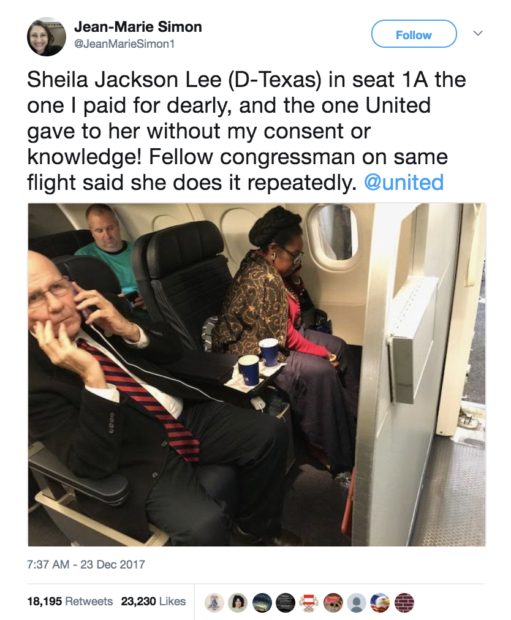
Jackson Lee’s most recent abuse of power comes at the expense of teacher Jean-Marie Simon who was allegedly bumped from her first class seat when Jackson-Lee demanded it. Simon was given a voucher for her flight by United and moved to the economy section. On her way to the back of the plane, Simon saw Jackson Lee occupying her seat.


In a Facebook post, Simon says she spoke with a congressman who said Jackson-Lee regularly poaches seats from other passengers.

“I was the last passenger on the plane. A Texas congressman, a nice guy, sat down next to me. He said was glad I had made it on the flight. I showed him my boarding pass with my seat, 1A, printed on it. He said, ‘You know what happened, right? Do you know who’s in your seat?’ I said no. He told me that it was Jackson Lee, a fellow U.S. congresswoman who regularly does this, that this was the third time he personally had watched her bump a passenger.”

In response to the accusation, Jackson-Lee called Simon racist, saying the teacher caused a stir “because I was an African American woman.”


Sunday, July 22, 2012

Obama Asserts Executive Privilege to Hide Involvement in... 'Fast and Furious'

by Susanne Posel

June 21, 2012
from OccupyCorporatism Website


In a vein effort to cover his tracks and protect his cohorts, President Barack Obama is claiming “executive privilege” regarding Fast and Furious (F&F) documents that expose their operation to smuggle weapons into Mexico by way of US agents that were handed off directly to Mexican drug cartels.

The House Oversight Committee (HOC), headed by Chair Darrell Issa, is flat out demanding that classified and undisclosed documents that show the Department of Justice (DoJ) and Attorney General Eric Holderwere directly involved with the F&F operation.

Just as the Oversight Committee votes on holding Holder in contempt or not, Obama claims a thinly veiled retreat; perhaps to mitigate his exposed connection to the DoJ’s involvement in the ruined operation.

Holder had attempted to subvert responsibility by offering to negotiate with Congress; yet Issa refused, moving forward with a motion for contempt of Congress.

Issa asserts:

“The committee has uncovered serious wrongdoing by the Justice Department. That wrongdoing has cost lives on both sides of the border.”

James Cole, Deputy Attorney General for the DoJ, wrote a letter to Issa acknowledging Holder’s,

“failure to comply with the Committee’s subpoena of October 11, 2011” however they claim they have made an “extraordinary effort to accommodate the Committee’s legitimate oversight interests” and provided “over 7,600 pages of documents and has made numerous high-level officials available for public congressional testimony, transcribed interviews, and briefings.”

The DoJ is choosing to call out their authority and hope to intimidate the HOC into ceasing all pursuant activity.

By citing that the DoJ’s Attorney General has opened an investigation in F&F, and that it is ongoing, supplants nothing. It only ensures by their words that getting caught during a covert operation will “not occur again.”

Holder and Obama have been discussing how to handle the F&F scandal. Choosing to hide under the cover of US presidency has only stood to fuel questions about Obama’s participation, knowledge and role in the operation.

Earlier this week, Holder advised Obama to use his executive privilege card concerning the internal documents of the F&F operations that would,

“have significant, damaging consequences.”

Holder went on to explain that handing over the documents to Congress,

“would inhibit candor of such Executive Branch deliberations in the future and significantly impair the Executive Branch’s ability to respond independently and effectively to congressional oversight.”

In an effort to downplay Obama’s use of executive privilege, Eric Schultz, White House spokesman said:

“dating back to President Reagan, presidents have asserted executive privilege 24 times. President Obama has gone longer without asserting the privilege in a congressional dispute than any president in the last three decades.”

However House Speaker John Boehner points out that Obama’s choice,

“implies that White House officials were either involved in the ‘Fast and Furious’ operation or the cover-up that followed.”

Executive privilege can be overturned with a court order, however history shows it is resolved mostly through negotiations .

The HOC has decided to hold Holder in contempt for failing to cooperate with their congressional inquiry into F&F.

Holder asserted that the HOC action was,

“divisive” and “does nothing to make any of our law enforcement agents safer.”

He maintains that his job is to “protect the American people” and this Committee is subverting his efforts to execute his job properly.

The family of Border Patrol Agent Brian Terry, who was killed by member of a Mexican drug cartel with guns that the DoJ provided them through F&F, has come forth to respond to Obama’s use of executive privilege.

Their statement reads that,

“President Obama’s assertion of executive privilege serves to compound this tragedy. It denies the Terry family and the American people the truth.”

The Terry family have been requesting for over a year and a half for the US government to hold those responsible within the government to “justice and accountability”.

They recognize that it is very,

“disappointing that [the Terry family] are now faced with an administration that seems more concerned with protecting themselves rather than revealing the truth behind Operation Fast and Furious.”


Source

.

Sunday, June 24, 2012

Darrell Issa: President’s Executive Privilege Claims ‘Simply Wrong’

Jun 24, 2012 10:05am


(ABC News)


Rep. Darrell Issa, R-Calif. said this morning on “This Week” that he will send a letter to President Obama today or tomorrow that “breaks down the points” of why the president’s executive privilege claims are “overbroad” or “simply wrong” concerning documents related to the botched “Fast and Furious” operation.

“There cannot be executive privilege over criminal cover-up or cover-up of crime. Lying to Congress is a crime. We have every right to see documents to say, ‘did you know, when did you know, what did you know,’ including even the president,” said Issa, who heads the House Oversight and Government Reform Committee.
Issa outlined this morning that before the House committee he leads voted to hold Attorney General Eric Holder in contempt, he tried to reach an agreement with Holder.

“They came with nothing. Not even an offer in a form of a piece of paper. What they said orally was ‘we will brief you. We will then give you the information we believe supports that briefing, but you have to first agree to dismiss your subpoenas and your contempt,” said Issa. “You can’t play liar’s poker when you’re looking for who killed somebody, when you’re looking into this kind of a crime, and when you’re looking into the cover-up. Remember, it was deny, delay, and recuse.”

Issa said he is specifically seeking access to a memo or email produced by Jason Weinstein, Deputy Assistant Attorney General at the Justice Department. The memo, confirmed to exist, is an evaluation of what happened during the “Fast and Furious” operation and, according to Issa, could answer crucial questions relating to his investigation.

On Wednesday, President Obama invoked executive privilege for the first time during his term in office just before a House committee headed by Issa voted to hold Attorney General Eric Holder in contempt of Congress for failing to provide documents related to the failed “Fast and Furious” operation that were subpoenaed more than 8 months ago. The use of executive privilege, while a rarity for the Obama administration, was used 14 times by Bill Clinton and six times by George W. Bush.

Holder is the first Obama administration official to be held in contempt of Congress. For his part, Holder called the contempt vote “extraordinary, unprecedented and entirely unnecessary.” The full House of Representatives plans to vote on whether to hold Holder in contempt of Congress in coming days. If the full House finds Holder in contempt, the matter would be handed over to the Justice Department and Holder could eventually be prosecuted.

Guns lost in the “Fast and Furious,” operation, which was originally meant to track the flow of firearms between the United States and Mexican drug cartels, were found near the scene of Border Patrol Agent Brian Terry’s killing in 2010, which sparked outrage.

video platformvideo managementvideo solutionsvideo player


Source

,

Wednesday, June 20, 2012

Fast and Furious scandal: House panel votes to hold Eric Holder in contempt


Video: The House Government and Oversight Reform Committee voted 23 to 17 to hold Attorney General Eric Holder in contempt for failing to share documents related to Operation “Fast and Furious.”


A House panel voted Wednesday to hold Attorney General Eric H. Holder Jr. in contempt for failing to cooperate with a congressional inquiry into Operation “Fast and Furious,” hours after President Obama asserted executive privilege over related documents.

By Ed O’Keefe, Peter Wallsten and Sari Horwitz, Updated: Wednesday, June 20, 4:55 PM

On a party-line decision, the House Oversight and Government Reform Committee voted 23 to 17 to hold Holder in contempt for failing to share documents related to the operation run out of the Phoenix division of the Bureau of Alcohol, Tobacco, Firearms and Explosives between 2009 and 2011, with the backing of the U.S. attorney in Phoenix. The move makes Holder the first member of Obama’s Cabinet held in contempt by a congressional committee
.


The panel’s actions will be reported to the full House, where Speaker John A. Boehner (R-Ohio) and GOP leaders have scheduled a floor vote for next week unless Holder hands over the documents before then. If passed by the House, the matter would then move to the U.S. attorney for the District of Columbia, Ronald C. Machen Jr., who is an employee of the Justice Department.

After the vote, Holder called the vote a “divisive action” that “does nothing to make any of our law enforcement agents safer.”

“It’s an election-year tactic intended to distract attention -- and, as a result -- has deflected critical resources from fulfilling what remains my top priority at the Department of Justice: Protecting the American people,” Holder said.

Obama’s decision to withhold the documents — his first use of executive privilege in response to a congressional investigation — and the House panel’s vote quickly intensified a long-simmering feud between the White House and Republican lawmakers and set up a clash over the extent of presidential power that may take months to resolve.

Ahead of the vote, Holder said in a letter to Obama that sharing the Fast and Furious documents “would raise substantial separation of powers concerns and potentially create an imbalance in the relationship” between Congress and the White House.

Releasing the documents “would inhibit candor of such Executive Branch deliberations in the future and significantly impair the Executive Branch’s ability to respond independently and effectively to congressional oversight,” Holder wrote.

Adding to the administration's defiance, White House Communications Director Dan Pfeiffer accused Republicans Wednesday of orchestrating a “taxpayer-funded election-year fishing expedition.”

“Given the economic challenges facing the country,” Pfeiffer said in a statement, “we believe that House Republicans should work with the rest of Congress and the president to create more jobs, not more political theater.”

Executive privilege has been invoked throughout U.S. history by presidential administrations to preserve the confidentiality of information in the face of legislative inquiries. The privilege is qualified, not absolute, and can be overturned in courts. But disputes over access to information rarely reach the courts and are most often resolved through political negotiations, according to the Congressional Research Service.

Before the vote, oversight chairman Darrell Issa (R-Calif.) said Obama’s move “falls short of any reason to delay today’s proceedings.”

“If the Justice Department had delivered the documents they freely admitted they could have delivered, we wouldn't be here today,” Issa said.

Aides said Issa learned of the president’s decision just minutes before the hearing began in an e-mail from Justice Department officials.

Congressional committees have held Executive Branch officials in criminal contempt of congress roughly a dozen times in the last 40 years. Usually, administration officials have cited executive privilege in refusing to share information, but eventually turn over requested documents before congressional committees reach the final stages of contempt proceedings, according to the CRS.

The attorney general attempted to stave off Wednesday's vote by meeting late Tuesday with leaders of the House oversight and Senate Judiciary committees to strike a deal that would have Justice hand over requested documents in exchange for the House panel dropping its plans to vote on contempt charges. But Issa declined the offer.

Committee Democrats criticized Issa's decision to move forward and blasted him for allowing the dispute to become a personal attack on Holder instead of a serious inquiry into Justice Department policy.

“We’ve been holding the attorney general to an impossible standard,” said Rep. Elijah Cummings (Md.), the panel's ranking Democrat.

“You accused him of a ‘cover-up' for protecting documents he was prohibited by law from producing. You claimed that he ‘obstructed’ the committee’s work by complying with federal statutes passed by both houses of Congress and signed by the president," Cummings said. “And earlier this month, you went on national television and called the attorney general — our nation’s chief law enforcement officer — a liar.”

Rep. Gerald E. Connolly (D-Va.) later called Wednesday’s hearing “a kangaroo court” with a predetermined outcome. Rep. Edolphus Towns (D-N.Y.) said he had never seen such personal attacks directed at an administration official during his three decades in Congress: “I think this is a major mistake and I really want you to know that this should be discontinued.”

But Rep. Ann Marie Buerkle (R-N.Y.) and other GOP lawmakers said the ongoing inquiry is a legitmiate, serious concern: “The people in my district ask over and over again, who’s responsible for this flawed operation? … We owe this answser to the American people. That is what this committee is charged to do.”

The White House, in asserting a privilege that many Democrats had attacked the George W. Bush administration for using, risked opening itself up to further criticism for secrecy.

Apparently seeking to preempt such attacks, White House spokesman Eric Schultz said via e-mail Wednesday that Obama has shown greater reluctance to use executive privilege than his predecessors. Dating back to Reagan, Schultz said, presidents have asserted the privilege 24 times.

“President Obama has gone longer without asserting the privilege in a Congressional dispute than any President in the last three decades,” Schultz wrote. He said Bush asserted executive privilege six times and President Clinton 14 times – “both of whom protected the same category of documents we’re protecting today.”

The failed talks with Issa were cited Wednesday morning in a letter to the congressman by Deputy Attorney General James M. Cole, in which Cole cited the administration’s “extraordinary effort” to comply with the House committee’s requests for information and documents and said the congressman had “rejected” offers by the attorney general to accommodate his requests.

In his statement, Pfeiffer said the concerns with the ATF’s gunwalking program began during the Bush administration and that Holder had moved to end the policy. “In fact, the Justice Department has spent the past 14 months accommodating Congressional investigators, producing 7,600 pages of documents, and testifying at 11 Congressional hearings. Yet, Republicans insist on moving forward with an effort that Republicans and objective legal experts have noted is purely political.”

Though Issa's inquiry has the support of House Republican leaders, the face-off with Holder has grabbed attention from the carefully-orchestrated summer plans of GOP leaders to hold votes in the months before the November elections on bills designed to bolster job creation and reduce federal regulatory burdens.

On Wednesday, Boehner spokesman Michael Steel said the president's decision to use executive privilege “implies that White House officials were either involved in the ‘Fast and Furious’ operation or the cover-up that followed. The administration has always insisted that wasn’t the case. Were they lying, or are they now bending the law to hide the truth?”

Issa scheduled the committee vote after concluding with Boehner and other GOP leaders in recent weeks that the Justice Department was withholding information sought as part of the committee’s investigation into the scandal. Boehner, House Majority Leader Eric Cantor (R-Va.) and Issa co-signed a letter last month to Obama asking that Holder comply with the congressional requests for information.

In Operation Fast and Furious, federal agents targeting the Mexico-based Sinaloa drug cartel did not interdict more than 2,000 guns they suspected of being bought illegally, in the hope of later tracking them to the cartel. The ATF lost track of most of the firearms, some of which have been found at crime scenes in Mexico and the United States.

Two of the guns connected to the botched operation were found at the Arizona site where U.S. Customs and Border Protection agent Brian Terry was killed in December 2010.

In recent weeks, Issa narrowed his request to the internal Justice deliberations since early February 2011, when Sen. Charles E. Grassley (R-Iowa) first began asking Justice about Fast and Furious. On Feb. 4, 2011, the Justice Department sent the committee a letter denying use of the “gunwalking” tactics used in Fast and Furious. Officials were later forced to retract the letter after whistleblowers came forward and said they had used those very tactics.

Issa also has asked Justice for all documents related to the treatment of the whistleblowers.

Obama’s assertion of privilege is likely to become fodder for his political opponents, who have latched onto the Fast and Furious scandal as a way to accuse the president of trying to avoid congressional scrutiny.

Within minutes of the White House announcement, conservative Web sites lit up with quotes from then-candidate Obama in 2007, who joined fellow Democrats in criticizing Bush administration officials for refusing to testify before congressional committees investigating the firing of U.S. attorneys.

“You know, there’s been a tendency on the part of this [Bush] administration to -- to try to hide behind executive privilege every time there’s something a little shaky that’s taking place,” Obama told CNN’s Larry King Live then. “And I think, you know, the administration would be best served by coming clean on this.”


Staff researcher Alice Crites contributed to this report.


Obama invokes executive privilege over Fast and Furious documents

President Obama
President Obama (Paul J. Richards / AFP Getty Images)

By Richard A. Serrano
June 20, 2012, 8:18 a.m. (Pacific)

WASHINGTON — Just as the House Committee on Oversight and Government Reform was about to vote Eric H. Holder Jr. in contempt of Congress for failing to comply with a subpoena for documents in the flawed Fast and Furious gun-tracking case, President Obama asserted executive privilege and backed up the attorney general’s position in refusing to turn over the material.

The fast-moving events Wednesday morning at the White House and on Capitol Hill significantly ratcheted up a growing constitutional clash between the two branches of the federal government, one that ultimately may not be resolved until it reaches the courts.

The Republican-led committee, chaired by Rep. Darrell Issa (R-Vista), will ask the full House for a floor vote holding Holder in contempt and requesting the U.S. Attorney in Washington, D.C., or a special prosecutor to force the attorney general to produce the documents.

“The committee has uncovered serious wrongdoing by the Justice Department,” Issa said of his investigation into Fast and Furious, in which several thousand firearms were deliberately circulated along the Southwest border and ended up in the hands of Mexican drug cartels. “That wrongdoing has cost lives on both sides of the border.”

Moments before the committee hearing, the White House announced that Obama had formally exerted executive privilege in the matter, giving Holder cover from releasing the material to the committee.

“We regret that we have arrived at this point,” Deputy Atty. Gen. James M. Cole told Issa in a letter that arrived on the Hill just before the committee went into session.

He said making the documents public “would have significant, damaging consequences,” but he did not disclose whether Obama has been briefed or had another supervisory role in Fast and Furious.

In a separate letter that Holder wrote to Obama shortly before the committee session, asking for executive privilege, the attorney general said he had “concluded that you may properly assert executive privilege over the documents at issue, and I respectfully request you do so.” Holder also did not mention any involvement by Obama in Fast and Furious.

According to the Obama White House, President George W. Bush asserted executive privilege six times during his two terms, and President Bill Clinton 14 times during his eight years in Washington.

“In fact,” said Eric Schultz, an Obama White House spokesman, “dating back to President Reagan, presidents have asserted executive privilege 24 times. President Obama has gone longer without asserting the privilege in a congressional dispute than any president in the last three decades.”

Republicans said Obama's move raises serious questions.

Sen. Chuck Grassley, ranking member of the Senate Judiciary Committee, asked how Obama could assert executive privilege "if there is no White House involvement?"

A spokesman for House Speaker John Boehner said Obama's move "implies that White House officials were either involved in the 'Fast and Furious' operation or the cover-up that followed."

"The administration has always insisted that wasn't the case. Were they lying, or are they now bending the law to hide the truth?" Brendan Buck said.

Staff writer Michael A. Memoli contributed to this report


P.S.
I Wonder: How many fundraiser stops (and teleprompter photo-ops) the president will have today?
.
.

Friday, September 23, 2011

Solyndra Execs take the Fifth


Solyndra Execs Stonewall Congress - 1 hour ago
told the Solyndra executives. "We're not done. No we're not." The decision of Solyndra CEO Brian Harrison and Chief Financial Officer WG Stover to ...ABC News - 1608 related articles


Solyndra Execs Plead Fifth At Congressional Hearing More Than A ...2 hours ago ... Top executives from a bankrupt California solar energy ...www.foxnews.com/.../solyndra-execs-plead-fifth-at-congressional-hearing-more-than-dozen-times/ - Similar


Solyndra Executives To Plead Fifth At Congressional Hearing Fox ...2 days ago ... The chairman of the House Oversight and Government Reform Committee said Tuesday that his panel will probe government loan programs ...www.foxnews.com/.../lawmakers-pursue-investigations-into-solyndra-loan/ - Cached - Similar


Monday, September 27, 2010

Report: US would make Internet wiretaps easier

– 1 hr 22 mins ago

WASHINGTON – Broad new regulations being drafted by the Obama administration would make it easier for law enforcement and national security officials to eavesdrop on Internet and e-mail communications like social networking Web sites and BlackBerries, The New York Times reported Monday.

The newspaper said the White House plans to submit a bill next year that would require all online services that enable communications to be technically equipped to comply with a wiretap order. That would include providers of encrypted e-mail, such as BlackBerry, networking sites like Facebook and direct communication services like Skype.

Federal law enforcement and national security officials say new the regulations are needed because terrorists and criminals are increasingly giving up their phones to communicate online.

"We're talking about lawfully authorized intercepts," said FBI lawyer Valerie E. Caproni. "We're not talking about expanding authority. We're talking about preserving our ability to execute our existing authority in order to protect the public safety and national security."

The White House plans to submit the proposed legislation to Congress next year.

The new regulations would raise new questions about protecting people's privacy while balancing national security concerns.

James Dempsey, the vice president of the Center for Democracy and Technology, an Internet policy group, said the new regulations would have "huge implications."

"They basically want to turn back the clock and make Internet services function the way that the telephone system used to function," he told the Times.

The Times said the Obama proposal would likely include several requires:

-Any service that provides encrypted messages must be capable of unscrambling them.

-Any foreign communications providers that do business in the U.S. would have to have an office in the United States that's capable of providing intercepts.

-Software developers of peer-to-peer communications services would be required to redesign their products to allow interception.

The Times said that some privacy and technology advocates say the regulations would create weaknesses in the technology that hackers could more easily exploit.
.
Source
.

Wednesday, July 16, 2008

Bush claims executive privilege on CIA leak

President Bush gestures in the briefing room of the White House in Washington, Tuesday, July 15, 2008, where he called on Congress to move quickly to put into force legislation designed to prop up mortgage giants Fannie Mae and Freddie Mac. (AP Photo/Ron Edmonds)

AP Photo: President Bush gestures in the briefing room of the White House in Washington, Tuesday, July...

By LAURIE KELLMAN, Associated Press Writer 24 minutes ago

WASHINGTON - President Bush has asserted executive privilege to prevent Attorney General Michael Mukasey from having to comply with a House panel subpoena for material on the leak of CIA operative Valerie Plame's identity.

A House committee chairman, meanwhile, held off on a contempt citation of Mukasey — who had requested the privilege claim — but only as a courtesy to lawmakers not present.

Among the documents sought by House Oversight Chairman Henry Waxman are FBI interviews of Vice President Dick Cheney.

They also include notes about the 2003 State of the Union address, during which President Bush made the case for invading Iraq in part by saying Saddam Hussein was pursuing uranium ore to make a nuclear weapon. That information turned out to be wrong.

Waxman rejected Mukasey's suggestion that Cheney's FBI interview on the CIA leak should be protected by the privilege claim — and therefore not turned over to the panel.

"We'll act in the reasonable and appropriate period of time," Waxman, D-Calif., said. But he made clear that he thinks Mukasey has earned a contempt citation and that he'd schedule a vote on the matter soon.

"This unfounded assertion of executive privilege does not protect a principle; it protects a person," Waxman said. "If the vice president did nothing wrong, what is there to hide?"

The assertion of the privilege is not about hiding anything but rather protecting the separation of powers as well as the integrity of future Justice Department investigations of the White House, Mukasey wrote to Bush in a letter dated Tuesday. Several of the subpoenaed reports, he wrote, summarize conversations between Bush and advisers — are direct presidential communications protected by the privilege.

"I am greatly concerned about the chilling effect that compliance with the committee's subpoena would have on future White House deliberations and White House cooperation with future Justice Department investigations," Mukasey wrote to Bush. "I believe it is legally permissible for you to assert executive privilege with respect to the subpoenaed documents, and I respectfully request that you do so."

White House spokesman Tony Fratto said Bush invoked the privilege on Tuesday.

Waxman said he would wait to hold a vote on Mukasey's contempt citation until all members of the panel had a chance to read up on the matter.

The Bush administration had plenty of warning. Waxman warned last week that he would cite Mukasey with contempt unless the attorney general complied with the subpoena. The House Judiciary Committee also has subpoenaed some of the same documents from Mukasey, as well as information on the leak from other current and former administration officials.

Congressional Democrats want to shed light on the precise roles, if any, that Bush, Cheney and their aides may have played in the leak.

State Department official Richard Armitage first revealed Plame's identity as a CIA operative to columnist Robert Novak, who used former presidential counselor Karl Rove as a confirming source for a 2003 article. Around that time Plame's husband, former Ambassador Joseph Wilson, was criticizing Bush's march to war in Iraq.

Cheney's then-chief of staff, I. Lewis "Scooter" Libby, also was involved in the leak and was convicted of perjury, obstruction and lying to the FBI. Last July, Bush commuted Libby's 2 1/2-year sentence, sparing him from serving any prison time.

Libby told the FBI in 2003 that it was possible that Cheney ordered him to reveal Plame's identity to reporters.

___

Associated Press writer Lara Jakes Jordan contributed to this report.

Source: http://news.yahoo.com/s/ap/20080716/ap_on_go_pr_wh/cia_leak