Showing posts with label conflict interest. Show all posts

Saturday, May 02, 2015

Christiane Amanpour named UNESCO Goodwill Ambassador for Freedom of Expression


U.N. - Top StoriesWednesday 29th April, 2015


29 April 2015 - The United Nations agency mandated to promote and protect press freedom worldwide has named renowned journalist and CNN Chief International Correspondent Christiane Amanpour its Goodwill Ambassador for Freedom of Expression and Journalist Safety.

Ms. Amanpour received the honour during a ceremony at UN Educational, Scientific and Cultural Organization (UNESCO) headquarters in Paris.

UNESCO Director-General Irina Bokova praised Ms. Amanpour for "her efforts to promote free, independent and pluralistic media, having the right to work free from the threat of violence, and contributing through this to peace, sustainability, poverty eradication and human rights."

"In the most challenging situations, addressing the most demanding interlocutors" said the Director-General, "integrity and courage have always guided you, with the conviction that freedom of expression, media freedoms are essential for stronger societies, for healthier democracies, for peace and reconciliation as well as sustainable development "we need to defend these principles more than ever today, at a time when they are challenged across the world."

In her acceptance speech, Ms. Amanpour stressed the important role of journalists as "pillars of reform, freedom and democracy" whose task is to "strengthen civil society."

"We"re here to make the world a better place" she said. She also made an impassioned plea for the release of all imprisoned journalists, wherever they may be, and condemned the increasing number of attacks and assassinations of media professionals.

Ms. Amanpour has won every major television journalism award, including 11 News and Documentary Emmy Awards, four Peabody Awards, two George Polk Awards, three duPont-Columbia Awards and the Courage in Journalism Award.

She has also received nine honorary degrees, has been named a Commander in the Most Excellent Order of the British Empire (CBE) and was this year inducted into the Cable Hall of Fame. She is a member of the board of directors of the Committee to Protect Journalists, one of UNESCO"s partners in its work for freedom of expression and journalists" safety.

UNESCO Goodwill Ambassadors are a group of personalities who use their talent and status to help shine a light on the work of the Organization in education, science, culture and communication.


.

Wednesday, April 22, 2015

Pope Francis to stop in Cuba en route to U.S., Vatican announces


Pope Francis salutes the crowd as he arrives for his weekly general audience in St. Peter's Square at the Vatican on April 22. (Filippo Monteforte / AFP/Getty Images)


By TRACY WILKINSON
Pope Francis
Cuba
Vatican City

Pope Francis will visit Cuba on his way to the United States in late September, the Vatican announces
Pope Francis on Wednesday confirmed he will travel to Cuba before his trip to the United States in September.

His spokesman, Father Federico Lombardi, announced at the Vatican that Francis had accepted the invitations of Cuban government officials and the island’s Roman Catholic bishops to visit.


Francis’ decision comes at a time of a historic renewal of diplomatic ties between the United States and Cuba after more than half a century, a breakthrough for which the pope has received much credit. Adding Cuba to the itinerary seals that accomplishment, in which he served as a bridge between the two erstwhile enemies.

As The Times reported in December after Presidents Obama and Raul Castro announced the thaw in relations, Francis had worked behind the scenes, steering complex negotiations between representatives of the two governments and then overseeing the final talks in Rome in October.


8


"Today we are all happy because we have seen how two peoples, who were far apart for many years, yesterday took a step to get closer," Francis said after the presidents’ announcement.

The first pontiff from the Americas, Francis, an Argentine and a Jesuit, is scheduled to begin a three-city tour of the United States on Sept. 23. His agenda includes speeches at the United Nations in New York and before Congress in Washington. In addition, he will meet with Obama and speak to a gathering of Catholic families in Philadelphia.


Both of Francis’ previous two predecessors also traveled to Cuba. In the first such trip by a pontiff, John Paul II went in 1998 for a groundbreaking meeting with Fidel Castro that is largely credited with the beginnings of slightly more freedom for the island’s Catholics.

Benedict XVI followed in 2012, when he saw Fidel’s successor, brother Raul Castro, and offered an important boost to Cardinal Jaime Ortega, who was also engaged in a form of rapprochement with the Communist government.

Benedict at the time reiterated long-standing Vatican positions -- condemning both Marxism and the U.S. embargo against Cuba -- but he recognized the beginnings of change.

“It must be said with joy that in Cuba, steps have been taken to enable the church to carry out her essential mission of expressing her faith openly and publicly," Benedict said in Havana.

"Nonetheless, this must continue forward, and I wish to encourage the country's government authorities to strengthen what has already been achieved and advance along this path of genuine service to the true good of Cuban society as a whole."

Mario Paredes, an expert on the church in Latin America with the American Bible Society, said Francis' decision to travel to Cuba was in keeping with his commitment to helping Latin America come to terms with the role the Cuban Revolution played in the region.

Paredes noted that the then-archbishop of Buenos Aires, Jorge Mario Bergoglio, who would later become Pope Francis, wrote a book about the first papal visit to the island in 1998, entitled "Dialogue between John Paul II and Fidel Castro."

"Even then he was already reflecting on Cuba and in defense of dialogue ... as a way of mending situations marred by mistrust and confrontation," Paredes said in a telephone interview from New York.

Follow @TracyKWilkinson on Twitter for more news from Latin AmericaCopyright © 2015, Los Angeles Times

UPDATES

10:50 a.m.: This article has been updated with comment from Mario Paredes.

10:19 a.m.: This article has been updated throughout with staff reporting and background.

This article was originally posted at 7:25 a.m.


.

Wednesday, July 23, 2014

Is fundraising interfering with President Obama's duties?


JULY 23, 2014, 6:36 PM|


President Obama has attended 398 fundraisers since taking office -- and this month's world and domestic issues have not slowed him down. After the Malaysia Airlines crash, President Obama kept his fundraising schedule in New York and chose to call world leaders from Air Force One. Major Garrett reports.


.

Wednesday, January 22, 2014

Thousands defend Holy See's UN status against attacks


United Nations Headquarters in New York City. Credit: UN Photo/John Isaac.

New York City, N.Y., Jan 21, 2014 / 04:35 am (CNA).- Catholics have joined with members of other faiths to support the Holy See's permanent observer status at the United Nations, defending against a group of abortion proponents seeking to oust the body from the international organization.

“The Holy See’s special status enables it to encourage genuine dialogue, promote peaceful resolution of conflicts, and appeal beyond the mere territorial interests of states to the consciences of their leaders,” said a declaration and petition supporting the Holy See's unique presence in world diplomacy.

The statement explained that the Holy See's “disinterested, non-partisan service has always been appreciated by the member states at the United Nations.”

“We join with the Member States in gratitude for the spiritual and moral witness of the Holy See at the United Nations,” it continued. “The world would be far poorer if the voice of the Holy See within the United Nations were ever silenced. May that day never come.”

The declaration and petition was launched by the Catholic Family and Human Rights Institute Jan. 17. Three days later, it had accumulated more than 3,000 signatures.

Austin Ruse, the institute’s president, said the petition campaign is a response to efforts to remove the Holy See from the U.N. General Assembly.

“The Holy See is the conscience of the UN. It is the only delegation that does not have political considerations in how they negotiate. They negotiate purely from first principles,” he said.

Drafted by Princeton Law School professor Robert P. George and William Saunders of Americans United for Life, the declaration noted that the Holy See has been working in diplomacy since the fourth century A.D. It now has diplomatic relations with 177 nations.

The declaration charged that opponents of the Vatican's presence at the U.N. dislike the Holy See’s “steadfast defense of the sanctity of human life and the inviolable dignity of the family.”

“Certain organizations, in the name of a false ‘liberation,’ seek to undermine central truths regarding the nature of the human person and of the family. In the name of a false doctrine of human rights, they deny what makes men truly human and violate true human rights,” the statement said.

The abortion advocacy group “Catholics for Choice” has been a longtime opponent of the Holy See’s permanent observer status. The U.S. bishops have warned that this group is “not a Catholic organization” but promotes teachings “contrary to the teaching of the Church.”

The group’s president, John O’Brien, used the Holy See representatives’ recent appearance at a hearing of the U.N. Committee on the Rights of the Child to criticize the permanent observer mission.

He that the Holy See “inexplicably … continues to enjoy the privileges of a state at the U.N.”

“The Holy See has no right to a seat at the U.N. and should not be signing these treaties and conventions,” he argued Jan. 16.

The Holy See’s representatives at the Jan. 16 hearing condemned violence against children and child exploitations, saying that the Vatican in recent years has made child protection a “priority.”

Signatories of the petition deplored efforts to end the Holy See’s permanent observer status, charging that these groups see the Vatican as “an obstacle to their goals of re-engineering humanity and revising basic moral understandings.”

“While many of us do not share or endorse the claims of the Catholic Church, we are united in supporting the Holy See’s continued role as permanent observer at the United Nations,” the document said.

A similar declaration was launched in the year 2000, gaining support from Protestant and Muslim groups as well as Catholics.

Ruse urged supporters of the Holy See’s U.N. presence to sign the petition and ask others to do so.

The signatories will be presented to representatives of the Holy See in New York, Geneva and Rome sometime before the end of 2014.

The petition can be viewed in full at www.defendtheholysee.org.


Source
.

Wednesday, January 15, 2014

U.S Secretary John Kerry thinks Pope can intervene in Middle East peace process


2014-01-14


Msgr. Pietro Parolin welcomed U.S. Secretary of State John Kerry for a very brief meeting at the Vatican.


Now, I'm headed to Kuwait to do a major conference for Syrian refugees.

The short visit underscores the pivotal role Pope Francis has gained in international affairs since taking office.

John Kerry made the pit stop in Rome to discuss the peace process between Israel and Palestine. In the past months, he pushed for negotiations, but with no success so far.

Thank you so much for arranging this, and thank you so much for doing this on short notice.

With Pope Francis visiting the Holy Land in May, the United States sees the Pope as a key ally in pushing both sides to the negotiating table.


The meeting lasted an hour and forty minutes. Both two secretaries also talked about Syria, South Sudan, and the healthcare reform in the U.S., a big sticking point between the government and American bishops.

Before saying goodbye, Kerry introduced some of his staff. His assistant secretary of state had special words for Msgr. Parolin about the Pope.

I would like to say that Pope Francis is exciting for non-Catholics as well.

That is very good news. Thank you.


RCA
CTV
JM
-PR
Up: KLH


.

Sunday, June 30, 2013

Tangled Web: Claire Shipman, ABC Reporter/Wife to Top Obama Aide, Headlines White House Events


By Scott Whitlock | June 27, 2013 | 15:36


ABC's Claire Shipman isn't just another pro-Obama journalist. She's also married to Jay Carney, the President's press secretary. If that wasn't enough of a conflict, Jeffrey Lord of the American Spectator recently revealed that Shipman has served on a White House panel in her official capacity as a journalist.

A series of 2010 videotapes shows Shipman's role in the "Council on Women and Girls" and its "Conversation on Workplace Flexibility." Lord explained, "On the stage where Ms. Jarrett was speaking was ABC senior correspondent Claire Shipman, who was about to serve that day as the moderator of the event’s initial panel." The event was closed to White House reporters.


According to Lord:

There is reporter Shipman sitting there in the flesh on stage at an official White House event, sharing the stage literally with Valerie Jarrett and First Lady Michelle Obama, then taking the controls to moderate an official White House event. Then she goes and participates in "Breakout Session 2," where she is yet again a participant in an official panel run by Obama GSA Administrator Johnson, sitting just down and across from the Obama Secretary of Labor. Then she heads back for the final session, sitting in the front row when the President himself comes in to conclude the forum.

But it wasn't just Shipman. Cokie Roberts, an ABC journalist and panelist on This Week, also participated:

But Shipman’s behavior pales with that of Roberts. Singled out by Jarrett at the beginning of the forum, Roberts says nothing until she appears in "Breakout Session 1." At which time, incredibly, the ABC News/NPR journalist says this, bold emphasis mine:

"In recent days I actually sort of showed up on Valerie Jarrett’s doorstep and said ‘We need to talk about this Council on Women and Girls and get it going and move it along. I feel very strongly that these issues are all about productivity and competition for the United States of America….’"

Lord marveld, "Here is a veteran Washington journalist for ABC and NPR saying flat-out that she, Cokie Roberts, 'showed up' on the doorstep of the senior advisor to the President of the United States and demanded that they 'talk about this Council on Women and Girls and get it going and move it along…'"

Even before her husband became Obama's chief spokesman, Shipman gushed over Obama. On October 31, 2008, the journalist wondered how the Democrat's wife dealt with her husband being "lusted after by all of these women out there." After all, according to Shipman, Obama is a "political rock star."

On January 18, 2007, Shipman gushed over the "fluid poetry" of the candidate.


Read more: http://newsbusters.org/blogs/scott-whitlock/2013/06/27/tangled-web-claire-shipman-abc-reporterwife-top-obama-aide-headlines#ixzz2XVf2LKIs

.

Thursday, June 06, 2013

ABC Reporter, Obama Press Team Member Tie the Knot


By Chris Ariens on August 1, 2012 11:40 AM


Matthew Jaffe, (left) a reporter for ABC News and Univision who most recently covered the GOP primary, has married a member of Pres. Obama’s press team.

Jaffe married Katie Hogan, the president’s deputy press secretary, in Lake Geneva, WI over the weekend. Hogan and Jaffe are based in Chicago, which is home to the president’s re-election campaign headquarters.

ABC tells us Jaffe’s been reassigned to general news and is no longer covering politics. He had been focusing on the Latino vote in November’s election. Fluent in Spanish, he’s reported for Univision’s morning show and both the English and Spanish language Univision websites, as well as ABC News Radio and ABCNews.com.

This is the second ABCer to be hitched to an Obama press team official. ABC News correspondent Claire Shipman is married to President Obama’s press secretary Jay Carney. Also, former “ABC This Week” executive producer Ian Cameron is married to Susan Rice, Pres. Obama’s Ambassador to the United Nations.


.
.

Monday, November 14, 2011

NBC News Hires Chelsea Clinton: Is There a Case for Nepotism?

Tuned In

NBC News Hires Chelsea Clinton: Is There a Case for Nepotism?


Craig Ruttle / AP
CRAIG RUTTLE / AP
Chelsea Clinton speaks during a session at the Clinton Global Initiative on September 22, 2011 in New York.

Across America, families are wracked with doubts about whether the next generation will ever be able to enjoy the opportunities afforded to their parents. But as it turns out, there’s still hope for you, Young America! You can have the opportunities your parents did, and even some they may never have dreamed of. As long as your parents are really, really famous.

This, anyway, is the experience of Chelsea Clinton, the 31-year-old former First Daughter, who will be joining celebrity offspring Jenna Bush, Meghan McCain and Luke Russert as an employee of NBC News. Reports the New York Times, Clinton will work on “Making a Difference,” NBC’s series of pieces on volunteerism. At least, until the former hedge-fund employee and IAC board member tires of her job and seeks another. Maybe she would like yours!

The announcement has already stirred a fair amount of snide reaction from other, non-American-royalty members of the media. The St. Petersburg Times’ Eric Deggans dubbed NBC the “Nepotism Broadcasting Network.” Glenn Greenwald of Salon sarcastically hailed “America’s meritocratic, watchdog news media.” Erik Wemple of the Washington Post noted that Clinton accepted a job as a journalist, yet is refusing to be interviewed about it, a stance he calls “hypocritical and intolerable.”

As someone who grew up in a rented house, not the White House, with parents whose connections to politics and media consisted of my Dad yelling at the NBC Nightly News, I’m annoyed that Clinton should get a job for having famous parents. All of which is compounded by NBC’s mealymouthed refusal to say that that’s essentially what this was. NBC News President Steve Capus told the Times, “It’s not about Chelsea Clinton saying, ‘Here I am; I want to be a TV star.’” Rather, “Mr. Capus said an intermediary contacted him in July with word that ‘she was kicking around what she wanted to do next.’”

See, it wasn’t about Clinton telling NBC to make her a TV star. It was about her intermediary telling NBC to make her a TV star. If you haven’t had this kind of luck, maybe your intermediaries just need to step up their game!

So, OK. However capable she is, Chelsea Clinton’s newest career turn is not, by any reasonable definition of the word, fair. She is starting a job she simply would not have were she not famous. But is that in itself a reason she should not be hired?

I have no idea whether Clinton will be any good at her job as TV correspondent. Quite possibly she won’t. But all other things being equal, fame—earned or inherited, deserved or not—quite simply is often an asset for an interviewer. People will sometimes talk to a famous person on camera because they recognize them and there’s an element of comfort. Famous people will sometimes more readily open up to other famous people, either because they have a connection, or because they believe the celebrity (or child or celebrity) knows what it’s like.

George Stephanopoulos, for instance, came to ABC from being a Clinton operative and White House communications director; a job related to journalism, perhaps, but not exactly working his way up covering the police beat. But his contacts earned in politics were undoubtedly an asset. Journalists and interviewers who start out anonymous but become famous can find that fame is a force multiplier; Oprah Winfrey worked her way up, for instance, but once famous, she could get celebrities to open up on her couch because she was Oprah, a peer, someone who gets it. Luke Russert, meanwhile, should be under no illusions that he would have his job were his last name Kowalski; but favoritism or no, he did end up having one of the most politically notorious interviews of this year, with Anthony Weiner and his “certitude.”

Don’t get me wrong: I find the idea of someone landing a plum career opportunity mainly because of who her parents are absolutely galling. I would hope most people do, at least on some level; we may not agree on much in America, but I would hope a country that was born out of rejecting a monarchy still has a healthy sense of disgust at people getting jobs because of who their parents are (common as it may be). But I have to at least accept that Clinton could end up surprising me and being good at this job, and for reasons that are not entirely fair.

And if she washes out? I just hope her backup career ambition is not newsmagazine TV critic.


Source: http://entertainment.time.com/2011/11/14/nbc-news-hires-chelsea-clinton-is-there-a-case-for-nepotism/#ixzz1djRwjwa4


Wednesday, August 17, 2011

Pentagon investigates DARPA defense contracts

Inspector General wants to know if company co-founded by agency's director unfairly benefited


DARPA
Regina Dugan became director of DARPA in July 2009.

msnbc.com

updated 8/17/2011 2:45:54 PM ET 2011-08-17T18:45:54

WASHINGTON — Pentagon inspectors are reviewing contracts awarded by its top research division, the Defense Advanced Research Projects Agency, to a Maryland-based company that was co-founded by the agency’s director.

The Pentagon’s Inspector General said it will also do a broader audit of all DARPA contracts and grants awarded in the past two years.

The audit, first reported by Wired.com and The Los Angeles Times, was revealed in a Defense Department letter to the Project on Government Oversight, a nonprofit watchdog group that seeks to expose corruption and other misconduct in government.

POGO had written to the Department of Defense Inspector General in May and June, expressing concerns about a potential conflict of interest in DARPA’s awarding of contracts to RedXDefense, a Rockville, Md.-based company that specializes in explosives detection systems. The company’s devices have been used by U.S. military forces to find roadside bombs in Iraq and Afghanistan.

Regina Dugan, who co-founded RedXDefense with her father, Vince Dugan, in 2005, became director of DARPA in July 2009. She was a senior official at DARPA before 2005. Vince Dugan remains CEO of RedXDefense.

RedXDefense has won $1.7 million worth of contracts with DARPA since Dugan took over as agency director, according to Wired. DARPA officials have said Regina Dugan recused herself from any decisions involving the company, and the contracts were awarded to RedXDefense fairly.

"At no time did Dr. Dugan participate in any dealings between the Agency and RedXDefense related to the contract,” DARPA spokesman Eric Mazzacone told Wired in March.

DARPA officials did not immediately respond to a request for comment from msnbc.com.

Wired said a financial report that Dugan filed last year showed she still owns tens of thousands of dollars’ worth of stock in RedXDefense, though the Times said she reported her stake had no fair market value.

The financial disclosure statement also said the company still owes Dugan “at least a quarter-million dollars” for a “note/loan” she had given it, according to Wired.

In addition to the inquiry involving the RedXDefense contracts, the Inspector General’s office will also do a broader audit to “determine the adequacy of DARPA’s selection, award, and administration of contracts and grants awarded in FY 2010 and FY 2011 for research and development projects,” according to a letter from Assistant Inspector General John Crane to POGO.

DARPA, which helps develop cutting-edge technology for the military, has an annual budget of about $3.1 billion. The agency was established in 1958 in response to the Soviet launching of Sputnik the previous year.

Source
.

Monday, August 01, 2011

Joe Biden collecting rent from Secret Service


By Rachel Rose Hartman | The Ticket – 3 hrs ago.. .


Biden (Riccardo De Luca/AP)
Joe Biden is a landlord to the Secret Service.

That's right.

The Washington Times reports that Biden has collected $13,200 from the Secret Service since April to rent a cottage adjacent to his Wilmington, Del., home and continues to charge the agency rent. The Secret Service has agreed to pay $2,200 per month for use of the house in order to provide security to the Biden family, according to Edwin M. Donovan, special agent in charge at the Secret Service's Office of Government and Public Affairs in Washington.

(By the way, that's no discount on the rent--the Times reports that's the amount paid by the previous tenant.)

Some of the watchdog types interviewed by the Times questioned whether the agreement is appropriate, especially given Biden's deficit reduction leadership role. Leslie Paige, spokeswoman for Citizens Against Government Waste, said there's no question Biden deserves protection, "but this arrangement seems bizarre to me."

"You'd think the vice president, who shepherded the deficit committee, would think twice about charging the Secret Service rent. Why would he need the money? I don't get it."

The agency says it is a unique situation. "We don't pay rent to any other protectees," Donovan told The Ticket, but he added that the agency had wanted to be in close proximity to the vice president's house. Officials had been renting other properties in the area when Biden's cottage tenant moved out. So, the Secret Service reached out.

"The cottage was an existing rental property at the time the Secret Service signed its lease," Kendra Barkoff, press secretary for the vice president, informed the newspaper and wrote in an email to The Ticket.

Source
.

Saturday, June 18, 2011

Clarence Thomas’s Friendship With Magnate Puts Focus on Ethics

A multimillion-dollar project to preserve a seafood cannery in Pin Point, Ga., highlights an unusual, and ethically sensitive, friendship between the Supreme Court justice, Clarence Thomas, and Harlan Crow, a Dallas real estate magnate and a major contributor to conservative causes. Since the two men met, Mr. Crow has done many favors for the justice and his wife, Virginia. In several instances, reports of Mr. Crow’s largess has provoked controversy and questions, adding fuel to a debate about Supreme Court ethics. But Mr. Crow’s financing of the cannery museum, his largest and previously unreported act of generosity, raises the sharpest questions yet — both about Justice Thomas’s extrajudicial activities and about the extent to which the justices should remain exempt from the code of conduct.
Although the Supreme Court is not bound by the code, justices have said they adhere to it. Justice Thomas, through a spokeswoman, declined to comment. Mr. Crow also would not comment.

Read More:
http://www.nytimes.com/2011/06/19/us/politics/19thomas.html?emc=na

.

Saturday, May 28, 2011

My Take: Welcoming the GOP-Catholic exchange on the budget


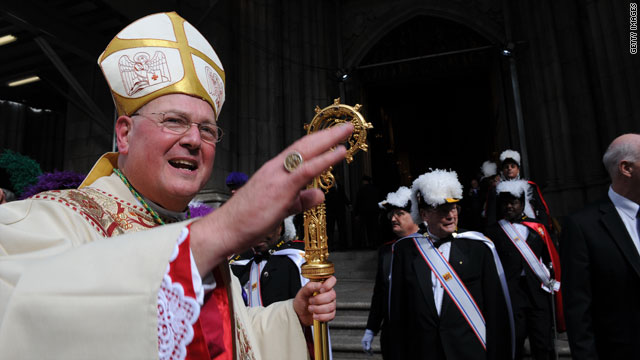
New York Archbishop Timothy Dolan.


May 25th, 2011

10:05 AMET


Editor's Note: Stephen Prothero, a Boston University religion scholar and author of "God is Not One: The Eight Rival Religions that Run the World," is a regular CNN Belief Blog contributor.

By Stephen Prothero, Special to CNN

A couple weeks ago, some Catholic leaders called out House Budget Committee Chairman Rep. Paul Ryan and House Speaker John Boehner for neglecting Catholic social teachings in their proposed 2012 budget.

Boehner avoided the issue in his recent commencement address at Catholic University, but Rep. Ryan tackled it head on in an April 29 letter to New York Archbishop Timothy Dolan, President of the U.S. Conference of Catholic Bishops.

Dolan responded in a letter dated May 18, and Ryan responded in turn. All three letters are now available on the House Committee on the Budget website.

I think of Ryan as a follower of the philosopher/novelist Ayn Rand more than a follower of Jesus, so I was surprised to see him offer such a thoughtful response, addressing such traditional topics in Catholic moral theology as “the well-being of the family, subsidiarity [more on that later], the preferential option for the poor, and the dignity of the human person.”

Throughout the four-page letter, he addresses topics—including hunger and homelessness—rarely addressed today by Republican politicians. In fact, he sounds at times like a throwback to President George W. Bush's "compassionate conservatism."

Ryan begins by sounding the alarm. Our economic situation is dire, he argues, largely because of unsustainable deficits and debt. And this dire situation by no means affect only the rich.

“Ultimately the weakest will be hit three times over,” Ryan writes, “by rising costs, by drastic cuts to programs they rely on, and by the collapse of individual support for charities that help the hungry, the homeless, the sick, refugees and others in need.”

I must say I find some of Ryan’s writing disingenuous, most notably his claim that his budget “reforms welfare for those who need it,” including the poor and the sick, while it “ends welfare for those who don’t—entrenched corporations, the wealthiest Americans.”

I also don’t buy that his budget is “aimed at strengthening economic security for seniors, workers, families, and the poor.” Ryan and other Republicans have repeatedly insisted that the aim of their budget is reducing the deficit and jump-starting the economy by coming to the aid of “job creators” who “encourage expansion, growth, and hiring.”

Still, I have to commend Ryan for taking his Catholic critics (and his Catholicism) seriously enough to respond with some care.

Ryan argues that his proposed changes to Medicare are “consistent with the preferential option for the poor” long articulated by Catholic theologians and rooted in the Gospel of Luke (“Blessed are the poor”).

He claims that his budget is “rooted in the dignity of the human person” because it gets citizens off the dole, and he finds support for this view in Pope John Paul II’s encyclical Centesimus Annus.

Ryan’s cleverest twist is an effort to justify his interpretation of federalism via the church’s “principle of subsidiarity,” which says it is wrong “to assign to a greater and higher association what lesser and subordinate organizations can do.” I am going to have to leave that one to the theologians to parse, but I have never thought of Roman Catholic governance as particularly attuned either to localism or to states' rights.

Archbishop Dolan’s response to Ryan's letter is, unfortunately, conciliatory to the point of fawning. In essence, he lauds Ryan for articulating his budget in terms of the church's social teachings. But he never really challenges Ryan’s highly unorthodox interpretations of those teachings, and at times he seems to endorse them.

After quoting from the Centesimus Annus encyclical, where John Paul II writes “the defenseless and the poor have a claim to special consideration,” Dolan basically takes at face value Ryan’s assurance that his budget "would be attentive to such considerations.”

And when it comes to subsidiarity and federalism, he meekly reminds Ryan that solidarity, too, is a Catholic value—taking care to act “with a view to the common good.”

Dolan writes that “a singularly significant part of our duty as pastors is to insist that the cries of the poor are heard,” and now some Catholic groups are taking Dolan to task for shirking that duty by being too conciliatory toward Ryan and his budget.

Yesterday Catholics United called on the Archbishop “to defend the poor, not tax breaks for the wealthy,” saying his letter to Ryan “shocks the conscience of all Catholics and people of faith who care about the poor and vulnerable.”

A similar but less strident challenge from Catholic Democrats is calling on Dolan to clarify his response, noting that his letter “is being interpreted by some as an endorsement of Ryan’s budget.”

I know that defenders of a strict separation of church and state will wonder why Ryan engaging in this public exchange with a Catholic bishop over what might seem to be a purely secular matter. But I welcome it.

All too often, politicians on both the left and the right cloak their public policy positions in vague claims that they are based in the Bible or Christian theology. Ryan's letter is not vague. He thinks his budget is in keeping with Catholic social teachings, and he has now told us why.

The next step in what Ryan is rightly calling a "constructive dialogue" is for American Catholics to weigh in. What do they think of Ryan's efforts to claim the imprimatur of Catholicism for the GOP budget? I am eager to hear.

The opinions expressed in this commentary are solely those of Stephen Prothero.
.
.

Thursday, November 25, 2010

Church or State? The Holy See at the United Nations.


Church or State? The Holy See at the United Nations. This special report by Center For Reproductive Law & Policy concludes that: " . . the status of the Holy See as a non-member state permanent observer in the United Nations is questionable. Moreover, there are doubts about whether, in 1964, the Holy See met the established criteria for attaining this position. . . the United Nations is creating a precedent for similar claims by other religions.

To ensure that the United Nations does not promote one particular religious view, religious entities such as the Roman Catholic Church should not be permitted to participate in that body as nonmember states. . . "

CENTER FOR REPRODUCTIVE LAW & POLICY
▪
INTERNATIONAL PROGRAM

Church or State?
The Holy See at the United Nations


The Roman Catholic Church is uniquely positioned to influence international deliberation on a wide range of issues, including population, family planning, and women's rights. Since the inception of the United Nations, the Roman Catholic Church has been an active participant in numerous international conferences organized by this powerful organization. Recently the Church has been involved in the 1992 United Nations Conference on Environment and Development, the 1993 Vienna Conference on Human Rights, and the preparatory process of the 1994 International Conference on Population and Development. In some of these conferences, the Church has taken high profile positions that have sparked worldwide attention and raised questions regarding its status at the United Nations. This publication provides information about the position and role of the Roman Catholic Church at the United Nations.

The Holy See and the Vatican City
Because the Roman Catholic Church has elected to participate in the United Nations as the “Holy See,” it is important to understand the historical origins of this entity and its current relationship to the Vatican City.

The “Holy See” is “the supreme organ of government of the [Catholic] Church,”1 with the Pope designated as its head in the Code of Canon Law.2 The Holy See consists of the Pope, the College of Cardinals, and the central departments that govern the Church.3 It is, by definition, a non-- territorial religious entity Prior to 1870, the Holy See was associated with the government of the Papal States, which had been created by Pepin-le-Bref and his son Charlemagne in the Ninth Century4 In 1870, Italian troops annexed the Papal States and granted freedom to the Apostolic Palaces in Rome. The Lateran Agreement of 1929, signed by Italy and the Holy See, finally settled that Rome was under the jurisdiction of Italy while the State of the Vatican City remained under the “sovereignty of the Supreme Pontiff.”5

The Vatican City is widely regarded as a “vassal” territory of the Holy See.6 Unlike any other modern nation, the Vatican City does not exist to support its citizens. Rather, its purpose is to provide a base for the central administration of the Roman Catholic Church. Only 0.44 square kilometers in size,7 the Vatican City is the smallest area in the world claiming to be a state.8 Its population is nominally 800 residents and 400 citizens, primarily constituted of Church officials who are there on a non-permanent basis.9 Italy carries out a number of official functions for the Vatican City by supplying the police force to patrol it,10 providing for the punishment of crimes committed within the city,11 and maintaining the water and railway systems for the area. The Vatican City is also dependent upon Italy for freedom of communications and transportation. 12

Status at the United Nations
In 1944, the Roman Catholic Church made tentative inquiries regarding the eligibility of the Vatican City to become a member state of the United Nations.13 Although the United Nations does not provide the international community with a definition of the term “state,”14 it does have requisite conditions for admission as a member.15 An applicant to the United Nations must: (1) be a State; (2) be peace-loving; (3) accept the obligations of the United Nations Charter; (4) be able to carry out these obligations; and (5) be willing to do so.16 Although the historical record is scant, there is some indication that member states viewed the Vatican City as being ineligible for United Nations membership. For example, United States Secretary of State Cordell Hull, in his reply to Vatican inquiries regarding possible membership, concluded that the Vatican City did not meet the requirements for admission.17 Article 24 of the Lateran Agreement binds the Holy See and the Vatican City to neutrality, and this policy of neutrality is regarded as incompatible with membership. In fact, the Vatican City has never made a formal membership application.

The Roman Catholic Church first officially participated at the United Nations when the Vatican City was invited to United Nations conferences through its membership in the Universal Postal Union and the International Telecommunication Union.18 In 1957, through an exchange of letters, the Holy See and the Secretary--General of the United Nations agreed to refer to the Papal delegation at the United Nations as the “Holy See.”19 Finally, on March 21, 1964, Pope Paul VI established the first Holy See “permanent observer” mission at the United Nations. As a result, the Holy See is regarded as a “non--member state” permanent observer.20 Switzerland is the only other entity that currently maintains non--member state permanent observer status.
The status of a permanent observer places restrictions upon an entity’s role at the United Nations, and these limitations generally vary according to the type of permanent observer status.21 There are no provisions in either the United Nations Charter or the Rules of Procedure of the Economic and Social Council (“ECOSOC”) that specifically refer to the participation of non--United Nations members in ECOSOC meetings. However, non-member state observers have been invited to participate in meetings discussing matters of concern to those states.22 Since the Holy See is a permanent observer, it cannot cast a vote in the General Assembly of the United Nations. But permanent observers have sometimes participated, on an ad hoc basis, in General Assembly discussions and decisions.23 The Holy See has participated in the General Assembly on several occasions. Pope Paul VI addressed that body on October 4, 1965,24 and Pope John Paul II did so on October 2, 1979. In 1978, the Permanent Observer for the Holy See addressed the Tenth Special Session of the General Assembly Devoted to Disarmament.

The Holy See has also participated actively in several United Nations conferences. Its position as a non-member state permanent observer has provided it with many advantages. Rules regarding access to and procedure for United Nations conferences are most often determined by the specific United Nations agency charged with organizing the meeting;25 the organizing body can thus determine whether it will permit a permanent observer to attend. Moreover, access to conferences convened by the General Assembly or ECOSOC is also established by the parameters set out by these United Nations agencies. Because the current United Nations trend is to provide widespread access to international conferences, participation in these meetings has been liberally granted.26 Recent General Assembly resolutions convening world conferences have invited “all States” to participate. States invited to participate in a conference in this manner are able to participate “in full, with full voting rights,” unlike the restricted manner in which other types of permanent observers participate.27 Because the United Nations treats the Holy See as a state, the Roman Catholic Church is able to participate fully and to vote in most conferences.

In granting the Holy See a non-member state permanent observer position, the Secretary-General of the United Nations was required to consult established criteria for a non--member state observer delegation. These criteria were whether the state had membership in at least one specialized agency of the United Nations and whether the state was generally recognized by members of the United Nations.28 At the time the Holy See was admitted as a non--member state permanent observer, it maintained delegates at specialized agencies such as the International Atomic Energy Agency and the Council for Cultural Co-operation of the Council of Europe.29 However, if “general recognition” is defined to mean recognition by a majority of United Nations members, the Holy See may have been incorrectly allowed to obtain non--member state permanent observer status. As of January 1, 1985, the Holy See maintained diplomatic relations with only fifty-three countries.30 Therefore, it is unlikely that the Holy See maintained relations with a majority of the existing 112 member states of the United Nations at the time its mission was established.

Status under International Law
The international legal status of the Holy See has been subject to scrutiny ever since it lost control over a specific territory3' After the annexation of the Papal States by Italy in 1870, the Pope continued to conclude agreements with some nations and to accredit and receive envoys.32 In 1929, with the creation of the Vatican City, the Holy See once again became associated with the government of a territory. But this territory can be regarded as an artificial construct that provided the Holy See with some claim to territorial integrity. While most international legal scholars would grant that the Holy See may possess “a degree of international personality,”33 there is considerable debate as to whether such personality amounts to statehood.

Even without an exhaustive review of international legal definitions of statehood, there are indications that the Holy See does not meet these criteria. According to the Montevideo Convention on the Rights and Duties of States: “The state as a person of international law should possess the following qualifications: a) a permanent population; b) a defined territory; c) government; and d) capacity to enter into relations with the other states.”34 These four factual criteria for determining statehood are founded upon principles that have been accepted by a host of international law scholars and are consistent with the foreign laws of some nations.35 The Holy See does not satisfy this definition. Almost by definition, it does not possess a defined territory Because the Holy See is the supreme organ of government for Catholics worldwide, it cannot be said to have a “permanent population.” Finally, the Holy See is itself the government of both the Roman Catholic Church and the Vatican City It cannot therefore be regarded as an entity that possesses a government. The only characteristic of a modern state that is attributable to the Holy See is its capacity to enter into relations with other states. The Holy See is party to international treaties and it, rather than the Vatican City, receives foreign envoys.36

It is equally uncertain whether the Vatican City satisfies the modern definition of a nation. Although it has a permanent population, a defined territory, and a government, the Vatican City’s capacity to enter into relations with other states is difficult to assess. The Vatican City has no foreign service of its own and no foreign ministry distinct from that of the Holy See.37 Article 3 of the Constituent Laws of the Vatican City reserves “to the Sovereign Pontiff, by means of the State Secretariat, . . . the right of representation of the Vatican State, with foreign powers, for the conclusion of treaties and for diplomatic relations.”38 A state wishing to enter into official relations only with the Vatican City would have to deal first with the Holy See.39 There also appears to be no diplomatic mission accredited to the Pope solely in his capacity as a temporal sovereign of the Vatican City40 Yet, at the same time, the Vatican City is a party to some international and bilateral agreements.

Conclusion
Because it is uncertain whether the Holy See or the Vatican City can be regarded as a state under international law, the status of the Holy See as a non-member state permanent observer in the United Nations is questionable. Moreover, there are doubts about whether, in 1964, the Holy See met the established criteria for attaining this position. If the United Nations treats the Holy See as a state with permanent observer privileges because of the Roman Catholic Church’s religious authority, the United Nations is creating a precedent for similar claims by other religions. To ensure that the United Nations does not promote one particular religious view, religious entities such as the Roman Catholic Church should not be permitted to participate in that body as non­member states.

Endnotes
1. Hyginus Eugene Cardinale, The Holy See And The International Order 85 (1976).

2. Codex luris Canonici (1917) Code c. 331: “The bishop of the Church of Rome, in whom resides the office given in a special way by the Lord to Peter, first of the Apostles and to be transmitted to his successors, is head of the college of bishops, the Vicar of Christ and Pastor of the universal Church on earth; therefore, in virtue of his office, he enjoys supreme, full, immediate and universal ordinary power in the Church, which he can always freely exercise.”

3. Robert A. Graham, Vatican Diplomacy 157-183 (1959).

4. James Crawford, The Creation of States in International Law 152 (1979).

5. Lateran Agreement, Feb. 11, 1929, Italy-Holy See, Art. XXVI, 0 VTS. 161, Europ.TS. No. 590019

6. Crawford, supra note 4, at 159; Josef Kunz, The Status of the Holy See in International Law, 46 Am. J. of Int. Law 313 (1952). Note also that the preamble to the Lateran Agreement states: A[I]t is deemed necessary to constitute Vatican City with special dispositions, . . . with exclusive and absolute power and sovereign jurisdiction over it to the Holy See.”

7. Edmund Jan Osmanczyk, Encyclopedia of the UN and International Agreements 862 (1985).

8. Crawford, supra note 4, at 154.

9 Louis Henkin, Richard Pugh, Oscar Schachter, & Hans Smit, International Law Cases and Materials 247 (3rd ed. 1993) (hereinafter “Henkin”).

10. Lateran Agreement, supra note 5, at Art. III.

11. Id. at Art. XXII.

12. Id. at Art. VI.

13. Crawford, supra note 4, at 156.

14. Hans Kelsen, Law of the United Nations 68 (1964).

15. UN. CHARTER Art. 4, para. 1.

16. Kelsen, supra note 14, at 67.

17. Crawford, supra note 4, at 156.

18. Cardinale, supra note 1, at 265.

19. Letters exchanged between the Holy See and the Secretary-General of the United Nations (Oct. 16, 1957, Oct. 29, 1957) (Discussing relations between the UN. and the Holy See).

20. There are five types of permanent observers: (1) Non-Member States; (2) Specialized Agencies of the UN. system; (3) Intergovernmental organizations not part of the UN. system; (4) National liberation movements recognized by the General Assembly; and (5) Non-governmental organizations. See R. G. Sybesma-Knol, Status of Observers in the UN. (1981).

21. Id. at 24.

22. Sybesma-Knol, supra note 20, at 33.

23. Id. at 30.

24. Pope Paul VI’s famous speech to the General Assembly includes the following statement: “Respect for life, even with regard to the great problem of birth, should find here in Your Assembly its highest affirmation and its most reasoned defence. Your must strive to multiply bread so that it suffices for the tables of mankind, and not favour an artificial control of birth, which would be irrational, in order to diminish the number of guests at the banquet of life.” Mark Shaw, Messenger Of Peace 59 (1965).

25. Id. at 27.

26. Id. at 34.

27. Id. at 35.

28. Selected Legal Opinions of the Secretariat of the United Nations and Related Inter- Governmental Organizations at 236, UN. Doc. ST/LEG/8 (1962).

29. Cardinale, supra note 1, at 260-265.

30. Osmanczyk, supra note 8, at 863.

31. Kunz, supra note 6, at 309 (the Holy See “remained, as always, a subject of general international law”); Crawford, supra note 4, at 153 (“[i]t was accordingly stated by various writers that the Holy See had no international status after 1870”); Cardinale, supra note 1, at 88 (the Holy See never lost its international juristic personality because “[between] 1870 and 1929 concordats and other agreements were signed with numerous countries, some. . . non-Catholic”); Sybesma-Knol, supra note 20, at 325 (“[it] is only logical that. . . there is some uncertainty about the legal status of these entities [such as the Holy See in international law]”); Graham, supra note 3, at 184 (“[e]ven without a state of his own, the Pope remained an international figure with an undefined standing”); Okeke, Controversial Subjects of International Law 65 (1973) (the Holy See is able to make international agreements, “one of the most effective and important evidences of personality in international law”); Henkin, supra note 9, at 299 (“[s]ome territorial entities have an international legal status though they do not easily fit into any of the established categories”).

32. Kunz, supra note 6, at 311.

33. Crawford, supra note 4, at 157.

34. Article I of the Montevideo Convention on the Rights and Duties of States, Dec. 26, 1933, 49 Stat. 3097, TS. 881, 165 L.N.TS. 19, 3 Bevans 145. This Convention was ratified by: Brazil, Chile, Colombia, Costa Rica, Cuba, Dominican Republic, Ecuador, El Salvador, Guatemala, Haiti, Honduras, Mexico, Nicaragua, Panama, United States and Venezuela.

35. For example, 201 of the Restatement of the Foreign Relations Law of the United States provides that a state is an “entity that has a defined territory and a permanent population, under the control of its own government, and that engages in, or has the capacity to engage in, formal relations with other such entities.” Restatement (Third) of the Foreign Relations Law of the United States (1986).

36. Henkin, supra note 9, at 300; Graham, supra note 3, at 344-346; Crawford, supra note 4, at 152-60.

37. Graham, supra note 3, at 345.

38. Special supplement of the Aeta Apostolicae Sedis, 7 June 1929

39 Graham, supra note 3, at 345.

40. Id.; Cardinale, supra note 1, at 179-205.
.

.

Monday, September 27, 2010

Hillary Clinton on Walmart


weneedhelp February 02, 2008

N
Related:

www.publicintegrity.org/clintonwalmart/index.htm

Hillary Clinton: The Wal-Mart Videos
By Bill Hogan and Alan Green

Throughout the 2008 presidential campaign, Hillary Clinton has studiously avoided discussing her five-and-a-half-year tenure as a director of Wal-Mart, the world’s largest retailer.

Clinton, who served on the Wal-Mart board from November 1986 to May 1992, while she was first lady of Arkansas, makes no mention of the experience in speeches, nor is it listed in her official biography or referenced anywhere on her campaign’s website. Indeed, as The New York Times put it last year, her stint as a director of Wal-Mart “remains a little known chapter in her closely scrutinized career.”

But a mammoth archive of Wal-Mart video footage that has gone all but unnoticed in the 2008 presidential campaign may shed new light into Clinton’s relationship with the company. In this segment from 1991, for example, made public here for the first time by the Center for Public Integrity, Sam Walton, the founder of Wal-Mart, introduces Clinton at the grand re-opening of the company’s original store in Rogers, Arkansas. “Without any question,” he says, “you’ve added more to our board than any person we’ve ever had on that board.”

In the video, Clinton is effusive in her praise of the company that she has now all but disowned. (In 2005 her Senate reelection campaign went so far as to return a $5,000 contribution from Wal-Mart’s political action committee, citing “serious differences with current company practices.”)

“I’m so proud of this company, and everything it represents,” Clinton says in the video clip. “Anytime I travel and I tell people I’m from Arkansas . . . Wal-Mart’s on top of the list, and everybody wants me to tell them about Wal-Mart and Sam Walton and Helen Walton and all of the Wal-Mart associates. It makes me feel real good about what we’re able to do and what we can show and the sort of leadership we’re given.”

For now, the video archive—maintained by a production company that for more than two decades recorded many shareholder meetings and other Wal-Mart events—is the clearest window into Clinton’s relationship with the company. According to The Associated Press, Wal-Mart has refused to release minutes of its board meetings during the period she was a paid director of the company.


Hillary Clinton was on Wal-Mart's board of directors

WARD HARKAVY, VILLAGE VOICE, 2000 - Twice in three days last week, Hillary Rodham Clinton basked in the adulation of cheering union members. Her record of supporting collective bargaining, however, is considerably worse than wobbly. Pity the thousands of unionists at last Tuesday's state Democratic convention who chanted her name, and the hundreds of retired Teamsters at Thursday's luncheon in midtown who had interrupted their Founder's Day meal to hear the corporate litigator turned union-loving Democrat deliver a campaign speech.

They would have dropped their forks if they had heard that Hillary served for six years on the board of the dreaded Wal-Mart, a union-busting behemoth. If they had learned the details of her friendship with Wal-Mart, they might have lost their lunches. . . In 1986, when Hillary was first lady of Arkansas, she was put on the board of Wal-Mart. Officials at the time said she wasn't filling a vacancy. In May 1992, as Hubby's presidential campaign heated up, she resigned from the board of Wal-Mart. Company officials said at the time that they weren't going to fill her vacancy.

So what the hell was she doing on the Wal-Mart board? According to press accounts at the time, she was a show horse at the company's annual meetings when founder Sam Walton bused in cheering throngs to celebrate his non-union empire, which is headquartered in Arkansas, one of the country's poorest states. According to published reports, she was placed in charge of the company's "green" program to protect the environment. But nobody got greener than Sam Walton and his family. For several years in the '80s, he was judged the richest man in America by Forbes magazine. . .

Was Hillary the voice of conscience on the board for American and foreign workers? Contemporary accounts make no mention of that. They do describe her as a "corporate litigator" in those days, and they mention, speaking of environmental matters, that she also served on the board of Lafarge, a company that, according to a press account, once burned hazardous fuels to run its cement plants. . .

The Clintons depended on Wal-Mart's largesse not only for Hillary's regular payments as a board member but for travel expenses on Wal-Mart planes and for heavy campaign contributions to Bill's campaigns there and nationally. . .

Meanwhile, Wal-Mart's first lady, who also benefited from Wal-Mart stock, solicits support from union workers. Which makes her words to the elderly Teamsters last week especially poignant: "You can count on me to stand up for the right to collectively bargain!" Right on, sister!

www.villagevoice.com/news/0021,harkavy,15052,5.html
http://www.washingtonpost.com/wp-dyn/content/article/2005/05/14/AR2005051400765.html
.
Source
.