Showing posts with label Caritas in veritate. Show all posts

Saturday, May 10, 2014

Pope Francis Calls For 'Legitimate Redistribution' Of Wealth To The Poor


AP | by NICOLE WINFIELD
Posted: 05/09/2014 8:35 am EDT
Updated: 05/09/2014 12:59 pm EDT


VATICAN CITY (AP) - Pope Francis called Friday for governments to redistribute wealth to the poor in a new spirit of generosity to help curb the "economy of exclusion" that is taking hold today.

Francis made the appeal during a speech to U.N. Secretary-General Ban Ki-moon and the heads of major U.N. agencies who are meeting in Rome this week.

Latin America's first pope has frequently lashed out at the injustices of capitalism and the global economic system that excludes so much of humanity.

On Friday, Francis called for the United Nations to promote a "worldwide ethical mobilization" of solidarity with the poor in a new spirit of generosity.

He said a more equal form of economic progress can be had through "the legitimate redistribution of economic benefits by the state, as well as indispensable cooperation between the private sector and civil society."

Francis had a similar message to the World Economic Forum in January and in h is apostolic exhortation "The Joy of the Gospel." That document, which denounced trickle-down economic theories as unproven and naive, provoked criticism in the U.S. that he was Marxist.

Francis has denied he's Marxist, and spent years in Argentina battling Marxist excesses of liberation theology. But he has said from the outset that he wants a church that "is poor and for the poor" and ministers to the most marginal of society.

On Friday, he urged the U.N. to promote development goals that attack the root causes of poverty and hunger, protect the environment and ensure "dignified" labor for all.

"Specifically, this involves challenging all forms of injustices and resisting the economy of exclusion, the throwaway culture and the culture of death which nowadays sadly risk becoming passively accepted," he said.

Source
.

Monday, September 17, 2012

Can Truth and Diplomacy Be Reconciled?

July 13, 2012
The latest Courtyard of the Gentiles gathering sought a balance between the two concepts in an increasingly relativistic culture.

Rome—The “Courtyard of the Gentiles” is an initiative of the Pontifical Council for Culture to promote dialogue between believers and non-believers, the result of a suggestion that Benedict XVI offered to the Roman Curia on the occasion of his Christmas greetings in 2009.

The most recent of these gatherings was held on June 26, at the Italian Embassy to the Holy See, housed at Palazzo Borromeo, a stately and historic mansion originally owned by the noble household of the Borromeos, among whose members there is a famous saint, San Carlo Borromeo (1538-1584). He was a leading figure during the Counter-Reformation and was responsible for significant reforms in the Catholic Church, following the Council of Trent and the implementation of its decrees.

As one can already and easily guess from the meeting’s title, “Diplomacy and Truth,” the event saw not only the participation of several cardinals and churchmen, but also, for the first time at a Courtyard of the Gentiles gathering, senior representatives of the diplomatic corps accredited to the Holy See and the Italian Republic. The possibility of reconciling diplomacy and truth, which are generally thought to be poles apart, was under the spotlight.

Among the keynote speakers were Cardinal Jean-Louis Tauran, president of the Pontifical Council for Interreligious Dialogue; the US ambassador to the Holy See, Miguel Humberto Diaz; the ambassador of Morocco to Italy, Hassan Abouyoub; Stefano Folli, editorialist for the Italian business daily Il Sole 24 Ore; and Hon. Gianni De Michelis, president of Ipalmo, an institute dedicated to improving Italy’s relations with Africa, Latin America, and the Middle and Far East.

“I believe that the Courtyard of the Gentiles is the most appropriate forum to discuss truth and diplomacy, precisely because it is a natural environment for dialogue,” said the Italian Ambassador to the Holy See, Francesco Maria Greco, introducing the proceedings over which he presided with the president of the Vatican’s Pontifical Council for Culture, Cardinal Gianfranco Ravasi. “And because diplomacy is no longer the art of reporting, but much more directly the art of tackling cultural, ideological, geopolitical, and geoeconomic diversity, I believe that in a forum such as the Courtyard of the Gentiles, we can address this dialogue, in the literal sense of a word that breaks through the moat of the lack of communication.”

Then the floor was taken by Cardinal Ravasi. “We have to say that truth is one of the major categories of human communication at all levels,” said the cardinal. “It’s true that diplomacy, many times, resorts to alternative routes, but we must also recognize [that diplomacy needs] a virtue that is essential also in communication: prudence, discretion, undertone. Here, in light of this we can also recognize that those two words, diplomacy and truth, are not so antithetical to each other after all.”

This, then, is the central question of the Courtyard of the Gentiles gathering: is it possible to reconcile truth and diplomacy? The answer is yes, if diplomats identify human nature and natural law as the foundation of a common truth, recovering a classical conception of truth that opposes the current subjectivism.

And, according to Cardinal Jean-Louis Tauran, the Vatican’s former secretary for Relations with States, it is precisely because of this objective, not subjective, conception that “an ambassador who tells lies, rarely does he reach his/her goal.” Much less so today, since in an increasingly globalized world information is by now relayed in real time, with diplomacy and transparency increasingly forced to go hand-in-hand.

This phenomenon has accelerated with the end of World War II, when “the leaders of nations got convinced of the need for diplomacy to be put at the service of a truth that would become the yardstick of the particular national truths.” On the other hand, Cardinal Tauran noted, for a diplomat to best fulfill his mandate, won’t he have to win the confidence of his counterparts? “And it’s right here that truth comes into the picture,” the cardinal said. Ultimately “who is the good diplomat? It’s the one who can remain silent in several languages.” Unsurprisingly, he then wound up his speech by quoting the diplomat par excellence, the Prince de Talleyrand, who used to say: “There is something more terrible than slander—truth.”

US Ambassador Diaz, almost as an unwitting representative of the “secular” front at the debate, took up the argument of natural law as the common ground between diplomacy and truth.

When, “for example, Secretary of State Clinton says that we Americans strongly support democracy,” it is not because “we want the other countries to be like us, but because we want all peoples to enjoy the constant protection of their natural rights, to which they are entitled regardless of whether they were born in Tallahassee or Tehran,” Diaz said. What is needed, he went on, is the building of bridges between truth and diplomacy, in order to deepen the bond of interdependence and friendship among peoples and nations of the world.

“What Pope Benedict XVI proclaims in his encyclical Caritas in Veritate about the light of reason and the role of reason in the proper exercise of love can be applied mutatis mutandis to the relationship between truth and diplomacy,” he said. “Diplomacy needs truth and the hand of reason not to lapse into mere self-centered human instrumentality. Diplomacy needs truth to foster transparent debates and authentic processes of community building.”

Ambassador Diaz again quoted the Holy Father’s encyclical, “Truth, in fact, is logos which creates dia-logos and hence communication and communion.” For without truth, the Pope contends, “charity degenerates into sentimentality. Love becomes an empty shell, to be filled in an arbitrary way. In a culture without truth, this is the fatal risk facing love.”

As the meeting concluded, Cardinal Ravasi extended an invitation to the next session of the Courtyard of the Gentiles, to be held in Stockholm September 13-14 in conjunction with the Swedish Embassy to the Holy See and focusing on the topic of faith-science interaction.

Source
.

Sunday, May 13, 2012

The pope: “Enough of this ephemeral culture”


05/13/2012


Benedict XVI greets the Italian prime minister, Mario Monti


The pontiff makes an appeal in Arezzo: “Let us beat the crisis by sharing resources and changing lifestyles”giacomo galeazziarezzo


Benedict XVI has made an appeal in Arezzo to beat the crisis by changing our lifestyles. On the helicopter ramp, the pope greeted prime minister Monti and (in a move that breaks with customary protocol) his wife Elsa, then during the homily of the mass said in Il Prato park, he called for a new effort to beat "an ephemeral culture which has disappointed many and determined a profound spiritual crisis". The pontiff’s advice for tackling this material and spiritual crisis was that one should not give way to “materialistic ideologies” but return to the teaching of values. In the name of values, of solidarity, dignity and life, the pope asked that everything be done to fight “an ephemeral culture which has disappointed many and determined a profound spiritual crisis".


"Within the context of the Church in Italy, committed [in the past decade] to the theme of education,” he said later in his homily, “we must ask, especially in this region where the Renaissance was born, what vision of Man are we proposing to the new generations… This land was the birthplace of great Renaissance personalities, from Petrarch to Vasari,” he said, “and played an active role in affirming that concept of Man which left its mark on the history of Europe, drawing strength from Christian values. In recent times, too, the ideal heritage of your city has been expressed by some of its most illustrious children – through their university research and other institutions – where they have elaborated the concept of civitas defining it in terms of the Christian ideal [of the era of the city-state to] the people of our time… Be ferment in society, be present as Christians, be active and coherent." Among the distinctive values of the Church in Arezzo, he said during the Parco del Prato mass, "are solidarity, attention to the weak, respect for the dignity of all". The pope also mentioned the "hospitality" that citizens of Arezzo have shown for centuries and their “solidarity” towards the poor and weak. Benedict XVI said mass alongside Tuscany’s bishops and before beginning the service he listened to the greeting of mayor Giuseppe Fanfani and bishop Riccardo Fontana, both of which referred to the economic crisis that is affecting society in Arezzo. The bishop also mentioned the issue of immigrants. "I know about your Church’s commitment to promoting Christian life,” said the pope in his homily. “Be ferment in society, be present as Christians, be active and coherent. With its centuries-old history, the city of Arezzo,” he stressed, “summarises significant expressions of culture and values.”


The pope mentioned many saints that hailed from this area, including Donato, a bishop who was committed to “uniting” peoples, and Pope Gregory X, committed to "reforming the Church" and to an attempt to heal the Schism with the Eastern church, apart from anything else, with the Council of Lyon. With the example of these and other saints and famous figures from Arezzo, Benedict XVI drew encouraging words for the local Church to be present in society. He often returned to the issue of “hospitality”, “solidarity”, “care of the weak” and of respect for the dignity of all. Even if “severely struck by the economic crisis”, let us continue to protect “the weaker members of society”, let us identify "quick and effective solutions" especially for the young, who have been hit hardest. The crisis can be beaten by sharing “resources” and changing “lifestyles”. “Of course,” said Benedict XVI, “this area has also been severely struck by the economic crisis. The complexity of the problems make it difficult to find quick and effective solutions to come out of the present situation, which affects the weakest elements especially and greatly worries young people.” He then went on to say: “Since the remotest times, attention to others has moved the Church to show concrete signs of solidarity with those in need, sharing resources and promoting simpler lifestyles."


.


Saturday, March 10, 2012

Corporate Social Responsibility and the tradition of Catholic Social Thought

#147 - March 2012

The recent report of the European Commission on Corporate Social Responsibility resonates with the innovative postulates of ‘Caritas in Veritate’.


unknownFor the Christian identity in the Modern World the emergence of Christian Social Thought has been of crucial importance. Its innovative character, which is largely forgotten today can be remembered with a quick glance on the first Papal Encyclical ‘Rerum Novarum’ of Pope Leo XIII. 1891 or even the reminiscence of it in the second Social Encyclical ‘Quadragesimo Anno’ 1931. Industrialization was the most radical socio-economic transformation in the history of mankind. Philosophers like Nietzsche and Marx questioned the role of Christian values in an unprecedented way. In this situation the Christian Social movement essentially extended Christian ethics beyond a mere individual virtue based doctrine into a ‘social teaching’ - calling for adequate rules and regulations within a ‘just’ social order.


In a way, we live in a very similar situation today. With Globalization and the emergence of the ‘post-national constellation’ (J. Habermas) the cultural samples and institutional solutions of the 20th century are again at stake. Will today’s Christians show the same cultural creativity and learn to express the Western Christian tradition in an up-to-date way? The recent social Encyclical ‘of Pope Benedict XVI (2009) pushes us into this direction. ‘Caritas in Veritate’ criticizes a widespread ideological dualism between market and state and calls for a new culture of Civic responsibility. Therefore, the document also addresses business leaders, costumers and investors. Like in the 19th century, when Entrepreneurs like Léon Harmel from France and Franz Brandts from Germany played an important role for the emergence of Catholic Social Thought, business practise will again be crucial.


The recent report of the European Commission on Corporate Social Responsibility resonates with the innovative postulates of ‘Caritas in Veritate’. It is not the commission’s first report on CSR but rather extends a number of trailblazing documents from 2001 as well as 2006. These reports – like a series of international activities including the Foundation of the Global Compact 1999/ 2000, the proclamation of the Millennium Development Goals etc. – are based on the assumption that Governments alone will no longer be able to secure basic public goods on a global scale. Based on recent Scientific literature the commission pledges for a advanced concept of CSR: this is not only orientated towards operational savings but calls for a ‘strategic implementation’ by the development of innovative goods, services and business models creating values for costumers, employees and shareholders. The reflection on cooperatives and mutual trusts seems to represent an explicit allusion to ‘Caritas in veritate’, here. This holds also true for the paper’s foundation in a subsidiary structure, which perceives it as the main task of political entities not to substitute or dominate but to support and nurture the Social Responsibility of Companies. According to the report, not Government but companies as well as unions and civil society should find new ways to walk the talk on Corporate Responsibility; consumers and investors are called to reward these activities, media to report on them.


What becomes obvious here is a really innovative concept of the modern social fabric. In many ways this can be perceived as a continuation of Catholic Social Thought, which impacted the Western market economies in the 20th centuries. The EU commission announces a series of instruments and procedures to strengthen the awareness and the role of Corporate Reponsibility in the interplay of the social actors and groups: Multi-Stakeholder-Forums, a code of conduct for self-regulation and co-regulatory arrangements, integration of Social and environmental criteria into public procurement, the obligation for banks to inform about their social and ecologic criteria etc. Transparency of information, competence-building in companies and social environment as well as hand-outs and platforms are the most important instruments of the commission to spread the word of CSR. Christian managers and associations – like the the global entrepreneurial associationUNIAPAC, which published their own paper on CSR already some years ago, the Papal commission ‘Justice and Peace’ etc. - should actively observe this process bringing in a genuine Christian perspective.


Prof. Dr. André Habisch

Scientific consultant of the Bund Katholischer Unternehmer in Germany and teaches business ethics at the Catholic University Eichstaett-Ingolstadt (Germany)


Source
.

Saturday, December 10, 2011

Pope Benedict: love and solidarity in an economic world


10/12/2011 12.58.14


In a world that has been battered by the global economic downturn Pope Benedict on Saturday stressed the duty the Church has at this time to proclaim with renewed vigor the message of Christ which is hope. The Holy Father was speaking to members of t
he Confederation of Italian Cooperatives and the Federation of Italian Co-operative Banks in the Clementine Hall in the Vatican.

The Pope recalled how the Church down through the years has encouraged the prolific presence of Catholics in Italian society through the promotion of cooperative institutions, the development of social enterprises and many other works of public interest, characterized by forms of participation and self-management.

What has prompted members to join in a co-operative-type organizations, said Pope Benedict was not only for economic reasons, but also the desire to live an experience of unity and solidarity.

The Pope also noted the fact that these institutions had a valuable role to play in promoting evangelical ideals and the culture of life and family.

Taking inspiration from his encyclical Caritas in Veritate, the Holy Father said that even in the field of economics and finance "right intention, transparency and the search for positive results were mutually compatible and must never be separated.”

Drawing his address to a close the Holy Father urged those present to remain faithful to the Gospel and the teaching of the Church which encourages “social development, experiences of microcredit and an economy driven by a logic of communion and fraternity.”

Even in the world economy, said Pope Benedict, it is necessary to draw on our relationship with God, in order to live in love and solidarity. Listen to Lydia O'Kane's report


Source

Sunday, November 20, 2011

Obama: Social Justice in Catholic Church Has Had 'Profound Influence' on Me


Published July 07, 2009

FOXNews.com


President Obama said the Catholic Church's long tradition of social justice has had a "profound influence" on him -- just days before he is to meet with Pope Benedict XVI on his first trip to Italy.


Obama told FOX News that he looks forward to reading the encyclical, a "circular letter" titled "Charity in Truth," published by the Vatican.


The encyclical -- set to be published on the eve of the G8 summit -- has been seen as a message from the pope to leaders of advanced nations who will convene in L'Aquila, Italy,on Wednesday.


"Specifically, I think that social justice derives from individuals having the freedom to pursue their own ideas of happiness and pursue prosperity using their blood, sweat, and tears," Obama told FOX News on Tuesday. "I also think that opportunities are provided to individuals through civic institutions like religious organizations. And I also (think) the government plays an important role."


The president said Catholicism impacted his life in the beginning of his political career when he was doing organizing work in Chicago.


"I've spoken in the past of my admiration for Cardinal Bernardin, who was somebody who was steeped in that tradition," he said. "I think the Holy Father has consistently spoken out on these issues. I'm sure he will again."


Joseph Bernardin served as Archbishop of Chicago from 1982 until his death in 1996.


Pope Benedict has been working on the encyclical since 2007, but has delayed issuing it. It has since been updated to reflect current issues like the economic crisis, according to the Vatican.


This is the third encyclical for the pope. He wrote "God is Love" in 2006 and "Saved by Hope" in 2007.


FOX News' Eve Zibel contributed to this report.


Source: http://www.foxnews.com/politics/2009/07/07/obama-social-justice-catholic-church-profound-influence/?test=latestnews#ixzz1eGMVy5dC

Tuesday, October 25, 2011

The Vatican’s Radical Ideas on Financial Reform

By Amy Sullivan @sullivanamy October 24, 2011


(L-R) Tapestries showing Bonifacia Rodriguez De Castro of Spain, Guido Maria Conforti of Italy and Luigi Guanella of Italy hang from Saint Peter's Basilica as Pope Benedict XVI leads a mass for their beatification in Saint Peter's Square at the Vatican October 23, 2011. REUTERS/Giampiero Sposito


Those politicians who think the Dodd-Frank law went too far in attempting to reform Wall Street will likely need smelling salts after taking a look at a proposal for reforming the global financial system that was released by the Vatican on Monday. The proposal’s centerpiece is a call for the formation of a global political authority that would, among other things, possess broad powers to regulate financial markets. The reality of globalization, says the document, necessitates a “gradual, balanced transfer of a part of each nation’s powers to a world authority and to regional authorities.” The Vatican envisions this global authority playing a role not just in overseeing financial markets, but also disarmament and arms control, food security and peace efforts.
Calling into question the entire foundation of neo-liberal economics and proposing one world financial order? You never know what those radicals over at the Pontifical Council for Justice and Peace will come up with next.

The 41-page document, “Towards Reforming the International Financial and Monetary Systems in the Context of Global Public Authority,” (it’s no wordier than some of the signs at the protests) can be seen as a practical extension of Pope Benedict XVI’s 2009 encyclical Caritas in Veritate. In that document, Benedict argued that there is “an urgent need of a true world political authority” to address problems of economic inequality both within and between countries. Writing in the wake of the financial meltdown, Benedict identified the roots of the crisis as economic, financial, and also moral. It is not possible, he suggested, to pursue the common good while also glorifying the values of utilitarianism and individualism.
The writers of this new Vatican proposal also hammered the values of the financial world, writing that “the crisis has revealed behaviors like selfishness, collective greed and the hoarding of goods on a great scale.” At fault, they say, is “an economic liberalism that spurns rules and controls.” It’s a fierce denunciation of the free-market theology embraced by Republicans and Democrats alike, and likely to put more than a few Catholic politicians in the uncomfortable position of either ignoring or downplaying the Vatican’s position on financial reform. I’ve put in calls to Speaker Boehner and Paul Ryan’s offices, and will update if and when they respond with comment.

Concern about the consequences of unfettered capitalism is not new for the Vatican, nor is the institution’s belief in the need for global authorities. (The document cites the teachings of popes over the past 40 years on the need for global institutions that can look beyond national interests.) But this proposal has a very specific context. This past June, the Vatican hosted a summit on “Ethics for the Business World” that examined possible options for ethical oversight in the post-crisis financial world, and which included leaders from banking, manufacturing and financial sectors.

Officials at the Vatican timed the document’s release to precede the G-20 Summit in France that will happen the first week of November. Of course, the document’s release also comes amid the campaign for the GOP presidential nomination. I would dearly love to hear a question about the proposal posed in an upcoming debate. The language of a “world global authority” to which nations transfer part of their powers seems almost drawn from a list of Phrases That Freak Out The Tea Party. But if Republicans can spend two hours talking about 9-9-9 on national television, surely they can spare a few minutes for the Vatican’s proposed financial reforms.


Source: http://swampland.time.com/2011/10/24/the-vaticans-radical-ideas-on-financial-reform/#ixzz1bpYyisJb

Saturday, February 12, 2011

Vatican official: Church’s justice teachings need new 'vocabulary' for some US audiences

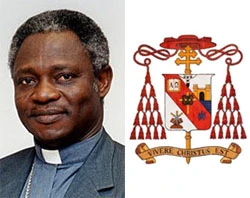
Cardinal Peter Kodwo Appiah Turkson


By Alan Holdren, Rome Correspondent

Vatican City, Jan 13, 2011 / 05:33 pm (CNA/EWTN News).- When he travels to the United States next month, Cardinal Peter Kodwo Appiah Turkson is aware that he may have to make some adjustments in the way he talks about the Church’s social teaching.

As president of the Pontifical Council for Justice and Peace, the Ghanaian cardinal, 62, is charged with making the Church’s social teaching more widely known and practiced around the world.

He will be in Washington to deliver the plenary address of the 2011 Catholic Social Ministry Gathering, Feb. 13-16. The gathering, on the theme of “Protecting Human Life and Dignity: Promoting a Just Economy,” is sponsored by 19 Catholic organizations, including the U.S. Catholic bishops.

In a recent interview with CNA, Cardinal Turkson said he has learned from past experience that the Church’s justice and peace terminology often needs clarification for an American Catholic audience. Key terms used by the Vatican — such as “social justice” and “gift” — are not always understood the way the Vatican intends, he said.

"We found out that some of the vocabulary which is just taken for granted and used freely may not always have the same sense or may have had some nuances which sometimes are missed because of the way the terms are used in the American political context,” Cardinal Turkson said in a Jan. 12 interview at the council’s offices in Rome.

Pope Benedict XVI appointed Cardinal Turkson to his post in Oct. 2009, just months after the Pope released his blueprint for the Church’s social teaching, “Caritas in Veritate” (Charity in Truth). The council has since made promotion of the Pope’s vision a top priority.

The encyclical outlines Pope Benedict’s plan for "integral human development" in economics, society and politics through the principles of charity and truth.

Cardinal Turkson said the Vatican is pleased by response to the document. But he said reaction from some sections of the audience in the United States was unexpected.

The council has been surprised to find that common terms were misunderstood or misinterpreted. He emphasized that the misunderstanding was not a general or widespread problem among American Catholics. But, he said, "in certain circles ... there is a difficulty."

For instance, the Pope's teaching on themes of "social justice" have been mistakenly connected to "socialism" and "communism." As a result, he indicated, the Pope is mistakenly seen as promoting socialist or big-government solutions to social problems.

The council has also learned that words like "social" and "solidarity" may have been dismissed by American readers for their perceived connection with communist regimes such as the Soviet Union, he said.

Cardinal Turkson explained that in the Church’s thinking, social justice involves citizens’ obligations and responsibilities to ensure fairness and opportunity in their communities and societies.

While this may include the adoption of specific government policies and programs, the emphasis in Catholic social teaching is on the obligations that flow from citizens' relationships in societies.

"Respecting, understanding and fulfilling those demands constitute our justice," he said. "It would be useful if we just observed our sense of justice as our ability to fulfill the demands of the relationships in which we stand."

This is in contrast to socialism, he explained, which is an ideology in which private property and private interests are totally placed in the service of government policies.

What the Pope proposes in “Caritas in Veritate,” said Cardinal Turkson, is "achieving the common good without sacrificing personal, private interests, aspirations and desires."

Cardinal Turkson said the Council was also surprised that the Pope’s concept of the “gift,” was perceived in some circles as encouraging government welfare handouts.

In "Caritas in Veritate," Pope Benedict described the concept of “gift” as a way to understand God’s love for men and women in his gift of life and his gift of Jesus.

"Truth is the light that gives meaning and value to charity," the Pope wrote. "That light is both the light of reason and the light of faith, through which the intellect attains to the natural and supernatural truth of charity: it grasps its meaning as gift, acceptance, and communion."

Gift, Cardinal Turkson explained, is "a very basic, deep theological expression of God's relation or the motivation for whatever God does in the world, and it's not quite the same as a handout."

"If we ever need to talk about this in a society where the sense of gift is that of a handout ... it doesn't quite express the sense of gift in this regard," he added.

While it is too late to add any explanations to the encyclical, the Council might tailor its language differently in future documents.

"We just realized that probably in the future, when ... this dicastery takes up the task of diffusing, presenting and talking about this it might be necessary to provide a footnote in which some of these expressions can be given an awareness of the different senses of expressions in different cultures and settings,” he said. We thought something like that would be useful and helpful to the readers."

Cardinal Turkson urged American Catholics and government and economic leaders to give a conscientious reading of "Caritas in Veritate."

The encyclical, he said, invites us "to go back or to remind about the centrality of the human person, his well being, his common good within everything that we do.”

Another important message, Cardinal Turkson said, is that “we must not sacrifice the good of the human person for anything that we aspire after or want to do with technology, business, economics or whatever."

The key to an authentically human vision of development is to consider the full ethical character of the individual in all decisions, he said.

"In details," he concluded, "it may be for food security and shelter for all persons, but at the end of the day we are looking at whether things that we are doing in the world as government, as a Church and all of that help advance the good of the individual person."
.


Source
.

Wednesday, September 15, 2010

CARITAS IN VERITATE or One World Government


Jul 8, 2009 at 11:34 AM

Veritas


ENCYCLICAL LETTER CARITAS IN VERITATE OF THE SUPREME PONTIFF BENEDICT XVI - June 29th, 2009
http://www.vatican.va/holy_father/benedict_xvi/encyclicals/documents/hf_ben-xvi_enc_20090629_caritas-in-veritate_en.html


While there is much that is good in this letter, in that it lays out many of the world's ills with clarity, and has some useful answers, I take issue with one major finding. The letter calls for “a true world political authority”, or in other words, One World Government. This is the outmoded doctrine of the 1920s, of people like Jean Monnet1 which lead to the establishment of the European Union with its seemingly unstoppable aspiration of centralised power in Europe, through the EU government.

There is much wrong with Nation States, but a great deal right with them when they cooperate together for the global good. This can be seen in a small way, in the way that NATO has maintained peace in Europe for the last 60 years, through the agreement of cooperating sovereign states.

Thank God that we had one sovereign Nation State left in Europe, that thought differently enough to oppose the One World Government ambitions of Adolf Hitler. Despite the shortcomings of Nation States, their very existence, not under the power of One World Government, guarantees that some will disagree with the Empire building aspirations of others, when that becomes tyrannical, and will fight when that option becomes the last resort.

If Nation States are the problem, “a true world political authority” is not the answer. As the letter states, “such an authority would need to be universally recognized and to be vested with the effective power to ensure security for all, regard for justice, and respect for rights”. The only way that it can have effective power is for it to be supra-national. One of the driving forces behind Monnet's plan for the United States of Europe, was the failure of the League of Nations, as it lacked supra-national power, because it was just an intergovernmental organisation.

The letter suggests that the problem of tyranny can be avoided:

Para 57 In order not to produce a dangerous universal power of a tyrannical nature, the governance of globalization must be marked by subsidiarity, articulated into several layers and involving different levels that can work together. Globalization certainly requires authority, insofar as it poses the problem of a global common good that needs to be pursued. This authority, however, must be organized in a subsidiary and stratified way, if it is not to infringe upon freedom and if it is to yield effective results in practice.

So it needs ultimate authority, but must also contain some clauses of subsidiarity. The Pontiff doesn't see the conflicting nature of that proposal. It is either in charge, or others are in charge of it. There is no middle ground. The EU plays that game very well, allowing its states to legislate, through subsidiarity, for only minor unimportant issues. All major issues and legislation are the province of the supra-national body. As Monnet said, when he realised that an organisation without total power would be a failure: “I was impressed with the power of a nation that can say no to an international body that has no supranational power. Goodwill between men and nations is not enough.2”

No, Pontiff Benedict, One World Government is not the answer to this difficult problem.

Note 1. Jean Monnet and Arthur Salter held senior positions in The League of Nations after The Great War. These two friends, a frenchman and a British Civil Servant between them sketched out the original blueprint for the “United States of Europe” with Monnet's influence extending all the way up to his death in 1979.

2. The Great Deception, Booker and North, Continuum, 2005, page 19

(Minor edit July 9th)
.
.
.

Caritas in Veritate: EPP Group holds structural dialogue with Churches

Conference on the Encyclical 'Caritas in Veritate'
Joseph Daul MEP (France), Chairman of the EPP Group in the European Parliament (in the middle), (r-l) Othmar Karas MEP (Austria), Vice-Chairman of the EPP Group responsible for intercultural activities, László Tőkés MEP (EPP Group, Romania), Vice-President of the European Parliament, Paolo Licandro, Deputy Secretary-General of the EPP Group, HE Archbishop André Dupuy, Apostolic Nuncio to the European Union, Father Piotr Mazurkiewicz, General Secretary of the Commission of Bishops' Conferences of the European Communities (COMECE), and Győrgy Hőlvényi, EPP Group Secretariat

Brussels, 14 September 2010

Caritas in Veritate: EPP Group holds structural dialogue with Churches

In conjunction with COMECE, the Commission of the Bishops' Conference of the European Community, the EPP Group in the European Parliament organised a dialogue on the encyclical 'Caritas in Veritate' (Charity in Truth) on the occasion of the first anniversary of its publication.

Joseph Daul MEP, Chairman of the EPP Group, László Tőkes MEP, Vice-President of the European Parliament, Othmar Karas MEP, Vice-Chairman of the EPP Group responsible for inter-religious dialogues, Archbishop André Dupuy, Apostolic Nuncio to the EU, and Father Piotr Mazurkwiewicz, General Secretary of COMECE and many other clergy, scholars and politicians participated in this dialogue.

'Caritas in Veritate' is the first social encyclical of Pope Benedict XVI and concerns the problems of global development and progress. Participants debated subjects such as 'Is a culture without values possible?', 'Family as the key for the future', 'Economy and civil society' and 'Development and environment'.

Joseph Daul MEP strongly supports the dialogue between the EPP Group and Churches and other religious organisations and will continue to deepen this special relationship. The Group is seeking to find common ground through open discussions between politicians and the representatives of Churches on current and future challenges facing European citizens and their governments. "It is important to seek common values and defend those values and fight against extremism, whether it be from the left or the right", he said.

Othmar Karas MEP said: "We have to broaden our network and get to know our allies. We want to attract more people. I would say that Christian dialogue is like the Cross, which doesn't cross out, but connects. There are many Christians and baptised politicians, but not every Christian and every baptised politician is a bearer of the Christian doctrine. We want to confront politicians with our message and the Church, so that they find support and guidance in their political work."
Archbishop André Dupuy, Apostolic Nuncio to the EU, stressed that the Papal encyclical 'Caritas in Veritate' was not intended to be a blueprint for economical needs, but to give direction to build a more fraternal world.

COMECE General Secretary Father Priotr Mazurkiewicz said that the Church does not give technical solutions but deals with ethical progress in society. The challenge is not to give technical advice to politicians but to put the people and their actions at the forefront.

HE Metropolitan Emmanuel of France, President of the Conference of European Churches (CEC), said cultural and ethical aspects of the encyclical are not just ideas, but form the essence of Christianity. In his view, the current economical crisis was not just an inevitable disaster, but the result of a degeneration of values.

Professor Stefano Zamagni of the University of Bologna agreed with HE Metropolitan Emmanuel by saying that the world is suffering from a lack of thought. Social and economical aspects appear to be separate issues but in fact, they are much more interlinked than many people think. Corien Wortmann-Kool MEP, Vice-Chairwoman of the EPP Group responsible for economics and environment, said that for this very reason, the EPP Group is focusing on the EU 2020 Strategy to revitalise Europe's economy, and to ensure the inclusion of people. "Work is not only a production factor, but gives also the opportunity for people to participate in society. We have an obligation to stimulate this", said Wortmann-Kool.

László Tőkes MEP, Vice-President of the European Parliament responsible for dialogue with Churches and religions and inter-cultural dialogue, concluded that European unity cannot be fulfilled without the participation of Churches and it cannot be fulfilled without their good cooperation."

More information on the conference
http://www.eppgroup.eu/Press/peve10/eve030_en.asp

Watch 'Religious institutions must be included in political dialogue' on
http://www.eppgroup.eu/tv/default.asp?vid_id=100915_event

For further information:
Eduard Slootweg, EPP Group Press & Communications Service, Tel: +32-475-721280

Notes to Editors:
The EPP Group is by far the largest political group in the European Parliament with 265 Members.

.


.

Tuesday, September 14, 2010

Encyclical "Caritas in Veritate" from the Perspective of Politics, Economics and Theology


Encyclical "Caritas in Veritate" from the Perspective of Politics

14.09.2010
09:00 - 18:00

Encyclical "Caritas in Veritate" from the Perspective of Politics, Economics and Theology

EPP-ED - Group of the European Peoples' Party and European Democrats
Rue Wiertz, 47-53
B-1047 Brussels
Phone: +32 (0)222 842234
Fax: +32 (0)223 06208
Email: epp-ed@europarl.eu.int

Link to the organizer: http://www.epp-ed.org/home/en/default.asp

--------------------------------------------------------------------------------
COMECE
19, Square de Meeûs
B - 1050 Bruxelles
Phone: +32 2 235 05 10
Fax: +32 2 230 33 34
Email: comece@comece.org

Link to the organizer: http://www.comece.org/
URL of Event:
http://www.comece.eu/content/site/en/activities/events/caritasinveritateconf/index.html?SWS=1ba360fb11c8bc12de6de4215cd27210

Type of Event
Conference / Convention

Policy Field of Event
European Integration, Institutions & Enlargement

Limitation
Registration required

Location of event
European Parliament, ASP building, 3rd Floor, Room 2
Brussels

Infos
The EPP Group in the European Parliament will be holding a conference, together with COMECE the theme of which will be the Encyclical letter 'Caritas in Veritate' from the perspective of Theology, Politics and Economy.


The conference will provide an opportunity for politicians working in the European Parliament, both clerical and lay professionals dealing with European politics, driven by a shared obligation towards Europe, to re-examine the key messages of the encyclical letter.

People
Joseph Daul, Chairman of the EPP Group; Laszlo Tokes, Vice-President of the European Parliament.
.
.
Source: http://www.europeanagenda.eu/events/29293.php
.

Saturday, January 23, 2010

Is President Obama reciting from "Caritas in Veritate"?

President Obama enthusiastically stating his agenda at Lorain County Community College in Elyria, Ohio, Friday.


As the days go by, it seems more and more as if President Obama is reciting form Caritas in Veritate, Benedict XVI's encyclical condemning greed, and calling for a compassionate, ecologically friendly - New World Order with teeth.
.
The U.S. President is now denouncing greed in high places.
Is the president forgetting he is in a high-place himself; who recently received a million dollar prize for peace he hasn't achieved, yet?
Where's the peace?
What was that money for?
..
Yes, folks it seems as if President Barack H. Obama is reading a script; And that teleprompter can be no other, but the one proceeding from the Vatican: Caritas in Veritate!
.
Hint:
Obama's papal visit occurred within days of Caritas in Veritate's release.

.
Read the headlines and verify it for yourself:
.

CNS STORY: Economist: UN could create economic body with teeth, as ... - 5:33pm
Jul 7, 2009 ... VATICAN CITY (CNS) -- Pope Benedict XVI's call for an international authority with "real teeth" to guide the global economy could be ...www.catholicnews.com/data/stories/cns/0903106.htm - Cached - Similar


BBC NEWS Europe Pope calls for a UN 'with teeth'
Jul 7, 2009 ... Pope Benedict XVI signs his encyclical Caritas in Veritate ... so that the concept of the family of nations can acquire real teeth... there ...news.bbc.co.uk/2/hi/8137849.stm - Cached - Similar


Give the UN real teeth: Pope Benedict XVI The Australian
Jul 8, 2009 ... VATICAN CITY: The Pope has called for a new world body "with real teeth" to restore the global economy, and for the creation of a financial ...www.theaustralian.com.au/...teeth...benedict-xvi/story-0-1225747117577


Pope Benedict XVI Calls for NEW FINANCIAL ORDER With 'Real Teeth' - 5:34pm
Jul 7, 2009 ... July 7 (Bloomberg) — Pope Benedict XVI called for a new financial order with “real teeth” as Group of Eight leaders prepare to discuss ways ...www.infiniteunknown.net/.../pope-benedict-xvi-calls-for-new-financial-order-with-‘real-teeth’/ - Cached


*Let the gnashing of teeth begin: Barack Obama to meet Pope ...
Jul 9, 2009 ... This will be very interesting indeed. Barack Obama is scheduled to knock on the doors of the Vatican on the last day of his G8 summit trip ...bluepanjeet.net/.../gnashing-teeth-barack-obama-meet-pope-benedict-xvi-july-10/ - Cached - Similar


Pope calls for a new world order, one with “teeth” possibly in ...
Jul 9, 2009 ... POPE Benedict XVI has proposed a new world political authority “with real teeth”, possibly in place of the United Nations, to enforce an ...
jehovahswitnessnews.wordpress.com/.../pope-calls-for-a-new-world-order/ - Cached


Video

Pope claims greed has 'wreaked havoc' on the ...current.com

Arsenio.

.

Sunday, January 17, 2010

Pope Continues Global “Green” Crusade for World Government

Pope Continues Global “Green” Crusade for World Government
AIM Column By Cliff Kincaid January 12, 2010


Glenn Beck recently said that he was inundated with messages from people concerned about an Obama executive order giving special rights to the international police organization known as Interpol. But what about the global campaign by the Vatican to establish a "World Political Authority" with "teeth." Don't look for Beck, O'Reilly or anybody else in the media to take on Pope Benedict XVI. It is just too controversial. Commentators who question the Vatican run the risk of being labeled anti-Catholic bigots.

Many Catholics, especially of a conservative persuasion, are embarrassed and troubled by what is happening inside their church. But they are mostly reluctant to say anything publicly. The facts, however, speak for themselves, and they are available on the Vatican's own website in the actual words and statements being uttered by the Pope.

Consider, for example, Pope Benedict's passionate embrace of the radical environmental movement. The Washington Times on Tuesday ran a front-page photo of the Pope greeting ambassadors to the Vatican during his new year's address to the diplomatic corps. "The Pope denounced the failure of world leaders to agree on a climate change treaty last month," the caption said. It's true. Despite the Climategate scandal that has thrown the man-made global warming theory into disrepute, the Pope is still a believer in the discredited claims being made about the role of man in creating a hotter planet and he is trying to force world leaders to embrace and act on them.

Acting more like a politician than a religious leader, the pope complained about the failure at the Copenhagen conference to come up with a new treaty to punish Western nations, led by the United States, that have used fossil fuels for industrial development. Referring to "the growing concern caused by economic and political resistance to combating the degradation of the environment," he said, "This problem was evident even recently, during the XV Session of the Conference of the States Parties to the United Nations Framework Convention on Climate Change held in Copenhagen from 7 to 18 December last. I trust that in the course of this year, first in Bonn and later in Mexico City, it will be possible to reach an agreement for effectively dealing with this question. The issue is all the more important in that the very future of some nations is at stake, particularly some island states."

The Pope, therefore, is going to use his influence to get a treaty written, passed, and imposed on the world.

The Pope went on to embrace other aspects of the global "progressive" agenda, endorsing the holding of the Nuclear Non-Proliferation Treaty Review Conference in New York in May, so that "concrete decisions will be made towards progressive disarmament, with a view to freeing our planet from nuclear arms." This is Obama's goal as well.

Zero nuclear weapons sounds good in theory, but what does it mean, practically speaking, when the world is confronted by a fanatical regime in Iran determined to acquire them? All that the Pope said about this was, "Concerning Iran, I express my hope that through dialogue and cooperation joint solutions will be found on the national as well as the international level." Not even President Obama treats the Iranian problem with such platitudes. Obama at least talks about sanctions against Iran.

In reality, the Pope's recipe for a nuclear-free world means appeasement of Iran, its acquisition of nuclear weapons, and a more dangerous world with more nuclear weapons.

Strangely, the Pope called for a new global warming treaty but admitted that centralized planning to "save" the environment hasn't worked on the national level. He said, "Twenty years ago, after the fall of the Berlin wall and the collapse of the materialistic and atheistic regimes which had for several decades dominated a part of this continent, was it not easy to assess the great harm which an economic system lacking any reference to the truth about man had done not only to the dignity and freedom of individuals and peoples, but to nature itself, by polluting soil, water and air?"

The Pope was admitting that a communist-style economic system was not only a threat to man but the environment. Yet, he now wants the United Nations to play a central role in policing a new global agreement on the environment and disarming the nations of the world. As dangerous as this may sound, this objective is consistent with his endorsement of a "World Political Authority," a key recommendation from his Caritas in Veritate encyclical.

In that controversial document, the Pope explained that a "World Political Authority" was necessary in order to "manage the global economy; to revive economies hit by the crisis; to avoid any deterioration of the present crisis and the greater imbalances that would result; to bring about integral and timely disarmament, food security and peace; to guarantee the protection of the environment and to regulate migration..."

These shocking statements in favor of what is clearly a world government immediately followed the Pope's recommendation that, in the face of the "unrelenting growth of global interdependence," the United Nations must be reformed so that "the concept of the family of nations can acquire real teeth."

So the Pope wants a strengthened United Nations to constitute a "World Political Authority" that will have the "teeth" to enforce its will on the nations of the world? Will somebody in the media explain why this is not global tyranny? This makes the controversy over Interpol look like peanuts.

Of course, few in the media want to bring up this sensitive subject. After all, the Pope is a religious leader of 1.2 billion Catholics, with 63 million of them here in the U.S. But it's precisely because the Catholic Church is the largest religious body in America that the statements of its leader deserve media scrutiny.

Before he spoke to the diplomats, on the occasion of the World Day of Peace, the Pope issued a January 1, 2010 statement based on the theme, "If You Want to Cultivate Peace, Protect Creation." Again, sounding like Al Gore or Barack Obama, the Pope said that "the threats arising from the neglect--if not downright misuse--of the earth and the natural goods that God has given us" were as troubling as "wars, international and regional conflicts, acts of terrorism, and violations of human rights."

The Pope reiterated that the campaign to pass a new global warming treaty should be part of a broader campaign to remake the global economy. "It should be evident that the ecological crisis cannot be viewed in isolation from other related questions, since it is closely linked to the notion of development itself and our understanding of man in his relationship to others and to the rest of creation," he said. "Prudence would thus dictate a profound, long-term review of our model of development, one which would take into consideration the meaning of the economy and its goals with an eye to correcting its malfunctions and misapplications. The ecological health of the planet calls for this, but it is also demanded by the cultural and moral crisis of humanity whose symptoms have for some time been evident in every part of the world." (emphasis in the original)

Is all of this flowery rhetoric designed to usher in a new socialist international order? Is this what he means by changing the "model of development?"

One problem is that the Pope gives fewer news conferences than Obama. In fact, he gives none. So who in the media has the courage to hold the Vatican accountable for its campaign to help Obama usher us into a New World Order on the basis of nonsense about the environment and nuclear weapons?

Cliff Kincaid is the Editor of the AIM Report and can be reached at cliff.kincaid@aim.org

.
Source:http://www.aim.org/aim-column/pope-continues-global-green-crusade-for-world-government/
.

Friday, December 04, 2009

HOLY SEE AND RUSSIA ESTABLISH FULL DIPLOMATIC RELATIONS

HOLY SEE AND RUSSIA ESTABLISH FULL DIPLOMATIC RELATIONS

VATICAN CITY, 4 DEC 2009 (VIS) - The Holy See Press Office released the following communique yesterday evening:

"This afternoon, 3 December 2009, His Holiness Benedict XVI received in audience Dimitri Medvedev, president of the Russian Federation. The president had previously met with Cardinal Secretary of State Tarcisio Bertone S.D.B. who was accompanied by Archbishop Dominique Mamberti, secretary for Relations with States.

"During the cordial discussions pleasure was expressed on both sides at the cordial relations that currently exist between them, and it was agreed to establish full diplomatic relations between the Holy See and the Russian Federation.

"Following an exchange of opinions on the international economic and political situation - also in the light of the Encyclical "Caritas in veritate" of which the Holy Father presented the president with a copy in Russian - attention turned to the challenges currently facing security and peace. The talks then turned to cultural and social questions of mutual interest, such as the value of the family and the contribution believers make to life in Russia".

OP/AUDIENCE/PRESIDENT RUSSIAVIS 091204 (190)


Source: http://212.77.1.245/news_services/press/vis/dinamiche/a0_en.htm
.
.
Related:

http://www.youtube.com/watch?v=b7z6kK3XfdU&feature=player_embeddedhttp://

.

Friday, October 02, 2009

Babylon is Back!


October 01, 2009

Dear Friends, thank you for joining us. This month I am very pleased to bring you an important message on the educational system of ancient Babylon. The Bible is full of living counsel which helps us understand our times. For instance, if we are watching, we can see the principles of ancient Babylon, played out in modern Babylon.

But before we begin the message for today, I want to remind you that you need to renew your subscription if you have not done so already, so that the end-time CDs from Keep the Faith will continue to come to your home. Please fill in the yellow card today and send it back to us immediately. We don’t want to lose anyone that wants to continue to receive the messages packed with spiritual blessings and useful information for you in these last days. All of our subscriptions are free of charge with no obligation, though we greatly appreciate any support you can send. Also, please share these CDs with others and encourage them to sign up for their own subscription.

One further suggestion is that you should visit our website. If you hear anything in the sermons that you receive from us each month that you would like to verify or document from publically available sources, you will find links to all of our documentation included in the relevant sermon text online. It is easy then to go directly to the source. You will also find additional Prophetic Intelligence Briefings online that are not on our sermon CDs for lack of space.

Let us begin today by reading a passage from Jeremiah, chapter 5:15. God doesn’t do anything important to His church without revealing it through His prophets in ample time so that His people can repent and prepare. God was pleading with Israel to turn from their idolatry and backsliding and return to God. It was God’s last call. Here is what Jeremiah said under the Pen of Inspiration in chapter 5:15. “Lo, I will bring a nation upon you from afar, O house of Israel, saith the Lord: it is a mighty nation, it is an ancient nation, a nation whose language thou knowest not, neither understandest what they say.”

Jeremiah was writing for his own time and the time of Israel before their Babylonian captivity. But did you know that Jeremiah also wrote these things more for our time than his own. Listen to this interesting statement from God’s last day messenger in the Signs of the Times, January 13, 1898 “The prophets of God spoke less for their own time than for the ages to come, and especially for the generation that would live amid the last scenes of this earth’s history.” The apostle Peter wrote of the prophets in 1 Peter 1:12; “Not unto themselves but unto us they did minister…”

The message of Jeremiah is particularly relevant to those living in the very last days. Spiritual Babylon is rising. But most people don’t want to hear of it. Leaders and people continue to follow after their own gods; god’s of materialism, entertainment, popularity, fashion, etc. Israel’s gods in the time of Jeremiah have their parallel today. And God’s message is the same today. Repent and return He says. Through Ezekiel he said: “turn ye, turn ye from your evil ways; for why will ye die, O house of Israel?”

Friends, the same message is for us. Spiritual Babylon will arise and oppress God’s church. How much easier it would be if God’s people were faithful to Him, if they followed His counsel in their schools, hospitals, publishing houses, churches and families.’

Under wicked kings, Israel and Judah rebelled against the plain counsel of the Lord and God sent them into captivity to Babylon. This has its parallel in the end times too, my friends. God is about to bring a great crisis upon the church. It will be a crisis that shakes everything and everyone to the foundations. Spiritual Babylon’s power will be mighty. She will oppress God’s people spiritually and physically. They will pass through the tribulation, but if they have prepared, they will be spared by God’s protection, “as a man spareth his own son.” Malachi 3:17.
We have this very interesting statement in the book Great Controversy, page 625. “Only those who have been diligent students of the Scriptures and who have received the love of the truth will be shielded from the powerful delusion that takes the world captive.” I think it is important to understand this word “shielded.” You actually have to be protected by God. It is not a matter of merely knowing the scriptures. It is not merely an intellectual knowledge the truth that will protect you. You must love Jesus who is the truth, with all your heart. Through His grace and power you must love and obey His law, which is the transcript of His character. Then you will be shielded by divine power in the coming confusion and chaos. Otherwise, you cannot survive spiritually.

In ancient Babylon, God had Daniel, Hananiah, Mishael and Azariah, children of nobility, princes of the royal family. They were actually relatives of the wicked kings Jehoahaz, Jehoiakim, and Zedekiah. These men purposed in their hearts, we are told in Daniel 1:8 that they would allow nothing to defile their bodies or their souls. God worked miracles for them so they could honor Him. Similarly today, there are those who are determined in their hearts to be faithful to the Lord Jesus Christ and choose to follow Him all the way in their daily lives. He will work miracles for and through them too.

The book of Daniel is a book written for those living in the last days and is of great spiritual importance to us. It contains principles as well as prophecies. The principles of education revealed in the book of Daniel are given to help us survive the last days and withstand the enormous pressure that will be applied on God’s people. If we ignore these principles we do so to our own destruction.

When Daniel and his friends, along with many other youth, were snatched from the shelter of their homes and taken to Babylon, they were put under the charge of Ashpenaz, master of the eunuchs. Now, in this crisis, the results of their spiritual training at home were revealed. There can be no doubt that the lifestyle and personal habits of Daniel and this three friends, such as pure food, clean thoughts and physical exercise gave the Babylonians reason to put them on the list of “Children in whom is no blemish, but well-favored” (that is; physically sound and well built).

But their good looks and bodily health was not enough. Apparently, there was some preliminary testing that took place to see which of the young men had the ability to learn the language and so-called “wisdom” of Babylon and then offer wise counsel to the king. Whatever training Daniel and his three friends had in Jerusalem, it trained them enough to be given entrance into the schools in Babylon. Ashpenaz had to find out which of these young people were “skillful in all wisdom, and cunning in knowledge, and understanding science,” it says in chapter 1:4. In other words, these chosen ones must have skill in discerning what is valuable knowledge and an ability to acquire it. They were also to be cunning in applying the knowledge they learned, and understanding in how to classify and systematize it. Ashpenaz was impressed in the preliminary tests with their intellectual ability, and he ranked them with the best young people who would have “had ability in them to stand in the king’s palace.”

At this point let me say a word about wisdom. There is a distinction between human knowledge and wisdom, and that which is gained from an experience with God. You cannot have this deeper knowledge without a walk with God every day. You can only have this when you earnestly plead with God for it, and then cooperate with God in your lifestyle so that He can pour His holiness into your soul. He makes you wise unto salvation, and you become wiser than you could be otherwise in earthly and spiritual matters. You know, by the still small voice, when to speak and what to say, and also when to be silent. But your heart must be trained to hear and understand God’s voice, otherwise how can He prompt you to do the right thing when you are brought into an emergency?

Babylon was the educational center of the world at that time. They had prestigious schools. Every great town had its library of clay tablets connected to the temple that was open to the public which indicates, apparently, that the people were educated to read and write. King Nebuchadnezzar was highly educated and placed a high value on its attainment. We know this from Daniel chapter 1:4. In fact, in this one verse of scripture we learn Nebuchadnezzar’s views of education. Babylon was far in advance of the system that prevails today, even in the leading and most prestigious universities of the world.

The schools of Babylon in all their vaunted academics, however, developed pride, love of pleasure and arrogance. It tended to train the upper class to oppress the lower classes, and many eked out an existence little better than slaves. Worse yet, the Babylonian schools mixed paganism, sorcery and superstition with the educational curriculum, and this would train Daniel and his friends against the principle of holiness unto the Lord. It would corrupt them and educate them to think and act like the Chaldeans. This they could not afford to allow. They had to be protected from this and their minds had to be at their peak efficiency to discern the truth from the error. They had cultivated simplicity, courtesy, gentleness, and self-sacrifice. They were men of prayer and they pled with God to protect them from corruption. They knew how much the wisdom of God far exceeded the wisdom of Babylon, so they purposed in their hearts not to defile themselves with anything that would degrade their sensibility to God’s voice. They had to purpose in their hearts to obey God at every turn. They had to train themselves to hear His voice amid all the din and confusion of other voices around them.

The first test of their character, however, was after they had been tested in their general knowledge, wisdom and skill and had been chosen to be part of the Babylonian training. The king intended to bestow honor on the youth brought to Babylon and he wanted them to have the best physical and mental development that could be attained so that they would be the best they could be in the royal palace. Therefore, he appointed what he thought would be best for them, the very things which he ate and drank. But this would train them to be self-indulgent and develop a taste for rich and harmful foods.
Furthermore, Daniel and his friends knew that they could not eat this food or drink this wine, because in doing so, they would be acknowledging the gods of Babylon and send a wrong testimony of their faith to the Babylonians. But the greatest fear was that they would compromise their sensibilities and no longer be able to hear the voice of God. The other Hebrews thought differently. They saw that their lives would be in danger if they rejected the kindness and benevolence of the King. They feared to insult him. So instead they chose to insult Jehovah and ate the king’s food.

Friends, God asks us in these last days to give up all things which will in any way check the flow of the Holy Spirit through our minds. Those living in the last days must have a mature faith. This means that they must have a mature lifestyle. This is the reason for careful obedience to the laws of health and temperance. Indulgence of appetite was the way Satan successfully tempted our first parents in the Garden of Eden to sin, and it is the way in which he will entrap many otherwise good people in the last days. God will also test His people just as He tested Daniel and his companions. A voluntary self-control of appetite lies at the foundation of every reform. You must get control of your appetite by the grace of God, if you want to be eternally saved, not because what you eat will save you, but because the indulgence of appetite leads to sin.
It means very much to be true to God. It is an experience that few appreciate. But if you do learn how to have it, you will be an instrument in the hands of God to do a powerful and mighty work – particularly under the power of the latter rain.

Daniel approached the two officers of the court and courteously asked if they could eat only pulse and water. Pulse was vegetables and fruits. Their request for a 10 day trial was granted after some hesitation. Then the privilege of eating simple food was extended throughout their training. God blessed them and made them prosper in Babylon, even in Babylon’s worldly training environment.

Let us try to understand the thinking of the Babylonians and their goals for the nations that they conquered. It was the purpose of King Nebuchadnezzar to make one huge harmonious empire. This meant that he not only had to defeat the nations in battle and subject them to Babylonian control, but he also had to globalize the politics of all the nations he conquered. He wanted to get everyone thinking and acting in uniform ways. He was an ancient social engineer. He did three things. First, he established an imperial system of political order that included an intricate array of officials including “the princes, the governors, and the captains, the judges, the treasurers, the counselors, the sheriffs.” They are all listed in Chapter 3:2, 3. Many of these officials were these young leaders that Babylon had trained for service to the king.

Secondly, King Nebuchadnezzar had to globalize the economy so that everything followed the new world order that he had established. That is one of the reasons why the treasurers were all called to the worship of the great image in Chapter 3. Notice that in this way the economy was directly connected to their religion.

Thirdly and ultimately, it was Nebuchadnezzar’s purpose to bring about a global or empire-wide religion, a “religious nationalism.” This religion, like so many other pagan religions, was rooted in the worship of the sun. The religions of other nations had to be ecumenically harmonized with Babylon’s religion. And once that was accomplished, everyone could worship at the same shrine, or in the same way. Many of these religions were not that far removed from Babylon’s religion. They worshipped the sun god. They had similar rites, rituals, feasts and festivals. They were relatively easy to integrate. But the Jews were a different story. Their religion was so different that it was a much more challenging task. Perhaps the greatest distinction was the Sabbath.
Let me point out that this is paralleled in modern Babylon. The conquest today is not with arms, missiles, tanks and bombers. It is with craft, manipulation, policy and politics on a global scale. The papacy is encouraging and assisting world political leaders in establishing a modern empire under the Babylonian principles of worship that are essentially the same as ancient Babylon, including political, economic and religious globalism. It involves the worship of the sun god, as represented in the symbols of Roman Catholicism and in the methods of worship used in her churches, and in particular, Sunday worship.

Modern social engineers such as world elites and globalists, like their ancient counterparts, want to establish a world government or another world empire that will once again assimilate all nations, kindreds, tongues and peoples into one common principle of worship. They want one world government, one world economy, and one world religion. And the papacy is skillfully positioning herself to manage the new empire at least from behind the scenes. That is what scripture tells us there in Revelation 13 & 18. There is arising a new “religious nationalism.” And those who don’t go along with this new global agenda will be considered to be disloyal citizens. More importantly, those that don’t go along with the universal Sunday laws will find themselves in prison, in torture chambers and under other forms of persecution. For Rome is preparing, we are told, to revive her former persecutions in the secret recesses of her massive institutions. That’s from the book Great Controversy, page 581.

Perhaps the best example of this assimilation in relation to modern Babylon is the ecumenical movement. The idea behind the ecumenical movement is essentially a “religious nationalism.” Rome is attempting to draw all the churches together in ecumenical activities and dialog so that she can neuter their distinctive voice and remove any opposition to her teachings and practices. Many of them are not that far removed from Romanism. After all, they mostly all observe Sunday, the sign of Rome’s authority. She wants them all to be saying the same things and thinking the same way. Once they are all speaking and thinking in uniformity, there are then no distinctive teachings that create any division between the churches, they can then become instruments of the “religious nationalism” to promote and even help enforce the observance of religious rites that will by law be imposed upon the nations. A world empire with a world religion will then become possible. Gradually, step by step this is successfully being brought into place. Once everyone is on the same principle, the Holy See will have sway with the nations and succeed in requiring all to worship in the same way.

Another example of the idea of “religious nationalism” of modern Babylon is the statements of Pope Benedict in September of 2007 calling on the nation of Austria to cherish its Christian heritage. To the diplomatic corp. he said: “Much of what Austria is and possesses, it owes to the Christian faith… An Austria without a vibrant Christian faith would no longer be Austria.” During his homily at Mass while visiting the shrine at Mariazell he added the one element upon which Rome intends to unite all the nations, and which is the key ingredient of Babylon’s “religious nationalism,” Sunday observance. “Give the soul its Sunday, give Sunday its soul,” he said.

It should be pointed out that this idea of “religious nationalism” which has as its goal a conformity or uniformity of culture and religion is a global concept, not linked to any particular nation, except the Vatican or the Holy See. It is transnational. In other words, it bypasses national or geographical borders and is linked, not to one’s own country, but to the Holy See. Moreover, it educates the student to be a “servant of god,” or a “servant of the gods.” “Religious nationalism” turns ordinary people into defenders of the faith. As “servants of the gods” they do the bidding of the common religious authority. This was the goal of the educational plan of both ancient and modern Babylon.

Ancient Babylon accomplished this by importing international students to study in Babylon and then used them to promote and develop the Babylonian culture and education among their own people. They chose the nobility. After all, once educated in Babylonian ways and means, they would have more credibility with their own people, and perhaps would be more effective in neutralizing their own nationalism and replacing it with Babylonian nationalism. Moreover, some of them at least would be in a position to help the king work through any issues that might arise related to the integration of the Hebrews into Babylonian culture and religion. This is clear from the scripture itself. Daniel 1:3 & 4 tell us that they needed to have the ability “to stand in the king’s palace.”

To stand before the king in ancient Babylon would be a great privilege. Yet these students were to be servants of a religious nationalism that worked to absorb God’s people into Babylonian philosophy and culture. To Daniel and his three friends, this would be a literal impossibility; but to the other Hebrews, it was a “necessity.” These Hebrews were offered privilege and honor in exchange for loyalty. They would be educated in all areas of Babylonian life and culture, science and logic as well as the mysteries of the Babylonian religion. And they were expected to obey.
Note the following statement about those living at the time when the Sunday movement becomes bold against commandment keepers. It is from Great Controversy, page 607. Note what is offered to some.

“As the movement for Sunday enforcement becomes more bold and decided, the law will be invoked against commandment keepers. They will be threatened with fines and imprisonment, and some will be offered positions of influence, and other rewards and advantages, as inducements to renounce their faith.”

Did you hear that? History repeats itself. Like the Hebrew children, they will be “offered positions of influence, and other rewards and advantages, as inducements to renounce their faith.” In other words, some will be bribed. In exchange for their loyalty and support for the Sunday law movement, they will be offered positions of influence so that they can be used to sway others.

I’ll read on: “But their steadfast answer is: ‘Show us from the word of God our error…’” I like that! God will have a faithful people who will not conform to the ecumenical “religious nationalism” that wants to bring them all into conformity to the Holy See.

The intentions of this “religious nationalism” became more clear in ancient Babylon over the years, both on the Plain of Dura before the great image, and at the time of Darius, when Daniel was threatened with death by lions. God made it clear Who was in charge by protecting these men from execution. Now in modern Babylon the same principle is unfolding. There is a steady, and sometimes stealthy attempt to legally restore the ancient religion of Babylon involving Sunday worship. Again, there will be an attempt to educate God’s people in the ecumenical way. You can see it happening in many parts of God’s church today. Yet there will be those who will refuse to go along with it, though sadly many will accept this uniformity to avoid the disadvantages.

There is yet another idea in this principle of “religious nationalism.” Ancient Babylon, as an empire, was concerned about all the nations, tongues and peoples under its rule. Babylonian education, culture and religion was for the common good, for all people, and therefore needed to be brought to them, if not by persuasion, then by force.

Modern Babylon by comparison has the same idea. The “brotherhood of humanity” is in a struggle against the evil in the world. The best and only solution, according to the Papacy, is to homogenize or conform all people of all races and all nations to one system of understanding. This would prevent wars, conflicts and schisms and promote the common good united under one god, the Pope of Rome.

In this idea is contained the principle of wealth re-distribution for the benefit of the poor. The idea of the “common good” is that all members of society work together for the benefit of all. It is a socialistic concept that requires a centralized global authority to control the politics, economics and religion of the empire according to moral principles guided by the religious authority, just as in ancient Babylon. In this system, each individual helps all, and the collective society helps the individual. While there is some good in this principle, there is a dark side. In an evil world, the empire is controlled by a few elite men who are determined to conform everyone to certain principles that defy the law of God. This is where the problem was for Daniel and his three friends. And this is the problem for God’s people in the last days.

Today modern Babylon is again advocating a global authority to guide the economies and politics of the world according to moral principles, principles which the Holy See is positioning herself to define as the moral authority of the world. She works with the “merchants of the earth” such as the central bankers and the “kings of the earth,” or the rulers, to engage them in the process of restructuring the global economy. The Holy See works with the nations to promote a globalism that enhances her position as the spiritual mother of all.

Babylonian education required that individuality be trained away from independent expression in exchange for the common expression with all the rest of society. Hebrew education was exactly the opposite because it trained the individual to exercise his independence and individuality. Without this independence the Hebrew system would not flourish. God’s plan was to educate His people to think for themselves, reason from cause to effect, and develop a love and loyalty to God that prevented apostasy both on an individual basis and on a church-wide basis. The human tendency to conform was always at odds with the principle of a divinely guided individuality.

Modern Babylon attempts to do the same as ancient Babylon by training the individual to think like everyone else and conform to social “norms” that limit or even prevent certain types of individual expression. If you do not conform to these demands, you are ostracized, unrecognized and unacknowledged.

The training of Babylon was rather elaborate. It involved many disciplines, from sciences, math, languages, political science, history, law, military strategy, to public affairs and religion or theology. But it also involved training in observation, judgment, prudence and discernment. It also taught its students how to think in the Babylonian way. It was considered that three years would be sufficient time to acquire these skills if the candidates had sufficient aptitude. They also had to learn the difficult and complex Chaldean and Aramaic languages. This was foundational to all other studies. Their training likely involved mental exercises like solving puzzles or riddles, etc. During their specialized education, the trainees covered a lot of ground and applied themselves diligently and mastered it. Moreover, they learned to articulately transmit that knowledge to others.

Also, Babylonian astronomers had reached a very high degree of development. They could, for instance, predict both lunar and solar eclipses by computation. Their mathematical skills were also highly developed. They used formulas that were as advanced as the Greek mathematicians. Moreover, the Babylonians were good architects and builders, as witnessed by the famed hanging gardens and beautiful building designs discovered by archeologists. They were reasonably good physicians, having discovered by research and repeated demonstration, the cures for many diseases. These things were part of their educational system, for why would these things be developed without imparting them to the succeeding generations.

These are, no doubt, the branches of learning that Daniel and his friends and the other captives learned in the school of Nebuchadnezzar. And it was no doubt in these branches of learning in which Daniel and his friends exceeded the Babylonians. Magic, sorcery, astrology and their related superstitions were very inexact matters and involved guesswork and supposition. Worse, their connection to the false religion of Babylon made them all the more odious to the faithful Hebrews. But the impressive mind of Daniel, standing before the king, no doubt made Nebuchadnezzar admire him greatly, greatly enough to place him and his companions in his cabinet of advisors, and eventually to oversee the vast number of Chaldeans in the realm.
No doubt Babylon provided these young men with educational books and good teachers who used the best known methods of teaching. But three years may seem too short to qualify these men for service to the king when they were starting from the very beginning to learn the language, plus all the information and knowledge and wisdom to be 10 times greater in understanding than all the magicians and astrologers in the realm. Humanly speaking, this would be impossible. But it is quite a testimony to the power of God. No doubt He gave them special grace and a special portion of His Holy Spirit to guide them and help them learn quickly, taking the key ideas and issues and applying them diligently. He gave them fantastic memories, and huge capacity for acquiring, sorting, synthesizing and applying the knowledge they gained.
These men were consecrated. No doubt they could see the differences between the education of Babylon and the education they had found in God’s word while at home with their mothers. They could see clearly that there was a wide gap between the superstition of pagan teachings and philosophy and their own.

Likewise today, there is a wide gap between the kind of education that God has ordained for His church and their institutions of learning and the learning in the schools of the world. For Christian schools to teach evolution, for instance, would be inappropriate. Yet it actually happens. For children from protestant homes to attend a Jesuit college or university would be most inconsistent with the teachings of God’s word. It would be absolutely foolhardy to voluntarily place oneself in the hands of modern Babylon for training.

Among the first things that the prince of the eunuchs did was to give these young men new Babylonian names. This signified a change in character. The fact that it was one of the first things also signifies its importance to the Babylon system of training. Their names reflected the qualities or benefits of worshipping the gods of Babylon. Since religious integration into Babylon’s mysteries was the ultimate goal of the Babylonians in their dealings with other nations, particularly the Hebrews, it was vital that they have Babylonian names, and Babylonian names that reflect their gods. As they hear their names repeated in various places and settings, they would subtly become submerged into the religious thinking and feelings of the Babylonian system of religion. If these young men were going to stand as advisors to the king, and help the king to integrate the Hebrew population into the Babylonian religion, these men would need to have a full complement of credentials and skills that would make them most useful to the king. Their minds would have to be absorbed in the Babylonian way of thinking so that they could represent the king before their own people, and so that they could help the government navigate through any difficulties that resulted from the religious thinking and mentality of the Hebrew people.

The issue will be the same at the end of time. Though we do not place so much emphasis on the character in choosing the names of our children today, modern Babylon’s purpose is still to change the character into its own likeness. Those who are preserved and who arrive at the new Jerusalem will maintain their spiritual independence and autonomy from the modern Babylonian system. They will not be swallowed up in the false worship that the Vatican will impose on the whole world. They will continue to obey God’s command to keep the Sabbath of the Lord regardless of the consequences or punishments brought upon them.

Remember, Nebuchadnezzar’s idea was to merge the religions of the nations, including the Hebrew faith into the Babylon system of worship, by force if necessary. But the king had not reckoned that there would be those in his employ that would resist this to the death. He expected that all the young men would be grateful for the privileges and honors they would be given and would therefore be willing to support the king’s agenda.

Young people from other nations were also in Babylon. They were to do the same thing. But their religious background and their mentality was not so foreign to the Babylonian way. After all, they were already heathens, and just needed some adjustments. But the Hebrews were quite distinct, and they would need special attention. So the Bible records for us that the finest Hebrew youth were chosen to take up that task of being retrained, or reframed into good Babylonians. Today this is much like sending Christian teachers to worldly institutions of learning, or universities of the fallen churches of Babylon, where they unlearn whatever they knew or thought they knew of the message of God for the last days, and they become infiltrated with false educational ideas. They then come to teach in God’s schools and bring their false ideas into the classroom and teach them to their students, thus spreading them for many years to come. Eventually they can, through this process, change God’s church from one that is loyal to God to one that conforms to the ecumenical principles of Rome.

These false ideas that are brought back to God’s institutions of learning vary depending on the person, but could certainly include evolutionary theories, false ideas about salvation, such as the unfallen nature of Christ, or the idea that you cannot have victory over your sins through the grace of Christ, that there is no sanctuary in heaven, or the concept that all we need is love and unity. These false ideas strike at the very heart of the distinctive message God has ordained to be given in the last days.

Satan’s plan was to get these Hebrew young men to compromise so that they would be unable to stand firm to principle and be unable to maintain the distinctives of the Hebrew faith in heathen Babylon. The tragedy is that many of the Hebrews were quite willing to integrate into the Babylonian ecumenical spirit. They had been trained to use situational ethics as their reasoning. Situational ethics is that process where a person can justify whatever they want to do, no matter how it violates the counsel of God, on the basis that the circumstances require it and that God will understand, or overlook it and forgive you.

Today there are many that preach and teach these same principles. They excuse the people from obeying the writings of the apostles and prophets because they supposedly wrote in the “context of their own times,” and not for us in every detail, only in general principles. They teach that the fourth commandment, the Sabbath commandment does not need to be kept anymore. All this makes religion easy.

The education of Daniel and his three friends in Babylon was mixed with sorcery and superstition. While the Hebrew youth would study the exact sciences and other legitimate learning, they kept themselves aloof of the heathen elements. It would have no doubt been difficult to preserve their faith in that heathen land with enormous pressure on them to conform to the customs and manners of the Chaldeans. We are not told how they avoided the common conflicts, but we do know that they held fast to their Hebrew faith.

Today we have a similar problem. The education of modern Babylon has similar characteristics. Again, there is the mixture of exact sciences with superstition and speculation. For instance, modern science involves the evolutionary process which is as speculative as anything can be. The Catholic Church has its own version of evolution. It is called deistic evolution, which is not all that far removed from the evolutionary ideas of secular scientists. The teachings of Rome also involve superstitions and heathen practices, such as praying for the dead. While in a different form, they are essentially the same in principle.

The educational system of the Babylonians was built on a principle of spiritualism, particularly spiritualism that predicts the future. The Babylonians were involved in divining the future by comparing the livers of dead beasts with clay model livers, or by watching how arrows fall, or by the pattern of oil spreading as it is poured on water. These magicians, astrologers, and other diviners also interpreted dreams through incantation formulas and by asking advice of the spirits of the dead. They were very interested in the future, and sought guidance from the spirits so they could navigate the future successfully. Their educational system was deeply imbedded with these principles. While Daniel and his friends avoided this sort of non-sense, they were nevertheless surrounded by it, and learned very quickly of the interest that the Babylonians had in prognostications of the future.

This placed these men, and particularly Daniel, in a position to see the need of a true understanding of the God who reveals all necessary secrets through his prophets.
God,meanwhile, was setting Daniel in place to be His prophet in Babylon. He placed Daniel close to the principles of spiritualism, so that he could learn how the Chaldeans thought and how to talk to them and help them understand the true God. Moreover, Daniel was destined to rule over these Chaldeans, and would have a need to understand their mentality.

Human beings naturally want to know the future. Since they cannot see beyond the present, they need prophecy to enlighten and guide them. And because God created man with this desire or need, He also provided prophecy in the word of God so that he can understand what is coming. That is one of the reasons why prophecy is in every book of the Bible.

Satan also has his way of dealing with this innate desire to know the future. Many are led to the wrong places for a knowledge of the future. And they will pay good money for the information. There are abundant false prophets and abundant false interpretations of prophecy. If they would just diligently study their Bibles, God’s people would have a knowledge that surpasses the mixture of false ideas that abound in our day. If we purpose in our hearts to live the way Daniel lived, we would be able to discern the subtle mixture of truth and error in most systems of philosophy.

Modern Babylon, my friends, is much the same today. Spiritualism is one of the key principles developed in the last days. Modern spiritualism is presented in a very attractive form. Many people, for instance, believe that the spirits of their dead relatives are hovering over them, or that they can feel their presence in the room with them. Moreover, many more are simply placated by spiritual leaders, priests and pastors who tell them that everyone is going to be saved and that they don’t need to worry themselves about the future. Or they are told that so long as they are baptized in the church, they will be saved.

Notice that when they were tested by the king, he found these four men “ten times better than all the magicians and astrologers that were in all his realm.” This tells us that apparently Nebuchadnezzar’s expectation was that eventually, as these men got more experience in the Babylonian ways, they would be involved in the speculative and superstitious knowledge of Babylonian spiritualism and the divining of the future, and guide him through difficult passages in his leadership as king. But Daniel had something infinitely better. He could offer the king a knowledge of the future rooted in the infallible and unchangeable word of God. As God’s prophet, he could guide the king concerning the future with certainty, quite unlike those Chaldean diviners.

Perhaps we can learn from the story why Daniel and his friends survived. First, they had educated themselves to have a firm resolution to remain true to God. “Daniel purposed in his heart…” (Dan 1:8). This was more than a mere passive desire. They actively willed to do the right and shun the wrong. Victory was only possible by the right action of the will. Second, their dependence on God brought upon them the power of Jehovah. In Chapter 2:28 Daniel said to the king, “But there is a God in heaven that revealeth secrets…” These Hebrews knew that they had to work diligently and that human effort was necessary. Yet they knew that it would be worthless if they did not rely on God for power. Third, they refused to blunt their spiritual and moral powers by indulgence in appetite in even one single instance. This was vital to their success. Fourth, they maintained a consistent prayer life. Victory cannot come in life without constant prayer for wisdom to navigate the difficulties and temptations.

Little did Nebuchadnezzar realize who was standing before him during the final exam. Here was a representative of the God of heaven, the God he did not know, the God whose will he was unknowingly fulfilling. Daniel and his friends excelled in Babylon by being faithful to God. When modern Babylon reaches its peak of power, will God have people alive that will again stand for truth and righteousness? Will He have Daniels whom He can bless with important responsibilities?

The lesson of the educational system of Babylon is put on record because it is God’s object lesson for us today. The relation of the Jews to Babylon is the same that God’s faithful people, the true Israel have to the modern churches of our day. The sins of ancient Babylon will be repeated today because the educational system today is the same. It exalts the human through sports, through the honors system, through modern philosophy, evolutionary science, superstition, entertainment, and much, much more.

Friends, I pray that you will “purpose in your heart” not to be defiled by Chaldean teaching and Babylonian living. The call today is to come out of her my people, that ye partake not of her sins and receive not of her plagues.


Primary reference works.

1. Haskell, Stephen N. The Story of Daniel the Prophet, (South Lancaster, MA, 1908, Bible Training School), chapters 1 & 2.
2. Henry, Matthew, Matthew Henry’s Commentary on the Whole Bible (1991, Hendrickson Publishers) pages, 1427-1429.
3. Jones, Alonzo T., The Place of the Bible in Education, (Oakland, CA, Pacific Press Publishing Co.), pp. 9-16.
4. Rosenkranz, Johann Karl Friedrich, The Philosophy of Education, (New York, 1886, D. Appleton and Company), pp. 183-195.
5. Sayce, A. H. Babylonians and Assyrians, (New York, 1900, Charles Scribner’s Sons), pp. 47-62.
6. SDA Bible Commentary, Volume 4, (Washington DC, 1976, Review and Herald Publishing Association), pages 743-764.
7. Sutherland, E. A. Living Fountains or Broken Cisterns, and Educational Problem for Protestants, (Battle Creek, MI, 1900, Review and Herald Publishing Co.), pp, 92-100.

Secondary Sources

1. Clarke, Adam, The Holy Bible, Containing the Old and New Testaments… with a Commentary and Critical Notes, Volume IV, Isaiah to Malachi, (New York, 1850, Lane & Scott), pages 564-567.
2. Cook, F. C., The Holy Bible According to the Authorized Version, with an Explanatory and Critical Commentary… (London, 1876, John Murray), pages 232-250.
3. Laurie, S. S., Historical Survey of Pre-Christian Education, (New York, 1970 AMS Press), pp. 57-61.
4. Rawlinson, George, The Five Great Monarchies of the Ancient Eastern World…, (New York, 1881, Dodd, Mead, and Co.), pp 12-14, 19-21.


Source: http://www.ktfministry.org/sermons/541/babylon-is-back


.