Showing posts with label PORTUGAL. Show all posts
Showing posts with label PORTUGAL. Show all posts
Friday, May 02, 2025
Tuesday, November 07, 2023
Tuesday, August 29, 2023
Pope tells Jesuits inclusivity, doctrinal evolution, synodality are crucial to Church
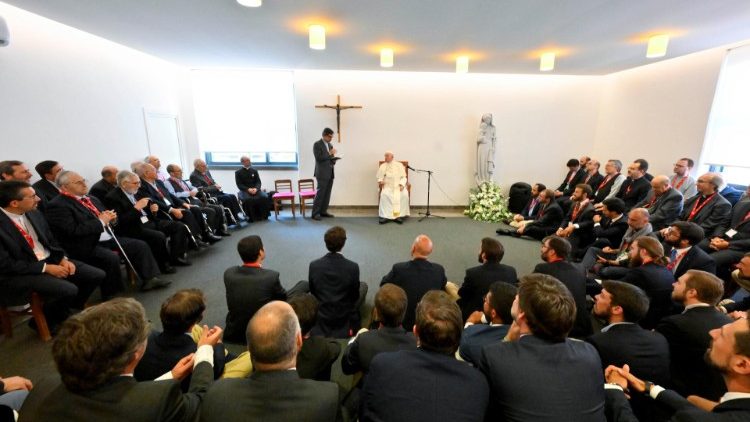
Pope Francis during his meeting with Jesuits in Lisbon during WYD 2023 (Vatican Media)
POPE
POPE
The Jesuit publication "La Civiltà Cattolica" publishes a transcript of the dialogue between Pope Francis and the Jesuits of Portugal during the Pontiff's visit to Lisbon for WYD 2023. In the conversation, the Holy Father addresses a range of topics, sharing insights on the Church's challenges and his vision for inclusivity, doctrinal development, and the Synod.
By Francesca Merlo
In an open dialogue with the Jesuits of Lisbon during his visit to Portugal for World Youth Day, Pope Francis engaged with them in conversation and covered a wide array of topics, sharing profound insights on the Church's contemporary challenges and his vision for inclusivity, doctrinal progression, and the Synod.
Inclusivity takes centre stage
Central to the discussion was the theme of inclusivity. Throughout World Youth Day in Lisbon, the rallying cry for an all-embracing Church resonated powerfully with the words "Todos, todos" (Everyone, everyone), pronounced by Pope Francis as he stressed that the Church "has space for everyone". He emphasized the pivotal importance of creating a space for all individuals, irrespective of their sexual orientation or gender identity, within the Church. This message continued to echo through his exchange with the Jesuits of Portugal.
Acceptance for all
The Pope reiterated his call to embrace homosexual people within the Church. He critiqued the disproportionate fixation on sexual transgressions, noting that other 'offenses' often remain overlooked. He emphasized the need for a pastorally sensitive and imaginative approach to accompany individuals on their spiritual journeys.
The Pope also recounted an encounter with a group of transgender individuals who were moved to tears by the Pope's acceptance and empathy. He underscored the necessity of reaching out to marginalized communities who often grapple with feelings of rejection, and he accentuated the significance of empathy and compassion.
Urgent concerns regarding ongoing wars
Addressing critical global concerns, Pope Francis conveyed deep apprehension over the persistent prevalence of wars since the conclusion of World War II. He spotlighted the contemporary state of global affairs and underscored the imperative of seeking peaceful resolutions.
Doctrinal Development
The dialogue delved into tensions existing within the Church, including reactionary attitudes and resistance to the tenets of the Second Vatican Council. The Pontiff acknowledged the intricate challenges posed by those who scrutinize Vatican II without explicitly naming it. He underscored the dynamic nature of doctrinal evolution and expounded on the notion that Church doctrine is not an unchanging monolith, but rather an evolving entity. He invoked historical instances such as the changing perspectives on the death penalty, nuclear weapons, and slavery to illustrate the fluidity of doctrine over time.
Against spiritual worldliness
Pope Francis expressed apprehensions about the encroachment of excessive worldliness into religious life. He cautioned against compromising core values with the allure of worldly ideologies. Referring to his recent communication to Rome's priests, he cautioned against succumbing to spiritual worldliness and the potential harm it could inflict on the Church. He further explored the challenges posed by a society permeated with an "eroticized" ethos and the implications of issues like pornography in the digital age.
Synodality
Finally, Pope Francis conveyed his anticipation regarding the impending Synod, a gathering of Church leaders to deliberate on significant matters. He clarified that the Synod wasn't his brainchild; instead, it aimed to restore synodality within the Church—a concept first championed by Pope Paul VI. He emphasized that the driving force behind the Synod was the Holy Spirit, guiding its deliberations devoid of political bias or a focus on garnering votes.
Saturday, February 25, 2023
Saturday, February 10, 2018
Leadership Summit Tackles Church Unity

NEWS
Andrew McChesney
Editor, Adventist Mission
FEBRUARY 7, 2018
Speaker after speaker cites John 17 at the two-day summit in Portugal
The article below was provided by Andrew McChesney, editor of the Seventh-day Adventist Mission Quarterly, who is in attendance at the Seventh-day Adventist global leadership summit being held in Lisbon, Portugal. Leadership summit attendees have been reflecting on various reports and presentations centering on unity. ~ Adventist Review Editors
By: Andrew McChesney, adventistmission.org
A Seventh-da Adventist leadership summit emphasized that unity is needed to finish the church’s mission of spreading the gospel and overwhelmingly endorsed the unity described by Jesus in John 17.
Unity is a key issue among church leaders as the General Conference, the administrative body of the world church, contends with several units that are not in compliance with voted policies. The General Conference’s Unity Oversight Committee, which is looking into the matter, is to present a document on the next possible steps to nearly 300 church leaders at the Annual Council meeting of the General Conference Executive Committee in October 2018.
“All unity has to be based on a theological foundation,”
Adventist Church president Ted N.C. Wilson, opening the 11th annual Global Leadership Summit in Lisbon, Portugal, declared that “real unity … comes from a heart-felt submission to God and to our fellow church members as we work together being instructed by the Holy Word, the Spirit of Prophecy, and the Holy Spirit.” Read the full transcript of Adventist Church president Ted N.C. Wilson’s speech here.
“The resulting unity far supersedes any privately held convictions after items have been carefully reviewed by the world church and decisions have been taken,” Wilson said in a keynote address. “It far supersedes any legal ‘rights’ that might be exercised. Moral and spiritual obligations to God, to His church, and to His united mission far outweigh any legal or independent opinions of a member or an organization within the general church body.”
Saturday, May 13, 2017
Friday, May 12, 2017
Pope, at Fatima shrine, urges end to wars tearing world apart

Reuters
Pope Francis, visiting one of Catholicism's most famous sanctuaries, on Friday prayed for an end to wars he said were lacerating the world and urged the faithful to "tear down all walls" to spread justice and peace.
At the start of a trip that will see him on Portuguese soil for less than 24 hours, Francis arrived at the Shrine of Fatima, where the Catholic Church teaches that the Madonna appeared to three Portuguese children 100 years ago in what was then an impoverished farming village.
The main purpose of the trip to the central Portuguese town, which receives around 7 million people a year, is a huge open-air Mass on Saturday to declare two of the children saints.
The two, Francisco and Jacinta Marto, died shortly after the apparitions at the ages of 9 and 10. The third visionary, Lucia Dos Santos, became a nun and died in 2005 at the age of 97.
Watched by hundreds of thousands of people, Francis read a long prayer before a small statue of the Madonna, leaving a gold rose at her feet.
"I implore for the world concord among all peoples" he said, decrying blood "shed in the wars tearing our world apart".
Since his election in 2013, Francis has made hundreds of appeals for peace, including calling for international mediation to reduce tensions between the United States and North Korea.
A banner in the crowd read: "Please pray for peace in Korea".
In his prayer, which the huge crowd listened to in near silence, Francis also hammered home another major theme of his papacy - justice for the poor, refugees and outcasts.
"We will follow all paths and everywhere make our pilgrim way; we will tear down all walls and cross every frontier as we go out to every periphery to make known God's justice and peace," he said.
The story of Fatima's shepherd children has captivated Catholics since their first reported vision on May 13, 1917.
The Church believes the Madonna gave the children three messages, the so-called secrets of Fatima.
The first two were revealed soon and concerned a vision of hell, seen by believers as a prediction of the outbreak of World War Two, a warning that Russia would "spread her errors" in the world, and a need for general conversion to God and prayer.
The "third secret" intrigued the world for more than three-quarters of a century, inspiring books and cults convinced that it predicted the end of the world.
In 2000, the Vatican said it was a prediction of the 1981 assassination attempt on Pope John Paul on May 13, the same day of the first reported apparition in 1917.
John Paul believed the Madonna had diverted one of the bullets that hit him from his vital organs. He donated it to the sanctuary, where it is now embedded in the crown of the statue that Francis prayed before on Friday night.
Wednesday, May 10, 2017
Pope Francis: I’m going to Fatima to entrust the eternal fate of mankind to Mary
Church

Diane Montagna | May 10, 2017

© Antoine Mekary / ALETEIA
Pope Francis General Audience May 10, 2017 © Antoine Mekary / ALETEIA
At the Wednesday audience, the pope asks for prayers for his upcoming pilgrimage to Fatima and speaks of Mary as the Mother of Hope.
VATICAN CITY — Mary is the “best of Mothers” who faithfully keeps the candle of hope burning in the darkness, Pope Francis said today, as he invited Christians to join him in prayer as he journeys to Fatima to “entrust to Our Lady the temporal and eternal fate of mankind.”
Continuing his series on Christian hope, at the Wednesday general audience, the pope turned to Mary, Mother of Hope.
Our Lady’s experience of motherhood models that of so many mothers in our world, the pope told an estimated 15,000 pilgrims gathered in St. Peter’s Square. Hers is a witness of courage in accepting her vocation and welcoming the new life entrusted to her.
“Still in the flower of youth … she responds with courage, even though she did not know the fate that awaited her,” he said.
Hers is also a witness of quiet yet trusting obedience to God’s will amid the trials of life. “Mary appears in the Gospels as a silent woman, who often did not understand everything that was happening around her, but she meditated on every word and event in her heart,” he said.
Diane Montagna | May 10, 2017
© Antoine Mekary / ALETEIA
Pope Francis General Audience May 10, 2017 © Antoine Mekary / ALETEIA
At the Wednesday audience, the pope asks for prayers for his upcoming pilgrimage to Fatima and speaks of Mary as the Mother of Hope.
VATICAN CITY — Mary is the “best of Mothers” who faithfully keeps the candle of hope burning in the darkness, Pope Francis said today, as he invited Christians to join him in prayer as he journeys to Fatima to “entrust to Our Lady the temporal and eternal fate of mankind.”
Continuing his series on Christian hope, at the Wednesday general audience, the pope turned to Mary, Mother of Hope.
Our Lady’s experience of motherhood models that of so many mothers in our world, the pope told an estimated 15,000 pilgrims gathered in St. Peter’s Square. Hers is a witness of courage in accepting her vocation and welcoming the new life entrusted to her.
“Still in the flower of youth … she responds with courage, even though she did not know the fate that awaited her,” he said.
Hers is also a witness of quiet yet trusting obedience to God’s will amid the trials of life. “Mary appears in the Gospels as a silent woman, who often did not understand everything that was happening around her, but she meditated on every word and event in her heart,” he said.
Friday, November 19, 2010
Obama's Russia 'reset' in peril in nuclear row

AFP/File – Russian President Dmitry Medvedev(R) and US President Barack Obama sign the new Strategic Arms Reduction …
by Stephen Collinson Stephen Collinson – 38 mins ago
WASHINGTON (AFP) – President Barack Obama will meet his Russian counterpart this weekend with his "reset" of ties with Moscow in peril, as he battles Republicans over a landmark nuclear treaty.
Obama, just back from rough G20 meetings in Asia, was traveling to a delicate NATO summit in Portugal Thursday, leaving domestic foes, emboldened by a mid-term election triumph, apparently smelling blood over his foreign policy.
In just a few days, the mood over the Strategic Arms Reduction Treaty (START), which makes deep cuts in superpower nuclear arsenals, has soured dramatically, prompting a sudden and high-powered White House counter-attack.
Obama warned on Thursday that comments by a key Republican, Jon Kyl, that the treaty may not be ratified this year in a "lame duck" session of the old Senate, posed a grave risk to US national and nuclear security.
"It is a national security imperative that the United States ratify the new START treaty this year," Obama said, after calling in Republican Cold War negotiators Henry Kissinger, James Baker and other luminaries as back-up.
"This is not about politics, this is about national security," he added.
Kyl's comments appeared to have sparked deep alarm in the administration over national security, possible damage to improved Russia-US relations and fears that Obama's already eroded political capital could be further depleted.
In a hastily-plotted counter-attack, Obama dispatched Secretary of State Hillary Clinton to her old stomping grounds where she is remembered as a persuasive ex-senator who once charmed Republicans.
On Thursday, Obama deployed a storied line-up of former secretaries of state and defense, alongside Kissinger and Baker, who his spokesman Robert Gibbs said were hardly "wild-eyed liberals."
The words Ronald Reagan meanwhile were never far from the lips of Obama spokesmen, as they deployed memories of a conservative hero to bolster what they say is a deal in an established tradition of arms control orthodoxy.
Obama will meet Russian President Dmitry Medvedev for the second time in as many weekends after the NATO summit in Portugal, which will take place with world leaders seeking to assess the impact of the American leader's domestic woes on his global leverage.
Officials argue that delaying the treaty, which could then slip into a new Congress and face further waits or even see its support crumble, will mean Russian nuclear stocks will fester unwatched by US inspectors.
They say it could also imperil political backing in Russia for the "reset" which has yielded Russian support of tough sanctions on Iran and Medvedev's decision not to supply S-300 air defense missiles to Tehran.
Stephen Flanagan, of the Center of Strategic and International Studies, said that if the treaty was eventually lost, it would "take away one of the most important foreign policy achievements that (Obama) has, so it would be damaging."
"It makes you question whether in fact that is what some of the Republicans are trying to do."
As well as demonstrating the capacity of the Senate to be tied in knots by just a few lawmakers, the row also raises the possibility that triumphant Republicans may be eyeing Obama's powers over foreign policy.
Gibbs declined to be drawn into billing Kyl's tactics as a partisan effort to hurt a weakened president.
"I don't know what their motives are, but delaying bringing this treaty up imperils our national security," Gibbs said, adding that ratification was a "no-brainer."
However, officials have said in private that the only possible motive for the exhaustive scrutiny of the treaty in Senate committees and through administration engagement must be to wound Obama.
Less than a week ago, the fruits of Obama's "reset" policy were on show, as he met Medvedev in a hotel towering over the Japanese port city of Yokohama, on the sidelines of a Pacific Rim summit.
Now the White House is scrambling to get the 67 votes needed to pass the measure in the Senate -- after already offering Kyl a 4.1 billion dollar concession to modernize US nuclear stocks.
The uncertainty will loom over the meeting of the NATO-Russia Council after the Lisbon summit, which is meant to expand the US-Russia reset into better ties between Moscow and the western alliance.
Last week, Obama promised to work with Moscow on its entry into the World Trade Organization next year.
Here again, opposition in Congress could be a problem, as lawmakers would be required to remove a Jackson Vanik waiver, a restriction dating to the Soviet era -- and may decide to make trouble for Obama again.
.
.
Tuesday, November 03, 2009
EU Presidency: Lisbon Treaty Could Enter Into Force Dec 1

BRUSSELS (Dow Jones)--The new European Union Lisbon Treaty could enter into force as early as Dec. 1, provided that the Czech president signs it, the Swedish government, which holds the EU rotating presidency until year-end, said Tuesday.
"Now all that remains is the Czech President's signature," Sweden said in a statement. "Provided that the treaty is signed in November, it can enter into force on 1 December 2009," it added.
Earlier Tuesday, Czech constitutional justices dismissed the complaint by a group of Euroskeptic senators that the Lisbon Treaty violates the country's constitution.
Czech President Vaclav Klaus has withheld signing until the court ruling, arguing that the document strips the Czech Republic of its sovereignty.
-By Alessandro Torello, Dow Jones Newswires; +32 2 741 14 88; alessandro.torello@dowjones.com
.


Friday, April 04, 2008
FIRE AND BRIMSTONE

Natural disaster
Fire and brimstone
Apr 3rd 2008
From The Economist print edition
The great Lisbon earthquake of 1755 was the Hurricane Katrina of its time
AT 9.30 on the morning of November 1st 1755, All Saints Day, an earthquake struck Lisbon while most of the population was at church. “I thought the whole city was sinking into the earth,” wrote a terrified English traveller. Those who could fled to the quayside and took to the boats. Ninety minutes later, a tsunami swept them away. Worse was to come. The cooking fires lit to celebrate the feast day spread in the high winds until almost all the city was ablaze. Within two hours, a European capital had been reduced to rubble, swept by floods and consumed by fire.
“Perhaps the Daemon of fear never spread so rapidly and so powerfully its terror upon the earth,” wrote Johann Wolfgang von Goethe, a German poet who was only six years old at the time but could still recall, when he published his autobiography more than half a century later, how frightened he was at hearing of the earthquake. John Wesley, the founder of Methodism, wrote extensively about it. Britain's parliament gave the victims £100,000, an early example of disaster relief.
The great Lisbon earthquake was the first of a series of natural disasters to strike Europe in the second half of the 18th and early 19th centuries, a period when growing scientific observation was providing new explanations of the natural world to rival those of the church. Because it occurred on a major religious holiday it also set off the sharpest arguments about its cause and significance. Nicholas Shrady, an American travel writer and architectural critic, tries hard to bring to life what happened, though he does not really do justice to the earthquake's impact on contemporary thought. Which is a shame, for this was significant.
Its most influential interpreter was Voltaire. In his satirical novel, “Candide”, published four years later, the eponymous hero arrives in Lisbon as the earthquake begins. He and his tutor, Dr Pangloss, are made scapegoats by the Inquisition. Candide is flogged and his tutor hanged, though he survives the ordeal. Pangloss embodies the view that, if God made the world, He must have created “the best of all possible worlds”. Voltaire used the earthquake to attack deistic optimism.
This slender volume suggests that scientific and technical responses mattered as much as moral and philosophical ones. For the rebuilding, Lisbon's military engineers invented Europe's first earthquake-proof buildings (soldiers marched round them to test reactions to vibrations). The government sent detailed questionnaires to every parish asking, for instance, “Did you perceive the shock to be greater from one direction than another? Did the sea rise or fall?” Modern seismologists used the responses to those questionnaires to reconstruct in detail what happened. The science of seismology springs partly from the disaster. John Mitchell, an English physicist and astronomer, was inspired by it to put forward the first theories of wave motion in the earth.
But Portugal was the main battleground between religious and scientific explanations. The man in charge of reconstruction, Sebastião José Carvalho e Melo (better known to history as the Marquis of Pombal), was one of Portugal's great modernisers. He not only needed, as he put it, to “bury the dead and feed the living”: he also had to save Lisbon from rivals who were urging the king to move the capital to Portugal's main source of wealth, Rio de Janeiro. Pombal reasserted order, organised food and shelter, and approved a rebuilding project now recognised as one of the great 18th-century urban plans.
But parts of the church viewed the earthquake as God's punishment. An influential Jesuit, Gabriel Malagrida, published his “Opinion on the True Cause of the Earthquake”, arguing that rebuilding was an offence against God. The Jesuits sought to prevent reconstruction. The conflict between clerical and secular authorities came to a head with an assassination attempt on the king, organised by a family to whom Malagrida acted as confessor. Eventually, the Jesuits were expelled from Portugal, and Malagrida garrotted and then burned. Pombal went on to reorganise Portuguese education, trade and law.
But modernisation was not to last. On the death of the king, reaction set in. Pombal was stripped of his posts and banned from coming within 20 miles of the new queen. She, it was said, had temper tantrums at the mere mention of the man who had saved her capital.
Subscribe to:
Posts (Atom)