Showing posts with label A. Sosa. Show all posts
Showing posts with label A. Sosa. Show all posts
Sunday, June 21, 2020


Friday, December 06, 2019
Father Sosa ‘dreams’ of a Society of Jesus that ‘builds a future full of hope’

Gerard O’Connell
December 05, 2019
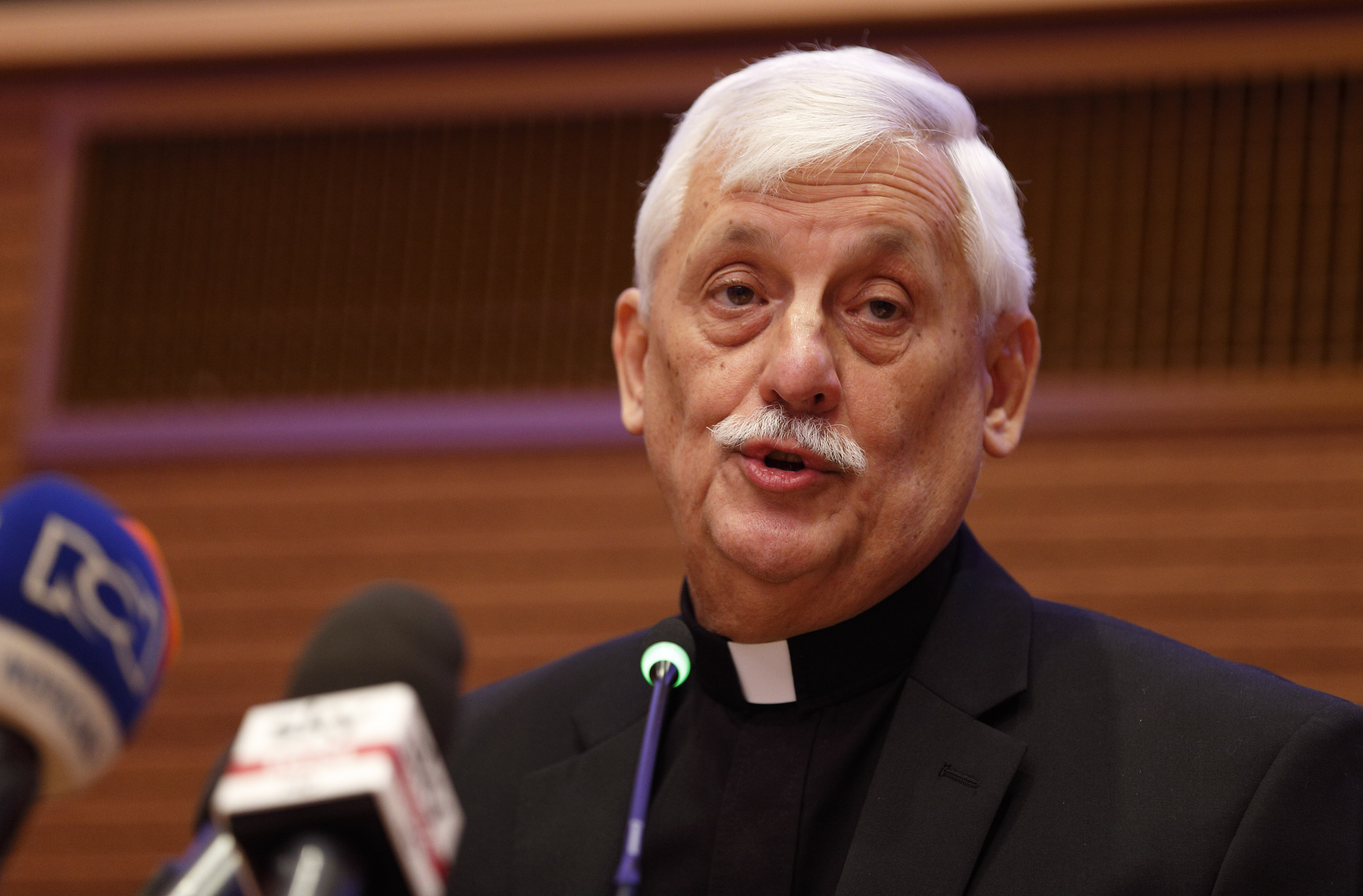
Jesuit Father Arturo Sosa Abascal (CNS photo/Paul Haring)
“We Jesuits are people of hope; we believe another world is possible,” Arturo Sosa, S.J., the superior general of the Society of Jesus, told journalists at an end-of-year reception at the Jesuit Curia in Rome on Dec. 4.
Greeting some 20 reporters in the Arrupe Hall of the Jesuit Curia, Father Sosa reflected on what the Jesuits have been doing over the past year and the significance of the mission Pope Francis has given to the Society when he confirmed the four universal apostolic preferences that are to permeate and inspire the work of Jesuits worldwide over the next 10 years.
The Venezuelan-born head of the Jesuits said that in his travels on all continents he has witnessed “the existence of so much frustration among so many people” in the face of “the inequality and poverty” in today’s world, together with “the forced movement of persons” who are either displaced in their home countries or forced to be refugees and “the difficulty” so many people have “to live in freedom and democracy.”
Father Sosa said the Society of Jesus will also seek to respond to “the concrete requests of Pope Francis” in support of his work for the renewal of the church and its structures.
Tweet this
Wednesday, March 27, 2019
Friday, March 02, 2018
Superior General of SJ visits St Aloysius institutions
DH News Service, Mangaluru Mar 1 2018, 23:10 IST

Superior General of Society of Jesus Rev Fr Arturo Sosa visited St Aloysius College on his tour to coastal city of Mangaluru, here on Thursday.
Addressing the staffers and alumni, Rev Fr Dr Arturo Sosa stressed on the need to focus on three types of reconciliation, namely reconciliation of humans, reconciliation of nature and reconciliation of God.
"We need to make our roots stronger by excluding violence and hatred," he said and added that biological sensitivity and sustainable development is a important orientation.
He also touched upon several other topics, such as education, sense of collaboration and practicality of life. Rev Fr Sosa was greeted according to the Indian tradition with a garland, tender coconut and cultural procession.
Later, the students of St Aloysius Institutions rendered an array of coastal folk art performances and dances. His delegation included Provincial of the Karnataka Jesuits Rev Fr Stanislaus D'Souza, Regional Assistant (South Asia) Fr Lisbert D'Souza and priests from Rome.
Fr Sosa was joined by Rector of Aloysius institutions Fr Dionysius Vas SJ, College Principal Fr Praveen Martis for a formal function. Rev Fr Arturo Marcelino Sosa Abascal SJ, a native of Venezuela and a doctorate in political science from the Venezuela university, is the 31st and present Superior General of the Society of Jesus, the largest male religious institute in the Roman Catholic Church.
In fact, he was the first Latin American person to lead the Society of Jesus, founded by St Ignatius of Loyola in 1534. Fr Arturo was elected Superior General on October 14, 2016.
There are 18 Jesuit provinces in India with over 4,000 priests offering their services in various fields.
He arrived at Mangaluru from Sri Lanka and will be leaving for Rome on Friday morning.
Saturday, June 03, 2017
Jesuit chief claims Satan is only a ‘symbol’ created by man

Fr. Arturo Sosa Abascal, SJ, is the General Superior of the Jesuit order.

Pete Baklinski
NewsCatholic Church
Fri Jun 2, 2017 - 2:02 pm EST
June 2, 2017 (LifeSiteNews) -- It’s been said that the greatest trick the Devil ever pulled was convincing the world he didn't exist. And the new head of the Jesuit order seems to have fallen for it.
Fr. Arturo Sosa Abascal, the Jesuit’s Superior General, said in a May 31 interview with the Spanish paper El Mundo that Satan is a “symbolic figure” who doesn’t really exist.
“We have created symbolic figures, such as the devil, in order to express [the reality of] evil,” said Abascal when asked if he believes evil is a process of human psychology or comes from a higher being.
“Social conditioning also represents that figure,” he added.
The Catholic Church teaches, however, that Satan is a real being, a fallen angel who was cast from Heaven into Hell after rebelling against God.
“The Church teaches that Satan was at first a good angel, made by God: ‘The devil and the other demons were indeed created naturally good by God, but they became evil by their own doing.’” states the Catechism of the Catholic Church.
Monday, May 22, 2017
Jesuit Superior General ‘signed letter praising Fidel Castro in 1989’
by Staff Reporter
posted Friday, 19 May 2017

Fr Arturo Sosa Abascal, superior general of the Jesuits (CNS)
The signatories expressed their 'respect for what you, as the main leader of the Cuban Revolution, have achieved for the dignity of your people'
Jesuit superior general Fr Arturo Sosa allegedly signed a letter praising Cuban dictator Fidel Castro in 1989.
Infovaticana says that ahead of the communist leader’s visit to Venezuela that year, nearly 1,000 “intellectuals and artists” sent him a “manifesto” welcoming him to their country.
The 810th name on the list of signatories is “Arturo Sosa, S.J.,” of the Centro Gumilla, of which he was director at the time.
The letter begins: “We… wish to publicly express our respect for what you, as the main leader of the Cuban Revolution, have achieved for the dignity of your people and therefore for all Latin America.”
It goes on to say that “only ideological blindness can deny the place the process you represent occupies in the history of the liberation of our peoples.”
The letter also describes Castro’s overthrow of the Batista government as an “exemplary victory over tyranny, corruption and servitude”, with the signatories pledging to use him as an example in their hope of creating a “just, independent” Latin America.
Castro’s regime brutally suppressed the Catholic Church after seizing power in 1959, nationalising Church schools, censoring publications and expelling priests.
It was only in the 1990s, some years after the letter was signed, that the Cuban government began relaxing restrictions on the Church.
Fr Sosa was elected 31st superior general of the Jesuits in October last year, succeeding Fr Adolfo Nicolas.
Observers have regarded him as being very left wing in the past, with the Centro Gumilla adopting a stance close to Liberation Theology. However, he later became disillusioned with the regime of late Venezuelan president Hugo Chavez.
Source
Sunday, March 19, 2017
“The fullness of women’s participation in the Church has not yet arrived”

Sunday, March 19, 2017, 00:01
Quotes and news
Fr Arturo Sosa Abascal, superior general of the Society of Jesus, said that “the fullness of women’s participation in the Church has not yet arrived”. According to the National Catholic Reporter, Fr Sosa was speaking at the annual Voices of Faith event for International Women’s Day at the Vatican’s Casina Pio IV.
Sosa acknowledged that “Pope Francis has been quite outspoken about women making decisions and holding responsibility in the Church. He has also created a study commission on the women’s diaconate to explore the history and role of women in this Church structure. But if we are honest, we acknowledge that the fullness of women’s participation in the Church has not yet arrived.”
Sosa called for a new type of ecclesiology – or theology of Church structures – that “should push the Church to become the People of God as we proclaimed [in] Vatican Council II”.
Saturday, March 11, 2017
Global Jesuit leader says women's inclusion in church structures 'has not yet arrived'

Kerry Alys Robinson, left, and Social Service Sr. Simone Campbell speak during the Voices of Faith gathering March 8 at the Vatican. (CNS photo/Massimiliano Migliorato, Catholic Press Photo)
Joshua J. McElwee | Mar. 9, 2017
The new leader of the global Jesuit order has said the Catholic church should recognize that women are still not allowed to have a full participatory role in the church's structures.
Jesuit Fr. Arturo Sosa Abascal, a Venezuelan who was elected the superior general of the Society of Jesus in October, said March 8 that while Pope Francis has acknowledged that women play a "fundamental role" in passing on the faith they are not yet fully included in church governance.
"Pope Francis has been quite outspoken about women making decisions and holding responsibility in the church," said Sosa, speaking at the annual Voices of Faith event for International Women's Day at the Vatican's Casina Pio IV.
"He has also created a study commission on the women's diaconate to explore the history and role of women in this church structure," Sosa continued. "But if we are honest, we acknowledge that the fullness of women's participation in the church has not yet arrived."
"That inclusion … remains stymied in many forms," said the priest, calling for a new type of ecclesiology — or theology of the structures of the church — that "should push the church to become the People of God as we proclaimed [in] the Second Vatican Council."
Wednesday, March 01, 2017
What has Mary Magdalene to do with Arturo Sosa Abascal, SJ?
By Dr. Jeff Mirus | Feb 28, 2017
A helpful reader, who is very good at spotting our typos, has also called my attention to C. C. Pecknold’s excellent critique of the relativist slush spewed out recently by the Black Pope. You may recall that the Superior General of the Society of Jesus, Fr. Arturo Sosa Abascal, was a prominent figure in my commentary last Friday: Why is there a resurgence of infidelity among Catholic leaders? Pecknold’s column neatly juxtaposes the current doctrinal scandal with the largely political suppression of the Society in the eighteenth century.
The implication is that the Society of Jesus right now is in far worse shape—and accordingly far more beloved by the world—than it was in the dark years of its official non-history. This extended from Pope Clement XIV’s bull of suppression, Dominus ac Redemptor Noster, in 1773 to the restoration of the Society in 1814 by Pope Pius VII. Here we have a damning insight, and all the more important for that reason.
Wednesday, February 22, 2017
New Jesuit chief claims Jesus’ own words against divorce are ‘relative,’ subject to ‘interpretation’
NEWS CATHOLIC CHURCH

Jesuit Superior General Fr. Arturo Sosa Abascal
Pete Baklinski
Wed Feb 22, 2017 - 12:05 pm EST
February 22, 2017 (LifeSiteNews) -- The new head of the Jesuit order, one of the most powerful figures in the Catholic Church worldwide, has claimed in an interview that the words of Jesus against divorce are “relative” and must be “discerned” according to the “conscience” of each individual.
Fr. Arturo Sosa Abascal made these statements in an interview with Giuseppe Rusconi published February 18 on the blog Rossoporpora. The relevant portions of the interview, translated by Matthew Sherry for Vatican expert Sandro Magister, appear below.
Historically, the Superior General of the Jesuits has been dubbed the “Black Pope” because of his influence in the Church.
Saturday, February 18, 2017
Jesuit Superior General visiting India

Society of Jesus' Superior General Father Arturo Sosa - AP
18/02/2017 16:37
The worldwide leader of the Society of Jesus is in India, the first country he chose to visit after being elected the 31st Superior General of the Jesuits in October. Arriving at New Delhi’s Indira Gandhi International Airport on February 18 on an 11-day visit, Venezuelan Father Arturo Marcelino Sosa Abascal was received by a team of Jesuits from the Delhi province. India is part of the Jesuit’s South Asia Assistancy that accounts for 4,000 members of the 16,000 Jesuits worldwide, the largest religious congregation for men in the Catholic church. The 68-year old Venezuelan is the first Jesuit chief from Latin America, the same region of Pope Francis.
Fr Sosa who will be in India until February 28, is being accompanied by three Rome-based assistants who look after the society’s ministries in South Asia. Fr Sosa will stay in Delhi for two days and then head to the Jesuit province of Madhya Pradesh that covers the tribal-dominated central Indian states of Chhattisgarh and Madhya Pradesh. In Madhya Pradesh capital Jabalpur he will meet all the Jesuit provincials of South Asia. Fr. Sosa will then proceed Raipur, the capital of Chhattisgarh, on February 27.
The South Asia Assistancy comprises Jesuits working in Afghanistan, Bangladesh, India, Nepal, Pakistan and Sri Lanka. It has 18 provinces and two regions. (Source: Matters India)
Saturday, February 11, 2017
Pope Francis praises expansion of historic Jesuit newspaper
February 9, 2017
CATHOLIC NEWS AGENCY

Pope Francis poses with Arturo Sosa Abascal, right, superior general of the Society of Jesus, and father Antonio Spadaro, editor in chief of the magazine "Civilta' Cattolica", at the Vatican Thursday, Feb. 9, 2017. (Credit: L'Osservatore Romano/Pool Photo via AP.)
Pope Francis praised the historic Jesuit-run paper La Civilta Cattolica for inaugurating four new language editions other than Italian. “The Catholic must never be afraid of the open sea, must never try to seek shelter in safe havens,” the pope told the publication’s writing staff, urging them to “stay in open water!”
ROME - As the historic Jesuit-run paper La Civilta Cattolica for the first time rolled out four new language editions other than Italian, Pope Francis praised their work, urging the writers to have a healthy dose of restlessness, openness and imagination.
Even with its 167 year history, the paper “continues with courage its navigation in the open sea,” the pope told the publication’s writing staff on February 9, urging them to “stay in open water!”
Monday, October 24, 2016
Pope Francis speaks to the Jesuits - Jesuit Congregation 36 (Update: Transcript of Speech).
To see subtitles in English
1.Go to Settings:

2. Then, click on the Settings Icon.
3. When window opens go to the 4th title from top, Subtitles/CC (1) Spanish (autogenerated).
4. When a new window opens click on the Auto-translate title;
5. When a new window opens slide languages to English, then click.
Now you should see a susbtitle in English at bottom of screen.
.
------------------------------------------------------
Related
DISCOURSE OF THE HOLY FATHER FRANCIS TO THE MEMBERS OF THE 36TH GENERAL CONGREGATION OF THE SOCIETY OF JESUS
24 October 2016
Dear Brothers and Friends in the Lord,
While praying over what I would like to say, I remembered with particular affection the words of Paul VI to us as we came to the end of the 32nd General Congregation: “This is the way, this is the way, Brothers and Sons. Forward, in nomine Domini. Let us walk together, free, obedient, united to each other in the love of Christ, for the greater glory of God.”1
Also, St. John Paul II and Benedict XVI have encouraged us to “lead a life worthy of the vocation to which we have been called”2 [Eph 4:1] “and following the path of mission” in full fidelity to your original charism in the ecclesial and social context that characterises this beginning of the millennium. As my predecessors have often told, the Church needs you, counts on you and continues to turn to you with confidence, particularly to reach the geographical and spiritual places where others do not reach, or find it difficult to reach.”3
Walking together – free and obedient – going to the peripheries where others do not reach, “under Jesus’ gaze and looking to the horizon which is the ever greater glory of God, who ceaselessly surprises us.”4 The Jesuit is called as Ignatius says “our vocation is to travel through the world and to live in any part of it where there is hope of greater service to God and of help of souls” [Con, 304]. That is, as Nadal used to say “for the Society the whole world is our home.”5
Ignatius wrote to Borgia regarding a criticism of the Jesuits who were called “angels” (Oviedo and Onfroy). Some critics used to say that the Society was not well instituted, that it had to be instituted more in spirit. “The Spirit which is guiding these critics” – Ignatius used to say – “does not know the state of things of the Society which are in the making, other than what is necessary (and substantial).”6 I very much appreciate Ignatius’s way of seeing things which are coming into being, removing oneself from the constraints of the concrete. It takes the Society from all that paralyses it, freeing it from frivolities.
What is “necessary and substantial” is the Formula of the Institute, which we should keep before our eyes every day, keeping our eyes on God our Lord. “The nature of this Institute which is his pathway to God.” This is how it was for the first companions and they foresaw that this is how it would be “for those who would follow us in this pathway.” So both poverty and obedience or the fact of not being obliged to sing the office in choir, are neither demands nor privileges, but aids to mobility and thus being available in the Society: “to run in the path of
Christ our Lord” [Con 582]. In virtue of the vow of obedience to the Pope we have a “surer direction from the Holy Spirit” [Formula of the Institute 3]. In the Formula, we have this Ignatian intuition. Its centrality is what makes the Constitutions stress that we always keep in mind “places, times and persons” so that all rules are aids – tantum quantum – for concrete things.
For Ignatius, being on the road is not only coming and going, but it translates into something qualitative: It is drawing profit, and progress, is going forward, to do something for others. This is how the two Formulas of the Institute, approved by Paul III [1540] and Julius III [1550] express it, when they focus the work of the Society on the faith - and its defence and propagation – and on the life and teaching of persons. So Ignatius and the first companions used the expression “to draw greater fruit” (aprovechamiento) [ad profectum,7 cf. Phil. 1:12 and 25] which is the practical criterion of discernment proper to our spirituality.
Drawing profit is not individualistic, but it is for the common good: “The end of this Society is to devote itself with Gods grace not only to the salvation and perfection of the members own souls, but also with that same grace to labour strenuously in giving aid toward the salvation and perfection of the souls of their neighbours” [General Examen, I, 2]. If at all the balance of Ignatius’ heart was inclined towards something, that was towards helping our neighbours, so much so that he used to get angry if somebody was to tell him that the reason that someone remained in the Society was “in order to save his own soul. Ignatius did not want men, who although being good, were not zealous for the service of their neighbour” (Aicardo I punto 10 p. 41).
We are to draw profit from everything. The Formula of Ignatius expresses a tension: “not only… but also…” and this conceptual framework combining tensions – the salvation and perfection of one’s own soul, and the salvation and perfection of one’s neighbour’s – from the higher realm of Grace – is proper to the Society of Jesus. The harmonization of this and of all the other tensions (contemplation and action, faith and justice, charism and institution, community and mission…) is not expressed in abstract formulations but is achieved in the course of time through what Faber called “our way of proceeding”8. Journeying and progressing in the following of the Lord, the Society moves towards harmonizing the tensions brought about by the diversity of the men whom it brings together and of the missions it receives.
Drawing profit is not elitist. In the Formula, Ignatius proceeds to describe the means for seeking the greater and more universal good which are truly sacerdotal. However, we observe that the works of mercy are taken for granted. The Formula says “without these being an obstacle” to mercy!!! Works of mercy – caring for the sick in hospitals, begging for alms, sharing, teaching catechism to children, the patient suffering of insults… are the daily bread of Ignatius and his first companions. They took care that none of these became obstacles!
Drawing profit in the final analysis is “that which they sought the most.” This is the magis, this more, which moves Ignatius to start accompanying people and helping them reflect on the various experiences of their lives with regard to faith, justice, mercy and charity. The magis is the fire, the fervour in action, awakening those who have become dormant. Our saints have always incarnated this fervour. It used to be said of St. Alberto Hurtado that he was a thorn in the flesh of the dormant Church. This militates against that temptation which Paul VI called spiritus vertiginis and de Lubac called “spiritual worldliness.” This temptation is not primarily moral, but spiritual, and distracts us from the essential: that we be fruitful persons, to let our
footsteps leave marks in history, especially in the lives of the very least in our society. “The Society is zealous”9 as Nadal used to say. To revive the zeal for mission for the greater good of persons in their life and doctrine, I would like to make more concrete these reflections in three points: given that the Society’s way of proceeding for the greater good is accomplished through joy, the cross and through the Church our Mother. We need to look at how we move forward by overcoming the impediments which the enemy of our human nature tries to put in our way when we are in the service of God and seeking the greater good.
1.- To ask insistently for consolation
We can always take a step forward asking insistently for consolation. In the two Apostolic Exhortations and in Laudato Si, I consistently underlined the importance of joy. In the Spiritual Exercises, Ignatius invites us to contemplate “the office of consolation,” which is the work of the Risen Christ Himself [Sp. Ex. 224]. This is the true work of the Society: to console the faithful people of God and to help them through discernment so that the enemy of human nature does not rob us of our joy: the joy of evangelising, the joy of the family, the joy of the Church, the joy of creation…. Let the enemy of our human nature not rob us of our joy, neither by despair before the magnitude of the evils of the world, and the misunderstandings between those who want to do good, nor let him replace it with foolish joys that are always at hand in all human enterprises.
This “service of joy and spiritual consolation” roots us in prayer. This consists in animating ourselves and animating others “to ask insistently for God’s consolation.” Ignatius formulated this in a negative way in the sixth rule of the first week when he said “It is very profitable to make rigorous changes in ourselves against desolation” by insisting more on prayer [Sp. Ex.
319] It is beneficial because one is “worth little in time of desolation.” [Sp. Ex. 324] To practice and teach this prayer of petition and supplication for consolation is the principal service we render to joy. If somebody does not consider himself worthy (something which is very common in practice), he should at least remain persistent in prayer for consolation for love of the message, because joy is constitutive of the Gospel message; he should therefore also ask for it for love of others, for his family and for the world. One cannot give a good piece of news with a sad face. Joy is not only decorative, it is also a clear indicator of grace, it shows that love is active, working and present. For this reason, in an age of instant gratification and unabated consumption, the search for joy should not be confused with the search for “a spiritual effect,” when our existential identity is more concerned with long lasting effects: Ignatius opens the eyes and wakes us up to the discernment of Spirits to discover the difference between long- lasting joys and transient joys. (Autobiography 8) Time is the key to recognising the action of the Spirit.
In the Exercises, “progress” in the spiritual life is brought about in consolation. It is to go from “good to better,” it is also “every increase in hope, faith and charity and every interior joy.” (Sp. Ex. 316) This service to joy was what led the first companions to decide not to disperse, but to institute the Society and celebrate spontaneously their companionship, which was characterised by joy and which made them pray together, go on missions together and then to reunite again, in imitation of the life of the Lord and his apostles. This joy of the explicit announcing of the Gospel - through preaching, faith and the practice of justice and mercy – is that which leads the Society to go to the peripheries. The Jesuit is a servant of the joy of the Gospel, both when he is working as an artisan, conversing and giving the spiritual exercises to a single person, helping him or her to encounter “this interior forum whence comes the power of the Spirit, which guide, free and renew him” 10 and when he is working with structures, organising works of formation, of mercy, or of reflection which are institutional expansions of
those turning points where the individual will is broken down and the Spirit enters to act. As M. de Certeau rightly said: The Spiritual Exercises are the apostolic method par excellence” which made possible the “a return to the heart, the beginning of docility to the Spirit which awakens and propels the exercitant to personal fidelity to God”.
2.- Letting ourselves be moved by our Lord placed on the cross
We can always take a step forward in letting ourselves be moved by the Lord crucified, by him in person, by him present in so many of our brothers and sisters who are suffering – the great majority of humankind! Father Arrupe used to say that wherever there is pain, the Society is there.
The Jubilee of Mercy is an appropriate time to reflect about the works of mercy. I have deliberately used the plural, because mercy is not an abstract word, but a lifestyle that places concrete gestures before the word. These gestures touch the flesh of the neighbour and become institutionalised in works of mercy. For those who do the Exercises this grace by which Jesus commands us to resemble the Father (cf. Lk 6:36), begins with this colloquy of mercy which is the expansion of the colloquy with the Lord placed on the cross for my sins. The entire second exercise is a colloquy full of sentiments of shame, confusion, pain and grateful tears, seeing who I am – making myself less – and who God is – making Him more – “who has given me life till now” – who Jesus is, hanging on the cross for me (Exx. 61 and preceding). The way Ignatius lives and formulates his experience of mercy is of great personal and apostolic benefit, and requires an acute and sustained experience of discernment. Our father said to Borgia: “I am personally convinced regarding myself that both before and after I am totally an obstacle. Because of this I feel increased spiritual happiness and joy in the Lord in as much as I cannot attribute to myself even a semblance of good.”12 So Ignatius lives from the pure mercy of God even in the smallest details of his life and of his person. And he used to feel that, the greater an obstacle he might pose, the more Lord treated him with goodness: “Such was the mercy of the Lord, and such was the abundance of his tenderness and the sweetness of his grace with him, that the more he wished to be punished in this way, so much more benign was the Lord, and the more generously he lavished his treasures from his infinite freedom. With that, he said that he believed that there is no person in the world in whom these two things coincided as much as in him: how much he failed God, and received all and many continuous graces from his hand.”13
Ignatius, describing his experience of mercy in these comparative terms – the more he failed the Lord, the more the Lord reached out in giving him his grace – released the life-giving power of mercy which we, many times, dilute with our abstract formulations and legalistic conditions. The Lord who looks at us with mercy and chooses us, sends us out to bring with all its effectiveness, that same mercy to the poorest, to sinners, to those discarded people, and those crucified in the present world, who suffer injustice and violence. Only if we experience this healing power first-hand in our own wounds, as people and as a body, will we lose the fear of allowing ourselves be moved by the immense suffering of our brothers and sisters, and will we hasten to walk patiently with our people, learning from them the best way of helping and serving them. (cf. GC 32, d.4 n.50)
3.- Doing good led by the good spirit, thinking with the Church
We can always take a step forward in doing good in the Good Spirit, sentire cum ecclesia, as Ignatius says. The way we do things in using discernment is also proper to the Society. Faber used to formulate it asking for the grace that “everything good would be realised, thought or organised, be done through the good spirit and not through the bad.”14 This grace of discernment, it’s not enough to think, do or organise the good, but do it of the good spirit, is what roots us in the Church, in which the Spirit works and distributes the diverse charisms for the common good. Faber used to say that, in many things, those who wanted to reform the Church were right, but that God did not want to correct it through their means.
It is proper of the Society to do things thinking with the Church. Doing this without losing peace and with joy, in the context of the sins we see, in us as well as in others, and in the structures that we have created, involves carrying the cross, experiencing poverty and humiliations, where Ignatius encourages us to choose between bearing them patiently or desiring them.15 Where the contradiction was very clear, Ignatius used to advise to recollect oneself, before talking or acting, in order to work in the Good Spirit. We do not read the rules for thinking with the Church as precise instructions about controversial points (some rules could be out of date), but examples where Ignatius was inviting in his times to “act against” the anti-ecclesial spirit, inclining ourselves totally and decisively towards our Mother, the Church, not in order to justify a debatable position, but to open space so that the spirit could act in its own time.
Service of the good spirit and of discernment makes us men of the Church – not clericalists, but ecclesiastics – men “for others,” with nothing of our own which cuts us off from others, but rather everything that is ours placed in common and for service.
We neither walk alone nor comfortably, but we walk with “a heart that does not rest, that does not close in on itself but beats to the rhythm of a journey undertaken together with all the people faithful to God.”16 We walk becoming all things to all people, with the goal of helping others.
This self-emptying makes the Society have and always able to have more the face, the accent and the lifestyle of all peoples, of every culture, inserting ourselves in all of them, in the very heart of every people, to become the church, there with every people, inculturating the gospel and evangelising every culture.
In a filial colloquy, or as a servant to his Mistress, we beg Our Lady of la Strada to intercede for us before the “Father of mercies and God of all consolation” (2 Cor 1:3), to constantly place us with her Son, with Jesus who carries, and invites us to carry the cross of the world with Him. We entrust to Her “our way of proceeding” that it should be ecclesial, inculturated, poor, attentive, free from all worldly ambition. We beg Our Mother to direct and accompany every Jesuit along with that part of the people faithful to God whom he has been sent, along these paths of consolation, of compassion and discernment.
Friday, October 14, 2016
Jesuits elect first Latin-American general
Austen Ivereigh
CONTRIBUTING EDITOR
October 14, 2016

Father Arturo Sosa, 68, the new Venezuelan general of the Society of Jesus
The Jesuits' new general is a Venezuelan whose past curiously mirrors that of the first Jesuit pope
The Society of Jesus has elected its first Latin-American leader since its foundation in 1540, a Rome-based Venezuelan whose past curiously parallels that of the first Jesuit pope.
Like Jorge Mario Bergoglio, who steered his divided province through the 1970s Argentine dictatorship, Father Arturo Sosa SJ, 67, was Venezuelan provincial between 1996 and 2004, when there were tensions within his province over the dictatorship of Hugo Chávez.
Prior to his appointment as provincial, he was in charge of the social apostolate of the Jesuits in Venezuela, which includes the massive poor-school Jesuit network, Fe y Alegría. He was also head of the Centro Gumilla, the Jesuit-run social and action research center.
In an interview in 2014 he described the authoritarian regime of Chávez’s successor Nicolás Maduro as a “popular tyranny”.
As an expert in political science and political theory, who has taught and researched widely and who knows the Maduro regime at first hand, his election seems designed, in part, to bolster the Vatican’s mediation in the fast-deteriorating situation there.
Sosa, becomes the 31st superior general of the Jesuits, was born in Caracas, Venezuela, on November 12, 1948. He has a doctorate in Political Sciences from the Universidad Central de Venezuela, and speaks Spanish, Italian, and English.
Among his distinguished academic posts, he has served as member of the founding board of the Andrés Bello Catholic University in Caracas and rector of the Catholic University of Táchira. He has taught and researched political science in many different institutes and colleges, and in 2004 was a visiting professor at the Latin-American Studies Center of Georgetown University.
He has been serving since 2014 as the Delegate of the General for the International houses and Works of the Society of Jesus in Rome, meaning he has had responsibility for Jesuit formation and other houses, including the Jesuit headquarters, or General Curia and the Gregorian University.
Some 212 Jesuit electors from across the world, mostly delegated by the nearly 17,000 Jesuits worldwide, who this morning voted for Sosa following the resignation of Father Adolfo Nicolás.
It is not yet clear how many ballots it took to elect him, but the result was known after just a couple of hours. The Jesuit electors have spent this week in the murmuratio, discussing the merits of possible generals with each other.
Sosa is thought to the first Jesuit general to sport a moustache.
Subscribe to:
Posts (Atom)