Showing posts with label Sustainability. Show all posts

Friday, October 16, 2026

Pope Leo XIV’s University Holds Second International Sustainability Conference Despite His Absence

 Pope Leo XIV’s University Holds Second International Sustainability Conference Despite His Absence

ROME REPORTS in English

Oct 16, 2026 

For Pope Leo XIV, sustainability is a moral responsibility. Building on Pope Francis’ mission to protect our “common home,” Pope Leo XIV has continued to emphasize the connection between environmental care, human dignity, and the protection of the most vulnerable. 

Rome Reports is an international news agency covering the Pope, the Vatican, Rome and the Catholic Church, as well as major social, cultural and religious debates.

Tuesday, September 29, 2026

Taxpayer-Funded Researchers Push Depopulation for “Sustainability”


Taxpayer-Funded Researchers Push Depopulation for “Sustainability”
The New American Video

Sep 28, 2026
A new taxpayer-funded “study” published in a UN-aligned journal argues that the human population must be slashed by 50 percent—to about 4 billion people by 2200—for “sustainable development.” Those who remain, the authors say, will have to accept a much lower standard of living, more restrictions on consumption, and even “resource quotas.”

On this episode of Behind The Deep State, The New American’s Alex Newman exposes the latest neo-Malthusian push for depopulation. He breaks down the paper in Sustainable Development, its ties to the UN’s Agenda 2030 Sustainable Development Goals, and the long history of this anti-human ideology—from Thomas Malthus and the Club of Rome to John Holdren and open calls at UN climate summits. Newman also notes what the study ignores: fertility rates have already collapsed below replacement in much of the world, and the real demographic crisis is coming from too few people, not too many.
Your tax dollars helped fund this. Don’t miss this must-see episode.


Tuesday, July 07, 2026

The Essence of Inclusive Capitalism with Lynn Forester de Rothschild


The Essence of Inclusive Capitalism with Lynn Forester de Rothschild
What is it? Why does it matter? And could it really be the answer to the problems we face on our planet today?


Ms. Rothschild is the founder of the Coalition for Inclusive Capitalism, which seeks to address growing wealth inequality

As part of our upcoming film, The Purpose of Capitalism: Lessons from Japan, we spoke to Ms. Rothschild about what inclusive capitalism is, why it matters, and whether it could really be the answer to the problems we face on our planet today.

This interview was condensed and edited for clarity.

TBT: What is inclusive capitalism?

Lynn Rothschild: Given what capitalism has done to workers, society, and the planet in the last 30 or 40 years, inclusive capitalism might sound like an oxymoron.

But inclusive capitalism is an aspiration; an aspiration to reform the capital markets so that our economic system becomes inclusive, sustainable, dynamic, and trusted. It’s about creating what I call the virtuous cycle, where companies that are doing the best with respect to their people, society, and planet are rewarded.

“It’s about creating what I call the virtuous cycle, where companies that are doing the best with respect to their people, society, and planet are rewarded.”

As Colin Meyer—the academic lead for the Future of the Corporation puts it—the purpose of business is to profitably solve the problems of people and the planet. We, as investors, need to stand behind the companies that are doing that work. This is the essence of inclusive capitalism.

TBT: When did you first start thinking about inclusive capitalism?

Lynn Rothschild: It was around 2007 and 2008, when the underpinnings of the financial system started collapsing. On a day that I will never forget, the market froze altogether.

There was a lot of despair and anger at the time—the feeling of not being included, that the system was rigged against the ordinary person—only good for those who have capital. The government stepped in, but their programs left many feeling desperate. People were losing their homes because they had been given a mortgage beyond their means, putting debt on people who never should have had it.

Around this time, I was asked to co-chair a task force with Dominic Barton [then Chairman of McKinsey in Asia], to look at capitalism under siege. We produced a report, ‘The Journey Toward Inclusive Capitalism’, and after holding several conferences, we set up the Coalition for Inclusive Capitalism.

TBT: What is the coalition? What does it do?

Lynn Rothschild: The coalition is a group of asset owners, asset managers, alongside leaders in philanthropy, academia, policy, and business that is dedicated to making capitalism work for everyone.

One initiative was the Embankment Project for Inclusive Capitalism. We had the CEOs of $32 trillion of assets put together metrics that companies could use on a standardised basis to tell investors, employees, and customers what they were doing to create more inclusive and sustainable capitalism.

Tuesday, May 26, 2026

“Enslaving Treaties – The Persistence of Colonial Ideology and Practice...."


“Enslaving Treaties – The Persistence of Colonial Ideology and Practice and the Quest for Sustainable Decolonization including Litigation”


The World Council of Churches (WCC), through its programme on Overcoming Racism, Xenophobia, and Related Discrimination, will convene on 26 May a global conversation shining a critical light on how colonial ideology continues to shape today’s economic systems through international investor treaties, especially the Investor-State Dispute Settlement system.


Photo: Albin Hillert/WCC


Titled “Enslaving Treaties – The Persistence of Colonial Ideology and Practice and the Quest for Sustainable Decolonization including Litigation,” the webinar will seek to expose how legal and financial frameworks established during and after colonial rule continue to constrain the sovereignty of nations in the Global South—often at the expense of human dignity, environmental protection, and intergenerational justice.

From the WCC’s 1st Assembly in Amsterdam in 1948, the WCC warned against the dangers of unchecked power—whether capitalist or communist—recognizing how vast economic and political concentrations of power give rise to greed, cruelty, and systemic injustice. The WCC also acknowledged that visions of racial equality, however imperfect, resonated deeply with peoples in Asia and Africa who were living under racist colonial domination.

Decades later, those warnings remain strikingly relevant.

International investor treaties, particularly those signed at the twilight of colonial rule or in its immediate aftermath, continue to bind developing nations into relationships of profound inequality. Often mediated through Euro-American economic frameworks, these treaties have created what many describe as a condition of “willing enslavement”—where governments are penalized for prioritizing environmental protection, public welfare, and climate action.

Through investor-state dispute settlement mechanisms, multinational corporations can sue governments for enacting climate or environmental regulations, effectively silencing democratic decision-making and perpetuating racialized economic injustice.

Building on its longstanding commitment to economic justice, climate justice, and children’s rights—including initiatives such as the New International Financial and Economic Architecture (NIFEA) and the Churches’ Commitment to Children programme—the WCC is reiterating the call to churches and ecumenical partners to speak truth to power, including embracing litigation as an appropriate approach to seeking justice for the marginalized and vulnerable communities.

The upcoming webinar will explore how churches can engage morally, ethically, and legally to challenge unjust treaties, including through third-party interventions in investor-state dispute settlement mechanisms cases. At stake is nothing less than the future of communities disproportionately affected by the climate emergency—especially racialized children, girls, and young women.

The webinar discussion will unpack the historical and contemporary realities of international investor treaties, particularly those rooted in the colonial and post-colonial eras. It will also explore strategies for effective, structured interventions by churches and ecumenical bodies to dismantle unjust and discriminatory economic frameworks.

As climate crises intensify and economic inequalities deepen, the WCC affirms that inaction is no longer a viable option.

This webinar marks a renewed call for churches worldwide to stand alongside marginalized communities, confront structures of domination, and work boldly toward a future where justice, sustainability, and dignity are not negotiable—but guaranteed.


Sunday, June 16, 2024

The Summit Of The Future | Through The Lens - Episode 6

 
P.S.
Most of the words expressed here are Sound Doctrine, except for "the Seven Year Tribulation", The Rapture (Pretrib), and prophecy regarding the nation of Israel.

Saturday, March 09, 2024

ROAD TO 2030 | A BRIEF HISTORY OF THE SUSTAINABLE DEVELOPMENT GOALS (SDGS)


FEBRUARY 28, 2023


In 2023, the world has reached the mid-way point for attaining the 2030 United Nations Agenda for Sustainable Development. On this occasion, the Virchow Foundation for Global Health will highlight history, progress and the challenges ahead for reaching the 17 Sustainable Development Goals (SDGs).

Key dates in 40 years of sustainable development


The development and adoption of the Sustainable Development Goals builds on decades of work done by countries and the United Nations. Before the first world conference on the human environment, hosted by the United Nations (UNCHE) and its Member States in Stockholm in 1972, environmental issues had not been given adequate attention from neither the public nor policy makers. During the UNCHE, a series of principles and an action plan was adopted from all participating countries. One significant outcome of the conference was the creation of the United Nations Environment Programme (UNEP).


Eleven years later, in 1983, the “Brundtland Commission”, named after and led by Dr. Gro Harlem Brundtland, was established. Also known as the World Commission on Environment and Development (WCED), or within the United Nations as the “UN Special Commission on the Environment”, the aim was to help direct countries globally towards sustainable development (1). The “Our Common Future” Report (also known as Brundtland Report) was published by the commission in 1987 shortly before their disbandment. It defined sustainable development for the first time as “a development that fulfils the needs of current generations without compromising the ability of future generations to fulfil their own needs” linking social, economic, cultural and environmental issues (1).

In June 1992, held on the 20th anniversary of the UNCHE, more than 178 countries adopted the “Agenda 21” action programme during the Earth Summit, the United Nations Conference on Environment and Development (UNCED), which took place in Rio de Janeiro. The Agenda 21 was a comprehensive plan of action to build a global partnership for sustainable development to improve human lives and protect the environment (2).

After the Earth Summit and Agenda 21, the next milestone was the unanimous adoption from all Member States of the Millennium Declaration during the Millennium Summit in New York. The start of a new millennium posed a unique opportunity to create a new strategy, adapted to the latest realities and needs of the world in the twenty-first century. The Summit, held in September 2000, was the largest gathering of heads of states and governments of all time until then. It led to the elaboration of the eight Millennium Development Goals (MDGs), to be achieved by the year 2015.

Wednesday, January 25, 2023

Symposium explores how religious communities can be agents of change in securing wellbeing and sustainability


NEWS
Symposium explores how religious communities can be agents of change in securing wellbeing and sustainability


More than 600 people attended the Ninth Annual Symposium on the Role of Religion and Faith-based Organizations in International Affairs, held online on 24 January. Exploring the theme “Securing People’s Wellbeing and Planetary Sustainability,” the symposium was organized by the World Council of Churches (WCC) and a coalition of faith-based and UN partners. The event featured UN officials, representatives of international faith-based organizations, and other experts on climate change, disarmament, and other relevant topics.


Rev. Dr. Liberato C. Bautista (third from left), Assistant General Secretary for United Nations and International Affairs, General Board of Church and Society of The United Methodist Church, served as chair of the 2023 Symposium Planning Team. In this photo taken during the concluding session of the symposium, he is accompanied by Ms. Nika Saeedi (fourth from left), global focal point on Religion, Mental Health and Psychosocial Support, and Hate Speech for UNDP, Mr. Jonathan Granoff (first from left), Senior Advisor and Representative to the United Nations of the Permanent Secretariat of the World Summit of Nobel Peace Laureates, and Dr. Ganoune Diop, Director, Public Affairs and Religious Liberty, Seventh-day Adventist Church. Photo:
WCC
25 January 2023


WCC central committee moderator Bishop Dr Heinrich Bedford-Strohm, who spoke at the symposium, noted that religion reaches not only people’s heads but also their hearts. “That is why religious communities are so important in issues like human wellbeing and planetary sustainability that are highly linked to our attitudes and lifestyles and can only be successfully pushed if political change is connected with a change of heart,” he said. “All together we want to secure people’s wellbeing and planetary sustainability as religious communities.”

On a personal note, Bedford-Strohm said this task comes closer to him when he thinks of his 3-year-old grandson. “I love him deeply,” he said. “He will be as old as I am now, in the year 2081. As every grandfather, I want him to have at least as good a life as I have now.”

Bedford-Strohm said he is convinced that churches and religious communities in general are the ideal agents of global civil society. “They are deeply rooted in local congregations and at the same time live in a global horizon by affirming their belief in a God who has created heaven and earth,” he said.

Many UN officials and civil society leaders reflected on why faith actors are critical players.

Ulrika Modéer, UN assistant secretary-general and director of the Bureau of External Relations and Advocacy for the United Nations Development Programme (UNDP), spoke on how gender inequality intersects with human insecurity.

“The rise of hate speech, radicalization, inequality, and political extremism are undoubtedly among the most pressing threats to human security, pushing back development gains by decades with a significant implication on women and girls,” she said. “Not to forget that at the current rate of progress, it may take close to 300 years to achieve full gender equality.”

Faith actors are a critical player, she said. “Historically, many faith actors have extended vital social services to local communities, especially humanitarian relief, health, and education,” Modéer said. “In fact, in many countries, they are the dominant civil society actors.”
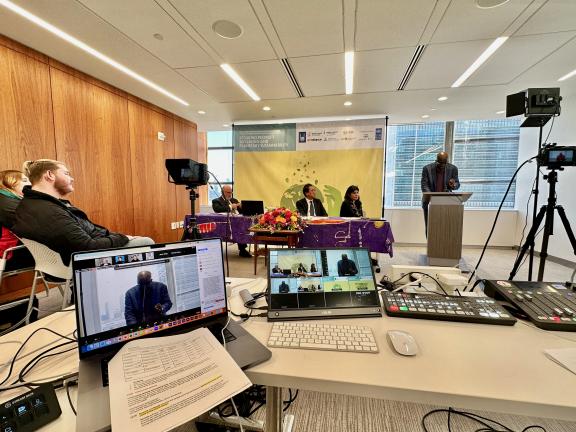


Some moderators and speakers took part of the symposium from a studio hub set especially for the event at the Church Center for the United Nations in New York City. Photo:
WCC

Discussions laid bare a variety of existential threats to human and planetary security, among them the threat of nuclear weapons.

Ambassador Sergio Duarte, a retired Brazilian ambassador and former UN High Representative for Disarmament Affairs, spoke on disarmament. “It has become commonplace to identify climate change and the existence of nuclear weapons as the two greatest existential threats to human life and civilization upon our planet,” he said. “We know that we cannot completely control the cosmic forces that shape our climate, but by working together we may avert disaster. Disarmament, on the other hand, depends entirely on our ability to muster the necessary political will.”

Speakers and participants also highlighted key learnings that relate to work for human security and the roles different actors can play. The symposium addressed, in concrete ways, the development of unity, solidarity, international cooperation, and global coordinated action necessary to make human security real.

Dr Ganoune Diop, director of public affairs for the World Headquarters of the Seventh-day Adventist Church and secretary general of the International Religious Liberty Association, reflected on envisioning and building a better future. “Nearly every area of human experience is connected to the undergirding issue of human security,” noted Diop. "From threats to personal security, to collective predicaments, to regional, national rifts in human solidarity, to needed global security, human security is in fact a lens through which to look at various aspects of human experience.”

WCC Director for International Affairs Peter Prove who attended the event in person remarked that “after 9 years, the Annual Symposium has become a fixture in the agenda of faith-based and UN partners in New York, and a key forum for the expression and development of shared priorities in the international agenda.”

The WCC’s participation in the promotion of all editions of the symposium has been facilitated by the Ecumenical Office to the United Nations, the WCC and ACT Alliance’s focal point for advocacy initiatives at the United Nations headquarters in New York City.

Learn more about the 9th Annual Symposium on the Role of Religion and Faith-Based Organizations in International Affairs

Watch the recording of the event

Ecumenical Office to the United Nations


Source

Thursday, December 29, 2022

The Great Carbon Con Is Coming to an End


MICHELLE YOU

Dec 20, 2022 7:00 AM


No more fluffy climate goals and emissions offsets. Businesses will soon be expected to show real progress.


ILLUSTRATION: YO HOSOYAMADA


A year after COP26, the United Nations Climate Change Conference which took place in November 2021, the number of FTSE 100 companies vowing to achieve net zero emissions by 2050 grew by 37 percent to 82 percent. Among the pledgers were some of the world’s biggest companies: Amazon, Apple, Ford, IBM, JP Morgan, Mars, and many others. But climate action is not just on the minds of industry giants: it’s a growing concern for every business as scrutiny grows.

Making a pledge is the easy part. In 2023, we will see businesses held to account for what they actually deliver. Organizations will be forced to show that the commitments they’ve made are meaningful, providing transparent and ongoing proof that they are taking necessary actions to reduce their carbon emissions.

Growing skepticism of over-ambitious, opaque, and even fraudulent climate pledges is turning up the heat on businesses. Already, we’re seeing customers voting with their wallets, employees choosing employers based primarily on net zero credentials, and investors making choices about what to fund based on tangible climate action. To put that in numbers, as many as 60 percent of millennials are willing to pay more for truly sustainable products; two-thirds of people are more likely to work for a company with strong and meaningful environmental policies; and research by Amazon has found that as many as 83 percent of investors want to invest in more sustainable startups.

For too long, businesses have been pouring investment into traditional emissions-avoidance offsets—paying someone else to reduce future emissions to compensate for their own. Emissions-avoidance offsets include clean cookstove projects, investment in renewable energy, and forestry protection.

As attention turns to delivery in 2023, awareness will grow that these traditional offsets are at best a distraction that doesn’t count towards net zero, and at worst are downright fraudulent. Until now, carbon avoidance offsets have been an easy, cheap way for businesses to tick the box of sustainability, letting them spin a story about commitment and willingness to tackle the climate crisis. In 2021, more than $1 billion of offsets were sold.

In 2023, businesses feeling pressure from all sides will need to look to other solutions if they want to demonstrate delivery. For instance, awareness of carbon-removal technologies has grown. There is now a broader understanding and acceptance that these technologies, which actively suck carbon out of the atmosphere through direct air capture, enhanced weathering, and other methods, are critical to reaching our global climate goals. And progress has been made—in 2022, a host of major players in Silicon Valley, including Google, Meta and Shopify, formed an alliance to commit $925 million in carbon removal by 2030. While this is a promising step, access to and investment in carbon-removal technologies must become mainstream if they are to go from being in their infancy to scaling at the pace the planet needs them to.

In 2023, a climate pledge will only be a baseline, the bare minimum. People across the board will demand more from the business they work for, spend money with, and invest in. Those that can’t demonstrate tangible progress towards their net zero goals will be left behind.


Friday, June 17, 2016

From Carbon Challenges to Community Gardens, Jesuits Heed Pope’s Call


Friday, June 17, 2016


WASHINGTON D.C. (PRWEB) JUNE 14, 2016

As the one-year anniversary of Laudato Si’, Pope Francis’ groundbreaking encyclical on the environment, approaches, Jesuit institutions are taking stock of their response to the pope's rallying cry to care for our common home.

From carbon emission challenges to organic farms and sustainable practices, to environmental courses and an online environmental textbook, to prayer services and reflections that incorporate Ignatian spirituality, Jesuit parishes, schools, universities and social ministries are living Laudato Si’, while recognizing there’s much more to do. Click here to see a roundup of Jesuit institutions’ environmental programs and activities.

“We are just beginning to see the impacts of the encyclical, which is not about short-term change or easy fixes,” said Jesuit Father Timothy P. Kesicki, president of the Jesuit Conference, the organization that represents the Society of Jesus in Canada and the U.S. “Pope Francis is calling us to ecological conversion and integral change, to free ourselves from a culture of waste and to live in solidarity with creation and the most vulnerable. This is at the heart of our teaching and who we are as Catholics.”

As members of the pope’s religious order, Jesuits have taken special care to prioritize action on the issue. Following is a sampling of how Jesuit institutions have risen to the challenge:

Jesuit universities leading the way: All 28 Jesuit universities in the U.S. have embraced Laudato Si’. Jesuit schools and universities are integrating themes of sustainability, ecology and social justice into their dialogue, practices, course offerings and curriculum.

Loyola University Chicago held a symposiumlast fall, “Caring for Our Common Home: Conversations on Ecology & Justice.” Just weeks after the release of the pope’s encyclical, Georgetown University in Washington, D.C. announced it would not make or continue any direct investments of endowment funds in companies whose principal business is mining coal for use in energy production. Last fall, Xavier University in Cincinnati won the 2015 “Learning By Design” Magazine award for integrating sustainability into the design and renovation of its main classroom building, Altar Hall. Xavier is also identifying ways to integrate ecology into its curriculum and in the fall offered a course on Sustainable and Resilient Communities at the intersection of social justice and environmental stewards

Ignatian Carbon Challenge: Created by a team of theology and science teachers at Cheverus High School in Portland, Maine, the Ignatian Carbon Challenge invites both individuals and institutions to address climate change and environmental justice through a series of monthly challenges. The online program is run by the Ignatian Solidarity Network, which works to educate and form advocates for social justice animated by the spirituality of St. Ignatius of Loyola and the witness of the Jesuit martyrs of El Salvador and their companions.

Prayer and discussion at Jesuit parishes: Many of the 62 Jesuit parishes in the U.S. have responded to the encyclical by holding prayer services and hosting discussions on the implications of Laudato Si’. For example, St. Ignatius Loyola Parish and School in Sacramento, California, hosted an educational series on the encyclical and on September 1, the World Day of Prayer for Creation, held a schoolwide prayer service.

Free online environmental science textbook: In January, Healing Earth, a free online environmental textbook created by the International Jesuit Ecology Project (IJEP) was launched for higher education and secondary schools around the world. This online textbook addresses the major ecological challenges of our time, including climate change, from an integrated scientific, spiritual, and ethical perspective.

Ignatian spirituality meets organic farming: In Guelph, Ontario, theIgnatius Jesuit Centre encompasses 600 acres of farmland, wetland and woodland. The Centre offers Ignatian spirituality retreats and programs for people seeking to connect their lives with God and all creation, while Ignatius Farm is a model for organic and community-shared agriculture, and the mentoring of organic growers. And at the Ignatius Old-Growth Forest, 100 acres are being restored, offering a beautiful place for people of all ages to connect with the natural world.


Right outside Montreal at La Ferme Berthe Rousseau, an associate work of the Jesuits' French Canadian Province, people facing personal challenges in their lives are welcomed. Through community life on the farm and communion with the land – living with residents and visitors, taking care of the animals, harvesting the vegetables – residents can begin to heal.

###

About the Society of Jesus in Canada and the United States
Founded in 1540 by Saint Ignatius Loyola, the Society of Jesus (Jesuits) is the largest order of priests and brothers in the Roman Catholic Church. Jesuit priests and brothers are involved in educational, pastoral and spiritual ministries around the world, practicing a faith that promotes justice. In Canada and the United States, there are 30 Jesuit colleges and 80 pre-secondary and secondary schools with a shared goal of developing competent, compassionate and committed leaders in the service of the Church and society. Jesuits minister in parishes and at retreat houses and serve as chaplains at prisons, hospitals, nursing homes and in the military. In Canada and the U.S., the Jesuits are represented by the Jesuit Conference of Canada and the United States, headquartered in Washington, D.C. For more information on the Society of Jesus, visit http://www.jesuits.org.


Jesuit Conference of Canada and the United States
Pope Francis is calling us to ecological conversion and integral change, to free ourselves from a culture of waste and to live in solidarity with creation and the most vulnerable. This is at the heart of our teaching and who we are as Catholics.


Source