Showing posts with label Pilgrims. Show all posts

Thursday, November 27, 2025

Who Were the Pilgrims Who Celebrated the First Thanksgiving?


Photo caption
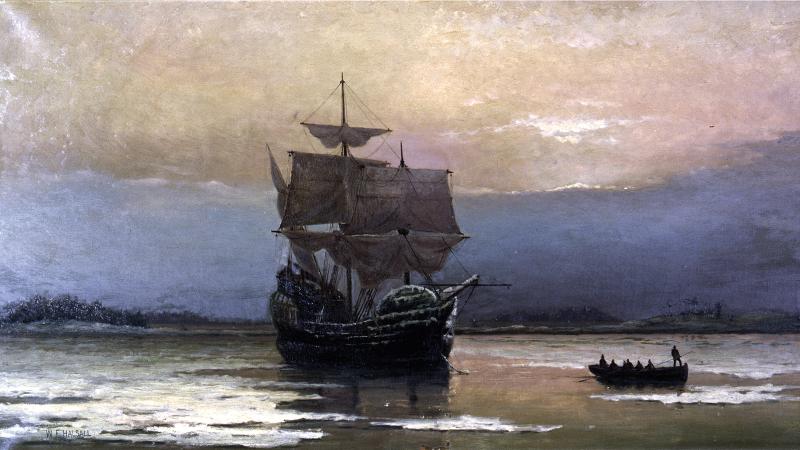
The Landing of the Pilgrims in 1620, a tapestry by Mabelle Linnea Holmes.
—Jamestown-Yorktown Educational Trust, Virginia / Bridgeman Images

An NEH-funded film revisits the Puritan Separatists who arrived aboard the Mayflower.

HUMANITIES, November/December 2015, Volume 36, Number 6

In 1620, the Mayflower plowed across the Atlantic through headwinds and ocean currents at an incredibly slow two miles per hour. The overcrowded vessel’s crossing took more than two harrowing months. On the way, its 102 passengers witnessed an astonishing scene. During a fierce storm, an indentured servant named John Howland had come topside for fresh air when the ship rolled violently, casting him into the raging sea. He sank well beneath the waves. Such a fate almost certainly meant death by drowning. Yet, somehow, Howland had managed to grab a halyard on his way overboard, and desperately clung to it long enough for the crew to haul him back to safety.


Wednesday, November 27, 2013

The Pilgrim Separatists

 
Pilgrim Separatists and the Founding of America - Drive Thru History


coldwatermedia

Uploaded on Jun 25, 2010


Pilgrim Separatists and the Founding of America - Drive Thru History

This clip on Pilgrim Separatists and the founding of America is from Episode 2 called "The Pilgrims". From the Drive Thru History American History series.


Drive Thru History on Facebook:
http://www.facebook.com/drivethruhistory

Purchase Drive Thru History here:
http://tinyurl.com/yhxus8v

.

Monday, November 19, 2012

Pilgrim's Progress (Classic Version)


Uploaded by Spiritlessons on Aug 27, 2011

The Pilgrim's Progress is an allegory of a Christian's journey (here represented by a character called 'Christian') from the "City of Destruction" to the "Celestial City". Along the way he visits such locations as the Slough of Despond, Vanity Fair, the Doubting Castle, and the Valley of the Shadow of Death. Bunyan, the author, had very little formal education and a humble background. Nonetheless Pilgrim's Progress is considered one of the masterpieces of English literature, and is required reading for Christians who are on the spiritual path in a world of temptations.
.
 .

Wednesday, November 30, 2011

Relic to promote motherhood in Russia


Uploaded by on Nov 12, 2011

A sacred relic, believed by some Orthodox Christians to be the belt of the Virgin Mary, is drawing thousands of Russian pilgrims in search of a cure for a myriad of ailments including infertility. But the treasure -- a 2,000 year old cincture woven from camel fur - is also having political resonance.Russian leaders have called the country's shrinking population a matter of national security and now the influential Orthodox church has joined the fight.It wants to take the relic to pregnancy centres to discourage women from having abortions and save mother Russia by promoting motherhood.Al Jazeera's Neave Barker reports from Samara.

Thursday, November 25, 2010

Why did the Pilgrims come to America?


Feb 23rd, 2009

by Anthony Delgado


First let's define Pilgrims. Pilgrims are typically considered to be early protestant Christian settlers from England...

Why did the Pilgrims come to America?

First let's define Pilgrims. Pilgrims are typically considered to be early protestant Christian settlers from England. They chose to come to America to escape religious persecution from the church and from the English monarchy. At the time Protestants were forced to practice their beliefs in secrecy, otherwise they would be considered a threat to the Church and to the throne, which was far from the reality. The secret living is what caused them to make the trek to the Americas in order to escape this way of living.

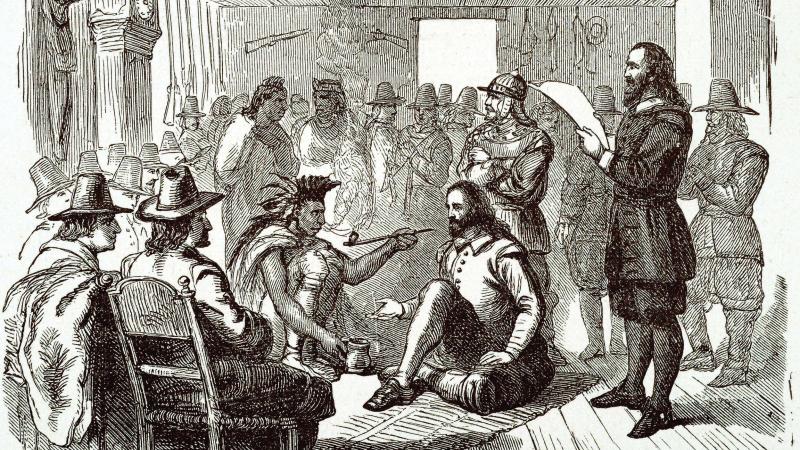
Pilgrims began to migrate to the Americas in about 1620 AD. The first settlers came over on the Mayflower and landed in Plymouth. They received aid from the Native Americans and actually befriended them, a concept contrary to other settlers. These pilgrim communities are the ones that the typical Thanksgiving stories come out of.

There were more ships than just the Mayflower that came over, over many years, containing Pilgrims or Protestants. They formed communities all over the northern coast and eventually moved inland. Many of today's Amish communities are descendant of these early settlements.

Today, just as in the sixteen hundreds, Protestants as well as all religions are able to practice their religion freely, as long as the practice does not break any laws in the United States. It was the protestant migration that paved the way for early constitutionalists to include freedom of religion into the constitution even though they themselves were mostly Protestant and could have made it the national religion.

-- Why did the Pilgrims come to America?
.
.
KKKKKKKKKK
.
*Amish: Personally, I don't agree with this statement. Amish are actually descendants of German Protestants who emigrated to the U.S. (also fleeeing religious persecution) a couple of centuries later:

Amish Mennonites are a group of Christian church fellowships that form a subgroup of the Mennonite churches. The Amish are known for simple living, plain dress, and a reluctance to adopt many conveniences of modern technology.

The history of the Amish church began with a schism in Switzerland within a group of Swiss and Alsatian Anabaptists in 1693 led by Jakob Ammann.[2] Those who followed Ammann became known as Amish.[3] These followers were originally from three main places: the German-speaking parts of Switzerland, Alsace (now part of France), and the Palatinate of Germany. In the early 18th century, many Amish and Mennonites emigrated to Pennsylvania for a variety of reasons.
...
Amish Mennonites began migrating to Pennsylvania in the 18th century as part of a larger migration from the Palatinate and neighboring areas. This migration was a reaction to religious wars, poverty, and religious persecution on the Continent. The Amish congregations remaining in Europe slowly merged with the Mennonites. Most Amish communities that were established in North America did not ultimately retain their Amish identity. Many of these eventually united with the Mennonite Church, and other Mennonite denominations, especially in the early 20th century. The more traditionally minded groups became known as the Old Order Amish.

http://en.wikipedia.org/wiki/Amish
.

Saturday, April 24, 2010

Modern Day Pilgrims and Puritans


It's my opinion that a situation exists today in America simiilar to the conditions in colonial New England. Back then, there were Pilgrim settlers and Puritan settlers on the coast of present day Massachusetts. These two groups differed fundamentally in that the Pilgrims (also called Separatists) separated themselves from the Church of England to worship The Almighty God as they were led by the Holy Spirit through prayer and study of the Holy Bible; On the other hand the Puritans remained within the Corporate Body of the Church of England, and attempted to 'reform' that denomination from within its structure. The Pilgrims saw the futility in undertaking such a task, and readily 'extracted' their participation from an apostate church. During the same period the Puritans (who quickly followed the Pilgrims sojourn) enthusiastically defended the Anglican Church's sovereignty, even in the newly 'acquired' colonial territories. The Puritans saw themselves as the defenders of the Faith. While the Pilgrims sought to dedicate their efforts to worship their Creator in spirit and in truth without involving themselves in clerical matters.
.
My comparison does not refer to the doctrines the two groups espoused, or how they relate to modern Christian beliefs, But rather to their approach to livng a 'religious' lifestyle and their relationship to the 'world' .

There are two similar forces in christian churches today. There is a group similar to the Pilgrims of yesteryear who refuse to participate in an Ecumenical Corporate Structure that is genetically a clone, and also a member of the New Age organizations NCC and WCC; A Corporate Body that may own a copyright (Registered Trademark) of (on) its name.

The modern day Pilgrims separate themselves from these generic churches which are indistinguishable one from the other, since they believe the time has arrived for a millennium of peace and security. Had they read their Bibles prayerfully they would have discerned that it's time for the second coming of Jesuschrist to bring judgement to a rebellious and sinful world. To bring judgement and destruction to the evil doers; Not peace and security! Also, to save and remove His faithful servants from this corrupt environment.
.
The Puritans of today are busy planting churches on every corner, and organizing volunteer programs to help Haiti, to help the elderly, and to feed the needy. Yet, their sermons are devoid of any redeeming truths. This social gospel is not Biblical. They lie about there awaiting mankind decades of hope and prosperity; When the signs clearly point towards a time of unprecedented destruction and chaos. Had they read their Bibles, instead of People Magazine, they would have known that Jesus is at the threshold. The Puritan's counterpart now are as lost and confused as their namesakes were 400 years ago; Since the purpose of the Lord for a Church and a faithful people are not to defend corporations, societies, real estate property, or fallible men; But, rather to be the salt of the earth. To represent the Almighty God, to love, and to worship only Him with all your might. To prepare a people for the great day of the Lord. Never has it been the purpose of God to have a group of politicians using His name to further their sinful goals, and goad others to do likewise (conform).
The Puritans and the Pilgrims are alive today.


Which group are you in?
Are you in the group that wants to "fix" the church, the USA, the world?

Or, are you instead in the group that is reforming themselves and preparing others for the soon triumphant return of the Lord?


The Pilgrims and the Puritans are back!
Arsenio..

Thursday, April 22, 2010

The New England Colonies


Depicting the Pilgrims as they leave Holland for new shores, "The Embarkation of the Pilgrims" can be found on the reverse of a $10,000 bill. Too bad the bill has not been printed since 1946.


The founders of the New England colonies had an entirely different mission from the Jamestown settlers. Although economic prosperity was still a goal of the New England settlers, their true goal was spiritual. Fed up with the ceremonial Church of England, Pilgrims and Puritans sought to recreate society in the manner they believed God truly intended it to be designed.

Religious strife reached a peak in England in the 1500s. When Henry VIII broke with the Catholic Church of Rome, spiritual life in England was turned on its ear. The new church under the king's leadership was approved by the English Parliament, but not all the people in England were willing to accept the Church of England. At first, the battles were waged between English Catholics and the followers of the new Church — the Anglicans. The rule of Queen Elizabeth brought an end to bloodshed, but the battle waged on in the hearts of the English people.

The Pilgrims, called the Separatists in England because of their desire to separate from the Anglican Church, were persecuted by agents of the throne.

The Puritans, so named for their desire to purify the Church of England, experienced the same degree of harassment.
Pilgrims and Puritans both believed in the teachings of John Calvin. According to Calvin, neither the teachings of the Catholic nor the Anglican Churches addressed God's will. By the end of Elizabeth's reign, England was a nation of many different faiths.


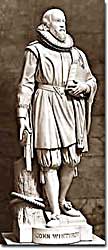
John Winthrop was a spiritual and political leader of the Massachusetts Bay Colony. He was elected governor of the colony in 1629.


The Stuart family, who ascended to the throne after the demise of Elizabeth, made matters worse for the followers of John Calvin. King James and his son Charles supported the Church of England, but secretly admired the ceremonies of the Catholic Church. To these kings, Calvin was a heretic, a man whose soul was doomed for his religious views.

The Pilgrims, called the Separatists in England because of their desire to separate from the Anglican Church, were persecuted by agents of the throne. The Puritans, so named for their desire to purify the Church of England, experienced the same degree of harassment. By the second and third decades of the 1600s, each group decided that England was no place to put their controversial beliefs into practice.


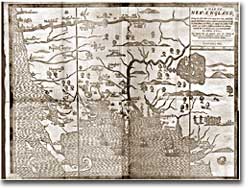
This map, the work of William Hubbard, depicts the expanding New England colonies as they were in 1677.


Where else but in the New World could such a golden opportunity be found? The land was unspoiled. Children could be raised without the corruption of old English religious ideas. The chance to create a perfect society was there for the taking. The Stuart kings saw America a means to get rid of troublemakers. Everything was falling into place.

By 1620, the seeds for a new society, quite different from the one already established at Jamestown, were planted deeply within the souls of a few brave pioneers. Their quest would form the basis of New England society.


Source: http://www.ushistory.org/us/3.asp
.

The Pilgrims and Puritans

For most Americans, the Thanksgiving holiday will be spent doing something other than pondering history. Even I will be watching the Packers beat play the Lions in an artificial war waged by men far more durable than I. Later in the day however, I will spend time talking with my family about the courageous group of Pilgrims that landed in a region which has largely forgotten God in our day. They were Puritans you say? Well yes and no. They had the same beliefs and origins, and because of that we sometimes inaccurately called them Puritans. But they were actually another group of people categorized as Separatists; the ones who came here we also call The Pilgrims. The Puritans soon after lived in the colony right next door. One thing is for sure, the Boston and Plymouth colonies were both filled with durable people, and they had so very much in common. But one group being Puritans and the other being Separatists, they also had their differences. This page on aPuritansMind.com has an excellent morsel of church history for you to feast on. It's a five minute overview of the differences and similarities between the Puritans and Pilgrims, taking you all the way back to their Reformation roots. Enjoy the read, and enjoy the day, being thankful for what the Lord has accomplished through them, to the glory of the almighty God. ...


Total Reformation for the Glory of God

by Samuel T. Logan. Jr.

--------------------------------------------------------------------------------

What's the difference between the Pilgrims and the Puritans? Are they all the same folks? When did the two groups first form? And why did they emerge as distinct religious groups?

Excellent questions, every one!

In answering all of the above questions, the year 1517 was especially crucial.

Most know one reason for this-in October of 1517, Martin Luther nailed his theological theses (declarations) to the castle door in Wittenberg, Germany. But 1517 is a crucial year for another reason as well, for in that year, in Boston, England, at a site where now stands an English pub called Martha's Vineyard, John Foxe was born. To anticipate just a bit, John Bunyan, author of Pilgrim's Progress, once said that something John Foxe did, more than any other human action, caused the rise and the flourishing of Puritanism.

by 1526, regular (rather subversive) theological discussions were being conducted in the White Horse Tavern in Cambridge. Participants included such future luminaries as Thomas Bilney, Hugh Latimer, Nicholas Ridley, and Thomas Cranmer. Every one of the four was later martyred.

In the meantime, in the late 1520's and early 1530's Henry VIII was experiencing matrimonial and political difficulties such that, in 1533, he insisted that the Convocation of Canterbury declare his marriage to Catherine of Aragon annulled. In the next year, Henry had the English Parliament declare him the Supreme Head of the Church in England, thus severing all ties with the Roman Church.

While Henry had no particular desire to "reform" the theology of the church, those who had been meeting at the White Horse (and many of their colleagues and supporters) saw this as an opportunity "of the Lord." Perhaps now the Scriptures alone could genuinely become the foundation of the church and the nation.

Such hopes found little royal support during Henry's lifetime, but, when the King died in 1547, his nine-year-old son Edward officially assumed the throne, ruling primarily through regents, both of whom (first the Duke of Somerset and then the Duke of Northumberland) had more sympathy for the vision which had illuminated those White Horse discussions. The push for the purification of the church and the state gained great momentum in England between 1547 and Edward's death in 1553.

But the next Tudor on the throne was Mary Tudor, better known to later generations as "Bloody Mary." Mary wanted nothing more than to return "her" country to the Roman Catholic fold, no matter the cost.

Between 1553 and 1558, Protestant exiles flooded Europe, hoping to escape Mary's sword by gathering in such Protestant bastions as Geneva and Frankfurt. To the latter came the 38-year-old John Foxe. Foxe developed a powerful vision of what England could be, if only God's Word were fully and faithfully followed.

Mary's death in 1558 and the accession to the English throne of Mary's Protestant sister Elizabeth reversed the earlier tide and sent Englishmen and Englishwomen home in droves. The seed which became Puritanism received a full shot of theological fertilizer from the pen of John Foxe.

During Mary's reign, hundreds had died for their faith. Would the people of England honor those deaths by seizing the marvelous opportunity the Lord had given England by removing Mary and replacing her with Elizabeth?

Would the people of England now insist that their church and their state be completely purified of all non-biblical elements so that both institutions (and all the people therein) might bring singular honor to the Lord God of Scripture?

These were the questions asked in Foxe's monumental work which we know as The Book of Martyrs. First published in 1563 Foxe's work was an intense account of the pain suffered by the Marian martyrs and a clarion call to bring both the nation and the church of England into full conformity to the Word of God.

Many of those who shared the dream which had been nurtured at the White Horse Tavern now seized upon Foxe's expression of God's expectations of His people and insisted, with ever-increasing fervor, that both their royal and their ecclesiastical leaders direct all English affairs sola Scriptura, according to the Scriptures alone.

Queen Elizabeth I, however, saw things differently. Her vision was of political stability and order. Elizabeth had no interest in any kind of extremism, especially the kind of religious extremism which the theological heirs of those White Horse discussants seemed to her to represent.

England (including the English church) should, in this Elizabethan view, be broad and inclusive and should base its life on tradition and reason as well as on the teachings of Scripture.

So, by 1570, there had developed in England two parties- 1) those who favored this more rationalistic understanding of church and state, and 2) those who continued to insist that further purification of those two entities was required by Scripture and that England must now seize the spiritual opportunity so brilliantly described by John Foxe. And it was in the midst of this controversy that the term "puritan" began to be regularly used by the first group as a derisive epithet of attack upon the second group.

The 1570's saw the intensification of this conflict with little "progress," at least from the standpoint of the Puritan party. In fact, with the dismissal of Thomas Cartwright from his teaching position at Cambridge for promulgating the heresy of Presbyterianism, it appeared to some Puritans that the cause was being lost and this perception led to the first major split within the Puritan party.

As the Puritan impulse might be primarily associated with (though it actually preceded) Foxe's Book of Martyrs, so the "Pilgrim" ethos might be traced appropriately to Robert Browne's book, Reformation Without Tarrying for Anie, first published in 1580. Browne might be called a disillusioned Puritan. He shared the vision which informed Foxe's work, but after more than a decade of seeking revival within the English church, he came to the conclusion that it just wasn't going to happen. Browne "separated from" the English church and, with the like-minded Robert Harrison, started his own congregation in Norwich in 1581.

Thus was formed the "Separatist" movement, a movement which later produced suchleaders as John Smyth (whom some regard as the father of English Baptists), John Robinson, William Brewster, and William Bradford. The latter three were directly involved in that group of Separatists which, in 1608, left England for the Netherlands, and then later decided to emigrate to the New World, landing at Plymouth, Massachusetts, in 1620.

Many (probably most) Puritans chose to remain within the English church working for reform, and it was from this group that a much larger group of emigrants left from England for New England in the late 1620's, establishing their colony at Massachusetts Bay.

The Boston and Plymouth colonies were distinct political and religious entities (at least until the English government combined them in the late 1680's) and, while relations between them were generally friendly, members of both groups were crystal clear on the differences between them.

"Puritans" wanted to remain as part of the English establishment, working for biblical reform from within. Even as they emigrated to New England, they affirmed their "Englishness" and saw the main purpose of their new colony as being that of a biblical witness, a "city on a hill" which would set an example of biblical righteousness in church and state for Old England and the entire world to see. As deeply committed covenant theologians, they emphasized especially strongly the corporate righteousness of their entire community before God.

"Pilgrims" wanted to achieve "reformation without tarrying," even if it meant separating from their church and their nation. While they continued to think of themselves as English, their emphasis was on their new political identity and spiritual identity. Because of their passionate commitment to the necessity of reformation immediate and without compromise, they emphasized especially strongly individual righteousness before God.

What united Massachusetts Bay and Plymouth, what united both Puritans and Pilgrims was far more significant than what distinguished them. All children of the Reformation, they knew that salvation was by grace alone through faith alone in Christ alone. And they knew this because they took, as their authority, Scripture alone.

They all knew that to God alone must be the glory and, in their different ways, they sought to bring every thought and every action-religious, political, social-captive to the Lordship of Jesus.

Could there be any more important goal for American Christians today?


Reprinted from Tabletalk magazine, vol. 20, no. 11, November 1996, with permission of Ligonier Ministries, P.O. Box 547500 Orlando, Florida 32854 1-800-435-4343.


[Dr. Logan is President of Westminster Theological Seminary in Philadelphia, Pa. where he teaches church history.]


Source: http://www.puritansermons.com/banner/logan1.htm
.