Showing posts with label world economic forum. Show all posts
Showing posts with label world economic forum. Show all posts
Tuesday, January 17, 2023


Monday, January 16, 2023
Tuesday, December 13, 2022
Wednesday, June 10, 2020
The Great Reset | Launch session 3 June 2020
The Great Reset | Launch session 3 June 2020
#WorldEconomicForum #TheGreatReset
The Great Reset | Launch session 3 June 2020
22,833 views22K views
•Streamed live on Jun 3, 2020

World Economic Forum
“The Great Reset” will be the theme of a unique twin summit to be convened by the World Economic Forum in January 2021. In-person and virtual dialogues will address the need for a more fair, sustainable and resilient future, and a new social contract centred on human dignity, social justice and where societal progress does not fall behind economic development. The World Economic Forum is the International Organization for Public-Private Cooperation. The Forum engages the foremost political, business, cultural and other leaders of society to shape global, regional and industry agendas. We believe that progress happens by bringing together people from all walks of life who have the drive and the influence to make positive change.
- World Economic Forum Website ► http://www.weforum.org/
- Facebook ► https://www.facebook.com/worldeconomi...
- YouTube ► https://www.youtube.com/wef
- Instagram ► https://www.instagram.com/worldeconom...
- Twitter ► https://twitter.com/wef
- LinkedIn ► https://www.linkedin.com/company/worl...
- TikTok ► https://www.tiktok.com/@worldeconomic...
- Flipboard ► https://flipboard.com/@WEF
Friday, November 16, 2018
Sunday, January 28, 2018
Saturday, January 27, 2018
Will Free Markets Make a Comeback?

World Economic Forum
Published on Jan 26, 2018
Is the liberalization of trade and investment an unstoppable force or something more cyclical and prone to reverses? Learn about how the world will do business in 2018.
· Katherine Garrett-Cox, Chief Executive Officer, Gulf International Bank (UK), United Kingdom; Young Global Leader
· John McDonnell, Shadow Chancellor of the Exchequer of the United Kingdom
· Peter Kodwo Appiah Turkson, Cardinal; Prefect, Dicastery for Promoting Integral Human Development, Vatican City State
Moderated by · Oliver Cann, Head of Media Content, World Economic Forum
http://www.weforum.org/
Wednesday, January 24, 2018
Pope Francis and World Council of Churches head address Davos participants
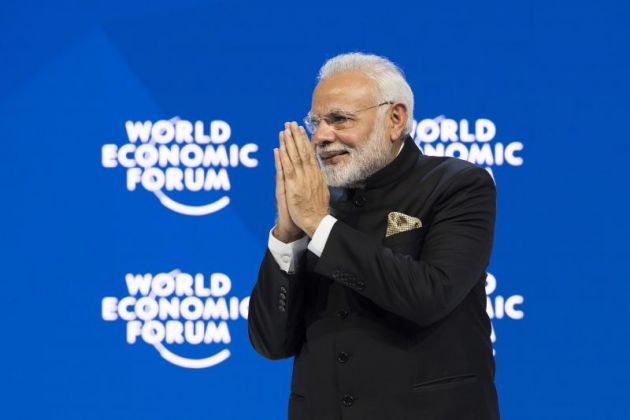
(Photo: World Economic Forum)India's Prime Minister Narendra Modi opens the World Economic Forum (WEF) in Davos, Switzerland on Jan. 23, 2018.
Pope Francis has urged participants at the World Economic Forum meeting to take bold steps to build a sustainable, human-centered future while World Council of Churches leader Olav Fykse Tveit has called on the world to say no to nuclear weapons.
Related
Tackle worsening global inequality 'now,'says World Council of Churches Olav Fykse Tveit
Polarizing populism creating global divisions, World Council of Churches head warns at Davos
UK's Christian Aid urges Davos meeting to act on Swiss banking secrecy
The Pope echoed the theme of the meeting, Creating a Shared Future in a Fractured World, calling on participants to build "inclusive, just and supportive societies."
The 48th World Economic Forum Annual Meeting is taking place Jan. 23-26 in snow-besieged Davos-Klosters, Switzerland and U.S. President Donald Trump who is expected to deliver the closing speech is drawing most attention due to his isolationist rhetoric.
Davos was opended on Jan. 23 by Indian Prime Minister Narendra Modi said the world is facing many new and serious challenges from the rise of anti-globalization to technological changes and the environment.
Tuesday, January 23, 2018
Indian PM Modi defends globalization at Davos summit

◢
TUE JAN 23, 2018 / 12:48 PM EST
Paritosh Bansal
India's Prime Minister Narendra Modi gestures as he speaks at the Opening Plenary during the World Economic Forum (WEF) annual meeting in Davos, Switzerland, January 23, 2018.
REUTERS/DENIS BALIBOUS
(Reuters) - Indian Prime Minister Narendra Modi mounted a defense of globalization at the World Economic Forum on Tuesday, urging joint action on climate change and economic cooperation, in a speech some delegates took as a swipe at U.S. President Donald Trump's America First agenda.
Modi, making the forum's first speech by an Indian head of state in more than two decades, did not mention Trump by name but he criticized the rise of protectionism in remarks delivered three days before the U.S. President will address the summit.
"Instead of globalization, the power of protectionism is putting its head up," Modi said, speaking in Hindi and causing an initial flurry in the audience of business and political leaders as people reached for their translation headsets.
"Their wish is not only to save themselves from globalization, but to change the natural flow of globalization."
Modi is leading a big government and business delegation to the summit in the Swiss ski resort of Davos, aiming to showcase India as a fast-growing economic power and a potential driver of global growth.
His opening address was a moment of personal triumph for the nationalist leader once shunned by the West for failing to prevent communal rioting in his home state. The occasion also recognized India's growth as an economic and geopolitical power.
Anindya Bakrie, chief executive of media company PT Bakrie Global Ventura, part of Indonesia's Bakrie conglomerate, said Modi's remarks were a welcome contrast to U.S. isolationism.
"For developing countries, when we hear the U.S. talking about isolationism it's a bit concerning. So to have more and more leaders talk about the benefits of globalization is really good," Bakrie said.
Tuesday, November 18, 2014
Millennials Exploring Social Exclusion With Pope Francis: God, the Internet and Disrupting Business
Michelle Arevalo-Carpenter
Social Entrepreneur and Human Rights Techie. Lives in Quito
Posted: 11/17/2014 2:02 pm EST Updated: 11/17/2014 2:02 pm EST
Next week 40 Global Shapers of the World Economic Forum will travel to the Vatican from 5 continents to hold a private audience with Pope Francis at the Vatican. This meeting aims to respond to challenge Pope Francis poses: How do we create a new global mindset to overcome social and economic exclusion?
Ever since I was honored with an invitation to join this gathering in Rome, I've been wondering: Why invite 40 millennials and not the top 40 CEOs? What sort of insight can we offer that the world's foremost academics on social inclusion couldn't? How can a heterogeneous group with diverse religious beliefs help shape a debate hosted at the center of the Catholic world?
The Internet as a gift of God.
I found part of the answer online. Pope Francis understood from early in his tenure the power of social media and the internet. In fact, writing about communications and global understanding, Pope Francis calls the internet a gift from god. The English-language Pontifex twitter account has almost 5 million followers, the PopeApp has more than over 200,000 downloads and his entire agenda is available and streamable for the world to see. Given this interest in the possibilities the web can offer to his pastoral concern for humanity, conferring with digital natives is a smart move. Among the 40 participants, many are already using technology to enhance democratic participation, document and visualize human rights information oramplifying the voice of the underheard through mobile.
Real change will bring about some disruption -- which Gen Y's love.
Another hint about why Pope Francis is interested in this meeting can be found in the Evangelii Gaudium, a document Pope Francis issued in 2013 outlining his views on church reform. In it, Pope Francis goes beyond suggesting business people become more charitable. In fact, he questions the notion of Milton Friedman that "the only social responsibility of business is to increase its profits." A section dedicated to the economy and distribution of income indicates:
Business is -- in fact -- a vocation, and a noble vocation, provided that those engaged in it see themselves challenged by a greater meaning in life.The challenge of overcoming socio-economic exclusion is too large for governments, charities, non-profits and agencies to tackle alone. The private sector has played a crucial role in catalyzing important leaps in health, engineering, communications and technology. Knowing this, Pope Francis suggests it is time to review the purpose of business and rethink models of growth.
This concept is not new to millennials -- a generation that brings us professionals who make career decisions based on meaning before salaries. In engaging Gen Y leaders, Pope Francis finds natural allies for creating a new global mindset around business. Thousands of companies that tend to appeal to the next great generation are enterprises with a social mission. Many of them have joined an international movement of B Corporations -- companies that redefine business success by making a public and often statutory commitment to their social mission. This way, directors and shareholders are not forced to abandon their altruistic objectives when times get tough. The long-term vision is to forever change the raison-d'être of business in society. This January at Davos, Pope Francis nudged the business community in this direction:
I ask you to ensure that humanity is served by wealth and not ruled by it.Empathy + risk-taking = change
Now, switching to a global mentality where businesses have a mission beyond pleasing shareholders requires a significant leap. This is where Pope Francis has identified the potential of focusing on younger leaders -- having a shorter trajectory, emerging leaders have less to lose and therefore a more open mind about re-engineering the way the private sector is structured. In his 2013 manifesto, Pope Francis reminds his followers,
Young people call us to renewed and expansive hope, for they represent new directions for humanity and open us up to the future, lest we cling to a nostalgia for structures and customs which are no longer life-giving in today's world.
Given the right opportunities, young people are more susceptible to developing deep empathy and stimulate innovation. The Catholic Church, in particular, Jesuits, have leveraged this feature of youth capacity for empathy with impressive results.
In Latin America, TECHO, a youth-led non-profit dedicated to alleviating poverty in urban slums, was founded as a Jesuit initiative. The impact speaks for itself: over 600,000 young volunteers from all faiths have been mobilized in 19 countries to build over 120,000 transitional homes for those at the base of the pyramid. The homes are built entirely by young volunteers and families, who later engage in community development initiatives to give continuity to the projects.
Likewise, the Jesuit Refugee Service (JRS) has offered legal aid to 600,000 refugees in dozens of countries so they can unlock the key to inclusion in their home countries: legal documentation. In giving young lawyers the chance to understand the harsh reality of trying to make a living as a non-citizen, JRS is changing mentalities and the course of their careers forever.
Unlikely allies
Under Pope Francis´s leadership, the Catholic church has gained more non-Catholic fans than ever. Pope Francis understands the challenge. Speaking about young people in the Evangelii Gaudium, he admits
[A]s adults, we find it hard to listen patiently to them, to appreciate their concerns and demands and to speak to them in a language they can understand.His statements about evolution and creation, his open support for the inclusion of gays and lesbians in the church and his challenging world leaders on wealth distribution demonstrate leadership that is willing to question traditional interpretations of doctrine and focus on action. Without appealing to religious piety, millennials -- in our search for a meaningful life and career -- may be Pope Francis' unlikely allies in this quest for developing a new global mindset.
.
Wednesday, January 23, 2013
The best article ever written about ‘sybaritic gabfest’ Davos
Posted by Max Fisher on January 23, 2013 at 1:40 pm
More »

Prime Minister of Georgia Bizdina Ivanishvili, left, talks with President of Azerbaijan Ilham Aliyev at Davos. (JOHANNES EISELE/AFP/Getty Images)
The World Economic Forum, also known as “Davos” for the Swiss mountain town where it is held, also known as the largest annual gathering of political and business elites up to and including heads of state, is impossible not to mock.
Maybe it’s the way that so many smart and powerful people seem to always end up saying so little of consequence. Maybe it’s incongruity, as this Dealbook article pointed out last year, of the rich and powerful gathering in cloistered splendor at a time of rising income inequality. Or maybe it’s just the mental image of former Russian President Dimitri Medvedev sharing a hot cocoa with Citigroup CEO Michael Corbat.
Whatever the reason, do not expect anyone this year to surpass the pinnacle of World Economic Forum satire, achieved in 2011 by Reuters blogger Felix Salmon with “The Triumph of Davos.” Writing from Davos itself, Salmon seemed bothered by the wide gap between the mood at the conference and the events in Cairo, where protesters were on day three of a Tahrir Square sit-in that eventually became the Egyptian revolution.
Salmon’s post (satirically) congratulated Davos on its “effective and timely intervention in Egypt,” which he said had finally disproven “cynics” who saw the conference as a “sybaritic alpine gabfest.” In reality, of course, despite Davos’s self-image as a world-changing collective of benevolent elites, the conference didn’t do much of anything for Egypt. Here’s more from Salmon:
With money from a large number of the Davos rich and communications expertise from broadcast, telecommunications, and social-media representatives, the manifesto put together in the space of just two days at the Congress Center became a clear rallying point not only for Egypt’s disaffected youth but also for their counterparts across the region. And with radical and democratic change now just a matter of timing, Arab countries saw that a peaceful transition to stable democracy was both possible and necessary. The rest is history.
Salmon asks of the Davos critics, “Did they think that the Forum’s commitment to improving the state of the world was simply a veneer designed to make an astonishingly expensive professional-networking event look vaguely respectable? Of course it wasn’t.” Ouch.
Substitute Egypt with Syria, for example, or the Sahel, or whatever other major global crisis you like, and Salmon’s post might still hold up. He concluded, “The triumph of Davos in 2011 has confirmed the World Economic Forum as an indispensable gathering-point for global leadership for decades to come.”
More »
Prime Minister of Georgia Bizdina Ivanishvili, left, talks with President of Azerbaijan Ilham Aliyev at Davos. (JOHANNES EISELE/AFP/Getty Images)
The World Economic Forum, also known as “Davos” for the Swiss mountain town where it is held, also known as the largest annual gathering of political and business elites up to and including heads of state, is impossible not to mock.
Maybe it’s the way that so many smart and powerful people seem to always end up saying so little of consequence. Maybe it’s incongruity, as this Dealbook article pointed out last year, of the rich and powerful gathering in cloistered splendor at a time of rising income inequality. Or maybe it’s just the mental image of former Russian President Dimitri Medvedev sharing a hot cocoa with Citigroup CEO Michael Corbat.
Whatever the reason, do not expect anyone this year to surpass the pinnacle of World Economic Forum satire, achieved in 2011 by Reuters blogger Felix Salmon with “The Triumph of Davos.” Writing from Davos itself, Salmon seemed bothered by the wide gap between the mood at the conference and the events in Cairo, where protesters were on day three of a Tahrir Square sit-in that eventually became the Egyptian revolution.
Salmon’s post (satirically) congratulated Davos on its “effective and timely intervention in Egypt,” which he said had finally disproven “cynics” who saw the conference as a “sybaritic alpine gabfest.” In reality, of course, despite Davos’s self-image as a world-changing collective of benevolent elites, the conference didn’t do much of anything for Egypt. Here’s more from Salmon:
With money from a large number of the Davos rich and communications expertise from broadcast, telecommunications, and social-media representatives, the manifesto put together in the space of just two days at the Congress Center became a clear rallying point not only for Egypt’s disaffected youth but also for their counterparts across the region. And with radical and democratic change now just a matter of timing, Arab countries saw that a peaceful transition to stable democracy was both possible and necessary. The rest is history.
Salmon asks of the Davos critics, “Did they think that the Forum’s commitment to improving the state of the world was simply a veneer designed to make an astonishingly expensive professional-networking event look vaguely respectable? Of course it wasn’t.” Ouch.
Substitute Egypt with Syria, for example, or the Sahel, or whatever other major global crisis you like, and Salmon’s post might still hold up. He concluded, “The triumph of Davos in 2011 has confirmed the World Economic Forum as an indispensable gathering-point for global leadership for decades to come.”
.
Subscribe to:
Posts (Atom)