Showing posts with label money laundering. Show all posts

Thursday, October 22, 2026

AI-Powered Princes and the Grandparent Trap: An FBI Agent’s Guide to Scams

An FBI agent discusses the latest ways scammers are separating you from your money – and how to avoid getting conned.


MATTHIAS BALK|PICTURE ALLIANCE VIA GETTY IMAGES
An older woman uses a phone.


By Olivier Knox

Oct. 21, 2026

Internet crime is big business. In 2025, the FBI’s Internet Crime Complaint Center tallied more than a million complaints covering losses of nearly $21 billion. Operations that spread across continents are constantly evolving and are using artificial intelligence to get more sophisticated.

To prepare you for the inevitable attempts to make off with your money, we sat down with Supervisory Special Agent Timothy Lynch, unit chief of the FBI’s Cyber-Enabled Fraud and Money Laundering Unit.

Our conversation has been edited for length and clarity.

Decision Points: What is the most common kind of scam that you see, and how does it work?

Lynch: The most common scam right now would be cryptocurrency investment fraud, where people receive cold calls and emails asking them to make some kind of investment in cryptocurrency, where there are claims that are going to be incredible returns on investment. In actuality, the scammers are just taking their funds wholesale. It is by far the most common. It has the highest loss amount. We had about $7.2 billion in reported losses last year.

Why am I getting so many obviously scammy text messages?

Because scam has become global in nature and industrial in scale.

Over the last 10 years or so, we've seen an incredible rise of what are actually known as scam compounds. These are anywhere from 100- to 500-acre mini cities, typically based in Southeast Asia and now Africa. What they're doing is they are buying up cell phone information in bulk, and they are sending out a lot of these cold call solicitations, trying to victimize people.

Sunday, October 26, 2025

Cuba Captures Fugitive Chinese National Accused of Running Fentanyl Network Into the U.S.

Story by Pedro Camacho


Alleged Chinese fentanyl kingpin Zhi Dong Zhang has been arrested by Cuba after escaping custody in Mexico back in July© Mexican government

Cuban authorities have detained a Chinese national accused by the United States of running an international fentanyl and cocaine trafficking network after his escape from custody in Mexico earlier this year, according to Mexican security officials.

Cuba has not issued an official statement on Zhang's detention or on whether it intends to extradite him to Mexico or the United States.

The fugitive, identified as Zhi Dong Zhang and also known as "Brother Wang," had been sought by U.S. authorities on charges of drug trafficking and money laundering, as Al Jazeera reports.

Zhang was first indicted in federal court in Atlanta in 2022, accused of directing a transnational network that trafficked large quantities of cocaine and fentanyl into the United States through distribution hubs in Atlanta and Los Angeles. Prosecutors allege millions of dollars in drug proceeds were collected in U.S. stash houses and transferred to accounts Zhang could access from Mexico.

Mexican authorities arrested Zhang in Mexico City in October 2024 at the request of the U.S. government. A judge later granted him house arrest, from which he escaped in July 2025 despite being under military guard.

Security officials quoted by El País described Zhang as "a major international money laundering operator" who established "connections with other cartels for the transfer of fentanyl from China to Central America, South America, Europe, and the United States." He is alleged to have maintained ties with Mexico's Sinaloa and Jalisco New Generation cartels.

The case has unfolded amid growing tensions between Washington, Mexico, and China over the trafficking of fentanyl, a synthetic opioid estimated to be 50 times more potent than heroin and responsible for tens of thousands of overdose deaths in the United States each year.

While Mexico has been the primary transit route for the drug, U.S. officials have increasingly turned their attention to China-based suppliers of precursor chemicals.


Tuesday, December 12, 2017

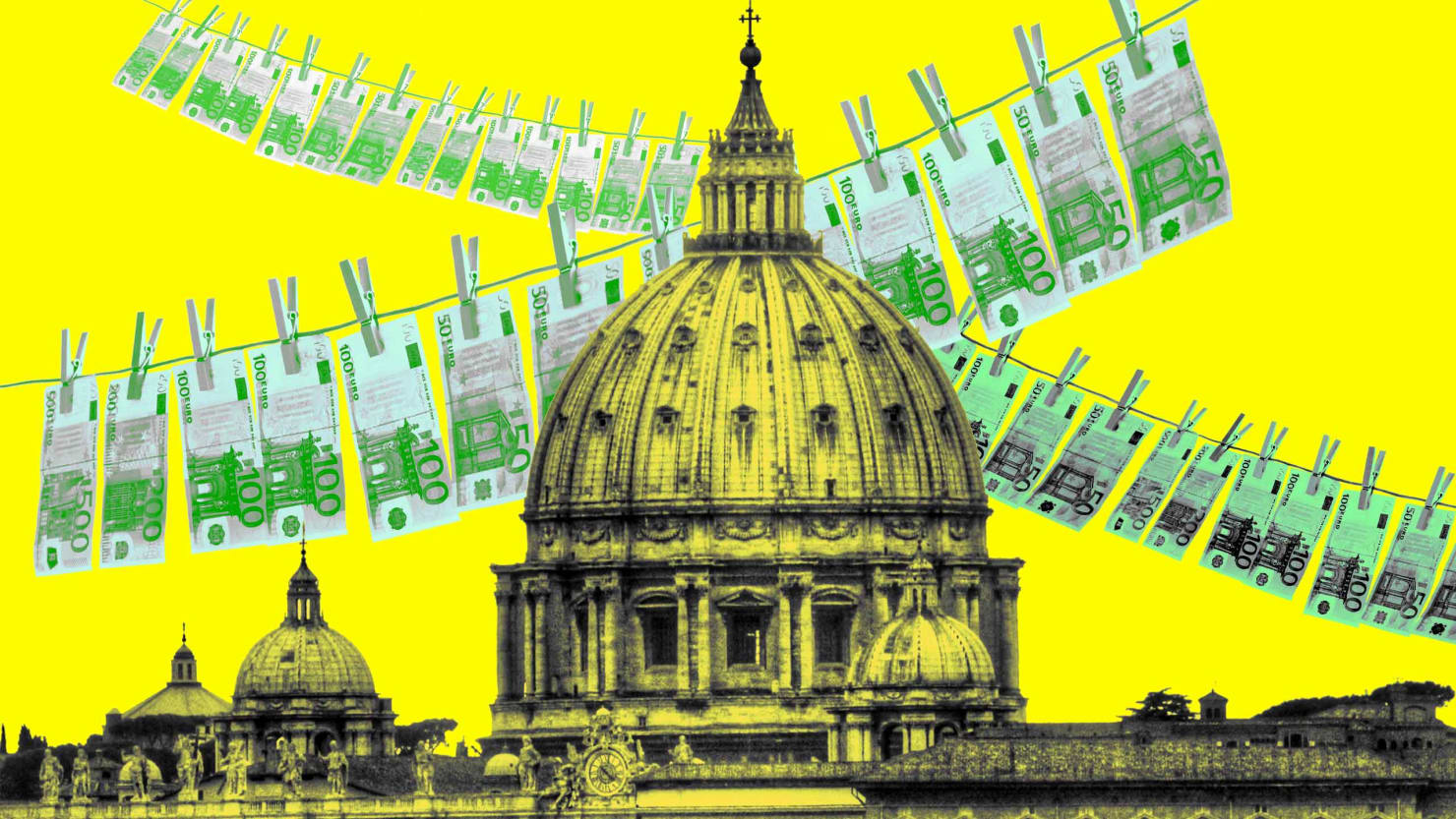
The Vatican’s Dirty Money Problem


Photo Illustration by Elizabeth Brockway/The Daily Beast


FISHY

A mysterious firing and a new report on the Vatican’s creative bookkeeping begs the question: Why does no one ever get in trouble for laundering money at the Holy See?


Barbie Latza Nadeau


12.12.17 1:06 PM ET


ROME—In 2015, the Council of Europe’s financial-evaluation arm Moneyval laid down the law for the Vatican Bank, telling the rather unholy financiers who had been accused of abetting money laundering for years that it isn’t enough to just smoke out suspicious account holders and freeze assets. Instead they said the Vatican Bank, formally known as the Institute for Religious Works, or IOR, needed to start actually prosecuting criminal cases.

Two years later, thousands of accounts have been closed or frozen, but Moneyval still isn’t happy. According to its 209-page December 2017 progress report, the Vatican gets good marks for not funding terrorism and for flagging potential illegal behavior. But the holy bank fails once again to actually hold anyone accountable for what are clearly crimes such as “fraud, including serious tax evasion, misappropriation and corruption,” according to the report.


More curious still, a week before the highly anticipated report was released, the IOR Deputy Director Giulio Mattietti was fired with no advance warning and escorted from his office out of fear he might remove files from his desk.

Mattietti was hired in 2007 by Paolo Cipriani, the former head of the bank who resigned under pressure a few months after Pope Francis was elected in 2013, after a Vatican accountant nicknamed “Monsignor 500” for his penchant for 500-euro notes, was arrested for trying to smuggle $26 million to Switzerland. Mattietti’s removal followed the sacking of a lower-level IOR employee days earlier. The Vatican gives no official reason for either of the firings beyond “reforms,” but a source close to the bank says the bank employees who were let go may have been whistleblowers who were alerting officials outside the bank about continuing impropriety.

In fact, despite apparently precise record keeping on the part of IOR, Moneyval evaluators still found 69 actions involving 38 customers that were not in accordance with money laundering and fraud standards set forth by the Council of Europe. None of those suspect cases were prosecuted to the fullest extent under the law, and instead Moneyval investigators point to vague records that imply that the cases were closed.

“Eight money-laundering investigations have been closed formally without any charges, while six additional investigations have been concluded without an indictment for any offense and their formal closure has been requested,” the report states.

And that is a problem.


Wednesday, November 12, 2014

NWO: Jesuit infiltration, increased surveillance & enforcement of the mark of the beast


friendofYahushua

Published on Nov 9, 2014


FAIR USE NOTICE: This video may contain copyrighted material. Such material is made available for educational purposes only. This constitutes a 'fair use' of any such copyrighted material as provided for in Title 17 U.S.C. section 107 of the US Copyright Law.

PLEASE watch this video in its entirety!

As Christians anticipate the imminent return of the Son of the Most High, Bible prophecy indicates that the world will soon go through unprecedented changes, which will take the great majority of us by surprise.

Satan, the father of lies and enemy of God, knows his time is very short as prophetic signs point to the imminent glorious return of the Son of God and Saviour of the human race, Jesus the Christ. Satan is using the Antichrist pope and the Vatican's Jesuits to infiltrate and manipulate all levels of government, institutions and churches with the purpose of ushering his sadistic new world order.

Since 9/11, the world has witnessed increased surveillance and the infringement and regression of individual rights, false flag attacks and other fear-mongering tactics to bring the false messiah who will be none other than satan in the flesh. He will masquerade himself as Christ to a deceived world, which has rejected the Christ of the Bible and His Law of love, His holy ten-commandments.

However, this false messiah will not be able to deceive the elect of the Most High as well as countless others, who will come to the knowledge of the truth, in these end times. The false messiah will change the 7th day Sabbath commandment of the Most High which points to Him as the Creator to SUNday, the venerable day of the sun, in partnership with the Antichrist pope, to bring about Sunday laws worldwide.

Sunday worship will be the enforced mark of the Vatican beast, the prophesied first beast of Revelation 13 and whore of Babylon in Revelation 17. This is what the Vatican beast has to say about its mark:

"Sunday is our MARK of our authority [...] The church is above the Bible, and this transference of Sabbath observance is proof of that fact". — Catholic Record of London, Ontario. Sept. 1, 1923.

Those who accept Sunday rather than the commanded 7th day Sabbath of God will pay a miserable price for disobeying an offended God. The seven plagues of the Most High will soon fall upon those who will take the mark of the beast (Sunday rest and worship) -- rather than observing the commandments of the Most High including the 7th day Sabbath commandment (Exodus 20:8-11) - and their fate will be an unpleasant one, as mentioned in Revelation 14:9-10.

Sunday observance cannot be found in the Bible. Christ or His apostles never ordained or commanded a change in the day of rest from the 7th day of the week to the 1st day of the week.

The Catholic church has even admitted this fact through the following statement:

"From beginning to end of Scripture, there is not a single passage that warrants the transfer of weekly public worship from the last day of the week [Saturday] to the first [Sunday]." Catholic Press, Sydney, Australia, August, 1900.

Soon, every man, woman and child will have to make a very important decision that will alter the fate: either embrace Christ and His commandments including the 7th day Sabbath commandment or obeying the satan-inspired beasts of Revelation 13, including the Vatican and the United States and their one world government and false religious system.

In Revelation chapter 14 verse 12 and in Revelation chapter 22 verse 14, those who will receive eternal life in Christ's kingdom are identified as the saints who keep the commandments of God and have the faith of Christ. In contrast, those who willingly reject God's commandments, including the 7th day Sabbath commandment, will die for their disobedience since the wages of sin is death (Romans 6:23).

Make the right choice: choose Christ, put your faith and trust in the Son of God, keep His holy ten commandments through the Holy Spirit (Exodus 20:1-17) and Christ will reward you, as a gift, with eternal life in His everlasting kingdom of love, peace and joy (Revelation 14:12; Revelation 22:14).

For more information and videos on Christian beliefs and prophecy, please visit:www.theseventhdayremnantchurch.org; www.remnantofgod.org, www.sdrministries.org, www.john1429.org, along with cregen124 and NicholasPoGM's YouTube channels.
.
.

Sunday, June 15, 2014

Cleaning Up the Vatican


By PAUL VALLELYJUNE 13, 2014


Credit
Angelo Carconi/Associated Press


LONDON — It looked extremely dramatic when Pope Francis fired the entire board of the Vatican’s financial watchdog last week. But that was only the half of it. The seismic changes that are underway behind the scenes in Rome are even more radical than public appearances suggest. And they offer illuminating insights into the steely character of the man who likes to present himself to the world as a model of smiling humility.

The body known as Rome’s Financial Information Authority (F.I.A.) supervises everything from the Vatican Bank to the real estate of the Holy See, its staff salaries and even the Vatican pharmacy. Its five Italian members were due to serve until 2016 when Francis asked them to resign early — to be replaced by an international team of financial experts that includes Joseph Yuvaraj Pillay, the man who turned around the Singapore economy, and Juan Zarate, a former financial security adviser to President George W. Bush.

The drastic move came after months of infighting between the old guard and the F.I.A.’s director, René Brülhart, a Swiss anti-money-laundering expert, charged with cleaning up one of the world’s most secretive banks, which has assets worth more than $8 billion. A former head of Liechtenstein’s financial intelligence unit, he found his reforms continually frustrated by an old-boy network. He complained to the pope, who swept aside the obstacle in a single move.

But there was more to it than that, as anyone would have suspected who knew the modus operandi of Jorge Mario Bergoglio when he was archbishop of Buenos Aires before he became pope. There, too, he had faced a banking scandal in which his predecessor, Cardinal Antonio Quarracino, had become embroiled in underwriting a multimillion dollar insurance deal for a family of prominent bankers who turned out to be paying all his credit card bills. When the bank went insolvent, bankers were jailed, and the Catholic Church was asked to repay huge sums it did not have, Cardinal Bergoglio called in the international accountants Arthur Andersen, closed the church bank and transferred its assets to commercial banks.

He acted swiftly, decisively and transparently — on several levels at once. And that is what he has been doing for the past year with the opaque finances of the Vatican and its scandal-mired bank.

He certainly needs to do so. The bank has had a highly dubious history since the 1980s when it was implicated in the collapse of Italy’s largest private bank, the Banco Ambrosiano, whose chairman, Roberto Calvi, was found hanging from Blackfriars Bridge in London, an incident that was widely seen as a murder disguised as suicide. A warrant was issued for the arrest of the president of the Vatican Bank, Archbishop Paul Marcinkus, alleging he was an accessory to fraudulent bankruptcy, but he was never put on trial.

The bank’s checkered history has continued until recent times. In a 2012 report, the Council of Europe’s monetary authority failed the Vatican Bank on seven of its 16 core anti-money-laundering regulations. Other banks distanced themselves from it to such an extent that in 2013 Deutsche Bank closed down the Vatican’s 80 cash machines and credit card payment services. Impropriety clung to the institution like a bad smell.

Quite rightly Pope Francis made reform of the Vatican Bank one of his first priorities. Within days of becoming pope he stripped the bank’s five supervisory cardinals of their $42,000 annual stipend. In a sermon at a Mass for bank staff he pointedly described their organization as “necessary up to a certain point.” He demanded tighter accounting, better reporting practices and enhanced internal controls. Ten months later, unhappy with progress, he dismissed all but one of the five cardinals in January. He also replaced the F.I.A.’s president with an archbishop with a track record of reform within the Vatican bureaucracy.

Shrewdly, as before, he has brought in outsiders. The U.S. regulatory and compliance consultants of Promontory Financial Group are combing through the bank’s 19,000 accounts. They have found poor cash-flow checks, inadequate documentation, ignorance on due diligence and a system of proxies that clouds who really controls many accounts. When the clerics in charge were asked how they answered to the regulator, they replied: “We answer to God.” Now they answer to Mr. Brülhart. Some 1,600 accounts have been closed so far.

He has hired other external advisers. Ernst & Young is scrutinizing Vatican property holdings. KPMG is bringing its accountancy systems up to international standards. McKinsey is reforming its media operations, which include TV, radio and a newspaper. Deloitte is advising on management.

But Francis wanted to address the issue at a deeper level too. Does the Catholic Church need its own bank at all? He set up a committee, which included the Harvard law professor Mary Ann Glendon, to ask more fundamental questions. It was given powers, in a letter of authority handwritten by Francis, to summon any documents and data it deemed necessary and told to report directly to the pope, bypassing the Curia, the Vatican bureaucracy.

That committee issued its report last month — and explains the timing of the F.I.A. house-cleaning. And that was not all. Two of the bank’s most longstanding senior officials were eased into early retirement. And a new business manager from Australia, Danny Casey, was brought in to force fiscal transparency and discipline across all Vatican departments. He will be the right-hand man of Cardinal George Pell, former archbishop of Sydney, a traditionalist but also a vocal critic of the dysfunction of the Curia under the last papacy. Cardinal Pell is head of the new Secretariat of the Economy created by Francis in February to bring financial discipline to the Vatican, where each department has been acting as an individual center of power.

At one point Francis seemed set on closing the Vatican Bank, which was founded more than 70 years ago. In the 1970s, the Vatican used it to finance covert anti-Communist missions in central America. In the 1980s, Pope John Paul II used it to channel money to the Polish Solidarity movement. Now, Francis appears to have been convinced that the bank is still needed because so many bishops, priests and religious orders work in countries without secure banking systems.
But the pope is adamant it must become transparent and accountable. He is considering setting up a Vatican central bank to more closely control transfers of money abroad. That would remove the possibility that the $3 billion the bank transfers each year could be used for money-laundering — though other measures will be needed to combat the abuse of accounts for Italian tax evasion.

The scandal clinging to Vatican finances taints an institution that Francis famously said he wants, above all, to be “a poor church, for the poor.” There are many in the Vatican, wedded to a more elitist view of the church, who are unhappy at this. So far they have been unsure how to resist a pope who operates outside the old Curia channels and acts with admirable unpredictability.

What helps Francis, oddly enough, is that the scandal is far from over. One of the Vatican’s most senior accountants, Msgr. Nunzio Scarano, who worked for 22 years in the Administration of the Patrimony of the Apostolic See, the department in charge of paying Vatican salaries and managing its property and financial portfolios, is currently under arrest, awaiting trial on corruption and money laundering charges.

Nicknamed “Monsignor Cinquecento” after the 500-euro bills he routinely flashed in public, Monsignor Scarano owned luxury properties and expensive works of art. He has been accused by Italian magistrates of having transferred millions out of the Vatican Bank and smuggling it to Switzerland to help rich friends avoid taxes. The director of the Vatican Bank and his deputy, who were named in Italian court documents, have resigned. The court case will undoubtedly bring more explosive and embarrassing revelations.

On it goes. Even the previous pope’s right-hand man, Cardinal Tarcisio Bertone, is under investigation for using his influence to steer almost $20 million in Vatican Bank loans — money that was eventually lost — to a film company run by a friend. “It’s something that’s under study,” Pope Francis has told reporters. “It’s not clear. Maybe it could be true, but at this time nothing is definitive.”

One thing, however, is definite. Pope Francis knows that he has to get a grip on the Vatican’s chaotic finances. He has only just begun.

Paul Vallely is a visiting professor in public ethics at the University of Chester and the author of “Pope Francis: Untying the Knots.”


A version of this op-ed appears in print on June 14, 2014, in The International New York Times

.
.
.

Sunday, November 17, 2013

Vatican plays down mafia threat to Pope


1:54am November 16, 2013


Pope Francis delivers a speech during a meeting of the world's cardinals. (AAP)


The Vatican has downplayed a warning that Pope Francis could be targeted by the mafia because of his reforms to Holy See financial bodies.

"There is no reason for concern, and there is no need to feed alarmism," Vatican spokesman Father Federico Lombardi said.

He added that the Vatican - and, by extension, the Pope - was "extremely calm" regarding the alleged threat.

The warning was voiced by Nicola Gratteri, a respected state prosecutor in the southern Calabria region, who said the vicious local mafia, the 'Ndrangheta, is "nervous" the Pope is threatening its interests.

"Those who up to now have fed off the power and wealth coming directly from the Church are nervous, upset," he said in an interview published by the newspaper Il Fatto Quotidiano this week.

The Pope, Gratteri said, "is dismantling the Vatican's economic centres. If the mafia bosses can trip him up, they won't hesitate."

Gratteri didn't substantiate his warning. But his words reverberated through the Italian and foreign media, sparking fears for the pontiff's safety.

Initially the Vatican tried to dismiss the allegation. But from Thursday it started saying it was simply taking the warning in its stride.

Implied in Gratteri's comments is that Italy's mafia has its tentacles in the Vatican's obscure financial dealings and agencies, some of which have been marred by scandal.

Since taking the papacy in March, Pope Francis has set about cleaning up the Holy See's vast holdings and making them more transparent.

One of his first steps was to install a special commission tasked with investigating the Vatican's bank and another to probe Vatican finances in general.

The Pope has also called in a US consultancy, Promontory Financial Group, to conduct an external review of the Vatican bank's money-laundering rules and, more recently, to look into the internal agency handling its many real estate holdings.

The Vatican's bank, known as the Institute for Religious Works, was notably the main shareholder of the Banco Ambrosiano, which collapsed in 1982 amid accusations of laundering money for the mafia.

Banco Ambrosiano's chairman Roberto Calvi - dubbed "God's Banker" - was found hanging from a London bridge that year in a suspected murder by mobsters.

The Vatican's agency handling its real estate assets, the Administration of the Patrimony of the Apostolic See, came under scrutiny when a prelate, Nunzio Scarano, was arrested in June on suspicion of acting as a front for dubious international payments made through the Vatican bank.

Scarano wrote to the Pope to defend himself, accusing cardinals of covering up irregular financial activities carried out by his superiors.

Italy's various crime syndicates have been held responsible for several high-profile assassinations and abductions.

Although the Sicilian mafia Cosa Nostra is perhaps the best-known, the Calabrian 'Ndrangheta, whose name comes from the Greek for courage or loyalty, is considered by many as more dangerous and difficult to predict.

It has a tight clan structure which has made it famously difficult to penetrate, and specialises in drug and arms trafficking, prostitution, extortion and illegal construction.

The 'Ndrangheta runs an international crime network from its base in Calabria and has been linked to operations across western and northern Europe and as far afield as the Americas and Australia.


Source
.

Tuesday, August 20, 2013

Signing of a Memorandum of Understanding


Between Financial Intelligence Authority of the Holy See and Vatican City State with the Financial Crimes Enforcement Network of the United States

Signing of a Memorandum of Understanding


The Financial Intelligence Authority of the Holy See and Vatican City State (Autorità di Informazione Finanziaria - AIF), signed a Memorandum of Understanding yesterday, 7 May, in Washington, D.C., with the Financial Crimes Enforcement Network (FinCEN), its U.S. counterpart at the U.S. Department of Treasury, to strengthen its efforts to fight money laundering and terrorism financing globally.

The Memorandum was signed by René Brülhart, Director of AIF, and Jennifer Shasky Calvery, director of FinCEN, and will foster bi-lateral cooperation in the exchange of financial information.

“This is a clear indication the Holy See and the Vatican City State take international responsibilities to combat money laundering and the financing of terrorism very seriously, and that we are cooperating at the highest levels”, said Brülhart. “The Vatican has shown that it is a credible partner internationally and has made a clear commitment in the exchange of information in this fight”.

AIF was established in 2010 and became operational in April 2011. It is the competent authority of the Holy See and Vatican City State for financial intelligence and for supervision and regulation in the prevention and countering of money laundering and financing of terrorism.

AIF is currently in discussions with various Financial Intelligence Units (FIUs) of other countries and jurisdictions, including European countries, about entering into Memorandums of Understanding (MoUs) to strengthen bilateral cooperation to fight Money Laundering and Terrorism Financing.

Until now AIF has already signed MoUs with the FIUs of Belgium, Spain, Slovenia, and now of the U.S., which plays a leading role in combating money laundering.

AIF is currently in discussions with more than 20 other FIUs, and expects several MoUs to be signed in the course of the year.

May 9, 2013


Source
.

Wednesday, August 07, 2013

Consulates and the Vatican in chaos as HSBC tells them to find another bank


By Joanne Hart, Financial Mail On Sunday

PUBLISHED: 16:42 EST, 3 August 2013 | UPDATED: 02:58 EST, 5 August 2013


Diplomats in London have been thrown into chaos after Britain’s biggest bank, HSBC, sacked them as customers and gave them 60 days to move their accounts.

Their situation has been made far worse because other banks have been closing ranks and refusing to take their business.

More than 40 embassies, consulates and High Commissions have been affected. Even the Vatican has been given its marching orders.


Havoc: HSBC's decision to sack embassies as customers has caused chaos also because other banks refused to take their business

The Pope’s representative office in Britain, the Apostolic Nunciature, has banked with HSBC for many years but was told to find another bank.

One diplomatic source said he believed HSBC feared being exposed to embassies after it was fined $2billion (£1.32billion) by US authorities last year.

It was blamed for alleged money-laundering activities said to have been conducted through its Latin American operations by drug cartels. HSBC admitted at the time that it had failed to effectively counter money laundering.

Bernard Silver, head of the Consular Corps, which represents consuls in the UK, said: ‘HSBC’s decision has created havoc. Embassies and consulates desperately need a bank, not just to take in money for visas and passports, but to pay staff wages, rent bills, even the congestion charge.’

Embassies also have to pay for ambassadorial accommodation and sometimes even school fees for diplomats’ children. None of these bills can be settled without a valid British bank account.

John Belavu, minister at the Papua New Guinea High Commission, said: ‘We’ve been banking with HSBC for 22 years and for them to throw us off in this way was a bombshell.’

Lawrence Landau, honorary consul of Benin, said: ‘We have been trying everyone, but all the UK banks are clamming up.’

Other embassies are equally fraught. One said: ‘HSBC did not give us any real explanation. They have only given us until the middle of August to find another bank. We can’t find one and we are going crazy.’


Marching orders: The Vatican's representative office in Britain has been told by HSBC to find another bank.
Banking sources said diplomatic missions are considered to be ‘politically exposed’, which means they are at risk of money laundering activities.
HSBC, however, claims its decision is part of an assessment of all business customers to see if they satisfy five criteria – ‘international connectivity, economic development, profitability, cost efficiency and liquidity’.

One diplomat said: ‘We don’t even know what these criteria mean.’

HSBC would not explain the requirements to The Mail on Sunday and merely said: ‘HSBC has been applying a rolling programme of “five filter” assessments to all its businesses since May 2011, and our services for embassies are no exception.’

The Foreign & Commonwealth Office said it was in contact with HSBC and had provided a number of diplomatic missions with letters of introduction ‘to help in opening a new bank account’.

The debacle comes as HSBC prepares to unveil its half-year profits tomorrow. The group is expected to report that it made $14.6billion (£9.6billion) in profits for the first six months of the year. It made $12.7billion in the same period last year.


Source: http://www.dailymail.co.uk/money/news/article-2384003/Consulates-Vatican-chaos-HSBC-tells-bank.html#ixzz2bFrqJzEn

.

Monday, July 01, 2013

Vatican Bank Director Resigns Amid Scandal


The director of the Vatican bank and his deputy have resigned over a financial scandal that has already seen one monsignor jailed.

In a statement, the Vatican said Paolo Cipriani and his deputy Massimo Tulli stepped down "in the best interest of the institute and the Holy See".

Mr Cipriani, along with the bank's then-president, was placed under investigation by Rome prosecutors in 2010 for alleged violations of Italy's anti-money laundering rules after financial police seized €23m (£19.7m) from a Vatican account at a Rome bank.

Neither has been charged and the money was eventually ordered to be released.

But the bank, known as the Institute for Religious Works (IOR), has remained under the spotlight amid concerns it has been used as an offshore tax haven.

Last week, a Vatican accountant was arrested as part of the broadening investigation into IOR.

Monsignor Nunzio Scarano is accused of corruption and slander in connection with a plot to smuggle €20m (£17.1m) into Italy from Switzerland without reporting it to customs officials.

Scarano, dubbed "Don 500" by the Italian media because of his alleged favourite euro banknote, admitted under questioning on Monday that his behaviour was wrong, but insisted that he was only trying to help out friends.

According to wiretapped phone conversations, Scarano was in regular contact with both Mr Cipriani and Mr Tulli to get the required bank approval to move large amounts of cash into and out of his IOR accounts.

Current IOR president, Ernst von Freyberg, will serve as interim director, a Vatican statement said.


.

Friday, June 28, 2013

Cleric and 2 Others Arrested in Vatican Bank Investigation


By RACHEL DONADIO

Published: June 28, 2013


ROME — The Italian police on Friday arrested a prelate, a financial broker and an agent of the Italian Secret Service on corruption charges as part of a complex plot in which the priest — who is already under investigation on suspicion of money laundering involving the Vatican Bank
— is accused of trying to repatriate millions of euros from Switzerland to Italy in a private plane.


Francesco Pecoraro/Associated Press

Prosecutors allege that a broker and a secret service agent had been plotting to help Monsignor Nunzio Scarano bring 20 million euros into Italy from Switzerland in a private jet.

Those arrested were charged with fraud, corruption and slander as part of a broad investigation tied to the famously secretive Vatican Bank.

Prosecutors say that the broker and the Secret Service agent had been plotting to help the priest bring 20 million euros, or $26 million, into Italy from Switzerland in a private jet, the ANSA news agency reported. It said that the 20 million euros belonged to “some friends of the monsignor.” The plot never went through.

In a statement, the Vatican spokesman, the Rev. Federico Lombardi, said that the priest, Msgr. Nunzio Scarano, had been suspended from his position at one of the Vatican’s main financial departments “more than a month ago, ever since his superiors were informed that he was under investigation.”

The Vatican spokesman said that the Holy See had not received any requests from the Italian authorities, but confirmed its “willingness for full collaboration,” and that the Vatican’s internal financial watchdog was following the matter and would take appropriate measures “if necessary.” Those would include requesting that the Vatican’s internal prosecutor open an internal investigation into the monsignor.

A Vatican official said Monsignor Scarano had been suspended from his position as an accountant at APSA, a department that oversees the Vatican’s real estate holdings, after prosecutors in Salerno opened a separate investigation into money laundering. The official indicated that the suspension was a sign that the Vatican was stepping up its internal vigilance.

Only priests, religious, Catholic institutions, employees of Vatican City State and diplomats accredited to the Holy See are allowed to have accounts at the Vatican Bank, known as the Institute for Works of Religion, but rumors have long swirled about whether accounts were used as fronts for other interests, including organized crime and Italian politicians.

In the past, the Italian prelates who controlled the Vatican Bank tended to see any inquires into possible malfeasance as an attack on its sovereignty. Pope Francis and his predecessor, Benedict XVI, have tried to make the Vatican Bank more transparent.

It was not immediately clear whether the Vatican was cooperating with Italian authorities or whether the arrests stemmed from several suspicious transactions — six in 2012 and seven in the first half of 2013 — that Vatican officials said they had flagged and brought to the attention of the Vatican’s own internal prosecutors.

The arrests Friday were the most dramatic events to emerge from the Rome prosecutors’ investigation into the Vatican Bank since 2010, when prosecutors seized 23 million euros from two external accounts used by the Vatican Bank and placed its then-president and director general under investigation.

It had been acting on a warning from the Bank of Italy urging Italian banks to be more vigilant in their dealings with the Vatican, which has not come into full compliance with European banking norms, making it costly and problematic for other banks to do business with it.

In recent years, the Vatican has been under pressure to meet European norms as a condition for using the euro. In 2010, it created an internal financial watchdog and last year appointed as its director a Swiss lawyer who had helped Liechtenstein clean up its murky banking system.

This month, Pope Francis appointed a trusted prelate to a top post at the bank and on Wednesday, the pope took a further step and created a committee of prelates and a Harvard Law School professor to report directly to him on the bank’s progress.

In an interview last month, the new president of the Vatican Bank, Ernst von Freyberg, who was appointed in February by Benedict in one of his last acts as pope, said that he was committed to making the bank more transparent and compliant.

Last year, a report by Moneyval, a monitoring agency under the Council of Europe, said that the Vatican had made progress but still needed to improve in terms of compliance and customer due diligence. The Vatican must submit a new progress report to Moneyval this fall.

Vatican officials have said that the Vatican needs a bank to help Catholic institutions operate around the world, including in politically sensitive areas. The bank had total assets of 7.1 billion euros under management in 2012, most of it invested in government bonds, and turned a net profit of 86.6 million euros.


.

Thursday, April 11, 2013

Rev. Jeremiah Wright's daughter, Jeri Wright, indicted for alleged money laundering, report says

April 11, 2013 4:45 PM


Rev. Jeremiah Wright / Chip Somodevilla/Getty Images via CBS Chicago (CBS) CHICAGO - The daughter of President Barack Obama's former pastor was indicted Wednesday on charges of money laundering and lying to the feds, CBS Chicago reports.

Jeri L. Wright, daughter of the Rev. Jeremiah Wright, is accused of participating in a fraud scheme allegedly orchestrated by former Country Club Hills Police Chief Regina Evans and her husband involving a $1.25 million state grant, the station says.

Jeri Wright, 47, of Hazel Crest, Ill., is charged with two counts of money laundering, two counts of making false statements to federal law enforcement officers and seven counts of giving false testimony before a grand jury.


.

Monday, February 18, 2013

Was the Pope pushed? An abuse scandal, corruption and the dark intrigue behind Benedict's shock resignation


By GUY ADAMS

PUBLISHED: 18:13 EST, 15 February 2013 | UPDATED: 19:05 EST, 15 February 2013


The room full of people was still in shock at the news of his resignation when Pope Benedict XVI tottered across the marble floor towards a tall, heavy-set man in the red robe and skullcap of a cardinal.

As cameras rolled on Monday in the gilded Sala del Concistoro at the Apostolic Palace in Rome, Benedict grabbed the man by his shoulders, looked deep into his eyes and — struggling to hold back tears — shared a long embrace.

It was a public show of affection to one of the Pope’s most important fratres carissimi or ‘dear brothers’.


Dark intrigue: Benedict's decision to become the first leader of the Catholic Church to step aside since the Middle Ages has left a slew of unanswered questions

It was also a display of respect. For the man was Cardinal Angelo Sodano, who as Dean of the College of Cardinals will organise the coming conclave at the Sistine chapel where 117 cardinals from across the world choose the next pontiff.

Yet in these ancient hallways, things are never entirely as they seem.

Dust may still be settling on Benedict XVI’s unexpected resignation, at the age of 85, but cynical eyes have begun to turn towards his relationship with Sodano the power-broker.

Sodano has lost little time in expressing his ‘sense of loss and almost disbelief’ at Benedict’s decision to quit, telling reporters that Monday’s announcement felt ‘like a lightning bolt in a clear blue sky’. But Vatican insiders smell a rat about those widely reported comments. They point out that, far from being surprised at Benedict’s announcement, Sodano had been told the previous Friday. And far from a ‘sense of loss’, previous form suggests the ambitious cardinal would have been delighted at the news.


More...
Pressure grows on Pope to leave Rome after he retires so he does not interfere with successor's work
'You don't get down from the cross': Polish cardinal provokes fury by suggesting Pope should have died in office
The Papal Apocalypse! Doomsday fanatics claim next pontiff will be the last according to 12th century Prophecy of the Popes
A liberal Pope? Not a prayer: Benedict’s successor will feel the shadow of his continuing presence in Vatican City


Benedict’s decision to become the first leader of the Catholic Church to step aside since the Middle Ages has left a slew of unanswered questions. In the official statement, the German-born Pope blamed his resignation on advancing years, saying declining health had left him unable to properly lead the world’s 1.2 billion Catholics.

‘Having repeatedly examined my conscience before God, I have come to the certainty that my strengths, due to an advanced age, are no longer suited to an adequate exercise of the Petrine ministry,’ he said.

An official spokesman later added that Benedict is suffering from a ‘decline in vigour, both of the body and spirit’.

To a degree, that’s probably true. Italian newspapers have revealed Benedict suffered a ‘serious fall’ this year and underwent heart surgery in November to replace a pacemaker fitted after an earlier heart attack.


Dust may still be settling on Benedict XVI's unexpected resignation, at the age of 85, but cynical eyes have begun to turn towards his relationship with Cardinal Angelo Sodano (pictured) - the power-broker

But in a world governed by tradition, serving Popes don’t step aside, no matter how ailing.

Benedict’s predecessor, John Paul II, served for 27 years, surviving an assassination attempt. After being diagnosed with Parkinson’s in 2001, he suffered severe difficulties speaking and even sitting up. But he carried on until his death in 2005.

The last pope who failed to carry on until the bitter end was Gregory XII, who was forced out in 1415.


The last to go voluntarily was Celestine V, who resigned in 1294.

But if the fact of the Pope’s departure is unusual, its timing looks downright suspicious.

The Vatican claims he’d been considering the move for almost a year, praying intensively as he decided whether to quit.

But if so, why did he recently allow officials to schedule an official tour of Brazil for July?

Why, too, insiders wonder, shortly before Christmas did Benedict promote one of the Vatican’s most glamorous figures, fellow German Georg Ganswein, to Archbishop and the high-profile position of Prefect of his Pontifical Household?

At the time of his appointment, the 56-year-old — who is known as ‘the Black Forest Adonis’ and ‘Gorgeous George’ on account of his good looks — was billed as the perfect right-hand man to protect an ageing Pontiff from the daily grind of Vatican politics.


Benedict promoted Georg Ganswein (pictured) to Archbishop and the high-profile position of Prefect of his Pontifical Household

Ganswein then appeared on the cover of last month’s Italian Vanity Fair, billed as the ‘George Clooney of Catholicism’.

The article pointed out that papal aides are promoted to archbishop when an ailing Pope wishes to create an unofficial ‘gatekeeper’. But if Benedict knew he was about to quit, why appoint Ganswein to this position?

The Pope’s departure also comes at a time of scrutiny over the Vatican’s alleged links to the world of organised crime.

Last summer saw the scandalous trial of Paolo Gabriele, his butler, who was sentenced to 18 months in prison for stealing confidential documents from his master’s desk and passing them to a journalist.

The papers were given to Gianluigi Nuzzi, a reporter whose ‘Vatileaks’ scoop alleged corruption at the Vatican Bank, including the laundering of £160 million on behalf of the Mafia.

In the wake of Nuzzi’s revelations, the bank’s president was forced to resign. A replacement is due to be announced in the coming months.

His identity is of great concern to organised criminals, who fear the ‘wrong’ appointee will attempt to wipe clean the tarnished bank’s slate by confessing a raft of previous financial misdeeds.

Benedict was expected to usher in just such a new broom; his successor may not. The fact his departure is good news for the mafia has left many suspicious.

But the most curious figure in the shock resignation is Cardinal Sodano.

The Pope and the cardinal are hardly allies. Indeed, for years they have been regarded as bitter rivals, clashing repeatedly as they each climbed the slippery pole of the hierarchy.

Months after Benedict became Pope, Sodano resigned as the Vatican’s Secretary of State, its most senior political and diplomatic post, after 12 years in the high-profile job. This hardly makes him an obvious candidate for a public papal embrace.

The second source of suspicion is Sodano’s professed surprise at Monday’s news.

Several Vatican insiders, including Nigerian Cardinal Francis Arinze, a top contender to be the next Pope, say Sodano learned of the coming resignation in Benedict’s private quarters the previous Friday.


Not allies: For many years, the Pope (right) and Cardinal Sodano (left) have been regarded as bitter rivals, clashing repeatedly as they each climbed the slippery pole of the hierarchy


If that is the case, then why did the Cardinal describe Benedict’s departure, three days later, as a bolt from the blue?

And what really happened at the Friday meeting? Though held in secret, reports in the Italian press claim there was a heated argument between the men over the fraught question of how the Church should deal with clergy accused of sexual abuse.

In recent years, Benedict has taken a relatively hard line on dealing with paedophile priests, an issue that has damaged the hierarchy’s reputation.

Not only has he apologised publicly to victims, he has also insisted that the Vatican, rather than individual diocese, should be in charge of investigating future abuse complaints, referring them to the police whenever possible.

Sodano takes a different view. The cardinal has been reluctant to proceed with investigations into suspect priests over the years, and famously used a prayer during Easter Mass in 2010 to describe the complaints of victims of abuse as ‘petty gossip’.

He has clashed with Benedict over this issue several times over the years. In 1995, they fell out over how to deal with Cardinal Hans Hermann Groer, who resigned as Archbishop of Vienna after being accused of molesting young men.


While it seems Sodano had several reasons to seek the Pope's resignation, that doesn't mean he had the ability to execute such an audacious plot

Benedict advised the then Pope, John Paul II, to issue an apology over the appalling allegations, which were later proven. Sodano, as the Vatican’s Secretary of State, chose to over-rule him.

Then, in 1998, Sodano instructed Benedict — then Cardinal Joseph Ratzinger — to drop an investigation into multiple counts of abuse by Fr Marcial Maciel Degollado, founder of a holy order called The Legionaries of Christ. In a plot twist worthy of a Dan Brown novel, a Catholic journal uncovered evidence that Sodano had issued the order after receiving $15,000 from the order for being its ‘cheerleader’.

Benedict waited eight years for revenge. In 2006, he removed Maciel — later revealed to have fathered several children by different women — from his post. Sodano’s resignation from Vatican Secretary of State came soon afterwards.

Yet while it seems Sodano had several reasons to seek the Pope’s resignation, that doesn’t necessarily mean he had the ability to execute such an audacious plot.

A hostile cardinal seeking to bring down a Pope would have to unearth a catastrophically devastating scandal from his past.

With Benedict’s childhood in the Hitler Youth and long career in a Church ridden with sex abuse allegations, there are avenues for attack. But eight years of scrutiny from the media has left little mud sticking to him.

There is a dubious incident from 1980, when as Archbishop of Munich he transferred a paedophile priest to another parish. And there have been complaints that during the Eighties and Nineties, in his role as head of the Vatican’s Congregation for the Doctrine of the Faith, he ignored complaints of abuse.

Getting the Pope to resign would have taken something more damning. Did Sodano stumble on a scandal? It seems unlikely.

A more plausible explanation is perhaps that constant exposure to Vatican politics had left the monkish and cerebral Benedict tired and desperate to find an escape.

‘Maybe an unpleasant meeting with Sodano pushed him over the edge,’ says a veteran insider. ‘The Vatileaks scandal showed the place to be completely dysfunctional. It’s been that way throughout history.’

As for Sodano, he’s no doubt hoping one piece of Vatican history repeats itself. The last time a College of Cardinals chose a new Pope was in 2005 and Benedict was Dean of the College of Cardinals. This time, of course, the dean is none other than Cardinal Angelo Sodano.


.
.

Friday, January 04, 2013

Vatican can’t take credit card payments


By : CNN


Vatican shops and museums can no longer accept card payments


If you’re planning on visiting the Vatican any time soon, take plenty of cash for tickets and souvenirs.

Vatican museums and shops have been unable to accept credit or debit card payments since Jan. 1, after the Bank of Italy prevented Deutsche Bank from providing the service due to concerns about financial oversight in the city-state, sources familiar with the matter told CNNMoney.

The world’s smallest state is home to the Pope and such popular tourist sites as St. Peter’s Basilica and the Sistine Chapel, attracting some 5 million visitors per year.

The Vatican has taken several steps in recent years to improve its record on banking supervision. But a report last year by Moneyval — an independent group of European experts — found it was still falling short of international standards to tackle money laundering and other financial crimes.

Related: Swiss bank to close after U.S. tax case

The Vatican said in a statement that an agreement with one of its contractors was about to expire. It was talking with other service providers and the interruption of service “should be short.” Neither Deutsche Bank nor the Bank of Italy issued statements.

Deutsche Bank’s Italian arm had run the payments system since 1997. It was told in 2010 by the Bank of Italy that it needed authorization, which it duly sought. The request triggered an in-depth assessment of the Vatican’s banking regulation by the Bank of Italy, the sources said.

Related: EU strikes deal to bring banks under single supervisor

The review by the central bank revealed similar concerns to the Moneyval report, and as a consequence Deutsche Bank was told in December it would not receive permission to continue arranging payments, the sources said.

Any bank with operations in Italy would run into the same problem, they added.

Vatican Museums apologized on its website for the inconvenience caused. Tickets can still be bought online using a credit or debit card, but that service will also be suspended beginning Jan. 15.


–CNN’s Richard Greene contributed to this article


.

Tuesday, December 21, 2010

Italian judge upholds seizure of Vatican assets


$30 million held in money-laundering investigation

The Associated Press
updated 12/20/2010 1:54:17 PM ET 2010-12-20T18:54:17

ROME — A judge has upheld the seizure of euro23 million ($30.2 million) in Vatican assets in a money-laundering probe involving the Holy See's bank, the second time the bank has been denied the return of the funds.

Italian authorities seized the funds in September as part of a probe into whether Vatican banking had violated Italian laws mandating transparency in money movement — a key weapon in the war against organized crime and political and business corruption.

News reports quoted Judge Maria Teresa Covatta as saying the intended beneficiaries of the transactions from the Vatican bank account at a Rome bank were still unclear. The Vatican bank is formally named Institute for Religious Works, or IOR, in Italian.

Covatta said that nothing had changed in the way the Vatican guards the identity of its clients since its initial appeal in late October. She added that Italian authorities lack "the possibility of checking" the identities of the beneficiaries of clients receiving checks or fund transfers through Italian banks while IOR continues to conduct business in this way.

Court documents indicate that prosecutors have alleged that clergy might have been front men for corrupt businessmen and mobsters. The Vatican has blamed the seizure on a "misunderstanding" and has said it can clear up the matter.

In September, Italian financial police seized assets from an IOR account at the Rome branch of Credito Artigiano SpA after investigators alleged that the Vatican had failed to provide information about the origin or destination of the funds.

Most of the euro23 million ($30.2 million) was destined for JP Morgan investment bank in Frankfurt, with the rest going to another Italian bank, Banca del Fucino.

In a separate case, police say they uncovered money laundering involving the use of a Vatican Bank account by a priest whose uncle was convicted of Mafia association.

Source
.