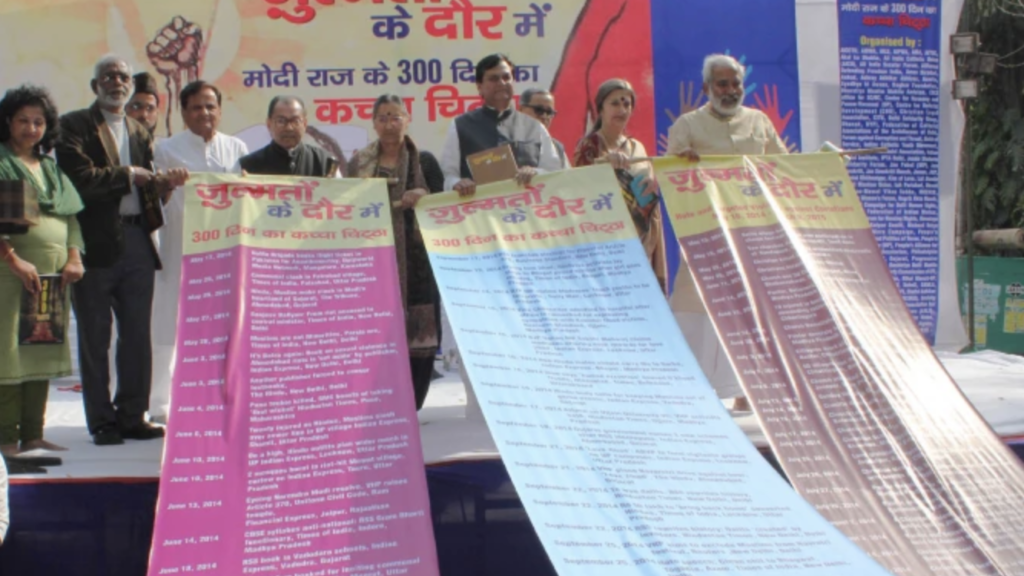
Activists display a long list of atrocities against minorities on the first 300 days of the Narendra Modi government on March 19, 2015. (Anto Akkara via CNA)
Activists in India are decrying remarks from the leader of the Hindu nationalist Bharatiya Janata Party (BJP) in which the politician threatened to prescribe the death penalty for religious conversions in Madhya Pradesh state.
“A provision for capital punishment will be made in the Madhya Pradesh Freedom of Religion Act for religious conversion,” declared Mohan Yadav, BJP chief minister of the state, at an International Women’s Day program on March 8.
Yadav said the state government “wouldn’t spare those behind illegal conversions.”
“Proposing the death penalty for religious conversion of girls is not only bizarre but deserves to be condemned by all who cherish the rights and freedoms enshrined and guaranteed in the constitution,” outspoken Jesuit peace activist Father Cedric Prakash told CNA on March 13.
Asserting that Article 25 of Indian Constitution “unequivocally states that every citizen has the right to freely preach, practice, and propagate one’s religion,” Prakash said the chief minister’s remarks were “demeaning a citizen’s fundamental right,” which he said “speaks volumes of the abysmal depth to which fascism has taken the country.”
The United Christian Forum (UCF) has listed 834 crimes against Christians in India in 2024, shooting up from 127 in 2014 when the Hindu nationalist BJP captured power at the national level.
The majority of the incidents have been assaults and arrests of Christians on conversion charges that critics have deemed fraudulent.
There is “a very clear political agenda behind the conversion rhetoric,” Prakash said.
“It polarizes the people — we against them; majority vs. minority,” he said. “It helps create fear among the majority [Hindus] that the minorities of the country — namely Muslims and Christians — will take over the reins of power in the country.”
While Hindus account for nearly 80% of India’s 1.44 billion people, Muslims account for 14% and Christians 2.3%.
Other minorities like Sikhs, Jains, and Buddhists account for the remaining population.
John Dayal, a Catholic columnist and social activist, told CNA that the call for the death penalty for conversions “exposes the cavalier, and cynical, manner in which [Hindu nationalists] have crafted this political strategy to criminalize Christian presence and community growth in the state.”
Madhya Pradesh state has reported several incidents of harassment of Christian institutions and arrest of clergy, pastors, and lay Christians. Christians are below one-half of 1% of the state’s 89 million people.
“The Christian community, and civil society too, must challenge anti-conversion laws in India as a travesty to human rights and a fraud on the constitution of democratic India,” Dayal said.
A.C. Michael, the Catholic coordinator of UCF, told CNA the threat to introduce the death penalty for conversions is “mere propaganda to boost Hindu nationalist forces.”
“As a matter of fact, the very anti-conversion law being framed under the garb of ‘freedom of religion’ is itself an anti-constitution law. We are hopeful it will not stand scrutiny in court of law when challenged,” Michael said.
He noted that the Supreme Court of India itself last year said the law may run afoul of the national constitution.
Though a dozen of India’s 28 states have enacted anti-conversion laws, Michael pointed out: “There has been hardly any conviction for forceful conversions despite hundreds being arrested regularly on conversion charges, mostly in BJP-ruled states.”
Church officials did not respond to requests for comment on the chief minister’s remarks.


