Showing posts with label looting. Show all posts

Saturday, October 24, 2026

Louvre and other museums closing for Saturday protests as French authorities deploy 70,000 officers

Oct. 23, 2026 at 3:06 am 
Updated Oct. 23, 2026 at 7:12 am
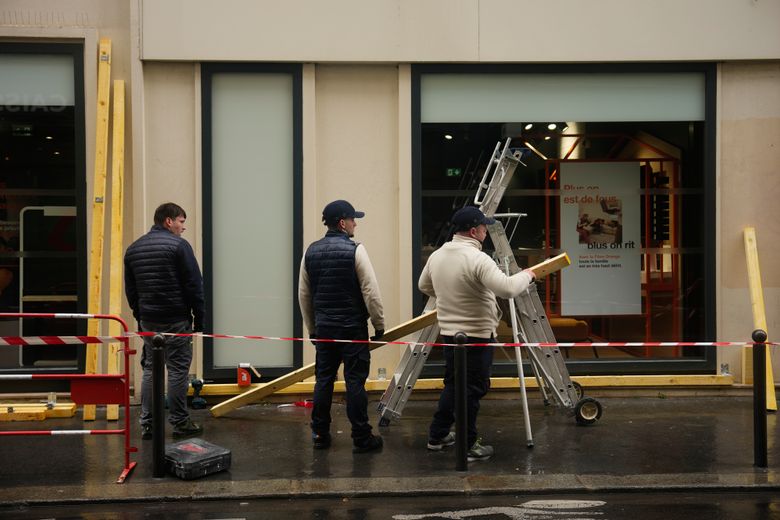


1 of 5 | Workers board up a storefront on the eve of a demonstration against rising living... (AP Photo/Teresa Suarez)More

By
ELITSA GADEVA and SYLVIE CORBET
The Associated Press


PARIS (AP) — Some 70,000 law enforcement officers will be deployed across France on Saturday while the Louvre and several other major Paris museums will be closed as authorities seek to prevent renewed violence during planned protests.

Protests last week devolved into mayhem, with people setting fires, storming public buildings, smashing shop windows, looting and clashing with police. It was France’s most violent unrest in years.

Demonstrators plan to take to the streets again Saturday to denounce the high cost of living. Students, members of the CGT labor union and activists from the “ yellow vest ” movement, whose demonstrations against social injustice shook France in 2018 and 2019, are all set to join.

While some protests have been banned for security reasons in several cities, including Lyon, Nice and Montpellier, marches are expected in many other places including in Paris and Marseille.

French Interior Minister Laurent Nuñez said some 70,000 police officers and gendarmes would be deployed, along with helicopters, armored vehicles and water cannons. In addition, elite police units will help secure public buildings like city halls in a “highly mobile” security operation, he said.

“There have been numerous calls from radical far-left groups on social media to commit acts of violence and vandalism. There have also been renewed calls for looting, with those messages clearly being spread by rioters,” Nuñez said at a news conference.

“We will be absolutely uncompromising” with those involved in violence, he added, warning that police will have a “very firm approach to making arrests, and there will be legal consequences.”

Paris museums to be closed

In a statement to The Associated Press, the Culture Ministry said the Louvre, the Orsay and Picasso museums as well as the Grand Palais would be closed. The ministry called on all institutions under its authority to adopt any necessary measures to ensure “visitor safety, staff protection and the preservation of artworks,” according to the statement.

After two days when admission was by invitation only, Art Basel Paris opened to the public Friday — but only for the day, with the threat of unrest prompting organizers to cancel the weekend program. One of the world’s most prestigious contemporary art fairs, Art Basel includes exhibitions by 211 international galleries at Paris’ Grand Palais.

“This decision has not been taken lightly, and the safety of everyone involved in the fair remains our utmost priority,” organizers said in a statement Thursday.

Saloni Doshi, an art collector who traveled to Paris from India for the fair, grew worried last Saturday as she saw the fires and panicked people, and she received phone calls from friends asking whether Paris was safe. She agreed with the organizers’ rationale to close.

Antoine Donzeaud and Elisa Rigoulet, the owners of the gallery exo exo, felt the same.

“We understand this decision, which we consider reasonable and consistent with the urgency of the social demands currently unfolding in France,” they said in a text message.

But some visitors were disappointed.

“It’s very sad, because we just came here to the fair, and we could not get in because they canceled it for the weekend,” said Fabián Hernández, 32, from Mexico City. “So it’s very busy today, and it’s disappointing to me because I love the art fair, you know? But it is what it is.”
An anti far-right protest is planned

A demonstration Saturday in the city of Orléans, about 110 kilometers (70 miles) south of Paris, will also be closely watched.

About 50 organizations have called for a protest against the far right on the sidelines of the two-day congress of Marine Le Pen’s nationalist, anti-immigration party ahead of next spring’s presidential election. Organizers include labor unions, left-wing political parties, student organizations and anti-racism groups.

Hugues Moutouh, the prefect of the Loiret region, said that 20,000 to 30,000 demonstrators from across the country were expected.

Le Pen, whom opinion polls place as the front-runner in next year’s election, accused left-wing organizations and political parties of trying to “disrupt a political party’s democratic congress,” on news broadcaster Franceinfo.

Still, she said she had “no concerns” about security because the government had “recognized the need for measures allowing the congress to proceed safely.”

___

Associated Press writers David Biller and Samuel Petrequin in Paris contributed to this report.

ELITSA GADEVA.
SYLVIE CORBET.


Wednesday, June 29, 2016

Venezuelans are storming supermarkets and attacking trucks as food supplies dwindle


By Joshua Partlow and Mariana Zuñiga
The Americas

une 28 
J

Joffren Polanco stands beside his almost empty fridge in Caracas, Venezuela. (Alejandro Cegarra/For The Washington Post)


CARACAS, Venezuela — In the darkness the warehouse looks like any other, a metal-roofed hangar next to a clattering overpass, with homeless people sleeping nearby in the shadows.

But inside, workers quietly unload black plastic crates filled with merchandise so valuable that mobs have looted delivery vehicles, shot up the windshields of trucks and hurled a rock into one driver’s eye. Soldiers and police milling around the loading depots give this neighborhood the feel of a military garrison.

“It’s just cheese,” said Juan Urrea, a 29-year-old driver, as workers unloaded thousands of pounds of white Venezuelan queso from his delivery truck. “I’ve never seen anything like this before.”

The fight for food has begun in Venezuela. On any day, in cities across this increasingly desperate nation, crowds form to sack supermarkets. Protesters take to the streets to decry the skyrocketing prices and dwindling supplies of basic goods. The wealthy improvise, some shopping online for food that arrives from Miami. Middle-class families make do with less: coffee without milk, sardines instead of beef, two daily meals instead of three. The poor are stripping mangoes off the trees and struggling to survive.

“This is savagery,” said Pedro Zaraza, a car-oil salesman who watched a mob mass on Friday outside a supermarket, where it was eventually dispersed by the army. “The authorities are losing their grip.”

[Venezuela declares a 2-day workweek because of energy shortages]

What has been a slow-motion crisis in Venezuela seems to be careening into a new, more dangerous phase. The long economic decline of the country with the world’s largest oil reserves now shows signs of morphing into a humanitarian emergency, with government mismanagement and low petroleum prices leading to widespread shortages and inflation that couldsurpass 700 percent this year.

The political stakes are mounting. Exhausted by government-imposed power blackouts, spiraling crime, endless food lines, shortages of medicine and waves of looting and protest, citizens are mobilizing against their leaders. In recent days, Venezuelans lined up to add their names to a recall petition that aims to bring down the country’s president, Nicolás Maduro, and put an end to the socialist-inspired “revolution” ignited 17 years ago by Hugo Chávez.

“This can’t continue,” said Angel Rondon, a mechanic who now sometimes eats just once a day. “Things have to change.”


A woman who had been standing in line outside a center in Caracas certifying signatures for a referendum to recall President Nicolás Maduro reacts after learning the center had closed, without attending to those still standing in line. (Alejandro Cegarra/For The Washington Post)


Disillusioned ‘Chavistas’

The rumor spread quickly on a recent Tuesday evening in the poor farmlands near Barlovento an hour east of Caracas: A truck carrying rice had tipped over, and food was free for the taking. Glenis Sira, a mother of seven, grabbed a plastic bag and ran from her cinder-block shack. More than 1,000 people joined her in scrambling to reach the village of La Fundacion before they realized there was no rice truck, only rumor.

“We have never had this level of need,” said Sira, one of several witnesses who described the melee.

For decades Venezuela was one of Latin America’s more stable and developed democracies, with a middle class accustomed to the benefits of oil wealth. Economic crises in the 1980s and 1990s battered many Venezuelan families. But the Chávez era was marked by rising oil prices and declining poverty, leaving few people prepared for the sickening free fall of the past few years.

[Harrowing scenes of Venezuela on the brink of collapse]

Sira has long been a proud “Chavista,” convinced that government spending can create a more equal society. Chávez’s government, flush with oil money and billions of dollars in foreign loans, gave her the Madres del Barriosubsidy for mothers in extreme poverty. Another program helped residents to finish houses under construction. Youths from her community received scholarships.

“I always lived for the revolution,” she said.

But many of the welfare programs started by Chávez have dried up, and the nearest store has little more than two-liter bottles of Pepsi and packs of Pall Mall cigarettes. Under Chávez, the government established anetwork of government-run supermarkets that sold basic foods at subsidized prices. But inflation has put even these bargains out of reach for many people. A single kilogram of yucca — about two pounds — now costs about one-third of the weekly minimum wage.

Sira’s neighbors hunt for deer and armadillos for subsistence and barter their meager catch. She lives off what she can grow — yams, tomatoes, corn — or what she can forage. Once a cacao-producing region, the area has been devastated by drought.

“I’m a Chavista and, damn it, this situation is hard,” she said. “That is why the revolution is being killed. Because we are hungry.”


Andrea Sira, 11, at her home on the outskirts of Barlovento. The only food in her fridge was mangoes. (Alejandro Cegarra/For The Washington Post)


A child in her house in Barlovento waits for lunch, which consists of only boiled yam. Food sold in the black market can be 1,000 percent higher than what it cost in government-regulated grocery stores. (Alejandro Cegarra/For The Washington Post)
Falling oil prices

Venezuela’s ability to produce food and other goods has dwindled over the years as the government has expropriated private companies, expanded price controls and otherwise discouraged private production. Corn, rice and other foods once grown domestically now have to be imported.

In the past two years, oil prices have dropped by half to below $50 per barrel, the economy has contracted severely and imports have grown more unaffordable. Private companies have shut down for lack of access to government-controlled dollars to pay for raw materials. The government has so far prioritized making debt payments to avoid default while cutting back on imported products, including food. In recent days, airlines such as Lufthansa, LATAM and Aeromexico have stopped flying to Venezuela as the strict currency controls make it difficult for them to be paid in full.


About 87 percent of people say they don’t have enough money to buy food, according to a recent study by Simon Bolivar University.

“We have not yet seen the climax of the crisis,” said Luis Vicente Leon, director of the polling firm Datanalisis. He estimated that retail food outlets in Caracas lack about 80 to 85 percent of their usual products. “Supplies have deteriorated to a very significant degree, and it’s probable that things will continue to get worse.”

This year, Maduro decreed that food distribution would be placed under the control of thousands of local citizen committees that critics say are biased toward government supporters. That meant subsidized food would be diverted from the poorly stocked government-run supermarkets.
Over the first five months of this year, Venezuelans have violently looted businesses — or tried to do so — at least 254 times, according to the Venezuelan Observatory of Social Conflict. The number of protests over food has risen each month, to 172 in May. Several people have died and hundreds more have been arrested in incidents of unrest across the country.

Maduro’s administration has blamed the incidents on an “economic war” led by foreigners and private businessmen who, it claims, are hoarding food supplies to destabilize the government.

“There is no humanitarian crisis,” foreign minister Delcy Rodriguez said at an Organization of American States meeting last week.


A man rests in front of a local store in Barlovento. The store has not received food since January, forcing people to go to bigger towns or even Caracas to shop. (Alejandro Cegarra/For The Washington Post)
An endless wait for food

Transporting the nation’s food means running a gantlet of need. On June 20, hundreds of protesters blocked a highway in an area called El Guapo, east of Caracas, paralyzing dozens of delivery trucks. During the day-long standoff, driver Jonathan Narvaes, 32, watched as residents ransacked trucks carrying flour and pasta. Soldiers used tear gas to disperse the crowds.

“My boss wants me to try again,” Narvaes said. “I told him,‘Boss, they almost killed me on Monday.’ ”

Bakery looted amid Venezuela food shortages


Surveillance camera footage shows violent looting at a bakery in the Venezuelan capital of Caracas as the country battles widespread shortages of basic goods amid a reeling economic crisis. (Reuters)

Drivers unloading cheese in Caracas, after a 15-hour journey from near the country’s western border with Colombia, said that trucks have been shot at and battered with rocks and that they must pay bribes in money or cheese at military checkpoints along the way.

“Similar situations are happening in almost the whole country,” said Alfredo Sanchez, the head driver of a delivery company called Paisa.

A driver who gave his name as Tony, with the Lacteos La Guanota company, said that when he drove through north-central Aragua state one recent day, protesters surrounded trucks and hauled away the cargo of pigs and chickens. “I was very afraid,” he said.

Some wealthier consumers have resorted to having food shipped to Venezuela. Soraya Cedillo, the owner of a courier company, said that 70 percent of her customers are Venezuelans living in the United States buying products such as corn flour, sugar, powdered milk, toilet paper and tampons for relatives back home.


WorldViews newsletter

Important stories from around the world.


Two months ago, Maria Eugenia Rodriguez, a dentist and mother of two, began shopping online forproducts such as powdered milk, sugar and bread. “I buy Splenda from Amazon,” she said, referring to the online retailer. “Every few weeks I get a box full of staples from a courier in the States that arrives to the door of my house.”

In Caracas, shopping lines have grown so long that they have created ecosystems of commerce. Outside the Plansuarez supermarket in Caracas, vendors sold cigarettes and lemonade out of rusty shopping carts one recent day to the hundreds who had lined up. To cut down on crowds, officials allow in each day only people with certain numbers on their national identification cards.

“We’re waiting without even knowing what they will bring today, or if they’ll bring anything,” Yorilei Ramos, 51, said as she stood alongside her 9-year-old daughter. “Your kids are crying, ‘I’m hungry,’ and you have to tell them, ‘I have nothing.’ ”


What the chaotic scene in Venezuela looks like


The country is undergoing critical food shortages, and the political opposition is pushing for a recall referendum to cut short President Nicolás Maduro’s term and trigger new elections.

Read more:

6 things you need to know about Venezuela’s political and economic crisis

Venezuela is on the brink of a complete economic collapse

The only number that matters in Venezuela is this one

Venezuela faces ‘worst-case scenario’ as Zika outbreak expands

Today's coverage from Post correspondents around the world


Sunday, May 03, 2015

The Baltimore Orioles 'no fan game' (April 29, 2015)


The Orioles are playing the first zero fan game ever right now (9 Photos)


BY JEFF APR 29, 2015


Have you ever gone to a ball game and thought it was a little too crowded or a little too loud?

Today, for the first time in the history of Major League Baseball a game is being played with no one in attendance.


Due to concerns over public safety the Chicago White Sox and Baltimore Orioles had the first two games in their series postponed. Finally they are underway, but fans have been barred from attending the game.


It is being played right now; as of this posting in the 3rd inning and it is shockingly quiet to listen to a baseball game with no crowd.


i

The players are not without a sense of humor about it, signing autographs…


And giving curtain calls to a phantom audience.


Previously the lowest attended game in the history of baseball was six people, and that was in 1882.


Since then, the lowest attended game in Baltimore was in 2010 when only 9,129 fans bought tickets.


You can watch for yourself on MLB.tv, it is currently their free game of the day.


Source: http://thechive.com/2015/04/29/the-orioles-are-playing-the-first-zero-fan-game-ever-right-now-9-photos/#hDs52CM02bSRxTYK.99

-or-

Source
.
.,
.
.

Thursday, August 22, 2013

Churches In Egypt Cancel Sunday Masses For the First Time in Over 1500 Years

 Daniel Doherty | Aug 22, 2013


The persecution of Coptic Christians in Egypt has become so bad and so violent in recent weeks that churches in the northern part of the country have cancelled Sunday masses and prayer services for the first time in nearly two millennia. The Times of Israel reported this story a few days ago:


Amid escalating violence against Egypt’s Copts, churches in Minya, located in upper Egypt, cancelled Sunday Mass for the first time in 1,600 years. Other churches in Minya also didn’t hold prayer services.

“We did not hold prayers in the monastery on Sunday for the first time in 1,600 years,” Priest Selwanes Lotfy of the Virgin Mary and Priest Ibram Monastery in Degla, just south of Minya, told the al-Masry al-Youm daily.

He said supporters of ousted president Mohammed Morsi destroyed the monastery, which includes three churches, one of which is an archaeological site. “One of the extremists wrote on the monastery’s wall, ‘donate [this] to the martyrs’ mosque,’” Lotfy added.

Copts, the largest indigenous Christian minority in the Middle East and North Africa, make up about 10 percent of Egypt’s total population of some 90 million people. One of the world’s oldest Christian communities, they have generally kept a low-profile, but have become more politically active since Mubarak was ousted and sought to ensure fair treatment in the aftermath. They regularly face violence and discrimination within Egyptian society.

The Times further points out that over 58 Coptic churches in Egypt have been desecrated since last Sunday and hundreds more have been killed. The reason is because many radical Islamists contend that Coptic Christians are principally responsible for the ousting of their Dear Leader, former Muslim Brotherhood President Mohamad Morsi, and therefore must be punished accordingly. Recall earlier this month that an innocent, ten-year-old Christian girl was murdered in cold blood. Why? Because she had the audacity to walk home from Bible Study class…

Meanwhile, the military pledged last week to rebuild every Coptic church Islamists have burned, looted, and destroyed:

The Egyptian defense minister has ordered the repair and reconstruction of all churches that suffered damage in the country’s violent demonstrations since the Egyptian military removed President Mohamed Morsi from power last month.

Defense minister Col. Gen. Abdel Fattah El-Sisi intends to fix the damage to Coptic churches at Rabaa Adaweya and Nahda squares, according to a report by the Mid-East Christian News.

Dozens of churches were attacked and burned in riots after thousands of demonstrators took to the streets of Cairo and other Egyptian cities to demand the end of what they call military rule, following the removal of Morsi on July 3. Many of Morsi's supporters have voiced criticism at Egypt's Christian minority for largely supporting the military's decision to oust him from office.

“The Egyptian defense minister ordered the engineering department of the armed forces to swiftly repair all the affected churches, in recognition of the historical and national role played by our Coptic brothers,” read a statement that aired on Egyptian television.

Perhaps the Egyptian military’s resources could be better spent on -- oh, I don’t know -- protecting its people. After all, if they don’t, I see no compelling reason why we should continue sending them foreign aid.


Source
.

Saturday, July 06, 2013

After Armageddon


StrongIslandPrepper

Published on Sep 17, 2012

....

Wikipedia:

After Armageddon is a 2010 History Channel docudrama that first aired on December 21, 2010.
...
The plot centers around the Johnson family (consisting of Chris (Rob Hartz) and Ellen (Kathleen Cameron) Johnson, and their son Casey (Hy Rillero)) of Los Angeles, California, one of a small number of families to survive a global pandemic that, according to the opening of the film, occurs "sometime in the future..." [1] The disease began as a particularly virulent flu strain in Southeast Asia. Efforts made to contain the virus in that portion of the world are ineffective as global transportation networks carry infected individuals all around the world. Hospitals become overloaded, and the public works infrastructure begins to shut down. Eventually, the main characters leave L.A., encountering many hardships along the way. They make it to a friendly small town, where life begins again.

Interspersed with the above are interviews with various experts giving their perspective on what is most likely to occur in a global pandemic scenario.


..
...

.

Monday, August 08, 2011

Rioting Widens in London on 3rd Night of Unrest

By RAVI SOMAIYA and JOHN F. BURNS

Published: August 8, 2011


Sang Tan/Associated Press
A shop was set on fire Monday in Croydon, south London. The home secretary said there had been hundreds of arrests.


LONDON — The rioting and looting that convulsed poorer sections of London over the weekend spread Monday to at least eight new districts in the metropolitan area and broke out for the first time in Britain’s second-largest city, Birmingham, in what was developing into the worst outbreak of social unrest in Britain in 25 years.

Unrest was also reported early Tuesday by the police in two other major cities, Manchester and Liverpool.

Prime Minister David Cameron, apparently caught off guard while on vacation with his family in Tuscany, reversed an earlier decision not to cut short his holiday in the face of plunging world financial markets and boarded a plane for home to lead a cabinet-level meeting on Tuesday to deal with the turmoil.

For Mr. Cameron’s government — indeed for Britain — the rapidly worsening situation presented a profound challenge on several fronts.

For a society already under severe economic strain, the rioting raised new questions about the political sustainability of the Cameron government’s spending cuts, particularly the deep cutbacks in social programs. These have hit the country’s poor especially hard, including large numbers of the minority youths who have been at the forefront of the unrest.

Together with the inevitable pressures to restore some of the spending cuts, Mr. Cameron and his colleagues have to confront the dark shadow that the rioting has cast on plans for the 2012 summer Olympic Games. That $15 billion extravaganza will have its centerpiece in a sprawling vista of new stadiums and an athletes’ village that lie only miles from the neighborhoods where much of the violence in the last three days has taken place. With the Games set to begin in barely 12 months, Britain will have to satisfy Olympic officials that there is no major risk of the games being disrupted, or ruined, by a replay of the rioting.

Beyond these challenges is the crisis that has enveloped London’s Metropolitan Police, popularly known as Scotland Yard, on which security for the Olympics, and the immediate hopes of quelling the rioting, depend.

Even before the outbreak of violence, the police have been deeply demoralized by the government’s plan to cut about 9,000 of its force of about 35,000 officers and by allegations that it badly mishandled protests against the government’s austerity program last winter and failed to properly investigate the newspaper phone-hacking scandal that has dominated the headlines here for much of the summer. The force now faces widespread allegations that it failed to act quickly and forcefully enough to quell the rioting at its outset over the weekend.

With huge fires burning into the night in several of the neighborhoods overrun by the rioters, Home Secretary Theresa May said she had issued instructions that officers do everything possible to restore order and arrest the principal culprits in the disorder. Striking a note that was common among community organizers in the neighborhoods where rioting has occurred, Ms. May said that social deprivation was no defense.

“There is no excuse for violence, no excuse for looting, no excuse for thuggery, and those who are responsible must know that they will be brought to justice,” she said. “I think this is about sheer criminality.”

Despite an additional build-up in the number of riot police officers, many of them rushed to London from areas around the country, gangs of hooded young people appeared to be outmaneuvering the police for the third successive night. Communicating via Blackberry instant-message technology that the police have struggled to monitor, as well as by social networking sites like Facebook and Twitter, they repeatedly signaled fresh targets areas to those caught up in the mayhem.

They coupled their grasp of digital technology with the ability to race through London’s clogged traffic on bicycles and mopeds, creating what amounted to flying squads that switched from one scene to another in the London districts of Hackney, Lewisham, Clapham, Peckham, Croydon, Woolwich and even, late on Monday night, at least minor outbreaks in the mainly upscale neighborhood of Notting Hill and neighboring Camden.

The mayhem also spread for the first time beyond London to the city of Birmingham, 110 miles northwest of London, as well as to Manchester and Liverpool. The police said that at least 200 hooded youths massed near a shopping center in the middle of Birmingham, smashed shop and car windows, terrorized bus passengers and looted stores. The police said they had thrown a half-mile cordon around the city center and had arrested at least nine people, including some younger than 18.

In London, Ms. May, the home secretary, said there had been more than 200 arrests before nightfall, and the figure appeared to have risen sharply as the unrest metastasized in the evening hours, running broadly from north to south over a distance of about 15 miles on either side of the Thames.

Nothing remotely like it had been seen in London since 1985, when another eruption that occurred mainly among black youths led to violent running battles with the police. Known as the Broadwater Farm riots for the housing project where it began, the turmoil took place in the Tottenham district, where the current unrest started on Saturday. That grew from a protest outside a police station about the shooting last week by the police of Mark Duggan, 29, who lived in the housing project.This time, hundreds of young people, their faces covered in scarves or ski masks, looted; attacked police officers with wooden staves, gasoline bombs, broken bottles, pieces of masonry and even shopping carts; and set fire to police vehicles, private cars, trash bins and buildings.

Some large buildings burned deep into the night, as the police and television network helicopters circled overhead. Some of the rioters could be seen using BlackBerrys as they broke away from police cordons, slipping down side streets and opening new battlefronts. Hundreds of police officers followed them from riot scene to riot scene.

In some neighborhoods, officers appeared to allow the looting to go unchecked, concentrating instead on stopping new outbreaks of violence elsewhere.

At one point, two priests entered the Pembury Road housing project in Hackney, the scene of some of the worst violence, to gain permission from rioters to allow an ambulance to take an injured elderly lady to safety. In Camden Town, an affluent neighborhood in north London, a group of about 20 masked youths broke into a cellphone shop run by one of Britain’s biggest operators, O2. Chanting “O2, O2, O2”, they looted with extraordinary rapidity, to the sound of wailing alarms and smashing glass. Tim Godwin, the acting commissioner of Scotland Yard, appealed to people to help identify the rioters. Mr. Godwin conceded, obliquely, that the unrest was at least partly rooted in social deprivation, saying there was “a conversation to be had” about grievances among the youths committing the violence, but said that could come only after the unrest had ended.


Alan Cowell contributed reporting from London, and Rick Gladstone from New York.

Source


London Riots Continue


Friday, January 15, 2010

Looters roam Haiti streets as US troops pour in

Machete-wielding looters brought more terror to Haiti's streets Friday as US troops poured into the quake-ravaged nation to start streaming tons of aid to traumatized and destitute people.

Saturday, January 16, 2010
By: Stephane Jourdain


Haitian looters fight for food, January 15, 2010 in a street of Port-au-Prince. US military leaders said they would pour 10,000 troops in earthquake-battered Haiti in the coming days, warning that it was urgent to bring water and food to prevent deaths and unrest. AFP PHOTO OLIVIER LABAN-MATTEI.


PORT-AU-PRINCE, January 16, 2010 (AFP) - Machete-wielding looters brought more terror to Haiti's streets Friday as US troops poured into the quake-ravaged nation to start streaming tons of aid to traumatized and destitute people.

Three days after Tuesday's earthquake, anger and frustration mounted in the ruined capital city, with thousands of people still desperate for food and water amid the stench of corpses left rotting in the tropical sun.

A vanguard of the 10,000 US troops being deployed to Haiti took control of the airport, clogged with tons of relief supplies, and began the first mass distributions of aid seeking to quell any threat of violence.

"As long as the people are hungry and thirsty, as long as we haven't fixed the problem of shelter, we run the risk of riots," warned Brazilian Defense Minister Nelson Jobim, after a visit to the capital Port-au-Prince.

Haitian officials said at least 50,000 people had been killed and 1.5 million left homeless in the Caribbean nation, one of the poorest countries in the world, which has long witnessed violence and bloodshed.

As UN officials on the ground pleaded for more medical and food aid for survivors, looting became widespread and there were angry scuffles at the few distribution points.

The fourth night after the quake brought fresh fears for many families already terrorized by armed gangs.

"Men suddenly appeared with machetes to steal money," said Evelyne Buino, a young beautician, after a long night in a neighborhood not far from the ruined city center.

"This is just the beginning."

"We need to protect and guard (our home). There are many armed men, a lot of looting," Eglide Victor, whose shabbily-built house was the only one left standing on his street in the heart of the Haitian capital, told AFP.

Officials have estimated that some three million people -- a third of the population -- were affected by the 7.0-magnitude quake.

"We really need to focus on the living, and what we can do for them," Nicholas Reader, spokesman for the United Nations Office for the Coordination of Humanitarian Affairs (OCHA), told AFP.

UN chief Ban Ki-moon is set to visit Haiti on Sunday as the world body appealed for 562 million dollars from donors. Ban said the UN system was mobilizing all its resources "as fast as we possibly can."

The UN mission in Haiti (MINUSTAH) was hit hard by the quake, with 37 of its 12,000 employees confirmed dead and 330 unaccounted for.

UN officials said the World Food Programme was now feeding around 8,000 people several times a day and hopes to feed roughly one million people within 15 days and two million people within a month.

"People had reserves for a few days, but now they are dwindling. They are afraid to go downtown in search of food because it has become too dangerous," said Haiti resident Patricia Etique, a Swiss citizen.

With thousands of bodies piled up on the streets of the capital, there was also a race against time to reach any survivors still in the ruins and treat those who were badly injured.

Foreign relief teams were increasingly seen on the streets, some backed by vital heavy-lifting equipment.

Scores more survivors were pulled alive from the rubble. A Belgian rescue team extracted a 28-year-old Haitian woman from one building after first amputating her leg above her right knee.

"We're very happy. It's what we're here for, and after this amount of time and the heat, it's great to still find people alive," Sergeant Major Edouard Dekoster, part of a specialized search and rescue team, told AFP.

US President Barack Obama finally reached Haiti's President Rene Preval by telephone Friday, and offered "full support" in earthquake relief aid and long-term rebuilding.

But President Preval told AFP that the aid operation needs to be better organized.

"We need international aid, but the problem is the coordination," he said.

Preval, whose temporary seat of government is now a police station near the capital's airport, said 74 planes from countries including the United States, France and Venezuela, had arrived in a single day.

Scientists warned that Haiti and its neighbors must prepare themselves for more massive quakes after the devastating tremors this week increased pressure along a lengthy fault line.

Paul Mann, a senior research scientist at the Institute for Geophysics at the University of Texas at Austin, warned that just because the rebuilding process had started people shouldn't assume the risk was over.

"This relief of stress along this area near Port-au-Prince may have actually increased stress in the adjacent segments on the fault," he told AFP.

bur/aad/hg
.
.
.