Showing posts with label Astronomy. Show all posts
Showing posts with label Astronomy. Show all posts
Saturday, August 22, 2026


Thursday, August 13, 2026
Wednesday, August 12, 2026
Total solar eclipse Aug. 12, 2026 live updates
Follow our live coverage of the total solar eclipse 2026 as we count down to eclipse day with the latest news, expert insight and updates before bringing you live reports from Greenland and Spain.
By Daisy Dobrijevic
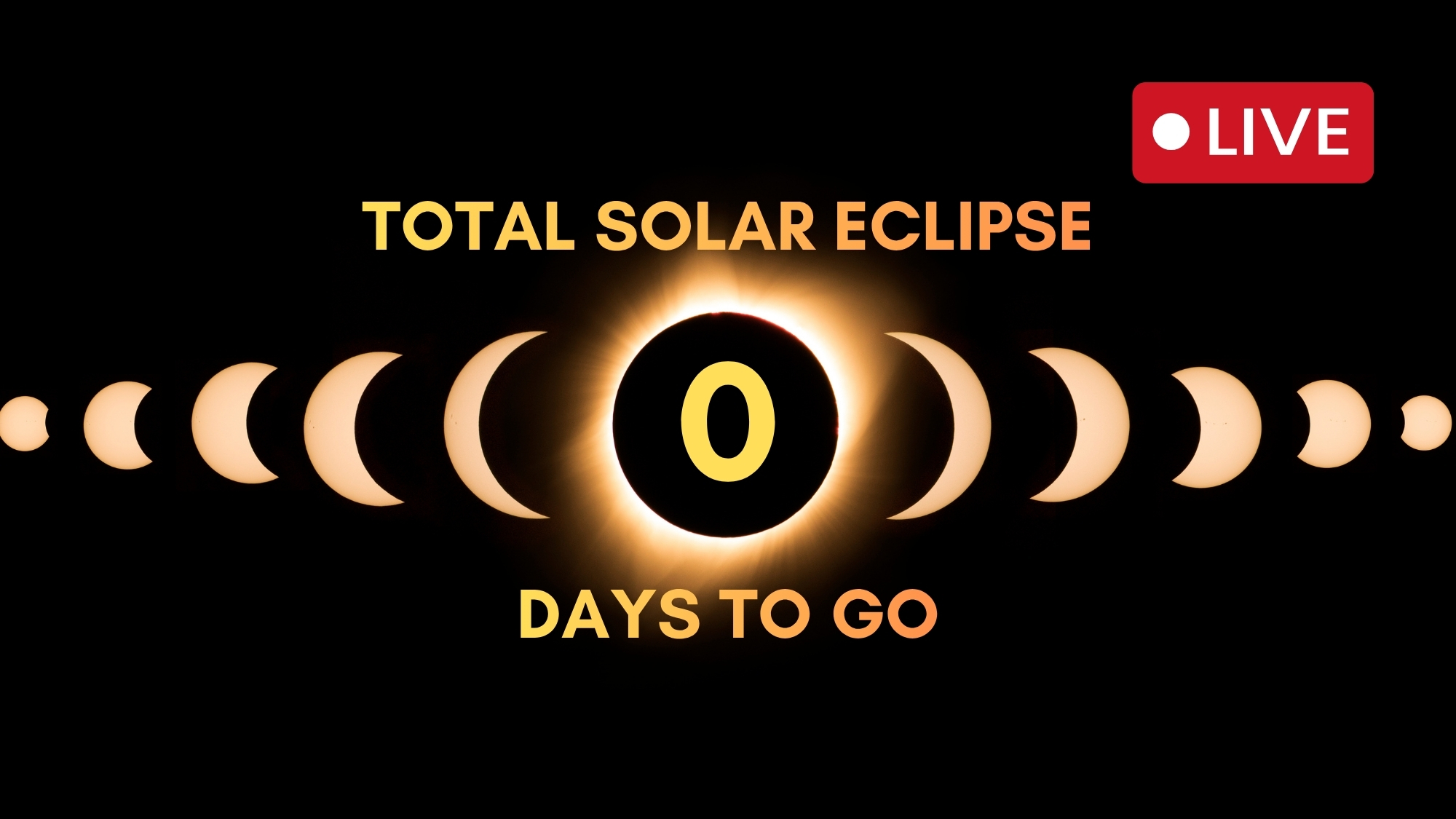
Today, Aug. 12, a total solar eclipse will darken the sky for millions of people. (Image credit: © Created in Canva Pro)
Today, Aug. 12, 2026, Europe will experience its first total solar eclipse since 1999, as the moon's shadow sweeps across Greenland, Iceland, northern Spain and the Balearic Islands.
Along the narrow path of totality, day will briefly turn to twilight as the moon completely covers the sun, revealing its elusive outer atmosphere — the corona. Meanwhile, millions more skywatchers across much of Europe, as well as parts of northeastern United States and eastern Canada, will witness a partial solar eclipse as the moon appears to take a bite out of the sun.
Live reporting from the path of totality
We'll be following the eclipse from two locations along the path of totality.
Our skywatching editor Daisy Dobrijevic is currently aboard HX Expeditions' MS Spitsbergen exploring Greenland's dramatic coast. She'll be aiming to witness totality from Scoresby Sund, the world's largest and longest fjord system. Dobrijevic is hoping for more eclipse luck than last time, when unfortunately, totality was a total bust, but not for the reason you may think.
Monday, September 08, 2025
Sunday, September 07, 2025
Thursday, August 21, 2025
Fr. Richard D’Souza named Director of Vatican Observatory 19 Aug 2025
Communications Office
Interviews
Pope Leo XIV has appointed Fr. Richard D’Souza SJ as Director of the Vatican Observatory. Fr. D’Souza, who has been a staff member at the Observatory since 2016, succeeds Br. Guy Consolmagno SJ whose mandate ends in September 2025.
Fr. D’Souza hails from the region of Goa in India. He entered the Society in 1996 and was ordained a priest in 2011. He has a doctorate in astronomy with a particular research focus on the phenomenon of galaxy merging and its effects on the properties of galaxies like the Milky Way.
In this interview, Fr. D’Souza shares his thoughts about his new role and the long tradition of Jesuit presence at the Vatican Observatory.1. The Vatican Observatory has a long and storied history and can be considered as one of the ways the Church demonstrates her support for “true and solid science” (cfr. Pope Leo XIII). How do you see this mission being lived out today?
The main way we can live out this mission is to accomplish the best scientific research possible. Through the scientific teams and projects we take part in, the research papers we publish, the scientific conferences we organize/attend, and the friendships we maintain with our scientific colleagues, we are witnessing the fact that the Church supports “true and solid science.” We have historically limited ourselves to astronomy, but today we are slowly branching out to other allied scientific disciplines, including theoretical physics and meteorology/climate science.
Thursday, August 14, 2025
Sunday, March 30, 2025
Thursday, March 13, 2025
Friday, February 28, 2025
Monday, February 10, 2025
Pope Francis’ astronomer shares ‘A Jesuit’s Guide to the Stars’

As director of the Vatican Observatory, Jesuit Brother Guy Consolmagno is known informally as “the pope’s astronomer.” | Credit: “EWTN News Nightly” screenshot

By Tessa Gervasini
Washington, D.C. Newsroom, Feb 7, 2025 / 17:00 pm
Brother Guy Consolmagno, SJ, has spent the last 30 years staring at the sky. As the director of the Vatican Observatory, known informally as “the pope’s astronomer,” he has just published his 13th book — “A Jesuit’s Guide to the Stars: Exploring Wonder, Beauty, and Science,” which he said he wrote at the suggestion of Loyola Press.
“I pulled together a lot of ideas, some of my own experience and some of the history of the Jesuits working on science,” he told “EWTN News Nightly” on Feb. 5.
Consolmagno has been the director of the Vatican Observatory since 2015. He told “EWTN News Nightly” anchor Tracy Sabol that the observatory was officially established in 1891 to “show the world that the Church supports science. And we have been doing that ever since,” he said, adding that “we’re doing cutting-edge research, as we’re also carrying forth the message of how the heavens proclaim the glory of God.”
In his book, Consolmagno disputes the idea that we can’t study science and also be people of faith.
Monday, February 03, 2025
Friday, December 06, 2024
Sunday, August 07, 2016
The Inquisition followed sound science
AUGUST 05, 2016

TONI DEMURO
WHEN POPE JOHNPaul II announced in 1992 that Galileo was correct, more than 350 years after his condemnation by the Inquisition, the world reacted with apathy, relief, and amusement. No one doubts any more that Earth revolves around the sun, and even private Catholic schools had been teaching heliocentricity to their students prior to the official apology.
Our historical understanding of the Galileo affair tends to implicate the church as clinging unnecessarily to a literal interpretation of the Bible, which required the faithful to accept the untenable theory of geocentrism. From elementary school onward, we’re taught that the church stood firmly athwart scientific progress, bellowing “Stop!” Indeed, the clash has gone down through the ages as a sort of morality play of science versus religion, pitting the proponents of progress against religious reactionaries. But what if that morality play itself is nothing more than dogma?
We know that Galileo’s ideas were correct, yet the best science of the 17th century tended to favor a universe with Earth at its center. Did the Inquisition rely too heavily on theology, or did its perpetrators instead judge Galileo according to the scientific standards of their day? In other words: Did the Inquisition get it right?
Wednesday, July 13, 2016
Thursday, July 30, 2015
Blue moon on the horizon: Rare phenomenon of two full moons within a calendar month will light up skies on Friday
'Blue moon' refers to when a full moon occurs twice in a calendar month
The moon does not appear blue, but its usual silvery grey colour
Lunar event will occur on Friday night and is the first since August 2012
There won’t be another for three years, until January 31, 2018
By SARAH GRIFFITHS FOR MAILONLINE
PUBLISHED: 07:16 EST, 30 July 2015 | UPDATED: 09:31 EST, 30 July 2015
'Once in a blue moon' is not just a phrase that's used for occasional events.
It is also a unusual astronomical phenomenon that occurs when a full moon occurs twice in a calendar month.
The lunar event will take place on Friday night and will be the first blue moon to occur since 2012.

The unusual 'blue moon' lunar event will take place on Friday night and will be the first to occur since 2012. This image shows an image of the last blue moon, which occurred on August 31, 2012. It is seen here above the cloudy night skies of Cincinnati, Ohio
Blue moons are not as rare as other celestial events, but there won’t be another for three years, until January 31, 2018.
Anyone hoping to see a dazzling sapphire orb crossing the sky will be disappointed, however, because a blue moon is usually a silvery grey.
Friday night's lunar phase on July 31 fits the calendar definition of ‘blue’ because there was another full moon on July 2.
Blue moons are due to the difference between calendar and lunar months.
While a calendar month lasts from 28 to 31 days, a lunar month - the time interval between two full moons - is always 29.53 days long.
Confusingly, there is also a ‘seasonal’ definition that says a blue moon is the third of four full moons in one season.

Blue moons are due to the difference between calendar and lunar months. While a calendar month lasts from 28 to 31 days, a lunar month - the time interval between two full moons - is always 29.53 days long. A stock image showing different phases of the moon through the lunar months is pictured above
According to this definition, tomorrow’s full moon is not ‘blue’ at all. The next seasonal blue moon is not due until May 26, 2016.
While the blue event is of interest to astronomers, it is of more significance to astrologers, who say blue moons mark a time of upset, change and possibilities.
Occasionally, the moon really does appear blue, but that usually happens because of an erupting volcano.
In 1883, blue moons appeared almost every night after the Indonesian volcano Krakatoa exploded with the force of a nuclear bomb.
Plumes of ash rising high into the atmosphere acted like a filter only allowing blue moonlight to pass through the tiny particles.
Blue coloured moons were also seen in 1983 after the eruption of the El Chichon volcano in Mexico.
There were other reports of blue moons caused following the Mount St Helens and Mount Pinatubo volcanic eruptions in 1980 and 1991.
Wildfires producing smoke containing one micron-wide ash particles can also produce a blue coloured moon.
WHY THE MOON CAN APPEAR BLUE AND RED AT TIMES
Confusingly the term 'blue moon' doesn't mean that the Earth's satellite will look blue in colour.
But this can happen in unusual sky conditions when fine particles of dust or smoke act as a filter, only allowing blue light to pass through the tiny particles.
Reports of blue moons followed the Mount St Helens and Mount Pinatubo volcanic eruptions in 1980 and 1991, for example.

In April this year, the moon appeared to glow red in an event called the 'blood moon'. Skygazers in the US, Canada, Australia and New Zealand were treated to a total eclipse of the moon (pictured over New Zealand)
In April this year, the moon appeared to glow red in an event called the 'blood moon'.
Blood moons occur during a lunar eclipse, when the moon passes in the shadow of the Earth, called the umbra, where light from the sun is blocked by our planet.
This gives rise to the moon's ‘blood red’ appearance during a total eclipse, when the entire moon is in shadow and the Earth's atmosphere scatters the sun's red light.
As a result, the red light reflects the moon's surface, casting a reddish rush hue over it.
The last blood moon, which occurred over the Easter weekend, was the third in a series of four, with the final one expected on September 28.
Source
.
Tuesday, February 18, 2014
S0 News February 18, 2014: Sky Spraying, Solar Eruption

Suspicious0bservers
Published on Feb 18, 2014
Welcome to the Channel: http://youtu.be/Wo3prvrLInE
Our Website: http://www.suspicious0bservers.org
Blog: http://www.suspicious0bserverscollect...
Major Warnings/Alerts: https://twitter.com/TheRealS0s
STARWATER Article: http://wavechronicle.com/wave/?p=1151
S0 Notes on Solar Shutdown: http://www.suspicious0bservers.org/fo...
Donate memberships for others: http://tiny.cc/f195ww
Today's Featured Links:
Ganymede: http://news.brown.edu/pressreleases/2...
SRM Warming: http://iopscience.iop.org/1748-9326/9...
Japan Snow: http://www.cnn.com/2014/02/16/world/a...
IPCC History: http://www.suspicious0bservers.org/se...
Earth WindMap: http://earth.nullschool.net/#current/...
0bserver Shop: http://www.cafepress.com/s0s
Original music by NEMES1S
http://www.suspicious0bservers.org/shop/ [Get NEMES1S Music!]
REPEAT LINKS:
WORLD WEATHER:
NDBC Buoys: http://www.ndbc.noaa.gov/
Tropical Storms: http://www.wunderground.com/tropical/
HurricaneZone Satellite Images: http://www.hurricanezone.net/westpaci...
Weather Channel: http://www.weather.com/
NOAA Environmental Visualization Laboratory: http://www.nnvl.noaa.gov/Default.php
Pressure Maps: http://www.woweather.com/cgi-bin/expe...
Satellite Maps: http://www.woweather.com/cgi-app/sate...
Forecast Maps: http://www.woweather.com/weather/maps...
EL DORADO WORLD WEATHER MAP: http://www.eldoradocountyweather.com/...
TORCON: http://www.weather.com/news/tornado-t... [Tornado Forecast for the day]
HURRICANE TRACKER: http://www.weather.com/weather/hurric...
US WEATHER:
Precipitation Totals: http://www.cocorahs.org/ViewData/List...
GOES Satellites: http://rsd.gsfc.nasa.gov/goes/
THE WINDMAP: http://hint.fm/wind/
Severe Weather Threats: http://www.weather.com/news/weather-s...
Canada Weather Office Satellite Composites: http://www.weatheroffice.gc.ca/satell...
Temperature Delta: http://www.intellicast.com/National/T...
Records/Extremes: http://www.ncdc.noaa.gov/extremes/rec...
SPACEWEATHER:
Spaceweather: http://spaceweather.com
SOHO Solar Wind: http://umtof.umd.edu/pm/
HAARP Data Meters: http://www.haarp.alaska.edu/haarp/dat...
Planetary Orbital Diagram - Ceres1 JPL: http://ssd.jpl.nasa.gov/sbdb.cgi?sstr...
SDO: http://sdo.gsfc.nasa.gov/data/
Helioviewer: http://www.helioviewer.org/
SOHO: http://sohodata.nascom.nasa.gov/cgi-b...
Stereo: http://stereo.gsfc.nasa.gov/cgi-bin/i...
SOLARIMG: http://solarimg.org/artis/
iSWA: http://iswa.gsfc.nasa.gov/iswa/iSWA.html
NASA ENLIL SPIRAL: http://iswa.gsfc.nasa.gov:8080/IswaSy...
NOAA ENLIL SPIRAL: http://www.swpc.noaa.gov/wsa-enlil/
GOES Xray: http://www.swpc.noaa.gov/sxi/goes15/i...
Gamma Ray Bursts: http://grb.sonoma.edu/
BARTOL Cosmic Rays: http://neutronm.bartol.udel.edu//spac...
ISWA: http://iswa.ccmc.gsfc.nasa.gov:8080/I...
NOAA Sunspot Classifications: http://www.swpc.noaa.gov/ftpdir/lates...
GONG: http://gong2.nso.edu/dailyimages/
GONG Magnetic Maps: http://gong.nso.edu/data/magmap/ondem...
MISC Links:
JAPAN Radiation Map: http://jciv.iidj.net/map/
RADIATION Network: http://radiationnetwork.com/
LISS: http://earthquake.usgs.gov/monitoring...
QUAKES LIST FULL: http://www.emsc-csem.org/Earthquake/s...
RSOE: http://hisz.rsoe.hu/alertmap/index2.php [That cool alert map I use]
Moon: http://www.fourmilab.ch/earthview/pac...
.
.
Monster asteroid whizzes past Earth a year after Russia explosion
17/02 10:34 CET

A gigantic asteroid has whizzed ‘close’ to Earth – around a year after another exploded over Russia, injuring hundreds of people.
The space rock, which measured around 270-metres (885 ft) wide, raced past the planet at about 27,000mph (43,000kph) around 3am CET on Tuesday.
The asteroid came within about 1.6 million miles (2.6m km) of Earth.
On February 15, 2013, a smaller asteroid, around 20m (65ft) in diameter, hit Earth over Chelyabinsk, Russia. Its massive impact shattered windows and damaged buildings, with the flying glass injuring around 1,200 people.
A specialist robotic telescope service, which had hoped to capture pictures of Tuesday’s asteroid, failed to operate. The telescope, based at an observatory in the Canary Islands, broadcasts footage on slooh.com. But the equipment froze over, meaning the asteroid could not be captured.
Paul Cox, Slooh’s technical and research director, said: “We continue to discover these potentially hazardous asteroids – sometimes only days before they make their close approaches to Earth.
He added: “We need to find them before they find us!”
Copyright © 2014 euronews
Source
.
.
Thursday, June 13, 2013
3MIN News June 13, 2013: X-Ray Andromeda, Sunspots/CHs Incoming

Suspicious0bservers
Published on Jun 13, 2013
How to Watch the Sun
http://youtu.be/ld5ecZuHECA
Donations Optional: http://tiny.cc/f195ww orhttps://www.paypal.com/cgi-bin/webscr...
Original music by Nemes1s
http://www.suspicious0bservers.org/shop/ [Get NEMES1S Music!]
http://www.soundclick.com/nemes1s
Animations and Visual Effects by Xaviar Thunders [Check him out on YouTube]
Donations Optional: http://tiny.cc/f195ww orhttps://www.paypal.com/cgi-bin/webscr...
0bserver Shop: http://www.cafepress.com/s0s
TODAY's New LINKS:
Andromeda X-Rays: http://chandra.si.edu/photo/2013/m31/
Radio Anomaly: http://iridl.ldeo.columbia.edu/maproo...
Shakemap, PrincetonUniv: http://global.shakemovie.princeton.ed...
US TEC: http://www.swpc.noaa.gov/ustec/images...
US Windmap http://hint.fm/wind/
US Severe Weather: http://www.weather.com/news/tornado-c...
UK/EU MET Office: http://www.metoffice.gov.uk/weather/e...
NOAA: http://www.weather.gov/forecastmaps
EU Weather Alerts: http://www.meteoalarm.eu
US Weather Warnings: http://www.weather.gov
India: http://202.54.31.51/nowcast/http://www.imd.gov.in/section/nhac/dy...http://www.imd.gov.in/section/satmet/...
The REAL Climate Changer: http://youtu.be/_yy3YJBOw_o
Ice Age Soon? http://youtu.be/UuYTcnN7TQk
An Unlikely but Relevant Risk - The Solar Killshot:http://youtu.be/X0KJ_dxp170
REPEAT LINKS:
WORLD WEATHER:
NDBC Buoys: http://www.ndbc.noaa.gov/
Tropical Storms: http://www.wunderground.com/tropical/
HurricaneZone Satellite Images:http://www.hurricanezone.net/westpaci...
Weather Channel: http://www.weather.com/
NOAA Environmental Visualization Laboratory:http://www.nnvl.noaa.gov/Default.php
Pressure Maps: http://www.woweather.com/cgi-bin/expe...
Satellite Maps: http://www.woweather.com/cgi-app/sate...
Forecast Maps: http://www.woweather.com/weather/maps...
EL DORADO WORLD WEATHER MAP:http://www.eldoradocountyweather.com/...
TORCON: http://www.weather.com/news/tornado-t... [Tornado Forecast for the day]
HURRICANE TRACKER: http://www.weather.com/weather/hurric...
US WEATHER:
Precipitation Totals: http://www.cocorahs.org/ViewData/List...
GOES Satellites: http://rsd.gsfc.nasa.gov/goes/
THE WINDMAP: http://hint.fm/wind/
Severe Weather Threats: http://www.weather.com/news/weather-s...
Canada Weather Office Satellite Composites:http://www.weatheroffice.gc.ca/satell...
Temperature Delta: http://www.intellicast.com/National/T...
Records/Extremes: http://www.ncdc.noaa.gov/extremes/rec...
SPACEWEATHER:
Spaceweather: http://spaceweather.com
SOHO Solar Wind: http://umtof.umd.edu/pm/
HAARP Data Meters: http://www.haarp.alaska.edu/haarp/dat...
Planetary Orbital Diagram - Ceres1 JPL:http://ssd.jpl.nasa.gov/sbdb.cgi?sstr...
SDO: http://sdo.gsfc.nasa.gov/data/
Helioviewer: http://www.helioviewer.org/
SOHO: http://sohodata.nascom.nasa.gov/cgi-b...
Stereo: http://stereo.gsfc.nasa.gov/cgi-bin/i...
SOLARIMG: http://solarimg.org/artis/
iSWA: http://iswa.gsfc.nasa.gov/iswa/iSWA.html
NASA ENLIL SPIRAL: http://iswa.gsfc.nasa.gov:8080/IswaSy...
NOAA ENLIL SPIRAL: http://www.swpc.noaa.gov/wsa-enlil/
GOES Xray: http://www.swpc.noaa.gov/sxi/goes15/i...
Gamma Ray Bursts: http://grb.sonoma.edu/
BARTOL Cosmic Rays: http://neutronm.bartol.udel.edu//spac...
ISWA: http://iswa.ccmc.gsfc.nasa.gov:8080/I...
NOAA Sunspot Classifications:http://www.swpc.noaa.gov/ftpdir/lates...
GONG: http://gong2.nso.edu/dailyimages/
GONG Magnetic Maps: http://gong.nso.edu/data/magmap/ondem...
MISC Links:
JAPAN Radiation Map: http://jciv.iidj.net/map/
RADIATION Network: http://radiationnetwork.com/
LISS: http://earthquake.usgs.gov/monitoring...
QUAKES LIST FULL: http://www.emsc-csem.org/Earthquake/s...
RSOE: http://hisz.rsoe.hu/alertmap/index2.php [That cool alert map I use]
Moon: http://www.fourmilab.ch/earthview/pac...
.
Subscribe to:
Posts (Atom)