Showing posts with label Economics. Show all posts

Wednesday, October 21, 2026

More Than 600 Migrants Depart Southern Mexico in New Caravan Heading North

More Than 600 Migrants Depart Southern Mexico in New Caravan Heading North

FREEDOMNEWS TV - NATIONAL / SCOOTERCASTER

Oct 20, 2026

October 20 Tapachula, Mexico - Hundreds of migrants, including families with children, leave Tapachula, on October 20, 2026, in a new caravan heading north. Migrants cite insecurity and a lack of economic opportunities as reasons for leaving their home countries.

Video by Julio Rosas | Licensing @FreedomNTV Desk@freedomnews.tv

Saturday, October 03, 2026

A Campaign to Address Global Economic Inequality

This content is not subject to review by Daily Kos staff prior to publication.

Friday, October 2, 2026 at 4:21 PM EDT


by Lawrence S Wittner
Community

Although the temper tantrums of Donald Trump and Benjamin Netanyahu dominated mass media coverage of the 81st session of the UN General Assembly, which opened in September 2026, the event also included the announcement of a far more significant matter: a campaign to address the problem of worldwide economic inequality.

On September 24, standing in for South African President Cyril Ramaphosa, Ronald Lamola, South Africa’s Minister of International Relations and Cooperation, told General Assembly delegates that “the promise of democracy and international cooperation wanes when we cannot demonstrate that they can address inequality and insecurity.” Thus, “together with Brazil, Norway, and Spain, South Africa calls on this Assembly to throw its weight behind the establishment” of an International Panel on Inequality (IPI). Based on the model of the Intergovernmental Panel on Climate Change, the IPI would research inequality within and between countries and develop policies to close the widening gap between the rich and the poor.

That gap is enormous. As Nobel Prize-winning economist Joseph Stiglitz and other specialists have recently reported, “the richest 10 percent of adults globally receives more than half (53 percent) of the world’s income, whereas the poorest half receives 8 percent.” When it comes to wealth, that “is even more concentrated, with the richest 10 percent owning around three-quarters of global wealth while the poorest half owns just 2 percent.” And “almost two-thirds of people live in countries where inequality is rising.” In turn, this economic inequality leads to “unequal access to education, health care, housing and finance,” factors shaping “the opportunities that direct people’s lives.”

The speech at the General Assembly, as well as the specialists’ report, originated with developments within the G20, an international forum of nations with advanced and emerging economies seeking to coordinate global economic policy. In 2025, when the South African government held the presidency of the G20, it commissioned a study of global inequality by independent experts and chaired by Stiglitz. Appearing last November, the study maintained that “inequality is one of the most urgent concerns in the world today,” and that “combating it is necessary and possible.” Indeed, according to the study, the inequality emergency was on a par with the climate emergency, and an IPI, once established, would gather information on the problem and propose solutions to it.

Recently, the campaign for a global response to global economic inequality has picked up momentum. By mid-September 2026, when the UN General Assembly session was underway, more than 1,500 economists and academics from more than 100 countries had signed an open letter backing the creation of an International Panel on Inequality. Among the high-profile signatories were former U.S. Treasury Secretary Janet Yellen, Nobel Prize-winning economist Daron Acemoglu, and numerous other prominent economists, including Thomas Piketty, Mariana Mazzucao, and Jayati Ghosh. In the letter, they maintained that “extreme concentrations of income and wealth translate into undemocratic concentrations of power, unravelling trust in our societies and polarizing our politics.”

Sunday, September 27, 2026

United in debt: America has become a nation of fake rich people

by John Mac Ghlionn, opinion contributor - 09/26/26 1:00 PM ET


Phoenix-based content creator holds up a house margarita while filming content during the grand opening of Padeland, a venue for the racket sport padel in Chandler, Ariz., Thursday, Aug. 13, 2026. (AP Photo/Rebecca Noble)


The U.S. now functions as two distinct, fully realized nations occupying the same geographic coordinates. One exists in concrete and brick, where citizens drive 20-year-old sedans and buy generic eggs. The other exists within a six square-inch, forever-vibrating rectangle, where every third twenty-something is a lifestyle curator living a life built on reckless financial decisions.

A recent report by Empower, a major financial services company based in Colorado, found that 24 percent of Gen Zers experience intense pressure to display material wealth on social media, even as 41 percent of all Americans don’t consider themselves financially well-off. The math is simple, brutal and undeniable. Millions of broke people spend borrowed money to convince other broke people they live like oil barons.

Walk into a cafe in any major city on a Tuesday morning. The line stretches out the front door with men and women waiting to pay $7 for an oat milk latte. The transaction takes three seconds via a plastic card. The coffee is gone in ten minutes. The debt remains on the balance sheet for 30 days at a 28 percent annual percentage rate.

The person holding the cup takes four photos of the foam art before taking a single sip, uploading the image to an audience of 700 acquaintances doing the exact same thing three blocks away. It’s entirely absurd and slightly insane, but this is modern-day America, where a sandwich that costs more than most can reasonably afford becomes a status symbol for a sick, performative culture.

The physical economy relies on the illusion of endless prosperity. A $400 T-shirt made of standard cotton moves off the rack because it contains a small but highly visible logo. The owner wears it to a sit-down dinner, paid for with a buy-now-pay-later app that splits a $120 pasta bill into four easy installments due every two weeks.

Tuesday, August 25, 2026

Economic D-Day and the Prophesied Buy and Sell Restrictions


AI Overview

President Trump's announced "Economic D-Day" is a modern geopolitical campaign to totally isolate Iran, while "prophetic buy and sell restrictions" refer to biblical end-times prophecies about a centralized system controlling global commerce.

The "Economic D-Day" Against Iran

The Announcement: U.S. President Donald Trump declared an unprecedented financial operation to cut off Iran's remaining economic lifelines. Details were covered by sources like Iran International.

The Goal: The strategy targets oil smuggling, cash transfers, and front companies to force Tehran to halt its nuclear program and reopen the Strait of Hormuz.

The Penalties: The U.S. administration warned that any foreign country, bank, or business continuing to trade with Iran will face severe secondary economic consequences.

Prophetic Buy and Sell Restrictions

The Biblical Source: In the New Testament book of Revelation (Revelation 13:17), prophecy speaks of a future system where no one can buy or sell unless they have the "mark, name, or number" of the beast.

The Interpretation: Many theologians and believers view this as a total restriction on personal economic freedom for those who refuse to comply with a future global authority.

Modern Parallels: Commentators often link current events—such as strict international banking sanctions, asset freezes, and the rise of digital currencies—to the potential framework for future prophetic economic controls.

How They Connect

"Economic D-Day" is a specific political and military-linked sanction strategy against a single nation. However, prophetic observers often use these sweeping government actions and threats of total financial isolation as modern examples of how quickly global trade can be restricted.


Source: Google AI

Thursday, August 13, 2026

Iran looks to ramp up economic alliance with BRICS nations as war with U.S. drags on


Published Thu, Aug 13 2026  8:48 AM EDT

Chloe Taylor@ChloeTaylor141

Key Points

  • Iran is set to join the BRICS New Development Bank, the country’s central bank chief said Thursday.
  • Iran would have to move through the NDB’s accession process before it can become an official member country.
  • The war with the U.S. and Israel has further ramped up the pressure on the Iranian economy, with inflation surging, growth plummeting and its currency in freefall.

A woman and a child walk past Iranian-made Zolfaghar missiles displayed at Azadi Square in Tehran on July 24, 2026.
Afp | Getty Images


Iran is set to join the BRICS New Development Bank, the country’s central bank chief said Thursday, as Tehran seeks to shore up its economic alliances almost six months into its war with the U.S. and Israel.

The BRICS alliance was set up in 2006 by founding members Brazil, Russia, India and China, with South Africa joining in 2010.

It has since expanded to include Iran, Egypt, Ethiopia, Saudi Arabia, the UAE and Indonesia, with various other nations — including Belarus, Cuba and Nigeria — joining as partner countries.

Iranian state media reported Thursday that Abdolnasser Hemmati, governor of the Central Bank of Iran, had announced Iran would soon become a member of the BRICS Bank. Hemmati is currently in India ahead of next month’s BRICS Summit, according to Iran’s Tasnim News Agency.

“We are seeking to establish bilateral and trilateral monetary cooperation with member states,” Hemmati said, per Tasnim’s report.

The NDB was established by Brazil, Russia, India, China and South Africa to help mobilize resources for infrastructure and sustainable development projects in emerging markets and developing countries.

A spokesperson for the NDB told CNBC the bank cannot confirm information regarding Iran’s membership.

Tuesday, May 26, 2026

How a Family of 4 Lives on $225,000 a Year in Washington Heights


Photographs by Bess Adler May 25, 2026

How can people possibly afford to live in one of the most expensive cities on the planet? It’s a question New Yorkers hear a lot, often delivered with a mix of awe, pity and confusion.

We surveyed hundreds of New Yorkers about how they spend, splurge and save. We found that many people — rich, poor or somewhere in between — live life as a series of small calculations that add up to one big question: 

Ellen Hagan grew up in a small town in Kentucky, and moved to New York City as quickly as she could after she graduated from college. She arrived a few weeks before Sept. 11, and tried to get her bearings in a city turned upside down.

She found a group of fellow young artists and writers who wanted to take advantage of everything they could in the city, on very limited budgets. They went to poetry readings and dance parties, and rented tiny apartments in the East Village.

All the while, Ms. Hagan was diligent about saving money, even when she had very little of it.

“I didn’t know what I was saving for, but I knew I wasn’t going to have a job that would give me a pension,” she said. “I wanted to make enough money to live the New York existence I was dreaming of.”

“Enslaving Treaties – The Persistence of Colonial Ideology and Practice...."


“Enslaving Treaties – The Persistence of Colonial Ideology and Practice and the Quest for Sustainable Decolonization including Litigation”


The World Council of Churches (WCC), through its programme on Overcoming Racism, Xenophobia, and Related Discrimination, will convene on 26 May a global conversation shining a critical light on how colonial ideology continues to shape today’s economic systems through international investor treaties, especially the Investor-State Dispute Settlement system.


Photo: Albin Hillert/WCC


Titled “Enslaving Treaties – The Persistence of Colonial Ideology and Practice and the Quest for Sustainable Decolonization including Litigation,” the webinar will seek to expose how legal and financial frameworks established during and after colonial rule continue to constrain the sovereignty of nations in the Global South—often at the expense of human dignity, environmental protection, and intergenerational justice.

From the WCC’s 1st Assembly in Amsterdam in 1948, the WCC warned against the dangers of unchecked power—whether capitalist or communist—recognizing how vast economic and political concentrations of power give rise to greed, cruelty, and systemic injustice. The WCC also acknowledged that visions of racial equality, however imperfect, resonated deeply with peoples in Asia and Africa who were living under racist colonial domination.

Decades later, those warnings remain strikingly relevant.

International investor treaties, particularly those signed at the twilight of colonial rule or in its immediate aftermath, continue to bind developing nations into relationships of profound inequality. Often mediated through Euro-American economic frameworks, these treaties have created what many describe as a condition of “willing enslavement”—where governments are penalized for prioritizing environmental protection, public welfare, and climate action.

Through investor-state dispute settlement mechanisms, multinational corporations can sue governments for enacting climate or environmental regulations, effectively silencing democratic decision-making and perpetuating racialized economic injustice.

Building on its longstanding commitment to economic justice, climate justice, and children’s rights—including initiatives such as the New International Financial and Economic Architecture (NIFEA) and the Churches’ Commitment to Children programme—the WCC is reiterating the call to churches and ecumenical partners to speak truth to power, including embracing litigation as an appropriate approach to seeking justice for the marginalized and vulnerable communities.

The upcoming webinar will explore how churches can engage morally, ethically, and legally to challenge unjust treaties, including through third-party interventions in investor-state dispute settlement mechanisms cases. At stake is nothing less than the future of communities disproportionately affected by the climate emergency—especially racialized children, girls, and young women.

The webinar discussion will unpack the historical and contemporary realities of international investor treaties, particularly those rooted in the colonial and post-colonial eras. It will also explore strategies for effective, structured interventions by churches and ecumenical bodies to dismantle unjust and discriminatory economic frameworks.

As climate crises intensify and economic inequalities deepen, the WCC affirms that inaction is no longer a viable option.

This webinar marks a renewed call for churches worldwide to stand alongside marginalized communities, confront structures of domination, and work boldly toward a future where justice, sustainability, and dignity are not negotiable—but guaranteed.


Saturday, March 28, 2026

'Dr. Doom' Nouriel Roubini Warns Trump May Escalate Iran War: 'If HeChickens Out Right Now...'


March 28, 2026 1:43 AM


by Ananya Gairola Benzinga Staff Writer


On Friday, Nouriel Roubini, the economist who called the 2008 financial crisis, cautioned that President Donald Trump is more likely to intensify the U.S. conflict with Iran rather than seek a quick resolution.

Trump May Choose Escalation Over Ceasefire

Roubini dismissed the notion that Trump is searching for an "off-ramp" to end the war, despite market optimism around a potential peace deal, he told CNBC at the Ambrosetti Forum in Cernobbio, Italy.

"If he chickens out right now, he loses credibility. He lost the war," Roubini said, adding that such a move could hurt Trump's chances in upcoming elections.

Thursday, March 19, 2026

Losing Democrat Candidate Charges 13 Bucks For Water After Dumping $24,000,000 On Failed Bid


Photo by Kamil Krzaczynski/Getty Images

Anthony IafrateAssociate EditorMarch 18, 20261:29 PM ET


Democratic Rep. Raja Krishnamoorthi of Illinois held an election night party that featured a cash bar charging nearly $13 for water and soda and over $20 for wine.

The campaign of Krishnamoorthi, who lost the Democratic Illinois Senate primary Tuesday, hosted the celebration at The Westin Michigan Avenue Chicago, according to a photo shared by Chicago Tribune investigative reporter Gregory Royal Pratt. The reporter, who stated in an X post that he was in attendance at the party, enclosed a picture of its cash bar’s pricey drinks menu —which listed water and soda at $12.85 a drink, domestic beer at $15.34, premium beer at $18.03, and wine or spirits at $21.87.

“In case you’re wondering, the senate candidate has spent more than $20 million on succeeding [Democratic Illinois Sen.] Dick Durbin but the campaign party is cash bar,” Pratt wrote in his post.

Federal Election Commission (FEC) records list the total receipts of Krishnamoorthi’s failed campaign as over $30 million, its total disbursements at about $24 million, and its cash on hand at nearly $7 million, for coverage ending Feb. 25. Meanwhile, Democratic Illinois Lt. Gov. Stratton’s victorious campaign listed only $4 million in total receipts, just under $3 million in disbursements, and more than $1 million in cash on hand, for the same coverage period.

Sunday, November 09, 2025

Senate reaches deal to extend government funding, a major sign shutdown is poised to end


Senate reaches deal to extend government funding, a major sign shutdown is poised to end


Updated 10:51 PM EST, Sun November 9, 2025


Duffy: ‘Substantial’ number of Americans likely won’t be able to travel for Thanksgiving
01:43

What we're covering

• Senate moves forward: The Senate voted 60-40 on Sunday on a key step toward reopening the government. The vote came after a critical group of eight Senate Democratic centrists reached a deal with Senate GOP leaders and the White House to reopen the government in exchange for a future vote on extending enhanced Affordable Care subsidies.


Senate holds rare Saturday session in attempt to end government shutdown

Saturday, November 08, 2025

Monday, November 03, 2025

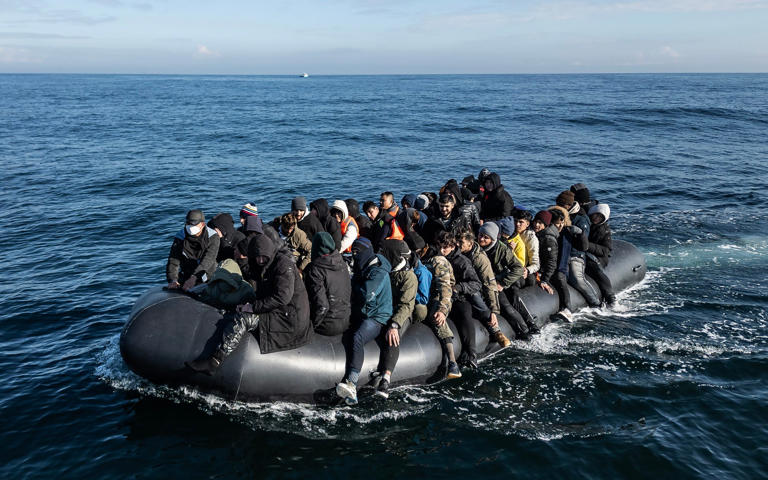
UK records biggest increase in asylum claims in Europe

UK records biggest increase in asylum claims in Europe

Story by Tim Wallace


Overall migration dropped in the UK, despite surge in asylum applications - Dan Kitwood/Getty

Britain posted the biggest rise in asylum claims in Europe last year, new figures show, as the number of applications surged to a record high.

A total of 108,000 claims were lodged in 2024, reflecting a 28pc jump on the 84,000 recorded in 2023.

This increase far outstripped the UK’s peers across the Continent, including France and Germany, where the number of asylum claims actually fell.

Last year’s tally was also the highest number of applications on record for the UK, according to the Organisation for Economic Cooperation and Development (OECD), eclipsing 103,000 asylum claims lodged in 2002.

The latest figures will raise fresh concerns over the Channel migrant crisis and the Government’s ability to crack down on small boats.

Thursday, July 24, 2025

How the 'No Buy 2025' trend could help you get your budget on track this year

Is this the year of cutting back?


Yahoo Personal Finance · Getty Images


Ivana Pino · Senior Writer
Mon, July 21, 2025 at 11:44 AM EDT

Sometimes, getting your budget on track starts with a detox to wipe the slate clean and build new habits. Many consumers have taken on no-spend challenges to put themselves to the test and see if they can go a day, week, or month without spending money.

Others have taken it a step further and adopted a “no buy” year to cut out unnecessary spending and focus on what matters. Here’s what you need to know about No Buy 2025 and how to incorporate it into your life.

What is No Buy 2025?

No Buy 2025 is a personal finance trend in which individuals commit to avoiding non-essential (AKA discretionary) purchases for a set period this year, which could range from a few weeks to the full year.

One example of this trend in practice is “No Buy July,” where participants challenge themselves to avoid spending money for the full month.

“No Buy July is like a financial detox,” said Hanna Kaufman, CFP® at Betterment. “For one month, you hit pause on all non-essential spending — think: takeout, impulse Amazon buys, new clothes — and focus only on what you really need.” She explained that it’s a challenge that helps people reset their spending habits, get clarity on their financial priorities, and boost their savings without having to make huge sacrifices.