Showing posts with label European Union. Show all posts

Tuesday, October 13, 2026

‘Mass for Europe’ to be celebrated in Brussels on 15 October

12 October 2026

Invitation


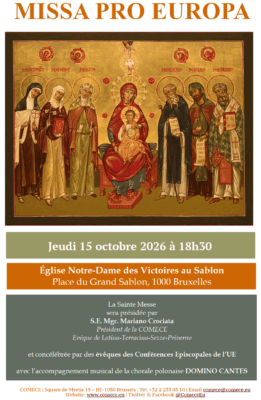
EVENT | ‘Mass for Europe’ to be celebrated in Brussels on 15 October


The public is warmly invited to join the bishops of the European Union for the Mass for Europe, to be celebrated on Thursday, 15 October 2026, at 18:30 at the Église Notre-Dame des Victoires au Sablon, Place du Grand Sablon, 1000 Brussels. The celebration is open to everyone and no registration is required. Download Poster

The Mass will take place in the context of the autumn 2026 Assembly of the Commission of the Bishops’ Conferences of the European Union (COMECE), to be held in Brussels from 14 to 16 October. The Assembly will bring together the bishops who compose COMECE and represent the episcopal conferences of the EU Member States.

The Mass will be presided over by H.E. Mgr Mariano Crociata, President of COMECE, and concelebrated by the bishops participating in the Assembly. Musical accompaniment will be provided by the Polish choir Domino Cantus.


Source

Tuesday, November 18, 2025

COMECE urges stronger action to tackle religious discrimination and protect freedom of religion in the EU

17 November 2025

Annual Article 17 TFEU EU-Churches meeting: COMECE urges stronger action to tackle religious discrimination and protect freedom of religion in the EU

COMECE participated in the Article 17 TFEU Annual High-Level Meeting between the European Commission and religious leaders on the theme “Living together in increasingly polarised societies” on Monday, 17 November 2024. During the meeting, COMECE Vice-President, Mgr Czeslaw Kozon, called for stronger institutional action, including “the appointment of an EU Coordinator on combating anti-Christian hatred and the urgent need for improved religious literacy”. Read the COMECE contribution | Photo Gallery

The meeting was hosted by Magnus Brunner, EU Commissioner for Home Affairs and Migration and the Commissioner responsible for the implementation of the Article 17 TFEU Dialogue. COMECE was represented by its Vice-President, Mgr Czeslaw Kozon, Bishop of Copenhagen.

Nigel Farage, Zia Yusuf Clash With Reporters Over Immigration, NHS...

Tuesday, March 04, 2025

António Costa - President of the European Council


António Costa
Official portrait, 2024
President of the European Council
Assumed office
1 December 2024
Preceded byCharles Michel
Prime Minister of Portugal
In office
26 November 2015 – 2 April 2024
PresidentAníbal Cavaco Silva
Marcelo Rebelo de Sousa
Preceded byPedro Passos Coelho
Succeeded byLuís Montenegro
Secretary-General of the Socialist Party
In office
22 November 2014 – 7 January 2024
PresidentCarlos César
DeputyAna Catarina Mendes
José Luís Carneiro
João Torres
Preceded byAntónio José Seguro
Succeeded byPedro Nuno Santos
Leader of the Opposition
In office
22 November 2014 – 26 November 2015
Prime MinisterPedro Passos Coelho
Preceded byAntónio José Seguro
Succeeded byPedro Passos Coelho
Mayor of Lisbon
In office
1 August 2007 – 6 April 2015
Preceded byCarmona Rodrigues
Succeeded byFernando Medina
Minister of Internal Administration
In office
12 March 2005 – 17 May 2007
Prime MinisterJosé Sócrates
Preceded byDaniel Sanches
Succeeded byRui Pereira
Minister of Justice
In office
25 October 1999 – 6 April 2002
Prime MinisterAntónio Guterres
Preceded byJosé Vera Jardim
Succeeded byCeleste Cardona
Minister of Parliamentary Affairs
In office
27 November 1997 – 25 October 1999
Prime MinisterAntónio Guterres
Preceded byAntónio Couto dos Santos
Succeeded byLuís Marques Mendes
Member of the Assembly of the Republic[1][2]
In office
23 October 2015 – 26 March 2024
ConstituencyLisbon
In office
5 April 2002 – 9 March 2005
ConstituencyLeiria
In office
4 November 1991 – 26 October 1995
ConstituencyLisbon
Member of the European Parliament
In office
20 July 2004 – 11 March 2005
ConstituencyPortugal
Personal details
Born
António Luís Santos da Costa

17 July 1961 (age 63)
Lisbon, Portugal
Political partySocialist (since 1975)
Height1.70 m (5 ft 7 in)
Spouse
Fernanda Tadeu
 
​
(m. 1987)​
Children2
Parents
Alma materUniversity of Lisbon
Signature
Websiteportugal.gov.pt/pm
Military service
Allegiance Portugal
Branch/servicePortuguese Army

Thursday, February 20, 2025

We are all Jesuits

Signs of the Times

We are all Jesuits

Signs of the Times #89


Feb 20, 2025


Quotes for the Times:

“There is something that binds the leaders of the European Union together it creates unbreakable ties.” Herman van Rompuy President of the European Council, Interreligious Dialogue, Florence, Sept. 2012.

“A US betrayal is surreal for Europeans.” Farah Stockman, New York Times, Feb. 19, 2025.

The leaders of Europe recently suffered a collective double whammy to their dreams of turning Europe into Europestan, by two emissaries from the new sheriff in Washington DC. The first speech, by Pete Hegseth, caused them to lose their minds. The second speech by J D Vance, caused them to break down in tears.

The first whammy took place in Brussels, Feb. 12, at the Ukraine Defense Contact Group meeting. Pete Hegseth told the assembled defenders of Ukrainian ‘democracy’ that - the Ukraine war must stop – Ukraine will not return to its pre-war boundaries – Ukraine will not join NATO – tell your citizens the truth – and the defense of Europe was no longer the priority of the US.

Tuesday, September 21, 2021

A weekly day of synchronised rest time for citizens and workers


Renato Cursi
20/09/2021 14:59 

The EU should seek a weekly day of common rest time for workers, as enshrined in Art 2(5) ESC.

Sunday as a common day of rest was part of the EU working time directive 93/104/EC with Art 118a(2) TEC as legal basis, which allows the EU to protect the health workers, but annulled by the CJEU in case C-84/94 (merely) because it “failed to explain why Sunday, as a weekly rest day, is more closely connected with the health ... of workers than any other day of the week”.
The EU should continue to pursue a common weekly day of rest, where the choice of the day is left open.

1. While working times fragmentise & reach out to weekends, much time is lost which in the past was used for civic engagement, joint social, sports or faith-related activities, domestic & care responsibilities and, more generally, to spend time together. This trend should be countered through more synchronised resting time.

2. Many workers have lower stress levels & recover better during common time off with families, friends & communities as opposed to spending time alone and are more performing at work & less often ill & absent. Beyond increased presenteeism, better work-life balance and less stress would bring further benefits to firms’ competitiveness: Healthy working conditions, which also include recreation, allow workers to be more creative, involved & performing to drive innovation.

3. A common day of rest would strengthen the cultural identity & is crucial for common European volunteering & engagement.


Saturday, June 16, 2018

Merkel Seeks Macron's Help as Asylum Crisis Threatens EU Unity


Photographer: Louisa Gouliamaki
AFP via Getty Images


 By
Brian Parkin
‎June‎ ‎16‎, ‎2018‎ ‎8‎:‎14‎ ‎AM‎ ‎EDT


European remedy needed to solve European challenge, she says

French-German meeting June 19 will seek policy options

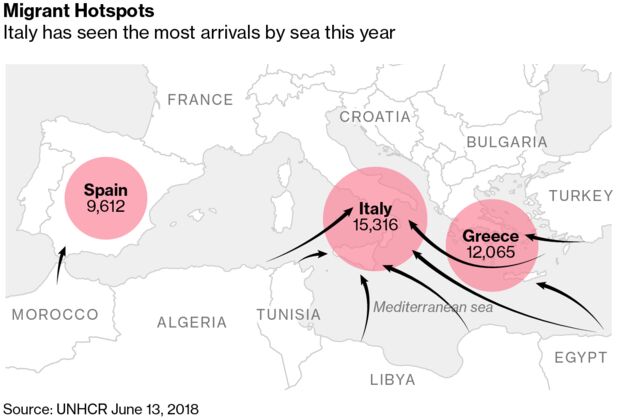
German Chancellor Angela Merkel says she will turn to France to help diffuse a domestic crisis over migration amid an increasing risk that the European Union may unravel unless its member states adopt a common policy.

At a regular meeting of their joint Cabinets on Tuesday, Germany will seek the support of French President Emmanuel Macron to find a common EU response for managing an influx of refugees, Merkel said Saturday in a weekly podcast. The stakes for the EU are high, she said.

A dispute in Merkel’s coalition over migration policy has escalated into one of the biggest tests of her chancellorship, while the populist government that took over in Italy this month has blocked refugee vessels from entering Italian ports.

Getting all of the EU states on board for an overhaul of asylum practices and rules is “in my view one of the most decisive issues for European unity,” the Christian Democrat chancellor said. The inflow of migrants is “a European challenge that requires a European answer.”

Read more: Merkel Risks Crisis in Refugee Clash With Allies

As the domestic storm unfolded this week, Merkel remained insistent that the EU-28 can only solve migration challenges as a group. That’s fomented a deep rift between her CDU and its Christian Social Union allies, who claim they have national and EU authorization to start turning away refugees arriving on Germany’s borders who first claimed asylum in other EU states.

A European solution “doesn’t convince me,” said Bavaria’s Prime Minister Markus Soeder in a June 14 Bild Zeitung interview. The move would mean “the majority of asylum seekers who come to Europe make their way to Germany.”

The joint cabinet meeting with France offers Merkel a chance to air proposals for revamping regional asylum policy ahead of a European Council meeting June 28-29. Merkel has asked the CSU to be patient, a request that the Bavarians have ignored.


Saturday, December 23, 2017

One by One Kings of Europe Returning to Harlot: Hungary, Poland, Moving on Pope’s Demand, Uniting Church & State, Making EU Great


One by One Kings of Europe Returning to Harlot: Hungary, Poland, Moving on Pope’s Demand, Uniting Church & State, Making EU Great

December 17, 2017


Andrew & Hilari Henriques


“Make America Great Again,” Donald Trump’s oft-repeated campaign slogan that still can be seen with emblazoned white words on t-shirts, hats, bumper stickers and signs that reflect the sentiments of many Americans. For different people, that vague four-word phrase has taken on different meanings; however, all who have repeated and believe in this concept believe America to have lost something that formerly made it great. For some, this idea reflects a longing to return to the “glory” of the Reagan era, while others are nostalgic to return to the Jim Crow era, while others still, which make up a large percentage, it means making America “moral,” devout, even dogmatic, wherein the church dictates to the state to enforce its decrees, a time period in which Sunday laws were in effect. Individuals longing for restoration of morality and peace in America recoil in horror at the prevailing depravity, the existent vileness and increasing crime, citing them as reasons for churches to become active in politics, thus removing the separation of church and state. President Donald Trump is just the man to remove that separation just as he promised during his campaign; and he is swiftly moving toward it. Politicians from countries around the world are taking note of this, and are also desirous for their respective nations to return to what they consider their former greatness, which involves a return of “Christian” values to government. Hungary and Poland are such countries; in fact, the entire European Union is calling for a return to its “Christian roots.”

A Brietbart headline reads as follows: “Hungary: Governments should be dedicated to ‘Christian Values’ that made Europe Great.”1 In other words, Hungary wants to return to the “greatness” that Europe formerly possessed because of its union of church and state. This was during the time that Roman Catholicism was in the ascendancy and not only ruled the church but also the state. Let us not infer, but allow the Hungarian Prime Minister to speak. “Hungarian Prime Minister Viktor Orbán said that after decades of being under the control of ‘anti-Christian, internationalist powers’ the country needs a government ‘based on the teachings of Christ’ which ‘made Europe and the Hungarians great.’ Speaking at a celebratory event marking the 500th anniversary of the Reformation, the conservative Fidesz party leader said that it was a duty of his government to protect ‘the ways of life that have their roots in Christianity’, including human dignity, the family, the nation, and faith communities, adding that Christian Europe needs a spiritual and intellectual renewal.”2 Make no mistake about it, Europe will have a spiritual renewal, a return to its “Christian,” Roman Catholic roots, following in America’s footsteps; but it will be anything but great. It will involve the restriction of civil and religious liberty and the enactment of Papal decrees, specifically, a Sunday Law. “The decree enforcing the worship of this day [Sunday] is to go forth to all the world. As America, the land of religious liberty, shall unite with the papacy in forcing the conscience and compelling men to honor the false sabbath, the people of every country on the globe will be led to follow her example.”3

In the Brietbart article, Poland is mentioned among the European nations calling for the restoration of religion into politics; and it is mentioned in conjunction with a Roman Catholic Feast, so we know exactly whose “Christian” values these politicians are desiring to implement in their governments. “Last month, fellow former Soviet satellite state Poland celebrated another important date in Christian history, with the Catholic Feast of the Holy Rosary that marked the anniversary of the Battle of Lepanto where ‘the Christian fleet overcame the Muslim armada, saving Europe from Islamisation.’”4

Just a few days ago (December 14), Poland’s Prime Minister essentially repeated the words of Hungarian Prime Minister as the headline conveys, “New Polish PM sees return to Christian roots as only way to stop Europe’s decline.” In the article can be read the following: “Mateusz Morawiecki, the new Prime Minister of Poland, spoke about re-Christianizing Europe during the first interview after his nomination… Speaking about Polish mining and the problematic EU climate policy, he said, ‘we want to transform Europe.’ He digressed that his dream is to ‘re-Christianize Europe.’ Morawiecki specified that, ‘unfortunately, in many places, not only are Christmas Carols not sung, but churches are empty, and some are even turned into museums.’ Morawiecki welcomed the interviewer, Redemptorist Brother Piotr Dettlaff, with the greeting “Szczęść Boże...” It is still used today when addressing priests and members of religious orders.”5

However, it is not only the political leaders of Hungary and Poland that are calling for a return to “Christian” roots in Europe, a re-union of church and state, but also religious leaders across Europe. In fact, they are the ones inspiring the political leaders. Note the following news headlines: “Europe will be 'adrift' if it loses Christian roots, faith leaders warn;”6 Pope Francis sees hope for European Union, urges leaders to return to roots;”7 “Pope Francis reminds EU heads of their Christian roots;”8 and “Pope Francis Reminds Emmanuel Macron of France’s ‘Christian Tradition.’”9

Just as Hungary, Poland and the European Union is following America’s lead in making their countries “great again,” it should be understood what it was that did make America Great at its establishment, the principles of Republicanism and Protestantism. “Republicanism and Protestantism became the fundamental principles of the nation. These principles are the secret of its power and prosperity. The oppressed and downtrodden throughout Christendom have turned to this land with interest and hope. Millions have sought its shores, and the United States has risen to a place among the most powerful nations of the earth.”10 Once these principles are completely done away, neither America nor any other country that rejects these principles will be great; and national apostasy will be followed by national ruin.


Saturday, October 28, 2017

Pope to European civil and Church leaders: men and women are different


Vatican City, Oct 28, 2017 / 10:36 am (CNA/EWTN News).- In a lengthy speech to civil and ecclesiastical leaders of Europe on Saturday, Pope Francis defended the family as being made up of a man and woman open to life – saying that this fundamental community is also a model for secular communities.

“The family is the harmonious union of the differences between man and woman, which becomes stronger and more authentic to the extent that it is fruitful, capable of opening itself to life and to others.”

“Secular communities, likewise, are alive when they are capable of openness, embracing the differences and gifts of each person while at the same time generating new life, development, labor, innovation and culture,” the Pope said Oct. 28.

In the family we find an example for all types of community, he continued, where “diversity is valued and at the same time brought into unity.”

In this way, the person and community “are thus the foundations of the Europe that we, as Christians, want and can contribute to building,” he emphasized in an audience for a Vatican-sponsored conference on the future of Europe.

Taking place in Rome Oct. 27-29, “(Re)Thinking Europe: A Christian Contribution to the Future of the European Project” gathered together hundreds of high-level Church and E.U. political leaders, including academics, ambassadors, bishops and European politicians.
The Pope has addressed E.U. leaders several times over the last few years, beginning in Strasbourg, France in November 2014.

His most recent address took place in March of this year, when he spoke on the occasion of the 60th anniversary of the signing of the Treaty of Rome, which established the European Economic Community and is one of the two most important treaties in the modern-day European Union (EU).

In a departure from his earlier speeches, however, Francis did not appeal to the “Christian roots” or cultural patrimony of Europe, but instead focused specifically on what the “Christian contribution” is and can be for Europe, specifically in politics.

He pointed to the common secular philosophy that seeks to omit religion from the political sphere, calling it a regrettable “secularist prejudice,” which is “incapable of seeing the positive value of religion’s public and objective role in society.”

The result of relegating religion to merely the private sphere results in a “certain groupthink,” he said; one which appears frequently in international meetings and which “see the affirmation of religious identity as a threat to itself and its dominance.”

What this does, he said, is promote a false conflict between the right to religious freedom and other fundamental rights.

The Pope stated that instead, politics has a “fundamental responsibility” to favor dialogue, “in any form whatsoever.”

He pointed out that unfortunately politics is becoming a forum for conflict, dialogue being replaced by shouting and demands, the primary goal of the common good abandoned.

Extremist and populist groups, which are gaining ground in some countries, have made “protest the heart of their political message, without offering the alternative of a constructive political project,” he argued.

In the face of these challenges, “Christians are called to promote political dialogue,” he said, “especially where it is threatened and where conflict seems to prevail.”

Echoing previous messages, not just to European leaders, but also in general audiences, Francis urged Christians to be involved in politics, saying they’re called to restore its dignity, viewing it as a lofty service to the common good.

“This demands a suitable formation, since politics is not the ‘art of improvising,’” he said. “Instead, it is a noble expression of self-sacrifice and personal dedication for the benefit of the community. To be a leader demands thoughtfulness, training and experience.”

The Pope also emphasized that the European Union, at a time of crisis such as now, needs to work together to promote a positive future.

“A European Union that, in facing its crises, fails to recover a sense of being a single community that sustains and assists its members – and not just a collection of small interest groups – would miss out not only on one of the greatest challenges of its history, but also on one of the greatest opportunities for its own future,” he said.


Friday, March 24, 2017

Pope Francis to offer birthday counsel to troubled EU


Angus MACKINNON
AFP

March 24, 2017


Pope Francis has made his concerns over Europe's refugee crisis clear on several occasions (AFP Photo/Vincenzo PINTO)More


Vatican City (AFP) - European Union leaders will receive guidance from Pope Francis Friday, on the eve of the troubled bloc's 60th anniversary celebrations in Rome.

On past form, the Argentine pontiff is unlikely to pull his punches in a Friday evening audience with 27 heads of state or government tasked with charting a "common future" for a union soon to lose Britain from its ranks.

Francis has made it clear he believes that the EU's future should include a much greater emphasis on combatting social injustice than there has been in six decades of integration driven primarily by trade liberalisation and monetary union.

Today's Europe needs to adopt "new, more inclusive and equitable economic models, aimed not at serving the few, but at benefiting ordinary people and society as a whole," he said in a speech last year.

Some EU governments and also a significant bloc in the European Parliament agree with him.

But there is no consensus among the 27 member states on this or almost any other issue to do with the bloc's next steps.

The future, too, is clouded by the advances of far-right and populist parties -- a trend the pope has highlighted as a danger on both sides of the Atlantic.

- Migrant crisis -

"Crises provoke fear, alarm," he said in a January interview, recalling that the "obvious example of European populism" was Germany in 1933, the year Adolf Hitler seized power.

Francis's most senior lieutenant, Vatican Secretary of State Pietro Parolin, said this week that populism was a "sign of a profound malaise felt by many people in Europe".

This, he said, was based on genuine concerns about migration and the economic crisis to which the EU had to respond with concrete action.

Among the questions facing the EU is whether it should adopt a two-speed model, allowing some countries to deepen cooperation and pool sovereignty in various areas faster than others?

Is it time the EU finally realised the ambition of having some kind of military capacity?

Does the euro need to be underpinned by a banking union and greater fiscal harmonisation?

These issues form the backdrop to Saturday's anniversary summit, at which both Poland and Greece have threatened to block the final statement.

However, they are not the most pressing concerns as Francis sees it.

The 80-year-old pontiff reiterated again this week that Europe is currently confronted with its biggest refugee crisis since World War II.

And it seems inevitable that he will remind the leaders of his view that they have a responsibility to address it, with compassion, as he did at the European Parliament in November 2014.

- 'Dare to change' -

"I dream of a Europe where being a migrant is not a crime but a summons to greater commitment on behalf of the dignity of every human being," he told an audience of EU big-wigs, including German Chancellor Angela Merkel, last year.

In that speech, delivered as he accepted the EU's Charlemagne Prize for his contribution to European unification, Francis implored today's leaders to learn from the bloc's founding fathers.

In the aftermath of war, they had inspired because they had "dared to change radically the models" that led to conflict.

Officially, the Vatican has always supported the idea of European integration, despite disappointment over repeated failures to enshrine an explicit commitment to Christian values in the bloc's founding treaties.

"The celebrations (this weekend) remind us that it is still possible today to work together because that which unites us is stronger than that which divides us," Parolin said.

"The vision of the founding fathers was rooted in the cultural, religious, judicial, political and human heritage of Europe, built over centuries. That is why Rome was chosen for the signature of the treaties. It is the symbol of this shared heritage in which Christianity was certainly a fundamental component.

"Today we have to rethink the EU along these lines, more a community on a journey than a static, bureaucratic entity."


Source


Pope Francis to meet EU leaders in Vatican


Pope Francis greets Jean-Claude Juncker, President of the European Commission, during the Charlemagne Prize award ceremony on 6 May 2016 - EPA
23/03/2017 15:30


(Vatican Radio) Pope Francis is set to receive 27 European Union heads of State and government at a private audience in the Vatican’s Sala Regia on Friday evening.

The encounter takes place on the eve of the 60th anniversary of the signing of the Treaty of Rome.

Leaders will be joined at the audience by representatives of EU institutions.

These include Antonio Tajani, President of the European Parliament, Donald Tusk, President of the European Council, and Jean-Claude Juncker, President of the European Commission.

Pope Francis will address the group after speeches made by Italian Prime Minister Paolo Gentiloni and Antonio Tajani.


Wednesday, October 05, 2016

Role of the Catholic Church in a process of the European integration


EVENT REPORT 21-22.09.2016 

THE CATHOLIC CHURCH IN THE EUROPEAN UNION

XVI International Conference


EUROPEAN SOLIDARITY

A series of incidents that dismayed Europe and the world in the past couple of years, have
revealed an urgent need for a greater solidarity among the member states of the European
Union. The war in Syria, political instability in the south-Mediterranean region, Crimea’s
annexation by Russia, the economic crisis in Greece and other countries, the so-called
‘bloody terrorism’ of ISIS against Europe and finally crowds of asylum seekers and migrants
on their way to the old continent from all over the world, require a thorough discernment of the
new situation and a joint action taken in a spirit of solidarity by all the European Union’s
countries.

The sixteenth edition of the conference on the role of the Catholic Church in the process of
European integration co-organised by COMECE together with partners in Cracow, on
September 21-22, 2016 focused this time on four specific issues imperatively necessitating
solidarity in the EU, namely the solidarity in security and defence policy, solidarity towards the
challenges of migrations and asylum, solidarity in reference to the energy and climate policy
and finally the role of Churches and religious communities in strengthening solidarity in
Europe.

The Catholic Church and other religious communities have their role to play in encouraging
European solidarity, not only providing with the best practice examples, but also through the
institutional dialogue with the EU. Acknowledging churches’ identity as well as their specific
contribution in shaping the process of the European integration shows their impact on the EU
policy. Fr. Olivier Poquillon OP, Comece Secretary General highlighted the need for a more
participative approach in order to combat the perception of the European Union as a
centralized, disembodied administration detached from the people’s reality. He also
mentioned the importance to promote EU good practices that led to the achievement of
decades of peace and prosperity in the old continent. Finally, he stressed the need for a better
involvement of the citizen across a constructive articulation of solidarity and subsidiarity.

The experts’ knowledge, as well as the discussions allowed the participants to better
understand European solidarity, which is a value often referred to at the EU level, but not
always soundly interpreted or subjected to possible reductions or even withdrawals resulting
in undesirable socio-political developments.

First panel focussed on the security and defence issues. The entire European security
architecture has trembled as the eastern flank of the continent has been destabilised. The
current Russian-Ukrainian conflict has been described as a game changer for European
security. In this context, the debaters agreed on considering that the unity of all of the EU
Member States was the best safeguard for their security.

Another panel discussed the threats against EU energy policy raising awareness about its
geopolitical fragility because of its excessive concentration on short term economical aspects.
Strategic EU energy security policy should be at the very heart of the European construction
without forgetting its geopolitical and ecological dimension, reminded by pope Francis. The
energy solidarity approach can boost prosperity for the people of Europe and enhance EU
position in the neighbourhood.

Last panel was dedicated to migration and asylum. The panellists addressed the principles
that should guide European societies in this matter, including respect of human dignity,
promotion of common good, solidarity and subsidiarity. Jose Luis Bazan, COMECE Legal
Advisor on Migration and Asylum, emphasised the importance of a responsible solidarity that
takes into account the reality of societies, reminding the “intelligent hospitality” and openness
that the Church must promote.

At the invitation of Card. Dziwisz, High representatives of all the Churches present in Ukraine
had an chance to dialogue together and to express their commitment to work jointly on
rebuilding Peace.

Irmina Nockiewicz


More information : http://www.kosciol-europa.org.pl


Series of conferences on the role of the Catholic Church
in the process of European integration


This initiative of the series of conferences on the role of the Catholic Church in the
process of European integration dates back to 2000 and aims at promoting a diversified
perspectives on the horizon of European unity, as well as at showing the substantial of the
Catholic Church in the process of European integration. Catholic Church brings its specific
contribution into the EU debate on the basis of Article 17(3) of the Treaty on the Functioning of
the EU.

Each year the conference is structured around workshops held on topics related with the
general theme relevat to the current state of play of EU policies. The event, inspired by H.E.
Mgr Tadeusz Pieronek, is organized by the Pontifical University of John Paul II, Konrad
Adenauer Foundation in Poland, the Robert Schuman Foundation in Luxembourg in cooperation
with the COMECE (Commission of the Episcopates of the European Community),
the Group of the European People's Party (Christian Democrats) in the European Parliament,
the Polish Delegation in the EPP (Christian Democrats) in the European Parliament, the
European People's Party and the publishing house "Around Us" (Gliwice).


Source