Showing posts with label Universities. Show all posts

Wednesday, July 29, 2026

Gary Peters (Michigan Senator)

From Wikipedia, the free encyclopedia

Gary Peters


Official portrait, 2018

United States Senator from Michigan

Incumbent

Assumed office January 3, 2015

----

Personal details

Born Gary Charles Peters

December 1, 1958 (age 67)

Pontiac, Michigan, U.S.

Party Democratic

Spouse Colleen Ochoa

Children 3

Education

Alma College (BA)

University of Detroit Mercy (MBA)

Wayne State University (JD, MA)

Michigan State University (MA)

Recorded April 20, 2023

Gary Charles Peters (born December 1, 1958) is an American politician, lawyer, and former naval officer serving as the senior United States senator from Michigan, a seat he has held since 2015. A member of the Democratic Party, he was the U.S. representative for Michigan's 14th congressional district, which included the eastern half of Detroit, the Grosse Pointes, Hamtramck, Southfield, and Pontiac, from 2009 to 2015 (the district was Michigan's 9th congressional district until 2013).

---

Early life and education

After high school, Peters attended Alma College, where he graduated magna cum laude in 1980 with a bachelor of arts in political science and was inducted into Phi Beta Kappa.[4] He later earned a master of business administration from the University of Detroit Mercy in 1984.[8] Peters also holds a juris doctor and a master of arts in political science from Wayne State University and a master of arts in philosophy from Michigan State University.[9]

Source: Wikipedia

P.S.

University of Detroit Mercy:

The University of Detroit Mercy is a private Catholic university in Detroit, Michigan, United States. It is sponsored by both the Society of Jesus (Jesuits) and the Sisters of Mercy. The university was founded in 1877 and is the largest Catholic university in Michigan.

Sunday, May 31, 2026

Ras Baraka and Mikie Sherrill are both alumni of Jesuit Universities


Ras Baraka
and Mikie Sherrill are both alumni of Jesuit higher education institutions. [1, 2]

The two New Jersey Democrats—who competed in the 2025 gubernatorial primary before Baraka endorsed Sherrill, who is now the Governor of New Jersey—completed different graduate degrees at distinct Jesuit universities. [1, 2, 4, 5]

Educational Breakdown

Ras Baraka: Earned his Master of Arts in Education Supervision from Saint Peter's University (located in Jersey City, NJ). Saint Peter's is a private Jesuit university founded by the Society of Jesus in 1872. [1]

Mikie Sherrill: Earned her Juris Doctor (JD) from the Georgetown University Law Center (located in Washington, D.C.). Georgetown is the oldest Catholic and Jesuit institution of higher education in the United States, founded in 1789. [1]


How Jesuit Education Influenced Their Careers

Ras Baraka's Path: His degree in educational leadership directly fed into his career within public school systems. Before serving as Mayor of Newark, Baraka spent years as a school administrator, notably serving as the principal of Newark's Central High School. [1, 2]

Mikie Sherrill's Path: Raised Catholic, Sherrill has explicitly stated that Georgetown Law was a natural fit because the Jesuits epitomize the philosophy of service and giving back to communities. She used her law degree to transition from her career as a Navy pilot into legal public service, first as a federal prosecutor and later as a public servant. [1, 2, 3]


Source: Google Artificial Intelligence


Wednesday, March 11, 2026

Academia didn’t learn from Oct. 7. It doubled down Story


by Samuel J. Abrams, Washington Examiner


Academia didn’t learn from Oct. 7. It doubled down

One might have thought the campus chaos that followed Oct. 7, 2023, would force a moment of academic sobriety.

After the massacre in Israel, the country watched elite universities descend into moral confusion — students chanting slogans they barely understood, administrators hiding behind procedural evasions, and faculty members serving not as guides but as accelerants. The congressional hearings that followed did

Nor is sociology unique. Similar language now saturates much of the modern university. Across disciplines, professional associations increasingly define their purpose in terms of political ends — equity, disruption, justice, social progress — rather than the pursuit of truth. The American Educational Research Association, for instance, themed its 2024 annual meeting around “dismantling racial injustice” — not just studying it, but actively attempting to dismantle it. Scholarly guilds are recasting themselves not as communities of analysis but as engines of social change.

The result is a profound professional deformation: the conversion of academic departments into ideological projects. Barnard College’s Women, Gender, and Sexuality Studies department, for instance, proudly declares that it “is dedicated to linking inquiry and action, theory and practice.”

Fortunately, mainstream observers have begun to acknowledge what was long treated as impolite to say: Faculty activism has become a gateway to campus radicalism. And even Harvard President Alan Garber admitted that the university “went wrong” by allowing professors to inject their personal views into the classroom, arguing that faculty activism has chilled free speech and debate. Professors are no longer simply interpreters of social life. Too often, they are organizers, legitimators, and moral enforcers — providing students with not only ideas, but marching orders.

The consequences are profound.

When a discipline defines its mission as “disruption,” it overtly and willfully abandons the central norms of scholarship. Research becomes, in the spirit of Max Weber, socially instrumental and outcome-driven. Questions are permitted or discouraged based on political utility. Peer review becomes ideological sorting. Students are trained not to analyze complexity but to rehearse commitments.

Sunday, February 15, 2026

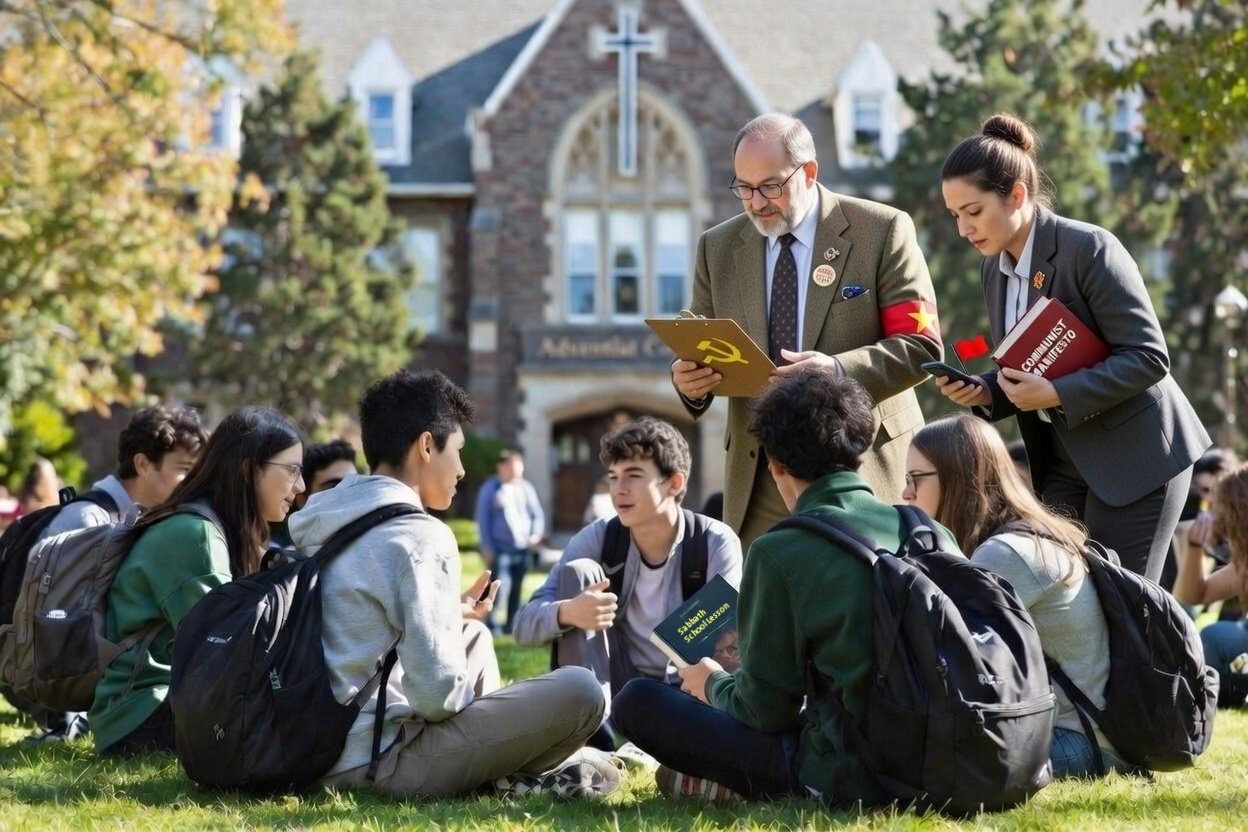
Infiltration of Marxist Thought into Adventist Institutions


February 13, 2026 Dr. Adami A. Gabriel


When the Church Speaks the Language of Babylon:

A Prophetic Warning Against the Subtle Infiltration of Marxist Thought into Adventist Institutions

By: Dr. Adami A. Gabriel, PsyD


1. Introduction – The Language of the Age and the Church of Prophecy

Every generation faces the challenge of communicating the gospel in a changing world. Language, however, is never neutral. Words carry worldviews. Whoever defines the terms defines the debate, and whoever shapes the debate shapes belief. As the American linguist Edward Sapir stated, "Human beings... are very much at the mercy of the particular language which has become the medium of expression for their society". He further elaborated that "We see and hear and otherwise experience very largely as we do because the language habits of our community predispose certain choices of interpretation" (1929). This strongly suggests that language is inherently biased by cultural assumptions and worldviews. Philosopher Ludwig Wittgenstein (1922) famously articulated the deep connection between language and our perception of reality, stating "The limits of my language mean the limits of my world". The Marxist philosopher and linguist V.N. Voloshinov (often associated with Mikhail Bakhtin) argued that "Every word is a microcosm of the world, every word is a philosophy." (1973). The French philosopher Michel Foucault (1978) extensively explored how "discourse” is inseparable from power relations. He argued that the power to define "what can be said" and "who can speak" fundamentally shapes societal knowledge and belief. Finally, in modern cognitive linguistics, authors like George Lakoff (2004) emphasize how political "framing" through language heavily influences public opinion and belief systems. He argues that political discourse relies on specific, culturally embedded frames, and controlling the frame, or defining the terms, is essential to winning a debate and shaping public understanding.

Secular scholars and academics understand these principles on how influencing, shaping and reengineering culture and worldviews through language work and operate. In recent decades, secular society has produced a new moral vocabulary—equity, systemic oppression, inclusion, diversity, allyship, and social justice. These terms, born out of Marxist and postmodern theories (Mor Barak, 2005), often embed values that differ from biblical anthropology and morality.

In official statements and institutional materials, the Seventh-day Adventist Church increasingly employs this same vocabulary in its attempts to address racism, poverty, and human suffering. While these causes may appear righteous, the uncritical adoption of the world’s terminology risks compromising the distinct prophetic mission entrusted to the remnant church. Scripture warns,

“Do not be conformed to this world, but be transformed by the renewing of your mind” (Romans 12:2, NKJV).

When the church begins to think and speak in the categories of the world, its transformation becomes reversal.

This paper offers a public apologetic and prophetic warning: that the borrowing of secular ideological language—especially language rooted in Marxist social theory—inevitably shapes thought, theology, and practice (Wittgenstein, 1922; Foucault, 1978; Lakoff, 2004). It will demonstrate, through examples from official SDA sources, how such language has become normalized, and then will analyze, through Scripture and the writings of Ellen G. White, why this blending of sacred and profane language is spiritually dangerous, even when pursued for a “good cause.”

Thursday, December 04, 2025

Christian OU student flunked after calling gender ideology 'demonic'


By Jon Brown, Christian Post Reporter Wednesday, December 03, 2025

A Christian pre-med student has gone viral in recent days for filing a religious discrimination complaint with the University of Oklahoma after a trans-identified teaching assistant allegedly flunked her for an essay stating that gender ideology is "demonic."

Samantha Fulnecky, a junior at the University of Oklahoma who is majoring in psychology, received a zero out of 25 for a 650-word opinion essay she was told to write in her "Lifespan Development" class in response to an article about social gender expectations, according to The Oklahoman.

According to a copy of her essay published by the local outlet, Fulnecky asserted that God created two distinct genders with different roles, and that the idea of changing one's gender is a satanic assault against that design.

"I strongly disagree with the idea from the article that encouraging acceptance of diverse gender expressions could improve students' confidence," she wrote. "Society pushing the lie that there are multiple genders and everyone should be what they want to be is demonic and severely harms American youth."

Graduate teaching assistant William "Mel" Curth, who uses "she/they" pronouns, took apparent offense at Fulnecky's claims in the essay, and was especially upset at her use of the word "demonic" to describe gender ideology.

"To call an entire group of people 'demonic' is highly offensive, especially a minoritized population," Curth reportedly wrote in an online grading portal.

"Please note that I am not deducting points because you have certain beliefs, but instead I am deducting point [sic] for you posting a reaction paper that does not answer the questions for this assignment, contradicts itself, heavily uses personal ideology over empirical evidence in a scientific class, and is at times offensive," Curth also said.

"I implore you [to] apply some more perspective and empathy in your work," Curth added.

Thursday, October 16, 2025

Reflective comments on Fr General's Speech - IAJU 2025 Assembly

 
Reflective comments on Fr General's Speech - IAJU 2025 Assembly

International Association of Jesuit Universities

Sep 29, 2025

In response to the powerful address delivered by Fr. Arturo Sosa, S.J., Superior General of the Society of Jesus, titled “The Jesuit University: Witness to Hope, Creative and Dialogical Presence,” the opening plenary of the 2025 International Association of Jesuit Universities (IAJU) Assembly gathered institutional leaders to reflect and discern concrete paths forward.


Thursday, August 28, 2025

The Inaugural Symposium of the Global Research Alliance of Jesuit Universities (GRAJU) (HE Memo#Y3.51)

27 Aug 2025 | Office of the Vice President for Higher Education


HE Memo#Y3.51
27 August 2025

TO:

The Higher Education Community

FROM:

[Sgd.] Maria Luz C Vilches, PhD
Vice President for Higher Education

SUBJECT:

The Inaugural Symposium of the Global Research Alliance of Jesuit Universities (GRAJU)

We start the year with the good news that Ateneo de Manila is one of the founding members of the Global Research Alliance of Jesuit Universities (GRAJU). GRAJU seeks to build a unified research network that enhances scholarly partnerships, interdisciplinary innovation, and mission-driven inquiry. Established on 4 August 2025, GRAJU has been initiated by six Jesuit universities, including Ateneo de Manila University (the Philippines), Fordham University (USA), Georgetown University (USA), ITESO, Universidad Jesuita de Guadalajara (Mexico), Sogang University (South Korea), and the Universidad de Deusto (Spain).

And not only that! Ateneo de Manila is where the inaugural symposium will take place on 9–12 March 2026 on the theme: The AI Frontier and the Distinctives of Global Jesuit Higher Education. We are thankful to the Office of the Assistant VP for Research, Creative Work, and Innovation (RCWI) as well as the Office of the Assistant VP for University Partnerships and Internationalization (UPI) for coming together to jointly provide the overall support for this symposium. We shall also be forming committees that can help with necessary arrangements for the success of the symposium.

Wednesday, May 15, 2019

His wealthy dad admitted bribing his way into Georgetown. Now he's suing to block expulsion


By Richard Winton
May 15, 2019 | 2:35 PM


California businessman Stephen Semprevivo departs federal court May 7 in Boston after pleading guilty to charges that he bribed the Georgetown tennis coach to get his son admitted to the school. (Steven Senne / Associated Press)


The son of a Los Angeles executive who admitted paying a $400,000 bribe to secure a spot at Georgetown for his child as a tennis recruit sued the university to prevent it from kicking him out and nullifying his college credits.

Ten hours after the lawsuit landed in the federal court system early Wednesday, Georgetown University informed Adam Semprevivo, a junior at the college and the son of Stephen Semprevivo, it was rescinding his offer of admission.

“I guess the dean of admissions stayed up all night conducting the entire investigation,” said David Kenner, the student’s attorney.

“If they get to do this, he will lose his credits for three years at Georgetown,” Kenner said, noting he had paid $200,000 for three years of classes. The attorney said the lawsuit will be amended to prevent any action by the university and to note his client’s lack of due process.

The lawsuit alleges the college was seeking to academically discipline him even though he knew nothing of the bribe his father paid college consultant William “Rick” Singer.

Singer, in turn, paid Georgetown’s then-tennis coach to fake documents indicating that Adam Semprevivo was a tennis recruit and let him into the elite university. The student is the first among dozens of wealthy families ensnared in the far-reaching college admissions scandal to sue a university in connection with the scam.

Semprevivo offered to withdraw from Georgetown if he could keep his credits for his work there over three years. According to the lawsuit filed in Washington, D.C., federal court, Georgetown’s legal counsel told Semprevivo on Tuesday the school would not agree to that deal. The lawsuit seeks an injunction preventing the school from expelling him.

Georgetown declined to comment on the pending litigation but a spokeswoman said Wednesday that two students were informed of the university’s intent “to rescind their admission and dismiss them from Georgetown.”

Tuesday, March 27, 2018

Christian Colleges Are Tangled In Their Own LGBT Policies


March 27, 20187:26 AM ET
Heard on Morning Edition


TOM GJELTEN


Calvin College in Michigan is affiliated with the Christian Reformed Church, which holds that "homosexual practice ... is incompatible with obedience to the will of God as revealed in Scripture."Noah PreFontaine/Calvin College


Conservative Christian colleges, once relatively insulated from the culture war, are increasingly entangled in the same battles over LGBT rights and related social issues that have divided other institutions in America.

Students and faculty at many religious institutions are asked to accept a "faith statement" outlining the school's views on such matters as evangelical doctrine, scriptural interpretation and human sexuality. Those statements often include a rejection of homosexual activity and a definition of marriage as the union of one man and one woman. Changing attitudes on sexual ethics and civil rights, however, are making it difficult for some schools, even conservative ones, to ensure broad compliance with their strict positions.

"Millennials are looking at the issue of gay marriage, and more and more they are saying, 'OK, we know the Bible talks about this, but we just don't see this as an essential of the faith,' " says Brad Harper, a professor of theology and religious history at Multnomah University, an evangelical Christian institution in Portland, Ore.

LGBT students at Christian schools are also increasingly likely to be open about their own sexual orientation or gender identity.


Thursday, March 08, 2018

UCLA 'Social Justice Advocates' resume fight against 'privilege'


Toni AiraksinenNew York Campus Correspondent@Toni_Airaksinen

Today at 9:54 AM EDT


UCLA's "Social Justice Advocates" program is once again paying students to fight “whiteness, privilege, and heteronormativity” on campus.

The program appeared to have gone defunct as of January, even being scrubbed from the school's website, but the SJA Facebook page has lately shown renewed signs of life.


Image via Facebook: UCLA Social Justice Advocates


The University of California-Los Angeles (UCLA) has resumed a program that pays students to fight “whiteness, privilege, and heteronormativity” on campus.

The UCLA “Social Justice Advocates” program initially sought to hire 8-10 students last May to promote social justice, in line with a trend seen at other schools including Washington State University, the University of Arizona, and Oregon State University. 


Monday, February 26, 2018

Catholic colleges say peaceful gun control protests won’t impact admission


Colleen Dulle

February 26, 2018


High school students Mia Arrington, center, 18, of West End, and Cheyenne Springette, right, 17, of Mt. Oliver, lead chants as they march down Liberty Avenue during a walk-out in solidarity with other high schools across the country to show support for Parkland, Fla, students in downtown Pittsburgh. (Stephanie Strasburg/Pittsburgh Post-Gazette via AP)


After a gunman killed 17 students at Marjory Stoneman Douglas High School on Feb. 14, the survivors of the shooting quickly mobilized to speak out against gun violence, inspiring a number of protests at high schools across the country.

Students in Arizona, Colorado, the District of Columbia, Maryland, Minnesota, Montana, New Jersey and Washington state staged “walk out” protests as students left class at predetermined times and gathered elsewhere for a rally or demonstration. Some also participated in a “die in” protest, laying on the ground outside the White House.

Still, some high school students may worry that participating in protests could lead to a suspension or other disciplinary action, which could jeopardize their college prospects.

In response, a wave of colleges and universities around the country have issued statements of support for the students, saying that suspensions for peaceful protests will not affect admission decisions—a relief in particular for high school seniors who have already been admitted or wait-listed but have not yet committed to a school. They may have worried that college administrators could still reject their applications.

Monday, May 01, 2017

Recruiting Non-Adventist Students Already the Norm in Adventist Higher Education


26 April 2017 | Jared Wright


Last week I wrote about proposed solutions to the enrollment problem that faces institutions of higher education in the North American Division. Loma Linda University President Richard Hart stated in his April, 2017 newsletter “Being Distinctive or Being Inclusive?” that leaders in North American higher ed are increasingly looking outside the Adventist denomination to recruit students. Hart wrote, “Has the time come when we should openly invite students of other faiths to join our campuses as we look to share our message and strengthen our academic offerings?”

For many Adventist institutions outside North America, recruiting non-Adventist students is already the norm. Sahmyook University in metro Seoul, South Korea, provides the most obvious example: of Sahmyook’s 5,787 students enrolled in 2016, only 809 (14%) were members of the Adventist Church, according to data from the General Conference Office of Archives, Statistics, and Research. Over half of South Korea’s population claimed no religious affiliation in a 2015 census while 27.6% identified as Christians. Another 15.5% claimed Buddhism. Of South Korea’s estimated population of 50.8 million, there were 245,621 Seventh-day Adventists in 2015 (0.5% of the population).

South Korea’s demographics make looking outside the Adventist denomination for Sahmyook’s enrollment seem an obvious choice. Sahmyook is not alone either. The University of Arusha in Tanzania has 610 Adventist students out of 3,155 (19.3%).


Thursday, October 20, 2016

College hosts, pays for three-day ‘social justice summit'


Anthony Gockowski

Investigative Reporter@AGockowski

Today at 10:06 AM EDT


The summit was founded in 2009 to train students "in a social justice framework for campus leadership, community engagement, and change activism."


California State University-San Marcos is hosting a three-day, two-night social justice extravaganza where students will learn to “recognize their personal connection with systems of power and privilege.”

The all-inclusive event, formally known as the “Social Justice Summit,” will feature a weekend of “experiential activities, individual reflections, and group dialogues” where participants will come to learn the “distinct difference between equality and equity.”


"[T]he Social Justice Summit will set the foundation for individuals to explore diversity..." Tweet This

[RELATED: School holds pro-BLM conference exploring white privilege]

“In the spirit of community, the Social Justice Summit will set the foundation for individuals to explore diversity, become aware of the existence and impact of oppression, and initiate sustainable change, both in self and society,” a description of the event states, noting that participants will “engage in work that creates a paradigm shift in thought and action to attain an equitable society free of oppression.”

While student participants will be required to put down a “non-refundable $5 deposit,” all other costs, including “room, food, transportation, and all materials provided during the summit,” will be on the house.

The Social Justice Summit, founded in 2009, claims to train students “in a social justice framework for campus leadership, community engagement, and change activism” with the goal of increasing their “awareness of personal identity within the context of multiple types of cultures” while forming “relationships and support networks with other individuals committed to social justice.”

To help student participants prepare for the three-day event, the school has provided them with a list of possible resources to look over before attending, including a six step guide on “speaking up against everyday bigotry” and another set of readings on “white privilege.”

[RELATED: Students nationwide to attend four-day, university funded white privilege bash]

Cornel West, a well-known commentator and a prominent member of the Democratic Socialist party, will be kicking off the event with a talk on the subject.

Campus Reform reached out to the school for comment but did not receive a response in time for publication.

Follow the author of this article on Twitter: @AGockowski


Source


Monday, February 22, 2016

Leave China, Study in America, Find Jesus


Why a Growing Number of Chinese Students at U.S. Universities are Coming Home with Christian Beliefs


February 22, 2016


Carl Court—Getty Images
Nuns wave as Pope Francis arrives to lead a service at St Patrick’s Cathedral on September 24, 2015 in New York City.


Shelly Cai was 18 years old when she left the southern Chinese metropolis of Nanjing to enroll in the University of Wisconsin-Madison. In August 2010, after a 13-hour flight from Shanghai to Chicago and a three-hour bus ride, Cai finally arrived in Madison, where a distant cousin picked her up. During orientation, Cai found herself jet lagged, struggling to make sense of all the English. Five days in, she learned her grandfather in Nanjing had passed away. Not wanting her new roommate to see her cry, she spent the night at the study den in the basement, surrounded by washers, dryers, and stored bikes. One day in early September, as frigid weather moved into Madison, a group of students approached Cai in her dormitory hallway to ask her opinion about God. She realized that she had never thought about it before. Out of simple curiosity, she began to attend a Bible study group. And so her spiritual journey began; four years after coming to Wisconsin, Cai was baptized and then tied the knot with an American in a Madison church.

Cai’s path to faith is one followed by thousands of young Chinese who have come Stateside to study, but ended up embracing Christianity. While firm statistics do not exist on the number of Chinese converts in the United States, it’s clear that a rapidly increasing number of Chinese students, including Cai, have come Stateside to pursue higher education; more than 304,000 Chinese studied in American colleges and universities in 2015 alone, many hailing from large cities like Beijing and Shanghai. China is the largest secular country in the world; young Chinese people often identify as atheists, although many may have visited a Buddhist temple to pray for good luck before an exam, or celebrated traditional festivals with roots in Chinese folklore. Public preaching is forbidden there, and the Communist Party-state oversees all religious matters, often with a heavy hand. Meanwhile, the state-controlled educational curriculum emphasizes patriotism and socialism, promoting a purely materialistic and scientific worldview.

But many feel that there is something missing. “In the past few years, Chinese people’s spiritual demands have surged,” declared a May 2015 article in news magazineSouthern Weekly. On Weibo, a Chinese microblogging platform, users blame a spiritual void for many disheartening social trends, including the flaunting of wealth by the country’s reviled nouveau riche. Chinese President Xi Jinping averred in a February 2015 speech, “When people have belief, our people have hope, and our nation has power.” But Xi’s words aside, it’s unclear what coherent belief system the Party can offer to meet growing demand.


Media 02.11.16


Chinese Students Are Flooding U.S. Christian High Schools

As a result, U.S. universities are the first places that hundreds of thousands of educated young Chinese are exposed to different religious ideas, and invited to consider them freely. Sensing an opportunity, on-campus Christian fellowships and churches have gone out of their collective way to help those fresh from China. At some universities, Christian fellowships and churches assist Chinese student associations with pick-up services from airports and temporary housing at Christian homes before school housing becomes available. Some even take new Chinese students on trips to shopping malls or help them move into their rooms.

In August 2015, for example, 470 freshman from China and their parents signed up for a paid pick-up service organized by the Chinese student union at Purdue University in Indiana. While waiting for the shuttle to be filled, students were offered drinks and snacks including Wangwang crackers, a common Chinese snack—all compliments of the on-campus Great Lafayette Chinese Alliance Church. When the last group arrived at Purdue campus after midnight, church volunteers greeted travelers, wearing neon vests and waving flashlights to gather students and help them move into their dorms. The church also provided temporary accommodation for dozens of students at local homes.

Despite Marxism’s disavowal of God, recent arrivals from China make a surprisingly good fit with American Christian student groups. Overseas Chinese students often stick to their own crowd; they are not Americanized like second or third generation American-born Chinese, but neither do they identify with less educated Chinatown immigrants who came Stateside for work. They don’t yet know America—or, often, English—particularly well, and they find the keg-guzzling social scene at many campuses off-putting.

“One day I was walking on campus, I just felt like there are waves of Chinese students walking past me,” said Duncan Szeto, who has volunteered at the Mandarin-speaking fellowship at Columbia for three years. “It just hit me that there are so many Chinese students. I know each of them has a soul that God values.”

Some of those souls are looking for a place to belong. Christian services and fellowships can help some international students adjust to American campus life by offering a tight-knit, caring group with social events—often with a religious twist. Many campus Christian fellowships run general-interest events to attract international students, including dinners during Chinese holidays, weekend trips, and English conversation groups. A Mandarin-language Christian fellowship at Columbia University, for example, created a guidebook for new students with tips on navigating the Columbia library system and a complete list of Morningside Heights grocery stores, its pages decorated with Bible verses.

While no definitive statistics can be found on the number of Christian converts from mainland China, those immersed in campus spiritual life say it is significant, and growing. Gregory Jao, national director of campus engagement for InterVarsity Christian Fellowship/USA, a nationwide evangelical ministry, estimated that his organization serves between 1,600 and 1,800 overseas Chinese out of a total of about 5,000 international students under its tent. Valerie Althouse, who served as a chaplain at NYU for about nine years, said that Chinese have been the majority of those involved in the school’s spiritual programming. “Part of it is language-based—it seems most Chinese greatly desire to improve [their] English—and also [their] curiosity about Americans, American Life, and even our religious beliefs and democratic system,” Althouse said.

* * *

In September 2010, Cai went to her first Sunday sermon, at Harvest Church of Madison, a church near campus founded in 2007 with a relatively young congregation numbering about 40. Not understanding most of the English, Cai watched anxiously and followed the other worshippers as they stood and sat, remaining silent during the occasional outbursts of laughter at the pastor’s jokes. Although the crowd was friendly and upbeat, she felt she did not belong.

“When I started going to church, my impression was that it was just too remote,” said Cai. She said she could not have imagined becoming a believer as an adult. “If you started telling me this when I was little, perhaps. But now, I’d have thought it would have been too late.”

Like Cai, Bai Yucheng also left China in 2010 to attend a U.S. school, the University of Arizona. His image of campus life had consisted primarily of party scenes from movies and television shows. Bai thought he would study engineering or finance and make a living in one of those fields after graduation. But he quickly soured on American social life. “I realized that there is no real opportunity to meet people that I can connect with on a deeper level,” he said.

“Bai was surprised to discover that the Christians at the fellowship were smart, frank, and willing to have deep conversations with him—even when his questions about the existence of God got a little snarky.”

When a friend took him to an InterVarsity meeting, Bai was surprised to discover that the Christians at the fellowship were smart, frank, and willing to have deep conversations with him—even when his questions about the existence of God got a little snarky. “I think it’s sad that many Christian American students I meet don’t seem to know how to effectively answer these questions. But I was satisfied with the fact they didn’t seem to try to cover up for Christianity,” he said. Bai said that he became instant best friends with many of them.

Bai also learned that neither engineering nor finance was his calling. “I didn’t feel intellectually satisfied,” said Bai, who is now earning his masters degree in the modern history of Christianity in China at Columbia. “If I don’t study what I really want to explore, it will be a waste of the great opportunity to learn at a university.” Bai is writing his thesis on a pair of Chinese pastors who became rivals in the 1950s, shortly after the Communist party came to power; the two had disagreed over whether Christianity was compatible with Communism. Bai also runs a campus discussion group for non-Christian students, most of them Chinese, who are curious about the Bible; it’s called “Group Investigating God.”

Accidental as Bai’s and Cai’s encounters with Christianity may seem, scholars think it’s common for international students new to the United States to seek meaning from religion when things they learned back in their own country no longer seem to apply.


Media 09.23.15


‘God’s United Front’ and the Battle Over China’s Crosses

“When people go to a new place, their identity as immigrants makes them look for meaning: ‘Why me? Why is this happening to me?’ When people start to ask questions like these, Christianity provides answers that many find acceptable,” said Yang Fenggang, a sociology professor at Purdue University and the author of Chinese Christian in America: Conversion, Assimilation, and Adhesive Identities. “They need to learn how to interact with classmates of other races, how to interact with professors,” said Yang. “A person won’t be able to lead a normal life if they look to Marxism or Maoism to guide their daily life here.”

Young Chinese students in the United States have been writing and thinking about Christianity for some time. In 1996, Feng Bingcheng, a biologist-turned-pastor who came Stateside for his Ph.D. in 1982, published Song of the Traveling Son, a Chinese-language book borrowing its title from a household Tang dynasty poem. The book draws on Feng’s own experience and theories in an attempt to verify the authenticity of Christianity.

Feng’s book addressed itself to Chinese students studying in the United States. “I don’t expect this little book to immediately overturn an atheist thought system accumulated over decades,” Feng wrote in the foreword. “The main goal of the book is to remove the barrier and let people humbly get closer to God.” The text has garnered mixed reviews on Douban, a film and book discussion platform popular in China. But many who come Stateside to study have found the text powerful and accessible, even 20 years after its publication. And now there are far more Chinese students—as recently as the 2004/2005 academic year, only 62,523 of them studied Stateside, less than one fourth of current numbers.

“Some ministry workers say they find Chinese students’ lack of experience with religion an advantage because it makes them more receptive to the gospel.”

Some ministry workers say they find Chinese students’ lack of experience with religion an advantage because it makes them more receptive to the gospel. By contrast, India, which accounts for 13.6 percent of the total number of foreign college and university students in the United States—second only to China—is already full of diverse, thriving, and freely practiced religions. Hon Eng, an InterVarsity minister and a religion life advisor at Columbia who has also worked at NYU, said the Indian students he’d seen come to study in the United States usually stick with their original belief system, be it Hinduism, Sikhism, or Jainism. Similarly, students from places like South Korea (comprising 6.5 percent of foreign students at U.S. colleges and universities) and Taiwan (comprising 2.2 percent) have often already been exposed to Christianity back home.

The influx of Chinese students has been transforming not just for them, but for some campus evangelists. Ariane Brotto, a Brazilian doctoral student at Columbia University, preaches to Chinese students despite not speaking a word of Mandarin. It started in 2012, when a young Chinese man in her laboratory kept asking her why she seemed happier than her stressed-out peers. One afternoon, Brotto stopped him in the hallway of her laboratory building and handed him a Chinese-language Bible. After an hour, she asked the man what he thought. He responded, “I want to start a relationship with God.” Brotto thought he hadn’t understood her English correctly. But he insisted that he wanted to start praying.


The NYRB China Archive 03.24.14


Chinese Atheists? What the Pew Survey Gets Wrong 

Ian Johnson 
from New York Review of Books


Some predict that the future of Christianity lies in China. After all, they argue, the popularity of the faith is declining in the United States, the largest Christian country in the world. Meanwhile, in China, even government figures acknowledge a growing number of followers, from 14 million in 1997 to 23 million in 2010. (This number is generally considered a low estimate.) The Washington, D.C.-based non-profit Pew Research Center estimated that there were 67 million Christians in China in 2010. This number continues to grow, with underground activities including house churches.

Some analysts credit the rise of religion among Chinese people—both in-country and overseas—to China’s economic reforms, its concomitant opening to the West, and the 1989 crackdown on student protesters in Tiananmen square in central Beijing, which shattered the idealism many Chinese had once harbored. Government pushback has sometimes been fierce. Frequent reports emerge of Chinese authorities cracking downon Christianity, demolishing church buildings, taking down crosses, and harassing lawyers who defend churches. Domestically, state-run media largely avoid coverage of mainstream Christianity, or any other religion at all. But many people are familiar with the heavy coverage of government crackdown on cults, such as Falun Gong, which has been outlawed in China as a xiejiao, meaning “evil cult,” since the late 1990s.

In this atmosphere, it is perhaps natural that Cai’s parents, who asked not to give their full names given the sensitivities surrounding religion in China, were concerned when she first became interested in Christianity during her freshman year. “We had only heard about Christianity, but had never really come into contact with it or gotten to know much about it,” they wrote to Foreign Policy. “When Shelly began frequenting and then soon joined a church in her freshman year, we really didn’t understand and feared that it was like Falun Gong. Maybe she would be misled or possessed.” Their concerns abated in August 2015, after they visited Madison for their daughter’s wedding and were favorably impressed by her church.

* * *

Leah Yuan, a Shenyang native now living in the United States, converted to Christianity while enrolled at Mount Holyoke College in Massachusetts after listening to a sermon by Feng, the biologist-turned-pastor. “I thought that to believe or not to believe was like tea and coffee,” meaning a matter of free choice, said Yuan, who now studies actuarial science. She explained her conversion in terms of percentages: it started with 10 percent belief and 90 percent choice; four years later, it has become 70 percent belief and 30 percent choice. “If you think that belief can make you better, you can choose to believe, which rationally opens the door for you.”

Yujie Wu, a 43-year-old engineer, came to the United States for post-doctoral research in 1998 and converted to Christianity a year later. It all started when his fiancée and he searched for a Chinese person to marry them—“it didn’t feel quite right to get married by an American judge,” Wu said—and a friend suggested a Chinese pastor in Salt Lake City. Wu’s family and his wife, who currently live in New York City, now take their children to a Chinese church on the Upper West Side each Sunday. “People think change is a sharp angle, but to me it’s a large circle,” he said. “At each given period I felt that I was on a straight line, my direction unchanged. Years later, I discovered that it has turned 180 degrees.”

Before 1989, when the Tiananmen crackdown occurred, “very few Chinese students would go to church when studying in North America,” said Yang, the Purdue professor, who taught at the prestigious Renmin University in Beijing before leaving for the United States in 1989. In fact, he added, “they stayed far away from it.” When Yang converted to Christianity in the United States, his father, a life-long Communist Party member who refused to visit him, called him a traitor. “For my generation, it was a real struggle between Marxism; communism versus Christianity.” But the younger generation of Chinese have grown up in what’s essentially a market economy; one stripped of religious meaning, but also of any competing ideology.

That’s left a void that some are trying to fill. Brotto, the Brazilian preacher, says she now knows more Chinese people than Brazilians in New York. She leads an English-speaking Bible study group that targets non-believers generally, but attracts mostly Chinese students. She claims that in the past two years, she has converted six Chinese students to Christianity. “I think it’s just the timing that God has prepared for Chinese people,” she said.


.

Thursday, December 17, 2015

University moves to fire professor who says Sandy Hook massacre is a hoax — and allegedly harassed parents of victims


Grade Point


By Susan Svrluga 

December 17 at 1:23 PM 


A school bus traveling from Newtown, Conn., to Monroe stops near 26 angel signs in January 2013, on the first day of classes for Sandy Hook Elementary School students since the previous year’s shootings. (Jessica Hill/AP)

Florida Atlantic University on Wednesday moved to fire a professor who outraged many by calling the shooting at Sandy Hook Elementary School an elaborate hoax.

James Tracy, an associate professor at the university, has written that although the news media reported that 26 people died in a mass shooting at the school in Newtown, Conn., the incident was staged.

[After Newtown shooting, parents enter the lonely quiet]


Last week, the parents of of one child, Lenny and Veronique Pozner, wrote an opinion piece in the Sun-Sentinel that began: “It’s been three years since we last embraced our precious little boy, Noah. At six-years-old, he was the youngest child murdered at the Sandy Hook Elementary School….

“The heartache of burying a child is a sorrow we would not wish upon anyone. Yet to our horror, we have found that there are some in this society who lack empathy for the suffering of others. Among them are the conspiracy theorists that deny our tragedy was real. They seek us out and accuse us of being government agents who are faking our grief and lying about our loss.”

Among the conspiracy theorists — and they mention Republican candidate Donald Trump’s “rantings on the Alex Jones radio show” — one who got widespread attention was Florida Atlantic University professor James Tracy.

“Tracy even sent us a certified letter demanding proof that Noah once lived, that we were his parents, and that we were the rightful owner of his photographic image. We found this so outrageous and unsettling that we filed a police report for harassment. Once Tracy realized we would not respond, he subjected us to ridicule and contempt on his blog, boasting to his readers that the “unfulfilled request” was “noteworthy” because we had used copyright claims to “thwart continued research of the Sandy Hook massacre event.”

[False flags, true believers and trolls: Understanding conspiracy theories after tragedies]

They noted that the First Amendment protects freedom of speech but does not ensure someone a job, and called on the university to do the right thing.

Tracy wrote in an email that he is not able to comment publicly about the matter at this time.

On the “Hoax at Sandy Hook” Facebook page, a post apparently written by him several days after the op-ed piece ran defended his assertions that no one died at the elementary school that day, that the event was a staged drill, that “local co-conspirators” benefited financially by faking grief, and that the Pozners were trying to intimidate his employer into firing him for his extensive research.

The post quoted the Pozners as writing:

“The FAU Academic Affairs Faculty Handbook clearly states that ‘A faculty member’s activities which fall outside the scope of employment shall constitute misconduct only if such activities adversely affect the legitimate interests of the University.'”

“Do ‘the legitimate interests of the university’ include the pursuit of truth?” Tracy asked in the post.

He gave examples of that research, such as, “Other anomalies were striking when the performance occurred, including no surge of EMTs in to the building, no string of ambulances to take them to hospitals to be declared dead or alive, no Med-Evac helicopter called to the scene, no 469 other students evacuated and no bodies placed on the triage tarps outside. ”

Tracy earned his doctorate at the University of Iowa, according to Florida Atlantic’s website, and “teaches courses examining the relationship between commercial and alternative news media and socio-political issues and events.” He presents his expertise as “media history and analysis, political economy of communication.”

On social media, people called on the university to fire Tracy “if they had an ounce of human decency” and “if you have any compassion for human suffering.”

A university spokesman said that by law the school is unable to comment at this point in the process, beyond the public statement that university officials posted Wednesday:

“Today, James Tracy, an associate professor in the School of Communication and Multimedia Studies, was served a Notice of Proposed Discipline — Termination by the Vice Provost for Academic Affairs at Florida Atlantic University.


.

Evangelical Christian college suspends professor for posting that Christians and Muslims “worship the same God”

The Volokh Conspiracy
Opinion


By Eugene Volokh 

December 16 at 8:37 PM 


In this Dec. 13, 2015 photo, Larycia Hawkins, a Christian, and an associate professor of political science at Wheaton College, a private evangelical school in Wheaton, Ill., wears a hijab at a church service in Chicago. The school said in a statement Tuesday Dec. 16, 2015, it has Hawkins placed on administrative leave because of statements she made on social media about similarities between Islam and Christianity. (Stacey Wescott/Chicago Tribune via AP)

A professor at Wheaton College — an evangelical Christian school — postedthis on Facebook, together with a photo of herself wearing a headscarf (see also Kirkland An’s post on this at the Post’s Acts of Faith blog):


I don’t love my Muslim neighbor because s/he is American.

I love my Muslim neighbor because s/he deserves love by virtue of her/his human dignity.

I stand in human solidarity with my Muslim neighbor because we are formed of the same primordial clay, descendants of the same cradle of humankind — a cave in Sterkfontein, South Africa that I had the privilege to descend into to plumb the depths of our common humanity in 2014.

I stand in religious solidarity with Muslims because they, like me, a Christian, are people of the book. And as Pope Francis stated last week, we worship the same God.

But as I tell my students, theoretical solidarity is not solidarity at all. Thus, beginning tonight, my solidarity has become embodied solidarity.

As part of my Advent Worship, I will wear the hijab to work at Wheaton College, to play in Chi-town, in the airport and on the airplane to my home state that initiated one of the first anti-Sharia laws (read: unconstitutional and Islamophobic), and at church.

I invite all women into the narrative that is embodied, hijab-wearing solidarity with our Muslim sisters–for whatever reason. A large scale movement of Women in Solidarity with Hijabs is my Christmas ‪#‎wish‬ this year.

Perhaps you are a Muslim who does not wear the veil normally. Perhaps you are an atheist or agnostic who finds religion silly or inexplicable. Perhaps you are a Catholic or Protestant Christian like me. Perhaps you already cover your head as part of your religious worship, but not a hijab.

***I would like to add that I have sought the advice and blessing of one of the preeminent Muslim organizations in the United States, the Council on American Islamic Relations, ‪#‎CAIR‬, where I have a friend and Board colleague on staff. I asked whether a non-Muslim wearing the hijab was haram (forbidden), patronizing, or otherwise offensive to Muslims. I was assured by my friends at CAIR-Chicago that they welcomed the gesture. So please do not fear joining this embodied narrative of actual as opposed to theoretical unity; human solidarity as opposed to mere nationalistic, sentimentality.

Document your own experiences of Women in Solidarity with Hijabs #wish.

Shalom friends.

She has now been suspended; Wheaton College explained the suspension this way:


In response to significant questions regarding the theological implications of statements that Associate Professor of Political Science Dr. Larycia Hawkins has made about the relationship of Christianity to Islam, Wheaton College has placed her on administrative leave, pending the full review to which she is entitled as a tenured faculty member.

Wheaton College faculty and staff make a commitment to accept and model our institution’s faith foundations with integrity, compassion and theological clarity. As they participate in various causes, it is essential that faculty and staff engage in and speak about public issues in ways that faithfully represent the College’s evangelical Statement of Faith.

I’m no theologian, but I would have thought that the professor’s statement — that Christians and Muslims “worship the same God” — is at least defensible even from an evangelical Christian perspective, and likely even correct. They both believe that they are worshiping the Creator of the universe, though of course they have different understandings of who his prophets are, different beliefs about the Trinity, and different understandings of the law that God wants us to follow.

And even if the statement is viewed less literally, I would think that Prof. Hawkins’ point, which is that Christians should love Muslims, and that they should stand together with them in “human solidarity,” would also be unobjectionable. The brotherhood of man, saved and unsaved, orthodox and heretical seems to me to be fairly standard Christian theology. I can certainly see why Wheaton might object to claims that Islam is theologically sound — but I don’t think that would be the “theological implication” of Prof. Hawkins’ statement.

But I’m happy to be enlightened, by those who are more familiar with Wheaton’s brand of Christianity; please let me know what you think.

My view is that people who teach at religious colleges, which have as their mission to “serve Jesus Christ and advance His Kingdom” — rather than to pursue knowledge, wherever it might lead — can rightly be expected to follow religious orthodoxy. Such requirements of orthodoxy strike me as bad for the pursuit of knowledge, but I presume that faculty members and students go into such institutions aware of the requirements, and able to evaluate the costs and benefits of those requirements. (I’m much more bothered when institutions that claim to be all about untrammeled inquiry and challenges to orthodoxies try to constrain faculty and student views; that strikes me as a sort of bait-and-switch.) I’m just surprised that Wheaton’s religious orthodoxy would condemn Prof. Hawkins’ position.

UPDATE: Some people suggested that Muslims don’t worship the same God as Christians because they don’t believe in the Trinity, and in Jesus as the son of God. But I take it that this would mean that Jews and Christians don’t worship the same God, either. Yet I had thought that Christians generally believed that Jews and Christians do worship the same God, though maybe I’m mistaken. Or is there an important theological distinction between Jews’ rejection of the divinity of Jesus and Muslims’? (I realize that there are other distinctions between Christians and Muslims that aren’t focused on the rejection of the Trinity and the divinity of Jesus; here, I’m just focusing on “they don’t believe in Jesus as the son of God, so they don’t believe in the same God” argument.)


.

Monday, January 05, 2015

Ignatius, what happened? The Atlantic looks at 'rebranding' of Jesuit colleges


December 31, 2014

Dawn Eden


A new article in The Atlantic looks at how many Jesuit colleges are rebranding themselves to project an image of fidelity to so-called "Catholic values" without proclaiming fidelity to actual Catholic teachings.

There is a lot to chew on in Autumn Jones' "The New Brand of Catholic Universities," and more than a few religion ghosts – that is, hints of valuable religion angles that are left unexplored. Key words? Ex Corde Ecclesiae.

Two points especially call out for clarification. The first is that of what happened to the Jesuits. Jones writes:
A fourth of the 28 Jesuit colleges and universities currently have lay presidents, and the number of Jesuit priests who are active in everyday operations at the schools isn’t nearly as high as it once was.

That is putting it mildly. Here's how the Washington Post reported the decline in local Jesuit vocations in 2011, which reflects a global trend:

When John Langan came to Georgetown University in 1975 as a young Jesuit priest, he was one of 112 brothers from the Catholic order on campus. ...
Today there are barely half as many Jesuits at Georgetown, the order’s flagship university. Gonzaga, a Jesuit high school in Northwest Washington, is down to 17, compared with 43 in 1970.

It would have been enlightening for the Atlantic to at least ask why there are fewer Jesuits at Jesuit colleges. The reasons (such as those brought out by First Things then-editor David Mills in his response to the 2011 WaPo piece) could shed light upon the forces contributing to the diminishment of the schools' Catholic identity.

The other omission in the Atlantic piece concerns an issue raised by one of Jones' sources:

Sean Daru, a 2014 Regis [University] graduate from Denver, sought a Catholic education and needed to stay close to home for family reasons. Regis was his only option. "It is different in very meaningful and obvious ways," Daru said. "Some of those differences are good and necessary. And some of those differences aren’t. While, undoubtedly, there are things that make Regis Catholic, there are things that are missing that are central to what it would be to be a Catholic university."

That last line is a great quote; I would call it the heart of the article.

After reading it, one would expect a follow-up question: What things are missing from Regis that are central to the student's idea of a Catholic university? Eucharistic adoration? Required classes in Catholic theology? A social-justice club that is active in the pro-life arena? The reader is left guessing.

One last note: The Atlantic quotes Gonzaga University President Thayne McCulloh extensively throughout its article, even giving him the last word.

However, although the article mentions organizations that are working to promote Catholic identity at Jesuit colleges, it fails to quote any representative of such a group, or any outside critic. Instead, it permits McCulloh to respond extensively to a generalized account of such groups:

Today, a handful of organizations, concerned about these changes, advocate for a stronger Catholic identity at Jesuit universities. The 1887 Trust and the Father King Society are two examples. Participants share concerns regarding events, speakers, curriculum requirements, and faculty appointments.
But McCulloh hasn’t been fazed by these efforts: "I respect the right of people to form groups, to create circles, to engage in discussion about issues that are important to them and those they feel ought to be relevant to us. I have actively engaged with them and I have let them know that I do not agree with their perspective."
"If they experienced it with us, no, they would not find perfection," McCulloh continued. "But they would find that all of the things that the Church and the Jesuits are asking universities to do are here and obvious."

Once again, the last line invites a follow-up: What things are church authorities and the Jesuits asking universities to do?

Without any information from an actual representative of the groups that are calling Jesuit universities to greater religious accountability, McCulloh is responding to a straw man. In other words, where is the other side of this debate?


.

Monday, October 06, 2014

Famous, Influential, and Noteworthy Alumni

Today, the Jesuit, Catholic educational tradition encompasses a world-wide network of universities, colleges and schools, including 28 universities and colleges in the United States.
Listed below are just a few of the famous, influential, and noteworthy alumni from Xavier University and other Jesuit universities and colleges.

Xavier University -


Charles Geschke
Chairman, Adobe Systems
'62 and '63

James M. Posey, Jr.
Denver Nuggets
'99

George Schaefer, Jr.
President/CEO, Fifth Third Bank
'74


Tyrone Hill
Cleveland Cavaliers
'90

Daniel P. Burnham
President/CEO of Raytheon
'68

John M. Grissmer
Film Producer North Salem Productions
'55

Jack Miles
1996 Pulitzer Prize winner for God: A Biography
'64

Carlos T. Alcantara
President/CEO Chalaco
'91


Sylvia Sieve Hendon
Judge, First District Court of Appeals
'65


George Castrucci
Retired President, Great American Broadcasting
'59

Charles J. Austin, PhD
Retired President, East Texas University
'56

Lawrence A. Leser
Retired Chairman, E.W. Scripps
'57

Robert P. Hummel MD
Retired Chief of Staff, UC Medical Center
'47


Richard Griffin
Inspector General, Dept. of Veterans Affairs
'71

Albert A. Carr, Jr. MD
Retired Consultant, Aventis
'53, '54 and '94

Lionel Chalmers
Los Angeles Clippers
'03

Thomas J. Fogarty MD
Professor of Surgery at Stanford University Medical Center
'56 and '88


David West
New Orleans Hornets
'03

Bill Cunningham
Radio Announcer, Attorney
'70

Paul Cashen
Co-founder/Former President, PC on Call
'93

Kim Nuesse
First female Police Chief, Sandusky, OH
'01


Bob Herzog
Local 12 Traffic Reporter, Attorney
'96

Gerald J. DeBrunner
Retired Vice President, Deloitte & Touche
'59

Russell Goings
Owner, Praise Song; pioneering African-American stockbroker on Wall Street
'59

Peter K. Hamaguchi
President, Hiroya, Inc.
'62 and '92

J. Barton Luedeke
Retired President, Rider University
'68


Robert J. Kohlhepp
President/CEO Cintas Corp.
'71
Kay Napier
Vice President, Procter and Gamble
'79

Dan Hurley
Local Historian
'68

Bill Kelly
Vice Chairman/Owner, Jelly Belly


Simon Leis
Hamilton County Sheriff
'56

Bettye Jane Ruffin
National Manager, Export Operations, Toyota
'76

Thomas H. Siemers
President/CEO, First Franklin Savings
'53 and '61

Kathy R. Wade
Executive Artistic Director, Learning Through Art
'77

Robert Conway
The Bistro (Restaurant) Group
'49

Brian Grant
Los Angeles Lakers
'94

Ken Lucas
Kentucky Congressman
'70


John A. Boehner
Ohio Congressman and House Majority Leader
'77

James Bunning
Kentucky Senator, ballplayer
'53

Daniel Pilarczyk
Cincinnati Archbishop
'65 and '75

Warren D. Eckles, Jr. MD
President/CEO American Health Group
'80


J. Kenneth Blackwell
Former Secratary of State, State of Ohio
'70 and '72

Theodore C. Annis
President, Ted Annis Foundation
'64

Tara Boothe
Professional Basketball Player in Switzerland
'06

Gene Beaupré
Local Politics Expert
'69

Gerald P. Belle
Executive Chairman, Merial
'68

Timothy S. Hogan,
Judge, Hamilton County Municipal Court
'68


Tim Burke
Chair, Hamilton County Democrat Party
'70

Gordon F. Brunner
Retired Chief Technology Officer, P&G
'65

Janet Smith Dickerson
Vice President, Princeton University
'68

Thomas P. O'Donnell
Retired Chairman, Sun Sentinel
'53

Sr. Margaret Stallmeyer, C.D.P., ME
President, Thomas More College
'72

Daniel P. Shannon MD
Chief Pediatric Services, Massachusetts General
'57 and '78

Roland F. Moores
Retired Foreign Service Officer, U.S. Dept. of State
'35


Michael J. Conaton
Director, The Midland Co.
'55 and '95

Sr. Nancy Linenkugel, OSF, EDM, MHA
President, Chatfield College
'80

Robert R. Siegenthaler
Retired President of Operations Capital Cities/ABC
'55

Charles P. Gallagher
Chairman/CEO, Gallagher Enterprises
'60

John M. Logsdon III
Inst. Director, George Washington University
'60


Damon Jones
Assoc. Dir., External Relations, P&G Geneva,Switzerland
'97

Lloyd Ward
Former CEO, US Olympic Committee
'84

Betty Jane Ruffin
Manager, Export Operations, Toyota
'76

Diane Kamionka
President/CEO Cintech Solutions
'81


Julie Isphording
Member, First Women's Olympic Marathon Team
'83

John B. Maydonovitch
General Manager, MCE
'70

Dave Milam
Co-founder, iMark
'97

Mary Jean Ryan, F.S.M. MEA
President/CEO SSM Health Care, St. Louis
'74


Byron Larkin
Basketball Star and Announcer
'88

Joe Sunderman
Xavier Men's Basketball Broadcaster
'79

Joseph P. Viviano
Retired Vice Chairman, Hershey Foods'59


And other Jesuit universities -


Campbell Brown
CNN Anchor
Regis University '91

Vince Lombardi
Legendary Green Bay Coach
Fordham University '37

Enrique Bolanos
President of Nicaragua
Saint Louis University '62

Johnnie Cochran
Attorney
Loyola Marymount University '62

Gail Collins
New York Times Editorial Page Editor
Marquette University '67


Brandi Chastain
Soccer Player
Santa Clara University '91

Robert Shapiro
Attorney
Loyola Marymount University '68

Dennis Strigl
CEO, Verizon Wireless
Canisus College '74

Bob Newhart
Comedian
Loyola Chicago '52


Clarence Thomas
Supreme Court Justice
College of the Holy Cross '71

Pat Buchanan
Former Senior White House Advisor
Georgetown University '61

Jack Riley
Actor, Rugrats (voice of Stu Pickles)
John Caroll University '57

Eric Carmen
Musician
John Carroll University


John Zogby
President & CEO, Zogby International
Le Moyne College '70

Siobhan Fallon Hogan
Actress
Le Moyne College '83

Tim DeKay
Actor
Le Moyne College '85

Colin Hanks
Actor, Orange County
Loyola Marymount University


Elmore Leonard
Author
University of Detroit Mercy '50

Keegan-Michael Key
Actor, Mad TV
University of Detroit Mercy

Amy Yasbeck

Actress
University of Detroit Mercy

Gordon Bowker
Co-founder of Starbucks
University of San Francisco


Alejandro Toledo
Former President of Peru, 2001- 2006
University of San Francisco '71

Pierre Salinger
Former Press Secretary
University of San Francisco '47

Jason Miller

Late Actor & Pulitzer Prize-winning playwright
University of Scranton '61

Kathleen Abernathy
FCC Commissioner
Marquette University '82

Will Durant
Philosopher and Author
St. Peter?s College 1907

Jameer Nelson
NBA Player, Orlando Magic
St. Joseph?s University '04


Geraldine Ferraro
Vice Presidential Candidate
Fordham University Law '60

Gene Kranz
Former NASA Director of Mission Operations
St. Louis University '54

John Barrasso
Senator, Elected 2008
Georgetown University ?74

Richard J. Durbin
Senator, Elected 1996
Georgetown University '66

Michael Johanns
Senator, Elected 2008
Creighton University ?74


Mark Kirk
Senator, Elected 2010
Georgetown University ?92

Barbara A. Mikulski
Senator, Elected 1986
Loyola University Maryland ?58

Robert P. Casey, Jr.
Senator, Elected 2006
College of the Holy Cross ?82

Mazie K. Hirono
Senator, Elected 2012
Georgetown University ?78

Patrick J. Leahy
Senator, Elected 1974
Georgetown University ?64


Robert Menendez
Senator, Elected 2006
Saint Peter?s University ?76

Gwen Moore
Representative, Elected 2004
Marquette University ?78

Mick Mulvaney
Representative, Elected 2010
Georgetown University ?89

Jerrold Nadler
Representative, Elected 1992
Fordham University ?78

William J. Pascrell Jr.
Representative, Elected 1996
Fordham University ?59


Michael Capuano
Representative, Elected 1998
Boston College ?77

Henry Cuellar
Representative, Elected 2005
Georgetown University ?78

John D. Dingell
Representative, Elected 1955
Georgetown University ?49

Lois Frankel
Representative, Elected 2012
Georgetown University ?73

Steny H. Hoyer
Representative, Elected 1981
Georgetown University ?66


Hakeem Jeffries
Representative, Elected 2012
Georgetown University ?94

Ann McLane Kuster
Representative, Elected 2012
Georgetown University ?84

Zoe Lofgren
Representative, Elected 1994
Santa Clara University ?75

Edward J. Markey
Representative, Elected 1976
Boston College ?68

Juan C. Vargas
Representative, Elected 2012
Fordham University ?87


Peter J. Visclosky
Representative, Elected 1984
Georgetown University ?82

Frank Wolf
Representative, Elected 1980
Georgetown University ?65


Bill Clinton
Former President
Georgetown University '68

Denzel Washington
Best Actor
Fordham University '77

Pearl Bailey
Entertainer
Georgetown University '85

Tom Clancy
Author
Loyola College in Maryland '69


Alan Alda
Actor
Fordham University '56

Mickey Kantor
Former Secretary of Commerce
Georgetown University '68

Tim Russert
Former NBC News Senior VP
John Carroll University '72

Joseph Califano, Jr.
Former Secretary of Health, Education,
and Welfare
College of the Holy Cross '52

Mark Lamping
President and CEO, St. Louis Cardinals
Rockhurst University '80


Chris Farley
Actor and Comedian
Marquette University '86

Lionel Cartwright
Country Singer
Wheeling Jesuit University '82

John Beilein
Head Coach, University of Michigan Men?s Basketball Team
Wheeling Jesuit University '75

Jim Hendry
General Manager, Chicago Cubs
Spring Hill College


Linda Cardellini
Actress, Scooby-Doo, ER
Loyola Marymount University '01

Bob Denver
Actor, Gilligan?s Island
Loyola Marymount University '57

Bob Beemer
Oscar-winning Sound Editor
Loyola Marymount University '77

Mila Kunis
Actress, That 70s Show, Family Guy (voice)
Loyola Marymount University

William M. Daley
Former U.S. Secretary of Commerce
Loyola University Chicago


Jennifer Morrison
Actress, House M.D.
Loyola University Chicago '00

Philip Caputo
Author, Pulitzer Prize-winning journalist
Loyola University Chicago '64

Leslie David Baker
Actor, The Office
Loyola University Chicago

Amy Madigan
Actress
Marquette University

George Wendt
Actor, Cheers
Rockhurst University


Carmen Wong Ulrich
Financial expert, Host of On the Money
Fairfield University

Duff McKagan
Former Guns 'N Roses bassist
Seattle University

Paul Marcarelli
Actor, Verizon Wireless Commercials
Fairfield University

Mary Alice Williams
Emmy-winning journalist
Creighton University '71


Chris O?Donnell
Actor
Boston College '94

Doug Flutie
Bills and Chargers Quarterback
Boston College '85

August Busch IV
Anheuser-Busch President
St. Louis University '87

Lisa Murkowski
Senator, Elected 2004
Georgetown University ?80
Timothy H. Bishop
Representative, Elected 2002
College of the Holy Cross ?72


Vern Buchanan
Representative, Elected 2006
University of Detroit Mercy ?86

David Cicilline
Representative, Elected 2010
Georgetown University ?86

John Delaney
Representative, Elected 2012
Georgetown University ?88

Jeff Fortenberry
Representative, Elected 2004
Georgetown University ?86

Paul Gosar
Representative, Elected 2010
Creighton University ?81


Jared Huffman
Representative, Elected 2012
Boston College ?90

William Keating
Representative, Elected 2010
Boston College ?74

Frank A. LoBiondo
Representative, Elected 1994
Saint Joseph?s University ?68

Stephen Lynch
Representative, Elected 2000
Boston College ?91

Michael Quigley
Representative, Elected 2009
Loyola University Chicago ?89


Robert C. Scott
Representative, Elected 1992
Boston College ?73

Adam Smith
Representative, Elected 1996
Fordham University ?87

Chris Van Hollen Jr.
Representative, Elected 2002
Georgetown University ?90

Filemon Vela
Representative, Elected 2012
Georgetown University ?85

Peter Welch
Representative, Elected 2006
College of the Holy Cross ?69

James P. Moran
Representative, Elected 1990
College of the Holy Cross ?67

Timothy F. Murphy
Representative, Elected 2002
Wheeling Jesuit University ?74

Bill Owens
Representative, Elected 2010
Fordham University ?74

Gary Peters
Representative, Elected 2008
University of Detroit Mercy ?84

Trey Radel
Representative, Elected 2012
Loyola University Chicago ?99


Albio Sires
Representative, Elected 2006
Saint Peter?s University ?74

Lee Terry
Representative, Elected 1998
Creighton University ?87


Source: http://www.xavier.edu/jesuitresource/jesuit-a-z/Jesuit-Alumni.cfm