Showing posts with label FREEDOM. Show all posts

Sunday, October 11, 2026

My Message To All Americans


My Message To All Americans

Tulsi Gabbard
 
Oct 10, 2026

Tulsi Gabbard's powerful message at the Texas Youth Summit, warning about threats to our freedom, constitutional rights, privacy, and the future of our republic. She calls on the next generation of Americans to stand up, speak out, hold leaders accountable, and defend the freedoms that make America great.

Tuesday, September 29, 2026

Human Rights in the Post-Pandemic Era


By Michael Tomlinson September 1, 2026 

In 2020, governments around the world panicked in response to the declaration of a pandemic and imposed drastic interventions to impede the spread of Covid-19, interventions which crushed human rights on an unprecedented scale and without sufficient justification. Yet this was widely accepted, even by human rights organisations. How could this happen? And how could we amend human rights protections to ensure that it does not happen again?

In the aftermath of the Second World War, there was recognition that rights should be codified, leading to the United Nations’ Universal Declaration of Human Rights. These rights are taken to be universal and inalienable.

The Declaration includes declaration of the rights to ‘life, liberty and security of person,’ freedom from torture, equality before the law, freedom of movement, including ‘the right to leave any country including his own, and return to his country,’ freedom to own property, freedom of thought, opinion and expression, freedom of assembly, and the right to education.

These are a mix of fundamental rights and other categories. Fundamental rights are everyone’s birthrights originating in fundamental capabilities or states of being which we all have unless we are actively prevented from exercising them by others.

We do not need to apply for permission to exercise this type of right. The classic case of a fundamental right is freedom of expression. We all have this capability as soon as we can speak (or sign), and no one should take it away from us.

Freedom from torture is fundamental to health and well-being and again is the natural state of being unless torture is inflicted on us.

Freedom of education is in a different category, as education by its nature needs to be provided by someone, a government, or a private organisation, which costs money. There is no fundamental right to have education provided without contributing to the cost of it through fees or taxes, but where it is provided it should be accessible to all on an equal basis. So, this right is really about equity.

Commendably, the Declaration does not include any qualifications to fundamental rights, although it is understood elsewhere that:

They should not be taken away, except in specific situations and according to due process. For example, the right to liberty may be restricted if a person is found guilty of a crime by a court of law.

No one would dispute this exception: even the most libertarian of countries puts people in jail if they break the law (but authoritarian countries have laws that put people in jail for reasons that would never be acceptable in truly democratic counties, for example, insulting the President). Once the possibility of wider exceptions is recognised, however, abuses become possible.

The best justification for exceptions is where someone exercises their own right by contravening someone else’s right. Even in the case of free speech, one of the most fundamental of all rights, it is universally accepted that it is not permissible to advocate for or incite violence, especially against an ethnic or religious group. The most notorious examples of this over the last hundred years have been the Nazi campaign of vilification against the Jews, which led directly to their killing around six million Jewish people in the Holocaust, and the Hutu government incitement of the population against the Tutsi (‘cockroaches’), which led to at least 800,000 deaths. In these cases, a direct line can be drawn between incitement and genocide. In other cases, incitement is more coded and difficult to prove.

Saturday, September 19, 2026

When freedom of religion is not


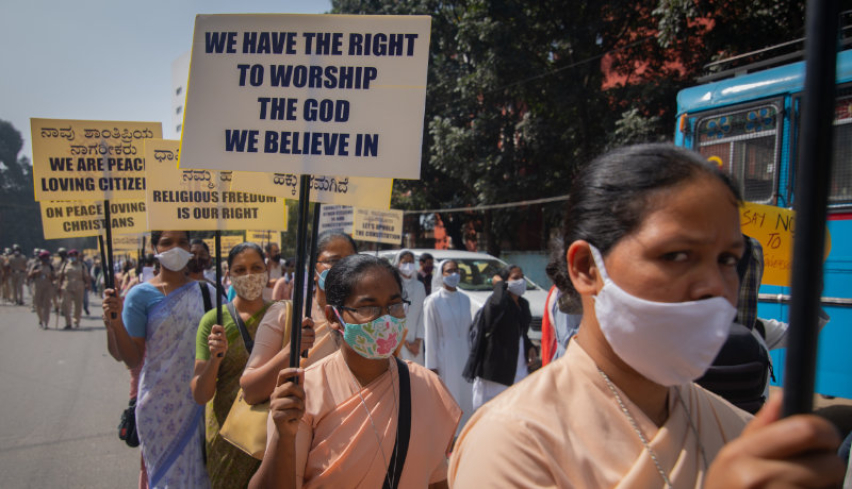
Indian Christians protesting the Protection of Right to Freedom of Religion Bill also known as the Anti-Conversion Bill makes provisions for the prohibition of unlawful conversion from one religion to another by force, allurement, or by any fraudulent means with punishments ranging between a minimum of three years and a maximum of 10 years along with monetary penalties. Abhishek Chinnappa/Getty Images


A devastating wave is crashing over South Asia, wreaking havoc on those who choose to follow a faith other than the majority. It is a wave of anti-Christian sentiment. So-called “Freedom of Religion” and “Anti-Blasphemy” laws fuel it, generating a powerful undercurrent of distrust and disdain toward Christians.

They suppress one of the most basic human rights: the right to worship without government interference. India and Pakistan stand out as countries where this hostility results in unsubstantiated accusations, unjust arrests, and violence.

Sovereign states almost universally agree on protecting an individual’s right to choose their faith.

Sovereign states almost universally agree on protecting an individual’s right to choose their faith and peacefully practice and share it as they see fit. In fact, 175 of the 193 United Nations members are parties to the UN International Covenant on Civil and Political Rights.

This instrument, designed by the UN to protect citizens from the treacherous waves of religious persecution, includes India and Pakistan among its bound members. Still, religious freedom violations persist in South Asia.

Six pastors and one Christian have recently been sentenced to five years’ imprisonment.

Thirteen of India’s 28 states have “Freedom of Religion” laws. Under Madhya Pradesh’s state “Freedom of Religion” law, six pastors and one Christian have recently been sentenced to five years’ imprisonment. The pastors attended a child’s birthday party hosted by a Christian family. An uninvited neighbor showed up intoxicated and began to cause a commotion, inciting over 100 people to rage against the Christian family.

A guest called police to restore order. The neighbor consequently filed charges against the pastors. The charges led to convictions, despite testimony from the party host disputing any wrongdoing.

In Pakistan, anti-Christian sentiment has recently resulted in a large mob trapping between 10 and 15 Christian families in their homes.

In Pakistan, anti-Christian sentiment has recently resulted in a large mob trapping between 10 and 15 Christian families in their homes after an anonymous package containing a burned Quran was mailed to a shopkeeper, alleging that a Christian had desecrated the Quran. The accused and his family had to be evacuated with the aid of an armored police escort.

We applaud the government for stepping in to help. Still, one has to wonder whether it would have been necessary if the government had reformed the laws that fuel anti-Christian sentiment and, in doing so, rescued the country as a whole.

As Christians, we stand against conversion by coercion, fraud or force.

Following Jesus is a choice that each person must make on their own. As Christians, we stand against conversion by coercion, fraud or force. We believe that governments have an obligation to protect their citizens from all manner of exploitation, even religious exploitation. Laws protecting people from coercion, force and fraud are one thing. Laws that prohibit people from hearing about or choosing another religion are a completely different matter.

One enforces human rights; the other violates them. Ironically, the so-called “Freedom of Religion” laws place people in bondage by restricting their free speech and their ability to proclaim and live out their faith freely.

Thursday, September 17, 2026

National Reform and the Rights of Conscience (with text) | A. T. Jones


National Reform and the Rights of Conscience (with text) | A. T. Jones
EllenWhiteAudio - English

Sep 16, 2026  Pamphlets – A. T. Jones Audiobooks

National Reform and the Rights of Conscience, by A. T. Jones (1889), answers the National Reform movement, which sought to amend the United States Constitution and set up a so-called Christian government. Jones shows that such a scheme would shut every honest dissenter out of citizenship while rewarding hypocrisy, and that the "liberty" it promised is the same kind the Papacy and the Inquisition were willing to grant. A clear, timely defense of religious liberty and of every person's right to worship God according to conscience. This edition shows the full text on screen, so you can read along as you listen.

📖 Listen to more pamphlets by A. T. Jones:
   • Pamphlets – A. T. Jones Audiobooks  

💝 Help us make more materials:
https://www.aplib.org/donate/

🎧 Listen online or download this and other audiobooks to your device at:
https://www.ellenwhiteaudio.org/

📱 Follow us on our social media:
• Facebook:   / ellenwhiteaudio  
• Instagram:   / ellenwhiteaudio  

📚 To know and learn more about our pioneers, visit:
https://www.aplib.org/

Alonzo Trevier Jones (1850–1923) was a prominent Seventh-day Adventist minister, editor, and theologian who played a central role in the 1888 Minneapolis Conference. Known for his powerful preaching on righteousness by faith and religious liberty, his writings remain an important part of the Adventist theological heritage.

Monday, September 14, 2026

Islam Expert: You Should Be Worried About Their Plan


No.1 Islam Expert: You Should Be Worried About Their Plan

Real Life with Jack Hibbs and Calvary Chapel Chino Hills

 Streamed live on Sep 9, 2026

Dr. Jay Smith, the world's leading expert on Islam, will talk on the subject of Islam and the hidden political agenda built in to their belief system. 


Thursday, September 03, 2026

How Frederick Douglass Escaped Slavery


Douglass looked back on September 3, 1838 as the day when his “free life began,” but he encountered several close calls during his journey to freedom.


Bettmann / Getty Images


Published: September 03, 2013 Last Updated: May 27, 2025

Never had Frederick Douglass been so nervous. The butterflies in his stomach fluttered with every bounce of the carriage over Baltimore’s cobblestone streets as he approached the Baltimore and Ohio railroad station. The enslaved man, then known by his birth name of Frederick Augustus Washington Bailey, was embarking on a perilous journey with New York—and freedom—his intended destinations.

After Douglass’ attempt to escape slavery two years prior was betrayed by a fellow enslaved person, he had been jailed, sent to Baltimore by his master and hired out to work in the city’s shipyards. Undeterred, Douglass vowed to try to escape again on September 3, 1838, although he knew the risk. “I felt assured that if I failed in this attempt, my case would be a hopeless one,” he wrote in his autobiography. “It would seal my fate as a slave forever.”

Douglass disguised himself as a free Black sailor, a creditable ruse given the nautical knowledge he gained from working on the waterfront. He also knew that the deference shown to sailors in a seafaring city such as Baltimore could work to his benefit. He donned a red shirt and sailor’s hat and loosely knotted a black cravat around his neck. Into his pocket, Douglass stuffed a sailor’s protection pass, which he could present in lieu of the “free papers” that railroad officials required Black passengers to carry as proof they were not enslaved. Douglass had borrowed the document from a free African American seaman, but he bore little resemblance to the physical description detailed on the piece of paper. Close examination by a railroad official or any authority would reveal the subterfuge and imperil both Douglass and his friend.

To avoid the scrutinizing eyes of the ticket agent inside the station, Douglass waited and jumped on the moving train at the last moment as it began to puff its way north. Many minutes passed before the conductor finally entered the segregated passenger car bearing the train’s African-American riders. Although Douglass remained calm on the outside, his heart pounded as the conductor carefully inspected the passengers’ free papers. “My whole future depended upon the decision of this conductor,” he wrote.


Illustrations depicting Frederick Douglass’s life from slavery to abolitionist.
Photo12/UIG/Getty Images

Monday, August 31, 2026

Praxis Over Dogma EG White vs Dr Thurman vs Dr Cone


Praxis Over Dogma EG White vs Dr Thurman vs Dr Cone

Fred Ball
 Aug 24, 2026

Sponsored by FD Ball Faith and Finance Advisors, this animated video stages a profound, intergenerational dialogue introducing Dr. Howard Thurman and Dr. James H. Cone to Ellen G. White’s 1891 address, "Our Duty to the Colored People". The video contrast-maps White’s practical, institutional efforts to uplift the oppressed in the Jim Crow South against Thurman’s psychological armor for those with their backs against the wall and Cone’s radical, systemic demands for total black liberation.

Tuesday, August 11, 2026

Americans’ role in the surveillance state


The United States is quickly becoming a surveillance state. While this rightly concerns many people, I don’t think they realize how much of a role they play in this trek toward a dystopian future.
People are concerned about Flock and other license plate readers, never considering that it’s our desire for government to keep us safe that is driving the need for surveillance. To make matters worse, many are hoping the federal legislation will help protect their privacy. I guess many Americans are willing to trade a federal government with limited and enumerated powers for protection against the nightmare they created.

Meanwhile, cities and states across the nation are passing gun-owner control laws, forgetting that it is often lawful gun-owners who are saving the day while others wait for the police to show up. Maybe, if more people defended themselves and their family, police wouldn’t need all this surveillance tech.

The Constitution Study with Paul Engel on America Out Loud Talk Radio can be heard weekdays at 4:00 p.m. ET. Listen on iHeartRadio, our world-class media player, or our free Apple, Android, or Alexa apps. Listen to other episodes of The Constitution Study, which are available on podcasts.

Transcript Summary of this podcast episode ⤵


Americans are being told that more surveillance is the price of safety. License plate readers, body cameras, digital IDs, car kill switches, and age verification rules are all sold as common-sense protections. The pitch sounds comforting. Trust the system, and it will keep you safe.

But safety without liberty is not security. It is submission.

The Constitution protects us from unreasonable searches and seizures. It does not promise freedom from being recorded in public. The real danger comes later, when data is stored, shared, searched, and used without meaningful limits. That is where the line is crossed. A camera on a street corner is one thing. A searchable database of everywhere you have been, every plate you passed, every movement logged and cataloged, is something else entirely.

The same problem appears in other forms. Government wants to decide when your car may start, what your child may see online, and which shoppers qualify for subsidized food. Each plan is wrapped in concern for public welfare. Each one shifts power away from families, property owners, and citizens, and toward distant officials who know little about your life.

That is the trade many Americans keep making. We ask government to protect us, then act surprised when it starts controlling us. We want crime prevented, children shielded, and order restored. Those are worthy goals. Yet every new layer of control teaches the public to depend less on themselves and more on force from above.

A free people do not survive by outsourcing responsibility. They survive by taking it back.

If liberty means anything, it means ordinary citizens must defend their rights, train their children, watch out for one another, and demand real limits on government power. Otherwise, the surveillance state will keep growing, not because it was imposed on us all at once, but because too many of us welcomed it one convenience at a time.


Friday, January 30, 2026

The Coming Showdown: Trump’s Insurrection Act Gambit and America’s Final Tribal War


01/21/2026 // Mike Adams 


Introduction: The Final Battle for America's Soul

According to insider reports, President Donald Trump is preparing to declare victory on November 5th and then immediately invoke the Insurrection Act upon taking office in January 2025. This will complete a political coup designed to trigger planned Leftist uprisings across major U.S. cities. The declaration will be used to authorize federal troops to engage in violent uprisings against political dissidents and non-citizens. Such a move is not mere political strategy; it represents the final battle in an American tribal war between two monstrous, irreconcilable systems of control, each seeking to impose its own form of tyranny over the people.

The American people are now trapped on a battlefield not of their own making. On one flank stands a Democrat faction that, as reported by NaturalNews.com, has shown it will use 'tyranny, censorship, and authoritarianism as weapons' and has taught conservatives 'to take no prisoners when the actual conflict begins' [1]. On the other flank stands a Republican faction, represented by Trump, that is reportedly preparing to use federal power to crush dissent. Caught in the middle are the people, whose constitutional rights and personal liberties are the first casualties in this final war for the nation's soul.

Tuesday, January 13, 2026

Hegseth Brings 'Arsenal of Freedom' Tour to Lockheed Martin’s Fort Worth F-35 Plant


Hegseth Brings 'Arsenal of Freedom' Tour to Lockheed Martin’s Fort Worth F-35 Plant


by Fort Worth Inc. Staff

Jan. 12, 2026

5:45 p.m.


Lockheed Martin


Speaking on the factory floor in front of a newly completed F-35, Hegseth thanked the more than 600 employees in attendance for their role in equipping the U.S. military.

Lockheed Martin on Monday welcomed U.S. Secretary of War Pete Hegseth to its F-35 Lightning II production facility in Fort Worth as part of his nationwide Arsenal of Freedom Tour, a visit that highlighted the company’s central role in U.S. defense manufacturing and a record year for the world’s most advanced fighter aircraft.

Hegseth toured the F-35 final assembly line, met with Lockheed Martin executives, and addressed more than 600 employees inside the sprawling North Texas facility, which employs roughly 19,000 workers. The Fort Worth plant is the sole final assembly site for the F-35 and anchors a national supply chain of more than 1,900 suppliers, over half of them small businesses.

“I’m looking out into an incredible audience of Americans here who are committed to an incredible company that’s building incredible platforms,” Hegseth told employees. “Thank you for accepting and grasping the challenge of President Trump as well as our department. We are shoulder to shoulder with you because we can’t deter the next conflict without the skills and capabilities you have.”

Friday, November 07, 2025

Pope Leo meets Palestinian president, calls for two-state solution to "end the conflict" in the Middle East


By Chris Livesay

November 6, 2025 / 11:36 AM EST / CBS News

Rome — Pope Leo XIV met Palestinian President Mahmoud Abbas at the Vatican on Thursday, marking their first in-person encounter since the Chicago native was chosen to lead the Catholic Church in May. The two had spoken previously on the phone.

The hour-long meeting, described by the Holy See as "cordial," focused on the humanitarian crisis in Gaza and renewed calls for a two-state solution, a position the Vatican has consistently promoted as the only viable path to peace between Israelis and Palestinians.

The talks came nearly a month after a U.S.-brokered ceasefire took hold in Gaza, bringing a fragile calm following two years of conflict that began with Hamas' Oct. 7, 2023, terrorist attack on Israel.

According to a Vatican statement, both leaders agreed on "the urgent need to provide assistance to the civilian population in Gaza," and to "end the conflict by pursuing a two-state solution," which would see an independent Palestinian state created alongside Israel.


Pope Leo XVI meets with President of the State of Palestine Mahmoud Abbas during an audience at the Apostolic Palace, Nov. 6, 2025, in Vatican City.Simone Risoluti/Vatican Media via Vatican Pool/Getty

Abbas' visit also marked the 10th anniversary of the "Comprehensive Agreement" signed in 2015 between the Holy See and the State of Palestine — which saw the Vatican, like a rising number of countries, formally recognize Palestinian statehood.