A therapist told me my mom and dad were causing all my problems—so I cut them off for five years.
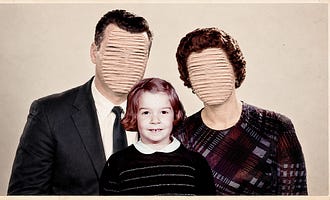
In 2008, Christina Buttons took the advice from her therapist to cut off her parents completely. (Illustration by The Free Press)
By Christina Buttons
08.12.26 —Culture and Ideas
Book reviews, cultural critiques, essays on the zeitgeist, and profiles of the avant-garde.
“We have two adult children, a son aged 30 and a daughter aged 27. We are estranged from them both,” wrote a 60-year-old mom.
“Our oldest son, 27, has gone no contact with our entire family,” wrote a 57-year-old mom.
“It seems like she’s been influenced by the “no contact” movement too common in her generation, which rejects normal parents as toxic,” wrote yet another mom, this one 55, whose daughter doesn’t speak to her.
I’ve read so many messages from people who are desperately sad that their adult children don’t talk to them. That’s because I’m the editor of Tough Love with Abigail Shrier, our weekly advice column, so it’s my job to sort through the letters she gets. You ask: How do you rebuild a relationship with your son when you’ve been cut off? If your daughter’s decided you’re toxic, how do you cope with the pain?
At the heart of these questions is another, even deeper one: How could my own child reject me like this?
In her essay today, Christina Buttons answers that question—explaining why she went no contact with her parents for five years, at the age of 19, and why she’ll always regret it.
If you’re one of the many people who’s told us that your child isn’t speaking to you right now: This is proof that there’s always hope.
—Freya Sanders
***
When I was 19, my therapist told me I was not safe living with my parents.
It was 2008, and I had been struggling with suicidal thoughts for a little while. I had admitted this to my best friend, who recommended her therapist to me, and in the months that followed, that therapist told me that my parents were “toxic” and “coercive”; I needed “boundaries.” Suddenly, all my problems had a tantalizingly simple root cause: my mom and dad.
So, I cut them off completely. I didn’t speak to them for five years. Now, I deeply regret it.
Nearly two decades later, the framework that felt revelatory to me at the time is everywhere. More people than ever are in therapy, and therapeutic language increasingly shapes how we understand family conflict. Going no contact with a relative is described as “self-care.” Painful experiences are “trauma”; hurtful words are “abuse.” Today, 10 percent of the U.S. population is estranged from a parent or child. And as The Wall Street Journal recently reported, increasing numbers of them are being encouraged to do so by their therapists.
I know firsthand how destructive this can be. I hope my story gives others reason to think carefully before allowing a therapist to help them sever a family relationship.
***
When I started middle school, I was painfully shy, sensitive, and insecure, and I struggled to make friends. I didn’t confide much in my parents, partly because I was a poor communicator, and partly because I did not want to draw attention to myself. I kept my struggles hidden for as long as I could, but when I was 12, a school counselor noticed that I was depressed. She encouraged my parents to seek professional help.
That’s when I started seeing a therapist for the first time. This therapist tried to talk to me in an infantilizing way, using puppets. I did not respond to her approach and after several sessions, I refused to continue seeing her. I continued to withdraw, spending more time alone on my computer, and my mental health only deteriorated further. Over the next few years, I was severely disturbed: I engaged in self-harm, developed an eating disorder, abused drugs, and cycled through emergency rooms, psychiatric hospitals, group homes, and outpatient day treatment programs. At age 15 I created a Myspace account, and was groomed online and then sexually assaulted by a man in his late 40s. Immediately afterward, I attempted suicide, wound up in the emergency room, and had another psychiatric hospital stay. This time, my parents realized it was not safe for me to live at home anymore. They sent me to live at a psychiatric residential treatment facility in Utah for a year.
It was a difficult decision for them, and being away was difficult for me. But the program helped me turn things around. I credited it with saving my life. In Utah, I had an excellent therapist who taught me to challenge my negative thinking, take responsibility for my actions, and communicate more effectively with my parents. They were closely involved in my treatment, and over time our relationship significantly improved. I returned home shortly before my 17th birthday, completed a step-down program, finished high school, enrolled in community college, worked part-time retail jobs at the mall, and began my first serious relationship.
Things were good for a while.
Two years later, that began to change. My relationship had ended, and I had stopped attending college because I didn’t know what I wanted to study. Though I was working part-time as a nanny, my parents expected me to attend school or work full-time if I were going to live at home. But I mostly wanted to make friends, date, and have experiences I felt I had missed out on as a teenager. Tensions between us were growing.
That’s when the suicidal thoughts reemerged, and I started going to my friend’s therapist.
This was the first therapist I’d seen as an adult. When I was a teenager, my therapists were in regular communication with my parents, so when I complained about something that happened at home, they could hear another account and challenge my interpretation. But in my new therapist, I had someone I could vent to who didn’t know their side of the story. I liked that.
I didn’t speak to my parents for five years. Now, I deeply regret it.
The problem was that I was not especially good at judging conflicts myself. My early teen years—when I should have been developing my social skills and impulse control, and learning how to regulate my emotions—had been tumultuous. While my peers were laying the groundwork to be independent, I spent most of those years being kept alive in hospitals and treatment centers. I entered adulthood naive and highly malleable.
As I documented in my journal at the time, my new therapist recognized that I had the emotional maturity of someone much younger. Yet she seemed to treat my narration of events as fully reliable, while often undermining my parents by characterizing their expectations and reactions as unreasonable. I told her about the time that I had allowed my best friend to throw a party at my parents’ house while they were away, and how they were very upset and felt that I had betrayed their trust. My therapist told me they had overreacted and that this was a normal thing for a teenager to do.
Up to that point, I had associated the word abuse with the physical or sexual kind, but she began teaching me about emotional, verbal, and psychological abuse—and began encouraging me to see some of my own experiences as belonging to those categories. For example, my parents frequently reminded me that they were still paying for certain things, such as my phone service, and that this came with certain expectations. Looking back, I think what they said was fair—they were encouraging me to be independent—but my therapist described it as a form of “coercive control,” a term originally developed to describe patterns of domination within intimate-partner relationships. She was the expert, so I believed her. She recommended books like Adult Children of Abusive Parents and Toxic Parents. And as I continued seeing her, I began pulling back from my parents, spending more and more time away from home.
When I began therapy in January 2008, I had been skeptical of my therapist’s insistence on revisiting the past. After a few months, I was writing that “there is so much more I will need to work through now.”
The breaking point came in April of that year, when my parents went out of town, trusting me to watch the house and take care of the family dog. I let my best friend, the same friend who had recommended the therapist, invite over a man she was dating, who stole jewelry from my parents’ bedroom. They were understandably furious. There was a major confrontation in the aftermath, and I thought I had irreparably damaged our relationship. “Everything I had worked so hard to gain with my parents is soon about to be gone,” I wrote in my journal.
(Courtesy of the author)
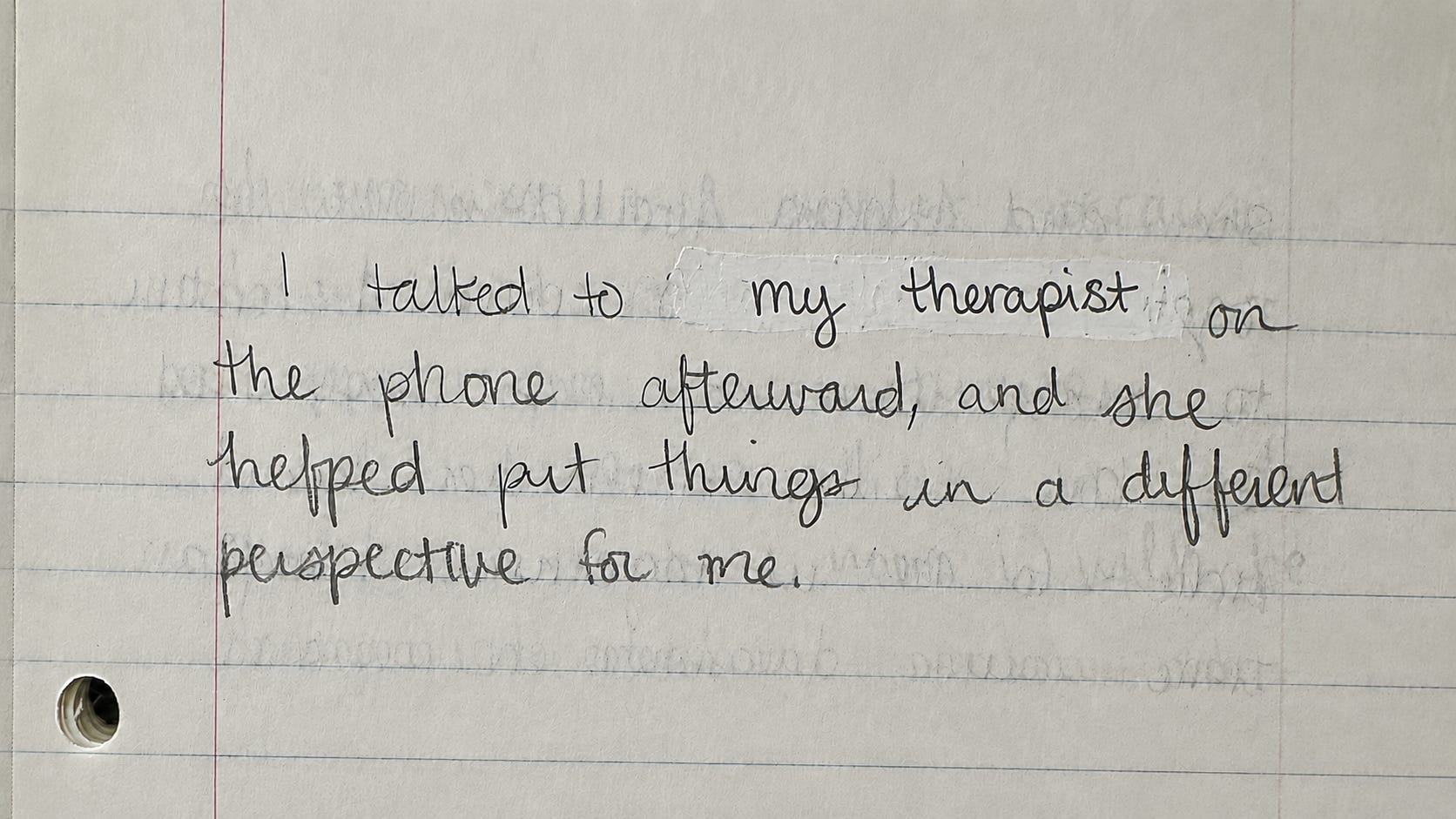
Then, I called my therapist, and my understanding of the event fundamentally changed. She “helped put things in a different perspective for me,” I wrote. According to the trauma framework she had been teaching me, painful childhood experiences could continue shaping a person’s difficulties long into adulthood. She encouraged me to understand myself as a victim of abuse and to see my depression, self-destructive behavior, and other problems as consequences of what had happened to me. Instead of viewing the confrontation primarily as a response to what I had done, I began to see it as part of a larger pattern of harm.
Once I began reinterpreting my life through this framework, old events took on different meanings. Growing up, my parents were frequently frightened by and angry about the dangerous choices I was making—using drugs, for example, or sneaking out at night. They sometimes said hurtful things to me. My therapist and I discussed these experiences, often stripped of the context in which they had occurred. I increasingly adopted the language she used: toxic, trauma, boundaries. She repeatedly described my parents’ language as evidence of verbal and emotional abuse.
By cutting off my parents, I caused myself far more pain and suffering than I would have experienced otherwise.
“I now realize the extent of the abuse and the consequences it has had on me,” I wrote in my journal. I began to downplay the severity of my own out-of-control behavior and discount how much effort my parents had made to help me. Even the residential treatment center that I had once credited with saving my life became evidence of mistreatment. Instead of remembering how troubled I had been, and how much it had helped me improve, I wrote that my parents’ decision to place me there was extreme and unwarranted.
Looking back, I understand why this way of thinking was so seductive. For years, I had struggled to explain why my life had gone so dramatically off course. The trauma framework offered a simple answer, and it gave me relief by shifting responsibility for what had gone wrong away from me. My depression, low self-worth, self-harm, and years of psychiatric crises could all be traced back to the same source: my parents. “I’ve finally found the missing piece to the puzzle,” I wrote. “It all makes sense now.”
Then, I called my therapist, and my understanding of the event fundamentally changed. She “helped put things in a different perspective for me,” I wrote. According to the trauma framework she had been teaching me, painful childhood experiences could continue shaping a person’s difficulties long into adulthood. She encouraged me to understand myself as a victim of abuse and to see my depression, self-destructive behavior, and other problems as consequences of what had happened to me. Instead of viewing the confrontation primarily as a response to what I had done, I began to see it as part of a larger pattern of harm.
Once I began reinterpreting my life through this framework, old events took on different meanings. Growing up, my parents were frequently frightened by and angry about the dangerous choices I was making—using drugs, for example, or sneaking out at night. They sometimes said hurtful things to me. My therapist and I discussed these experiences, often stripped of the context in which they had occurred. I increasingly adopted the language she used: toxic, trauma, boundaries. She repeatedly described my parents’ language as evidence of verbal and emotional abuse.
By cutting off my parents, I caused myself far more pain and suffering than I would have experienced otherwise.
“I now realize the extent of the abuse and the consequences it has had on me,” I wrote in my journal. I began to downplay the severity of my own out-of-control behavior and discount how much effort my parents had made to help me. Even the residential treatment center that I had once credited with saving my life became evidence of mistreatment. Instead of remembering how troubled I had been, and how much it had helped me improve, I wrote that my parents’ decision to place me there was extreme and unwarranted.
Looking back, I understand why this way of thinking was so seductive. For years, I had struggled to explain why my life had gone so dramatically off course. The trauma framework offered a simple answer, and it gave me relief by shifting responsibility for what had gone wrong away from me. My depression, low self-worth, self-harm, and years of psychiatric crises could all be traced back to the same source: my parents. “I’ve finally found the missing piece to the puzzle,” I wrote. “It all makes sense now.”
(Courtesy of the author)
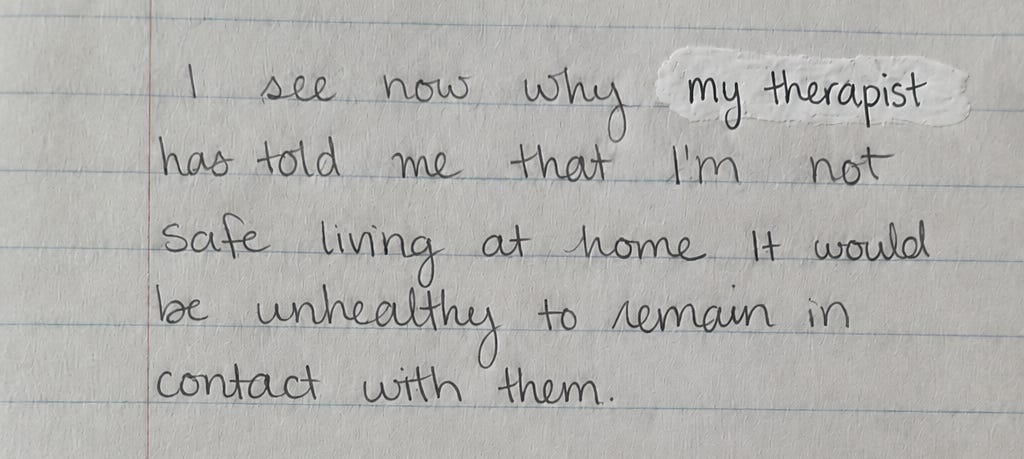
My therapist also taught me to think about safety in psychological terms. Before that, I had associated being unsafe with the threat of physical harm. Now I understood that a home could be unsafe because of its emotional effects on me. In the same journal entry, I wrote: “I see now why my therapist has told me that I’m not safe living at home. It would be unhealthy to remain in contact with them.”
Three months after starting therapy, I was no longer living at home. I moved into my best friend’s house, paid back my parents for the value of the stolen jewelry, got my own phone service, and changed my number. I did not provide them with any explanation. “I’m just going to have to make it on my own now,” I wrote in my journal.
I would not speak to my parents for the next five years.
My therapist also taught me to think about safety in psychological terms. Before that, I had associated being unsafe with the threat of physical harm. Now I understood that a home could be unsafe because of its emotional effects on me. In the same journal entry, I wrote: “I see now why my therapist has told me that I’m not safe living at home. It would be unhealthy to remain in contact with them.”
Three months after starting therapy, I was no longer living at home. I moved into my best friend’s house, paid back my parents for the value of the stolen jewelry, got my own phone service, and changed my number. I did not provide them with any explanation. “I’m just going to have to make it on my own now,” I wrote in my journal.
I would not speak to my parents for the next five years.
***
To be clear: I take a great deal of responsibility for my separation from my parents. It was my decision to estrange myself, and in particular, to continue the estrangement long after I stopped seeing that therapist. But going no contact was not my idea. My therapist gave me the language and therapeutic rationale that made separation seem not merely justified, but healthy. Once I believed that contact itself was harmful, repairing the relationship was no longer my goal.
Therapists like the one I had are teaching patients to embrace profoundly backward philosophies. Families inevitably produce conflict. Parents inevitably disapprove of their children’s choices, lose their tempers, make mistakes, and say things they regret. Children do the same. If people are taught to perceive these experiences as evidence of psychological harm, normal family relationships will never survive.
I understand why these attitudes take hold. The trauma framework gives coherence to complicated life histories. For me, it explained years of turmoil. Later in my life, I had a similar experience when I was falsely diagnosed with autism: Once again, I had a simple framework to explain my struggles—one that turned out to be entirely wrong.
By cutting off my parents, I caused myself far more pain and suffering than I would have experienced otherwise. Once I was on my own, my circumstances became increasingly precarious. I found myself in desperate situations and made choices that exposed me to serious harm, some with consequences that still affect my life today. I often wish I had not removed from my life the people who cared about me enough to try to stop me. Though I eventually returned to college at age 22, I made many decisions that I deeply regret in the intervening years—primary among them, the pain I caused my parents.
But shame, combined with a healthy dose of stubbornness, sustained the estrangement still further.
Then, in 2013, my mother was diagnosed with cancer, the same disease her mother had died from when my mom was just 14. My parents no longer had my number, so they reached me through a friend. All of a sudden, the reasons I used to justify staying away seemed horribly trivial. I was living a few hours away at the time. Within days, I was by their side.
We did not relitigate the past. We simply resumed being a family, as if I had never left. My mother survived. I showed up for the medical appointments and holidays, and over time my parents and I developed the kind of close relationship I had always wanted to have. I became much more open with them, and now I share everything going on in my life with them. I eventually moved to another state, but we speak every week and see one another several times a year.
These days, I am wary of explanations that organize too much of a life around a single cause. My therapist should have helped me develop that wariness. A good therapist will challenge your cognitive distortions, help you see another point of view, and help you strengthen your family relationships, not sever them.Yes, some parents are genuinely abusive. Some family relationships should end. Mine was not one of them. My parents made mistakes—as did I—but reducing our relationship to its worst moments gave me a distorted picture of the whole. I’m sure many other adult children can say the same.
Today, outside of my husband, my relationship with my parents is the one I value most. I am 37 now and expecting my first child. I will never be able to get back the five years my parents and I lost. But I am so grateful that our estrangement did not become permanent. And I am even more grateful that in a few short months, the parents I once believed didn’t belong in my life will become grandparents to my first child.


No comments:
Post a Comment