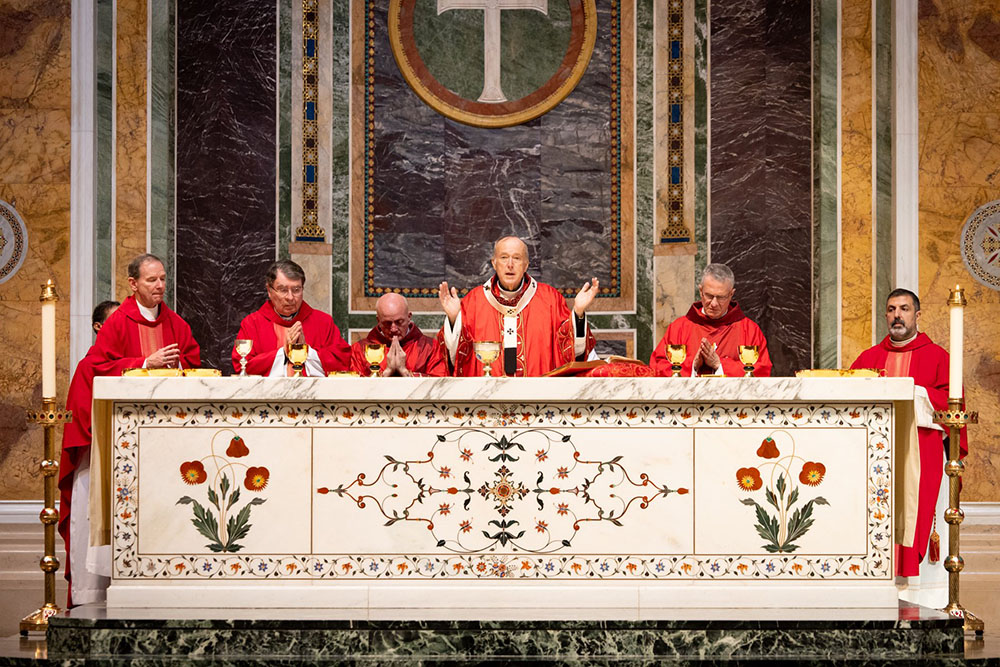
Washington Cardinal Robert McElroy, center, concelebrates the 73rd annual Red Mass at the Cathedral of St. Matthew the Apostle in Washington Oct. 5, 2025. Also pictured are Bishop Michael Burbidge of Arlington, Va.; Cardinal Christophe Pierre, the apostolic nuncio to the United States; Deacon Robert Vince, who serves at the cathedral; Archbishop Timothy Broglio of the Archdiocese for the Military Services; and Washington Auxiliary Bishop Juan Esposito. (OSV News/John Carroll Society/Christopher Newkumet)
Mark Zimmerman/Catholic Standard
View Author Profile

OSV News
Due to security concerns, no Supreme Court justices attended this year's Red Mass Oct. 5 at the Cathedral of St. Matthew the Apostle in Washington. The annual Mass prays for jurists and public officials the day before the start of the Supreme Court's term.
The Metropolitan Police Department of Washington reported that they had arrested a New Jersey man who had set up a tent on the steps of the cathedral and that they charged him with possession of explosives.
The Mass was delayed for about 20 minutes and hundreds of people waited outside before they were allowed to enter the cathedral through a side entrance.
At the Mass, Washington Cardinal Robert McElroy emphasized that "men and women of the law are architects of hope by reason of their vocation."
That hope, he said, is especially needed as the nation faces eroding faith in institutions, a collapse of political dialogue, a growth in political violence, and ongoing needs of the poor and powerless.
McElroy was the main celebrant and homilist at the 73rd annual Red Mass Oct. 5. The Red Mass, sponsored by the John Carroll Society of the Washington Archdiocese, invokes God's blessings on those responsible for the administration of justice and on all public officials. The name of the Mass stems from the red vestments worn by the presiding clergy.
Normally several Supreme Court justices attend the annual Red Mass, but as the security situation unfolded, none of the justices attended this year's Mass.
Concelebrants in 2025 included Cardinal Christophe Pierre, apostolic nuncio to the United States; Archbishop Timothy Broglio of the U.S. Archdiocese for the Military Services, who also is the president of the U.S. Conference of Catholic Bishops; Bishop Michael Burbidge and retired Bishop Paul Loverde of Arlington, Virginia; Washington Auxiliary Bishops Roy Campbell Jr. and Juan Esposito; and 12 priests, including Msgr. Ronald Jameson, the rector of St. Matthew's Cathedral.
In his homily, Washington's archbishop highlighted three key areas where people who work in the law can be architects of hope.
"The first is the crisis of institutional life in our nation. Our age has witnessed a dramatic collapse of faith in institutions of all kinds," McElroy said, noting "a corrosive instinct to attack every major institution."
Catholic social teaching, he said, "underscores that healthy governmental, cultural, religious and economic institutions are essential for the accomplishment of the common good and the service of all in the world in which we live."
The cardinal said two elements are vital to establishing healthy attitudes toward institutions.
"The first is the rejection of the hyper-criticism toward institutional life which is undermining the fundamental ability of institutions in government and society to serve the common good," the cardinal said. "The second is the reinvigoration of the countervailing forces in our government and society that constrain harmful accretions of power and delimit their proper scope."
He emphasized that men and women of the law "lie at the heart of this twofold conversation within our nation. By engaging constructively, dialogically and charitably in this conversation, you can help identify a pathway forward for us all. You can bring hope."
McElroy said a second area where people working in law can be architects of hope involves "the collapse of political dialogue within our nation and the growth of political violence. We have witnessed the assassination of Charlie Kirk and the assault on the Capitol. Both mark the progression from civil dialogue to uncivil dialogue to force and fear."
Noting that "we live at a moment in which politics is tribal, not dialogical, and where party label has become a shorthand for worldview on the most volatile topics in our national life," the cardinal said, "The result is explosive, within politics, family life, and friendships."
Whether they are students of the law, judges, legislators, public advocates or legal counsels, men and women working in the law "are by that commitment privileged and obligated to raise the plane of our political and social discussion," McElroy said, adding, "No group in our society has a greater capacity to remold our political discourse. No group has a deeper calling to bring hope."
A third key area where women and men of the law can be architects of hope, the cardinal said, was highlighted in that day's reading from the Gospel of Luke, which included the passage, "The Spirit of the Lord is upon me, because he has anointed me to bring glad tidings to the poor."
"The Scriptures point unswervingly to the need to keep the poor and the powerless at the forefront of our thoughts and actions," Washington's archbishop said.
He noted, "For in every social and economic system they are disproportionately shut out from the rights and privileges that are vital to their well-being. This includes our legal system. Whether they are those accused of crimes or those who are victims of crimes, or those who have been injured and seek civil redress, systemic inequalities in our legal system cry out for reform."
McElroy underscored how men and women involved in different aspects of the law can bring hope to the poor and other people in need.
He urged law students to make a commitment in their lives "to integrating substantive and caring pro-bono work as part of your ongoing career." Prosecutors, who often face "overwhelming caseloads," should "see the humanity deeply both in those you are prosecuting and in those who were victimized," he said.
Legislators must "provide the resources and processes necessary to make the legal rights of the poor and middle class more than theoretical," McElroy continued. "For defense attorneys, sustain hope in your own lives even when you confront injustice or indifference. For our judges, shapers of the laws that affect so many so profoundly, let the humanity and thirst for justice that led you to the law sustain and guide you, so that hope is reflected and created by your actions."
He counseled teachers of the law to "lift the minds and the hearts of your students always to the noble and the compassionate, rather than the easy or the expedient."
Closing his homily, McElroy said, "As women and men of the law, you participate in the mission of God's justice that Jesus announces in today's Gospel. May you take up the challenge to be true architects of hope, in this land, at this moment, in God's grace."
Msgr. Peter Vaghi, the longtime chaplain of the John Carroll Society, welcomed the congregation filling the cathedral.
The society is named for Archbishop John Carroll, who in 1789 became the nation's first Catholic bishop, leading the new Baltimore Diocese, which then included the territory of all 13 original states.
The Mass began with a color guard of Fourth Degree Knights of Columbus marching to the front of the cathedral bearing flags of the United States and of the Vatican, and people in the congregation sang the National Anthem.
After the Mass ended, the congregation sang "America the Beautiful," and then a recessional hymn seeking the Holy Spirit's help and guidance, "O Spirit, All Embracing."


No comments:
Post a Comment