Showing posts with label CHAVEZ. Show all posts
Showing posts with label CHAVEZ. Show all posts
Sunday, January 18, 2026
Friday, March 08, 2013
Venezuela's Chavez to be Embalmed, Displayed in Museum
Breaking News
March 07, 2013
Venezuela's Vice President Nicolas Maduro has announced that the late President Hugo Chavez will be embalmed and his body displayed forever in a Caracas military museum.
Mr. Maduro compared the late president to other revolutionary leaders whose bodies also have been preserved, including Russia's Lenin and China's Mao. He said President Chavez will lie in state for seven more days to give more Venezuelans the chance to pay their respect.
President Chavez will be honored at a state funeral Friday, attended by 30 heads of state. The United States is sending a diplomatic delegation.
Thousands of grieving Venezuelans waited for as long as 10 hours to look at Mr. Chavez's body in Caracas.
Mr. Maduro will be formally sworn in as acting president late Friday. He will likely face off in elections to be called within 30 days against opposition leader Henrique Capriles, who lost to Mr. Chavez in the October presidential polls.
President Chavez died Tuesday after a two-year fight against cancer. He was 58 years old.
Mr. Chavez, a staunch socialist, was elected president in 1998. He earned the enmity of the United States and others for such policies as nationalizing major companies and courting world leaders such as Fidel Castro, Iran's Mahmoud Ahmadinejad and Libya's Moammar Gadhafi.
The country's opposition accused him of being a dictator. But millions of poor Venezuelans revered him for using the country's vast oil wealth to give them access to low-cost food, free medical care and other social programs. However, experts say Mr. Chavez failed to control crime or use oil wealth to enrich the overall economy.
.
Wednesday, March 06, 2013


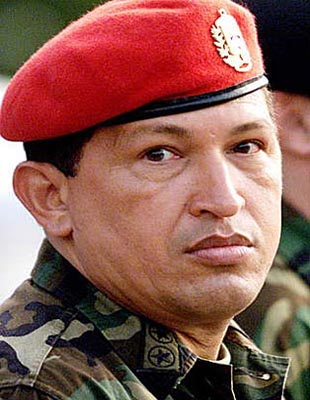


Cuban Medicine Killed Hugo Chavez
By Joel Hirst
Published February 28, 2013
Fox News Latino

There is perhaps no worse political disaster for the government of Cuba than the death of President Hugo Chávez of Venezuela. After the Soviet Union collapsed and ceased to subsidize the Castro regime, the government of Cuba went through a very difficult period. That is, until President Chávez picked up the tab.
While the real amount of the subsidy is unknown, Venezuela does send more than 115,000 barrels of oil a day to the refinery at Cienfuegos and pays for tens of thousands of Cuban doctors and sports trainers who are deployed all over Latin America. The true amount is probably significantly north of five billion dollars a year.
If there was anybody that could expect the very best Cuban medicine had to offer, it was the Castro's five billion dollar man. This makes the upcoming death of Chávez that much more embarrassing for the Castros, because the velocity at which the strongman has deteriorated is due in no small part to the incompetence of the Cuban doctors at Cimeq - the hospital of choice for the communist party leaders.
According to Dr. Jose Marquina, who has become well known for having the only information on the Venezuelan president's condition that has proved over time to be accurate, the Cuban doctors are at least partially at fault for the Venezuelan leader's imminent demise. He has said that the Cubans misdiagnosed the cancer, treating Chávez with chemotherapy and other treatments designed for the wrong type of cancer. This made the disease resistant and impossible to treat, while causing other complications which affected not only Chávez's life expectancy but also the quality of what life remained.
If President Chávez, with an unlimited wallet and access to the best Cuban medicine has to offer —as the VIP of Havana's Cimeq hospital, the hospital of the communist party leadership and Fidel himself — was assassinated by Cuban mal-practice, it begs the question what can ordinary Cubans hope for from their dilapidated dictatorship?
For Americans, subject for years to endless waves of Cuban propaganda through movies like Michael Moore's "Sicko," among so many others, at very least we now know the truth about the island dictatorship's archaic medical infrastructure. Maybe now we can turn that particular page in Cuba's ongoing propaganda war.
Joel D. Hirst is a Principal at Cordoba Group International and author of "El Teniente de San Porfirio," a novel on Socialist Venezuela by Grito Sagrado Press. He tweets @JoelHirst.
Source: http://latino.foxnews.com/latino/opinion/2013/02/28/cuban-medicine-killed-hugo-chavez/#ixzz2MjntW1GM
..
Tuesday, October 02, 2012
Hugo Chavez Supports Obama

Monday October 1, 2012 Posted 1 day, 2 hours ago by Seth Mela
Hugo Chavez: ‘If I Were American, I‘d Vote for Obama’
-TheBlaze.com
Venezuelan President Hugo Chavez has offered his endorsement of President Barack Obama’s re-election.
And not just that, he think Obama would vote for him too.
“If I were American, I’d vote for Obama,” Chavez said in a televised interview that aired Sunday, according to the Associated Press.
Chavez is seeking another six-year term in an election next weekend. According to Reuters, he’s confident that if it were possible, he‘d have Obama’s support.
“Obama is a good guy … I think that if Obama was from Barlovento or some Caracas neighborhood, he’d vote for Chavez,” he said.
It’s a kinder assessment than the one Chavez gave last year, when he reportedly called Obama “a clown” and “an embarrassment.” Chavez famously referred to then-President George W. Bush as “the devil” in 2006.
According to the AP, Chavez also said he’d like to have “normal” relations with the U.S. Obama was criticized in July after he said Chavez has not been a “serious” national security threat in recent years.
What bothers me is WHY would a man like Chavez want to support Obama? What is it about the character of both men are similar? Why does Chaves support the political agenda of Obama? These are serious issues to consider... what do you think?
Sunday, September 25, 2011
Hundreds Gather at NY Riverside Church to Pray for Health of Venezuelan President
By


Ecumenical gathering to pray for the health of Venezuelan President Hugo Chavez held on 21 September 2011 (Agencies).
The church is known around the world as a hub for progressive thought and action within the United States, the place at which Martin Luther King Jr. gave his most radical speech, Beyond Vietnam, in which he denounced his government’s use of war and destruction against the people of Vietnam.
Bolivian President Evo Morales, also in New York for the UN summit, said his prayers for Chavez were accompanied by prayers for, "peace, social justice, and the demands of our peoples."
Monday, March 15, 2010
Chavez criticises Internet freedom

All your Internet are belong to us
By Inquirer staff
By Inquirer staff
Mon Mar 15 2010, 05:52
VENEZUELA'S PRESIDENT has called for more online regulation after he wrongly fingered a website for writing about a murdered minister.
According to Reuters, Hugo Chavez was lambasted by Internet freedom groups for his call to regulate the Internet. The Venezuelan President made his remarks after he claimed that the Venezuelan online gossip site, Noticierodigital, misreported an earlier comment from Chavez about the assassination of Diosdado Cabello, a senior minister. Unfortunately for Chavez, he was incorrect in his accusation that the site misstated his words for two days.
According to Reuters, Chavez said, "The Internet cannot be something open where anything is said and done. Every country has to apply its own rules and norms."
"We have to act. We are going to ask the attorney general for help, because this is a crime. I have information that this page periodically publishes stories calling for a coup d'etat. That cannot be permitted," he continued.
Chavez has now added Venezuela to a growing list of countries that are toying with the idea of suppressing Internet freedom.
Wherever this sort of talk rears its oppressive head, whether it be in communist China, Cuba or Vietnam, socialist Venezuela, Brazil, or Scandinavia, theocracies in Iran, Saudi Arabia, Israel or other countries in the Middle East, or in the corporate dominated 'democracies' of the US, UK and Europe, we oppose it. µ
According to Reuters, Hugo Chavez was lambasted by Internet freedom groups for his call to regulate the Internet. The Venezuelan President made his remarks after he claimed that the Venezuelan online gossip site, Noticierodigital, misreported an earlier comment from Chavez about the assassination of Diosdado Cabello, a senior minister. Unfortunately for Chavez, he was incorrect in his accusation that the site misstated his words for two days.
According to Reuters, Chavez said, "The Internet cannot be something open where anything is said and done. Every country has to apply its own rules and norms."
"We have to act. We are going to ask the attorney general for help, because this is a crime. I have information that this page periodically publishes stories calling for a coup d'etat. That cannot be permitted," he continued.
Chavez has now added Venezuela to a growing list of countries that are toying with the idea of suppressing Internet freedom.
Wherever this sort of talk rears its oppressive head, whether it be in communist China, Cuba or Vietnam, socialist Venezuela, Brazil, or Scandinavia, theocracies in Iran, Saudi Arabia, Israel or other countries in the Middle East, or in the corporate dominated 'democracies' of the US, UK and Europe, we oppose it. µ
..
..
Saturday, January 23, 2010
Tens of Thousands of Venezuelans Protest Hugo Chavez

Saturday, January 23, 2010
Jan. 23: Opposition members shout slogans against Venezuela's President Hugo Chavez during a protest in Caracas.
CARACAS, Venezuela — Tens of thousands of Venezuelans opposed to President Hugo Chavez took to the streets Saturday, blaming him for rolling blackouts, water rationing, widespread crime and other problems they say are making daily life increasingly difficult.
Chavez backers flooded the capital's avenues with an equally impressive demonstration as the socialist leader confronts mounting criticism and an emboldened opposition ahead of upcoming congressional elections.
Waving Venezuelan flags, protesters accused Chavez of dragging the politically divided South American country into a severe crisis as he accelerates his drive to transform it into a socialist state.
"Chavez is leading the country to ruin," said 79-year-old Olga Damjanovich at the opposition protest. "He's controlled all the country's institutions for more than a decade, so how could it be possible that he's not responsible for the problems weighing down on us?"
Many wore T-shirts that read: "3 Strikes: Blackouts, Water Rationing and Crime. Chavez, You've Struck Out!"
Chavez backers rebutted the criticism, accusing opponents of exaggeration.
"Things aren't all as we would like them to be, but we know that El Comandante (Chavez) is doing what he can to help us, the poor," said Yorbert Rodriguez, a 39-year-old bricklayer.
Political rivals organized Saturday's demonstrations to coincide with the 52nd anniversary of an uprising that toppled Venezuela's last dictator, Gen. Marcos Perez Jimenez. Chavez allies argued that democracy is growing stronger, while government foes said their liberties are slipping away.
Opposition parties hope to make a strong showing in September's elections by holding Chavez responsible for rampant crime, a recent currency devaluation widely expected to boost inflation — which ended 2009 at 25 percent — and electricity rationing.
Chavez, a tireless campaigner who remains popular, has overcome bigger obstacles during his 11-year presidency. The former paratroop commander emerged unscathed from a botched 2002 coup and devastating two-month strike the following year.
Margarita Lopez Maya, a political science professor at the Central University of Venezuela, believes increasing numbers of Venezuelans are "putting the president's capacity to resolve problems in doubt," but they haven't embraced the opposition as a result.
"There may be doubts — even disapproval, but there's no alternative these people believe in," she said.
.
.
Source: http://www.foxnews.com/story/0,2933,583747,00.html
``
Chavez backers flooded the capital's avenues with an equally impressive demonstration as the socialist leader confronts mounting criticism and an emboldened opposition ahead of upcoming congressional elections.
Waving Venezuelan flags, protesters accused Chavez of dragging the politically divided South American country into a severe crisis as he accelerates his drive to transform it into a socialist state.
"Chavez is leading the country to ruin," said 79-year-old Olga Damjanovich at the opposition protest. "He's controlled all the country's institutions for more than a decade, so how could it be possible that he's not responsible for the problems weighing down on us?"
Many wore T-shirts that read: "3 Strikes: Blackouts, Water Rationing and Crime. Chavez, You've Struck Out!"
Chavez backers rebutted the criticism, accusing opponents of exaggeration.
"Things aren't all as we would like them to be, but we know that El Comandante (Chavez) is doing what he can to help us, the poor," said Yorbert Rodriguez, a 39-year-old bricklayer.
Political rivals organized Saturday's demonstrations to coincide with the 52nd anniversary of an uprising that toppled Venezuela's last dictator, Gen. Marcos Perez Jimenez. Chavez allies argued that democracy is growing stronger, while government foes said their liberties are slipping away.
Opposition parties hope to make a strong showing in September's elections by holding Chavez responsible for rampant crime, a recent currency devaluation widely expected to boost inflation — which ended 2009 at 25 percent — and electricity rationing.
Chavez, a tireless campaigner who remains popular, has overcome bigger obstacles during his 11-year presidency. The former paratroop commander emerged unscathed from a botched 2002 coup and devastating two-month strike the following year.
Margarita Lopez Maya, a political science professor at the Central University of Venezuela, believes increasing numbers of Venezuelans are "putting the president's capacity to resolve problems in doubt," but they haven't embraced the opposition as a result.
"There may be doubts — even disapproval, but there's no alternative these people believe in," she said.
.
.
Source: http://www.foxnews.com/story/0,2933,583747,00.html
``


Saturday, September 12, 2009
Chavez’s grip strengthens

By The Daily Progress
Published: September 13, 2009
Much diplomatic tut-tutting was sparked by Venezuelan strongman Hugo Chavez’s gift of a book to President Obama at the Summit of the Americas in April.
The book, “The Open Veins of Latin America: Five Centuries of the Pillage of a Continent,” wasn’t just an afterthought of a gift. Mr. Chavez, a political theater expert, made sure that the cameras captured the surprise gift and handshake, evidently intended to make a statement at Mr. Obama’s expense. That’s because the book makes the case against the U.S. and Europe for meddling in South America economically, politically and militarily.
President Obama sloughed off criticism of the warm greetings between the two, saying at the time that “Venezuela is a country whose defense budget is probably 1/600th of the United States’... . It’s unlikely that as a consequence of me shaking hands … with Mr. Chavez that we are endangering the strategic interests of the United States.”
Since the time of the infamous handshake, Mr. Chavez has been busy. He’s tried to prop up an ideological pal in Honduras, handed off anti-tank rocket launchers to terrorist insurgents in Colombia and closed 32 radio stations and two television stations in his own country. He’s criticized Peru for granting asylum to a leading political opponent in the 2006 Venezuelan presidential race, whom Mr. Chavez since tried to jail on corruption charges. He’s also proposed legislation prescribing prison terms for anyone convicted of “media crimes” in Venezuela.
Mr. Chavez has also been busy strengthening an axis between Venezuela and Iran. Although Iran is oil-rich, it falls about 40 percent short of its needed refining capacity. So, recently, he announced a deal to export 20,000 gallons of gasoline a day to Iran.
But in the most ominous development since the Obama-Chavez handshake, the Venezuelan leader announced plans to build what he called a “nuclear village” in Venezuela with Iranian cooperation. He offered no details, other than to defend his ally against charges it’s trying to build a nuclear weapon. CNN quotes him as saying, “Soon they will accuse us also of building an atomic bomb.”
Manhattan District Attorney Robert M. Morgenthau warned just that in a Wall Street Journal opinion piece (“The Emerging Axis of Iran and Venezuela,” Sept. 8). Pointing to a Carnegie Endowment for International Peace report, Mr. Morgenthau wrote that Venezuela has an estimated 50,000 tons of uranium ore in the ground. The report, he said, hints that Iran could be the beneficiary of any Venezuelan mining. Mr. Morgenthau’s office has investigated illegal Iranian bank transactions designed to hide the transfer of more than $300 million in cash to pay for nuclear weapons components and missiles. He wrote that his office believes Iran and Venezuela are working together to get around sanctions on weapons sales.
Mr. Chavez is opening up Venezuela to Iran because his “regime is bent on becoming a regional power and is fanatical in its approach to dealing with the U.S.,” Mr. Morgenthau said. And, he warned us all: That handshake in April “is no reason to assume the threat has diminished. In fact … we are entering a period where the fruits of the Iran-Venezuela bond will begin to ripen.”
.
Source: http://www2.dailyprogress.com/cdp/news/opinion/op_ed/article/chavezs_grip_strengthens/45280/
Note: Bolds and Italics added.
.
Tuesday, August 18, 2009
Anti-American Amigos
AUGUST 16, 2009, 11:09 P.M. ET
Anti-American Amigos
Why is the Obama administration trying to help Hugo Chavez?
Hugo Chávez took a break last week from lobbying Washington on behalf of deposed Honduran President Manuel Zelaya to travel to Quito, Ecuador, for a meeting of South American heads of state.
There he launched a virulent assault on the U.S. military, reiterated his commitment to spreading revolution in the region, and threatened the continent with war. Mr. Zelaya was by his side.
The Venezuelan's tirade against the U.S. and its ally Colombia raised the question yet again of what the U.S. could possibly be thinking in pushing Honduras to reinstate Mr. Zelaya. He was removed from office by the Honduran Congress in June because he violated the country's constitution and willfully incited mob violence.
But that's not the only thing that made him unpopular at home. He also had become an important ally of Mr. Chávez and was quite obviously being coached to copy the Chávez power grab in Venezuela by undermining Honduras's institutional checks and balances.
If Honduras has been able to neutralize Mr. Chávez, it's something to celebrate. A Chávez-style takeover of institutions in Bolivia, Ecuador and Nicaragua has quashed political pluralism, free speech and minority rights in those countries. There is now a heavy presence of Cuban state intelligence throughout the Venezuelan empire. Mr. Zelaya literally has become a fellow traveler of Mr. Chávez, leaving no doubts about the course he would put Honduras on if given the chance.

As a U.S. senator, Mr. Kerry has the luxury of treating Latin America like his playground, as Democrats have done for decades, foisting on it ideas that Americans reject. Venezuelans still recall how Connecticut's Chris Dodd played the role of chief Chávez cheerleader in the Senate while the strongman was consolidating power.
But Mr. Obama is the president and commander in chief, and millions of people in this hemisphere are counting on the U.S. to stand up to Venezuelan aggression. Playing footsie under the table with Mr. Chávez on Honduras while the Venezuelan is threatening the peace isn't going to fly in a hemisphere that prefers liberty over tyranny.
Both Colombian and U.S. officials allege that the Venezuelan National Guard and high-ranking members of Mr. Chávez's government are in cahoots with criminal enterprises that run drugs in South America. The evidence suggests an alliance between the terrorist Revolutionary Armed Forces of Colombia (FARC)—the largest exporter of cocaine from that country—and members of Mr. Chávez's cabinet. There is also evidence in documents and video captured from the FARC that the rebels have influence at high levels of the Ecuadoran government.
The cocaine business is a big revenue raiser for the terrorist organization and for its business partners on the continent. This is why Colombian President Alvaro Uribe has agreed to allow U.S. drug-surveillance planes to use Colombian military bases.
In Quito, Mr. Chávez flew into a rage about that agreement. "The U.S. is the most warlike government in the world," he told his South American peers and Mr. Zelaya. "The Yankee military pays no mind to its president," he said, artfully exempting Barack Obama from blame. "In Colombia [the U.S. military] has immunity. They can rape women, they can kill and they can destroy in every direction. You can't do anything to them. It's horrible."
The military-bases agreement is far more limited than what Mr. Chávez claimed, but he wasn't about to miss an opportunity to ratchet up the tension. "The winds of war are starting to blow," he warned.
His counterparts didn't buy it. Colombia was not condemned in Quito, largely because key members of the group didn't want their own sovereign decisions subject to continental review. But Mr. Chávez is not going away. He has pledged to continue with efforts to destabilize surviving democracies.
Honduras remains a target. Argentina is also in his sights. In an interview with the Argentine daily La Nación, he spoke of his alliance with Argentina's President Cristina Kirchner. "We are going to work to reinforce the Caracas-Buenos Aires axis, which is a central axis," Mr. Chávez said. "Like the Caracas-Quito axis, the Caracas-Buenos Aires axis is fundamental for the integration."
The U.S. war on drugs has been a colossal failure because of the large cocaine market in the U.S. The tragedy—beyond the violence it creates—is that criminal enterprises, flourishing because of U.S. customers, wreak havoc on frail institutions. That's bad enough. But the Obama administration pours salt in that gaping wound by refusing to support the U.S.-Colombia Free Trade Agreement our ally has asked for, and now by backing Mr. Chávez's Honduran pawn.
Anti-American Amigos
Why is the Obama administration trying to help Hugo Chavez?
Hugo Chávez took a break last week from lobbying Washington on behalf of deposed Honduran President Manuel Zelaya to travel to Quito, Ecuador, for a meeting of South American heads of state.
There he launched a virulent assault on the U.S. military, reiterated his commitment to spreading revolution in the region, and threatened the continent with war. Mr. Zelaya was by his side.
The Venezuelan's tirade against the U.S. and its ally Colombia raised the question yet again of what the U.S. could possibly be thinking in pushing Honduras to reinstate Mr. Zelaya. He was removed from office by the Honduran Congress in June because he violated the country's constitution and willfully incited mob violence.
But that's not the only thing that made him unpopular at home. He also had become an important ally of Mr. Chávez and was quite obviously being coached to copy the Chávez power grab in Venezuela by undermining Honduras's institutional checks and balances.
If Honduras has been able to neutralize Mr. Chávez, it's something to celebrate. A Chávez-style takeover of institutions in Bolivia, Ecuador and Nicaragua has quashed political pluralism, free speech and minority rights in those countries. There is now a heavy presence of Cuban state intelligence throughout the Venezuelan empire. Mr. Zelaya literally has become a fellow traveler of Mr. Chávez, leaving no doubts about the course he would put Honduras on if given the chance.

Getty Images
Venezuelan President Hugo Chávez salutes Raul Castro while Argentine President Cristina Kirchner looks on in Caracas, Venezuela, Aug. 11.
Venezuelan President Hugo Chávez salutes Raul Castro while Argentine President Cristina Kirchner looks on in Caracas, Venezuela, Aug. 11.
Among the theories making the rounds about Mr. Obama's motivations in trying to force Honduras to take Mr. Zelaya back, there is the hypothesis that this administration is tacking hard to the left. Mr. Obama has expressed the same views on Honduras as Sen. John Kerry (D., Mass.), who holds that the interim government must be forced to reinstate Mr. Zelaya and who has, over more than two decades in office, consistently allied himself with socialist causes in Latin America.
The Americas in the News
Get the latest information in Spanish from The Wall Street Journal's Americas page.
Get the latest information in Spanish from The Wall Street Journal's Americas page.
As a U.S. senator, Mr. Kerry has the luxury of treating Latin America like his playground, as Democrats have done for decades, foisting on it ideas that Americans reject. Venezuelans still recall how Connecticut's Chris Dodd played the role of chief Chávez cheerleader in the Senate while the strongman was consolidating power.
But Mr. Obama is the president and commander in chief, and millions of people in this hemisphere are counting on the U.S. to stand up to Venezuelan aggression. Playing footsie under the table with Mr. Chávez on Honduras while the Venezuelan is threatening the peace isn't going to fly in a hemisphere that prefers liberty over tyranny.
Both Colombian and U.S. officials allege that the Venezuelan National Guard and high-ranking members of Mr. Chávez's government are in cahoots with criminal enterprises that run drugs in South America. The evidence suggests an alliance between the terrorist Revolutionary Armed Forces of Colombia (FARC)—the largest exporter of cocaine from that country—and members of Mr. Chávez's cabinet. There is also evidence in documents and video captured from the FARC that the rebels have influence at high levels of the Ecuadoran government.
The cocaine business is a big revenue raiser for the terrorist organization and for its business partners on the continent. This is why Colombian President Alvaro Uribe has agreed to allow U.S. drug-surveillance planes to use Colombian military bases.
In Quito, Mr. Chávez flew into a rage about that agreement. "The U.S. is the most warlike government in the world," he told his South American peers and Mr. Zelaya. "The Yankee military pays no mind to its president," he said, artfully exempting Barack Obama from blame. "In Colombia [the U.S. military] has immunity. They can rape women, they can kill and they can destroy in every direction. You can't do anything to them. It's horrible."
The military-bases agreement is far more limited than what Mr. Chávez claimed, but he wasn't about to miss an opportunity to ratchet up the tension. "The winds of war are starting to blow," he warned.
His counterparts didn't buy it. Colombia was not condemned in Quito, largely because key members of the group didn't want their own sovereign decisions subject to continental review. But Mr. Chávez is not going away. He has pledged to continue with efforts to destabilize surviving democracies.
Honduras remains a target. Argentina is also in his sights. In an interview with the Argentine daily La Nación, he spoke of his alliance with Argentina's President Cristina Kirchner. "We are going to work to reinforce the Caracas-Buenos Aires axis, which is a central axis," Mr. Chávez said. "Like the Caracas-Quito axis, the Caracas-Buenos Aires axis is fundamental for the integration."
The U.S. war on drugs has been a colossal failure because of the large cocaine market in the U.S. The tragedy—beyond the violence it creates—is that criminal enterprises, flourishing because of U.S. customers, wreak havoc on frail institutions. That's bad enough. But the Obama administration pours salt in that gaping wound by refusing to support the U.S.-Colombia Free Trade Agreement our ally has asked for, and now by backing Mr. Chávez's Honduran pawn.
.
.
Source: http://online.wsj.com/article/SB10001424052970204683204574354550413462742.html?mod=googlenews_wsj
.
Tuesday, July 14, 2009
Ousted Honduran president gives ultimatum
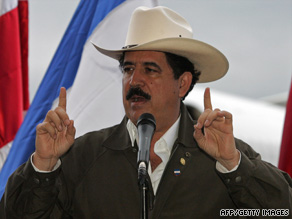
Deposed Honduran President Jose Manuel Zelaya says he must be returned to power.
Ousted Honduran president gives ultimatum
Story Highlights
Ousted Honduran leader will resort to other means if talks fail to return him to power
Jose Manuel Zelaya did not elaborate on what other means he would explore
Zelaya was deposed in a military-led coup on June 28
Both sides are currently in mediated talks to resolve situation
Ousted Honduran leader will resort to other means if talks fail to return him to power
Jose Manuel Zelaya did not elaborate on what other means he would explore
Zelaya was deposed in a military-led coup on June 28
Both sides are currently in mediated talks to resolve situation
updated 10:17 p.m. EDT, Mon July 13, 2009
Next Article in World »
Next Article in World »
(CNN) -- Deposed Honduran President Jose Manuel Zelaya on Monday gave the interim government that ousted him an ultimatum: if ongoing negotiations do not restore him to power, he will consider the talks failed and resort to other means.
Zelaya's remarks came at a news conference in Managua, Nicaragua. He did not elaborate on what other means he might explore.
The statement puts pressure on the next round of mediation between the two sides, expected to take place Saturday in Costa Rica.
Zelaya demanded that "the explicit mandates of the international organizations be carried out," referring to resolutions passed by the Organization of American States and United Nations calling for his return as president.
Since the June 28 military-led coup, Zelaya and interim Honduran President Roberto Micheletti have drawn hard stances. Both claim that the democratic process is on their side.
Both Micheletti and Zelaya accepted an offer from Costa Rican President Oscar Arias to mediate talks. Both men met individually with Arias last week, but they did not meet face-to-face.
Micheletti said Monday he expected talks between the two delegations to resume on Saturday in Costa Rica.
United Nations Secretary-General Ban Ki-moon spoke with Arias Monday and gave his support for his mediation efforts.
"The Secretary-General has offered technical assistance for the mediation and agreed to work together with President Arias to help the parties reach an agreement," a U.N. statement said. "The Secretary-General is confident that an open dialogue and international support will help resolve the current crisis."
Micheletti has adamantly denied there was a coup, insisting instead that Zelaya was ousted through a constitutional process in which the supreme court and the national assembly participated.
Zelaya, a leftist who took office in 2006 on a narrow victory, had been at odds with Honduran lawmakers, the country's supreme court and the military over a referendum he had planned to hold last month. Congress had forbidden it and the supreme court ruled it illegal.
Zelaya sought the referendum to see if voters wanted a measure on November's ballot to establish a constitutional assembly to study whether a president could run for re-election. Under the current charter, a president can serve only one four-year term.
Venezuelan President Hugo Chavez, a Zelaya ally, won a similar referendum this year and many Hondurans thought Zelaya was trying to maneuver a way to seek re-election in November -- an assertion he has denied.
Zelaya vowed to hold the vote anyway, but was toppled before the voting started.
After 18 years of nearly uninterrupted military rule, Honduras returned to civilian control in 1981. Since then, the military had not seemed interested in holding power in the nation of more than 7 million people, about 70 percent of whom live in poverty.
The statement puts pressure on the next round of mediation between the two sides, expected to take place Saturday in Costa Rica.
Zelaya demanded that "the explicit mandates of the international organizations be carried out," referring to resolutions passed by the Organization of American States and United Nations calling for his return as president.
Since the June 28 military-led coup, Zelaya and interim Honduran President Roberto Micheletti have drawn hard stances. Both claim that the democratic process is on their side.
Both Micheletti and Zelaya accepted an offer from Costa Rican President Oscar Arias to mediate talks. Both men met individually with Arias last week, but they did not meet face-to-face.
Micheletti said Monday he expected talks between the two delegations to resume on Saturday in Costa Rica.
United Nations Secretary-General Ban Ki-moon spoke with Arias Monday and gave his support for his mediation efforts.
"The Secretary-General has offered technical assistance for the mediation and agreed to work together with President Arias to help the parties reach an agreement," a U.N. statement said. "The Secretary-General is confident that an open dialogue and international support will help resolve the current crisis."
Micheletti has adamantly denied there was a coup, insisting instead that Zelaya was ousted through a constitutional process in which the supreme court and the national assembly participated.
Zelaya, a leftist who took office in 2006 on a narrow victory, had been at odds with Honduran lawmakers, the country's supreme court and the military over a referendum he had planned to hold last month. Congress had forbidden it and the supreme court ruled it illegal.
Zelaya sought the referendum to see if voters wanted a measure on November's ballot to establish a constitutional assembly to study whether a president could run for re-election. Under the current charter, a president can serve only one four-year term.
Venezuelan President Hugo Chavez, a Zelaya ally, won a similar referendum this year and many Hondurans thought Zelaya was trying to maneuver a way to seek re-election in November -- an assertion he has denied.
Zelaya vowed to hold the vote anyway, but was toppled before the voting started.
After 18 years of nearly uninterrupted military rule, Honduras returned to civilian control in 1981. Since then, the military had not seemed interested in holding power in the nation of more than 7 million people, about 70 percent of whom live in poverty.
.
.
Friday, May 08, 2009
Chavez seizes oil service firms

Mr Chavez is tightening his grip on the oil industry
Venezuelan President Hugo Chavez has sent troops to take over companies that provide services for the oil industry.
VENEZUELA UNDER CHAVEZ
KEY STORIES
Chavez cuts budget over oil price
Chavez wins chance of fresh term
Venezuela marks decade of Chavez
Chavez opponents make poll gains
FEATURES AND ANALYSIS
Tough times ahead Hugo Chavez wins the right to stand for re-election but faces bumpy economic ride
Referendum: Venezuelan views
Local hero
A tale of two Venezuelas
BACKGROUND
Chavez profile
Venezuela guide: Key facts
Timeline: From Columbus on
RELATED INTERNET LINKS
PDVSA
Venezuelan government (in Spanish)
"This is a revolutionary offensive," he told workers near Lake Maracaibo, Venezuela's main oil-producing area.
Military vehicles were used as the state oil company seized supply boats and two US-owned gas facilities.
Mr Chavez nationalised Venezuela's main oil assets two years ago. The fresh drive comes as falling oil prices put state finances under pressure.
The move places hundreds of boats, several ports and an estimated 8,000 oil workers under state control.
The state-owned oil company PDVSA has recently clashed with foreign and local service providers over the prices they charge.
The service companies are owed billions of dollars by PDVSA. But the state firm says lower oil prices mean the contractors are being paid too much.
President Chavez has re-invigorated his nationalisation programme since his victory in a February referendum that removed limits on how many times he and others can stand for re-election.
Venezuela has some of the biggest oil reserves in the world and is the largest oil exporter in the Americas.
Source:http://news.bbc.co.uk/1/hi/world/americas/8041366.stm
.
Sunday, March 15, 2009
Chávez says yes to Russian base
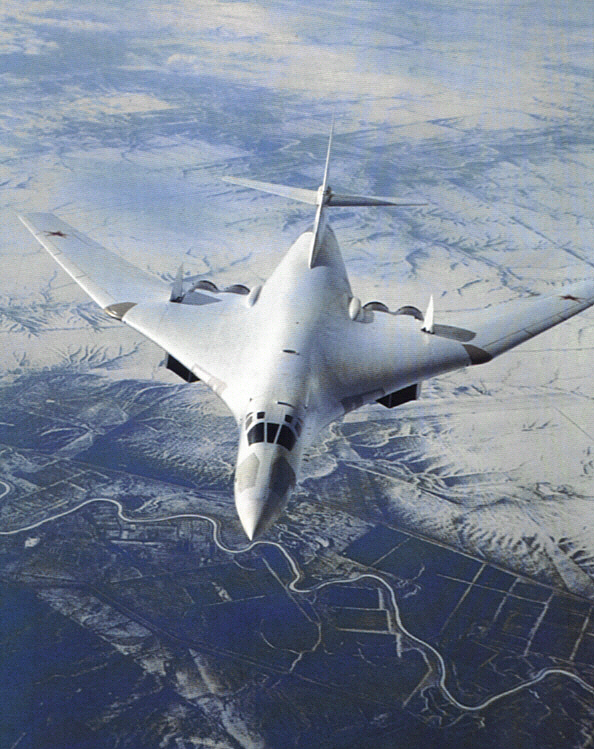
Chávez says yes to Russian baseTom Parfitt in Moscow The Guardian, Monday 16 March 2009
Russia is planning to open an airbase for its strategic nuclear bombers in Venezuela in a snub to the United States that taints a promised rapprochement between Moscow and Washington.
Venezuela's president, Hugo Chávez, has offered a Caribbean island for the base and a team of Russian officers has already inspected the facilities, it has emerged.
Major General Anatoly Zhikharev, the Russian air force's chief of staff for long-range aviation, told reporters in Moscow that Chávez had proposed the site and the Russian side was considering it. "If a relevant political decision is made, this is possible," he said.
Kremlin officials yesterday attempted to play down the proposal, saying it was theoretical, but Zhikharev stressed that the military aerodrome on La Orchila island was ideal for Russia's Tu-160 "Blackjack" strategic bombers, which flew to Venezuela for high-profile exercises in September. The air force chief said he had visited La Orchila to examine its military airfield. The runway was being extended, he said, making it the right length for takeoff by Russia's long-range bombers when they are heavily loaded with fuel. Foreign bases were forbidden under Venezuelan law, "but the temporary deployment of a contingent, for example for carrying out patrols, which is what we do, is possible," Zhikharev added.
The White House has been unnerved by recent Kremlin moves to expand its military potential to the Americas. The possibility of Russia opening an airbase on Cuba has also been mooted. Analysts said the La Orchila proposal was unlikely to pose a direct military threat to the US, but demonstrated that Moscow and Washington were competing hard for influence in South America, despite promising to "press the reset button" in their relations.
The Tu-160 has a range of 12,300km without refuelling.
Venezuela's president, Hugo Chávez, has offered a Caribbean island for the base and a team of Russian officers has already inspected the facilities, it has emerged.
Major General Anatoly Zhikharev, the Russian air force's chief of staff for long-range aviation, told reporters in Moscow that Chávez had proposed the site and the Russian side was considering it. "If a relevant political decision is made, this is possible," he said.
Kremlin officials yesterday attempted to play down the proposal, saying it was theoretical, but Zhikharev stressed that the military aerodrome on La Orchila island was ideal for Russia's Tu-160 "Blackjack" strategic bombers, which flew to Venezuela for high-profile exercises in September. The air force chief said he had visited La Orchila to examine its military airfield. The runway was being extended, he said, making it the right length for takeoff by Russia's long-range bombers when they are heavily loaded with fuel. Foreign bases were forbidden under Venezuelan law, "but the temporary deployment of a contingent, for example for carrying out patrols, which is what we do, is possible," Zhikharev added.
The White House has been unnerved by recent Kremlin moves to expand its military potential to the Americas. The possibility of Russia opening an airbase on Cuba has also been mooted. Analysts said the La Orchila proposal was unlikely to pose a direct military threat to the US, but demonstrated that Moscow and Washington were competing hard for influence in South America, despite promising to "press the reset button" in their relations.
The Tu-160 has a range of 12,300km without refuelling.
.
.
Thursday, March 05, 2009
Venezuela seizes US rice producer

Page last updated at 04:29 GMT, Thursday, 5 March 2009
Venezuela seizes US rice producer
Mr Chavez has accused rice producers of sidestepping quotas
Venezuelan President Hugo Chavez has ordered the expropriation of a rice mill, amid a battle with food companies over price regulation.
Mr Chavez said the mill, owned by a subsidiary of US food giant Cargill, was not distributing rice at government-set prices.
He also threatened to nationalise the country's largest food processor and private company, Polar.
Venezuela has already set quotas and prices for 12 basic foods.
Under the measure, 80% of all rice produced must be basic white rice. The measure also includes 95% of all cooking oil, coffee and sugar.
Producers of items such as powdered milk, cheese and tomato sauce are also affected.
'Intolerable'
Last week President Chavez ordered troops to rice processing plants after accusing producers of sidestepping the law on controlled prices by producing a higher grade of rice.
Cargill, which operates one rice-processing plant in Venezuela, said the mill does not produce the plain rice that is under regulation.
"Prepare the decree, we are going to expropriate Cargill. We are not going to tolerate this," Mr Chavez said.
Mr Chavez is attempting to reduce the cost of the basic shopping basket of ordinary Venezuelans at a time of soaring inflation, says the BBC's Will Grant in Caracas.
But business leaders and food producers are furious at what they see as a further attack on their ability to turn a profit, our correspondent says.
The move against Cargill is unlikely to be viewed favourably in Washington either, which angered Venezuela last month by criticising its human rights record, our correspondent adds.
Venezuela seizes US rice producer
Mr Chavez has accused rice producers of sidestepping quotas
Venezuelan President Hugo Chavez has ordered the expropriation of a rice mill, amid a battle with food companies over price regulation.
Mr Chavez said the mill, owned by a subsidiary of US food giant Cargill, was not distributing rice at government-set prices.
He also threatened to nationalise the country's largest food processor and private company, Polar.
Venezuela has already set quotas and prices for 12 basic foods.
Under the measure, 80% of all rice produced must be basic white rice. The measure also includes 95% of all cooking oil, coffee and sugar.
Producers of items such as powdered milk, cheese and tomato sauce are also affected.
'Intolerable'
Last week President Chavez ordered troops to rice processing plants after accusing producers of sidestepping the law on controlled prices by producing a higher grade of rice.
Cargill, which operates one rice-processing plant in Venezuela, said the mill does not produce the plain rice that is under regulation.
"Prepare the decree, we are going to expropriate Cargill. We are not going to tolerate this," Mr Chavez said.
Mr Chavez is attempting to reduce the cost of the basic shopping basket of ordinary Venezuelans at a time of soaring inflation, says the BBC's Will Grant in Caracas.
But business leaders and food producers are furious at what they see as a further attack on their ability to turn a profit, our correspondent says.
The move against Cargill is unlikely to be viewed favourably in Washington either, which angered Venezuela last month by criticising its human rights record, our correspondent adds.
Monday, February 16, 2009
TAKE A LOOK-Venezuela's Chavez wins vote on re-election

Mon Feb 16, 2009 2:10pm GMT
A polarized Venezuela celebrated and deplored on Monday
socialist President Hugo Chavez's referendum victory that allows
him to run for re-election in an OPEC nation facing plummeting oil
income. Chavez, who has been in power for 10 years and vows to rule
for decades, promised to repay the clear backing in Sunday's vote
from his mainly poor supporters by combating their No. 1 concern
-- crime that has given Venezuela one of the world's highest
murder rates. To read stories om the referendum, double-click on the
brackets.
A polarized Venezuela celebrated and deplored on Monday
socialist President Hugo Chavez's referendum victory that allows
him to run for re-election in an OPEC nation facing plummeting oil
income. Chavez, who has been in power for 10 years and vows to rule
for decades, promised to repay the clear backing in Sunday's vote
from his mainly poor supporters by combating their No. 1 concern
-- crime that has given Venezuela one of the world's highest
murder rates. To read stories om the referendum, double-click on the
brackets.
MAIN STORIES
> Polarized Venezuela cheers, deplores Chavez win [ID:nN16297398]
> ANALYSIS-Chavez helped by vote as economy bites [ID:nN15286117]
> ANALYSIS-Venezuela econ woes cast pall on vote [ID:nN16299877]
FACTBOXES
> Basic facts about Venezuela's Hugo Chavez [ID:nN15373858]
> Facts about Venezuela's oil industry [ID:nN09517544]
> Main events in Chavez's decade [ID:nN16302511]
> Social projects win Chavez support [ID:nN10426386]
> Venezuela's Chavez's policies 10 years on [ID:nN02463494]
.
Sunday, February 01, 2009
Venezuela, at 11th hour, names Feb 2 Chavez holiday
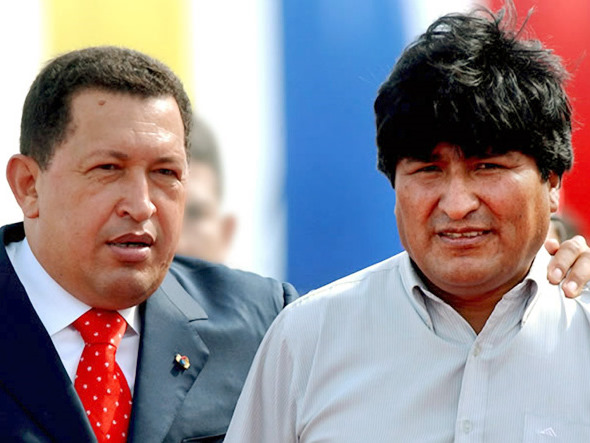
Venezuela, at 11th hour, names Feb 2 Chavez holiday
Sun Feb 1, 2009 9:59pm EST
Sun Feb 1, 2009 9:59pm EST
CARACAS (Reuters) - Venezuela's government, known for spur-of-the-moment decisions, on Sunday created a new national holiday on Feb 2 to commemorate populist President Hugo Chavez's taking power.
The Sunday afternoon announcement came less than 24 hours before the holiday was to begin.
The popular anti-U.S. leader, who on Monday celebrates 10 years of his self-styled socialist revolution, has changed the country's flag, coat of arms, and moved the time zone by half an hour.
Vice President Ramon Carrizalez said on Sunday the day would declared "a day of festivity, because the people have things to celebrate and many things to defend."
Chavez on Monday was to host friendly leaders including Bolivia's Evo Morales and Nicaragua's Daniel Ortega to mark his taking power in 1999, two weeks before a vote to determine if he should be allowed to stay another decade.
The vote would amend the constitution, which he helped rewrite, to remove a provision limiting presidents to two successive terms.
The loquacious leader is famous for showing up hours late to scheduled events, talking for up to eight hours in a single sitting and making major policy announcements in off-the-cuff commentary.
(Reporting by Brian Ellsworth, editing by Alan Elsner)
The Sunday afternoon announcement came less than 24 hours before the holiday was to begin.
The popular anti-U.S. leader, who on Monday celebrates 10 years of his self-styled socialist revolution, has changed the country's flag, coat of arms, and moved the time zone by half an hour.
Vice President Ramon Carrizalez said on Sunday the day would declared "a day of festivity, because the people have things to celebrate and many things to defend."
Chavez on Monday was to host friendly leaders including Bolivia's Evo Morales and Nicaragua's Daniel Ortega to mark his taking power in 1999, two weeks before a vote to determine if he should be allowed to stay another decade.
The vote would amend the constitution, which he helped rewrite, to remove a provision limiting presidents to two successive terms.
The loquacious leader is famous for showing up hours late to scheduled events, talking for up to eight hours in a single sitting and making major policy announcements in off-the-cuff commentary.
(Reporting by Brian Ellsworth, editing by Alan Elsner)
Saturday, January 31, 2009
World Social Forum tells Davos to fix crisis -- or else

A nun cheers Paraguay's President Fernando Lugo during a conference with members of Brazil's Landless Movement
World Social Forum tells Davos to fix crisis -- or else
2 hours ago
BELEM, Brazil (AFP) — Leftwing leaders and groups attending the World Social Forum in Brazil have dealt an ultimatum to political and corporate chiefs meeting at the same time in the Swiss resort of Davos: fix this crisis -- or else.
Brazilian President Luiz Inacio Lula da Silva said at the event in Belem that it was urgent for the rich nations "to resolve this crisis so the poor countries can develop."
But he warned against worrying signs of protectionism, saying: "It's not fair that, now that the rich countries are in crisis, they forget their talk about free trade."
The presidents of Venezuela, Bolivia, Ecuador and Paraguay echoed his comments putting the blame for the worldwide turbulence on developed nations, particularly the United States.
Venezuelan President Hugo Chavez also urged the forum's 100,000 particpants to "go on the offensive" to counter free trade pacts and other US-sponsored neoliberal economic initiatives in Latin America.
Unions needed no encouragement. They said capitalism was on the ropes and that government efforts around the world to revive it were misguided.
Mass lay-offs were likely to lead to street violence that could presage a fundamental shake-up of society, they said.
"It's obvious the effects of this crisis will be large-scale social conflicts," Martha Martinez, the Americas director for the World Federation of Unions, told trade unionists.
Many of the labor, environmental, religious, indigenous and charity groups represented at the World Social Forum felt emboldened by the shifts being felt around the globe.
The more optimistic said they expected a fairer world would emerge, one where wealth was more evenly distributed.
"I think the future of the planet is socialist," said Sonia Latge, the political science director for Brazil's Workers' Central of Brazil.
Others, though, acknowledged that the changes were unpredictable -- and brought their share of pain.
"There is a very important risk of a cut in public aid," Jean-Louis Vielajus, the head of a French NGO umbrella organization called Coordination SUD, told AFP.
"There is a sense of injustice" that so many billions were being spent on shoring up the battered world financial system while so little was going to fight poverty, deforestation, hunger and sickness, he added.
Taciana Gouveia, the head of the Brazilian Association of NGOs (ABONG), said Brazil's associations were not yet in need, "but we will probably see problems in 2010 or afterwards -- especially if things get worse."
Seen as key to the direction of the world's future economic policies was new US President Barack Obama, who is hastening another massive bail-out for his country, which was at the epicenter of the crisis.
"He still has to prove himself. But what he's said in his speeches, his actions -- up to now, it's a very good sign," Cassandre Blier of the World University Service of Canada, an international development organization, told AFP.
The World Social Forum was to wrap up Sunday after a final round of talks, shows and meetings among participants.
Despite its sprawling, semi-organized nature, participants lauded the opportunity it presented to coordinate strategies and build partnerships, especially in this time of upheaval.
"It's positive that the forum exists and continues to exist," said Gouveia.
2 hours ago
BELEM, Brazil (AFP) — Leftwing leaders and groups attending the World Social Forum in Brazil have dealt an ultimatum to political and corporate chiefs meeting at the same time in the Swiss resort of Davos: fix this crisis -- or else.
Brazilian President Luiz Inacio Lula da Silva said at the event in Belem that it was urgent for the rich nations "to resolve this crisis so the poor countries can develop."
But he warned against worrying signs of protectionism, saying: "It's not fair that, now that the rich countries are in crisis, they forget their talk about free trade."
The presidents of Venezuela, Bolivia, Ecuador and Paraguay echoed his comments putting the blame for the worldwide turbulence on developed nations, particularly the United States.
Venezuelan President Hugo Chavez also urged the forum's 100,000 particpants to "go on the offensive" to counter free trade pacts and other US-sponsored neoliberal economic initiatives in Latin America.
Unions needed no encouragement. They said capitalism was on the ropes and that government efforts around the world to revive it were misguided.
Mass lay-offs were likely to lead to street violence that could presage a fundamental shake-up of society, they said.
"It's obvious the effects of this crisis will be large-scale social conflicts," Martha Martinez, the Americas director for the World Federation of Unions, told trade unionists.
Many of the labor, environmental, religious, indigenous and charity groups represented at the World Social Forum felt emboldened by the shifts being felt around the globe.
The more optimistic said they expected a fairer world would emerge, one where wealth was more evenly distributed.
"I think the future of the planet is socialist," said Sonia Latge, the political science director for Brazil's Workers' Central of Brazil.
Others, though, acknowledged that the changes were unpredictable -- and brought their share of pain.
"There is a very important risk of a cut in public aid," Jean-Louis Vielajus, the head of a French NGO umbrella organization called Coordination SUD, told AFP.
"There is a sense of injustice" that so many billions were being spent on shoring up the battered world financial system while so little was going to fight poverty, deforestation, hunger and sickness, he added.
Taciana Gouveia, the head of the Brazilian Association of NGOs (ABONG), said Brazil's associations were not yet in need, "but we will probably see problems in 2010 or afterwards -- especially if things get worse."
Seen as key to the direction of the world's future economic policies was new US President Barack Obama, who is hastening another massive bail-out for his country, which was at the epicenter of the crisis.
"He still has to prove himself. But what he's said in his speeches, his actions -- up to now, it's a very good sign," Cassandre Blier of the World University Service of Canada, an international development organization, told AFP.
The World Social Forum was to wrap up Sunday after a final round of talks, shows and meetings among participants.
Despite its sprawling, semi-organized nature, participants lauded the opportunity it presented to coordinate strategies and build partnerships, especially in this time of upheaval.
"It's positive that the forum exists and continues to exist," said Gouveia.
Monday, January 26, 2009
Venezuelan President Hugo Chavez says OPEC could cut output - again

Venezuelan President Hugo Chavez says OPEC could cut output - again
THE ASSOCIATED PRESS
January 26, 2009 08:20
CARACAS, Venezuela - Venezuelan President Hugo Chavez says OPEC could further reduce oil production to boost low prices.
The Organization of Petroleum Exporting Countries has reduced output by 4.2 million barrels per day since September through a series of production cuts as the 13-member cartel seeks to bolster prices.
Chavez said OPEC could cut production by as much as four million barrels per day if necessary.
If OPEC must "cut four million more in production, we cut," Chavez said during a Monday radio broadcast.
Venezuela announced this month that it was reducing output by 189,000 barrels per day under OPEC's cuts.
Venezuela is currently producing about 2.4 million barrels of oil a day, according to OPEC.
January 26, 2009 08:20
CARACAS, Venezuela - Venezuelan President Hugo Chavez says OPEC could further reduce oil production to boost low prices.
The Organization of Petroleum Exporting Countries has reduced output by 4.2 million barrels per day since September through a series of production cuts as the 13-member cartel seeks to bolster prices.
Chavez said OPEC could cut production by as much as four million barrels per day if necessary.
If OPEC must "cut four million more in production, we cut," Chavez said during a Monday radio broadcast.
Venezuela announced this month that it was reducing output by 189,000 barrels per day under OPEC's cuts.
Venezuela is currently producing about 2.4 million barrels of oil a day, according to OPEC.
Thursday, October 30, 2008
Venezuela's first satellite launched from China

A rocket carrying a Venezuelan satellite blasts off early Thursday from southwestern China's Sichuan province.
Story Highlights
Telecommunications satellite will let rural areas access educational, medical info
Chinese rocket carrying satellite lifts off from Xichang Satellite Launch Center
Satellite reportedly designed to last 15 years
Venezuela spent $241 million in five years to develop the Simon Bolivar Satellite
Next Article in Technology »
The telecommunications satellite will let rural communities in Venezuela access educational and medical information that has been difficult for them to come by as a result of their relative isolation, said Rodolfo Navaro, technical manager for the Bolivarian Space Activity Agency.
"It is not focused on commercial ends, but on providing a service to the communities which have never enjoyed a modern communication system," he said, according to the Bolivarian News Agency.
"It is not focused on commercial ends, but on providing a service to the communities which have never enjoyed a modern communication system," he said, according to the Bolivarian News Agency.
"Aboriginal communities, for instance, would receive long-distance education, or maybe they would request medicines, air or river ambulance service, medical checkups, among other options."
A Chinese rocket carrying the satellite lifted off early Thursday from the Xichang Satellite Launch Center in southwestern China's Sichuan province, according to an account in China's state-run news agency, Xinhua.
The satellite is designed to last 15 years, the agency said.
President Hugo Chavez announced after taking office that Venezuela would send crafts into space, and the country spent $241 million in five years to develop the Simon Bolivar Satellite, named for the general whose military victories led to independence from Spain for several South American nations in the early 1800s.
Chavez referred to the satellite's launch as a key step toward greater scientific and technological independence for Venezuela, the Bolivarian News Agency reported.
The satellite will have the ability to cover the Caribbean, Central America and parts of South America, the agency said.
Friday, September 26, 2008
Russian Moves Show Military Ambitions

Miraflores Palace/Reuters
President Hugo Chávez, holding a replica Russian Tu-160 long-range bomber, and Prime Minister Vladimir V. Putin in Orenburg, Russia, on Friday.
By GRAHAM BOWLEY and MICHAEL SCHWIRTZ
Published: September 27, 2008
Published: September 27, 2008
Russia stepped up efforts to project its increased might on the world stage on Friday, welcoming President Hugo Chávez of Venezuela by signing a $1 billion military loan to Venezuela and announcing wide-ranging plans to modernize its nuclear deterrence
The Russian Navy also dispatched a warship to the Indian Ocean to try to intercept a Ukrainian vessel carrying 30 battle tanks that was seized by pirates, as the United States also sent a warship in hot pursuit.
After a military exercise in the southern city of Orenburg, near the border with Kazakhstan, the Russian president, Dmitri A. Medvedev declared that by 2020 Russia would construct new types of warships, including nuclear submarines carrying cruise missiles, and an unspecified space defense system.
"A guaranteed nuclear deterrent system for various military and political circumstances must be provided by 2020," Mr. Medvedev said, in comments reported by Reuters.
"Large-scale construction of new types of warships is planned, primarily of nuclear submarines armed with cruise missiles, and multi-purpose submarines," he was quoted as saying. “A system of air and space defense will be created.”
Russia, irritated by Western recognition of Kosovo’s independence, NATO’s expansion into the former Soviet realm, and the United States’ insistence on establishing a missile defense system in eastern Europe, has become increasingly keen to project its military might, defiantly ignoring American and European warnings when it sent troops into Georgia last month.
In a sign of increasing antagonism, Russia has withheld some cooperation with other Western countries on international efforts to halt Iran’s nuclear ambitions.
The Russian government said Tuesday that it would boycott a meeting that had been scheduled at the United Nations for Thursday to discuss a fourth round of sanctions to force Iran to give up what many countries think is a program to develop nuclear weapons. The session was to have included the five permanent members of the Security Council and Germany.
The Russian announcement was viewed by many diplomats as retribution for a tough speech that Secretary of State Condoleezza Rice delivered last week in which she denounced Russia’s behavior in the Georgian crisis.
On Friday, Russia and the United States agreed to seek a new United Nations resolution calling on Iran to comply with earlier demands to suspend uranium enrichment — a sign that the two countries at least were talking, but the statement only reiterated previous positions, The Associated Press reported.British Foreign Secretary David Miliband said the brief resolution will affirm the three previous ones, which imposed progressively tougher sanctions on Iran for refusing to halt its enrichment program and urged Tehran to comply, The A.P. reported.
Emboldened by lucrative oil revenues, and the United States’ distractions in Iraq and Afghanistan, Russia has also said it wants to build alliances to stand up to American power in the world, and has sought closer relations with Mr. Chávez, a longtime critic of the United States.
Mr. Chávez, on his second visit to Russia in two months, met with Prime Minister Vladimir V. Putin on Thursday, and on Friday traveled to Orenburg to meet with Mr. Medvedev.
The $1 billion loan for arms purchases and military development was announced in a Kremlin statement released Thursday night. The statement said Mr. Putin and Mr. Chávez had spoken on enhancing economic cooperation and trade in commercial goods as well as military technologies.
The $1 billion loan will help finance programs related to military-technical cooperation, the statement said. The Kremlin would not elaborate on the details of the deal.
Between 2005 and 2007 Venezuela has signed 12 contracts for weapons purchases from Russia for a total of more than $4.4 billion, the Kremlin statement said.
The move is the latest gesture of military friendship between Russia and Venezuela, two counties that have increasingly positioned themselves as mavericks vis-à-vis the West.
The Kremlin says its economic and political stability have allowed it to broaden the scope of its military and economic cooperation beyond what it calls its traditional sphere of influence.
Earlier this month a pair of Russian Tu-160 long-range bombers capable of carrying nuclear weapons received a warm welcome when they landed in Venezuela. Russia has also dispatched a squadron from its North Sea Fleet to the Caribbean to take part in joint naval exercises with the Venezuelan Navy sometime in November.
“Latin America, of course, is becoming an obvious link in the chain making up a multipolar world,” Mr. Putin said during his meeting with Mr. Chávez. “We will allocate more and more attention to this vector of our economics and foreign policy.”
Russia has already delivered Sukhoi Su-30 fighters, Mi-17 transport helicopters, and thousands of Kalashnikov assault rifles to Venezuela. There are also plans to build a factory in the country that will manufacture these weapons under license.
Graham Bowley reported from New York and Michael Schwirtz from Moscow. Neil Macfarquhar contributed reporting from the United Nations.
Subscribe to:
Posts (Atom)