Showing posts with label Schools. Show all posts

Friday, October 16, 2026

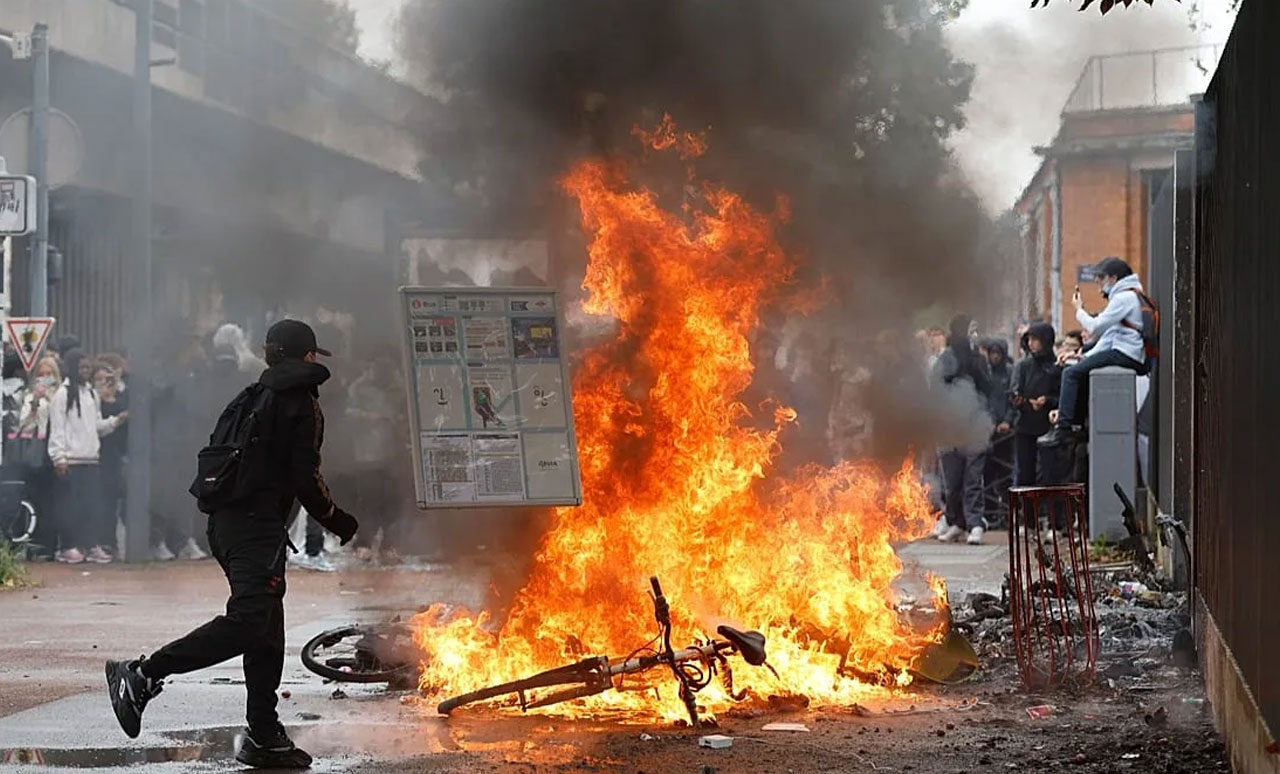
School Blockades Continue Across France as Protesters Are Called to the Bastille


Image: Srpske Novine from Euronews


Pastor Hal MayerSpeaker / Director

School Blockades Continue Across France as Protesters Are Called to the Bastille

Thursday October 15th, 2026

The Epoch Times, by Etienne Fauchaire: Blockades at high schools and universities continued across France on Oct. 7, a day before students and teachers were expected to return to the streets for another nationwide protest.

The Student Union called on high school and university students to resume blockades on the morning of Oct. 8 before “converging on Bastille” in Paris at 3 p.m., a call seen as a reference to the storming of the Bastille on July 14, 1789, during the French Revolution.

Several education unions, including SNES-FSU, France’s largest secondary school teachers’ union, also called for strikes and demonstrations in support of the students.

The number of disrupted high schools fell significantly on Oct. 7. Classes were fully or partially suspended at 459 schools, compared with 891 the previous day, according to the Education Ministry, which described the movement as being in sharp decline.

The Oct. 8 demonstrations will mark the fourth nationwide day of action in a protest movement led largely by far-left student organizations and initially fueled by grievances over school conditions.

Thursday, October 08, 2026

Your Kids Are Already Communists, and College Will Make It Worse | Mark Thornton


misesmedia

Sep 28, 2026
Dr. Mark Thornton argues that America's schools and universities have spent 150 years quietly instilling a collectivist ideology, and that the real problem isn't declining test scores but a progressive worldview baked in from kindergarten up. Drawing on Bastiat, Mises, and South Carolina history, he shows how to fight it from the bottom up. 

Recorded in Greenville, South Carolina, on September 12, 2026. 

Special thanks to Bryan Lee Briggs for sponsoring this event.

Wednesday, October 07, 2026

France keeps 400 schools closed as country gripped by student protests


France keeps 400 schools closed as country gripped by student protests
AP Archive

Oct 7, 2026
(2 Oct 2026) 
RESTRICTION SUMMARY: 

ASSOCIATED PRESS 
Paris, France - 2 October 2026
1. Various of high school students protesting outside Voltaire high school with people driving by and honking in support
2. Wide of protest signs and students' feet on barricade at Voltaire high school protest
3. Mid of various protest signs 
4. Mid of protesters singing French National Anthem: 'La Marseillaise'
5. Wide of students protesting outside a high school in France, holding signs and banners.
6. SOUNDBITE (French) Sophie Bordy, literature teacher: "The youth is extremely anxious. High school students are very anxious, mainly because of Parcoursup (France’s online platform for university admissions). Regarding all high school students in France, there is a lack of places in higher education, and the algorithms make it unclear why some of our students don't have a place in higher education even though they have excellent records, have passed the baccalaureate with honors, and therefore, we as teachers understand this movement."
7. Wide of Voltaire bust by Jean-Antoine Houdon at Voltaire high school
8. Mid of students clapping and chanting during the high school protest
9. Wide of high school students gathering on the street during protest in France and drivers passing by and honking in support
10. SOUNDBITE (French) Sophie Bordy, literature teacher:
"I think the French support the movement because, those who have children understand the anxieties that students, young people, experience regarding Parcoursup (France’s online platform for university admissions) and the future being offered to them. We are coming out of an extremely severe heatwave. Here, they took their exams in gyms, basements, on ping-pong tables. The public needs to know that we did not have the same study conditions; I am 50 years old. It has deteriorated significantly."
11. Mid of protest sign reading (French) 'Anger' at protest
12. Close up of protest signs at the high school demonstration in France demanding justice and critiquing police presence. (French) 'Police Everywhere, Justice Nowhere'
13. Mid of protester holding a sign reading (French) 'To protest is a fundamental right'
14. SOUNDBITE (French) Sophie Bordy, literature teacher: 
"In my opinion, the treatment by the State and police violence only make things worse. It seems quite urgent to me that the State considers having the minister meet with the young people and understand that their anxieties are real. And these are young adults, you know, they are 16, 17, 18 years old. They are future citizens. Some of them are even citizens already. They must be urgently received so that a genuine signal of appeasement is given by the government."
15. Wide of students gathering outside a high school in France during the protest
STORYLINE:
High school students built a barricade in front of  Voltaire High School in northeastern Paris on Friday, in a fifth day of protests in the French capital demanding more resources for education and denouncing pressure on students.

Voltaire High School is one of the 400 high schools that remained closed on Friday, but students nevertheless gathered in front of it. Students taking part in the protest cited staff shortages, deteriorating conditions in some schools, long school days and Parcoursup, France’s national online platform for university admissions.


Sophie Bordy, a literature teacher in Voltaire high school  says there are reasons for the students to be anxious and that parents and, more generally, the population have understanding.


AP video shot by Oleg CETINIC.

Tuesday, October 06, 2026

Supreme Court Set to Hear Case Involving Religious Exemptions for Private Schools to Receive Public Funds


by Craig Nash | Oct 6, 2026 | News


(Credit: Mark Thomas / Pixabay / https://tinyurl.com/5tnsvvak)

Among a handful of religious-liberty cases the U.S. Supreme Court (SCOTUS) will hear this session, which began yesterday, one pits a Colorado nondiscrimination law against the state’s Universal Preschool Program (UPK). The early childhood program provides preschool tuition for up to 15 hours per week for students in their final year before kindergarten. Yet Colorado law prohibits funding for preschools that discriminate on the basis of sexual orientation or gender identity.

Two Catholic parishes in the Archdiocese of Denver contend the nondiscrimination policy, which forbids them from denying admission to students with same-sex parents, violates their First Amendment rights. They have refused to sign the nondiscrimination agreement, denying them state funds from the UPK program.

According to Linda Greenhouse, who covers SCOTUS cases for The New York Times, St. Mary Catholic Parish v. Roy concerns a 2022 ruling that declared Maine’s exclusion of religious schools from receiving publicly funded private school subsidies was unconstitutional. Plaintiffs in the Colorado case are arguing that the religious exemption in the Maine case also applies to Colorado religious schools.

The State of Colorado argues that the Maine decision prohibited disqualifying private schools from public funding solely because they provided religious education. They contend that their refusal to allow a school to receive UPK funds has nothing to do with the schools’ right to provide religious education, but with their refusal to serve particular students.

The case, scheduled to appear before the court in early November, will clarify what counts as a religious exemption in public education.


Monday, October 05, 2026

French students close hundreds of schools in protest

Reuters

Oct 5, 2026  

French high school students have blockaded hundreds of schools across the country in protest against poor conditions in education. According to officials, between 400 and 500 schools remain closed amid the unrest.

Thursday, October 01, 2026

FRANCE IN FLAMES Thousands arrested as French students torch schools & douse teachers in petrol in protests over ‘rat-infested classes’


Thousands arrested as French students torch schools & douse teachers in petrol in protests over ‘rat-infested classes’

Harvey Geh , Foreign News Reporter|
Peter Allen|
Anna Shreeves

Published: 08:22, 1 Oct 2026|
Updated: 14:45, 1 Oct 2026


THOUSANDS of students have been arrested after rioters set fire to schools and allegedly attacked teachers in a wave of shock protests across France.

Wild scenes have grown in scale and ferocity over the country as students continue set up barricades, ransack buildings and igniting fires over claims of rat and cockroach-infested classrooms.


Students have urged schools to improve classroom conditions
Credit: AFP
 

Teenagers battle riot cops launching tear gas at them
Credit: Shutterstock Editorial


A youngster launches an object towards a fire amid the protests
Credit: AFP
 

Barricades and piles of rubbish have been set ablaze by students
Credit: Shutterstock Editorial

It is reported thousands students – several under 16 – have been arrested following clashes with the police.

France’s prime minister convened a crisis meeting on Thursday, calling for ministers’ trips to be cancelled as they focus on the containing the nationwide spread of mayhem.

Interior Minister Laurent Nunez condemned what he called an “escalation of violence” outside certain schools, France D.W reports.

The demonstrations kicked off on September 21 near the start of the academic year at a school in Créteil, a Paris suburb, and have snowballed from there.


Tuesday, September 29, 2026

Gaza Catholic school reopens, welcoming 1,000 students

The building sheltered more than 450 people displaced by bombardment. Now, the parish hopes the school can give children a sense of safety and routine amid the destruction.


The Roman Catholic Holy Family Church in Gaza City, 2021. (Photo by Anas-Mohammed/Shutterstock)


September 28, 2026 


Holy Family School in Gaza City reopened Sept. 15 for about 1,000 students, serving families from Holy Family Catholic Parish and the wider community, according to Aid to the Church in Need (ACN).

Before the war, five Christian schools operated in Gaza — three Catholic, one Orthodox, and one Evangelical — and Christian pupils attended different schools across the territory.

George Akroush, director of the Latin Patriarchate of Jerusalem’s Project Development Office, told ACN that around 130 Christian pupils, about 13% of the student body, would attend Holy Family School. Most of the school’s students are Muslim.

“For the first time, all Christian students in Gaza will be studying together in one Christian school,” Akroush told an ACN delegation visiting the region. “This creates a strong sense of community and shows that the Church remains close to them, accompanying them in the midst of all they are going through.”

Before reopening, the school sheltered more than 450 people displaced by Israeli bombardment, according to ACN. Holy Family parish priest Father Gabriel Romanelli said staff worked to make the school a place where children could feel safe amid the destruction in Gaza.

“For the students and the families, reopening the school will bring some sense of normality. We have worked hard to ensure that it is a safe environment,” Father Romanelli told ACN. “There is almost nowhere in Gaza that has not been destroyed; destruction is all around. But we have worked hard to make the school a clean environment, where the children, who have been through so much, can feel safe.”

Father Romanelli said “the needs in Gaza are enormous.” The parish hopes to offer families some sense of normality, he said, “even though nothing is normal in Gaza.” After Sunday Mass, he takes parishioners to a beach in Gaza City for recreation, despite the rubble there.

The school will also provide support for children and teachers affected by the war.

“Many of the teachers are so traumatized, and it is almost as if they are not the same people who we knew before the start of the war,” Father Romanelli told ACN.

He said the school has added special psychosocial support to its program and plans to offer activities after classes. Children have asked him to keep the school open because they have nowhere else to go, he said.

“Everyone in Gaza is carrying so much trauma,” the parish priest told ACN, adding, “For me, the school is a light in the darkness. It means a lot to people. When they see the 1,000 students coming in their uniforms to the school, it shows them that there is a future.”


Monday, September 28, 2026

Parents Lose Religious Freedom Challenge to Connecticut School Vaccine Law

By Christianity Daily

September 22, 2026 01:11 EDT


Photo credit: Unsplash/ CDC

A Connecticut judge has dismissed a lawsuit brought by parents challenging the state’s elimination of religious exemptions from school vaccine mandates.

Judge Edward Krumeich of the Connecticut Superior Court granted a motion to dismiss the case last Monday. The lawsuit was filed by parents Keira Spillane and Anna Kehle against Gov. Ned Lamont, state education and health officials, the Orange Board of Education and Whitby School.

The parents argued that vaccinating their children would violate “their closely held religious beliefs” about the sanctity of human life because some vaccines were developed using cell lines derived from aborted fetuses. They also claimed vaccines containing animal-derived components would “defile their children’s blood.”

Their lawsuit alleged violations of the Connecticut Religious Freedom Restoration Act, the Connecticut Constitution and the U.S. Constitution. It cited the state constitution’s declaration that “the Free Exercise of Religion shall forever be allowed in Connecticut,” along with federal protections for free exercise and equal protection.

It cited three constitutional protections: Article I, Section III of the Connecticut Constitution, which states that “the Free Exercise of Religion shall forever be allowed in Connecticut,” the Free Exercise Clause of the First Amendment, and the Equal Protection Clause of the Fourteenth Amendment to the U.S. Constitution.

State officials sought dismissal based on legislation enacted in 2021 and a law passed this year clarifying that religious exemptions to school vaccine requirements are not protected by the state RFRA.

The ruling concludes four years of litigation over Connecticut’s removal of the exemption. The Connecticut Supreme Court rejected the plaintiffs’ state and federal constitutional claims in 2024. Still, it returned the RFRA issue to the Superior Court, which has now ruled that eliminating the exemption does not violate the law.

Connecticut is among a small number of states that do not permit religious exemptions from school vaccine mandates, according to the National Conference of State Legislatures. California, Maine, Minnesota and New York are also listed among them.


Friday, September 11, 2026

It's Head Lice Season. Here's What to Know


A head louse on hairOxford Scientific—Getty Images


by
Dominique Mosbergen
Health correspondent
Sep 9, 2026 10:15 AM ET


As children return to school, families have a lot to look forward to: fresh routines, new connections, crisper weather—and a greater risk of head lice.

September is National Head Lice Prevention Month in the U.S, coinciding with a time of year when infestations tend to surge. “Head lice can occur throughout the year, but cases are often noticed more frequently in late summer and early fall, when children return to school and resume close-contact activities,” says Dr. April Armstrong, chief of dermatology at the University of California, Los Angeles.

Head lice is a common childhood condition, with up to 12 million head lice infestations occurring among children ages 3 to 11 every year in the U.S., according to estimates from the U.S. Centers for Disease Control and Prevention (CDC).

The insects don’t spread disease, but they can still cause a great deal of distress, doctors say. “Having head lice is not a sign of poor hygiene, but it can cause stress and anxiety because there is this stigma that it is,” says Dr. Carla Torres Zegarra, a pediatric dermatologist at Children’s Hospital Colorado. “If left untreated, it can also be very bothersome, causing itching and disturbing sleep.”

Here’s what to know about the pesky parasites, and how to spot, treat, and prevent them.

What are head lice?

Head lice, or Pediculus humanus capitis, are tiny, wingless insects that feed on human blood. They are found mostly on the scalp, but sometimes appear on eyebrows and eyelashes.

Adult head lice are about the size of a sesame seed and are usually tan to grayish-white in color, according to the American Academy of Pediatrics (AAP). Head lice lay and attach their eggs—known as nits—to the base of hair shafts using a glue-like substance. Infested people may have a combination of adult and juvenile head lice, nits, and empty egg casings on their scalp and in their hair.

Are they the same as pubic or body lice?

No. There are three different types of lice that feed exclusively on humans: head lice, pubic or “crab” lice, and body lice. Unlike head lice, which have elongated bodies, pubic lice have short and round bodies, resembling crabs. Pubic lice typically spread through sexual contact and are most common in adults.

When people have body lice, the insects are found primarily on their clothing and bedding, and sometimes on their bodies. Unlike head lice, body lice is connected to hygiene practices and access to clean clothing, and spread primarily through direct contact with someone who has body lice or with their contaminated clothing or bedding. In the U.S., body lice mostly affects people without access to housing, clean clothes, and regular bathing, CDC says.

How do head lice spread?

Since head lice can only crawl and not jump or fly, they typically spread via head-to-head contact. “That’s why it happens more in kids, because they play in close proximity,” Torres Zegarra says.

Head lice can also spread through objects that touch the head, such as combs, hats, helmets, and pillowcases. But this type of indirect transmission is much less likely since head lice typically survive for less than a day when away from the scalp, and nits can’t hatch at temperatures cooler than that of the human scalp, AAP says.

Getting head lice has nothing to do with personal hygiene or the cleanliness of the environment, and is caused solely by exposure to an infested person.

If there’s an outbreak of lice at your child’s school or daycare, that’s not a guarantee they’ll get it. Though head lice frequently spread in schools, research has found that head lice actually have a low contagion rate in classrooms. That’s why the CDC, AAP, National Association of School Nurses and other medical groups don’t recommend keeping children with head lice away from school.

Animals don’t get or spread head lice.

How do you know if you or your child has head lice?

An itchy scalp is the most common symptom of head lice, “particularly behind the ears and near the back of the neck,” Armstrong says. “Some people also describe a tickling sensation or the feeling that something is moving in the hair. Scratching may produce redness, small sores, or, occasionally, a secondary bacterial infection.”

People can have head lice without symptoms, too. “With a first infestation, itching may not begin for four to six weeks because it takes time for the body to develop an allergic response to louse saliva,” Armstrong says.

Examining the hair and scalp under bright light and finding live crawling lice is the best way to diagnose a head lice infestation. Using a magnifying glass or a special lice comb can help with this process, AAP says. “Nits located farther from the scalp are often empty or no longer viable, so their presence alone does not necessarily indicate an active infestation,” Armstrong says.

Misdiagnosis of head lice is common. “Many presumed lice and nits submitted by physicians, nurses, teachers, and caregivers to a laboratory for identification were found to be artifacts such as dandruff, hairspray droplets, scabs, dirt, or other insects,” such as those blown by the wind and caught in the hair, AAP says.

The CDC recommends that people visit a doctor if they suspect they may have lice.

Who is at risk of head lice?

Head lice infestations most commonly occur in preschool- and elementary school-age children and their families.

Research suggests that girls may get head lice more often than boys. But the AAP says head lice infestations do not appear to be influenced by hair length, hair type, and frequency of shampooing or brushing.

How do you treat head lice?

There are several over-the-counter and prescription medications approved by the U.S. Food and Drug Administration (FDA) to treat head lice, including lotions and shampoos that contain the insecticides permethrin or pyrethrin. Treatment of head lice often involves using one of these medications, combined with “careful combing using a fine-toothed lice comb,” Armstrong says.

Some of these medications kill only lice, while others target both lice and nits. Depending on the medication, a second application may be needed seven to ten days after the first treatment, Armstrong says.

In some cases, head lice can be resistant to these topical medications, AAP says. In those situations, manual removal of lice and nits might be necessary—an option also available to people who want to avoid insecticide-containing products. The AAP says home remedies such as using mayonnaise, melted butter, or olive oil could work to suffocate the lice, though these methods are not FDA approved or recommended, and more research still needs to be done on their effectiveness. A prescription oral medication can also be used.

Some internet sites recommend using essential oils and other botanical products to kill head lice, but the AAP says “the safety and efficacy of natural or herbal products are currently not regulated by the FDA, and until more data are available, their use in infants, children, and adolescents should be avoided.” The AAP also stresses that head lice treatment is only recommended for people “in whom diagnosis is highly suspected or proven.”

Torres Zegarra says she sometimes sees patients with itchy scalps who developed irritation because they tried head lice treatments despite not having any evidence of lice. “What I end up treating is not lice but the skin irritation caused by multiple treatments that were tried on the scalp,” she says.

Doctors say that cutting or shaving the hair of an infested person isn’t necessary, and it does not always work to get rid of head lice.

“Long or very thick hair may require more product and more time to comb thoroughly, but it can be treated successfully without removing the hair,” Armstrong says. “If live lice remain after treatment has been used correctly, a clinician should determine whether the cause is medication resistance, reinfestation, or an incorrect diagnosis before additional treatments are applied.”

How do you prevent head lice?

“There is no completely reliable way to prevent head lice, especially among young children who naturally play in close contact. The most effective step is to limit direct head-to-head or hair-to-hair contact when lice are known to be circulating,” Armstrong says.

If someone is confirmed to have head lice, members of their household and other close contacts should be carefully checked for infestation. “Clothing, towels, and bedding used during the two days before treatment can be washed and dried using heat,” Armstrong says. “Combs and brushes can be soaked in hot water. Extensive cleaning, fumigation, and pesticide sprays are unnecessary.”

AAP says parents and other caregivers could check children regularly to catch and treat early infestations, and children can be taught not to share personal items such as combs and hats. They shouldn’t refuse to wear helmets because of fear of head lice, however, particularly since the spread of lice through objects is uncommon, AAP says.

Ultimately, Torres Zegarra says “there’s no need to panic” when head lice arise. “It’s a nuisance problem but not a health crisis,” she says, adding that children with head lice shouldn’t be quarantined or kept away from school.

“No healthy child should lose out on education because of head lice. They should avoid head-to-head contact, but they shouldn’t be shamed or isolated,” Torres Zegarra says.


Thursday, September 03, 2026

New ‘reading’ mandate comes into effect for 5.5million Americans – and it will force ible studies

Allan Glen , News Reporter
Published: 12:48, 2 Sep 2026

Inside Trump's America-themed nine-hour prayer rally as 1,000s flock to National Mall to hear president read from Bible


A NEW reading mandate is coming into effect for millions of Americans.

The rule will force teachers in one state to ensure all students in grades 1 to 12 read passages and stories in the Bible.

Coming into effect in 2030, the mandate is part of a new reading list for public schools in Texas.

Teachers will have to follow the list, which has been approved by the State Board of Education.

This is the first time in the state’s history such a mandate has been enforced in the state.

According to reports, Texas is also the first state in the US to mandate the reading of direct religious texts.

The reading list contains nearly 200 mandatory readings for grades 1 through 12.

These range from classics such as Hickory Dickory Dock to Treasure Island and Hamlet.

Of these, 14 readings are Biblical stories or passages, amounting to one Biblical text for every 13 readings.

The list does not include any religious texts of faiths other than Christianity and Judaism.

In a blog post for the Baker Institute for Public Policy at Rice University, David R Brockman said the mandate designates “a single religious text, sacred to only two religions, Christianity and Judaism, as essential for student learning.”

He added: “The list’s Bible-only content could impair public schools’ ability to serve its religiously diverse population and potentially relegates non-Christian and non-religious Texans to the status of outsiders in their own public schools.”


Tuesday, August 11, 2026

No Deaths Among Adventist Members Reported After Colombia Earthquake


A magnitude 7.4 quake damaged an Adventist school and church as leaders assess needs and ADRA assists dozens of families in Cali.

August 10, 2026 | Bogotá, Colombia | Laura Acosta, USC, and Inter-American Division News Staff

Seventh-day Adventist leaders in Colombia reported no deaths or serious injuries among church members today, as they continued checking congregations and institutions after a magnitude 7.4 earthquake struck western Colombia, killing more than 100 people nationwide.

Pastor Henry Beltrán, president of the South Colombia Union, said the church was maintaining contact with local conference presidents to assess the condition of members, pastors, employees, churches, schools, and other institutions.

ADRA Colombia personnel survey damage to a collapsed building next to CEA Cámbulos Adventist School in Cali, Colombia, following the 7.4-magnitude earthquake on Aug. 10, 2026. [Photo: ADRA Colombia]“As of this time, we have received no reports of serious incidents or deaths within our church territory,” Beltrán said. “We continue gathering information and remain attentive to any needs that may arise.”

The earthquake struck at 7:34 a.m. local time on Aug. 10 near San José del Palmar in Colombia’s Chocó department according to the Colombian Geological Service. The shaking was felt across much of the country, including Cali, Pereira, Manizales, Bogotá, and Medellín.

Students Evacuated in Cali

One of the church’s principal concerns was the CEA Cámbulos Adventist School in Cali, where the earthquake damaged portions of the school’s infrastructure. An apartment building next to the campus also collapsed during the shaking.

Jaime Moreno, youth ministries director of the Pacific Colombia Conference, was in the conference offices when the earthquake began. He said students were evacuated to a nearby sports field and later released to their families.

Saturday, July 25, 2026

Taxpayer-funded trans dolls with removable genitalia to hit classrooms this fall for kids as young as 4 to ‘learn about different options’


By Gabrielle Fahmy
Published July 25, 2026, 7:23 a.m. ET


They’re dolling up the trans agenda — and taxpayers are footing the bill.

“First-of-their-kind” transgender dolls — complete with removable genitalia — will debut in some Minnesota classrooms this fall to kids as young as 4 years old.

The paper dolls, with gender-neutral names like “Sam,” “Rory,” “Avery” and “Parker,” have removable internal and external genitals, along with more than 100 interchangeable pieces of clothing, accessories and hairstyles — like a trans Mr./Mrs. Potato Head.

The dolls will be made available to kids between 4 and 10 years old in Minnesota this fall.University of Minnesota

The goal is for kids to “learn about the different options that exist for who they can be,” according to a therapist at the University of Minnesota Medical School, which spent over half a decade developing the controversial project funded by lefty Minnesota Gov. Tim Walz


The Medical School’s Institute for Sexual and Gender Health research over those six years included paying $20 to $60 for “trans and gender diverse” children and their parents to play with the dolls and “talk about gender and bodies” in groups.

Prototypes of the dolls were shown in a 2024 conference where one named “Sam” can be seen in what appears to be some phase of a gender transition, with a detachable penis off to the side, and a dress and girls’ underwear within reach.

The trans dolls — which promise to “make gender fun” — will be made available to teachers, school counselors, pediatricians and mental health providers, according to a website of the “MyGender Dolls” company. It features an image of a boy doll wearing a dress and others in various states of sexual identity confusion.

It’s not known whether parents — or children themselves — will be able to order a doll, or if they will only be marketed to professionals and schools. It is not known if parents will be able to opt out of such “therapeutic play” for their kids.


A blond doll named “Sam” can be seen in some phase of a sexual transition, with Professor Dianne Berg, co-founder of MyGender Dolls, proudly standing behind the table.University of Minnesota

The dolls began as a University of Minnesota research project, which was later spun into a commercial venture — “MyGender Dolls” — by two licensed psychologists who are professors at the medical school.

The website does not reveal the cost of the paper dolls.

The University of Minnesota’s Medical School has been receiving $15 million annual funding from the state via Walz — cash earmarked to “increase the medical school’s research capacity” and “ensure its national prominence.”

Friday, July 17, 2026

Mandatory Bible study in Texas ‘risks fuelling anti-Semitism’


Jewish leaders say Trump-backed ruling is unconstitutional and will alienate their children


The Texas ruling prompted demonstrations at the state Capitol in Austin Credit: Jay Janner/Getty

Emily Smith Foreign Breaking News Reporter Show biography


Published 17 July 2026 10:30am BST

Mandatory Bible reading for Texas school students has split the state’s religious Right, with Jewish leaders warning the move risks fuelling anti-Semitism and eroding religious freedom.

The Republican Texas state board of education voted to approve mandated Bible study in the school curriculum for more than five million students, with a spokesman declaring: “We’re going to stop watering down American history.

“We’re going to teach the truth. Our nation was founded as a Christian nation, and Texas is a Christian state.”

The changes, which will take effect in 2030, are the latest step in Texas’s drive to bring religion back into the classroom and will see children study stories such as David and Goliath, Daniel and the Lion’s Den and Noah’s Ark from the age of six.

However, the measure has prompted fierce opposition from Jewish leaders, who argue it is unconstitutional and will fuel a rapid rise in anti-Semitism across the state.

Rabbi Josh Fixler, associate rabbi at Congregation Emanu El in Houston, Texas, was among those who testified against the measure. “I absolutely think that this will contribute to anti-Semitism,” he told The Telegraph.

“If anti-Semitism is about making Jewish people feel isolated and pushing Jews out of public spaces and having Jews feel that their religious tradition is less than, then kids hearing these messages in public schools is absolutely going to isolate them.”

He added: “It’s going to result in non-Christian students, including my own kids, feeling alienated and isolated in spaces where they should feel belonging.

Saturday, June 27, 2026

Texas board approves adding Bible stories to required reading for public school students


Updated on: June 26, 2026 / 2:29 PM CDT / AP


Texas public schools will require students to read Bible stories under a reading list approved by the state's education board Friday, widening conservative efforts to bring more Christian teachings into U.S. classrooms.

The Texas State Board of Education, which is controlled by Republicans, approved the list of over critics who argued the titles lacked diversity and and blurs the separation of church and state.

Under the mandate, more than 5 million public school students in Texas must read traditional literary works such as E.B. White's "Charlotte's Web" and Charles Dickens' "Great Expectations." They'll also be required to read Bible stories, including passages from the New Testament and excerpts from the Book of Job. The rollout will be staggered, starting with elementary school students in 2030.

For months, critics have blasted both the push to require Bible readings and the state mandating what books are read by students, which are decisions typically left up to teachers. Teachers could still assign students other books to read on top of the required titles.

Supporters say Judeo-Christian traditions were fundamental to the nation's founding and that should be reflected in the public school curriculum.

Texas, which educates roughly 1 in 10 of the nation's public school students, has been at the forefront of a charge by conservatives to incorporate more religion into classrooms. The state already allows public schools to hire chaplains to counsel students, mandates the display of the Ten Commandments in classrooms and has approved an optional Bible-infused curriculum.