Monday, August 31, 2026


Friday, July 24, 2026
Sunday, February 15, 2026
Saturday, February 14, 2026
Buddhist monks conclude 2,300-mile 'Walk for Peace' at the Lincoln Memorial in Washington, DC
Friday, February 06, 2026
Saturday, April 26, 2025
Friday, April 25, 2025
Thursday, March 27, 2025
Tuesday, March 18, 2025
Friday, March 14, 2025
Christians, Muslims can speak out against injustice, proclaim beauty of diversity, Vatican says

The dome of the Istiqlal Mosque across from the Cathedral of Our Lady of the Assumption is seen at sunset in Jakarta, Indonesia, Sept. 4, 2024. (CNS photo/Lola Gomez).

March 7, 2025
VATICAN CITY (CNS) -- In a world where people are tempted to build walls to exclude others, Christians and Muslims are challenged to build, through dialogue, a shared future based on fraternity, leaders of the Dicastery for Interreligious Dialogue said in a message to Muslims around the world.
"We do not want simply to coexist; we want to live together in sincere and mutual esteem," said the message for the month of Ramadan, which began Feb. 28 in many countries and ends March 29.
"The values we share, such as justice, compassion and respect for creation, should inspire our actions and relationships, and serve as our compass in constructing bridges rather than walls, defending justice rather than oppression, protecting the environment rather than destroying it," it said.

Cardinal George Koovakad, dicastery prefect, and Msgr. Indunil Janakaratne Kankanamalage, secretary, signed the letter, which was released by the Vatican March 7.
"This year, Ramadan largely coincides with Lent, which for Christians is a period of fasting, supplication and conversion to Christ," the Vatican officials wrote. "This proximity in the spiritual calendar offers us a unique opportunity to walk side-by-side, Christians and Muslims, in a common process of purification, prayer and charity."
"This year," they wrote, "we wish to reflect with you not only on what we can do together to live better lives, but above all on what we want to become together, as Christians and Muslims, in a world in search of hope. Do we want to be simple co-workers for a better world or genuine brothers and sisters, bearing common witness to God's friendship with all humanity?"
"Our world is thirsting for fraternity and genuine dialogue," they said. "Together, Muslims and Christians can bear witness to this hope, in the conviction that friendship is possible despite the burden of history and ideologies that promote exclusion."

"Our trust in God is a treasure that unites us, far beyond our differences," the message said. "It reminds us that we are all spiritual, incarnate, beloved creatures, called to live in dignity and mutual respect."
"We desire to become guardians of this sacred dignity by rejecting all forms of violence, discrimination and exclusion," the Vatican officials said. "We have a unique opportunity to show the world that faith transforms people and societies, and that it is a force for unity and reconciliation."
Today there is a temptation to "build a culture of walls" to prevent encounters with other cultures and other people, they said. "Our challenge is to build, through dialogue, a common future founded on fraternity."
"Our faith and its values should help us to be voices that speak out against injustice and indifference, and proclaim the beauty of human diversity," they said.
Thursday, March 06, 2025
Wholly Coincidence in March

- Ramadan: Friday, February 28, 2025 and end on Saturday, March 29, 2025 (Muslim)
- Fat Tuesday/Mardi Gras: Tuesday, March 4 (Catholic)
- Ash Wednesday: Wednesday, March 5 (Catholic)
- Holi: Friday, March 14 (Hindu)
- Purim: Friday, March 14 (Jewish)
Friday, February 21, 2025
The United Nations and the New Age

The United Nations and the New Age

This is an extensive, well-documented study of the New Age philosophy that permeates the United Nations. We examine the UN’s one-world agenda, its antisemitism, its religious syncretism, and its influence in education. We visit the UN Meditation Room, look at the lives and beliefs of UN leaders such as Robert Muller, Dag Hammarskjöld, and U Thant. and analyze miscellaneous New Age organizations and programs that are affiliated with the UN, such as the Lucis Trust, the Temple of Understanding, Planetary Citizens, and the Earth Charter.
Sunday, February 16, 2025
Alice Bailey and Her 10-Point Plan to Destroy the Church
July 8, 2024|Defending the Faith
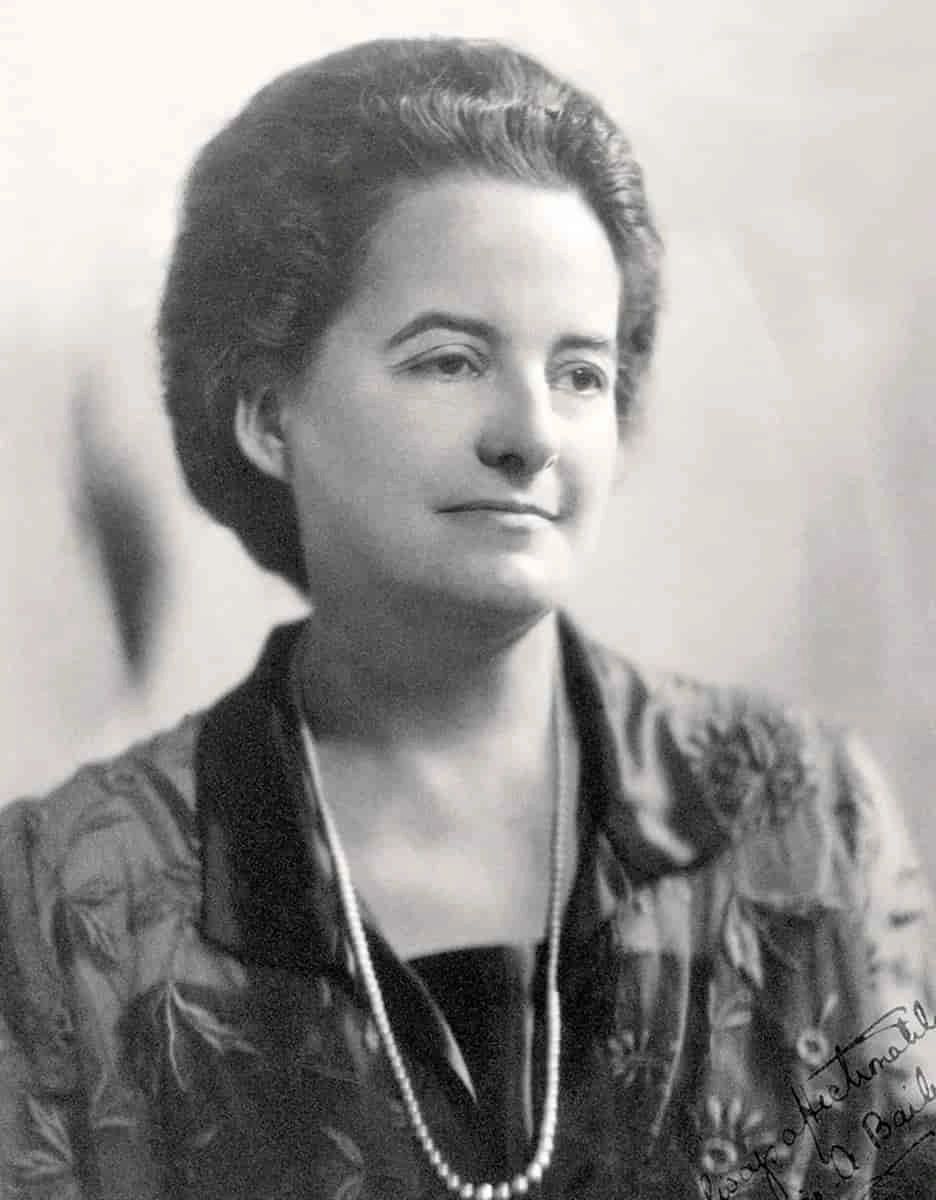
Who Was Alice Bailey?
Alice Bailey (1880-1949) was a British writer and theosophist known for her influential works on occultism and spirituality. She founded the Arcane School, which promotes esoteric philosophy. Bailey's teachings, often considered controversial, have had a lasting impact on New Age thought.
The 10-Point Plan to Destroy the ChurchBailey outlines a 10-point plan to undermine traditional Christian values and transform society. This plan, often discussed in Christian circles, includes the following points:1. Take God and prayer out of the education system.2. Reduce parental authority over the children.3. Destroy the Judeo-Christian family structure.4. If sex is free, then make abortion legal and accessible.5. Make divorce easy and legal. Free people from the concept of marriage for life.6. Make homosexuality an alternative lifestyle.7. Debase art; make it run mad.8. Use media to promote and change mindsets.9. Create an interfaith movement.10. Get governments to make all these laws and get the church to endorse these changes.
Monday, February 03, 2025
The Ecumenical Celebration within the Week of prayer for Christian unity


It was the Adventist Christian Church of Palermo on via Gioacchino Di Marzo that hosted on Tuesday 21st of January the Ecumenical Celebration within the Week of prayer for Christian unity that this year has the theme of the verse (11,26) of the Gospel of John "Do you believe this? ”.
“We are gathered here in the joy of being able to find each other again, to confess together what seduces and passions our hearts, the Lord Jesus – said the Archbishop of Palermo Mons. Corrado Lorefice - to whom we belong. Faith is a context of a relationship and chapter 11 of the Gospel of St. John has remnants of an amazing tenderness, a tenderness entrusted in terms of friendship, of love that binds Jesus to his brothers and sisters; the context of faith sends us back to a brotherly relationship, of friendship and love. Our meeting here tonight, all together, helps us confess that, do you think this? as an element of faith that accompanies us and that causes more and more relationships of friendship and brotherhood to erupt because the God that we have met is the one who has only one vision, that of a brotherhood that inhabits the earth as a fertile garden with its center the tree of life. God thought of us as brothers, as the community of Bethany. From today’s meeting you can smell the fragrance of friendship that collapses throughout the common house, today more than ever there is an attempt of hostility, to raise walls, to make the war rational”.
The initiative, coordinated by the Pastoral Office for Ecumenism and the Interfaith Dialogue directed by Fr Piero Magro, saw the participation of representatives of the Catholic Church, Anglican Church, Seventh-day Adventist Christian Church, Evangelical Church of Reconciliation, Evangelical Lutheran Church, Evangelical and Methodist Churches, Inter Pentecostal Pilgrim Community national, Eparchy of Plane of Albanians, Patriarchate of Russia Ecumenical Patriarchate of Constantinople, Orthodox Patriarchate of Romania.
Tuesday, January 28, 2025
"Every second counts": Doomsday Clock shows humanity closer than ever to catastrophe
Juan Manuel Santos
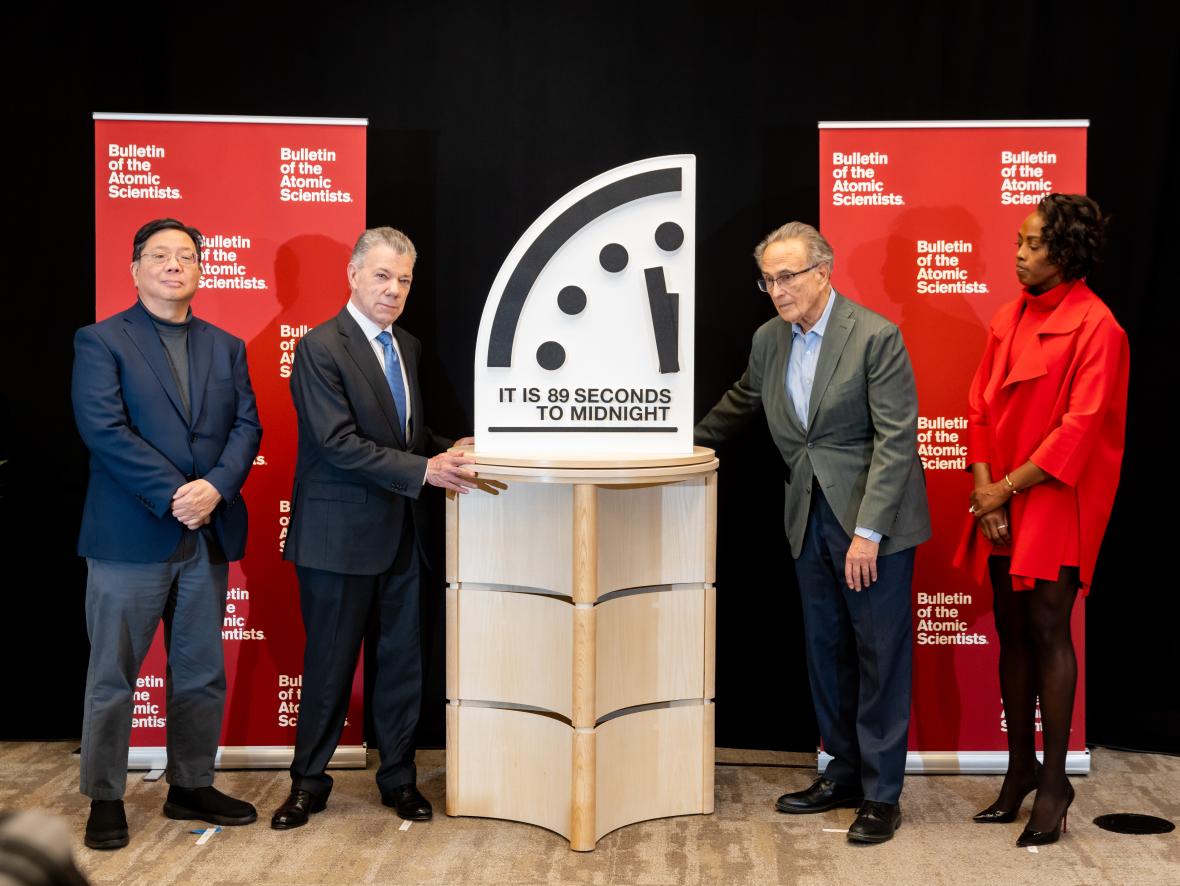
Juan Manuel Santos joins speakers Herb Lin, Suzet McKinney and Robert Socolow on stage for the Clock unveiling.
28 January 2025
The hands of the Doomsday Clock were moved forward to an unprecedented 89 seconds to midnight, the closest to catastrophe humanity has ever been. In his address at the Clock unveiling in Washington D.C., Chair of The Elders, Juan Manuel Santos highlighted the interconnect nature of entrenched, as well as emerging, existential threats and urged humanity to come together to protect our shared future.
Read his remarks in full:
Ladies and gentlemen, distinguished colleagues, and esteemed guests,
This clock is a stark diagnosis of our reality.
At 89 seconds to midnight, the Doomsday Clock stands closer to catastrophe than at any moment in its history.
The Clock speaks to the existential threats that confront us, and the need for unity and bold leadership to turn back its hands.
2024 was the hottest year on record, unleashing devastating climate shocks that destroyed lives and livelihoods across the globe.
The only effective response is for nations to work together, which is why it is so alarming that President Trump has signalled his intention to withdraw the United States from the Paris Agreement. In this crucial year for climate action ahead of COP30 in Brazil, I urge all other signatories to double down and reaffirm their commitment to meeting the Paris goals.
The climate crisis is a force multiplier for instability and insecurity, amplifying the likelihood and severity of all other existential threats.
Saturday, January 18, 2025
Saturday, December 28, 2024
Tuesday, December 24, 2024
Indian-Americans see their political power rise, this time under Trump
WFAE | By Steve Harrison
Published December 18, 2024 at 3:40 AM EST

At this summer’s Democratic National Convention, Kamala Harris spoke about her mother, who was born in the city of Chennai, India.
“My mother was 19 when she crossed the world alone, traveling from India to California with an unshakeable dream to be the scientist who would cure breast cancer,” said Harris, who would have been the first woman elected president, as well as the first person of South Asian descent.
Of course, President-elect Donald Trump won, sweeping all seven swing states.
Indian Americans might be expected to be devastated by Harris' loss. But they are still poised to have more influence than in any previous administration under President-elect Donald Trump.
Trump has nominated Kash Patel to lead the FBI and Jay Battacharya over the National Institutes of Health. Vivek Ramaswamy will co-lead the new Department of Government Efficiency.
Trump picked Harmeet Dhillon to head the Department of Justice’s Civil Rights Division.
And, of course, Usha Vance will be Second Lady of the United States.
“That might come as a surprise to a lot of people because Indian-Americans tend to be Democratic,” said Karthick Ramakrishnan, a researcher at UC Berkeley.
He said that’s based on polls of how Indian Americans, as well as “people who have run for office and won elected office. Or if you look at political contributions. It’s a pretty heavy tilt towards the Democratic Party.”
Courting Indian Americans
But despite that tilt, Trump has embraced — and courted — Indian Americans.
In 2019, Trump shared the stage with India’s conservative and controversial prime minister, Narendra Modi, at a massive rally in Houston. The event, held at a football stadium, was nicknamed “Howdy Modi.”
To massive applause, Trump pledged to work with Modi to make the two countries “even more prosperous than ever before.”
In Trump’s first term, he nominated more mainstream Indian American Republicans, like Nikki Haley as U.N. ambassador and Ajit Pai to lead the FCC.
In his sequel, he’s tapping Indian Americans who’ve made their names as disruptors or fierce defenders of him.
Dhillon opposed the Patriot Act after 9/11 and protested against what she said was discrimination against Sikhs. She became a key defender of Trump starting in 2016, and after Trump lost the 2020 election, she floated the idea of the U.S. Supreme Court to “step in and do something.”
And Patel has echoed Trump’s calls for retribution against political opponents and journalists. In an appearance on Steve Bannon’s podcast last year, Patel said: “We’re going to come after the people in the media who lied about American citizens, helped Joe Biden rig presidential elections. We’re going to come after you, whether it’s criminally or civilly — we’ll figure that out.”
Battacharya was a skeptic of the government’s efforts to contain the spread of COVID-19. He signed onto a statement known as the “Great Barrington Declaration,” which called for trying to protect vulnerable populations while reopening society sooner.
Hopeful about a second term
The prominence of Indian Americans in Trump’s second administration has surprised some.
Avantika Modi immigrated to the U.S. in the late '90s and moved to Charlotte in 2008.
She’s part of a wave of South Asians coming here for tech jobs in the city’s banks. That influx has made Indian Americans the second-largest group of foreign-born residents in North Carolina, after those born in Mexico.
She was disappointed Harris didn’t win. But she’s Googled Usha Vance and Trump’s Indian American nominees.
“I look at Vivek Ramasamy, and I look at his family,” she said. “And it’s the typical or traditional combination of education with tradition. And I think, ‘OK, maybe they are just doing this to win votes, and maybe they’ll actually do some good.’ ”
She’s cautiously optimistic about Trump’s second term.
“Some of the appointments he’s made of Indians maybe makes me hope and think that he’s not, you know, as racist as he is projected to be,” she said.
Shan Shanmugathan, of Charlotte, also works in IT. He grew up near where Harris’ mother was born in southern India. He also donated to Harris' campaign when she ran for California attorney general 14 years ago.
But he voted three times for Trump, saying the president-elect can be a buffoon, but is right more than he’s wrong.
He likes Trump’s picks, especially Battacharya to lead NIH.
“Jay Battacharya is not an ordinary guy. He’s a Stanford professor,” he said.
Shanmugathan said he appreciates Battacharya’s willingness in the early days of the pandemic to push to reopen schools.
“That’s a mark of courage, right? Especially when saying an unpopular opinion is the most difficult thing to do,” he said.
He also approves of Patel’s nomination to the FBI. He said the agency had become too political under President Biden.
Shift to the right
The Asian American Voter Survey found 77% of Indian Americans said they voted for Hillary Clinton eight years ago. It found in September that 69% planned to vote for Harris.
That shift to the right was seen in other minority groups in the 2024 election.
Amit Mehta, who arrived in Charlotte 25 years ago, said the shift to the GOP is mostly from younger Indian Americans, born in the U.S.
“If I look at my uncles and aunts that live here they are staunch Democrats — 100%, right?” he said. “But then there are younger people that I can see leaning right.”
He said he’s not surprised by the prominence of Indian Americans being tapped to serve. He said his peers have been successful in business, and politics is the next logical frontier.
Fully embracing heritage
Former La. Gov. Bobby Jindal in 2008 was one of the first prominent conservative Indian American politicians. Like Nikki Haley, born Nimarata Nikki Randhawa, he anglicized his name and became a Christian.
But many Indian Americans today — both Republicans and Democrats — are embracing their heritage, said Pomona College political science professor Sara Sadhwani, who studies Asian American voting.
“And certainly Vivek Ramaswamy falls into that category,” she said. “He talked about what it meant for him to be a Hindu. Which is much different from Bobby Jindal, from Nikki Haley — even Kamala Harris.”
Perhaps no conservative Indian American has embraced their faith more than Dhillon, Trump’s pick to lead the Civil Rights Division at the DOJ. She gave a Sikh prayer at the Republican National Convention this summer.
She told the audience that, “to show respect we cover our head when we pray.”
Dhillon had a scarf that was across her shoulder, and then gently wrapped it over her head. She recited her prayer in Punjabi and then in English.