Showing posts with label tobacco. Show all posts

Saturday, December 27, 2025

Coffee, Nicotine, and the Politics of Acceptable Addiction


Brownstone Journal

Coffee, Nicotine, and the Politics of Acceptable Addiction


By


 December 18, 2025 


Every morning, hundreds of millions of people perform a socially approved ritual. They line up for coffee. They joke about not being functional without caffeine. They openly acknowledge dependence and even celebrate it. No one calls this addiction degenerate. It is framed as productivity, taste, wellness—sometimes even virtue.

Now imagine the same professional discreetly using a nicotine pouch before a meeting. The reaction is very different. This is treated as a vice, something vaguely shameful, associated with weakness, poor judgment, or public health risk.

From a scientific perspective, this distinction makes little sense.

Caffeine and nicotine are both mild psychoactive stimulants. Both are plant-derived alkaloids. Both increase alertness and concentration. Both produce dependence. Neither is a carcinogen. Neither causes the diseases historically associated with smoking. Yet one has become the world’s most acceptable addiction, while the other remains morally polluted even in its safest, non-combustible forms.

This divergence has almost nothing to do with biology. It has everything to do with history, class, marketing, and a failure of modern public health to distinguish molecules from mechanisms.

Friday, May 31, 2013

A good time to quit smoking is May 31st World No Tobacco Day


INTERNATIONAL
MAY 30, 2013
BY: JACK DENNIS


May 31st is No Tobacco Day
Credits:
Centers for Disease Control and Prevention


The World Health Organization has designated May 31st each year as World No Tobacco Day.

RELATED TOPICS
International
smoking
cancer
lungs
Asthma
breathing


This annual day-long observation serves to highlight the health risks associated with tobacco use and to advocate for effective policies in reducing tobacco consumption.

Besides health, the cost of cigarettes is a primary reason more Americans are quitting tobacco products.

A person who buys one pack a day (the cost in Texas), in one month they spent $168, or an annual cost of $2,184. If the cost of a pack remained the same over ten years, that pack of day would add up to $21,840.

Smoking is the single most preventable cause of death and disease. Cigarettes cause more deaths than cocaine, auto accidents, AIDS, alcohol, heroin, fire, suicide and homicide combined.

The costs to our society include over 400,000 lives lost every year in the U.S.-- over 1200 each day -- and $50 billion annually in lost productivity and increased health care costs.

“Worldwide, the toll exacted by tobacco use is two to three million deaths each year,” indicates the World Health Organization. “Of the world's 1.2 billion smokers, 500 million of them will die because of smoking. This means that 9% of people now alive will die from cigarettes.”

Sixty percent of smokers start by the age of 14, and 90% of smokers are firmly addicted before reaching age 19.

Former Surgeon General C. Everett Koop alerted the nation that nicotine is as addictive as heroin or cocaine. Yet tobacco companies have been spending over $4 billion annually on advertising, or $15 annually for every man, woman, and child in the country.

Because of health problems associated with cigarette smoking, several nations have passed a ban on cigarette advertising. But in the US, the Congress legislated no significant change in this area in the past 30 years.


.
.

Thursday, February 28, 2013

UW-L professor questions effectiveness of 'sin taxes'


Erik Daily
Laci Wolter, manager at Holy Smokes on Rose Street, arranges liquor bottles on a shelf at the store. Despite promises from politicians that "sin taxes", like those on booze and cigarettes, can prevent use and offer a new pool of money for health programs, that's not necessarily true, said Adam Hoffer, assistant professor of economics for UW-L.


February 26, 2013 12:00 am • By PATRICK B. ANDERSON | panderson@lacrossetribune.com


Adam Hoffer knows people who question so-called sin taxes can be stigmatized as “crazy radicals that don’t know what they’re talking about.”

But taxing booze, cigarettes and soft drinks isn’t always a great idea, says the assistant professor of economics at the University of Wisconsin-La Crosse.

Hoffer co-wrote a column this month for U.S. News and World Report that raises doubts about the effectiveness of taxing tobacco and alcohol.

Such taxes heap more costs on low-income families without significantly deterring unhealthy behavior, Hoffer said.

Most of the money raised doesn’t go to health or prevention programs. Instead, Hoffer said, it gets lost in the shuffle of public funding.

“The policy makers in Madison have an idea of how much they want to spend on health care, regardless,” Hoffer said.

However, members of a Wisconsin anti-tobacco group say higher cigarette taxes have, in fact, curbed smoking, and they’re pushing for a similar increase for all tobacco products.

In the past six years, Wisconsin’s cigarette tax more than tripled, from 77 cents a pack to $2.52. Combine that with $1.01 for the federal government, and taxes account for well over half the retail price.

Politically safe ground

Hoffer started studying cigarette taxes as part of his doctoral dissertation at West Virginia University. His column points out a growing trend of lawmakers taxing unhealthy behaviors — expanding excise taxes to products such as candy and soft drinks.

Politicians look to sin taxes as a safe way to raise money without upsetting voters, Hoffer said. “You will see pitch forks and torches if some states try to increase their income tax or their sales tax.”

Taxing sin paints a rosier picture, he said: Hike the price on cigarettes to deter smokers, then funnel the money into health care and tobacco-prevention programs.

The problem is that sin taxes don’t always work as promised, Hoffer said. Nationally, about 20 cents of every dollar raised in cigarette taxes goes to the earmarked purposes.

Wisconsin’s cigarette tax goes into the state’s general fund, along with all excise taxes. Taxing cigarettes raised $587.8 million alone for the state in 2012. Less than 1 percent of tobacco taxes are spent on prevention programs.

“Lawmakers don’t want to label sources of money,” said Todd Berry, president of the Wisconsin Taxpayers’ Alliance.

‘An arms race’

Money the state raised from the cigarette tax jumped by about $93 million when lawmakers last raised the rate in 2009, but three years later it had dropped by about $56.5 million. Cigarette sales are on a steady decline.

“Especially among youth,” said Laura Smith, a spokeswoman for Health First Wisconsin. “It’s definitely one of the most effective ways to lower smoking rates.”

The share of high school students who smoke dropped from 20.7 percent in 2008 to 13.1 percent in 2012, according to the Wisconsin Youth Tobacco Survey.

Health First is asking state lawmakers to tax other tobacco products like cigarettes, hoping higher taxes will lead to a similar drop. The group tried unsuccessfully to have Gov. Scott Walker include the measure in his 2013-15 budget proposal, and is asking other state lawmakers for help.

Rep. Chris Danou, D-Trempealeau, said he would support such a plan. Tobacco companies roll out cigarette alternatives, and, because taxes are lower on the new products, people make the switch, Danou said.

“It’s an arms race,” Danou said.

Not a deterrent

Cigarette taxes may be a steady source of government revenue, but Berry said there’s little financial benefit in raising taxes on other vices.

For instance, the state raised about $9.2 million in 2012 from the excise tax on beer. Wisconsin taxes brewers and importers about 6.5 cents per gallon on beer sold in the state.

Even doubling that would pale compared to the $11 billion from income and sales taxes, Berry said.

“There’s not a lot of money in beer, wine and liquor,” Berry said.

That hasn’t stopped lawmakers in other states from taxing a whole new category of unhealthy products, including candy and soft drinks.

The soft drink industry spent $57 million on lobbying efforts in 2009, and “there’s a small army being raised to fight the 32-ounce soft drink ban in New York City,” Hoffer said.

Despite claims otherwise, most people paying sin taxes are not easily deterred by higher prices, Hoffer said.

“Whenever their price goes up, people hardly change their consumption whatsoever,” Hoffer said.

Higher taxes correlate to falling cigarette sales in Wisconsin, but the drop didn’t happen in a vacuum. There’s the 2010 law that prohibited smoking in bars and restaurants, and there’s also out-of-state competition. The cigarette tax is lower per pack in Minnesota, Iowa and Illinois.

Meanwhile, Hoffer argues that increasing excise taxes disproportionately affects low-income residents, who are more likely to smoke and more likely to be overweight or obese.

“We’re taking away from the people’s ability to spend more on healthy food,” he said.


.

Saturday, August 06, 2011

Self-Denial

There are many ways that we and others would be blessed if we denied ourselves harmful things such as tobacco and coffee.
There are many ways that we and others would be blessed if we denied ourselves harmful things such as tobacco and coffee. Illustration — Morgue File

I saw that there was danger of the saints making too great preparations for conferences; that some were cumbered with too much serving; that the appetite must be denied. There is danger of some attending the meetings for the loaves and fishes. I saw that all those who are indulging self by using the filthy weed tobacco, should lay it aside and put their means to a better use. Those make a sacrifice who deprive themselves of some gratification and take the means they formerly used to gratify the appetite and put it into the treasury of the Lord. Like the widow's two mites, such gifts will be noticed of God. The amount may be small; but if all wcll do this, it will tell in the treasury. If all would study to be more economical in their articles of dress, depriving themselves of some things which are not actually necessary and should lay aside such useless and injurious things as tea and coffee, giving to the cause what these cost, they would receive more blessings here and a reward in heaven. Many think that because God has given them the means, they may live almost above want, can have rich food, and clothe themselves abundantly, and that it is no virtue to deny themselves when they have enough. Such do not sacrifice. If they would live a little poorer and give to the cause of God to help forward the truth, it would be a sacrifice on their part, and when God rewards every man according to his works, it would be remembered by Him.

Early Writings, pp.121-122.
.

Sunday, February 28, 2010

Obama yet to kick smoking habit, should eat better


AP – President Barack Obama returns to the White House from the National Naval Medical Center in Bethesda, …


By STEVEN R. HURST, Associated Press Writer Steven R. Hurst, Associated Press Writer – Sun Feb 28, 2:51 pm ET

WASHINGTON – President Barack Obama hasn't kicked the smoking habit, takes anti-inflammatory medication to relieve chronic tendinitis in his left knee and should eat better to lower his cholesterol, his team of doctors concluded Sunday after the 48-year-old's first medical checkup as commander in chief.

The hoops-happy chief executive, who has endured an exhausting White House run and yearlong battles with congressional Republicans, was otherwise declared in excellent health and fit for duty.

The White House physician, Navy Capt. Jeffrey Kuhlman, said Obama should stick with "smoking cessation efforts," the use of nicotine gum, and come back in August 2011 after he turns 50.

Obama cholesterol levels have crept up to borderline high and he should alter his diet accordingly, according to a report the White House released after the 90-minute examination at National Naval Medical Center in Bethesda, Md. While at the facility, he visited 12 military service members receiving treatment and rehabilitation for injuries suffered in Iraq and Afghanistan.

The president is the picture of health, eats modest portions and exercises regularly. He is an avid basketball player and golfer. The slightly elevated cholesterol levels, tendinitis in his left knee and occasional smoking were the only negatives noted.

Obama said at a June news conference that he still had an occasional cigarette. It was his first public acknowledgment that he hadn't kicked the habit. He chews nicotine gum to avoid regular smoking, and his doctor said that should continue.

Kuhlman also said the president should modify his diet to bring his LDL, or bad cholesterol, below 130. At the time of his last exam, Obama's total cholesterol was 173, while his LDL was 96 and HDL, or good cholesterol, was 68.

This time, total cholesterol was up to 209, with HDL down slightly at 62. LDL was up to 138. Borderline high cholesterol starts at 200, with LDL considered in the same category at 130.

Kuhlman said Obama last checkup was in July 2008 when he was seen by the attending physician to Congress when Obama was an Illinois senator. During the 2008 White House race, his campaign released a statement from his longtime Chicago doctor saying Obama was in excellent health when examined January 2007.

Sunday's report said Obama is 6-foot-1 and weighs 180 pounds in shoes and exercise clothing. His pulse rate is 56, which is very good, as is his blood pressure — 105 over 62. The doctor said Obama's vision was 20/20 in both eyes for both distance and near vision.

The president was checked for and found free of colon cancer with a virtual colonoscopy, a scan that avoids the more invasive visual inspection with a camera device that is passed into the large intestine.

The tendinitis that Obama suffers in his left leg could be the result of his regular basketball playing.

Kuhlman said that there was mild popping and grinding in Obama's left knee and "some weakness" in his left hip, also possibly a result of rigorous and extended periods on the basketball court.

The doctor said Obama should:

_Have another exam for colon cancer in five years

_Continue smoking cessation efforts, a daily exercise program, a healthy diet, moderation in alcohol intake, periodic dental care, and remain up to date with recommended immunizations.

_Keep up a modified exercise regimen to strengthen his legs to ward off more difficulties with his knee.

_Modify his diet to lower his LDL cholesterol below 130.
.
.
Source: http://news.yahoo.com/s/ap/20100228/ap_on_go_pr_wh/us_obama_s_health;_ylt=AlSLIlw3bSnRhXXzG6MX_sJbbBAF;_ylu=X3oDMTM2bXVnMG1nBGFzc2V0A2FwLzIwMTAwMjI4L3VzX29iYW1hX3NfaGVhbHRoBGNjb2RlA21vc3Rwb3B1bGFyBGNwb3MDNgRwb3MDNgRzZWMDeW5fdG9wX3N0b3JpZXMEc2xrA29iYW1heWV0dG9raQ--
.
With all the stats provided above; He smokes = 6-foot-1 and weighs 180 pounds in shoes and exercise clothing; Therefore, he's fat!
.Whi

Wednesday, November 18, 2009

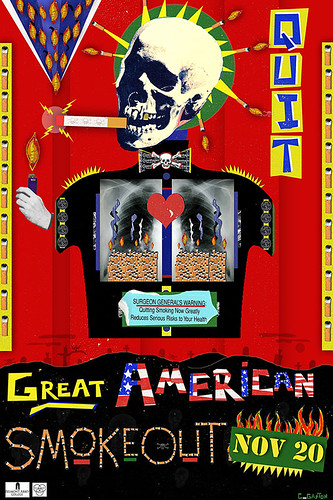
Great American Smokeout lights a spark to quit the habit


Jim Steinberg, Staff Writer
Posted: 11/18/2009 09:51:42 PM PST


Highland resident Dave Criner has been a smoker for 45 years.


The 70-year-old retired schoolteacher and former Marine has seen this habit curtail his active lifestyle and he has grown weary of enduring society's relentless assault on his behavior.

"I'm being crowded out by society," Criner said. "You go to a restaurant and you have to stand outside to smoke. And people look at you like some kind of pariah."

Today is the American Cancer Society's Great American Smokeout. For the past 34 years, the day has served as a springboard to get smokers thinking about making a plan to quit or just quitting altogether on that day.

Public health officials say smoking is the leading preventable cause of death and illness in the U.S. and is a leading cause of numerous kinds of cancers, heart attacks and other health problems.

Criner's decision was based on his own internal clock. Nov. 30 is the day he's selected to stop smoking.

For about a month, he's been tapering down from two packs a day to one pack, maybe a little less on some days.

He logs every cigarette he smokes these days.

Society's impact on his lifestyle was symbolically underscored on a trip to one of Hawaii's less populated islands. He stood across the street from the airport in the designated smoking zone. The uncovered parcel of real estate was the only spot around where it was raining.

There were family considerations for Criner as well.

--------------------------------------------------------------------------------


When he smoked outside of his home or at the home of his grandchildren, "they would follow me outside," he said.

And the final straw, he said, was when he was diagnosed with peripheral artery disease, which limited his ability to walk more than 200 yards.

That limitation forced him to cancel a cruise with his wife to the Pacific Northwest and Canada. He said he couldn't have done the walking required to participate in various port excursions.

And continued smoking will interfere with the medication his doctor prescribed. His artery disease puts him at increased risk for a heart attack or a stroke.

While Criner said he will be leaving the ranks of smokers soon, the number of smokers in the United States to be increasing.

According to a recently released national Centers for Disease Control and Prevention survey, cigarette smoking rose slightly last year for the first time in nearly 15 years.

An estimated 20.6percent, (46million) of U.S. adults were cigarette smokers, up from 19.8percent in 2007. But the difference was not regarded as statistically significant.

In the 10 years from 1998 to 2008, the proportion of U.S. adults who were smokers declined 3.5percent, from 24.1percent to 20.6percent, the CDC said.

Beckie Moore Flati, spokeswoman for the American Cancer Society's Inland Empire office in Riverside, said the Great American Smokeout can be a milestone for someone who stops smoking for the day.

"If they can do it for a day, they can do it for a week and for a month," she said.

Researchers say that quitting smoking can increase life expectancy - smokers who quit at age 35 gain an average of eight years life expectancy, those who quit at age 55 gain about five years and even long-term smokers who quit at age 65 gain three years, says the American Cancer Society.

Ernie Medina Jr., a preventive care specialist at Beaver Medical Group in Redlands, said that after a smoker stops for a month, the physical addiction to nicotine subsides.

But treatment must continue to address two other factors that contribute to cigarette dependency, behavioral and psychological.

Many former smokers revert back to the calming effects of nicotine when they encounter stress - sometimes years after they quit, said Medina, who teaches smoking cessation classes and works individually with people wanting to quit.

But nonsmokers have stress in their lives, too, Medina said. And they have learned to cope in other ways.

So former smokers must find other ways to cope with stress, such as exercise, Medina said.

Former smokers may also revert back to smoking in a social setting, when someone, for example, offers them a cigarette.

Usually, that one-time break from their successful smoking avoidance leads to a person's return to smoking.

"I can think of only one time in 16 years where that didn't happen," he said.

But a former smoker's return to smoking is nothing to be ashamed of, he said. It should be a lesson.

.


.

Wednesday, July 29, 2009

Reluctantly, President Obama Admits He Still Smokes But Is “95% Cured”


Photo (Courtesy) http://www.cbsnews.com/stories/2009/06/27/ap/preswho/main5118606.shtml

June 23, 2009 2:26 PM


A reformed smoker, Margaret Talev of McClatchy Newspapers, today asked President Obama about his struggle kicking the habit.

“As a former smoker, I understand the frustration and the fear that comes with quitting,” she said. “But with the new law that you signed yesterday regulating the tobacco industry, I'd like to ask you a few questions…How many cigarettes a day do you now smoke? Do you smoke alone or in the presence of other people?”


Talev also asked if the law President Obama signed Monday “should help you to quit? If so, why?”

Monday’s law grants authority over tobacco products to the U.S. Food and Drug Administration, bans all cigarettes from having candy, fruit, and spice flavors as their characterizing flavors, to take effect this October. In addition, the law will stop youth-based marketing such as tobacco manufacturers sponsoring sporting, athletic, and entertainment events using tobacco product brand names and logos, or giving away clothing bearing the brand name or logo of a tobacco product.


President Obama underlined that “the new law that was put in place is not about me. It's about the next generation of kids coming up.”

The president dismissed the legitimacy of the question in a way, saying “I think it's fair, Margaret, to just say that you just think it's neat to ask me about my smoking as opposed to it being relevant to my new law. But that's fine. I understand… It's an interesting human interest story.”


The president then added that “as a former smoker I constantly struggle with it. Have I fallen off the wagon sometimes? Yes.”

Continuing, the president said, “am I a daily smoker, a constant smoker? No.”


“I don't do it in front of my kids,” he said. “I don't do it in front of my family. And, you know, I would say that I am 95 percent cured.”

But, he allowed, “there are times where I mess up. And I mean, I've said this before. I get this question about once every month or so. And, you know, I don't know what to tell you, other than the fact that, you know, like folks who go to A.A., you know, once you've gone down this path, then, you know, it's something you continually struggle with, which is precisely why the legislation we signed was so important, because what we don't want is kids going down that path in the first place.”


-jpt


Source: http://blogs.abcnews.com/politicalpunch/2009/06/reluctantly-president-obama-admits-he-still-smokes-but-is-95-cured.html

..