Showing posts with label Synod. Show all posts

Tuesday, August 29, 2023

Pope tells Jesuits inclusivity, doctrinal evolution, synodality are crucial to Church


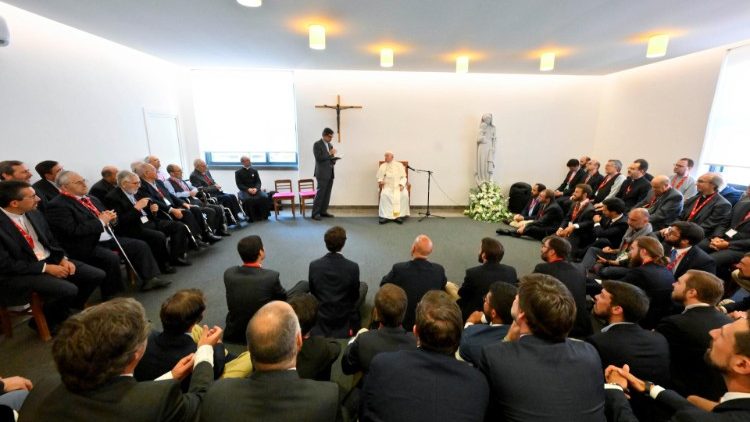
Pope Francis during his meeting with Jesuits in Lisbon during WYD 2023 (Vatican Media)
POPE


The Jesuit publication "La Civiltà Cattolica" publishes a transcript of the dialogue between Pope Francis and the Jesuits of Portugal during the Pontiff's visit to Lisbon for WYD 2023. In the conversation, the Holy Father addresses a range of topics, sharing insights on the Church's challenges and his vision for inclusivity, doctrinal development, and the Synod.


By Francesca Merlo

In an open dialogue with the Jesuits of Lisbon during his visit to Portugal for World Youth Day, Pope Francis engaged with them in conversation and covered a wide array of topics, sharing profound insights on the Church's contemporary challenges and his vision for inclusivity, doctrinal progression, and the Synod.
 
Inclusivity takes centre stage

Central to the discussion was the theme of inclusivity. Throughout World Youth Day in Lisbon, the rallying cry for an all-embracing Church resonated powerfully with the words "Todos, todos" (Everyone, everyone), pronounced by Pope Francis as he stressed that the Church "has space for everyone". He emphasized the pivotal importance of creating a space for all individuals, irrespective of their sexual orientation or gender identity, within the Church. This message continued to echo through his exchange with the Jesuits of Portugal.

Acceptance for all

The Pope reiterated his call to embrace homosexual people within the Church. He critiqued the disproportionate fixation on sexual transgressions, noting that other 'offenses' often remain overlooked. He emphasized the need for a pastorally sensitive and imaginative approach to accompany individuals on their spiritual journeys.

The Pope also recounted an encounter with a group of transgender individuals who were moved to tears by the Pope's acceptance and empathy. He underscored the necessity of reaching out to marginalized communities who often grapple with feelings of rejection, and he accentuated the significance of empathy and compassion.
Urgent concerns regarding ongoing wars

Addressing critical global concerns, Pope Francis conveyed deep apprehension over the persistent prevalence of wars since the conclusion of World War II. He spotlighted the contemporary state of global affairs and underscored the imperative of seeking peaceful resolutions.

Doctrinal Development

The dialogue delved into tensions existing within the Church, including reactionary attitudes and resistance to the tenets of the Second Vatican Council. The Pontiff acknowledged the intricate challenges posed by those who scrutinize Vatican II without explicitly naming it. He underscored the dynamic nature of doctrinal evolution and expounded on the notion that Church doctrine is not an unchanging monolith, but rather an evolving entity. He invoked historical instances such as the changing perspectives on the death penalty, nuclear weapons, and slavery to illustrate the fluidity of doctrine over time.

Against spiritual worldliness

Pope Francis expressed apprehensions about the encroachment of excessive worldliness into religious life. He cautioned against compromising core values with the allure of worldly ideologies. Referring to his recent communication to Rome's priests, he cautioned against succumbing to spiritual worldliness and the potential harm it could inflict on the Church. He further explored the challenges posed by a society permeated with an "eroticized" ethos and the implications of issues like pornography in the digital age.

Synodality

Finally, Pope Francis conveyed his anticipation regarding the impending Synod, a gathering of Church leaders to deliberate on significant matters. He clarified that the Synod wasn't his brainchild; instead, it aimed to restore synodality within the Church—a concept first championed by Pope Paul VI. He emphasized that the driving force behind the Synod was the Holy Spirit, guiding its deliberations devoid of political bias or a focus on garnering votes.


Saturday, October 06, 2018

Sex: the elephant in the room at Vatican youth synod


06 October 2018 - 05H37


© AFP | Pope Francis is attending the Synod of Bishops, focusing on Young People, the Faith and Vocational Discernment

VATICAN CITY (AFP) -

"We mustn't be afraid of sexuality!" French prelate Emmanuel Gobillard urged the Vatican synod on the role of young people, trying to break down the enduring taboo in the 1.3 billion-member Church.

But while the young insist that sex is an unavoidable topic at the month-long meeting of world bishops, the subject has a low profile in the gathering's 70-page working document.

The text notes "the beauty and depth of affective and sex life" that can be "disfigured" by "early sexual activity, multiple sexual partners, digital pornography, exhibiting bodies online and sexual tourism".

It admits that the Church is no longer the moral compass it once was: "Sociological studies show that many young Catholics do not follow Church teachings on sexual morals," it says.

But the fact that it mentions, once, the term LGBT (Lesbian, Gay, Bisexual and Transgender) was too much for Archbishop Charles Chaput of Philadelphia, a member of the synod's permanent committee.

"There is no such thing as an 'LGBTQ Catholic' or a 'transgender Catholic' or a 'heterosexual Catholic' -- as if our sexual appetites defined who we are," he told the meeting on Thursday.

The working document, which will be the basis for a final text, notes the existence of LGBT "who wish to benefit from greater closeness and experience greater care by the Church".

Sunday, October 25, 2015

Catholic bishops at synod call for a more welcoming church


NICOLE WINFIELD AND DANIELA PETROFF,

Last updated 14:47, October 25 2015


ALESSANDRO BIANCHI/REUTERS

Pope Francis, centre, chats with Cardinal Lorenzo Baldisseri, right, as he is flanked by Jesuit Superior Adolfo Nicolas Pachon as they leave the synod on the family in the Synod hall at the Vatican.


Catholic bishops have called for a more welcoming church for cohabitating couples and Catholics who have divorced and civilly remarried, but their stance on homosexuality has not changed.

Bishops from around the world adopted a final document on Saturday (Sunday, NZT) at the end of a divisive, three-week synod that exposed the split in the church between conservatives and progressives over how to better minister to Catholic families today.

In a win for the progressive camp, the document emphasized the role of discernment and individual conscience in dealing with difficult family situations, especially the vexing issue of whether civilly remarried Catholics can receive Communion.

Conservatives had resisted offering any wiggle room on the issue, since church teaching holds that such Catholics are committing adultery and are therefore barred from receiving the sacraments. While the document doesn't chart any specific path to receiving Communion as originally sought by the liberals, it opens the door to case-by-case exceptions.

"We are so happy that we could give this to the pope," said German Cardinal Reinhard Marx, who spearheaded the progressive camp on the issue. He called the document a "historic step".

The Reverend James Martin, a Jesuit author, said discernment and the examination of one's conscience in spiritual direction have always been part of the church's tradition.

"But its encouragement by the synod is notable, and should be seen as a welcoming gesture," he said.

Martin explained that discernment - a key concept in Francis' Jesuit spirituality - "relies on the idea that God can deal directly with us, through our inner lives. It is another encouragement to remind people, especially remarried Catholics, that an informed conscience is, as the church has always taught, the final moral arbiter."

The three paragraphs dealing with the issue barely reached the two-thirds majority needed to pass, but conservatives couldn't muster enough votes to shoot them down. The most controversial paragraph 85 - which says a case-by-case approach is necessary when dealing with remarriage since not everyone bears the same responsibility for the preceding divorce - only cleared by a single vote.

But the document's passage overall will give Francis the room to maneuver that he needs if he wants to push the issue further in a future document of his own. Marx said he hoped that Francis would issue it during his upcoming Jubilee Year of Mercy, which starts December 8.

In a final speech to the synod, Francis took some clear swipes at the conservatives who hold up church doctrine above all else, saying the church's primary duty isn't to condemn or judge but to proclaim God's mercy and save souls.

Francis said the synod had "laid bare the closed hearts which frequently hide even behind the church's teachings and good intentions, in order to sit in the chair of Moses and judge, sometimes with superiority and superficiality, difficult cases and wounded families."

"The synod experience also made us better realize that the true defenders of doctrine are not those who uphold its letter, but its spirit; not ideas but people; not formulas but the free availability of God's love and forgiveness," he said.

But in a bit of levity, Francis also included an acrostic in the footnotes of his speech _ perhaps a papal first - spelling out "Famiglia" (family in Italian) with poetic descriptions for each letter.

In a clear sign that the conservatives had failed to shut the door on the Communion issue, an umbrella group of 26 conservative pro-life organizations said in a statement late Saturday that there was now a "crisis of trust" in the church over the vote.

"Only the pope can restore trust between Catholic laypeople and church authorities in Rome," the group said in a statement.

The document was the culmination of a two-year process launched by Francis to put in practice his call for a church that is more a "field hospital for wounded souls" than an exclusive club for the perfect.

The bishops took his direction, finding ``positive elements" in couples who live together even though they are not married. Rather than condemning these couples for living in sin, the document says pastors should look at their commitment constructively and encourage them to transform their union in a sacramental marriage.

On gays, the synod document repeats church teaching that gays should be respected and loved and, in a novelty, says families with gay members require particular pastoral care. However, the document strongly rejects gay marriage and "gender theory," but omits references to church teaching that homosexual acts are "intrinsically disordered".

Only the 275 synod "fathers" were allowed to vote - none of the handful of women invited to participate - even though one of the 'fathers" with voting rights wasn't even a priest, much less a bishop.

Brother Herve Janson of the Little Brothers of Jesus told reporters he considered refusing to accept the invitation to participate, given that his status in the church is the same as a sister who heads a religious order of nuns.

"I was very upset, because while before the distinction (between voting and non-voting members) was between the clergy and laity, now it has become between man and woman," he said.

It wasn't clear if Francis intended to raise the issue of broader participation in the synod by letting Janson vote, or if his role was a one-time anomaly.

Francis took some of the most divisive wind out of the debate before the synod began by passing a new law making it easier for divorced couples to obtain an annulment, a church declaration that their marriage was invalid. That was aimed at answering a complaint by generations of Catholics who have been denied the sacraments because they divorced and remarried outside the church without an annulment.

The synod was about far more than just contentious issues, however, including how the church should provide better marriage preparation to couples and how to encourage families torn by migration, poverty and war to persevere in their faith.

- AP


.

Pope at Synod's End: 'Today Is a Time of Mercy'


EUROPE


By THE ASSOCIATED PRESS
OCT. 25, 2015, 6:36 A.M. E.D.T.


VATICAN CITY — Pope Francis declared Sunday that "Today is a time of mercy!" as he closed out a historic meeting of bishops that approved an important new direction in welcoming divorced and civilly remarried Catholics into the church.

The synod's endorsement, by a single vote, of Francis' call for a more merciful, less judgmental church was a clear victory for Francis and progressive prelates who have been seeking wiggle room in church teaching to allow these remarried Catholics to receive Communion. Conservatives had objected, citing church doctrine, but they couldn't muster the votes needed to block passage of the final document.

With the badly divided church hierarchy before him in St. Peter's Basilica on Sunday, Francis took veiled aim at those in the church who place more importance on doctrine and law than on God's mercy and forgiveness.

He warned them of the risk of "becoming habitually unmoved by grace," of turning a cold shoulder to God's most wounded children and of a "spiritual illusion" that doesn't let them see the reality of their flock before them and respond to it.

"A faith that does not know how to root itself in the life of people remains arid and, rather than oases, creates other deserts," he said, adding that moments of suffering and conflict are precisely the occasions for God to show mercy.

"Today is a time of mercy!"

Without changing church doctrine, the 275 synod "fathers" on Saturday approved a 94-point final document on responding better to the needs of today's Catholic families. The text covered a host of issues — migration, poverty, single parents and polygamy — but the most disputed section of the document concerned whether civilly remarried Catholics can receive Communion.

Church teaching holds that without an annulment, these Catholics are essentially committing adultury and cannot receive Communion.

While the document doesn't chart any specific path to receiving the sacraments as originally sought by liberal prelates — and doesn't even mention the word Communion — it opens the door to case-by-case exceptions by citing the role of discernment and individual conscience in spiritual direction.

The key paragraph 85 says a case-by-case approach is necessary when dealing with remarriage since not everyone bears the same responsibility for the preceding divorce. It passed with only one vote more than the two-thirds majority necessary.

Its passage will give Francis the room to maneuver that he needs if he wants to push the issue further in a future document of his own. German Cardinal Reinhard Marx, who spearheaded the German theological initiative that was decisive to getting the majority, said he hoped that Francis would issue it during his upcoming Jubilee Year of Mercy, which starts Dec. 8.

Speaking to thousands of people in St. Peter's Square after Mass Sunday, Francis recalled that the word "synod" means to "walk together" — a key concept for the pope, who has called for the church to walk with the faithful and accompany them through life's ups and downs.


.

Wednesday, November 06, 2013

Vatican launches world survey on modern family life

5 November 2013 Last updated at 10:15 ET

 
Pope Francis has called for an extraordinary synod to discuss the family


Related Stories
Vatican suspends 'bishop of bling'
Pope Francis pledges Vatican reforms
Pope: Church 'must heal wounds'

The Vatican has launched a worldwide survey to find out what Catholics really think about its teaching on marriage and family life.

Pope Francis is calling bishops to Rome next October to discuss possible reform that considers modern social realities.

The questionnaire asks for local views on premarital cohabitation, birth control and gay marriage.

Correspondents say it shows a greater interest in issues previously considered taboo.

"The social and spiritual crisis, so evident in today's world, is becoming a pastoral challenge in the Church's evangelising mission concerning the family," the Vatican survey says.

Analysis


David Willey BBC News, Rome

The questionnaire contains 39 questions couched in non-judgmental terms.

It aims at finding out, for example, what percentage of the Catholic flock is cohabiting with a member of the opposite sex without any intention of seeking the marriage bond.

It asks whether local laws on same-sex civil unions equate this with marriage between a man and a woman.

And it tries to find out what knowledge 21st century Catholics have about the controversial Vatican ban on artificial contraception issued back in 1968.

Since his election, Pope Francis has displayed a much more open attitude than his predecessors towards Church teaching - a position not shared by some of his top advisers.

While he is unlikely to change any basic Church doctrine, the Pope clearly wants to sound out the opinions of grassroots Catholics about new family situations. And this is something of a revolution.

Among the "many new situations requiring the Church's attention and pastoral care", it lists single-parent families, inter-religious unions and divorce. Under pressure

The BBC's David Willey in Rome says Pope Francis is under pressure from Catholics in many countries to take a fresh look at the Church's ban on contraception and its refusal to allow divorced and remarried Catholics to take Communion.

There appears to be a division of opinion on this between the Pope, who has more progressive ideas, and some of his top advisers, our correspondent adds.

The consultation is part of the preparation for the extraordinary meeting of the Synod of Bishops next year, which will focus on the subject of family.

"Concerns which were unheard of until a few years ago have arisen today as a result of different situations, from the widespread practice of cohabitation... to same-sex unions," the questionnaire says.

Pope Francis has signalled greater openness, and has said the Catholic Church is too tied up in "small-minded rules".

In an interview in September, he said the Church was too focused on preaching about abortion, gay people and contraception and needed to become more merciful.

Francis earlier created headlines by saying it was not up to him to judge about the sexual orientation of clergy as long as they were searching for God and had goodwill. 
Source
.

Friday, February 11, 2011

Concerns voiced that Middle East Synod was misunderstood by Muslims


By Alan Holdren, Rome Correspondent

Vatican City, Feb 10, 2011 / 01:52 pm (CNA/EWTN News).- The Vatican’s 2010 meeting for the Middle East has been misunderstood by many in the region as calling for a “new crusade” against Islam.

As officials gathered in Rome recently to assess last October’s special Synod for Bishops, a veteran Vatican adviser on Christian-Muslim dialogue told CNA that many Muslims saw the Synod as “a new project against Islam.”

“Many people, many Muslims, who have no idea of Christianity at all are interpreting it ... as a new crusade,” Father Samir Khalil Samir, SJ, of the Pontifical Oriental Institute said in a late January interview.

Church leaders from the region and Vatican officials met Jan. 20-21 to assess reactions to the Synod, and to suggest themes for the document that Pope Benedict XVI is writing in response to the Synod, known as a “post-synodal apostolic exhortation.”

On Feb. 8, the Vatican issued a statement that concluded: the “socio-political situation in the various countries of the Middle East remains tense.”

Fr. Samir said that the Synod was widely interpreted in political, not religious terms. “When Muslims meet,” he said, “usually they meet on a political level.” As a result, many saw the bishops as meeting to discuss “how to attack Islam.”

“Fifty-seven Muslim countries meet yearly, usually invited by Saudi Arabia and they discuss as nations how to defend Islam,” he said. “In their mentality, the West is still seen as Christian nations. It is still Christianity against Islam – properly because they don’t make a difference between religion and state.”

In its statement, the Vatican reported that the Synod’s final message had been sent to “political figures” throughout the region. It also reported that an international congress had been held in Syria on the state of Muslim-Christian relations in Arab countries. In addition, a meeting of Christians and Jews has been held in Jerusalem to “promote more objective information about the synodal assembly.”

The Vatican insisted in its statement that “respect for Christian communities” is necessary “to eradicate any hotbeds of anti-Christian sentiment in the Middle East, to halt the emigration of Christians from that region, which is their native land, and to favor the common good.”

The Vatican’s press office said the meeting was held to prepare the council members for direct collaboration in the Pope’s eventual preparation of a final document, called an apostolic exhortation. The Pope will set forth his teaching to guide the future of the Church on pastoral and practical questions proposed at the conclusion of the Synod.

The next meeting of the Special Council for the Middle East of the General Secretariat of the Synod of Bishops, under the leadership of the Synod’s secretary general, Archbishop Nikola Eterovic, will be held Mar. 30-31.

.
.
Related news :

Friday, October 08, 2010

North Americans to participate in Synod of Bishops for Middle East

SYNOD-NAMERICAN Oct-8-2010 (340 words) xxxi

North Americans to participate in Synod of Bishops for Middle East

By Catholic News Service

VATICAN CITY (CNS) -- Of the 185 voting members of the special Synod of Bishops for the Middle East, 12 are bishops who minister in the United States and Canada.

Like the synod membership as a whole, most of the North American participants are bishops of the Eastern Catholic churches: Melkite, Maronite, Chaldean, Syrian, Armenian or Coptic.

The full list of participants in the Oct. 10-24 synod was released at the Vatican Oct. 8 during a press briefing by Archbishop Nikola Eterovic, secretary general of the Synod of Bishops.

Pope Benedict XVI named Msgr. Robert L. Stern, general secretary of the Catholic Near East Welfare Association, to be a voting member of the synod.

And three Latin-rite bishops from North America are participating: Cardinal Roger M. Mahony of Los Angeles, Archbishop Allen H. Vigneron of Detroit, and Archbishop Thomas Collins of Toronto.

More North American participants are involved because of their ministry in Rome. Cardinal William J. Levada, prefect of the Congregation for the Doctrine of the Faith, is a synod member, as are Cardinal John P. Foley, grand master of the Equestrian Order of the Holy Sepulcher of Jerusalem, and Archbishop Raymond L. Burke, prefect of the Supreme Court of the Apostolic Signature.

The other North American members of the synod are:

-- Syrian Bishop Yousif Habash of Our Lady of Deliverance of Newark, N.J.

-- Melkite Bishop Ibrahim M. Ibrahim of Saint-Sauveur of Montreal.

-- Melkite Bishop Cyrille S. Bustros of Newton, Mass.

-- Maronite Bishop Joseph Khoury of Saint-Maron of Montreal.

-- Maronite Bishop Robert J. Shaheen of Our Lady of Lebanon of Los Angeles.

-- Maronite Bishop Gregory J. Mansour of St. Maron of Brooklyn, N.Y.

-- Chaldean Bishop Sarhad Y. Jammo of St. Peter the Apostle of San Diego.

-- Chaldean Bishop Ibrahim N. Ibrahim of St. Thomas the Apostle of Detroit.

-- Armenian Bishop Manuel Batakian of Our Lady of Nareg in New York.

Benedictine Father Mark Sheridan, a U.S. member of the International Association for Coptic Studies, was named an expert at the synod.

END
.
Source
.

Thursday, October 09, 2008

Synod: Ambivalence about modern Bible scholarship continues to swirl


Submitted by John L Allen Jr... on October 9, 2008 - 3:56am.
-->Posted on Oct 9, 2008 03:56am CST.


By JOHN L. ALLEN JR.Rome

Ambivalence about modern Biblical scholarship, which uses the same historical and literary tools to study scripture that one might apply to any other ancient text, continues to course through the Oct. 5-26 Synod of Bishops, devoted to “The Word of God in the Life and Mission of the Church.”
On the one hand, speakers have praised the contributions of Biblical scholars and called their work “essential” for a proper understanding of scripture. Yet several have also warned about a gap between exegetes and the rest of the church, especially the bishops, and the need for scientific study to be understood as no more than an appetizer, so to speak, before the main course of deep spiritual meditation.
In other words, the concern is that using the methods of scientific study should not lead to seeing the Bible as no more than an interesting piece of ancient literature, rather than the living Word of God.
That note was struck yesterday afternoon, in various ways, by at least four participants in the synod: Archbishop Terrence Prendergast of Ottawa, Canada; Bishop Félix Lázaro Martínez of Ponce, Puerto Rico; Cardinal William Levada, an American who heads the Congregation for the Doctrine of the Faith; and Fr. Julián Carrón, President of the Communion and Liberation movement.
Lázaro, for example, called for “mutual exchange between theology and exegesis.”
“It is the People of God,” he said, “who suffer the consequences of the existing dichotomy between theology and exegesis.”
Levada said that while the church must “treasure scientific research by the exegetes,” nonetheless “the interpretation of the Holy Scriptures cannot be only an individual scientific effort, but should always be compared, inserted and authenticated by the living tradition of the church.”
Prendergast called for the synod to ponder “the loss of confidence among Catholics that scripture truly communicates God’s revelation” and “how this may have been brought about by the influence of modern Biblical scholarship on preaching.” He also suggested renewal in “the church’s understanding of the spiritual sense of scripture” as a possible remedy.
Other notes struck yesterday afternoon include:
• Archbishop Donald Wuerl of Washington, D.C., pointed to “a highly secular and materialistic world view,” with an exaggerated focus on the individual, as a major pastoral challenge. He recommended efforts in preaching and religious education to connect the Bible readings presented in the Lectionary with the doctrinal teaching found in the Cathechism of the Catholic Church.• Archbishop Tomash Peta of Astana, Kazakhstan, in effect echoed Cardinal Marc Ouellet’s call for a “Marian paradigm” in the interpretation of scripture, though without directly using that term. He argued that Mary is the “key to understanding the Bible,” both in terms of her openness of heart and her “complete union with Jesus.”• Bishop Eduardo Patiño Leal of Córdoba, Mexico, was the first to raise the issue of “private revelation,” meaning spontaneous eruptions of alleged divine revelation in venues such as Marian apparitions (The on-going reports of revelation from Mary in Medjugorje, Bosnia, are probably the best-known contemporary example). In broad strokes, Patiño called for caution in approaching private revelation: “Simple people of good will are drawn to alleged manifestations,” he said, “but sometimes they transform themselves into isolated religious groups within the Catholic church who spread devotions and spiritual pointers whose origins are to be found in ‘private messages and revelations,’ that have to be evaluated with care and that still have to provide an impulse toward overall public revelation in the living tradition of the church.”• Fr. Heinz Steckling, Superior General of the Oblate Missionaries, urged synod members not to restrict their sense of God’s Word to the printed page, but rather also to be attentive to what God might be saying “in human culture, in inter-religious dialogue, in our own life history.” The Bible, he said, is like a language school in which one learns to hear God, but “it would remain dead letters on a page if we spent our whole lives in school without going out to hear God’s voice in the world around us.”• Beyond the nexus between the Bible and the church, Levada also stressed the importance of the Bible in the search for unity among the divided branches of the Christian family. He noted that through the centuries, the Bible has sometimes been a source of division – citing, for example, the Arian heresy and the Protestant Reformation. Nevertheless, he said, “attention given to the written Word of God is certainly a very strong bond that draws the Catholic church closer to the other confessions in the common search.”• Perhaps the day’s most practical speech came from Bishop Peter Ingham of Wollongong, Australia, who focused at some length on the role of the lector at Mass, meaning the person who reads the scripture passages aloud. Some lectors read too fast, Ingham complained, and others don’t give each word or bit of punctuation their due. He recommended practice reading aloud before Mass.• On a more lofty theological note, Bishop Oscar Brown Jiménez of Santiago de Verguas in Panama stressed the link between the Eucharist and the Bible. In that context, he suggested that perhaps the Western church should steal a page from the East, speaking of a “double epiclesis,” or calling down of the Holy Spirit, during the Mass – one which is implicit in the liturgy of the Word, and the other which is explicit in the words of consecration that transform the bread and wine into the body and blood of Christ. After all, Brown argued, it’s the same Holy Spirit present in both.• Archbishop Geraldo Lyrio Rocha of Mariana, Brazil, stressed the importance of Liturgies of the Word in communities that lack a priest. He said that in Brazi, an astonishing 70 percent of Catholic communities do not have regular Sunday celebrations of the Eucharist, a reflection of severe priest shortages in much of Latin America. (In the United States and Europe, the ratio of priests to Catholics is roughly 1-1,300; in Latin America, it's closer to 1-7,000.)
Each morning before the work of the synod begins, the bishops and other participants take part in a brief rite of morning prayer. As part of the service, a different bishop offers a brief spiritual reflection – ideally, modeling the sort of good homiletic practice for which various speakers have called.
This morning’s reflect was delivered by Cardinal Angelo Bagnasco of Genoa, who is also president of the Italian bishops’ conference. Speaking primarily to his brother bishops, Bagnasco said that pastors are painfully aware of their “moral and anthropological poverty” and the “insufficiency of our powers” facing the great challenges of the day. He called upon bishops to keep their gaze fastened upon Christ, and to be for one another a “small ray” of Christ’s light.
In other business, the synod yesterday chose moderators and relators for the small groups in various languages. Two Americans were tapped: Cardinal Francis George of Chicago, president of the U.S. bishops' conference, was elected moderator of one English-language group, and Bishop Gerald Kicanas of Tucscon, vice-president of the U.S. conference, was chosen as relator of the same group.