Showing posts with label J P Morgan. Show all posts

Tuesday, June 20, 2023

Newly Unsealed Documents Expose Plaskett's Email Soliciting Epstein's Contributions and Extending Fundraiser Invitation

Published On June 17, 2023 06:42 AM
Janeka Simon | June 17, 2023 06:42:18 AM


I

Delegate to Congress Stacey Plaskett. 
By ERNICE GILBERT, V.I. CONSORTIUM


"Epstein was a reprehensible person and I'm truly disgusted by his actions," Congressional Delegate Stacey Plaskett said earlier this month, speaking out after filings in the ongoing lawsuit between the Government of the Virgin Islands and JPMorgan brought her acceptance of Jeffrey Epstein’s donations to her political campaigns to the fore once again.

Ms. Plaskett said that she was unaware of Epstein’s campaign contributions until after it was reported in the press subsequent to her campaign’s federal filing. However, newly unsealed evidence submitted by JPMorgan’s legal team show that Delegate Plaskett in 2018, had personally requested that an invitation to her Bloomberg fundraiser be sent to Epstein. “I would be grateful for his support and the support of those that he may direct to assist me," she wrote.
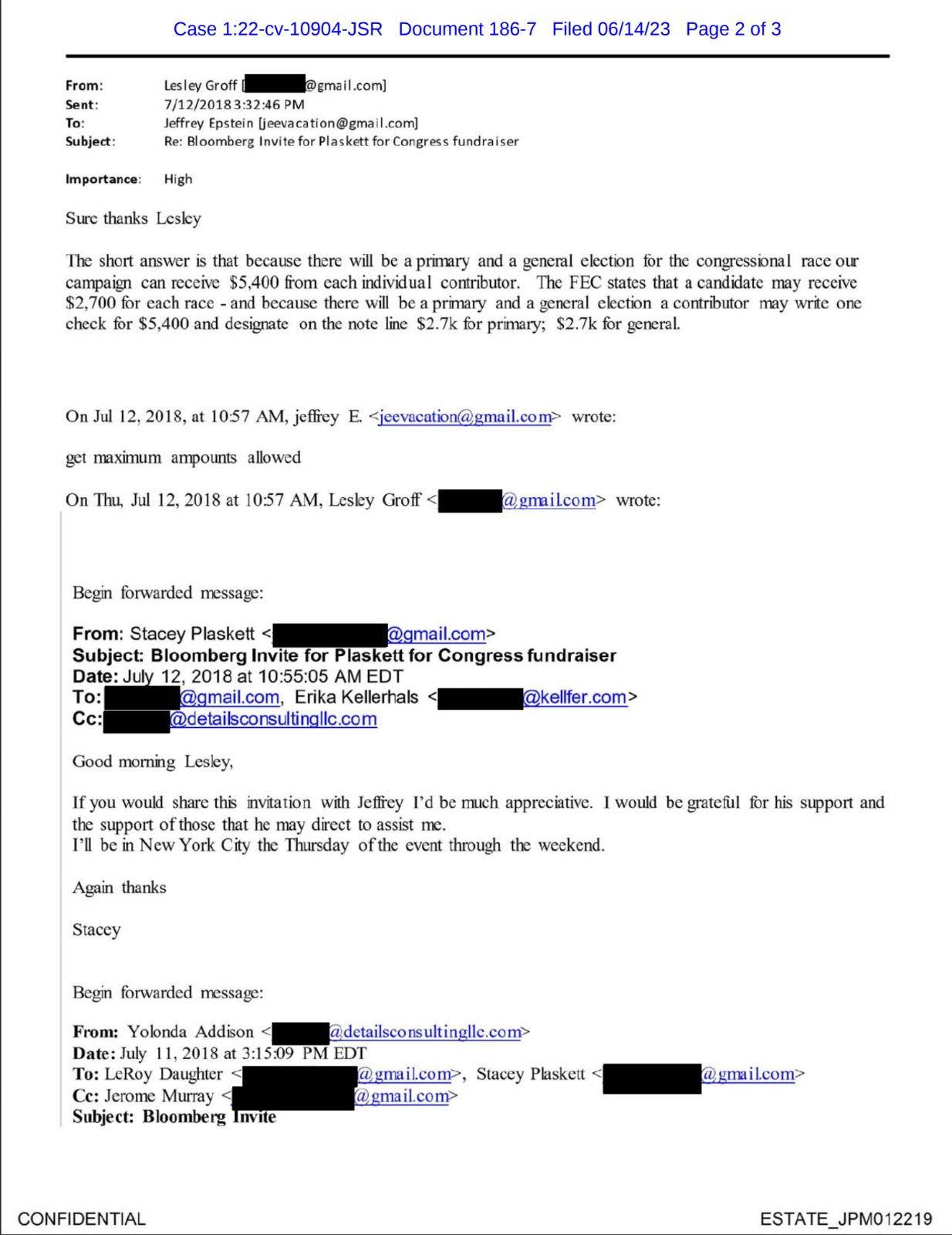


Email from Delegate to Congress Stacey Plaskett seeking support from Jeffrey Epstein and his circle of wealthy and powerful friends. (JPMorgan court filing)


The email was reportedly sent in July of 2018, just about a year before Epstein was arrested on sex trafficking charges. However, he was being investigated since March 2005 in Florida after the family of a 14-year-old girl reported that she was molested at his mansion. And in 2008, he pleaded guilty to one count of soliciting prostitution and one count of soliciting prostitution from someone under the age of 18. Additionally, at this point, multiple women had spent approximately a decade claiming that they had been groomed, trafficked and abused by the owner of Little St. James and his network of powerful friends.

Monday, December 23, 2013

A Locked Door, A Secret Meeting And The Birth Of The Fed


by Robert Smith and Jacob Goldstein
December 23, 2013 3:43 AM


Listen to this Story
Morning Edition

5 min 38 sec


J.P. Morgan: Not a pussycat. Hulton Archive/Getty Images

In 1907, the U.S. economy was in the grip of a financial crisis. Unemployment was up. The stock market was down.

People started panicking. They were lining up overnight to pull their money out of healthy banks This can be deadly for an economy: Healthy banks have to shut down, businesses can't get credit, they lay people off, and the economy gets worse.

At the time, the U.S. government had no way to deal with the panic. There was no institution that could step in to stop the run on healthy banks. So the job of stopping the panic fell to one man: J.P. Morgan (of J.P. Morgan fame).

He summoned dozens of the leading financiers in New York to his private library on Madison Ave, and essentially ordered them to contribute to a $25 million pool that would be used to backstop the system. Then he locked them in and made them stay there through the night, until they all agreed to his plan.

The plan worked — it essentially ended the Panic of 1907.

But some powerful people in Washington wondered: what about the next panic? Do we really want the fate of the U.S. economy to hinge on one rich guy in New York?

One person in particular decided this was a problem: Senator Nelson Aldrich, chairman of the Senate finance committee. Aldrich knew there was something America could do so that it would no longer have to rely on one guy to end panics. The U.S. could create a central bank.

This was not a new invention. Countries in Europe already had central banks. And, during panics, the central banks basically did what J.P. Morgan did in the U.S.: Act as lenders of last resort for healthy banks. When depositors were lined up out the door yelling for their money, banks that were basically sound could borrow from the central bank.

But just consider that name: central bank. Throughout American history, both of those words — "central" and "bank" — had been deeply unpopular. The thought of a bunch of rich bankers in New York controlling a powerful central bank did not inspire confidence.

Still, Aldrich realized he needed bankers' help to draw up a plan for a central bank. So he came up with a plan to gather in secret.

He told a handful of New York bankers to come on a given night, one by one, to a train station in New Jersey. There they would find a private rail car hitched to the back of a southbound train. To conceal their identities, Aldrich told the bankers to come dressed as duck hunters and to address each other only by first name.

The train headed south, and the bankers got off in Georgia. They spent the next week holed up in a private club at a place called Jekyll Island. (Apparently, the name didn't sound as sketchy then as it does today.)

At Jekyll Island, Aldrich and the bankers came up with a plan. They knew many Americans thought a central bank could become too powerful, too influential in the economy. So they came up with a classic, American workaround: The decided the U.S. should create lots of little central banks, scattered all around the country.

The plan they came up with still had a long way to go. It got shot down the first time in Congress. The plan for a central bank was debated, changed significantly, renamed. But the basic idea held up. And on December 23rd, 1913 President Woodrow Wilson signed the Federal Reserve Act into law.

Creating the Fed didn't solve the nation's economic problems. In fact, a few decades after the Fed was created, its policies made the Great Depression worse. And the Fed has changed significantly over the course of a century. But even after all those changes, there are still a dozen Federal Reserve banks scattered around the country in cities like Dallas, Richmond and, of course, New York.


Source
.