Thursday, July 02, 2026


Tuesday, June 16, 2026
Kinship 47th Annual Kampmeeting


47th Annual Kampmeeting
Tue, Jul 07 |
Bon Secours Retreat & Conference Center
Request Access
Time & Location
Jul 07, 2026, 11:00 AM – Jul 12, 2026, 3:00 PM
Bon Secours Retreat & Conference Center, 1525 Marriottsville Rd, Marriottsville, MD 21104, USA
About the event
Thriving in a Complex World embodies the spirit and theme of this year's Kampmeeting. It highlights the dynamic synergy of our SDA Kinship community and it's aspirations. Through hope and action, we create a space where every LGBT+ person, their families and allies can thrive. This theme reaffirms our dedication to building a community rooted in understanding, acceptance, and unity.
Request Access
Thursday, May 28, 2026
Tuesday, March 10, 2026
Sunday, December 28, 2025
Catholics in Maryland
Draft posted: 2019-02-09
On the ground from the beginning
Colonial Maryland, like its Chesapeake neighbor Virginia, was marked by slavery, but also by its distinction as a Catholic haven in British North America. George Calvert, Lord Baltimore, had been raised a Catholic, but he converted to the Church of England to pursue a life of service to King James. But, Calvert's conversion was half-hearted and he eventually reverted to Catholicism, and in the 1620s, he took up his long-held dream of helping to colonize North America with his fellow-Catholics in mind. He began by investing in an emerging Catholic colony in Newfoundland, but finding it inhospitable he set his sights on the Chesapeake. After visiting Virginia in 1629, Calvert pressed on to secure the necessary permissions from the Crown and the Privy Council to draw up a charter for Maryland. In 1631 the Privy Council embarked on the work of drawing up a charter that would grant Calvert absolute rule over the land between the Delaware Bay and the Potomac River. While charter was in preparation George Calvert died (1632), but his twenty-six year-old son, Cecil, took up his work. The younger Lord Baltimore was assisted in by Andrew White, SJ, who had been an advisor to George Calvert in planning and publicizing the venture since 1628.1
Andrew White's relationship with the Calverts assured that the English Jesuits would play a major role in the establishment of Catholic life in Maryland. In 1633, White set sail from England as one of the province's original Adventurers, leading British who were responsible for guiding expeditions of people with fewer means to populate the colony. White undertook his voyage on the Ark and Dove, bringing 26 men with him to support his mission to Christianize the territory. White's group was joined by other wealthy Adventurers and their accompanying Settlers, who were most often Protestant indentured servants. In March 1634, the vessels landed on an island in the lower Potomac, and from that spot, the Maryland Catholic community and the Society of Jesus grew up together in Lord Baltimore's North American colony.2
White's role in publicizing and recruiting colonists for the voyage ensured that he and the English Jesuits shared the interests of the wealthy Adventures who were responsible for creating the colonial community from the beginning. Despite their missionary aims for their interaction with the local native communities, the Jesuits found themselves aligned with the Catholic planter class who settled the area, rather than the burgeoning population of Protestant indentured servants who came to do the work of building the colony.
Thus, in the late 1630s, just as every other wealthy Adventurer did, the Jesuits undertook the process of claiming their land from Lord Baltimore. This early crew, Andrew White, John Altham (aka Gravenor), Thomas Copley, and Ferdinand Pulton, filed their claims as individuals rather than as an order because English, and hence Maryland, did not recognize the right of a religious order of corporate body to own property. Given that Lord Baltimore resisted the Jesuits' efforts to hold their land in common, eventually, they transferred the land rights to a layperson, Cuthbert Fenwick, to hold in trust for the order. In doing so they set into motion the process that resulted in the establishment of the first two Jesuit plantations in Southern Maryland: St. Inigoe's Manor and St. Thomas's Manor.3
Saturday, December 27, 2025
Washington Was Originally Named Rome, Maryland (Mary-Land)
Discover the unique history of Rome in Maryland and its influence on Washington D.C., from Francis Pope's estate to Tiber Creek's origins.
Washington’s Hidden Roman Legacy
Nestled in Washington D.C.‘s history is a surprising connection to a little-known place: Rome, in Maryland. This discovery offers a unique glimpse into America’s past.
Rome in America: A 17th Century Vision
In the 17th century, a vast estate of 400 acres existed southeast of what is now Georgetown, in Maryland. Owned by an Italian culture enthusiast, this land was ambitiously named Rome. The owner’s passion for Italy didn’t just influence the name; it shaped his vision for the New World. This estate was more than land; it was a symbol of aspiration and connection to ancient civilizations.
Transitioning from European inspiration to American reality, the landowner renamed Goose Creek to Tiber Creek. This act mirrored Rome’s iconic River Tiber, creating a symbolic link across continents. His vision was to merge the grandeur of ancient Rome with the budding potential of America.
Francis Pope: The Mastermind Behind Rome, Maryland
The visionary behind this American Rome was Francis Pope, who acquired the land on June 5th, 1663. His story, detailed in an October 7th, 1883 Washington Post article, reflects a blend of ambition and whimsy. Pope took pride in his estate, often boasting about his Rome on the Tiber. His unique naming scheme wasn’t just a personal quirk; it was a statement of cultural identity and historical awareness.
Francis Pope’s legacy extends beyond mere land ownership. He imbued his estate with a sense of historical and cultural significance. His choice to name the creek Tiber was a deliberate effort to echo the greatness of ancient Rome in the new American landscape.
Saturday, November 08, 2025
Thursday, September 18, 2025
National Hispanic Heritage Month Mass / Mes Nacional de la Herencia Hispana
Date & Time
4:00 pm
Organizer
301-853-4469
malteza@adw.org

Celebrate a special Mass to commemorate National Hispanic Heritage Month on Saturday, September 20, 2025. A procession will begin at 4:00 p.m. ET followed by Mass to begin at 4:30 p.m. ET at St. Bernard of Clairvaux Catholic Church at 5700 Saint Bernard Dr, Riverdale, MD. The Principal Celebrant is Most Reverend Evelio Menjívar, Auxiliary Bishop of Washington for this Mass.
Download Flyer: English | Español
Download Prayer Card: English/Español
Hispanic Popular Spirituality in the United States: English/Español
Please see the recommended resources to Share, Learn, and Celebrate National Hispanic Heritage Month.
For ASL interpretation, contact deafcatholic@adw.org two weeks in advance.


For more information, contact Alma Maltez 301-853-4469 or malteza@adw.org.
Explore the diversity of our community through our cultural events.
Friday, August 22, 2025
Tuesday, August 13, 2024
Maryland Rep. Steny Hoyer, 85, recovering after ‘mild’ stroke, his office says
By Allie Griffin
Published Aug. 13, 2024, 8:28 p.m. ET
Rep. Steny Hoyer (D-Md.) had a “mild” stroke over the weekend and was rushed to the hospital, his office announced Tuesday.
The 85-year-old former House majority leader “experienced a mild ischemic stroke and sought medical treatment” on Sunday night, his deputy chief of staff Margaret Mulkerrin said in a statement.
“Mr. Hoyer has responded well to treatment and has no lingering symptoms,” she said. “He expects to resume his normal schedule next week.”
The Democrat’s office didn’t state what hospital he was treated at or if and when he was released, but thanked his caretakers.
Rep Steny Hoyer
Rep Steny Hoyer, 85, suffered “a mild ischemic stroke” Sunday night, his office said.
ZUMAPRESS.com
“Mr. Hoyer’s wife and family extend their deepest thanks to his medical team,” his spokesperson said.
Hoyer announced that he was stepping down from his leadership position among House Democrats in November 2022 after several decades as a top Dem.
He continued to serve Congress since then and is an active member of the Appropriations Committee.
Hoyer’s health also made headlines in 2018 when he was hospitalized for a short time with pneumonia while he was House majority leader.
Rep Steny Hoyer
He has no lingering systems after undergoing medical treatment and is expected to return to his normal schedule next week.
Rod Lamkey – CNP / MEGA
The Maryland Democrat contracted COVID-19 in February 2022 — becoming the 32nd lawmaker to test positive for the virus at the start of the year.
Sen. John Fetterman (D-Pa.) suffered a stroke that “technically” killed him just two days before his Democratic primary victory.
“I didn’t have a near-death experience, because technically I had died,” Fetterman, 54, said of his life-altering stroke.
The medical episode sidelined him from the campaign trail for nearly three months and caused him to develop auditory processing challenges, which requires him to use closed-captioning monitors to follow along with people’s speeches.
Saturday, December 30, 2023
North American Division Continues to Promote Social Justice

In October 2018, Dan Jackson said (at the NAD Society of Communicators meeting) “Social Justice is the Gospel.” Not part of the gospel. Not an aspect of it. The whole kit and caboodle.

Five years later, in October this year, the NAD hosted a ‘Conscience and Justice convention at their office in Columbia Maryland. According to the Lake Region (regional) Conference, the meeting was a '“gathering of social justice visionaries and thought leaders.” A better name for it is the “NAD Christian Nationalism is Bad and Critical Race Theory is Good Social Justice SDA Polilib Woke Symposium” or NADCNBCRTGSJSDAPWS+, for short.
Some speakers at this event:
- The Honorable Maxine Waters (Invited), Member of Congress
- Nicholas Miller, Co-Director Washington Adventist University Center for Law and Public Policy
- Leon Russell, Chairperson (Invited) NAACP
- Claudia Allen
- Charde’ Hollins, Mental Health & Equity Consultant
- Kim Brace, Founder and President Election Data Services
- Paul Graham, Assistant to the Vice President for Pastoral Ministries for Revitalization — Potomac Conference
- G. Alexander Bryant, President, North American Division of the Seventh-day Adventist Church
- Derrick Greene, Founder Interfaith Action Movement
- Bishop Vashti Murphy McKenzie, President and General Secretary National Council of Churches
- Bettina Krause, Editor Liberty Magazine
- Marilyn Dabady Lynk, Associate Vice President Learning, Leadership & Organizational Development Diversity Inclusion Equity
- LGBTQIA: Love and Liberty
- Immigration Today: What’s New?
- Addressing Health Disparities as Evangelism
- The Redistricting Process: Drawing the Lines
- Democracy Today: Justice or Injustice?
- Threats to the Voting Rights Act
- Historically and Today: Where Does the Church Stand on Systemic Racism and Application of the Three Angels Message?
- Learning, Leadership & Organizational Development Equity, Diversity & Inclusion
Saturday, May 23, 2020
Therezinha Barbalho Ordained into the Gospel Ministry
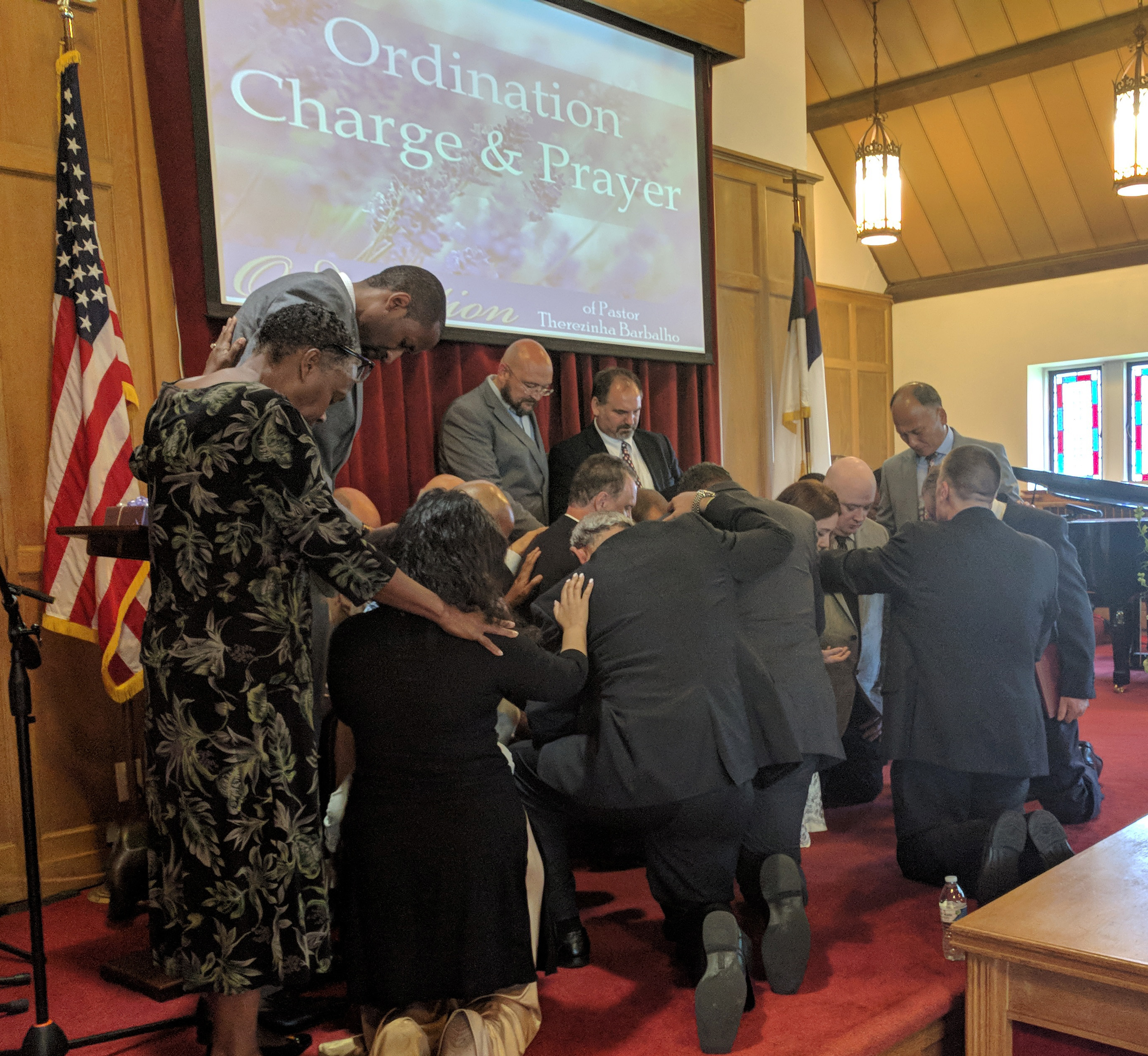
JUNE 27, 2019 BY COMMUNICATION
Therezinha Barbalho Ordained into the Gospel Ministry
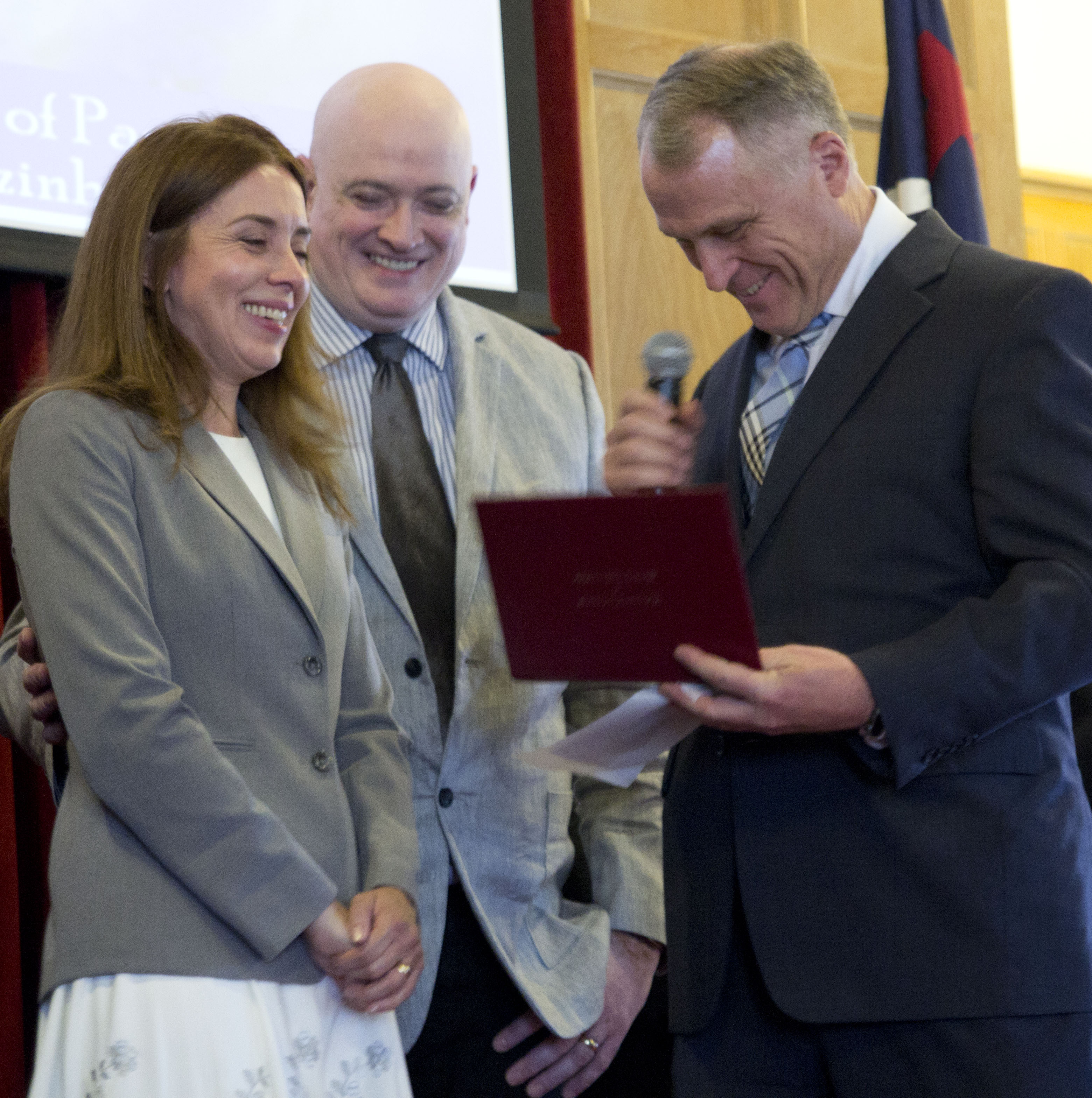
Pastor Therezinha Barbalho stands with her husband, Zeli Leite, and President Bill Miller.
Potomac administration recently had the privilege of ordaining Therezinha Barbalho, pastor of the Silver Spring SDA Church (Md.), into the gospel ministry.
“The call to ministry isn’t when someone says we couldn’t have done that without you,” said President Bill Miller, during the service. “It’s not when committees recommended you for ordination, a degree, interviews or endorsements. The call to ministry is when we hear His voice and we walk with Him into the human mess. The call to ministry is learning our limits and learning to trust in the God that is there with us.”
Barbalho says she felt called to pastoral ministry at the age of 18 and went on to graduate with a degree in theology. She worked as a Bible worker in Belém, São Paulo and later pursued a law degree. Even while practicing as a licensed lawyer in Brazil for 13 years, she continued to serve as a volunteer minister. After moving to the United States, Barbalho served as an associate pastor for the New Jersey Conference and later came to Potomac to pastor the Richmond Brazilian church (Va.)—where she held her first baptismal ceremony—and the Silver Spring church (Md.), where she works to date.
“I receive this moment, so needed for 32 years, understanding that God is making me, and promises to make me, more and more dependent on him,” shared Barbalho, during the service. “That is how I receive this blessing. I thank the Seventh-day Adventist Church for trusting that I can become fully dependent on Him.”
Saturday, July 20, 2019
Therezinha Barbalho Ordained into the Gospel Ministry
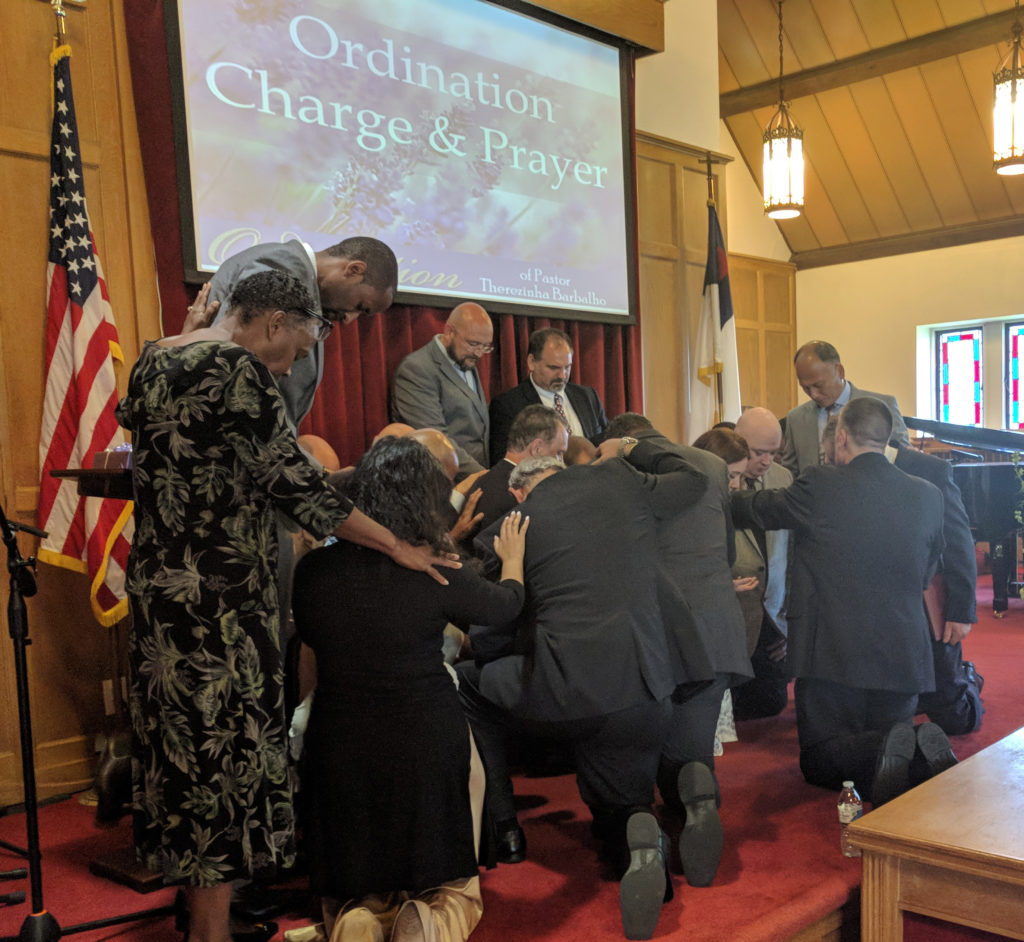

Pastor Therezinha Barbalho stands with her husband, Zeli Leite, and President Bill Miller.
Potomac administration recently had the privilege of ordaining Therezinha Barbalho, pastor of the Silver Spring SDA Church (Md.), into the gospel ministry.
“The call to ministry isn’t when someone says we couldn’t have done that without you,” said President Bill Miller, during the service. “It’s not when committees recommended you for ordination, a degree, interviews or endorsements. The call to ministry is when we hear His voice and we walk with Him into the human mess. The call to ministry is learning our limits and learning to trust in the God that is there with us.”
Barbalho says she felt called to pastoral ministry at the age of 18 and went on to graduate with a degree in theology. She worked as a Bible worker in Belém, São Paulo and later pursued a law degree. Even while practicing as a licensed lawyer in Brazil for 13 years, she continued to serve as a volunteer minister. After moving to the United States, Barbalho served as an associate pastor for the New Jersey Conference and later came to Potomac to pastor the Richmond Brazilian church (Va.)—where she held her first baptismal ceremony—and the Silver Spring church (Md.), where she works to date.
“I receive this moment, so needed for 32 years, understanding that God is making me, and promises to make me, more and more dependent on him,” shared Barbalho, during the service. “That is how I receive this blessing. I thank the Seventh-day Adventist Church for trusting that I can become fully dependent on Him.”
Friday, February 15, 2019
Dialogue Between Sabbatarian Adventists Explores Shared Values and Distinctive Beliefs

FEBRUARY 15, 2019
Conversation brought together Adventist and Adventist Reform thinkers and leaders.
By: Bettina Krause, Public Affairs and Religious Liberty News
Aspirit of friendship and mutual respect marked a two-day meeting between representatives of the Seventh-day Adventist Church and the Seventh Day Adventist Reform Movement. A small group of leaders and theologians from the two communions — which share a similar heritage as well as a number of key beliefs — met December 5 and 6, 2018, at the headquarters of the General Conference of Seventh-day Adventists in Silver Spring, Maryland, United States.
The goal, according to participants, was simply to establish a cordial relationship and to foster a better understanding of each other’s beliefs, mission, and identity.
“Our conversation was friendly and informative, and it acknowledged both our shared heritage, as well as a number of clear theological differences between our two communions,” said Nikolaus Satelmajer, one of the key organizers of the dialogue from the Seventh-day Adventist side.
The Seventh Day Adventist Reform Movement, headquartered in Roanoke, Virginia, United States, has a membership of some 42,000 in more than 130 countries. It traces its history, along with that of the larger Seventh-day Adventist Church, from the Millerite movement of the mid-1800s through to the official formation of the Seventh-day Adventist Church in Battle Creek, Michigan, in 1863. Reform Adventists also embrace the prophetic ministry of Ellen G. White, one of the co-founders of the Seventh-day Adventist Church, a denomination that today has some 21 million baptized members in more than 200 countries.
Monday, February 04, 2019
NAD Hosts First Religious Freedom Prayer Breakfast
On Religious Freedom Day, local faith, civic leaders gather at the Seventh-day Adventist Church in North America's headquarters
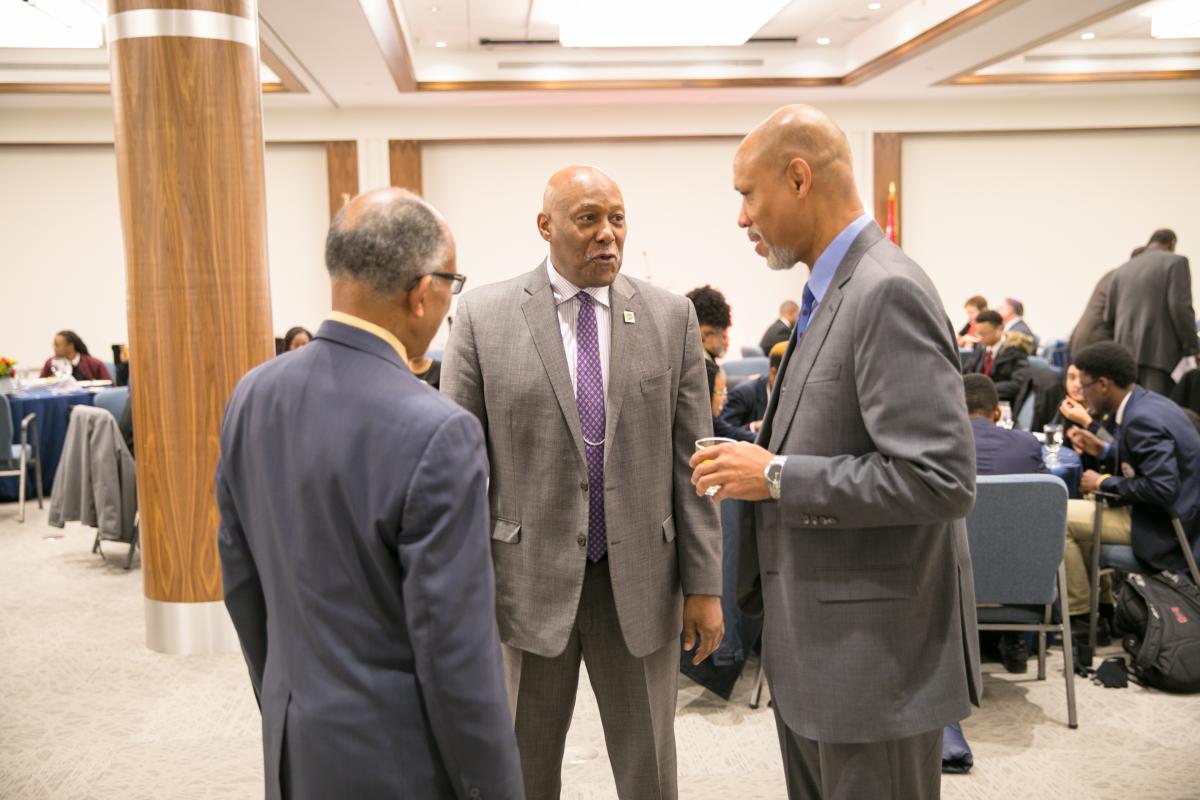
According to the Pew Research Center, nearly 78 percent of the world’s population is unable to worship their God in whatever way they see fit.
Today, on Religious Freedom Day (Jan. 16, 2019), local faith and civic leaders gathered at the North American Division (NAD) headquarters in Columbia, Maryland, for the NAD’s first Religious Freedom Prayer Breakfast. They celebrated the freedoms enjoyed in the United States and prayed for guidance in further fostering and sharing it with others.
“We were just really hoping to bring together a lot of religious groups to pray together as a faith-based community — not worrying about what day we worship [on]or what type of house of worship that we’re in,” said Orlan Johnson, director of Public Affairs and Religious Liberty for the North American Division of the Seventh-day Adventist Church, and one of the event organizers. “Just the idea that we should all pray together and to seek the best that we can seek for our nation, for our community, for all of our loved ones and we think we accomplished that today.”
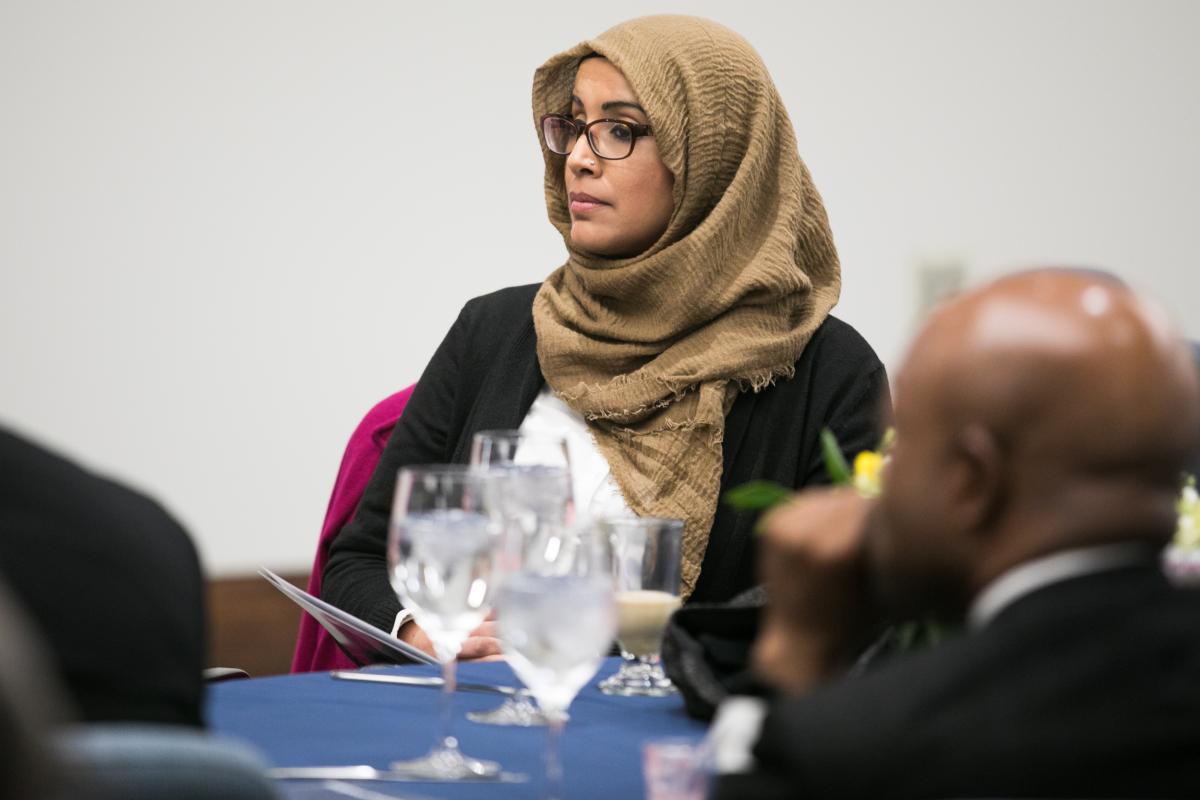
Saturday, August 11, 2018
Future teachers offered Master's in 'social justice' curriculum


Mason McKie
Texas Campus Correspondent @The_MasonMcKie on Jul 26, 2018 at 12:22 PM EDT
- The Loyola University Maryland School of Education is now offering a Master's degree designed to teach future K-12 teachers how to incorporate "social justice" into their curricula.
- The 33-credit program will introduce students to "social justice theories" with the goal of helping them understand "how dominant structures and institutions have been created resulting in adverse purposes."
Loyola University Maryland recently announced that it will offer a Master's degree program with a focus on “Curriculum and Instruction for Social Justice” for aspiring K-12 teachers.
According to the school’s website, the “33-credit Master of Arts degree is designed to help students understand the broader field of education, critically analyze it, and consider it as an instrument of positive change.”
"Our newly designed degree...highlights social justice theories and how to enhance the lives of students and empower marginalized communities." Tweet This
[RELATED: College offers social justice Master's for 'scholar-activists']
“Grounded in social justice theories and informed by current understandings of learning, graduates will appreciate the rich assets within marginalized communities that can be harnessed to enhance the lives of students and empower communities, while understanding how dominant structures and institutions have been created resulting in adverse purposes,” the university explains.
Admitted students will be able to choose from two pathways: a “thematic” program or one based on teaching English language learners.
While students in the thematic program will have relatively broad flexibility to choose courses that apply toward their degree, those enrolled in the Teaching English Language Learners (TELL) pathway must complete five specific courses that are required to earn a TELL concentration in any program.
The school explains that the overall coursework is designed to “challenge students’ assumptions about the field of education, teaching, learning, and curriculum,” and will “encourage students to think creatively and critically about education’s past and present inequities, its current place in society, and provide visionary possibilities for greater equity in our globalized society.”
[RELATED: UConn creates Minor in 'social justice community organizing']
In a blog post published by Loyola’s School of Education, Program Director and Associate Professor Dr. Stephanie Flores-Koulish explains that the “newly designed degree takes instruction to the next level—for educators and community leaders—and highlights social justice theories and how to enhance the lives of students and empower marginalized communities.”
“The program is an exciting reflection of the work the Loyola School of Education has done toward its Jesuit mission to prepare engaged educators who can bring about fundamental change by improving education for all children, especially those who suffer most from systemic inequities,” Flores-Koulish added.
The university did not immediately respond to Campus Reform’s request for comment.
Source
Saturday, April 14, 2018
Church Survival is Guaranteed Because of God’s Grace, Says Mark Finley
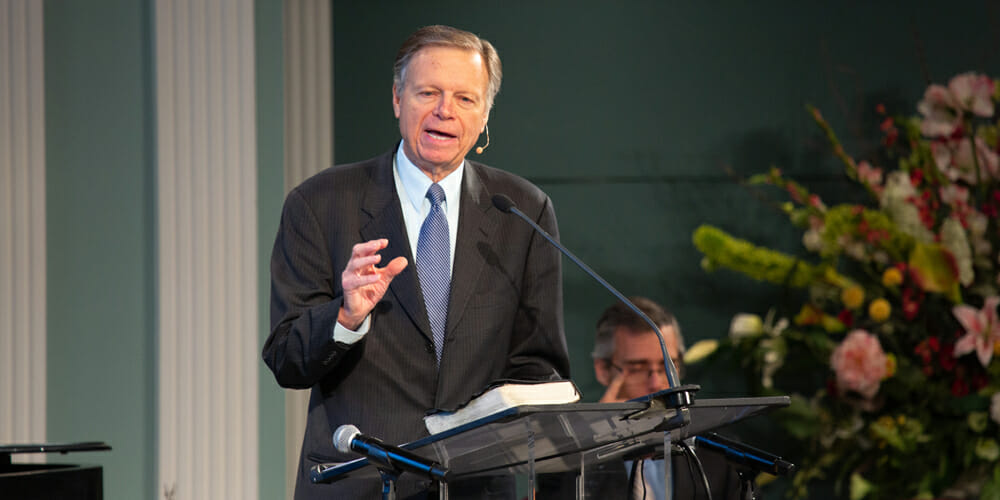
Church Survival is Guaranteed Because of God’s Grace, Says Mark Finley
News • Adventist Review Staff
Adventist Church Spring Council opens with a message of encouragement.
3 Min Read
Published on: 2 days ago
“Despite many challenges, God’s church will triumph,” said Mark Finley in his devotional message on the opening day of the Spring Council, a business meeting of the Executive Committee of the Seventh-day Adventist Church in Silver Spring, Maryland, United States, on April 10, 2018. “God’s church will rise to its destiny, and the gates of hell will not prevail against it.”
Finley, a seasoned evangelist and assistant to the world church president, based his message on Matthew 16:15, where Jesus asks His disciples, “Who do you say that I am?”
“This is a question for every heart,” he said. “It is a question every one of us has to answer.” And it is something, he acknowledged, that will inform the nature of our interactions with God’s church.
Current Challenges to the Church
Finley explained that wider contemporary issues present major challenges to a thriving church. “We live in a time of cynicism,” he said. “People distrust organizations.”
Opposition to church organization—in this case to Adventism—transcends ideological approaches, Finley said. “The far right and the far left have one thing in common—they are united in criticizing the church,” he said. “And no matter how conservative you are, there is another person ten times more conservative than you that will ‘shoot’ at you.”
But going to one extreme or the other is not the answer, he said. “If your religion makes you angrier, there is something wrong with your religion,” Finley said. “And if your religion makes you tolerant to sin, there is something wrong with your religion.”
The Church and Us
Finley explained that committing to the church does not mean being blind to its shortcomings. “The church is not perfect; there’s no doubt in many areas we could do much, much, much better,” he emphasized.
Indeed, part of being a leader is never be content [to be] where you are, because Jesus is always leading us to more, Finley said. “But if someone would write a book with all the faults of your wife, would you read it and not be ready to defend her?” he asked, in reference to occasional publications critical of the church. “The church is Christ’s bride,” he reminded his listeners.
Finley also reminded that the church is not a bureaucratic institution but is made up of people. And every one of us, he said, is a work in progress, as God chisels us until we become what He wants us to be. “The church does not come with stones fully polished,” he emphasized. “God is at work to build a temple of truth in which men and women reveal the character of God.”
A Commitment to Christ and His Church
No temple of truth is built with one stone, Finley explained. “While Jesus is the foundation, faithful men and women through the ages built upon that.”
Authentic faith demands a personal response to God’s calling, he emphasized. And that commitment is essential if we want to change the world.
“Education…science…military power…formal religion will not change the world. Only Jesus will,” he said. And as we try to become world changers, we must remember that only one thing can qualify us. “To know the living Christ, and to be changed by His grace and transformed by His love,” Finley said.
Once we meet Jesus, the church must move forward to accomplish the task set by the Lord Himself. Nothing should distract the church from it, said Finley. “God is appealing to His church not to be so focused on important administrative decisions that overlook the most important thing — preaching the living Christ.”
The Future of the Church
Whether we decide to support God’s church or fight against it, the church’s survival is guaranteed because of God’s grace, Finley emphasized. Sharing important lessons from Ephesians 5, he reminded that despite its mistakes and weaknesses, Jesus loves His church, and He promises to sanctify and cleanse it. “And the future of God’s church is glorious,” reminded Finley, “because He has promised to present His church blameless.”
According to Finley, it is an encouraging thought. “The church of God, the people of God, the truth of God will triumph,” he said.
Source
Wednesday, February 14, 2018
3 arrested after SUV crashes main gate of NSA headquarters; 3 injured
Doug Stanglin, USA TODAY
There is an ongoing investigation involving three people who have reportedly been shot outside NSA headquarters. Buzz60

Three people, including a police officer, were hospitalized Wednesday in a bizarre incident at the super-secret National Security Agency after officers apparently opened fire on a black SUV carrying three men as it breached the main gate, the FBI said.
While authorities have not determined why the car crashed through the entrance before ramming a concrete barricade, FBI Special Agent in Charge Gordon Johnson told reporters the bureau does not believe the incident was terrorism-related.
“There is no indication to think this is anything more than an isolated incident,” he said.
The FBI said authorities arrested the two passengers and the car's driver, who also was injured and hospitalized. Two others — a civilian and a police officer — sustained non-life threatening injuries in the ordeal that unfolded at 6:55 a.m.
The FBI said they believe none of the injuries was from gunfire.
It was unclear why the car, believed to be a rental with New York tags, was traveling on the road that leads exclusively to the NSA facilities, located on the grounds of Fort Meade between Washington and Baltimore.
“We are trying to talk to them to understand why they were here,” Johnson said. It does not appear that any law enforcement agencies were chasing the vehicle before it reached the security gate, he added.
“This vehicle did come onto the NSA’s compound unauthorized,” Johnson said. “NSA police responded accordingly.”
Although an NSA spokesman said earlier Wednesday that weapons were discharged in the incident, Johnson declined to speculate, pending a conclusion of the investigation. Photos of the car show bullet holes in the windshield that appeared to be from shots fired from outside the vehicle, rather than from inside.
Video footage by a chopper from WRC-TV shows police surrounding a handcuffed man sitting on the ground near the SUV.
Saturday, October 28, 2017
Reformation's impacts still felt locally after 500 years
Janet Heim 50 min ago

Gathered at Trinity Lutheran Church in Hagerstown are, left to right, Rev. Greg Shook, Rev. Marilyn Hembrock, and Rev. Kevin Munroe.
Joe Crocetta/Staff Photographer
It’s been just shy of 500 years since Martin Luther posted his 95 Theses on the door of All Saints’ Church, more commonly known as Castle Church, in Wittenberg, Germany, on Oct. 31, 1517.
“It moved Western society out of the Dark Ages,” said The Rev. G. Stanley Steele of St. Mark’s Lutheran Church in Hagerstown. “It had a huge political, huge cultural impact.”
Indeed, the impact has resounded locally, where some experts argue it’s impossible to separate the Reform movement from the history of Washington County.
“The Reformation, it’s one reason why Hagerstown is here,” said the Rev. Kevin Munroe of Zion Reformed United Church of Christ in Hagerstown. “You can’t really separate the history of the migration that took place because of the Reformation with why Hagerstown was founded.
Munroe said that a large number of people immigrated to the United States as a result of religious persecution in Europe.
“And as you go forward in Hagerstown,” he said, “the leadership of the town came out of the churches.”
Churches around the world and in Washington County have been celebrating the anniversary in a variety of ways. Besides individual churches marking the anniversary, an ecumenical committee of local church members and pastors has been working behind the scenes to plan ways to commemorate the milestone.
The result is a Reformation 500 Hymn Festival featuring Dr. Wayne L. Wold Sunday at Trinity Lutheran Church in Hagerstown at 4 p.m.
The anniversary of the Reformation is celebrated on Reformation Sunday, the Sunday closest to Oct. 31.
It’s a long and complicated history and this story only begins to tell some of it.
Who was Martin Luther and what is the Reformation?
Martin Luther is one of the most influential and controversial figures of the Protestant Reformation movement.
The Reformation, a time of questioning and rebirth, took place during the 14th, 15th and 16th centuries during the Renaissance, according to research done by Kent Shaffer of Zion Reformed United Church of Christ in Hagerstown.
Monday, October 12, 2015
The White House

Apostle of Maryland

Prayers written by White between 1634 and 1640 in English, Latin, and Piscataway
On November 22, 1633, he took Baltimore's offer and set sail from Cowes on the Isle of Wight with lord Leonard Calvert and fellow Jesuits John Altham Gravenor and Thomas Gervase on The Ark, one of George Calvert's ships.[4] Their landing on March 25, 1634, on St. Clement's Island marks the birth of the Maryland colony. The anniversary of this date is now celebrated as Maryland Day. In saying Catholic Mass that day, he became the first priest to do so in the original thirteen English colonies.[5] By July of that year, White had written his first discussion on the new colony, titled A Relation of the Sucessefull Beginnings of the Lord Baltimore's Plantation in Maryland. Sections of this were used to further advertise the colony.
White spent most of the next decade in St. Mary's City, working on English-Native American relations, particularly with the Yaocomico tribe, which consistently saw favorable trade treaties from Calvert because of White, and the Anacostans. In 1637 they were joined by Jesuits Thomas Copley and Ferdinand Poulton, and between 1634 and 1650 there averaged four permanent Jesuits in the Maryland Colony.[6] To further his missionary work, he wrote dictionaries and translated the catechism into the native languages. On July 5, 1640, he famously converted Chitomachon, the chief of the Piscataway Indians, to Christianity. The chief was baptized as Charles. He later baptized a princess of the Patuxent Indians, and much of her tribe.
In 1933, the architect and writer Christopher La Farge designed a monument to White that is located just outside St. Mary's City.[7]
Return to England
The English Civil War was to cut short his missionary work. In 1644, Richard Ingle and Puritan colonists from the neighboring Virginian colony of Jamestown, which had previously rebuffed George Calvert's visit, first raided St. Mary's City. Ingle succeeded in burning the town and, with the aid of William Claiborne, in controlling the Maryland Colony. White was again arrested for his Catholic preaching, and in 1645 he was sent with Thomas Copley in chains to London. Once there, he was tried for the crime of returning to England after being banished in 1606, which carried the punishment of death. He escaped this fate by arguing that his return was not of his own will. His petitions to return to Maryland denied, he spent the last decade of his life quietly in England until his death on December 27, 1656.