Showing posts with label Inquisition. Show all posts

Tuesday, January 06, 2026

Bellarmine – Champion of Rome


The Jesuit cardinal Robert Bellarmine (1542-1621), the 400th anniversary of whose death is noticed in 2021, was the greatest polemical theologian, controversialist and defender of the Papacy that the Church of Rome ever produced. Whereas the Council of Trent (1545-1563) dogmatically defined the doctrine of the Church of Rome in a series of decrees and anathemas, it fell to Bellarmine to provide all the theological underpinnings and, by controversy, to counter every argument of Protestantism, whether Lutheran, Calvinist or whatever. He did so principally by his lectures to young Jesuits training to be the foot soldiers of the Counter-Reformation, and by his printed Controversies. Bellarmine also produced a catechism that was adopted by the Roman Catholic Church as its official teaching until the First Vatican Council in 1870, which relied heavily on Bellarmine’s arguments in favour of Papal infallibility.[1] He was declared by Rome a Doctor of the Church in 1931, the prerequisite to which was his canonization as a saint the previous year.

The Protestant Reformers had studied the Scriptures in their original languages, and deeply familiarized themselves with church history and the writings of the Church Fathers, but there was little comparable expertise within the Church of Rome: few Roman apologists until Bellarmine could argue convincingly from history, or from the Fathers, or from the original languages, leaving the Church of Rome at a significant disadvantage in controversy. A milestone in modern history was the production of the Historia Ecclesiae Christi by Lutheran scholars at Magdeburg (1559-74), thirteen volumes covering a century each, often known as the Magdeburg Centuries. Painstakingly and meticulously researched using primary sources from all over Europe, the Magdeburg Centuries demonstrated the continuity in all ages of the Church and her doctrine in each article of faith. This made it relatively easy for Protestants to expose and counter the errors in the traditional narrative of the Roman church with its mediaeval legends, inventions, hagiographies, and forgeries.[2]

Roberto Francesco Romolo Bellarmino was born on October 4, 1542 in the town of Montepulciano in Tuscany, then within the Papal States. He was the third of five sons, and had seven sisters. His maternal uncle, Cardinal Marcello Cervini, hailed from the town, and became Pope Marcellus II when Robert was 12. In 1557 Spanish Jesuits set up a school in the town, which attracted away Robert from the local grammar school. Robert quickly came under their spell to join the order, contrary to the will of his father, who wished him to qualify in medicine. In an extraordinary circumvention of the requirement for a 2-year noviciate, Robert was fast-tracked into taking vows at the age of seventeen. Within days Robert was fitted with his cassock and dispatched to the Jesuits’ Roman College in Rome. He became Il Maestro Roberto at 21, and thereafter taught at Florence, then at Mondovi in Piedmont, and at Padua, all the while honing his skills in preaching.

Saturday, April 23, 2022

Nick Fuentes Longs for the Days of Catholic Monarchy, Crusades...

WARNING: Explicit Language used in this video.


“You know what democracy has given us? Obesity. Low rates of literacy. It’s given us divorce, abortion, gay marriage, liberalism, pornography. That’s what democracy has given us. Ghettos and crime and political correctness. Diversity. Yeah, the track record of democracy? Not so good. Catholic autocracy? Pretty strong. Pretty strong record. Catholic monarchy? Catholic monarchy, and just war, and crusades, and inquisitions? Pretty good stuff.”


Wednesday, June 06, 2018

Cardinal-designate focuses on the pastoral at doctrinal congregation


By Junno Arocho Esteves
Posted: 6/5/2018


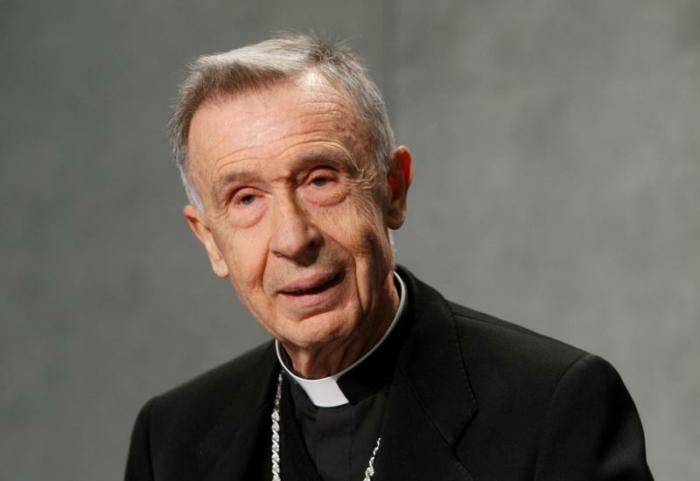
Archbishop Luis Ladaria, prefect of the Congregation for the Doctrine of the Faith, speaks at a news conference to present the document, "Placuit Deo," at the Vatican March 1. Archbishop Ladaria was one of 14 new cardinals named by Pope Francis May 20. (CNS photo/Paul Haring)


VATICAN CITY (CNS) -- When he was named secretary of the Vatican's doctrinal congregation, Cardinal-designate Luis F. Ladaria Ferrer marveled at being unexpectedly thrust into the limelight.

"That was very surprising. I would never have thought of ending up here. And I'm not the only one, seeing that my name was never mentioned in the newspapers," he said in August 2008 in an interview with the Italian Catholic magazine "30 Giorni."

Since then, the Jesuit prelate has had his share of surprises, which culminated in his appointment as prefect of the Congregation for the Doctrine of the Faith and now as a cardinal.

Born in Manacor, Mallorca, April 19, 1944, Cardinal-designate Ladaria earned a law degree at the University of Madrid. After obtaining his degree, however, he "realized that was not what I wanted."

"I wanted to become a priest, and I liked the Society of Jesus, which I knew. And so, it was a path open before me that I set out on almost naturally," he told "30 Giorni."

He entered the Jesuits in 1966 and, after studying theology and philosophy in Spain and Germany, he was ordained to the priesthood July 29, 1973.

As someone who "liked studying," the Spanish prelate went on to earn a doctorate in theology from the Pontifical Gregorian University in Rome in 1975 and began teaching dogmatic theology at the Pontifical University Comillas in Madrid. Nine years later, he returned to the Gregorian to teach, and he served as vice rector of the university from 1986 to 1994.

But, Cardinal-designate told "30 Giorni" that his time as vice-rector was "not very important."

"The Gregorian taught me to live in an international environment with students from over 100 countries, of different languages, races and cultures. All united by the love of study, but above all, of the Lord and his church. In a real university, students not only learn from professors, but also the reverse occurs. And I learned a lot from my students," he said.

Cardinal-designate Ladaria also said his time in Rome as a professor shaped his view on handling church issues that often can be used to advance extremist agendas, both on the left and the right.

"I must say that I don't like extremisms; either progressive or traditionalist ones," he said. "I believe that there is a middle path, which is taken by most professors of theology in Rome and in the church in general, which I think is the correct path to take."


Saturday, February 17, 2018

Catholic Inquisition and The Torture Tools by Former Priest Richard Bennett


Catholic Inquisition and The Torture Tools by Former Priest Richard Bennett


Published on Mar 7, 2007


Elusive Justice: The Search for Nazi War Criminals
A Vatican City priest baptized Nazi who were hiding in seminaries and then they were able to secure International Red Cross passports to allow them to flee to Argentina.
http://www.pbs.org/programs/elusive-j...
Most people have some knowledge of the holocaust. The 6 years of torture and atrocities that the Jews suffered under Hitler and the Nazis during the Second World War. While in no way downplaying the terrible events of the holocaust, such a massacre does not compare to the severity to the torture and murder that took place under Papal authority during the 605 years of the Inquisition. From the beginning of the Papacy, until the present time, it is estimated by credible historians that more than 50,000,000, men and women have been slaughtered for the crime of heresy charged against them by Papal Rome. This Video contains actual photographs of some of the instruments of torture that were used. Since we consider this Video on the Inquisition one of the more important message that we have given, please make it known to others, and if possible post the link on your own website.


Sunday, June 04, 2017

Secret Mexican diary sheds light on Spanish Inquisition


By Natasha Pizzey

Mexico City

03 June 2017

Latin America & Caribbean


Luis de Carvajal used gold leaf from Bibles to decorate the diary

A story of torture, betrayal and persecution is captivating Mexicans almost 500 years after it happened.

The dramatic life and death of the Carvajal family in 16th-Century Mexico is in the spotlight after a decades-long search for a national treasure came to an unexpected happy ending.

Luis de Carvajal "The Young" came to Mexico - then known as New Spain - with his large, well-to-do family during the early colonisation of the Americas.

His family governed part of northern Mexico and soon made enemies, including a power-hungry viceroy keen to topple him from power.

The ambitious viceroy discovered that Luis de Carvajal was a practising Jew, a crime punishable by death in the times of the Spanish Inquisition

Older relatives had urged Luis de Carvajal to convert to Catholicism for his own safety, but he staunchly stuck to his faith.


Sunday, August 07, 2016

The Inquisition followed sound science


By Jacob Haqq-Misra

AUGUST 05, 2016


TONI DEMURO


WHEN POPE JOHNPaul II announced in 1992 that Galileo was correct, more than 350 years after his condemnation by the Inquisition, the world reacted with apathy, relief, and amusement. No one doubts any more that Earth revolves around the sun, and even private Catholic schools had been teaching heliocentricity to their students prior to the official apology.

Our historical understanding of the Galileo affair tends to implicate the church as clinging unnecessarily to a literal interpretation of the Bible, which required the faithful to accept the untenable theory of geocentrism. From elementary school onward, we’re taught that the church stood firmly athwart scientific progress, bellowing “Stop!” Indeed, the clash has gone down through the ages as a sort of morality play of science versus religion, pitting the proponents of progress against religious reactionaries. But what if that morality play itself is nothing more than dogma?

We know that Galileo’s ideas were correct, yet the best science of the 17th century tended to favor a universe with Earth at its center. Did the Inquisition rely too heavily on theology, or did its perpetrators instead judge Galileo according to the scientific standards of their day? In other words: Did the Inquisition get it right?