Showing posts with label Zelaya. Show all posts

Tuesday, August 18, 2009

Anti-American Amigos

AUGUST 16, 2009, 11:09 P.M. ET

Anti-American Amigos
Why is the Obama administration trying to help Hugo Chavez?

Hugo Chávez took a break last week from lobbying Washington on behalf of deposed Honduran President Manuel Zelaya to travel to Quito, Ecuador, for a meeting of South American heads of state.

There he launched a virulent assault on the U.S. military, reiterated his commitment to spreading revolution in the region, and threatened the continent with war. Mr. Zelaya was by his side.

The Venezuelan's tirade against the U.S. and its ally Colombia raised the question yet again of what the U.S. could possibly be thinking in pushing Honduras to reinstate Mr. Zelaya. He was removed from office by the Honduran Congress in June because he violated the country's constitution and willfully incited mob violence.

But that's not the only thing that made him unpopular at home. He also had become an important ally of Mr. Chávez and was quite obviously being coached to copy the Chávez power grab in Venezuela by undermining Honduras's institutional checks and balances.

If Honduras has been able to neutralize Mr. Chávez, it's something to celebrate. A Chávez-style takeover of institutions in Bolivia, Ecuador and Nicaragua has quashed political pluralism, free speech and minority rights in those countries. There is now a heavy presence of Cuban state intelligence throughout the Venezuelan empire. Mr. Zelaya literally has become a fellow traveler of Mr. Chávez, leaving no doubts about the course he would put Honduras on if given the chance.

Getty Images
Venezuelan President Hugo Chávez salutes Raul Castro while Argentine President Cristina Kirchner looks on in Caracas, Venezuela, Aug. 11.


Among the theories making the rounds about Mr. Obama's motivations in trying to force Honduras to take Mr. Zelaya back, there is the hypothesis that this administration is tacking hard to the left. Mr. Obama has expressed the same views on Honduras as Sen. John Kerry (D., Mass.), who holds that the interim government must be forced to reinstate Mr. Zelaya and who has, over more than two decades in office, consistently allied himself with socialist causes in Latin America.


As a U.S. senator, Mr. Kerry has the luxury of treating Latin America like his playground, as Democrats have done for decades, foisting on it ideas that Americans reject. Venezuelans still recall how Connecticut's Chris Dodd played the role of chief Chávez cheerleader in the Senate while the strongman was consolidating power.

But Mr. Obama is the president and commander in chief, and millions of people in this hemisphere are counting on the U.S. to stand up to Venezuelan aggression. Playing footsie under the table with Mr. Chávez on Honduras while the Venezuelan is threatening the peace isn't going to fly in a hemisphere that prefers liberty over tyranny.

Both Colombian and U.S. officials allege that the Venezuelan National Guard and high-ranking members of Mr. Chávez's government are in cahoots with criminal enterprises that run drugs in South America. The evidence suggests an alliance between the terrorist Revolutionary Armed Forces of Colombia (FARC)—the largest exporter of cocaine from that country—and members of Mr. Chávez's cabinet. There is also evidence in documents and video captured from the FARC that the rebels have influence at high levels of the Ecuadoran government.

The cocaine business is a big revenue raiser for the terrorist organization and for its business partners on the continent. This is why Colombian President Alvaro Uribe has agreed to allow U.S. drug-surveillance planes to use Colombian military bases.

In Quito, Mr. Chávez flew into a rage about that agreement. "The U.S. is the most warlike government in the world," he told his South American peers and Mr. Zelaya. "The Yankee military pays no mind to its president," he said, artfully exempting Barack Obama from blame. "In Colombia [the U.S. military] has immunity. They can rape women, they can kill and they can destroy in every direction. You can't do anything to them. It's horrible."

The military-bases agreement is far more limited than what Mr. Chávez claimed, but he wasn't about to miss an opportunity to ratchet up the tension. "The winds of war are starting to blow," he warned.

His counterparts didn't buy it. Colombia was not condemned in Quito, largely because key members of the group didn't want their own sovereign decisions subject to continental review. But Mr. Chávez is not going away. He has pledged to continue with efforts to destabilize surviving democracies.

Honduras remains a target. Argentina is also in his sights. In an interview with the Argentine daily La Nación, he spoke of his alliance with Argentina's President Cristina Kirchner. "We are going to work to reinforce the Caracas-Buenos Aires axis, which is a central axis," Mr. Chávez said. "Like the Caracas-Quito axis, the Caracas-Buenos Aires axis is fundamental for the integration."

The U.S. war on drugs has been a colossal failure because of the large cocaine market in the U.S. The tragedy—beyond the violence it creates—is that criminal enterprises, flourishing because of U.S. customers, wreak havoc on frail institutions. That's bad enough. But the Obama administration pours salt in that gaping wound by refusing to support the U.S.-Colombia Free Trade Agreement our ally has asked for, and now by backing Mr. Chávez's Honduran pawn.
.
.
.

Sunday, July 26, 2009

The Path Forward for Honduras

OPINION
JULY 26, 2009, 8:57 P.M. ET

The Path Forward for Honduras
Zelaya’s removal from office was a triumph for the rule of law.


By ROBERTO MICHELETTI


One of America’s most loyal Latin American allies—Honduras—has been in the midst of a constitutional crisis that threatens its democracy. Sadly, key undisputed facts regarding the crisis have often been ignored by America’s leaders, at least during the earliest days of the crisis.


In recent days, the rhetoric from allies of former President Manuel Zelaya has also dominated media reporting in the U.S. The worst distortion is the repetition of the false statement that Mr. Zelaya was removed from office by the military and for being a “reformer.” The truth is that he was removed by a democratically elected civilian government because the independent judicial and legislative branches of our government found that he had violated our laws and constitution.

Let’s review some fundamental facts that cannot be disputed:

• The Supreme Court, by a 15-0 vote, found that Mr. Zelaya had acted illegally by proceeding with an unconstitutional “referendum,” and it ordered the Armed Forces to arrest him. The military executed the arrest order of the Supreme Court because it was the appropriate agency to do so under Honduran law.

• Eight of the 15 votes on the Supreme Court were cast by members of Mr. Zelaya’s own Liberal Party. Strange that the pro-Zelaya propagandists who talk about the rule of law forget to mention the unanimous Supreme Court decision with a majority from Mr. Zelaya’s own party. Thus, Mr. Zelaya’s arrest was at the instigation of Honduran’s constitutional and civilian authorities—not the military.

• The Honduran Congress voted overwhelmingly in support of removing Mr. Zelaya. The vote included a majority of members of Mr. Zelaya’s Liberal Party.

• Independent government and religious leaders and institutions—including the Supreme Electoral Tribunal, the Administrative Law Tribunal, the independent Human Rights Ombudsman, four-out-of-five political parties, the two major presidential candidates of the Liberal and National Parties, and Honduras’s Catholic Cardinal—all agreed that Mr. Zelaya had acted illegally.

• The constitution expressly states in Article 239 that any president who seeks to amend the constitution and extend his term is automatically disqualified and is no longer president. There is no express provision for an impeachment process in the Honduran constitution. But the Supreme Court’s unanimous decision affirmed that Mr. Zelaya was attempting to extend his term with his illegal referendum. Thus, at the time of his arrest he was no longer—as a matter of law, as far as the Supreme Court was concerned—president of Honduras.

• Days before his arrest, Mr. Zelaya had his chief of staff illegally withdraw millions of dollars in cash from the Central Bank of Honduras.

• A day or so before his arrest, Mr. Zelaya led a violent mob to overrun an Air Force base to seize referendum ballots that had been shipped into Honduras by Hugo Chávez’s Venezuelan government.

• I succeeded Mr. Zelaya under the Honduran constitution’s order of succession (our vice president had resigned before all of this began so that he could run for president). This is and has always been an entirely civilian government. The military was ordered by an entirely civilian Supreme Court to arrest Mr. Zelaya. His removal was ordered by an entirely civilian and elected Congress. To suggest that Mr. Zelaya was ousted by means of a military coup is demonstrably false.

Regarding the decision to expel Mr. Zelaya from the country the evening of June 28 without a trial, reasonable people can believe the situation could have been handled differently. But it is also necessary to understand the decision in the context of genuine fear of Mr. Zelaya’s proven willingness to violate the law and to engage in mob-led violence.

The way forward is to work with Costa Rican President Oscar Arias. He is proposing ways to ensure that Mr. Zelaya complies with Honduras’s laws and its constitution and allows the people of Honduras to elect a new president in the regularly scheduled Nov. 29 elections (or perhaps earlier, if the date is moved up as President Arias has suggested and as Honduran law allows).

If all parties reach agreement to allow Mr. Zelaya to return to Honduras—a big “if”—we believe that he cannot be trusted to comply with the law and therefore it is our position that he must be prosecuted with full due process.


President Arias’s proposal for a moratorium on prosecution of all parties may be considered, but our Supreme Court has indicated that such a proposal presents serious legal problems under our constitution.

Like America, our constitutional democracy has three co-equal and independent branches of government—a fact that Mr. Zelaya ignored when he openly defied the positions of both the Supreme Court and Congress. But we are ready to continue discussions once the Supreme Court, the attorney general and Congress analyze President Arias’s proposal. That proposal has been turned over to them so that they can review provisions that impact their legal authority. Once we know their legal positions we will proceed accordingly.

The Honduran people must have confidence that their Congress is a co-equal branch of government. They must be assured that the rule of law in Honduras applies to everyone, even their president, and that their Supreme Court’s orders will not be dismissed and swept aside by other nations as inconvenient obstacles.

Meanwhile, the other elements of the Arias proposal, especially the establishment of a Truth Commission to make findings of fact and international enforcement mechanisms to ensure Mr. Zelaya complies with the agreement, are worthy of serious consideration.

Mr. Zelaya’s irresponsible attempt on Friday afternoon to cross the border into Honduras before President Arias has obtained agreement from all parties—an attempt that U.S. Secretary of State Hillary Clinton appropriately described as “reckless”—was just another example of why Mr. Zelaya cannot be trusted to keep his word.

Regardless of what happens, the worst thing the U.S. can do is to impose economic sanctions that would primarily hurt the poorest people in Honduras. Rather than impose sanctions, the U.S. should continue the wise policies of Mrs. Clinton. She is supporting President Arias’s efforts to mediate the issues. The goal is a peaceful solution that is consistent with Honduran law in a civil society where even the president is not above the law.

Mr. Micheletti, previously the president of the Honduran Congress, became president of Honduras upon the departure of Manuel Zelaya. He is a member of the Liberal Party, the same party as Mr. Zelaya.
.
.
Source: http://online.wsj.com/article/SB10001424052970204886304574311083177158174.html?mod=googlenews_wsj

.

Tuesday, July 14, 2009

Ousted Honduran president gives ultimatum


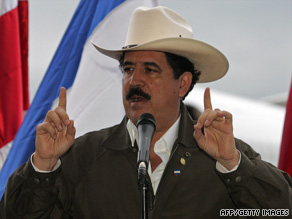
Deposed Honduran President Jose Manuel Zelaya says he must be returned to power.


Ousted Honduran president gives ultimatum

Story Highlights
Ousted Honduran leader will resort to other means if talks fail to return him to power
Jose Manuel Zelaya did not elaborate on what other means he would explore
Zelaya was deposed in a military-led coup on June 28
Both sides are currently in mediated talks to resolve situation


updated 10:17 p.m. EDT, Mon July 13, 2009
Next Article in World »


(CNN) -- Deposed Honduran President Jose Manuel Zelaya on Monday gave the interim government that ousted him an ultimatum: if ongoing negotiations do not restore him to power, he will consider the talks failed and resort to other means.


Zelaya's remarks came at a news conference in Managua, Nicaragua. He did not elaborate on what other means he might explore.

The statement puts pressure on the next round of mediation between the two sides, expected to take place Saturday in Costa Rica.

Zelaya demanded that "the explicit mandates of the international organizations be carried out," referring to resolutions passed by the Organization of American States and United Nations calling for his return as president.

Since the June 28 military-led coup, Zelaya and interim Honduran President Roberto Micheletti have drawn hard stances. Both claim that the democratic process is on their side.

Both Micheletti and Zelaya accepted an offer from Costa Rican President Oscar Arias to mediate talks. Both men met individually with Arias last week, but they did not meet face-to-face.

Micheletti said Monday he expected talks between the two delegations to resume on Saturday in Costa Rica.

United Nations Secretary-General Ban Ki-moon spoke with Arias Monday and gave his support for his mediation efforts.

"The Secretary-General has offered technical assistance for the mediation and agreed to work together with President Arias to help the parties reach an agreement," a U.N. statement said. "The Secretary-General is confident that an open dialogue and international support will help resolve the current crisis."

Micheletti has adamantly denied there was a coup, insisting instead that Zelaya was ousted through a constitutional process in which the supreme court and the national assembly participated.

Zelaya, a leftist who took office in 2006 on a narrow victory, had been at odds with Honduran lawmakers, the country's supreme court and the military over a referendum he had planned to hold last month. Congress had forbidden it and the supreme court ruled it illegal.

Zelaya sought the referendum to see if voters wanted a measure on November's ballot to establish a constitutional assembly to study whether a president could run for re-election. Under the current charter, a president can serve only one four-year term.

Venezuelan President Hugo Chavez, a Zelaya ally, won a similar referendum this year and many Hondurans thought Zelaya was trying to maneuver a way to seek re-election in November -- an assertion he has denied.

Zelaya vowed to hold the vote anyway, but was toppled before the voting started.

After 18 years of nearly uninterrupted military rule, Honduras returned to civilian control in 1981. Since then, the military had not seemed interested in holding power in the nation of more than 7 million people, about 70 percent of whom live in poverty.


.
.

Sunday, June 28, 2009

US has talked with deposed Honduran leader


US has talked with deposed Honduran leader

AP foreign, Sunday June 28 2009


WASHINGTON (AP) U.S. diplomats are working to ensure the safety of deposed Honduran President Manuel Zelaya and his family as they press for restoration of constitutional law and his presidency.


U.S. officials said Sunday evening they've spoken with Zelaya since he was taken to Costa Rica by the forces that wrested him from power.


They also say the U.S. told Honduran military leaders and other power players there that the United States and other nations in the Americas would not support a coup. They say Honduran military officials stopped taking their calls as the crisis unfolded.


Two senior administration officials briefed reporters on condition of anonymity, under ground rules set by the State Department.

THIS IS A BREAKING NEWS UPDATE. Check back soon for further information. AP's earlier story is below.


WASHINGTON (AP)President Barack Obama is calling for all sides in Honduras to respect democracy and the rule of law following the arrest of President Manuela Zelaya and his reported expulsion to Costa Rica.


Obama says any disputes must be settled peacefully through negotiations that are free from outside interference.


White House officials say Obama spoke with his national security adviser, James Jones, about the situation on Sunday morning. Aides from several agencies are monitoring the situation and providing updates to Obama, Jones and Jones' deputy.


Zelaya was detained shortly before voting was to begin on a constitutional referendum. He had insisted on holding the vote even though the Supreme Court ruled it illegal and everyone from the military to Congress and members of his own party opposed it.

.


.