AND THE THIRD ANGEL FOLLOWED THEM, SAYING WITH A LOUD VOICE, IF ANY MAN WORSHIP THE BEAST AND HIS IMAGE, AND RECEIVE HIS MARK IN HIS FOREHEAD, OR IN HIS HAND.
*** REVELATION 14:9
The hantavirus has medical officials on high alert after an international evacuation commenced of the affected cruise ship M.V. Hondius as it docked off Tenerife, with officials from more than 20 countries coordinating the return of passengers. Former CDC director Dr. Robert Redfield joins "NewsNation Prime" to discuss.
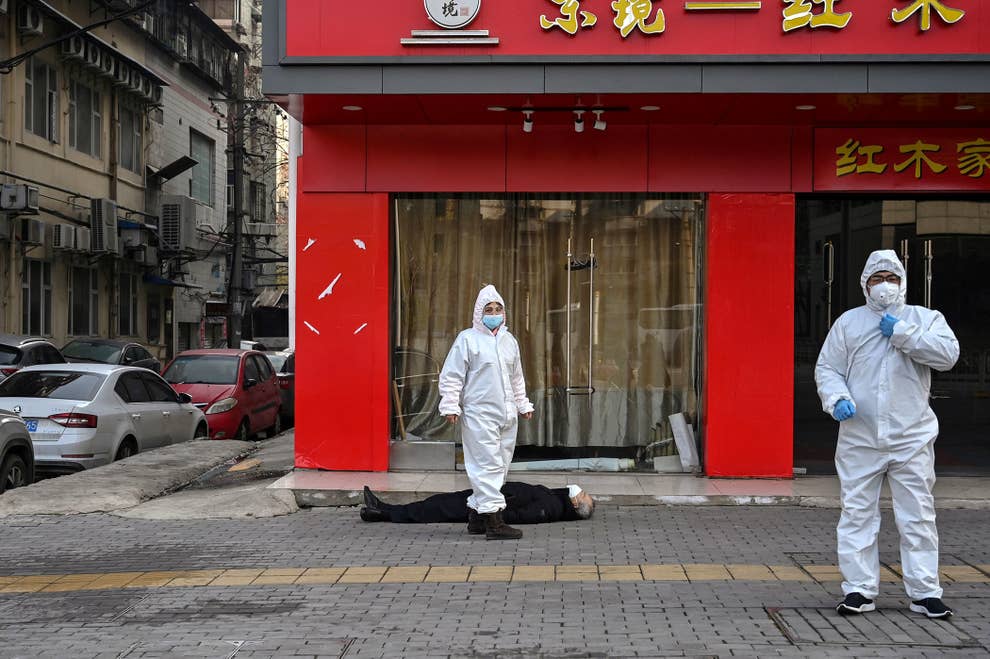
On Jan. 23, the Chinese government locked down the city of Wuhan, where the coronavirus that has infected more than 20,000 people and killed over 420 had been first reported.
PM Theresa May described loneliness as “the sad reality of modern life” affecting millions of people.
Britain appointed a “minister for loneliness” on Wednesday to tackle what Prime Minister Theresa May described as “the sad reality of modern life” affecting millions of people. Tracey Crouch, a junior minister for sport and civil society, will take on the role as part of a broader strategy to combat loneliness in Britain.
“For far too many people, loneliness is the sad reality of modern life,” May said.
“I want to confront this challenge for our society and for all of us to take action to address the loneliness endured by the elderly, by carers, by those who have lost loved ones - people who have no one to talk to or share their thoughts and experiences with,” the prime minister added.
More than nine million people say they are always or often lonely, out of a population of 65.6 million, according to the British Red Cross.
The charity describes loneliness and isolation as a “hidden epidemic” affecting people across all ages at various moments in their life, such as retirement, bereavement or separation.
As would-be vacationers avoid Florida and the Caribbean, other destinations promote themselves – subtly – as safe alternatives.
ASSOCIATED PRESS
Miami-Dade mosquito control inspector Yasser "Jazz" Compagines sprays a chemical mist into a storm drain Tuesday as a tour vessel passes by in Miami Beach. Bermuda, among other places, is seeing an uptick in visitors. Associated Press/Alan Diaz
NEW YORK — With government officials now warning pregnant women to avoid Miami Beach in addition to Puerto Rico, some sun seekers are desperately scrambling for a Zika-free vacation.
And that has left other tourist destinations to capitalize – quietly.
Travel experts say families worried about Zika are now looking to Arizona and Southern California to get some sun, along with cooler weather locales such as New England and Canada.
The Zika virus is transmitted by mosquitoes or through sex with an infected person. In pregnant women, a Zika infection can cause severe birth defects, including microcephaly, where babies are born with a dangerously small head. In others, it can lead to Guillain-Barre, which can cause temporary paralysis and in rare instances, death. That was the case earlier this month of a man between 35 and 45 years old who died in Puerto Rico after being infected.
Given that background, many would-be vacationers don’t want to take the risk.
Jen LeFante and her husband, Chris, are expecting their first child in March. The New Jersey couple had wanted to escape to Puerto Rico or the Florida Keys for some relaxation before the baby arrives.
“But it seems like every travel destination we picked is on the Zika list,” she says.
Instead, they are doing a number of smaller, driving trips including ones to upstate New York and Vermont.
“I’d much rather be on a beach,” LeFante said.
Bermuda has seen several groups move meetings and conventions there from Caribbean islands, according to Glenn Jones, director of public and stakeholder relations at the Bermuda Tourism Authority.
“That’s been a welcome and unexpected boost to our business this summer,” Jones said.
However, the island nation off the coast of the Carolinas has been careful about how it handles the situation. Educating tourists who ask about the absence of Zika is fine, but don’t expect a marketing campaign around it.
“There is a delicate balance there,” Jones says. “We don’t proactively seek to capitalize on this.”
Ingrid Kessler takes a vacation every few years with 10 family members, spanning three generations. This year’s adventure was planned for Riviera Maya in Mexico. But with two members of the group at child-bearing age – and older members with compromised immune systems – that plan was scrapped because of Zika. Canada’s Banff National Park was briefly considered as an alternative but the group wanted beach time and the chance to go scuba diving. So Bermuda won out.
Such travel shifts worry tourism officials in destinations with Zika.
Miami is the first spot on the U.S. mainland where the virus has been transmitted by mosquito bites. It has a lot at risk. More than 15.5 million people made overnight visits to Miami and nearby beaches in 2015, with an impact of $24.4 billion on the local economy, according to figures from the Greater Miami Convention and Visitors Bureau.
Some of that business is likely to go elsewhere.
Visitors’ bureaus in some other destinations either said they didn’t have proof of a Zika connection to their growth or were hesitant to speak about the bump, fearing that they might be perceived as gloating in somebody else’s misery. But clues to the shift have surfaced, including in regulatory filings of publicly traded companies.
James Murren, CEO of MGM Resorts International, said on a recent earnings call that Las Vegas was benefiting as vacationers book away from Florida.
“As sad as that situation is in Florida, I certainly don’t want to benefit from it as a result of that, but I can say that we’re seeing a pickup in air traffic and in driving traffic even in the last couple of months,” Murren said.
It’s too early to estimate the economic toll of Zika. There are added health costs, the loss of business and the lack of travel. The 2002 and 2003 outbreak ofSARS, severe acute respiratory syndrome, was estimated by the World Bank to have cost the global economy $54 billion.
The affected destinations aren’t sitting still. Some are rejiggering marketing campaigns, hoping to attract new audiences.
Ingrid Rivera Rocafort, executive director of the Puerto Rico Tourism Co., said the island is ramping up advertising efforts to lure baby boomers, retirees and gay and lesbian travelers.
Magazines including Travel and Leisure and Conde Nast Traveler have been offering “Zika-Free Destination” guides, offering alternative destinations. They include Bermuda, San Diego, Palm Springs, Hawaii, Arizona, and Charleston, South Carolina.
And not every destination has to be warm-weather.
“When travelers tell me they want a place that’s Zika-free, terrorist-free and affordable, I suggest Canada,” said Wendy Perrin, a travel expert who offers advice on WendyPerrin.com.
Those who really want to head to Latin America are planning trips to places that are at higher elevations where mosquitoes don’t live, such as Machu Picchu in Peru, Mexico City and Bogota, Colombia, Perrin said.
Perrin notes that mosquitoes have been spreading diseases like malaria, dengue fever and yellow fever for centuries, many of them deadlier than Zika.
“Obviously, people who are pregnant, or trying to be, should avoid Zika-affected areas,” she said. “But the rest of us should be careful not to focus so much on avoiding Zika that we choose a destination that puts our health at greater risk, whether from mosquitoes carrying other diseases or from another cause such as tainted water.”
MIAMI (CBSMiami) – A Texas leader described it as a souvenir you don’t want to bring home, but an El Paso man did. He got Zika while on vacation in Miami.
“After months of anticipation and waiting, El Paso has its first Zika case. This a gentleman who was healthy when he left El Paso, traveled to Florida, happened to go to the area where there has been some transmission of Zika by Mosquitos, came home infected, sick,” said El Paso PublicHealth Director Robert Resendes.
NEW YORK (Reuters) - New York City Mayor Bill de Blasio, reacting to a deadly outbreak of Legionnaires' disease, proposed legislation on Monday to register and maintain the city's estimated 2,500 cooling towers, some of which are being blamed for the illness.
On Monday the death toll was raised to 12 from 10 on Saturday and the number of cases to 113 from 108. Officials said the higher figures stem from new reporting, not new deaths or cases.
"All levels of government have been in close coordination and now we are turning our attention to ensuring we can handle any such outbreak in the future and, in fact, prevent any such outbreak," de Blasio said at a press conference on Monday.
The proposal comes as both city and state health officials work to find and disinfect every cooling tower in the city. In the South Bronx area, inspectors have found 39 such towers, 12 of which have tested positive for Legionella, the bacteria that causes Legionnaires' when it is inhaled through mist.
De Blasio said 22 of the identified cooling towers have tested negative for the bacteria, and five are still awaiting results. He said all will be disinfected by Monday night.
City health officials said the last time a person became sick with Legionnaires' was a week ago on Aug. 3, and that the outbreak has peaked.
On Saturday, Governor Andrew Cuomo, in partnership with the federal Centers for Disease Control and Prevention, sent state health workers to help inspect cooling towers in the South Bronx, a move that prompted political questions because of its overlap with the mayor's response to the outbreak.
But de Blasio said on Monday that health experts at all levels are working together.
"The politicians are not the issue here. The issue is the people who know the facts, are they working together constantly? The answer is yes," he said.
America is suffering from an epidemic of malnutrition. But it’s not what you think.
If you check the World Health Organization for malnutrition, you will find many studies about, and programs for malnutrition in children. It’s as if malnutrition doesn’t exist in adults? We’re all children. And many of us are suffering from malnutrition. If you search, you can find a few references where the definition of malnutrition includes ‘eating too much’. But that’s not it either.
America is suffering from an epidemic of obesity. There is no question about that. The only questions are about the causes. Few notice that obesity is easily caused by starvation.
It’s a common mistake, assuming that obesity is caused by too much junk food, combined with too little exercise. All to simple, and all too simplistic. The conclusions are easy to accept: judgement of people for their behaviors. People who are fat, especially people who are obese, are themselves at fault. If they would just eat less, and exercise more – they could solve their own problems. But that’s simplistic nonsense. No one wants to be obese.
Obesity, in America, is a disease of malnutrition. Cheap food makes us all poor, unhealthy, and fat. Obesity often results when your body is starving. When the food you eat does not provide the nutrients you need. Your body knows you are starving, no matter how much you are ‘eating. It reacts ‘hungrily’, trying to eat more food, to get the necessary nutrients. At the same time, because it senses ‘famine’, because the required nutrients are not available, it initiates a fat storage system to save calories, ‘until the famine passes’.
The (obese) body is doing it’s best to get the nutrients it needs, and to store extra food that is not needed. It urges you to eat more, you get fatter. But you are still starving all of the time. Because the food you are eating does not provide the nutrients you need.
Have you noticed? Obese people are often ‘starving’.
How can this be happening? Why is this happening? There are several factors:
In the past, there were lots of ‘healthy, nutritious foods’ around. Even if you ate cake every day, most of the other food you ate met your biological needs, so you didn’t need to keep eating and eating. Because your dietary needs were being met, your body was not ‘starving’. It didn’t push you to eat more. Because your body was not starving, it did not need to ‘store food’ for the famine.
In the past, foods were ‘seasonal’. People were forced to eat different foods in winter than in summer, different in spring than in fall. These dietary changes forced you to consume a wider variety of foods, more likely to meet your nutritional needs – over the year. Even foods like beef, chickens, eggs, and milk changed with the seasons, because the animal’s diets changed.
Today, it is possible to eat the same foods, day in and day out, with no seasonal changes, for many years. It is easy to ‘fill up’ several times a day on foods that do not meet your nutritional needs. Your body senses famine, stores fat for the famine, and urges you to eat more, to address your malnutrition, your starvation.
This also exacerbates the accumulations of toxic chemicals from your foods. When we eat the same foods, day after day, month after month, season after season, year after year, the toxic chemicals in those foods accumulate. When our diet was changing with the seasons, we consumed different toxic chemicals in different seasons, and left others behind. Our bodies had months to recover. But today, we seldom change our diet consciously, and even if we do, the market ensures that we pick many similar foods, developed by similar growing and manufacturing processes with similar toxic chemicals.
There is a second factor at play, which is often important. When you become obese, you don’t just ‘gain fat. Your stomach, and the rest of your digestive system grows. It takes more to make you ‘feel full’, you become more reliant on ‘feeling full’ to know when to stop eating. As soon as you feel ‘not full’, you start eating again. When you are ‘feeling full’, there’s always room for desert. Your body is starving. When you feel stomach discomfort, your body urges you to eat – because it knows you are starving.
As a result, even if you start eating the right foods, you will still feel hungry – and it might take a very long time to shrink your body, and your digestive system back to a ‘healthy’ size. For all of that time, it will be easy to think you are hungry, when you don’t need food. It can take a long time to learn that you are not ‘hungry’ whenever your stomach hurts, and you are not full when your stomach hurts. Those are lessons learned through malnutrition – hard to unlearn.
It’s ironic, that most of the treatments for obesity include some type of starvation. Cut back on calories, don’t eat this food, don’t eat that food. Fat loss diets range from rabbit food to lion food – but they seldom work. And sticking to them is almost impossible for anyone who has become obese. It’s hard to stick to a diet when you are malnourished. It’s hard to stick to a diet that doesn’t meet your nutritional needs, when you are starving.
The other ‘treatment’ suggested for obesity is exercise. There are a variety of reasons why exercise is a high risk for obese people, from high blood pressure to dehydration, to breathing problems because of their larger chest wall. But add to that, the fact that their bodies are not healthy, their bodies are starving, and thus more susceptible to, and more likely to be damaged by the stress of exercise.
There are people who can quit smoking in a day – I did it (after 5 or so unsuccessful attempts). And there are a few obese people who can ‘fix their eating’ almost overnight. But those are few, and far between. And perhaps more important, many who succeed have no idea what worked, what didn’t work, and how to proceed afterwards. If they want to remain ‘thin’, they are stuck in whatever rut that helped them lose weight, even if it was an unhealthy technique. They are unable to escape, for fear of becoming obese again. Dreaming about chocolate cake. I still dream about smoking sometimes….
You hear a lot about the epidemic of obesity in the USA. Is it really an epidemic of obesity?
It’s clear that high blood pressure, overweight-obesity, high blood sugar, high LDL cholesterol, high dietary salt, low dietary omega-3 fatty acids, high dietary trans fatty acids, alcohol use, low intake of fruits and vegetables, and low dietary poly-unsaturated fatty acids are all malnutrition – and most are nutritional deficiencies. Most of these diseases are caused by starvation, even though obesity is near the top of the list.
What about smoking, it’s not nutrition, or is it? People smoke to take nutrients – drugs – into their bodies. People smoke because if they stop, they’ll gain weight. Smoking is a substitute for eating. Smokers need more nutrients, to help their bodies heal and clear the toxic chemicals, but instead, they eat less. And what about alcohol? Both smokers and alcoholics are prone to malnutrition, because they substitute smoking, and alcohol for food.
There is an epidemic of malnutrition in America. That’s why so many people are so fat.
(or a better title would be: 'How to handle Ebola by experts from the CFR and Georgetown University')*
September 16, 2014 at 6:10 PM EDT
How effective will new U.S. aid and military support be in fighting Ebola? Laurie Garrett of the Council on Foreign Relations and Lawrence Gostin of Georgetown Law Schooljoin Judy Woodruff for a deep dive into the plan. Then special correspondent Fred de Sam Lazaro offers an update from Nigeria, a country that has been relatively successful in controlling the deadly virus.
JUDY WOODRUFF: Let’s dive deeper now into the president’s plan to ramp up the response to the Ebola outbreak and to try preventing a humanitarian catastrophe.
It comes amid prior criticism of the administration, along with the WHO and of other countries, for not doing more and for not getting it done faster.
We turn back to two who have been closely watching this and speaking with government officials in recent days.
Laurie Garrett of the Council on Foreign Relations, she has written widely about Ebola, including the books “Betrayal of Trust” and “The Coming Plague,”and Lawrence Gostin of Georgetown University. He’s the director of the O’Neill Institute for National and Global Health Law.
And we welcome you — welcome both of you back to the program.
Laurie Garrett, to you first. What is your assessment of the president’s plan that he outlined today?
LAURIE GARRETT, Council on Foreign Relations: Well, it’s a bold step forward. I’m delighted it’s actually taking place.
But I think everything depends on the haste with which we can mobilize. And I am afraid a lot of people don’t understand that committing troops and saying you’re going to build a hospital are all very good steeps, but it takes weeks to execute these things. And, in the meantime, the epidemic is doubling every 10 to 20 days. We don’t have a lot of time. We’re racing against a clock.
JUDY WOODRUFF: Lawrence Gostin, do you have the same concerns? What’s your assessment?
LAWRENCE GOSTIN, Georgetown Law: I think Laurie is right about timing.
First of all,I am very proud of my country. I mean, we have stepped forward when no one else would or could. But there are major unanswered questions. It’s not just timing, but also command-and-control. There’s chaos on the ground. It’s uncoordinated.
I was very pleased to see the president say that we have a command post, but how are we going to command Chinese or Cuban workers? I do think we need a U.N. Security Council resolution to actually have the kind of international legitimacy that we need.
JUDY WOODRUFF: So going beyond what the U.S…
LAWRENCE GOSTIN: Yes, the U.S. can’t do it alone.
JUDY WOODRUFF: Well, let me just go further here with what the U.S. is doing. You said you’re proud of your country. What specifically do you think is going to make the most difference here?
LAWRENCE GOSTIN: Well, I think the most difference will be training health workers, although — and building health facilities in the community, contact tracing. All of those things are very important.
JUDY WOODRUFF: Meaning going back and finding out where…
LAWRENCE GOSTIN: Meaning going back, finding out who has been in contact with whom, and quickly isolating them in safe conditions.
One of the big problems, though, is, is that even once we have built these treatment facilities, it’s going to be handed over eventually to the Ministry of Health in Liberia. And they just don’t have the health workers. The doctors and the nurses have been decimated. And so we really do have a huge infrastructure task.
JUDY WOODRUFF: Laurie Garrett, you laid out your concerns, but of what has been announced, how do you see this unfolding and making any difference?
LAURIE GARRETT: Well, first of all, we don’t have any commercial flights landing in the area now. And so just getting doctors on the ground, getting medical supplies, keeping stocks in place of such simple things as latex gloves to protect you from infection have all proven daunting, in the absence of real solidarity from neighboring countries and the willingness to have planes land and commercial flights.
So one huge role for the U.S. military is going to be helping Ghana, which has very kindly and generously agreed to be the air bridge for all supplies and human movement into the area, to extend their runway, build their airport up, have logistic and supply operations in place, and then to have smaller flights go from Ghana into specific targeted areas carrying supplies with them as needed.
But Larry points out a crucial problem with all of this. We don’t have a central command, which means we don’t even have a centralized list of what’s needed. Who needs latex gloves where? Is the situation more dire in this county in Sierra Leone or in this county in Liberia? Where do we need to deploy people first?
We don’t have that kind of operation in place. And our U.S. military is not going to play that role.We will have a central command, but it will be commanding U.S. military personnel, not people from other countries and certainly not the Liberians themselves.
And we also see that the response is not a regional one. We are, unfortunately, dividing our response according to kind of old colonial ties. So the French are focusing on Guinea, which used to be a French colony. The United Kingdom is focused on Sierra Leone, which is settled by the descendants of British slaves who came from the Caribbean, and we’re focused on Liberia, which is settled by former American slaves.
And so there’s this sort of distasteful neocolonial feel to things, and it means that the responses are not unified. They are very divided by country. So you have heard of 165 Cuban responders and 59 Chinese. They’re all going to Sierra Leone, where they will be under we don’t know what kind of command, loosely coordinated by the Sierra Leone government.
JUDY WOODRUFF: And, Lawrence Gostin, this is sounding like a very complicated effort, which we already knew, but it sounds even more complicated listening to the two of you.
What about the timing of this? How long is it going to take to begin to make a difference, to begin to get to the people who need treatment and are not receiving it?
LAWRENCE GOSTIN: Well, first of all, we are very late to the game. The fire has nearly burned the house down, and we have arrived. The cavalry has arrived.
It will take a long time, I think, to build the kind of facilities that we want. I mean, the whole idea, for example, that we’re sending 500,000 home kits suggests that we can’t get people into hospitals quick enough to treat them and isolate them, and people who…
JUDY WOODRUFF: These are self-testing kits?
LAWRENCE GOSTIN: These are self-testing kits or self-protecting kits. I’m not sure the community will know what to do with them when they get them.
And so this is a — this is a makeshift response to a huge humanitarian crisis. I don’t think it had to come to this, but now that we’re there, I’m really glad the see the United States military involved.
JUDY WOODRUFF: So, Laurie Garrett, should we be pleased that this is happening or more worried because it’s not the holistic response that I heard you describing that’s necessary?
“…if we can’t get a response on the ground immediately, effectively, across the region … then we’re talking about something equivalent to the Black Death’s impact on Tuscany and Florence in 1346. “
LAURIE GARRETT: Look, I’m delighted, like Larry, to see my country step up to the plate and play a role. And I’m hoping that we can save lots and lots and lots of lives and bring this epidemic under control.
But I agree completely we’re late to the game. And if you just do the math, based on the statement made today by WHO, a doubling time every 10 to 21 days, and you take the number of actually identified and suspected cases existing now and do your math, you can see that if we can’t get a response on the ground immediately, effectively, across the region, we will be looking at a quarter of a million cases by Thanksgiving, and 400,000 by Christmas if this is not abated and brought under control.
And then we’re talking about something equivalent to the Black Death’s impact on Tuscany and Florence in 1346.
JUDY WOODRUFF: Sobering, sobering any which way you look at it. We appreciate both of you joining us.
Laurie Garrett, Lawrence Gostin, thank you.
LAWRENCE GOSTIN: Thank you.
JUDY WOODRUFF: And one country in West Africa that has had relative success in controlling this virus so far is Nigeria.
While this nation has had 21 confirmed and suspected cases of the Ebola virus, including seven deaths, it has not had an explosive surge and spread since its first victim was reported in late July.
Our special correspondent, Fred de Sam Lazaro, is on assignment in Lagos, and he checked in with us earlier today.
FRED DE SAM LAZARO: Nigeria is Africa’s most populous country. It has the largest economy on the continent and its commercial capital, Lagos, has 20 million inhabitants, all of which have raised concerns that an Ebola outbreak would be catastrophic.
But that hasn’t happened, in part due to an early break, and in large part due the a good public health response, experts say. The virus was first brought to Nigeria by a Liberian traveler who fell ill at the airport, and, in a peculiar twist of fate, medical doctors were on strike when he was taken in for health care.
That exposed far fewer health workers to the virus, and health care workers have been especially hard-hit during this epidemic. They have contracted the virus and they have passed it on to their patients. Despite its reputation for chaos and dysfunction, Nigeria has launched a very sophisticated response to Ebola.
Everyone entering the country, including this reporter when we arrived yesterday at the airport, is screened for any symptoms. Those with an elevated fever, for example, are taken in for secondary screening to make sure it’s not related to Ebola.
There’s a call center where people can report suspected cases, and a concerted public awareness campaign that has kept fear from turning into panic. And a sophisticated surveillance systemhas enabled this country to trace and keep track of all cases and people with whom they came into contact.
All of these cases have been directly traced to that original index case, the Liberian traveler. This is reassuring, but at a time when there’s so much travel and when the virus is running amuck in other parts of West Africa, Nigeria is nowhere near being able to declare victory. A lot of fingers are still crossed tightly here.
JUDY WOODRUFF: And we will have more of Fred’s reporting from Nigeria in the coming days.
MONROVIA, LIBERIA – AUGUST 17: Hanah Siafa lies with her daughter Josephine, 10, while hoping to enter the new Doctors Without Borders (MSF), Ebola treatment center on August 17, 2014 in Monrovia, Liberia. The facility initially has 120 beds, making it the largest such facility for Ebola treatment and isolation in history, and MSF plans to expand it to a 350-bed capacity. Tents at the center were provided by UNICEF. The virus has killed more than 1,000 people in four African countries, and Liberia now has had more deaths than any other country. (Photo by John Moore/Getty Images)
There’s nothing more dangerous than religion in times of epidemics. The Church has always been a hindrance in controlling outbreaks, as the HIV/AIDS scenario shows. Pope Benedict XVI famously said that HIV/AIDS in Africa should be tackled with fidelity and abstinence and not by condoms. Calling it a cruel epidemic he had said that: ‘The traditional teaching of the church has proven to be the only failsafe way to prevent the spread of HIV/AIDs.’ Similarly, the Taliban has been very critical of polio vaccination in Pakistan and Afghanistan, going so far as to attack vaccination officials believing it to be an American plot to sterilise Muslims.
So it’s no surprise that the religious leaders in Africa are doing more harm than good when it comes to the Ebola outbreak. Religious leaders in Liberia are convinced that the Ebola virus is a plague unleashed by god to punish ‘immoral acts’ like homosexuality. Various church leaders of the Liberia Council of Churches (LCC) reportedly attended a meeting to discuss ‘a spiritual response’ to the outbreak which has claimed over a thousand lives in West Africa. A statement detailing the resolution summarised: ‘Liberians have to pray and seek God’s forgiveness over the corruption and immoral acts (such as homosexualism, etc.) that continue to penetrate our society. As Christians, we must repent and seek God’s forgiveness.’
Liberian President Ellen Johnson Sirleaf announced a 90-day state of emergency in the country, warning that ‘ignorance and poverty, as well as entrenched religious and cultural practices’ is worsening the epidemic. She also called for three days of fasting and prayer ‘to seek God’s mercy’.
People in Liberia and even Sierra Leone continue to fill churches to seek deliverance from the deadly outbreak defying official warnings to avoid public gatherings. Despite the warnings, people flocked to sing and pray at churches in Liberia’s capital Monrovia, with people comparing Ebola to the brutal civil war that ravaged the country and killed a quarter of a million people.
With no treatment available, churches furnished plastic buckets containing chlorinated water for worshippers to disinfect their hands. Not surprisingly, some of the locals terrified by the disease have attacked health workers and more recently ransacked a quarantine centre.
Why fasting and Ebola don’t mix
The Ebola death toll in West African countries stands at over 1000 showing no early hope of ending soon. Citizens are now joining hands and resting their faith on the almighty to intervene the spread of Ebola. The Women in Peacebuilding Network (WIPNET), who had earlier undertaken mass action for peace, recently declared a 14-day-fasting and prayer to seek spiritual help and end the Ebola outbreak. While the group’s religious approach was able to bring peace during war time in Liberia, the belief it will help in putting an end to the Ebola outbreak seems impractical.
Ebola infection is caused by a virus that directly attacks the immune system. A recent research published in the journal Cell Host & Microbe has revealed that the Ebola virus protein called VP24 actually disrupts the cell’s innate or natural immune response, making it extremely deadly. Knowing that the virus will instantly target the immunity, fasting is something that may go against preventing the spread of Ebola. Although there is evidence that fasting might enhance the ability phagocytic cells to engulf organisms to some extent, whether 14 day fasting will actually help the immune system to strengthen is questionable. Without meeting the basic nutritional needs of the body, the immune system might not function optimally, increasing susceptibility to infections.
In the wake of the Ebola outbreak in West Africa, sex workers in Kolkata’s biggest red light district area Sonagachi have been asked to not entertain Africans. Durbar Mahila Samanwaya Committee (DMSC), a forum of 1,30,000 sex workers in West Bengal, has warned of a life risk should they come in contact with infected persons.
‘We have requested the sex workers not to entertain Africans, as it can be a life risk for them if they get infected by the highly contagious Ebola virus causing havoc in some West African countries,’ Mahasweta, a member of the DMSC, told PTI. Read more…
What is ebola virus?
The Ebola virus disease (EVD), formerly known as Ebola hemorrhagic fever is a severe condition caused by a virus from the Filoviridae family. Known to be a condition that is transmitted from animals to humans, this virus spreads through direct contact with the bodily fluids of an infected person or animal.
How can it be prevented?
According to Dr Ratan, ‘There aren’t any vaccinations available as of now, so basic hygiene is of importance and a must be followed in order to prevent the onset of the condition. Simple activities like washing your hands well, drinking water from a clean source, maintaining general hygiene and cooking your meat well, can all serve as precautionary measures. Apart from that people should avoid crowded places, or those that are known to have an outbreak. It is also important that if they notice any early symptoms, they should visit a doctor immediately.’
Office of the Press Secretary For Immediate Release July 31, 2014
EXECUTIVE ORDER
- - - - - - -
REVISED LIST OF QUARANTINABLE COMMUNICABLE DISEASES
By the authority vested in me as President by the Constitution and the laws of the United States of America, including section 264(b) of title 42, United States Code, it is hereby ordered as follows:
Section 1. Amendment to Executive Order 13295. Based upon the recommendation of the Secretary of Health and Human Services, in consultation with the Acting Surgeon General, and for the purposes set forth in section 1 of Executive Order 13295 of April 4, 2003, as amended by Executive Order 13375 of April 1, 2005, section 1 of Executive Order 13295 shall be further amended by replacing subsection (b) with the following:
"(b) Severe acute respiratory syndromes, which are diseases that are associated with fever and signs and symptoms of pneumonia or other respiratory illness, are capable of being transmitted from person to person, and that either are causing, or have the potential to cause, a pandemic, or, upon infection, are highly likely to cause mortality or serious morbidity if not properly controlled. This subsection does not apply to influenza."
Sec. 2. General Provisions. (a) Nothing in this order shall be construed to impair or otherwise affect:
(i) the authority granted by law to an executive department, agency, or the head thereof; or
(ii) the functions of the Director of the Office of Management and Budget relating to budgetary, administrative, or legislative proposals.
(b) This order is not intended to, and does not, create any right or benefit, substantive or procedural, enforceable at law or in equity by any party against the United States, its departments, agencies, or entities, its officers, employees, or agents, or any other person.
Donald Trump: Keep out Ebola victims
Politico-Aug 1, 2014
Donald Trump has a message for the Ebola patient coming to the United States for treatment: Stay out. “Ebola patient will be brought to the U.S. ...