Showing posts with label Quebec. Show all posts
Showing posts with label Quebec. Show all posts
Sunday, August 16, 2026


Thursday, July 24, 2025
Wednesday, June 07, 2023
Saturday, July 30, 2022
Pope Francis meets with Canada's Jesuits
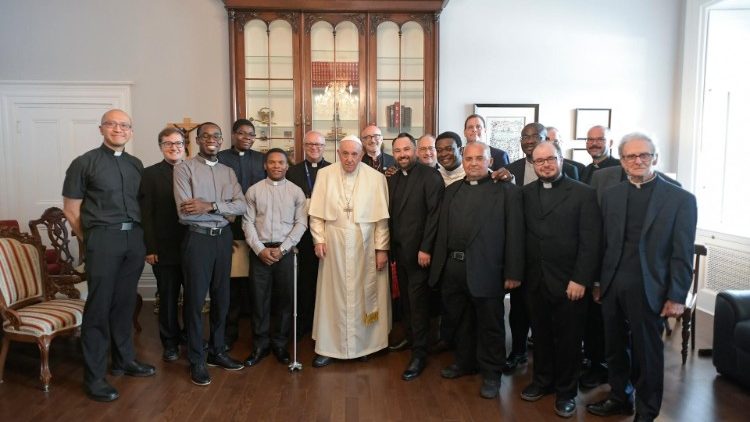
Pope Francis with Jesuits in Quebec (Vatican Media)
POPE
Pope Francis meets in Québec with his Jesuit confreres ministering in Canada for a private moment of conversation, already a tradition during his Apostolic Journeys.
By Deborah Castellano Lubov
Pope Francis met with his Jesuit confreres in the Archbishop's Residence in Québec City on his last day in Canada.
The Holy Father normally reserves a private moment to meet with his Jesuit brothers during his Apostolic Journeys.
The Pope typically responds to questions in an informal conversation with those gathered, which is generally written up and made available by Editor of La Civiltà Cattolica, Fr. Antonio Spadaro.
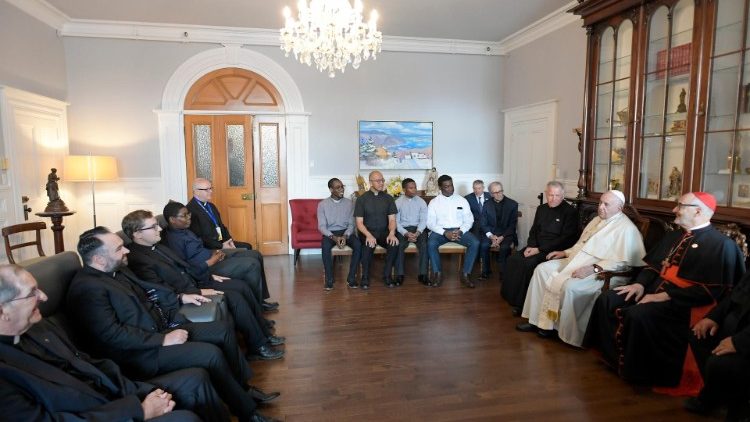
Pope with members of Society of Jesus in Canada
Pope's last day in Canada
Pope Francis is concluding his 'penitential pilgrimage' to Canada, 24 - 30 July, marking his 37th Apostolic Journey abroad and 56th country visited.

29/07/2022
A Conversation with Arctic Canada's Bishop Krótki of Iqaluit
During the his Journey, the Pope has repeatedly asked forgiveness for the wrongdoings committed, and has called for researching how these tragedies occurred so that they may never happen again.
After his meeting with the Jesuits and a subsequent meeting with indigenous, the Pope concluded his time in Québec.
Pope Francis then boarded the papal plane en route to the Arctic city of Iqaluit, in Nunavut Territory, for a few hours, to hold a public event and meet Inuit survivors of residential schools, before taking his return flight to Rome.
Monday, July 30, 2018
Where churches have become temples of cheese, fitness and eroticism
Posted 8:45 p.m. yesterday
Updated 9:17 a.m. today
By Dan Bilefsky, New York Times
MONTREAL — For generations, parishioners whispered their sins in the dark wooden confessional booths of Notre-Dame-du-Perpétuel-Secours, an imposing Roman Catholic church in Montreal. 7
But on a recent day, the edgy Quebec comedian Sugar Sammy was being filmed inside one of the booths, the latest intimate celebrity confessional on the talk show “Y’a du monde à messe,” or “The Church Is Packed.” 16
“I made a sex tape in order to be famous, because I thought it was the path to glory,” Sammy said with mock seriousness, as the camera zoomed in on his face, seen from behind a grill. “It didn’t work because no one watched it,” he continued. “I was the only person on the tape.” 21
A large audience gathered in the church roared with laughter. 5

The once-hallowed space, now illuminated with a giant pink chandelier, has been reinvented as the Théâtre Paradoxe at a cost of nearly $3 million in renovations. It is now host to, among other events, Led Zeppelin cover bands, Zumba lessons and fetish parties, as well as the talk show that Sammy appeared on. 13
And it is one of dozens of churches across Quebec that have been transformed — into university reading rooms, luxury condominiums, cheese emporiums and upmarket fitness centers. 6
At another event at the church, devoted to freewheeling dance, dozens of barefoot amateur dancers filled the space and undulated in a trancelike state in front of its former altar amid drums and chanting. Two men in tank tops clasped hands and twirled each other. A woman in blue juggled three white balls, putting one on her head. 4
Monday, September 08, 2014
Pope recalls beginnings of Church in Canada, calls for renewed Eucharistic, Marian devotion

Cathedral-Basilica of Notre-Dame de Québec
Catholic World News - September 08, 2014
On September 14, the Church in Canada will commemorate the 350th anniversary of the establishment of the first parish in what is now Canadian territory.
Pope Francis has named Cardinal Jaime Lucas Ortega y Alamino of Havana as his special envoy who will preside over the solemn Mass at the Cathedral-Basilica of Notre-Dame de Québec, the seat of the primate of Canada, Cardinal Gérald Lacroix.
In a letter to the Cuban prelate, dated July 25 and released September 6, the Pope recalled that the parish began as a shrine in 1647 and became a parish in 1664, a cathedral in 1674, and a minor basilica in 1874. The Pope also recalled that early this year, he canonized St. François de Laval, the first bishop of New France, whose relics are venerated in the cathedral.
Pope Francis asked Cardinal Ortega to “sweetly exhort the priests and faithful present there to follow Christ with perseverance and to venerate His Mother piously, as was the custom in these rather large regions. And at the same time, through the grace of God that arises in these places, we desire greatly the success of the new evangelization, by which the faithful may be led diligently, through true Eucharistic and Marian devotion, to a continuously greater charity and sanctity.”
Additional sources for this story
Some links will take you to other sites, in a new window.
Lettera del Santo Padre all’Inviato Speciale al 350° anniversario della celebrazione della fondazione della Parrocchia di Notre Dame-de-Québec (Holy See Press Office)Cathedral-Basilica of Notre-Dame de Québec
.
Saturday, June 18, 2011
This Week's Solar Flare Illuminates the Grid's Vulnerability

By PETER BEHR of ClimateWire
Published: June 9, 2011
A massive burst of solar wind that erupted from the sun Tuesday is expected to deliver only a "glancing blow" to the Earth's vulnerable magnetic field, NASA officials said yesterday. But it will preview what some experts call a potentially existential threat to the power grids of the United States and other nations, and the populations that depend on them.
Antti Pulkkinen, who leads NASA's "Solar Shield" satellite-based detection system at the Goddard Space Flight Center, said the cloud of ionized particles from Tuesday's violent "coronal mass ejection" will largely miss Earth, giving some North American residents a glimpse of the aurora borealis, or northern lights, this weekend. "It will not be a major event [for] the power grid," he said.
However, NASA spacecraft detected a much larger eruption last weekend on the backside of the sun headed away from Earth, generating a much faster-moving cloud.
"If this event was on a collision course with the U.S., we would have had a major space weather event," Pulkkinen said. "In this regard, we got lucky."
The next peak cycle of sunspot activity is predicted for 2012-2014, bringing with it a greater risk of large geomagnetic storms that can generate powerful rogue currents in transmission lines, potentially damaging or destroying the large transformers that manage power flow over high-voltage networks.
"Geomagnetically-induced currents on system infrastructure have the potential to result in widespread tripping of key transmission lines and irreversible physical damage to large transformers," a 2009 report (pdf) by the North American Electric Reliability Corp. (NERC) and the Energy Department says.
Agreement on the seriousness of the threat, but not the solution
In the worst-case scenario, the stockpile of spare transformers would fall far short of replacement needs. Urban centers across the continent would be without power for many months or even years, until new transformers could be manufactured and delivered from Asia. The transformers are not made in the United States.
"If the solar storm of 1921, which has been termed a one-in-100-year event, were to occur today, well over 300 extra-high-voltage transformers could be damaged or destroyed, thereby interrupting power to 130 million people for a period of years," Joseph McClelland, director of the Office of Electric Reliability at the Federal Energy Regulatory Commission, said at a May 31 House Energy subcommittee hearing on the issue.
"The U.S. society and economy are so critically dependent upon the availability of electricity that a significant collapse of the grid precipitated by a major natural or man-made EMP [electro-magnetic pulse] event could result in catastrophic civilian casualties," Rep. Trent Franks (R-Ariz.) said at the same hearing.
The U.S. grid currently relies for its defense on warnings from NASA that would alert U.S. utilities to take actions to protect their systems. Tuesday's storm did not require a response, NERC said.
But the alerts have the effect of advice and there are no mandatory, enforceable procedures or emergency actions, NERC officials say. No comprehensive plan exists to retrofit the transmission grid with protective devices, although the Electric Power Research Institute, the industry's primary research and development organization, is developing a range of technical responses.
The threat is a top priority for FERC and NERC, their officials say, but the two organizations have sparred over the reach of new federal authority that could be created to upgrade the grid's protective equipment and defensive plans.
While the House last year passed the "GRID Act," addressing vulnerabilities of the bulk power sector to natural threats and cyber attacks, action in the Senate is tied up by conflicting bids for jurisdiction by five different committees.
Learning from a 1989 solar storm
Pulkkinen said that NASA's satellite and computer systems provide a vital early warning capability. The solar eruptions can be detected several days before the space weather strikes the Earth, and more detailed threat analysis can be generated 24 hours before an event begins, he said.
The warnings weren't available during the last major solar storm that began on March 13, 1989.
That massive impulse blacked out the entire power grid in Quebec in 92 seconds, giving operators "no time to even assess what was happening to the power system, let alone provide any meaningful human intervention," said John Kappenman, author of a January 2010 report (pdf) by Metatech Corp. prepared for Oak Ridge National Laboratory.
More than 80 percent of Quebec's system was back up within 11 hours, Kappenman said. But he and other experts say the challenge to the U.S. grid is more serious for several reasons.
The Hydro-Québec power system draws almost entirely on hydroelectric generation, which permits a relatively simple and rapid restoration, he said. In contrast, the U.S. grid relies predominantly on steam electric generation, making restoration much more difficult, and a recovery as fast as Quebec's "is highly unlikely."
High-voltage lines act as antennae, attracting geomagnetic disturbances from the sun, and the larger and longer the lines, the greater the effect. The total length of U.S. high-voltage lines has increased nearly tenfold since the 1960s, Kappenman reported. The average length of the highest-capacity U.S. lines currently is four times greater than the smaller lines used more than a generation ago.
"Today's sprawling high-voltage power grids are more susceptible to space weather impacts than ever before," Kappenman said.
Designing defenses against space weather
Utilities have spent several billion dollars installing equipment to protect their transmission networks from lightning strikes, Kappenman added, but installations to defend against space weather are lagging. In part, that's because the research on the threat and the best countermeasures has not been completed. The transmission networks are so interconnected and interdependent that one company's investment in protective equipment could be nullified if a neighboring utility did nothing.
But some available defenses are also not being used, Kappenman said. He cited devices called "series capacitors" that can block the flow of geomagnetic currents on transmission lines. In the western section of the U.S. grid, many are in place. In the entire eastern grid, however, only two lines have this protection.
In the Quebec event, grid devices called compensators that were essential to counteract the rogue currents' effects tripped off to protect themselves. That "pulled the legs out" from under the province's grid, precipitating a rapid collapse of voltage, Kappenman said. This illustrates the need for complex modeling of the grid's vulnerabilities, he added.
The 1989 disturbance, which was felt by power systems deep into the United States and damaged a transformer at a nuclear plant, is far from the maximum. A report in the spring issue of the EPRI Journal notes that the 1921 storm was 10 times stronger (but it hit a far less developed and exposed grid network). The strongest solar storm on record hit in 1859, battering the U.S. telegraph system in places, EPRI said. That event may have been 50 percent more powerful than the 1921 storm, it reported.
Recent storms "do not represent the most severe storm events that are plausible," Kappenman said.
Richard Lordan, a senior technical executive at EPRI's Palo Alto, Calif., office, said his organization is researching a range of defensive strategies. The amount of long-distance power transfers can be reduced as much as possible, and generators close to population centers can be brought online.
"As a final resort, you can consider removing transformers from service," he said -- deliberately blacking out parts of the grid. EPRI has developed sensors that could detect high geomagnetic currents in transformers that would alert operators that the equipment had to be taken offline.
"If the storm is severe enough, operators have ways of islanding the system," he added, just as rolling blackouts have been used in extreme power emergencies like the Texas winter storm during this year's Super Bowl week. "It's preferable to take the system out and protect the equipment. It's a last-resort step.
"There are other [protective] devices under development," he said. "But the industry wants to be sure these devices don't impact the reliability of the system."
Critics call security process 'too slow'
The Department of Homeland Security has funded EPRI's design of a modular replacement transformer that is now being tested. It can be adapted to the range of substation configurations around the grid, and shipped in three pieces by truck to wherever it was needed. It will be installed for field testing in 2012.
But there are a host of unanswered policy questions before the replacement transformers could provide effective backup, he said, beginning with how they would be paid for.
"What would be the appropriate deployment strategy? How many are needed? Who owns them? Who maintains them? And who determines when an event is severe enough to warrant deployment?" he said. "These conversations are going on."
FERC and NERC agree that mandatory authority is needed to deal with solar weather emergencies that are days or hours away. NERC President Gerald Cauley says his organization "should be given authority under FERC oversight to address grid security vulnerabilities by enforceable means other than standards."
But they aren't in accord over whether the federal government can step in and direct a transformer replacement program. Cauley told the House hearing last month that NERC's current "bottoms-up" process for developing grid security standards that begins with its power company stakeholders is the right approach in this case.
The provisions in the House-passed GRID Act spelling out FERC's authority to order a transformer replacement program are not needed, Cauley said. "FERC already has the authority to order us to address these topics today," he said.
McClelland responded, "the commission has said on numerous occasions that when it comes to national security, the process -- the standards development process is too slow. It's too open, and it's too unpredictable."
Published: June 9, 2011
A massive burst of solar wind that erupted from the sun Tuesday is expected to deliver only a "glancing blow" to the Earth's vulnerable magnetic field, NASA officials said yesterday. But it will preview what some experts call a potentially existential threat to the power grids of the United States and other nations, and the populations that depend on them.
Antti Pulkkinen, who leads NASA's "Solar Shield" satellite-based detection system at the Goddard Space Flight Center, said the cloud of ionized particles from Tuesday's violent "coronal mass ejection" will largely miss Earth, giving some North American residents a glimpse of the aurora borealis, or northern lights, this weekend. "It will not be a major event [for] the power grid," he said.
However, NASA spacecraft detected a much larger eruption last weekend on the backside of the sun headed away from Earth, generating a much faster-moving cloud.
"If this event was on a collision course with the U.S., we would have had a major space weather event," Pulkkinen said. "In this regard, we got lucky."
The next peak cycle of sunspot activity is predicted for 2012-2014, bringing with it a greater risk of large geomagnetic storms that can generate powerful rogue currents in transmission lines, potentially damaging or destroying the large transformers that manage power flow over high-voltage networks.
"Geomagnetically-induced currents on system infrastructure have the potential to result in widespread tripping of key transmission lines and irreversible physical damage to large transformers," a 2009 report (pdf) by the North American Electric Reliability Corp. (NERC) and the Energy Department says.
Agreement on the seriousness of the threat, but not the solution
In the worst-case scenario, the stockpile of spare transformers would fall far short of replacement needs. Urban centers across the continent would be without power for many months or even years, until new transformers could be manufactured and delivered from Asia. The transformers are not made in the United States.
"If the solar storm of 1921, which has been termed a one-in-100-year event, were to occur today, well over 300 extra-high-voltage transformers could be damaged or destroyed, thereby interrupting power to 130 million people for a period of years," Joseph McClelland, director of the Office of Electric Reliability at the Federal Energy Regulatory Commission, said at a May 31 House Energy subcommittee hearing on the issue.
"The U.S. society and economy are so critically dependent upon the availability of electricity that a significant collapse of the grid precipitated by a major natural or man-made EMP [electro-magnetic pulse] event could result in catastrophic civilian casualties," Rep. Trent Franks (R-Ariz.) said at the same hearing.
The U.S. grid currently relies for its defense on warnings from NASA that would alert U.S. utilities to take actions to protect their systems. Tuesday's storm did not require a response, NERC said.
But the alerts have the effect of advice and there are no mandatory, enforceable procedures or emergency actions, NERC officials say. No comprehensive plan exists to retrofit the transmission grid with protective devices, although the Electric Power Research Institute, the industry's primary research and development organization, is developing a range of technical responses.
The threat is a top priority for FERC and NERC, their officials say, but the two organizations have sparred over the reach of new federal authority that could be created to upgrade the grid's protective equipment and defensive plans.
While the House last year passed the "GRID Act," addressing vulnerabilities of the bulk power sector to natural threats and cyber attacks, action in the Senate is tied up by conflicting bids for jurisdiction by five different committees.
Learning from a 1989 solar storm
Pulkkinen said that NASA's satellite and computer systems provide a vital early warning capability. The solar eruptions can be detected several days before the space weather strikes the Earth, and more detailed threat analysis can be generated 24 hours before an event begins, he said.
The warnings weren't available during the last major solar storm that began on March 13, 1989.
That massive impulse blacked out the entire power grid in Quebec in 92 seconds, giving operators "no time to even assess what was happening to the power system, let alone provide any meaningful human intervention," said John Kappenman, author of a January 2010 report (pdf) by Metatech Corp. prepared for Oak Ridge National Laboratory.
More than 80 percent of Quebec's system was back up within 11 hours, Kappenman said. But he and other experts say the challenge to the U.S. grid is more serious for several reasons.
The Hydro-Québec power system draws almost entirely on hydroelectric generation, which permits a relatively simple and rapid restoration, he said. In contrast, the U.S. grid relies predominantly on steam electric generation, making restoration much more difficult, and a recovery as fast as Quebec's "is highly unlikely."
High-voltage lines act as antennae, attracting geomagnetic disturbances from the sun, and the larger and longer the lines, the greater the effect. The total length of U.S. high-voltage lines has increased nearly tenfold since the 1960s, Kappenman reported. The average length of the highest-capacity U.S. lines currently is four times greater than the smaller lines used more than a generation ago.
"Today's sprawling high-voltage power grids are more susceptible to space weather impacts than ever before," Kappenman said.
Designing defenses against space weather
Utilities have spent several billion dollars installing equipment to protect their transmission networks from lightning strikes, Kappenman added, but installations to defend against space weather are lagging. In part, that's because the research on the threat and the best countermeasures has not been completed. The transmission networks are so interconnected and interdependent that one company's investment in protective equipment could be nullified if a neighboring utility did nothing.
But some available defenses are also not being used, Kappenman said. He cited devices called "series capacitors" that can block the flow of geomagnetic currents on transmission lines. In the western section of the U.S. grid, many are in place. In the entire eastern grid, however, only two lines have this protection.
In the Quebec event, grid devices called compensators that were essential to counteract the rogue currents' effects tripped off to protect themselves. That "pulled the legs out" from under the province's grid, precipitating a rapid collapse of voltage, Kappenman said. This illustrates the need for complex modeling of the grid's vulnerabilities, he added.
The 1989 disturbance, which was felt by power systems deep into the United States and damaged a transformer at a nuclear plant, is far from the maximum. A report in the spring issue of the EPRI Journal notes that the 1921 storm was 10 times stronger (but it hit a far less developed and exposed grid network). The strongest solar storm on record hit in 1859, battering the U.S. telegraph system in places, EPRI said. That event may have been 50 percent more powerful than the 1921 storm, it reported.
Recent storms "do not represent the most severe storm events that are plausible," Kappenman said.
Richard Lordan, a senior technical executive at EPRI's Palo Alto, Calif., office, said his organization is researching a range of defensive strategies. The amount of long-distance power transfers can be reduced as much as possible, and generators close to population centers can be brought online.
"As a final resort, you can consider removing transformers from service," he said -- deliberately blacking out parts of the grid. EPRI has developed sensors that could detect high geomagnetic currents in transformers that would alert operators that the equipment had to be taken offline.
"If the storm is severe enough, operators have ways of islanding the system," he added, just as rolling blackouts have been used in extreme power emergencies like the Texas winter storm during this year's Super Bowl week. "It's preferable to take the system out and protect the equipment. It's a last-resort step.
"There are other [protective] devices under development," he said. "But the industry wants to be sure these devices don't impact the reliability of the system."
Critics call security process 'too slow'
The Department of Homeland Security has funded EPRI's design of a modular replacement transformer that is now being tested. It can be adapted to the range of substation configurations around the grid, and shipped in three pieces by truck to wherever it was needed. It will be installed for field testing in 2012.
But there are a host of unanswered policy questions before the replacement transformers could provide effective backup, he said, beginning with how they would be paid for.
"What would be the appropriate deployment strategy? How many are needed? Who owns them? Who maintains them? And who determines when an event is severe enough to warrant deployment?" he said. "These conversations are going on."
FERC and NERC agree that mandatory authority is needed to deal with solar weather emergencies that are days or hours away. NERC President Gerald Cauley says his organization "should be given authority under FERC oversight to address grid security vulnerabilities by enforceable means other than standards."
But they aren't in accord over whether the federal government can step in and direct a transformer replacement program. Cauley told the House hearing last month that NERC's current "bottoms-up" process for developing grid security standards that begins with its power company stakeholders is the right approach in this case.
The provisions in the House-passed GRID Act spelling out FERC's authority to order a transformer replacement program are not needed, Cauley said. "FERC already has the authority to order us to address these topics today," he said.
McClelland responded, "the commission has said on numerous occasions that when it comes to national security, the process -- the standards development process is too slow. It's too open, and it's too unpredictable."
.
Subscribe to:
Posts (Atom)