Showing posts with label imunity. Show all posts

Wednesday, December 31, 2025

DPCU represented at annual Conference of Secretaries of Christian World Communions

6 Nov 2025


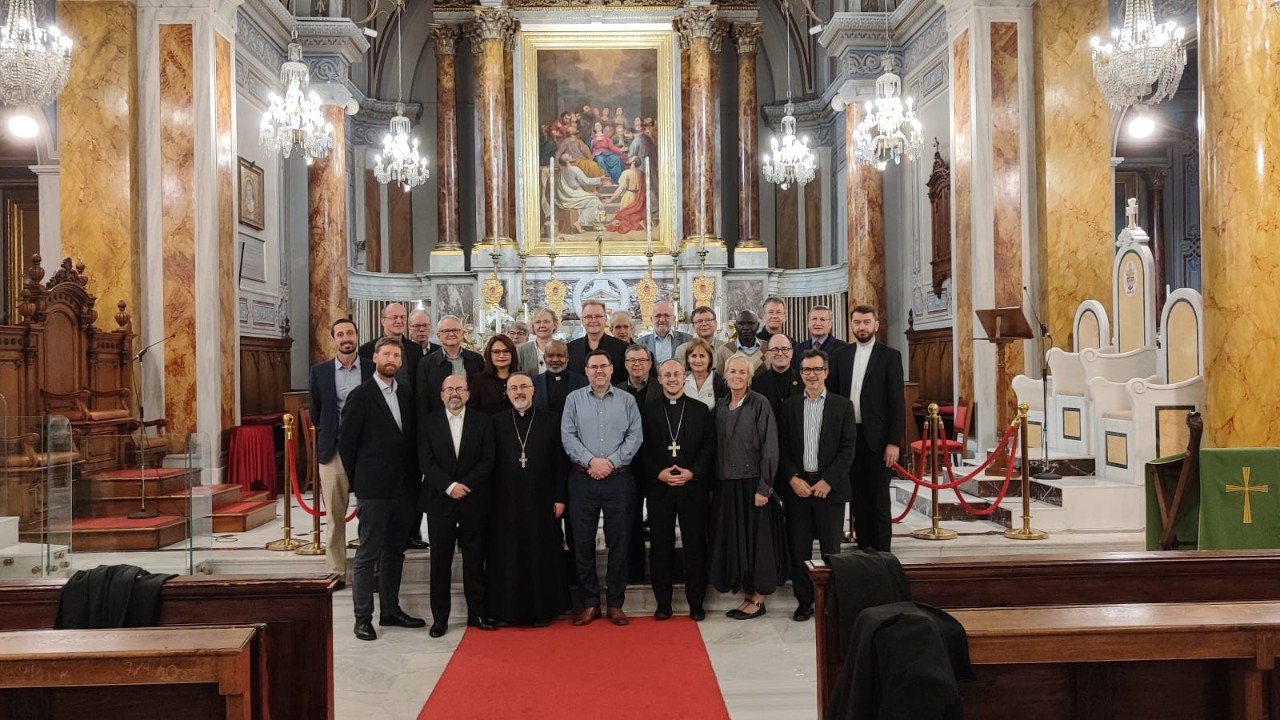
The annual Conference of Secretaries of Christian World Communions (CS/CWCs) took place in Istanbul, Turkey, from 4 to 6 November 2025, hosted by the Ecumenical Patriarchate. The gathering brought together representatives from a wide range of Christian communions to share updates on their activities and reflect on current challenges and opportunities in the service of Christian unity.

The Catholic Church was represented by Archbishop Flavio Pace, Secretary of the Dicastery for Promoting Christian Unity, assisted by Monsignor Andrzej Choromański, staff member responsible for multilateral relations within the Dicastery.

The Conference was chaired by Reverend César García, General Secretary of the Mennonite World Conference, with the assistance of Commissioner Jane Paone, The Salvation Army’s Secretary for International Ecumenical Relations, serving as secretary. Each day opened and concluded with a prayer time led by one of the participants according to his or her own tradition, offering a tangible sign of the spiritual diversity and communion that characterize the Christian family.

Thursday, February 20, 2014

Los Angeles Cardinal Unlikely to Face Charges


LOS ANGELES February 19, 2014 (AP)
By GILLIAN FLACCUS Associated Press


Top Headlines This Hour From ABC News
Next Video Catholic TV Star Defends Child Sex Abusers


The nation's largest Roman Catholic archdiocese has agreed to pay $720 million to clergy abuse victims over the past decade and released internal files that showed Cardinal Roger Mahony shielded priests and ordered a surrogate to withhold evidence from police, yet Mahony and other archdiocese leaders are unlikely to face criminal charges.

With the final $13 million settlement of existing old cases announced Wednesday, Mahony has emerged from the scandal with his reputation tarnished, but his place in the church intact — even after being publicly rebuked by his successor for internal church files showing that he and others worked to protect priests, keep parishioners in the dark and defend the church's image.

By settling the cases, the archdiocese avoids a trial in which Mahony would have been publicly questioned under oath about what plaintiffs' lawyers said was an attempt to thwart a Los Angeles police investigation.

During a deposition unsealed Wednesday, Mahony acknowledged he told an underling not to give police a list of altar boys who had worked with the Rev. Nicolas Aguilar Rivera. He testified he wasn't trying to hinder police, but he didn't want the boys to be scarred by the investigation and that he felt the altar boys were too old to be potential victims of the Mexican priest.

Police later found that 25 of Aguilar Rivera's alleged victims were altar boys and the other victim was training with the priest to be one, said Anthony DeMarco, a plaintiff attorney.

It's not clear what impact Mahony's action had on the investigation, though at the time, police complained that the archdiocese wasn't fully cooperating.

"Cardinal Mahony and those top officials have never been held fully to account," Jeff Anderson, a plaintiffs' attorney, said at a news conference. "What we see is a current and ongoing attempt to deflect and deny responsibility."

The priest is believed to have molested 100 additional children in Mexico both before and after his stint in Los Angeles, DeMarco said. He was defrocked in 2009 after attorneys in Los Angeles filed the first of their lawsuits.

The archdiocese said in a statement Tuesday that the church had settled the cases to "provide support to the victims through the healing process."

Mahony, who retired as head of the archdiocese in 2011, was admonished last year by Archbishop Jose Gomez for his handling of the abuse crisis. But he has avoided criminal prosecution, despite investigations by the Los Angeles County district attorney and the U.S. attorney's office.

With only a three- to five-year period to bring charges of obstruction of justice after a crime — depending on a federal or state court venue — it's unlikely he or other church administrators would face charges now for cases that date back more than a decade, said Lawrence Rosenthal, a criminal law professor at Chapman University and a former prosecutor.

In other cases, church leaders accused of shielding pedophile priests from prosecution have faced criminal charges.

Prosecutors in Philadelphia won the conviction of a monsignor after a change in state law gave prosecutors more time to file charges and seek evidence. A state appeals court last year, however, threw out the conviction and said he never should have been charged.

In Missouri, a judge found the Kansas City bishop guilty last year of failing to report child abuse to the state, making him the highest-ranking U.S. Roman Catholic official to be convicted of a crime related to the child sexual abuse scandal. He was sentenced to probation for the misdemeanor and remains head of his diocese.

A Los Angeles federal prosecutor involved in a 2009 grand jury investigation wrote that documents showed "the possibility of criminal culpability" by members of the archdiocese leadership, but a criminal conspiracy case was "more and more remote" because of the passage of time.

The newly disclosed testimony by Mahony deals mostly with Aguilar Rivera, who fled to his native Mexico in January 1988 after Mahony's top aide, Monsignor Thomas Curry, tipped him off about parent complaints and warned that the church would call police.

Aguilar Rivera, who was 46 at the time, remains a fugitive and is believed to be somewhere in Mexico.

U.S. authorities have an arrest warrant pending and could arrest him if he returns to American soil.

In the deposition taken a year ago, Mahony appears on video in his priests' collar, taking long pauses and glancing down frequently. At one point he explains why he told Curry not to share a list of altar boys with police. Allowing police to question altar boys at the two parishes where Aguilar Rivera worked during his 10-month stint in LA "could be very traumatic to those servers to all of a sudden be sitting in front of a policeman being interrogated," the cardinal said. "And we had no suspicion at that time of any other victims and nobody among the altar servers."

He denied under questioning from plaintiff attorneys that his motivation in holding back the list was to protect the priest and delay the investigation.

J. Michael Hennigan, an attorney with the archdiocese, said Mahony was in Rome on Wednesday and was not available to comment.

Hennigan said Mahony was "very vigorous" in trying to get Aguilar Rivera brought back to the U.S. for prosecution after he fled.

Mahony wrote to his counterpart in Aguilar Rivera's diocese and urged him to contact police.

In his testimony, Mahony also defended Curry, the vicar for clergy, for telling Aguilar Rivera that the church would need to contact police and that the accused priest was "in a good deal of danger."

The complaints came in on a Friday, and Curry met with the priest Saturday morning. Police weren't notified until Monday. By then, Aguilar Rivera was gone.

Victor Cortez, 34, said he was molested by Aguilar Rivera when he was 7 and kept the abuse secret for years.

"I've lived for 26 years with fear, and now I'm not afraid anymore," said Cortez, who was part of Wednesday's settlement announcement. "Once I got it all out, the problems just went away. I'm able to be a better father to my children and a better husband to my wife."

Mahony also testified about a 1986 letter he wrote to the director at a New Mexico center treating the Rev. Peter Garcia for pedophilia, warning that the priest couldn't return to Los Angeles in the foreseeable future.

"I believe that if Monsignor Garcia were to reappear here with the archdiocese, we might very well have some type of legal action filed in both the criminal and civil sectors," he wrote.

In his deposition, Mahony said the letter was not intended to protect Garcia from prosecution.

"Was I interested in having a big civil upset here for the archdiocese? No, I was not," he said. "But I was not encouraging him to avoid criminal prosecution."

Mahony, who turns 78 next week, has largely retreated from the public eye.

After giving his deposition last year, he traveled to Rome, where he helped elect the new pope. A month ago, he celebrated Mass with Pope Francis at the Vatican before having a private meeting with him.


Source
.
Monday, April 29, 2013

Protestantism and Catholicism Uniting

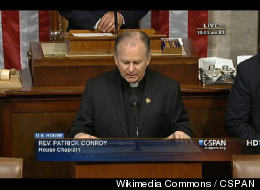
(Left) Barry Black, Chaplain of the U.S. Senate.
(Right) Patrick Conroy SJ, Chaplain of the U.S. House of Representatives;


Bible Echo and Signs of the Times


February 1, 1887

By Mrs. E. G. White

Romanism is now regarded by Protestants with far greater favor than in former years. There is an increasing indifference concerning the doctrines that separate the reformed churches from the papal hierarchy; the opinion is gaining ground that, after all, we do not differ so widely upon vital points as has been supposed, and that a little concession on our part will bring us into a better understanding with Rome. The time was when Protestants placed a high value upon the liberty of conscience which has been so dearly purchased. They taught their children to abhor popery, and held that to remain at peace with Rome would be disloyalty to God. But how widely different are the sentiments now expressed.

The defenders of popery declare that she has been maligned; and the Protestant world is inclined to accept the statement. Many urge that it is unjust to judge the Romish Church of today by the abominations and absurdities that marked her reign during the centuries of ignorance and darkness. They excuse her horrible cruelty as the result of the barbarism of the times, and plead that civilization has changed her sentiments.

Have these persons forgotten the claim of infallibility, for eight hundred years put forth by this haughty power? So far from relinquishing this claim, the church in the nineteenth century has affirmed it with greater positiveness than ever before. As Rome asserts that she has never erred, and never can err, how can she renounce the principles which governed her course in past ages?

Romanism as a system is no more in harmony with the gospel of Christ now than at any former period in her history. The Protestant churches are in great darkness, or they would discern the signs of the times. The Roman Church is far-reaching in her plans and modes of operation. She is employing every device to extend her influence and increase her power in preparation for a fierce and determined conflict to regain control of the world, to re-establish persecution, and to undo all that Protestantism has done. Catholicism is gaining ground in our country upon every side. Look at the number of her churches and chapels. Look at her colleges and seminaries, so widely patronized by Protestants. These things should awaken the anxiety of all who prize the pure principles of the gospel.

Protestants have tampered with and patronized popery; they have made compromises and concessions which papists themselves are surprised to see, and fail to understand. Men are closing their eyes to the real character of Romanism, and the dangers to be apprehended from her supremacy. The people need to be aroused to resist the advances of this most dangerous foe to civil and religious liberty.

In the days of Rome’s supremacy there were instruments of torture to compel assent to her doctrines. There was the stake for those who would not concede to her claims. There were massacres on a scale that will never be known to mortals, Dignitaries of the church studied, under Satan their master, to invent means to cause the greatest possible torture, and not end the life of their victim. The internal process was repeated to the utmost limit of human endurance, until nature gave up the struggle, and the sufferer hailed death as a sweet release.

Such was the fate of Rome’s opponents. For her adherents she had the discipline of the scourge, of famishing hunger, of bodily austerities in every conceivable, heart-sickening form. To secure the favor of Heaven, penitents violated the laws of God by violating the laws of nature. They were taught to sunder every tie which he has formed to bless and gladden man’s earthly sojourn. The churchyard contains millions of victims who spent their lives in vain endeavors to subdue their natural affections, to repress, as offensive to God, every thought and feeling of sympathy with their fellow-creatures.

The Romish Church now presents a fair front to the world, covering with apologies her record of horrible cruelties. She has clothed herself in Christlike garments; but she is unchanged. Every principle of popery that existed in ages past exists today. The doctrines devised in the darkest ages are still held. Let none deceive themselves. The popery that Protestants are now so ready to embrace and honor is the same that ruled the world in the days of the Reformation, when men of God stood up at the peril of their lives to expose her iniquity. She possesses the same pride and arrogant assumption that lorded it over kings and princes, and claimed the prerogatives of God. Her spirit is no less cruel and despotic now than when she crushed out human liberty, and slew the saints of the Most High.

Popery is just what prophecy declared that she would be,—the apostasy of the latter times. It is a part of her policy to assume the character which will best accomplish her purpose; but beneath the variable appearance of the chameleon, she conceals the invariable venom of the serpent. “We are not bound to keep faith and promises to heretics,” she declares. Shall this power, whose record for a thousand years is written in the blood of the saints, be now acknowledged as a part of the church of Christ?

It is not without reason that the claim has been put forth that Catholicism is now almost like Protestantism. There has been a change; but the change is in Protestants, not in Romanists. Catholicism indeed resembles the Protestantism that now exists; but it is far removed from Protestantism as it was in the days of Cranmer, Ridley, Knox, and other reformers.

As the Protestant churches have been seeking the favor of the world, false charity has blinded their eyes. They do not see but that it is right to believe good of all evil; and as the inevitable result, they will finally believe evil of all good. Instead of standing in defense of the faith once delivered to the saints, they are now, as it were, apologizing to Rome for their uncharitable opinion of her, begging pardon for their bigotry.

A large class, even of those who look upon Romanism with no favor, apprehend little danger from her power and influence. Many urge that the intellectual and moral darkness prevailing during the Middle Ages favored the spread of her dogmas, superstitions, and oppression, and that the greater intelligence of modern times, the general diffusion of knowledge, and the increasing liberality in matters of religion, forbid a revival of intolerance and tyranny. The very thought that such a state of things will exist in this enlightened age is ridiculed. It is true that great light, intellectual, moral, and religious, is shining upon this generation. In the open pages of God’s holy word, light from heaven has been shed upon the world. But it should be remembered that the greater the light bestowed, the greater the darkness of those who pervert or reject it.

A prayerful study of the Bible would show Protestants the real character of the papacy, and would cause them to abhor and to shun it; but men are so wise in their own conceit that they feel no need of humbly seeking God that they may be led into the truth. Although priding themselves on their enlightenment, they are ignorant both of the Scriptures and of the power of God. They must have some means of quieting their consciences, and they seek that which is least spiritual and humiliating. What they desire is a method of forgetting God which shall pass as a method of remembering him. The papacy is well adapted to meet the wants of all these. It is prepared for two classes of mankind, embracing nearly the whole world,—those who would be saved by their merits, and those who would be saved in their sins. Here is the secret of its power.

A day of great intellectual darkness has been shown to be favorable to the success of popery. It will yet be demonstrated that a day of great intellectual light is equally favorable for its success. In past ages, when men were without God’s word, and without the knowledge of the truth, their eyes were blindfolded, and thousands were ensnared, not seeing the net spread for their feet. In this generation there are many whose eyes become dazzled by the glare of human speculations, “science falsely so called;” they discern not the net, and walk into it as readily as if blindfolded. God designed that man’s intellectual powers should be held as a gift from his Maker, and employed in the service of truth and righteousness; but when they are idolized, and laid upon the shrine of Satan to be employed in the service of a false religion, then intelligence can accomplish greater harm than ignorance.

In the movement now in progress in America to secure for the institutions and usages of the church the support of the State, Protestants are following in the steps of papists. Nay, more, they are opening the door for popery to regain in Protestant America the supremacy which she has lost in the Old World. And that which gives greater significance to this movement is the fact that the principal object contemplated is the enforcement of Sunday observance,—a custom which originated with Rome, and which she claims as the sign of her authority.

The spirit of the papacy,—the spirit of conformity to worldly customs, the veneration for human traditions above the commands of God,—is permeating the Protestant churches, and leading them on to do the same work of Sunday exaltation which the papacy has done before them. Would the reader understand the agencies to be employed in the soon-coming contest? He has but to trace the record of the means which Rome employed for the same object in ages past. Would he know how papists and Protestants united will deal with those who reject their dogmas? Let him see the spirit which Rome manifested toward the Sabbath and its defenders.

The records of the past clearly reveal the enmity of Rome toward the true Sabbath, and the means which she employs to honor the institution of her creating. The word of God teaches that these scenes are to be repeated as papists and Protestants shall unite for the exaltation of the Sunday. For nearly forty years Sabbath reformers have presented this testimony to the world. In the events now taking place is seen a rapid advance toward the fulfillment of the prediction. There is the same claim of divine authority for Sunday-keeping, and the same lack of scriptural evidence, as in the days of papal supremacy. The assertion that God’s judgments are visited upon men for their violation of the Sunday-Sabbath, will be repeated. Already it is beginning to be urged.

Marvelous in her shrewdness and cunning is the Romish Church. And the Christian world will learn what Romanism really is, when it is too late to escape the snare.


.

Sunday, April 04, 2010

Pope's immunity could be challenged in Britain


Legal experts discuss possibilities ahead of September visit


By PAISLEY DODDS
updated 12:22 p.m. ET, Sun., April 4, 2010


LONDON - Protests are growing against Pope Benedict XVI's planned trip to Britain, where some lawyers question whether the Vatican's implicit statehood status should shield the pope from prosecution over sex crimes by pedophile priests.

More than 10,000 people have signed a petition on Downing Street's Web site against the pope's 4-day visit to England and Scotland in September, which will cost U.K. taxpayers an estimated $22.5 million. The campaign has gained momentum as more Catholic sex abuse scandals have swept across Europe.

Although Benedict has not been accused of any crime, senior British lawyers are now examining whether the pope should have immunity as a head of state or whether he could be prosecuted under the principle of universal jurisdiction for an alleged systematic cover-up of sexual abuses by priests.


Universal jurisdiction — a concept in international law — allows judges to issue warrants for nearly any visitor accused of grievous crimes, no matter where they live. British judges have been more open to the concept than those in other countries.

Lawyers are divided over the immunity issue. Some argue that the Vatican isn't a true state, while others note the Vatican has national relations with about 170 countries, including Britain. The Vatican is also the only non-member to have permanent observer status at the U.N.

Then again, no other top religious leaders enjoy the same U.N. privileges or immunity, so why should the pope?

David Crane, former chief prosecutor at the Sierra Leone war crimes tribunal, said it would be difficult to implicate the pope in anything criminal.

"It's a fascinating kind of academic, theoretical discussion," said Crane, who prosecuted Sierra Leone's Charles Taylor when he was still a sitting head of state. "At this point, there's no liability at all."

But Geoffrey Robertson, who as a U.N. appeals judge delivered key decisions on the illegality of conscripting child soldiers and the invalidity of amnesties for war crimes, believes it could be time to challenge the immunity of the pope — and Britain could be the place. He wrote a legal opinion on the topic that was published Friday in the U.S. news site The Daily Beast and Saturday in the British newspaper the Guardian.

"Unlike in the United States, where the judges commonly uphold what the executive says, the British courts don't accept these things at face value," Robertson told The Associated Press on Saturday. "The Vatican is not a state — it was a construct of Italian dictator Benito Mussolini."

But Jeffrey Lena, the California attorney who argued — and won — head of state immunity for Benedict in U.S. sex abuse cases, said the pope could not successfully be prosecuted for crimes under international law.

"Those who would claim that 'universal jurisdiction' could be asserted over the pope appear to completely misunderstand the sorts of violations, such as genocide, which are required to assert such jurisdiction," he said.

Still, Israeli officials, including former Prime Minister Ehud Barak, have recently been targeted by groups in Britain under universal jurisdiction. The law principle is rooted in the belief that certain crimes — such as genocide, war crimes, torture and crimes against humanity — are so serious that they are an offense against humanity and must be addressed.

Judges an unknown factor


It's a tactic that the British government would likely abhor, but British judges have often gone against government wishes in lawsuits.

Recent examples include British judges who issued an arrest warrant against Israel's former foreign minister for alleged war crimes, and a British court ruling this year that forced the government to release its intelligence exchanges with U.S. officials about the torture claims of a former Guantanamo detainee.

Prosecution in the deepening cleric sex abuse scandal, however, ultimately rests on the question of immunity. If British judges do challenge the pope's immunity, there are a handful of possible legal scenarios — all of them speculative.

The pope could be served for a writ for civil damages, a complaint could be lodged with the International Criminal Court, or abuse victims could try to have Benedict arrested for crimes against humanity — perhaps the least likely scenario.

Lawyers question whether an alleged systematic cover-up could be considered a crime against humanity — a charge usually reserved for the International Criminal Court — and whether it could be pursued under universal jurisdiction.

Attorney Jennifer Robinson in London, who has been researching the possibilities, says rape and sexual slavery can be considered crimes against humanity.

Others, like Hurst Hannum with the Fletcher School of Law & Diplomacy at Tufts University near Boston, are skeptical.

"No one would question that the Church's response to widespread abuses has been atrocious, but it's very difficult for me to see how that would fit 'crimes against humanity,'" said Hannum.

Robertson is more in favor of challenging the immunity question.

"Head of state immunity provides no protection in the International Criminal Court," said Robertson, who represented The Associated Press and other media organizations who sought to make U.S.-U.K. intelligence exchanges public in the case of former Guantanamo detainee Binyam Mohamed.

"If acts of sexual abuse by priests are not isolated or sporadic events but part of a wide practice both known to and unpunished by their de facto-authority — i.e. the Catholic Church ... then the commander can be held criminally liable," Robertson said.

CONTINUED : Is Vatican really a sovereign state?
.


.