Showing posts with label Kerry. Show all posts
Showing posts with label Kerry. Show all posts
Wednesday, January 17, 2024


Tuesday, June 20, 2023
John Kerry meets Pope Francis privately, says he's in great form and spirits
June 19, 20233:53 PM EDT
Updated 14 hours ago
VATICAN CITY, June 19 (Reuters) - U.S. climate envoy John Kerry met Pope Francis on Monday, the first official to have a private audience with him since his discharge from hospital, and told Reuters that he found the pontiff "in great spirits and in great form".
Francis, 86, left Rome's Gemelli hospital on Friday, nine days after surgery to repair an abdominal hernia.
"He was in great spirits and great form ... I was really amazed. He embraced a lot of our conversation. It was a nice meeting," said Kerry, who was the first person on the pope's public schedule.
"I found the pope to be very much the pope that I have had the privilege of seeing several times over the last years. He was strong. He was clear. He seemed in very good form and good spirits," Kerry, 79, said in an interview in front of St. Peter's Square.
In 2015, Francis wrote Laudato Si (Praised Be), a landmark encyclical on the need to protect the environment, combat climate change and reduce use of fossil fuels. An encyclical is the highest form of papal writing.
"Laudato Si stands up as a major and important turning point for a lot of people," Kerry said.
VATICAN CITY, June 19 (Reuters) - U.S. climate envoy John Kerry met Pope Francis on Monday, the first official to have a private audience with him since his discharge from hospital, and told Reuters that he found the pontiff "in great spirits and in great form".
Francis, 86, left Rome's Gemelli hospital on Friday, nine days after surgery to repair an abdominal hernia.
"He was in great spirits and great form ... I was really amazed. He embraced a lot of our conversation. It was a nice meeting," said Kerry, who was the first person on the pope's public schedule.
"I found the pope to be very much the pope that I have had the privilege of seeing several times over the last years. He was strong. He was clear. He seemed in very good form and good spirits," Kerry, 79, said in an interview in front of St. Peter's Square.
In 2015, Francis wrote Laudato Si (Praised Be), a landmark encyclical on the need to protect the environment, combat climate change and reduce use of fossil fuels. An encyclical is the highest form of papal writing.
"Laudato Si stands up as a major and important turning point for a lot of people," Kerry said.
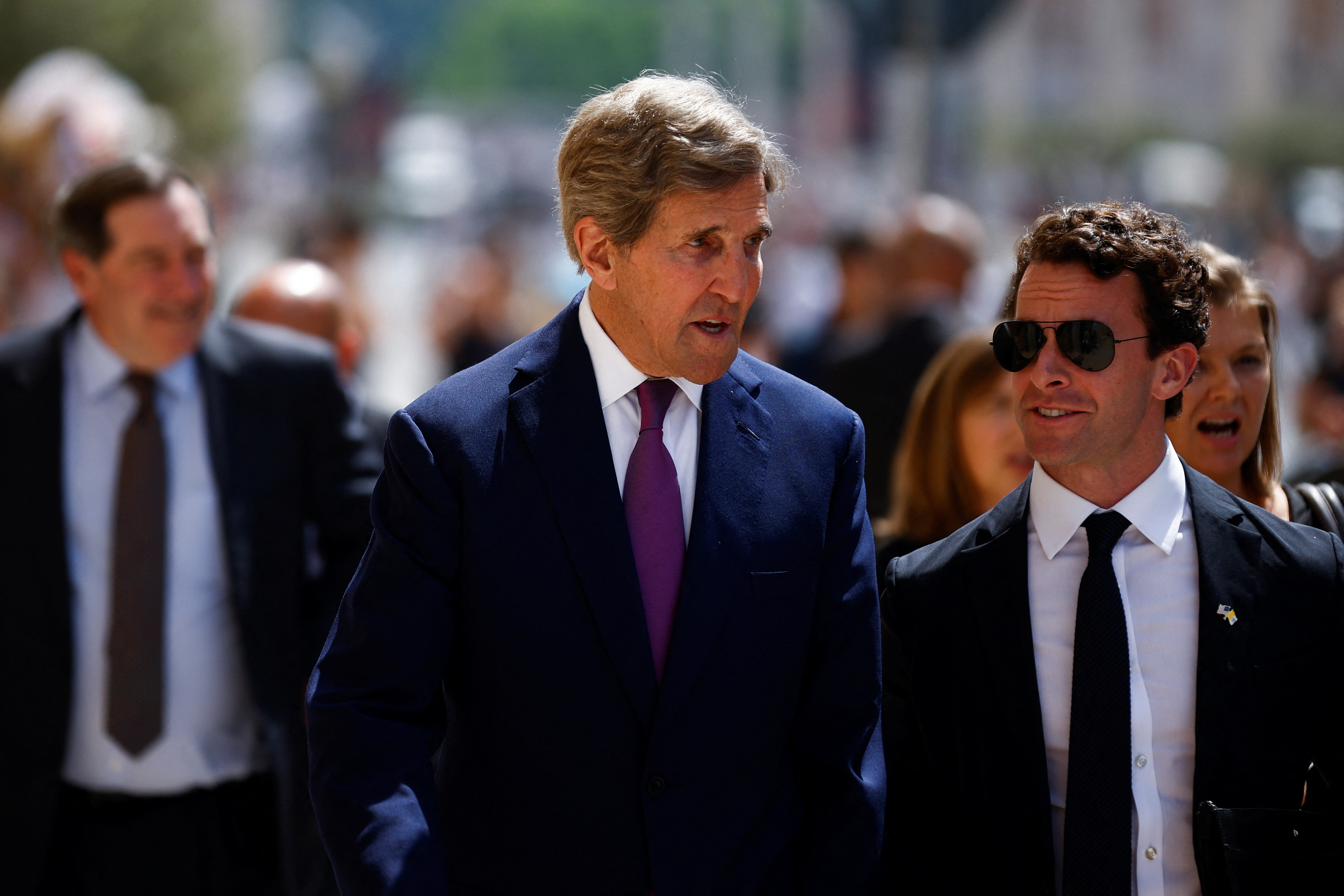
[1/4] U.S. Special Presidential Envoy for Climate John Kerry arrives for an interview with Reuters after meeting with Pope Francis, near the Vatican, in Rome, Italy, June 19, 2023. REUTERS/Guglielmo...
The former U.S. secretary of state said the pope had a "profound impact" on the 2015 Paris climate conference that set goals to limit global warming, and he thanked Francis for continuing "to sound the alarm" about the dangers and challenges of climate change.
Kerry is having a series of meetings ahead of COP28, the latest U.N. climate summit that is to be held at the end of this year in Dubai, in the United Arab Emirates.
"Now we have to continue and have the next movement, if you will, and I think COP28 in Dubai presents a good opportunity to do that because we all understand the implications of what's been happening over the last few years," Kerry said.
"This is getting more challenging, more serious, more immediate than it has been at any time, and I think that you are going to see more action as a result of that," he said.
The head of the United Nations climate body has said he was not satisfied with the outcome of a recent 10-day conference in Berlin, and that the process was moving too slowly given the urgency of the crisis.
(This story has been refiled to remove extraneous word 'Friday' from paragraph 1)
Reporting by Philip Pullella; editing by Toby Chopra and Mark Heinrich
Wednesday, November 25, 2020
Sunday, May 08, 2016
Kerry slams Trump's wall, tells grads to prepare for 'borderless world'

Kerry said no wall is big enough to keep dangerous terrorists out of the United States. ( AP Photo/Jose Luis Magana, File)
By PETE KASPEROWICZ (@PETEKDCNEWS) •5/6/16 12:04 PM
Secretary of State John Kerry took a shot at Donald Trump during his Friday commencement speech at Northeastern University, by saying no wall is big enough to keep dangerous terrorists out of the United States.
"Many of you were in elementary school when you learned the toughest lesson of all on 9/11," he said. "There are no walls big enough to stop people from anywhere, tens of thousands of miles away, who are determined to take their own lives while they target others."
"So I think that everything that we've lived and learn tells us that we will never come out on top if we accept advice from sound-bite salesmen and carnival barkers who pretend the most powerful country on Earth can remain great by looking inward," Kerry added. "And hiding behind walls at a time that technology has made that impossible to do and unwise to even attempt."
Kerry didn't mention Trump by name, but Trump has repeatedly called for a wall on the southern U.S. border, and many Democrats, and some Republicans, have taken to calling him a carnival barker.
More from the Washington Examiner
McCain: Joni Ernst would be a 'tremendous' VP pick
By Gabby Morrongiello
05/08/16 10:11 AM
Kerry also seemed to dismiss the importance of national borders, and said technology has reshaped the world into one that the U.S. must engage at the risk of being left behind. He said Trump and others who want to look inward are making a mistake, even in the face of rising tension and violence in the world.
"For some people, that is all they need simply to climb under the sheets, close their eyes and push the world away," Kerry said. "And shockingly, we even see this attitude from some who think they ought to be entrusted with the job of managing international affairs."
"The future demands from us something more than a nostalgia for some rose-tinted version of the past that did not really exist in any case," he said. "You're about to graduate into a complex and borderless world."
.
Saturday, February 13, 2016
John Kerry takes aim at Russia over Ukraine and Syria at security conference

U.S. Secretary of State, John Kerry, gestures during his speech at the Security Conference in Munich, Germany, Saturday, Feb. 13, 2016. (AP Photo/Matthias Schrader) (Matthias Schrader)

By The Associated Press | Wire reports
on February 13, 2016 at 8:06 AM, updated February 13, 2016 at 8:10 AM
MUNICH (AP) — U.S. Secretary of State John Kerry on Saturday sharply criticized Russia for its actions in Ukraine and Syria, accusing Moscow of "repeated aggression" in both places.
In a speech at the Munich Security Conference, Kerry said Russia is defying the will of the international community with its support for separatists in eastern Ukraine and its military intervention in Syria on behalf of President Bashar Assad.
His comments came just after Russia's prime minister, Dmitry Medvedev, told the conference that the West is rekindling the Cold War with sanctions imposed on Russia over Ukraine and with new NATO moves.
Kerry praised European nations for holding firm on the Ukraine penalties. He urged Moscow to act in good faith in forging a truce in Syria and to allow a political transition that would end the civil war.
He repeated allegations that Russian airstrikes in Syria have not been directed at terrorists but rather at moderate opposition groups supported by the U.S. and its European and Arab partners. Kerry also said that Russia would have to change tactics if an agreement Friday for a temporary truce in Syria is to actually take effect in a week.
"To date, the vast majority, in our opinion, of Russia's attacks have been against legitimate opposition groups and to adhere to the agreement it made, we think it is critical that Russia's targeting change," Kerry said. "If people who want to be part of the conversation are being bombed, we're not going to have much of a process."
Kerry added that the only way to end the Syrian conflict and ultimately defeat the Islamic State group is a political transition that removes Assad from power.
"Some argue that the reason humanitarian access has been denied and indiscriminate bombing continues is because Assad and his allies, including Russia, might believe that by defying the will of the international community, they can win the war," he said. "If that is what Russia and Assad think, then I believe they would have been missing the lessons of the last five years."
The opposition "may be pushed back here and there but they are not going to surrender," Kerry said.
On Ukraine, Kerry said Russia would continue to be subject to sanctions until it and the rebels it supports in the east come into full compliance with a political agreement reached last year in Minsk, the capital of Belarus.
"Russia has a simple choice: fully implement Minsk or continue to face economically damaging sanctions," he said.
on February 13, 2016 at 8:06 AM, updated February 13, 2016 at 8:10 AM
MUNICH (AP) — U.S. Secretary of State John Kerry on Saturday sharply criticized Russia for its actions in Ukraine and Syria, accusing Moscow of "repeated aggression" in both places.
In a speech at the Munich Security Conference, Kerry said Russia is defying the will of the international community with its support for separatists in eastern Ukraine and its military intervention in Syria on behalf of President Bashar Assad.
His comments came just after Russia's prime minister, Dmitry Medvedev, told the conference that the West is rekindling the Cold War with sanctions imposed on Russia over Ukraine and with new NATO moves.
Kerry praised European nations for holding firm on the Ukraine penalties. He urged Moscow to act in good faith in forging a truce in Syria and to allow a political transition that would end the civil war.
He repeated allegations that Russian airstrikes in Syria have not been directed at terrorists but rather at moderate opposition groups supported by the U.S. and its European and Arab partners. Kerry also said that Russia would have to change tactics if an agreement Friday for a temporary truce in Syria is to actually take effect in a week.
"To date, the vast majority, in our opinion, of Russia's attacks have been against legitimate opposition groups and to adhere to the agreement it made, we think it is critical that Russia's targeting change," Kerry said. "If people who want to be part of the conversation are being bombed, we're not going to have much of a process."
Kerry added that the only way to end the Syrian conflict and ultimately defeat the Islamic State group is a political transition that removes Assad from power.
"Some argue that the reason humanitarian access has been denied and indiscriminate bombing continues is because Assad and his allies, including Russia, might believe that by defying the will of the international community, they can win the war," he said. "If that is what Russia and Assad think, then I believe they would have been missing the lessons of the last five years."
The opposition "may be pushed back here and there but they are not going to surrender," Kerry said.
On Ukraine, Kerry said Russia would continue to be subject to sanctions until it and the rebels it supports in the east come into full compliance with a political agreement reached last year in Minsk, the capital of Belarus.
"Russia has a simple choice: fully implement Minsk or continue to face economically damaging sanctions," he said.
.
Thursday, February 11, 2016
World powers agree Syria ceasefire, says John Kerry
World powers agree Syria ceasefire, says John Kerry
7 minutes ago
From the section Middle East

World powers meeting on Syria have agreed to implement a nationwide ceasefire, US Secretary of State John Kerry has said.
Mr Kerry said the "cessation of hostilities" would not apply to jihadist groups Islamic State or al-Nusra Front.
He also said the powers had agreed to accelerate and expand the delivery of humanitarian aid.
.
Monday, December 14, 2015
Kerry Rips GOP Over Climate Deal: If You Don’t Accept the Science, You Won’t Be President

Secretary of State John Kerry, fresh off touting a historic global climate deal in Paris, tore into Republican climate change deniers today and said anyone who denies the science will not be President of the United States.
On ABC’s This Week, George Stephanopoulos brought up Republican opposition to the deal. Kerry said there is a consensus about climate change amongst the American people and local leaders, touting how the deal got done thanks to American leadership.
“What do members of Congress think when leaders of major countries around the world are actually stepping up to do these things? These guys aren’t making up the science or the plans to do it,” Kerry said. “And I think, frankly, a lot of members of Congress are on the wrong side of history, and I don’t believe you can be elected President of the United States if you don’t understand climate change and you’re not committed to this kind of a plan.”
On ABC’s This Week, George Stephanopoulos brought up Republican opposition to the deal. Kerry said there is a consensus about climate change amongst the American people and local leaders, touting how the deal got done thanks to American leadership.
“What do members of Congress think when leaders of major countries around the world are actually stepping up to do these things? These guys aren’t making up the science or the plans to do it,” Kerry said. “And I think, frankly, a lot of members of Congress are on the wrong side of history, and I don’t believe you can be elected President of the United States if you don’t understand climate change and you’re not committed to this kind of a plan.”
°
Tuesday, July 29, 2014
International Religious Freedom Report
Secretary Kerry (July 28): "The release of this report here today is a demonstration of the abiding commitment of the American people and the entire U.S. Government to the advancement of freedom of religion worldwide." Full Text» Briefing» Fact Sheet»
.
.
.
Monday, June 09, 2014
Kerry calls threats of swapped Taliban prisoners to resume jihad “a lot of baloney”
Robert Spencer Jun 9, 2014 at 12:07pm
“No one should doubt the capacity of America to protect Americans,” said Kerry. Oh, really? What about all the many Americans murdered by their Afghan allies over the past few years? What happened to our capacity to protect them? It was sacrificed on the altar of political correctness, specifically to the refusal of our government and military to face the fact that there is no way to protect the Afghan army and police from jihadist infiltrators.
“Kerry calls threats of swapped Taliban prisoners to resume war ‘a lot of baloney,’” by David Lerman and Greg Giroux, Bloomberg, June 9, 2014 (thanks to Samantha):
WASHINGTON — U.S. Secretary of State John Kerry said threats by the five freed Taliban prisoners swapped for Army Sergeant Bowe Bergdahl to return to war and kill Americans are “a lot of baloney.”
Defending the swap that secured the release of the last American prisoner of war in Afghanistan, Kerry said the movements of the five Taliban prisoners released to Qatar will be closely monitored.
“No one should doubt the capacity of America to protect Americans,” Kerry said from France in a taped interview for CNN’s “State of the Union” program Sunday.
Bergdahl, held captive for almost five years, was released May 31 in exchange for five Taliban prisoners held by the U.S. at the Guantanamo Bay prison camp in Cuba. The deal requires that the five men remain in Qatar for at least a year.
“They’re not the only ones keeping an eye on them,” Kerry said of the Qataris, while declining to elaborate.
“We have proven what we are capable of doing with al-Qaida,” he said.
The threats by the Taliban prisoners to resume fighting in Afghanistan and kill Americans amount to propaganda, Kerry said. “They’ll say whatever they want to stir the waters,” he said.
With the U.S. combat role in Afghanistan coming to an end and most troops to be withdrawn by the end of 2016, opportunities for Taliban to kidnap Americans will dwindle, Kerry said.
Whether or not Bergdahl deserted his post in eastern Afghanistan, as some of his former fellow soldiers claim, “it would have been offensive and incomprehensible to consciously leave an American behind,” Kerry said….
Source
.
Thursday, March 13, 2014
Aid Package For Ukraine Moves Slowly Through Congress

by David Welna
March 13, 2014 5:00 AM
Listen to Story
Morning Edition
5 min 3 sec
Democrats and Republicans generally agree that Congress needs to approve an aid package quickly. But it's proven harder than expected for everyone to agree on what should be in that aid package.
Copyright © 2014 NPR. For personal, noncommercial use only. See Terms of Use. For other uses, prior permission required.
RENEE MONTAGNE, HOST:
It's MORNING EDITION, from NPR News. Good morning. I'm Renee Montagne.
DAVID GREENE, HOST:
And I'm David Greene.
Democrats and Republicans on Capitol Hill are agreeing on something these days, that Congress needs to approve an aid package quickly for the fledgling and nearly broke government now ruling Ukraine. But it's been harder than expected for the House and Senate to agree on what should or should not be in that aid package. The biggest sticking point: a change in the rules at the International Monetary Fund that the Obama administration considers critical for rescuing Ukraine.
Here's NPR's David Welna.
DAVID WELNA, BYLINE: For the Obama administration, the $1 billion in loan guarantees the House approved last week for Ukraine is simply not enough. Appearing before a House panel yesterday, Secretary of State John Kerry said stabilizing Ukraine financially requires ratification of a set of reforms for the International Monetary Fund that have languished over the past four years due to Congressional inaction.
SECRETARY JOHN KERRY: It's only through the IMF, a reformed IMF, that Ukraine is going to receive the additional help it needs in order to stand on its own two feet.
WELNA: Kerry's plea was, in fact, heeded by his former colleagues in the Senate. New Jersey Democrat Bob Menendez, Kerry's successor as chairman of the Foreign Relations Committee, unveiled a bipartisan aid package for Ukraine that included loan guarantees, sanctions against those violating human rights in Ukraine or undermining its stability, and then one last provision.
SENATOR BOB MENENDEZ: It provides needed reforms to the United States' participation in the International Monetary Fund, which would allow the United States to leverage significant support from the IMF for Ukraine today, and for similar unforeseen crises in the future.
WELNA: Ranking Republican Bob Corker of Tennessee declared while he strongly supported including the IMF reforms in the aid package...
SENATOR BOB CORKER: This is going to be a little bit more difficult on our side of the aisle. I'll put it that way.
WELNA: Indeed, Kentucky Republican Rand Paul questioned whether it made sense to lend any money to Ukraine.
SENATOR RAND PAUL: I would ask for a show of hands of those would personally buy Ukrainian debt.
(LAUGHTER)
PAUL: Ukrainian debt is rated triple C-, not one person in this room would buy it. There's no expectation they can pay it back.
WELNA: Paul said because Ukraine owes Russia so much money, any loan to Ukraine would just end up in Russia's coffers. But Arizona's John McCain, a fellow Republican, wasn't buying it.
SENATOR JOHN MCCAIN: This whole situation in Ukraine is extremely fragile, and I would think the worst thing that we could do right now is say that we aren't going to assist you.
WELNA: In the end, only three Republicans on the panel opposed the aid package, which is now headed for a vote by the full Senate. But even if it wins quick approval there, it would still have to be reconciled with the House-passed Ukraine aid package, which does not include the IMF reforms. House Speaker John Boehner yesterday showed no inclination of going along with the Senate's version.
REPRESENTATIVE JOHN BOEHNER: This IMF money isn't necessary for dealing with this Ukraine crisis that we see today.
WELNA: Other House Republicans made it clear they had little use for the IMF anytime. Ted Yoho is a freshman from Florida, who's on the Foreign Affairs Committee. The IMF, he says, does not figure in the U.S. Constitution.
REPRESENTATIVE TED YOHO: Where does it say that we should have an International Monetary Fund that we should supply and support?
WELNA: So you would actually prefer that there not be U.S. participation in the IMF?
YOHO: When we're $17.4 trillion in debt and I've got people in my district that can't get health care or they can't send their kids to school, I think we need to look at that real carefully.
WELNA: Other House Republicans say the IMF reforms would diminish the clout of the United States by giving more of a voice to emerging nations, including Russia. But the refusal by Congress to ratify changes at the IMF has already reduced Washington's standing there, according IMF expert Scott Morris. He's a former Treasury Department official who's now at the Center for Global Development. He says House Republicans may, in fact, be strengthening Russia's hand at the IMF by refusing to approve reforms there.
SCOTT MORRIS: It's kind of a strange reaction to concerns about declining U.S. influence, is that you basically seek to hammer the nail in the coffin.
WELNA: Some House Republicans think a deal still is possible to get a Ukraine aid package soon. North Carolina's Patrick McHenry says if an unrelated provision sought by Republicans were added that blocks the IRS from cracking down on political non-profits, it just might pass the House.
REPRESENTATIVE PATRICK MCHENRY: Congress has done dumber and sillier things.
WELNA: But with Congress set to leave for a weeklong break, there's little chance of a Ukraine aid package emerging anytime soon. Ukraine's new prime minister, Arseny Yatseniuk, was at the Capitol last night meeting with congressional leaders, just days before Crimea is to vote on seceding from Ukraine to join Russia. With nothing concrete agreed upon yet about helping a struggling nation, a promised photo op of Yatseniuk with Speaker Boehner ended up getting canceled. David Welna, NPR News, the Capitol.
Copyright © 2014 NPR. All rights reserved. No quotes from the materials contained herein may be used in any media without attribution to NPR. This transcript is provided for personal, noncommercial use only, pursuant to our Terms of Use. Any other use requires NPR's prior permission. Visit our permissions page for further information.
NPR transcripts are created on a rush deadline by a contractor for NPR, and accuracy and availability may vary. This text may not be in its final form and may be updated or revised in the future. Please be aware that the authoritative record of NPR's programming is the audio.
Source
.
p.s.
Listen to the podcast and hear Senator Menendez speak of CRISISES.
Where did this man get his PHD? Guantanamo U, or perhaps, Jer-see City University?
What a maroon!
SENATOR BOB MENENDEZ: It provides needed reforms to the United States' participation in the International Monetary Fund, which would allow the United States to leverage significant support from the IMF for Ukraine today, and for similar unforeseen (CRISISES) crises in the future..
.
Thursday, March 06, 2014
Raw: Kerry, Lavrov Meet at Rome Conference

AssociatedPress

Published on Mar 6, 2014
http://smarturl.it/AssociatedPress
Secretary of State John Kerry met with his Russian counterpart at an international conference in Rome on Thursday. The meeting took place as Washington slapped new visa restrictions on Russian opponents of the new Ukraine government. (March 6)
The Associated Press is the essential global news network, delivering fast, unbiased news from every corner of the world to all media platforms and formats.
AP's commitment to independent, comprehensive journalism has deep roots. Founded in 1846, AP has covered all the major news events of the past 165 years, providing high-quality, informed reporting of everything from wars and elections to championship games and royal weddings. AP is the largest and most trusted source of independent news and information.
Today, AP employs the latest technology to collect and distribute content - we have daily uploads covering the latest and breaking news in the world of politics, sport and entertainment. Join us in a conversation about world events, the newsgathering process or whatever aspect of the news universe you find interesting or important. Subscribe: http://smarturl.it/AssociatedPress
http://www.ap.org/
https://plus.google.com/+AP/
https://www.facebook.com/APNews
https://twitter.com/AP
.
.
P.S.
Why meet at Rome?.
.
.
.
Monday, February 17, 2014
John Kerry Mocks Those Who Deny Climate Change

JAKARTA, Indonesia February 16, 2014 (AP)
By MATTHEW LEE AP Diplomatic Writer

U.S. Secretary of State John Kerry on Sunday called climate change perhaps the world's "most fearsome" destructive weapon and mocked those who deny its existence or question its causes, comparing them to people who insist the Earth is flat.
In a speech to Indonesian students, civic leaders and government officials, Kerry tore into climate change skeptics. He accused them of using shoddy science and scientists to delay steps needed to reduce emissions of greenhouse gases at the risk of imperiling the planet.
A day earlier, the U.S. and China announced an agreement to cooperate more closely on combating climate change. American officials hope that will help encourage others, including developing countries like Indonesia and India, to follow suit.
China and the United States are the biggest sources of emissions of carbon dioxide and other gases that cause the atmosphere to trap solar heat and alter the climate. Scientists say such changes are leading to drought, wildfires, rising sea levels, melting polar ice, plant and animal extinctions and other extreme conditions.
Also in the Jakarta speech, Kerry said everyone and every country must take responsibility for the problem and act immediately.
"We simply don't have time to let a few loud interest groups hijack the climate conversation," he said, referring to what he called "big companies" that "don't want to change and spend a lot of money" to act to reduce the risks.
Kerry later singled out major oil and coal concerns as the primary offenders.
"We should not allow a tiny minority of shoddy scientists and science and extreme ideologues to compete with scientific facts," Kerry told the audience at a U.S. Embassy-run American Center in a shopping mall.
"Nor should we allow any room for those who think that the costs associated with doing the right thing outweigh the benefits."
"The science is unequivocal, and those who refuse to believe it are simply burying their heads in the sand," Kerry said. "We don't have time for a meeting anywhere of the Flat Earth Society,"
Kerry said the cost of inaction will far outweigh the significant expense of reducing greenhouse gas emissions that trap solar heat in the atmosphere and contribute to the Earth's rising temperatures.
He outlined a litany of recent weather disasters, particularly flooding and typhoons in Asia, and their impact on commerce, agriculture, fishing and daily living conditions for billions of people.
"This city, this country, this region, is really on the front lines of climate change," Kerry said. "It's not an exaggeration to say that your entire way of life here is at risk."
He added: "In a sense, climate change can now be considered the world's largest weapon of mass destruction, perhaps even, the world's most fearsome weapon of mass destruction."
The solution, Kerry said, is a new global energy policy that shifts reliance from fossil fuels to cleaner technologies. He noted the President Barack Obama is championing such a shift and encouraged others to appeal to their leaders to join.
The U.S.-China statement issued just after Kerry left Beijing on Saturday said the two countries agreed on steps to carry out commitments to curb greenhouse gases, including reducing vehicle emissions, improving energy efficiency of buildings and other measures.
Beijing and Washington launched a climate change discussion last year, promising progress in five areas: reducing vehicle emissions; advanced electric power grids; capturing and storing carbon emissions; gathering greenhouse gas data; and building efficiency.
Kerry was in Indonesia on the last leg of a three-nation tour of Asia that started in South Korea. After leaving Indonesia on Monday, he planned to visit Abu Dhabi in the United Arab Emirates.
Before the climate change speech, Kerry toured Jakarta's Istiqlal Mosque, one of the largest in the world, to pay his respects to Indonesia's Muslim majority population.
Source
.
Tuesday, January 21, 2014
"Geneva 2" Conference: the World Council of Churches calls for an immediate truce
ASIA/SYRIA - "Geneva 2" Conference: the World Council of Churches calls for an immediate truce
Geneva – In the Syrian conflict "there is no military solution"; "an immediate cessation of all hostilities and armed clashes on the Syrian territory" is urgent; humanitarian assistance must be ensured; the right way is to "develop a comprehensive and inclusive process for the establishment of peace and rebuild Syria": are the recommendations by the World Council of Churches , which gathered about 30 religious leaders in Geneva, in view of the "Geneva 2" Conference, scheduled on January 22.
The Council has drawn up a document - sent to Fides Agency - to be delivered to the UN envoy to Syria, Lakhdar Brahimi, to the Arab League and to others present at the conference."There is no time to waste: too many people have died or have had to leave their home", explained Rev. Olav Fykse Tveit, general Secretary of the WCC, presenting the text and explaining that "Churches speak with one voice": leaders of the Church of the Middle East, the Vatican, Russia, United States, other European countries belonging to Catholic, Orthodox, Protestant and Anglican denominations participated in the drafting of the document.
"We are the silent majority of Syrians who want peace", stated the Catholic Aram I, head of the Armenian Apostolic Church, ensuring political leaders "the full support of all the Churches for your crucial mission".The WCC believes that "the churches can mobilize international opinion condemning everything that is wrong in this situation and arguing that the supreme good is peace".
The meeting of the WCC was accompanied by an ecumenical prayer to express solidarity with the people of Syria and to ask God for the gift of reconciliation.
Source
.
Related
The Vatican: We hope Geneva 2 conference will guarantee Syria's safety
President of the Pontifical Council Cor Unum in the Vatican, Cardinal Robert Sarah, expressed his hope that the international Geneva 2 conference on Syria will come out with guarantees to secure the safety and territorial integrity of Syria.
"The church hopes the international conference due to be held in Geneva on January 22nd will guarantee the Syrian territorial integrity with the belief that there is room for everybody in Syria, particularly for the Christians," the Cardinal said in statements to the Italian daily, L'Osservatore Romano.
He noted that the Vatican has been since the beginning following closely on the developments of the crisis in Syria and working to provide humanitarian aid and bringing peace to the country.
The Cardinal also voiced hope that all parties in Syria allow, for the public interest and a soon as possible, ending all acts of violence for the sake of enduring peace in the country.
Pope Francis has repeatedly called for international efforts to establish peace in Syria.
Source
---------------------------------Related------------------------------------------
Kerry confers Syria with Vatican before "Geneva-2"

Kerry confers Syria with Vatican before "Geneva-2"
7 days ago
News / Syrian Crisis
The Vatican urged an unconditional ceasefire in Syria and the involvement of all regional players including Iran in peace talks starting next week, as U.S Secretary of State "John Kerry" visited the Holy See on Tuesday.
Kerry said after meeting with Pope Francis's right-hand man "Pietro Parolin" that the U.S welcomed Vatican support for the Geneva-2 talks due to begin on January 22.
Kerry told reporters at the U.S embassy that "It is very important support and I know that the pope is particularly concerned about the massive numbers of displaced human beings and violence that has taken over 130,000 lives".
A Vatican statement following a workshop on Syria on Monday said the Holy See was ready to support all religious communities in the country towards reconciliation and said the recent interim deal over Iran's nuclear programme could have a positive effect.
It said "to build the basis for regional peace, Geneva-2 needs to ensure inclusive participation of all parties to this conflict, within the region and beyond", noting that " the deal with Iran creates a vital foundation for a lasting peace in Syria and "gives the world great hope that an extended period of grave distrust between Iran and other nations in the region and beyond might now be followed by a new era of trust and even cooperation".
"The first and most urgent step... should be an immediate ceasefire and end to violence of all kinds, an end without political preconditions", the Vatican said, echoing a joint call by Moscow and Washington on Monday for local ceasefires and humanitarian corridors.
It said "all internal combatants should put down their weapons. All foreign powers should take immediate steps to stop the flow of arms and arms funding that feed the escalation of violence and destruction".
Kerry said Parolin had also asked for a briefing on the status of the Middle East peace process following the resumption of Israeli-Palestinian talks and ahead of the pope's own visit to the region in May.
Kerry said "obviously there are issues of enormous concerns to the Holy See not just about peace but also about the freedom of access for religious worship in Jerusalem for all religions", adding "I think that our efforts over the last days could be augmented by the efforts of the Holy See with respect to trying to end the violence and bring about a peaceful resolution".
Kerry said he had also discussed possible Vatican involvement in efforts to restore stability in South Sudan.
U.S State Department spokeswoman "Jennifer Psaki" meanwhile denied a report in the BBC and the Guardian newspaper that Britain and the United States have told the Syrian opposition that they will stop their support if it fails to send a delegation to Geneva-2.
she said that Kerry "didn't indicate that the United States was planning to cut off assistance to the opposition in his public or private pronouncements".
.
Wednesday, January 15, 2014
U.S Secretary John Kerry thinks Pope can intervene in Middle East peace process
2014-01-14
Msgr. Pietro Parolin welcomed U.S. Secretary of State John Kerry for a very brief meeting at the Vatican.
Now, I'm headed to Kuwait to do a major conference for Syrian refugees.
The short visit underscores the pivotal role Pope Francis has gained in international affairs since taking office.
John Kerry made the pit stop in Rome to discuss the peace process between Israel and Palestine. In the past months, he pushed for negotiations, but with no success so far.
Thank you so much for arranging this, and thank you so much for doing this on short notice.
With Pope Francis visiting the Holy Land in May, the United States sees the Pope as a key ally in pushing both sides to the negotiating table.
The meeting lasted an hour and forty minutes. Both two secretaries also talked about Syria, South Sudan, and the healthcare reform in the U.S., a big sticking point between the government and American bishops.
Before saying goodbye, Kerry introduced some of his staff. His assistant secretary of state had special words for Msgr. Parolin about the Pope.
I would like to say that Pope Francis is exciting for non-Catholics as well.
That is very good news. Thank you.
RCA
CTV
JM
-PR
Up: KLH
.
Tuesday, January 14, 2014
US Secretary of State John Kerry Visits Vatican

Photo (Courtesy) http://news.yahoo.com/kerry-visits-papal-diplomat-talk-mideast-peace-153626045--politics.html
Lengthy Meeting With Archbishop Pietro Parolin Focuses on Middle East, US Healthcare Reform
Vatican City, January 14, 2014 (Zenit.org)
Ahead of the upcoming Geneva II Conference, US Secretary of State John Kerry met this morning with his Vatican counterpart, Archbishop Pietro Parolin.

According to Vatican spokesman Fr. Federico Lombardi, the meeting lasted roughly an hour and 40 minutes. Also present at the meeting were Archbishop Dominique Mamberti, Secretary for Relations with States, and Kenneth Hackett, the US Ambassador to the Holy See.
The main subject for discussion was "naturally the question of the Middle East and in particular, the Syrian situation, as well as the Peace Conference in Geneva which is scheduled for the month of January,” Fr. Lombardi said in a statement.
Archbishop Parolin, the Vatican Secretary of State, reiterated several concerns expressed by Pope Francis during yesterday’s audience with the Diplomatic Corps accredited to the Holy See.
“It is unacceptable that unarmed civilians, especially children, become targets,” the Holy Father said of Syria during his address. “I also encourage all parties to promote and ensure in every way possible the provision of urgently-needed aid to much of the population, without overlooking the praiseworthy effort of those countries – especially Lebanon and Jordan – which have generously welcomed to their territory numerous refugees from Syria.”
The two also discussed the peace process between Israel and the Palestinians. The Pope expressed his hope for a lasting solution yesterday and recently announced that he would embark on a “pilgrimage of peace” to the Holy Land in May.
Fr. Lombardi said Archbishop Parolin made known to Mr. Kerry concerns of the Holy See and US Bishops regarding healthcare reform in relation to religious freedom and conscientious objection in the United States. Debate continues to rage in the US over the administration's Health and Human Services (HHS) mandate which requires employers to cover contraception, abortifacients and sterilization in their insurance plans.
Although the Obama administration has made several concessions to religious institutions, employers who are Catholic are still compelled by law to cover contraceptives against their conscience.
Fr. Lombardi noted that the meeting was conducted in a positive and constructive atmosphere. The duration of the meeting, he said, “manifests the significance that it had.” (J.A.E.)
(January 14, 2014) © Innovative Media Inc.
Source
--- Related ---

Photo (Courtesy) http://news.yahoo.com/kerry-visits-papal-diplomat-talk-mideast-peace-153626045--politics.html
Remarks of US Secretary of State John Kerry on Vatican Meeting
"A very comprehensive, very, very interesting conversation."
Rome, January 14, 2014 (Zenit.org)
Here below are remarks made by U.S. Secretary of State John Kerry after meeting Vatican officials today:

---
Villa Richardson, Rome, 14 Jan. 2014
"Well, let me just say that it was a privilege for me as the first Catholic Secretary of State in about 32 or 33 years to have the privilege of going to the Vatican today to talk with the new secretary of state there about the broad array of issues that we face together across the world. And on a personal level, it was a thrill for me to be able to do that, as an altar boy, as a young kid, I would never have imagined that I would have been crossing the threshold of the Vatican to meet, as Secretary of State, with the Secretary of State of the Holy See.
And it was a very comprehensive, very, very interesting conversation. We touched on just about every major issue that we are both working on, that are issues of concern to all of us. First of all, we talked at great length about Syria, and I was particularly appreciative for the Archbishop’s raising this issue, and equally grateful for the Holy Father’s comments – the Pope’s comments yesterday regarding his support for the Geneva II process. We welcome that support. It is very important to have broad support, and I know that the Pope is particularly concerned about the massive numbers of displaced human beings and the violence that has taken over 130,000 lives.
In addition, the Secretary – Archbishop Parolin asked me for a solid briefing with respect to the Middle East peace process. Pope Francis will be going to Israel and the Palestinian territories and to Jordan in May, and so we agreed, after I gave a briefing, that we would stay in touch in order to keep him abreast of what we’re doing and then what progress there may be in the peace process. But obviously, there are issues of enormous concern to the Holy See, not just about peace, but also about the freedom of access for religious worship in Jerusalem for all religions and appropriate resolution with respect to Jerusalem that respects that going forward.
We also talked about Africa, the challenge of Sudan, where there are particular interests. There is a large Catholic population in South Sudan. President Kiir, himself, is Catholic, and I think that our efforts over the last days could be augmented by the efforts of the Holy See with respect to trying to end the violence and bring about a peaceful resolution. I think the Secretary of State of the Holy See was very interested in what he and they could do in order to try to assist in that process.
We talked also about Cuba and the need for respect for freedom of religion and freedom of – and respect for human rights. I raised the issue of Alan Gross and his captivity, and we hope very much that there might be able to be assistance with respect to that issue. And similarly, the Holy Father yesterday in his speech raised the responsibility that we all have for the climate, for responsibility for planet Earth, which is our common home, as he said. And we share the responsibilities with respect to that.
We talked about the common interest of Pope Francis and President Obama in addressing poverty and extreme poverty on a global basis. The United States of America is deeply involved in efforts in Africa and in other parts of the world – in Asia, South Central Asia – to address this poverty, as is the Catholic Church. And so we have a huge common interest in dealing with this issue of poverty, which in many cases is the root cause of terrorism or even the root cause of the disenfranchisement of millions of people on this planet.
So this was as comprehensive a conversation as I’ve had with any secretary of state or foreign minister in the course of my tenure, and I think, happily, we agreed on an enormous amount of things that we can cooperate on. That’s what’s important. We need to find all of the voices that are prepared to fight for anti-poverty or peace or for reconciliation among peoples, to bring religions together, to bring people together, and to make peace. I am very mindful of the fact that in his first Urbi et Orbi speech or address, the Holy Father did speak about the importance of peace and the importance of all people on Earth being peacemakers.
So I’m grateful for the conversation we had today. I know that the Holy Father is anticipating the visit of President Obama here, and the President is looking forward to coming here to meet with him. So much was agreed on as a mutual agenda this morning, and I’m particularly pleased to know that the Holy Father and the Secretary of State in the Holy See will continue to speak out about peace in the Middle East, continue to try to bring the parties together, continue to help address some of the most pressing concerns that are challenging failed states and failing states in too many parts of the world.
It is good to know that we will have this common enterprise together, and I was very grateful to the archbishop who I had the pleasure of congratulating on his elevation to cardinal, which will take place in February. So it was an all-in-all very helpful meeting, and I’m confident that the groundwork and agreement that we reached with respect to the peace process, as well as a number of other urgent priorities, will help us as we go forward in the next days and months."
---
On ZENIT's webpage:
US Secretary of State John Kerry Visits Vatican
(January 14, 2014) © Innovative Media Inc.
Source
.
.
Monday, November 04, 2013
Meet John Kerry, Skull and Bones Ambassador

corbettreport
Published on May 24, 2013
SHOW NOTES AND MP3: http://www.corbettreport.com/?p=7405
This week on The Corbett Report we look beyond the mainstream narrative of John Kerry and his background to find the real connections that have catapulted him into the corridors of power. From his billionaire wife to his Ivy League education to his Skull and Bones membership, we examine the real agenda of the new Secretary of State.
.
.
Tuesday, August 13, 2013
Kerry: Israeli Settlements Should Not Derail Peace Talks
 U.S. Secretary of State John Kerry speaks during a joint news conference at the Presidential Palace in Bogota, Colombia, Aug. 12, 2013.
RELATED ARTICLES
Israel Names Palestinian Prisoners to Be Released
Israel Approves New Settlement Homes
VOA News
August 12, 2013
U.S. Secretary of State John Kerry says new Israeli settlement activity should not derail peace talks with the Palestinians.
Kerry said during a visit to Bogota, Colombia, on Monday that "the United States of America views all of the settlements as illegitimate." But he added that the issue of settlements is best resolved by solving the problems of security and borders during talks.
Israel Sunday approved building almost 1,200 new homes in occupied areas claimed by the Palestinians for a future state. They include parts of East Jerusalem and the West Bank.
Palestinian officials say the move is an attempt to undermine the peace process. An Israeli government spokesman says the new homes will be in areas Israel will likely keep in any peace deal.
Israeli and Palestinian negotiators are set to resume peace talks Wednesday in Jerusalem. U.S. negotiator Martin Indyk will also attend.
On Monday, Israel published the names of 26 long-held Palestinian prisoners it plans to release ahead the talks.
Most of the Palestinians to be freed were jailed in the late 1980s and early 1990s for murder and attempted murder of Israelis and suspected Palestinian collaborators.
Israel agreed to free 104 inmates in stages. But their release depends on the progress of the U.S.-backed peace talks. Opponents of the prisoner release call it a reward for terrorism.
.
.
Thursday, July 25, 2013
Secretary Kerry Remarks at the 2013 U.S. Department of State's Iftar Dinner
1. From [U.S. Embassy to the Holy See (Vatican)] Facebook page:
U.S. Embassy to the Holy See (Vatican) shared a link.
6 hours ago
“Our freedom to worship is a powerful reminder of traditions we share. From many faiths, we stand together in one shared country.” --Secretary Kerry at the U.S. Department of State's Iftar dinner.
https://www.facebook.com/holysee.usembassy
2. Remarks at the Ramadan Iftar Dinner
Remarks
John Kerry
Secretary of State
Ben Franklin Room
Washington, DC
July 24, 2013
http://bcove.me/aq7o0eq4
Thank you very much. Assalamu alaikum. It’s wonderful to be here with everybody. And Farah, thank you for an extraordinarily gracious introduction. And most importantly, thank you for an absolutely extraordinary job, I think you will all agree, as our Special Representative to the Muslim Community. We are really pleased with what you’re doing. Thank you. (Applause.)
She said in her introduction that when I was a senator, she never dreamed that she could call me boss, but I want you to know, since I was an elected official, there were lots of things she could call me – (laughter) – and probably did. But I’m honored to, quote, “be her boss” today. I don’t think of myself that way. We’re a great team here at the State Department, an extraordinary group of people, all of whom – I see our Under Secretary Pat Kennedy here, and Under Secretary Wendy Sherman, and I haven’t looked around the whole room, but many other members of our team are here, and we all join together in welcoming you here to this break of the fast.
It is a privilege to do this. I know that Washington being sort of a little bit further north – try this in Boston or even further north, you wait till later. But I know the sun sets late, so we figured it would be a heck of a lot better to have an Iftar here at the State Department than to have a Suhoor. (Laughter.) And one thing I know as a former elected official, never keep people from their meal, and believe me, after a day of fasting, even more so. So eat. Everybody has to eat while I say a few words here if I can.
We are joined this evening by a really remarkable group of people. And I want to welcome my former colleagues from the United States Congress who are here, members of the Diplomatic Corps who are here, some of whom I saw just last night as we received many of them here. But I also especially want to recognize our Director-General of UNESCO, Irina Bokova, and Rashad Hussain, President Obama’s Special Envoy to the Organization of Islamic Cooperation. We’re delighted to have them here. (Applause.)
Most importantly – and I say this without any artifice – every single one of you were invited here because you are all doers. You are all active. You’re all engaged. You’re all involved in trying to make the world a better place, and you’re all involved in reaching out to other people and practicing, if not your faith, certainly practicing the best tenets of how human beings can live together.
And we are celebrating the holiest month of the Muslim calendar year, Ramadan. It is a time for peaceful reflection and for prayer. It is a time for acts of compassion and charity. So to all of you tonight, and to the millions of American Muslims across our land, and to the many more around the world, Ramadan Kareem.
I want to – (applause) – thank you. You can clap for Ramadan Kareem. (Applause.)
I want you to know that the tradition of sharing respect for this particularly holy month actually reaches back to the earliest days of our Republic. This is the Benjamin Franklin Room, and it’s a fitting venue for this occasion because Ben Franklin was really our first formal diplomat. And he was also among the earliest proponents of religious freedom in our country. He wrote in his autobiography, “Even if the Mufti of Constantinople were to send a missionary to preach Mohammedanism to us, he would find a pulpit at his service.”
To find a pulpit at one’s service, to profess one’s faith openly and freely, that is really a core American value. And I’m proud to say, as all of us are who are American here, that it is enshrined in our Constitution, and hard fought for. And it has been at the center of our story, our national story, since the 1600s, when a fellow by the name of John Winthrop, who happened to have been my great grandfather eight times removed, led a ship full of religious dissidents across the Atlantic to America in order to seek the freedom of worship.
Throughout its history, America didn’t always get it right. In my home state of Massachusetts, John Winthrop and Puritans overreached, and people ran away from Salem and from other places to found New Haven, Connecticut, and found Providence, Rhode Island, named Providence after wandering a year through the woods in the winter in order to escape from persecution. So we didn’t always get it right.
But throughout our history, we have struggled with the divisiveness of religious differences. I can proudly say today that no place has ever welcomed so many different communities, so many people, to worship so freely. The diversity and the patriotism of America’s religious communities today are sources of strength for all of us. And our freedom to worship is a powerful reminder of the traditions that we share. E pluribus unum: from many, one. And from many faiths, we do stand together in one shared country. Now ultimately, our sense of kinship is grounded in our shared sense of humanity, a moral truth that emerges based on the dignity of all human beings.
So tonight, I just pose a question to you: Can our great faith traditions – the Abrahamic faiths that Farah referred to – can they forge a common effort for human dignity? My faith and the faith that I have seen in the lives of so many Americans tells me that the answer to that is resoundingly yes. Our faiths and our fates – our fates are inextricably linked. It’s not enough just to talk about greater understanding. Our partnerships, the way we work every day in life, the way we reach out country to country, people to people, they have to foster a mutual respect and underscore the freedoms that we seek.
I think it’s safe to say – I hope it is safe to say that may there are four partnerships that will be critical if we’re going to live up to our obligations to one another: partnerships for peace, for prosperity, for our people, and for the future of our planet. Let me begin just quickly with the fourth.
For many of us, respect for God’s creation in almost every scripture really demands and translates into a duty to protect and sustain God’s first creation. Our response to climate change ought to be rooted in a fundamental sense of shared stewardship of the earth that emerges from that tradition. We must also obviously strive to forge a partnership for peace, and there is no religion, no philosophy of life – whether Hinduism, Confucianism, Native American tenets – nothing that doesn’t talk about peace and the responsibilities of each human being to another.
I’ve just returned, as many of you know, from the Middle East, and I can tell you the need for lasting peace and security between Israelis and Palestinians, between Sunni and Shia, between so many different minorities and so many different people has never been greater than it is today. Our partnership for peace obviously extends far and wide, from the Syrian people to people on every continent on this planet, all of whom seek to achieve the freedom and the dignity that they so richly deserve.
We also can find a common ground in the partnership for prosperity. Tahrir Square, a fruit vendor in Tunisia – these weren’t religiously motivated revolutions, not at all. They were demands for respect and opportunity by individual human beings frustrated by the inability of governments to address their needs. And when youth see no hope for escaping from poverty or improving their lives, then problems can become truly insurmountable.
And to meet the demands of these populations for dignity and for opportunity requires new and creative partnerships. We need to reach beyond governmental and beyond government itself in order to include business, civil society, and of course, people of all walks of life working together in order to invest in the future through collaborations like the Partnerships for a New Beginning.
This brings me to the fourth partnership quickly, and then I will close. That is the partnership between our peoples. Earlier this evening, I met very briefly in the Monroe Room there with a group of outstanding representatives of the State Department who are part of programs we sponsor working with Muslim communities around the world. I’m very proud of the work that they are doing, and as Secretary of State, I not only find it inspiring, I think it is something we need to export and grow. All of these initiatives, in the end, add up to the way you find a different way of doing things, a different way of bringing people together to work for these common goals.
I’m pleased to tell you tonight that we’re in the process of expanding our capacity to do just that here in the State Department. We’ve created the first faith-based office, which will reach out in a major way across continents and oceans in order to try to increase our engagement with faith communities, and you’ll be hearing a great deal more about this effort in the days ahead.
Before I close, let me share – just share a couple things with you. I was impressed when I first visited Saudi Arabia, and I met King Abdullah, and I listened to him talk about his sense of urgency about bringing faiths together and his own initiative to try to reach out across the divide and bring Muslim and all other religions together. That has grown. There are Jordanians – Prince Ghazi and others – who are working similarly in efforts to try to reach across the divide and prove that radical, political Islam does not represent the true heart and faith.
I’ll share a story with you. It’s a story of bringing people together and of what makes a difference. It involves a rabbi, a Greek Orthodox bishop, and an imam. Now I know that sounds like the beginning of a really bad joke – (laughter) – but I want to tell you right up front, it’s not, it’s a true story. And I think Congressman Keating from my home state is here, and you can ask him, because he lived this story as I did. It embodies the kind of partnership and the way in which all of us need to think and ways in which we can be inspired.
Back in the early 1990s in Massachusetts, the Muslim community in Quincy, Massachusetts, home, I might add, of former President John Adams and John Quincy Adams, this – the Muslim community was looking for more land on which they could build an Islamic center – not a mosque, an Islamic center. And they found a large parcel in a nearby town. But when the residents heard about the plans, not unlike what happened in New York and elsewhere, they tried to keep the mosque from being built.
Dr. Ashraf, the President of the Islamic Center of New England, was about to give up hope, literally about to quit. He called everybody and talked to people. Then, out of the blue, unsolicited, he received a phone call from a man in another town, who just said simply, “Dr. Ashraf, I heard you need some land on which you want to build a mosque and a school, a center. And we would love for you to come and build your center here. We welcome you.”
My friends, when they finally broke ground, there stood three men holding shovels, breaking ground together: a rabbi, a Greek Orthodox bishop, and the imam. Today, that center stands tall and proud, and tonight, Dr. Ashraf’s niece stands right here. This is Farah Pandith’s uncle. (Applause.)
This is what our shared humanity asks of us, even demands of us. And when we speak of our faith, it can’t be just about our personal relationship with God, it has to also be about our personal relationship one to the other, each to everybody else.
I think you will agree with me. I have never met a child in my life – two years old, two and a half years old, three years old – who hates anybody. They may hate their broccoli or something else they’re forced to eat, but they don’t hate other people or kids. They learn that. It is taught. It is passed down.
And what we need to do is care for our fellow men and women, whatever the differences. If we are doing God’s work, we can do that. So let us act in faith – act in faith – even as we preach it. Let us treat each other with respect. Let us lift up humanity and live our faiths fully and freely and draw inspiration from this day of fasting and every day of fasting in Ramadan. Ramadan Mubarak. Thank you. (Applause.)
PRN: 2013/0922
Source
.
Related: http://www.youtube.com/watch?v=bTzjvyi4cRg
.
More:
: .
: .
State Department Iftar

William Amos
Published on Jul 24, 2013
.
Monday, May 27, 2013
John Kerry: US effort in Palestine peace process renewed
Secretary of State reveals a plan by Tony Blair to bring $4 billion of investments to Palestine
By Francis Matthew, Editor at Large
Published: 22:59 May 26, 2013

US Secretary of State John Kerry announced his renewed determination to make the peace process in Palestine work, while also revealing a plan by Quartet Ambassador Tony Blair to bring $4 billion of investments to Palestine.
The plan to build a powerful private sector in Palestine includes investment from local, regional and international businesses designed to dramatically lift the Palestinian economy.
Over 300 key business and society leaders representing a large part of the Palestinian and Israeli GDPs were in attendance to hear US Secretary of State John Kerry, President Mahmoud Abbas and Israeli President Simon Peres speak at the World Economic Forum in Jordan.
Kerry was clear that the political leadership of Palestine and Isreal still had to reach an agreement, when he said that the two great peoples of Israel and Palestine should not be known for what they failed to do, or even worse refused to do.
“This economic plan does not replace the political process and the Two State Solution, and the lack of peace is the greatest danger to the region,” he said.
As a new Secretary of State, he recognised that he had been warned not to go near the Middle East, and commented that “I understand that the search for peace in Middle East is diplomatic quicksand. But cynicism never built anything and we all have to work for resolution of the conflict.”
Kerry spoke out unequivocally in favour of the Two State Solution, saying that it is the only sustainable answer. He dismissed any thought of a one state solution of Greater Israel as leading to decades of violence.
Kerry said that he had met the leaders of the Arab Peace Initiative last month who have updated their offer should be peace be achieved with Israel.
“No one is talking temporary borders or solutions. We are talking final and complete solution to be found in the next few months.”
Abbas
Palestinian President Mahmoud Abbas spoke earlier warning that the Two State Solution needs to be implemented before the wave huge of young Palestinians dismiss normal politics and turn to more radical solutions.
“Our young people are losing hope and do not believe they will get two state side by side. With this despair a desperate and radical element will prevail in the future. Give youth hope and a legitimate right to self determination.”
Abbas called for political leaders on both sides to prioritise the Two State Solution. He said he is deeply concerned the lack of progress will reinforce the dangerous status quo, which is untenable and will create a catastrophe. Abbas also called for the release of all Palestinian political prisoners.
Israel President Simon Peres described the Arab Peace Process as a meaningful change and a strategic opportunity. He called for two states to live side by side in peace and respect.
Peres said that “our leaders” must make the effort to bridge the gap between Palestine and Israel, in a clear hint to Israeli Prime Minister Benjamin Netanyahu to do more to restart the peace process.
“All these differences can be resolved in open and honest negotiations,” Peres said.
“Sceptics do not make history.”
The session was started by leading representatives of the business communities from both sides, Palestinian Munib Masri and Israeli Yossi Valdi issuing a stirring a call to action to both their leaders to break the impasse on the peace process and seek the implementation of the Two State Solution.
Over 300 key business and society leaders representing a large part of the Palestinian and Israeli GDPs were in attendance to hear US Secretary of State John Kerry, President Mahmoud Abbas and Israeli President Simon Peres speak at the World Economic Forum in Jordan.
Kerry was clear that the political leadership of Palestine and Isreal still had to reach an agreement, when he said that the two great peoples of Israel and Palestine should not be known for what they failed to do, or even worse refused to do.
“This economic plan does not replace the political process and the Two State Solution, and the lack of peace is the greatest danger to the region,” he said.
As a new Secretary of State, he recognised that he had been warned not to go near the Middle East, and commented that “I understand that the search for peace in Middle East is diplomatic quicksand. But cynicism never built anything and we all have to work for resolution of the conflict.”
Kerry spoke out unequivocally in favour of the Two State Solution, saying that it is the only sustainable answer. He dismissed any thought of a one state solution of Greater Israel as leading to decades of violence.
Kerry said that he had met the leaders of the Arab Peace Initiative last month who have updated their offer should be peace be achieved with Israel.
“No one is talking temporary borders or solutions. We are talking final and complete solution to be found in the next few months.”
Abbas
Palestinian President Mahmoud Abbas spoke earlier warning that the Two State Solution needs to be implemented before the wave huge of young Palestinians dismiss normal politics and turn to more radical solutions.
“Our young people are losing hope and do not believe they will get two state side by side. With this despair a desperate and radical element will prevail in the future. Give youth hope and a legitimate right to self determination.”
Abbas called for political leaders on both sides to prioritise the Two State Solution. He said he is deeply concerned the lack of progress will reinforce the dangerous status quo, which is untenable and will create a catastrophe. Abbas also called for the release of all Palestinian political prisoners.
Israel President Simon Peres described the Arab Peace Process as a meaningful change and a strategic opportunity. He called for two states to live side by side in peace and respect.
Peres said that “our leaders” must make the effort to bridge the gap between Palestine and Israel, in a clear hint to Israeli Prime Minister Benjamin Netanyahu to do more to restart the peace process.
“All these differences can be resolved in open and honest negotiations,” Peres said.
“Sceptics do not make history.”
The session was started by leading representatives of the business communities from both sides, Palestinian Munib Masri and Israeli Yossi Valdi issuing a stirring a call to action to both their leaders to break the impasse on the peace process and seek the implementation of the Two State Solution.
.
Thursday, January 24, 2013
While you were focused on the trivia...
Bread and Circus
People making noise over Beyonce lip-sync
Albany Times Union - 1 hour ago
No one is certain whether Beyonce Knowles lip-synced "The Star-Spangled Banner" at President Barack Obama's Inauguration on Monday. But everyone seems to have an opinion about it. A spokeswoman for the United States Marine Band said Tuesday ...
Katie Couric's Manti Te'o interview: instant reaction and analysis
Yahoo! Sports (blog)-by -41 minutes ago
Earlier this week, Katie Couric scored the first on-camera sit-down interview with Notre Dame'sManti Te'o. The interview will air on Thursday on ...
|
Watch More News Videos at ABC | Technology News | Celebrity News
John Kerry Tears Up During Smooth Confirmation HearingAnd to round out THE POLITICALLY CORRECT -- SOCIAL JUSTICE WEEK:
Defense Secretary Leon Panetta has announced his decision to open more than 230,000 battlefront posts to women. (Jan. 24)
.....................................
Now women can celebrate because they can die in combat in any country of their choice; there are no more obstacles for them if they chose to fight... freedom at last ...
.
1.
Religious beliefs

A Roman Catholic, Kerry was said to carry a rosary, a prayer book, and a St. Christopher medal (the patron saint of travelers) when he campaigned. However, while Kerry is personally against abortion, he supports a woman's legal right to have one, which puts him at odds with the Catholic Church. Discussing his faith, Kerry said, "I thought of being a priest. I was very religious while at school in Switzerland. I was an altar boy and prayed all the time. I was very centered around the Mass and the church." He also said that the Letters of Paul moved him the most, stating that they taught him to "not feel sorry for myself."[22]
2. Leon Panetta (1963)[27] – current Secretary of Defense; former Director of the Central Intelligence Agency; White House Chief of Staff under Bill Clinton
The Santa Clara University School of Law (Santa Clara Law) is the law school of Santa Clara University, a Jesuit university in Santa Clara, California, in the Silicon Valley region.
http://en.wikipedia.org/wiki/Santa_Clara_University_School_of_Law#Notable_Alumni
.
Subscribe to:
Posts (Atom)