Showing posts with label Bartholomew I. Show all posts
Showing posts with label Bartholomew I. Show all posts
Saturday, November 29, 2025


Thursday, December 01, 2022
Pope to Bartholomew: Only dialogue and encounter can overcome conflicts
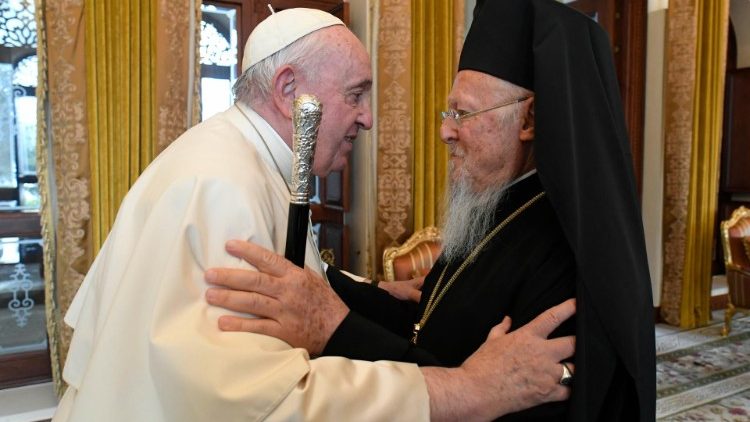
Pope Francis and H.B. Batholomew I of Constantinople (Vatican Media)
A Vatican Delegation led by Cardinal Sandri visits Istanbul for the occasion of the Feast of St. Andrew the Apostle and conveys Pope Francis’ “fraternal affection” to the Ecumenic Patriarch of Constantinople Bartholomew. In his message the Pope says that one of the most fruitful areas of cooperation between the Patriarchate and the Catholic Church is interreligious dialogue to promote peace.
By Lisa Zengarini
Following a long-standing tradition, on the occasion of today’s Feast of St. Andrew the Apostle, patron saint of Constantinople, Pope Francis has sent a delegation to Istanbul to convey his greetings and the assurance of his “fraternal affection” to the Ecumenic Patriarch Bartholomew.
The annual exchanges of Delegations
The visit is part of the annual exchange of Delegations between the Holy See and the Patriarchate for their respective patronal feasts, on 29 June in Rome, the Feast of St. Peter and Paul, and on 30 November in Istanbul.
In his message, Pope Francis notes that these visits are “an expression of the depth of the bonds” uniting the Catholic and Orthodox Church of Constantinople and “a visible sign” of their “cherished hope for ever deeper communion”, which he says is “an irrevocable commitment for every Christian” as well as “an urgent priority in today’s world”.
“Today’s world is greatly in need of reconciliation, fraternity and unity.”
Divisions are the result of sinful action
The Pope further highlights the need to continue analyzing the historical and theological reasons at the origin of the ongoing divisions between the two Churches “in a spirit that is neither polemical nor apologetic but marked instead by authentic dialogue and mutual openness”.
Likewise, he continues, they must “acknowledge that divisions are the result of sinful actions and attitudes which impede the work of the Holy Spirit, who guides the faithful into unity in legitimate diversity”.
They are therefore called “to work towards the restoration of unity between Christians not merely through signed agreements but through fidelity to the Father’s will and discernment of the promptings of the Spirit”.
“We can be thankful to God that our Churches are not resigned to past and current experiences of division, but, on the contrary, through prayer and fraternal charity are seeking instead to achieve full communion that will enable us one day, in God’s time, to gather together at the same Eucharistic table”
The Pope remarks that as they journey together toward the goal of unity, the Catholic Church and the Ecumenical Patriarchate are already working together for the common good of the human family in many areas including safeguarding creation, defending the dignity of every person, combatting modern forms of slavery, and promoting peace.
Dialogue and encounter are the only viable path for overcoming conflicts
One of the most fruitful areas of such cooperation, the message says, is interreligious dialogue.
The Pope recalls in particular his recent Apostolic Journey to Bahrain for the occasion of the Forum for Dialogue: East and West for Human Coexistence”, reiterating once again that “Dialogue and encounter are the only viable path for overcoming conflicts and all forms of violence”.
Prayers for the victims of the recent attack in Istanbul
Concluding his message Pope Francis recalls the victims of the recent terrorist attack in Istanbul on 12 November, entrusting them to the mercy of God, while praying he will convert the hearts of those who commit or support such evil actions.
Greetings to Bartholomew during the Wednesday General Audience
The Pope greeted his “dear brother” Bartholomew again during his Wednesday General audience. After his Catechesis, he asked the intercession of the Apostles Peter and Andrew for unity among Christians and peace in the world, especially in “tormented Ukraine”
“May the intercession of the holy brother Apostles Peter and Andrew soon allow the Church to fully enjoy her unity and peace to the whole world, especially at this moment to dear and tormented Ukraine, always in our hearts and in our prayers.”
May St Andrew "teach us to seek the Messiah at every moment of our lives and to proclaim him with joy to all those around us", he then said addressing the Spanish-speaking pilgrims.
The Vatican Delegation
According to the Holy See’s Press Office, the Pope’s message was consigned to H.B. Batholomew by Cardinal Leonardo Sandri and read out at the conclusion of the Divine Liturgy presided over by the Ecumenical Patriarch, His Holiness Bartholomew, in the Patriarchal church of St. George at the Fanar.
The Prefect Emeritus of the Dicastery for the Oriental Churches is accompanied by Mgr. Andrea Palmieri, Undersecretary of the Dicastery for the Promotion of Christian Unity. After the Liturgy presided over by the Ecumenic Patriarch, the Vatican Delegation, joined by the Apostolic Nuncio to Turkey, Archbishop Marek Solczyński. met with the Patriarch and held conversations with the Synodal Commission in charge of relations with the Catholic Church.
A Vatican Delegation led by Cardinal Sandri visits Istanbul for the occasion of the Feast of St. Andrew the Apostle and conveys Pope Francis’ “fraternal affection” to the Ecumenic Patriarch of Constantinople Bartholomew. In his message the Pope says that one of the most fruitful areas of cooperation between the Patriarchate and the Catholic Church is interreligious dialogue to promote peace.
By Lisa Zengarini
Following a long-standing tradition, on the occasion of today’s Feast of St. Andrew the Apostle, patron saint of Constantinople, Pope Francis has sent a delegation to Istanbul to convey his greetings and the assurance of his “fraternal affection” to the Ecumenic Patriarch Bartholomew.
The annual exchanges of Delegations
The visit is part of the annual exchange of Delegations between the Holy See and the Patriarchate for their respective patronal feasts, on 29 June in Rome, the Feast of St. Peter and Paul, and on 30 November in Istanbul.
In his message, Pope Francis notes that these visits are “an expression of the depth of the bonds” uniting the Catholic and Orthodox Church of Constantinople and “a visible sign” of their “cherished hope for ever deeper communion”, which he says is “an irrevocable commitment for every Christian” as well as “an urgent priority in today’s world”.
“Today’s world is greatly in need of reconciliation, fraternity and unity.”
Divisions are the result of sinful action
The Pope further highlights the need to continue analyzing the historical and theological reasons at the origin of the ongoing divisions between the two Churches “in a spirit that is neither polemical nor apologetic but marked instead by authentic dialogue and mutual openness”.
Likewise, he continues, they must “acknowledge that divisions are the result of sinful actions and attitudes which impede the work of the Holy Spirit, who guides the faithful into unity in legitimate diversity”.
They are therefore called “to work towards the restoration of unity between Christians not merely through signed agreements but through fidelity to the Father’s will and discernment of the promptings of the Spirit”.
“We can be thankful to God that our Churches are not resigned to past and current experiences of division, but, on the contrary, through prayer and fraternal charity are seeking instead to achieve full communion that will enable us one day, in God’s time, to gather together at the same Eucharistic table”
The Pope remarks that as they journey together toward the goal of unity, the Catholic Church and the Ecumenical Patriarchate are already working together for the common good of the human family in many areas including safeguarding creation, defending the dignity of every person, combatting modern forms of slavery, and promoting peace.
Dialogue and encounter are the only viable path for overcoming conflicts
One of the most fruitful areas of such cooperation, the message says, is interreligious dialogue.
The Pope recalls in particular his recent Apostolic Journey to Bahrain for the occasion of the Forum for Dialogue: East and West for Human Coexistence”, reiterating once again that “Dialogue and encounter are the only viable path for overcoming conflicts and all forms of violence”.
Prayers for the victims of the recent attack in Istanbul
Concluding his message Pope Francis recalls the victims of the recent terrorist attack in Istanbul on 12 November, entrusting them to the mercy of God, while praying he will convert the hearts of those who commit or support such evil actions.
Greetings to Bartholomew during the Wednesday General Audience
The Pope greeted his “dear brother” Bartholomew again during his Wednesday General audience. After his Catechesis, he asked the intercession of the Apostles Peter and Andrew for unity among Christians and peace in the world, especially in “tormented Ukraine”
“May the intercession of the holy brother Apostles Peter and Andrew soon allow the Church to fully enjoy her unity and peace to the whole world, especially at this moment to dear and tormented Ukraine, always in our hearts and in our prayers.”
May St Andrew "teach us to seek the Messiah at every moment of our lives and to proclaim him with joy to all those around us", he then said addressing the Spanish-speaking pilgrims.
The Vatican Delegation
According to the Holy See’s Press Office, the Pope’s message was consigned to H.B. Batholomew by Cardinal Leonardo Sandri and read out at the conclusion of the Divine Liturgy presided over by the Ecumenical Patriarch, His Holiness Bartholomew, in the Patriarchal church of St. George at the Fanar.
The Prefect Emeritus of the Dicastery for the Oriental Churches is accompanied by Mgr. Andrea Palmieri, Undersecretary of the Dicastery for the Promotion of Christian Unity. After the Liturgy presided over by the Ecumenic Patriarch, the Vatican Delegation, joined by the Apostolic Nuncio to Turkey, Archbishop Marek Solczyński. met with the Patriarch and held conversations with the Synodal Commission in charge of relations with the Catholic Church.
Sunday, May 27, 2018
Pope, patriarch call for ethical intervention in economy

Pope Francis embraces Ecumenical Patriarch Bartholomew of Constantinople at the conclusion of a meeting in the Apostolic Palace at the Vatican May 26. (Credit: CNS photo/Paul Haring.)
VATICAN CITY - Pope Francis and Ecumenical Patriarch Bartholomew of Constantinople called on Christians to work together to build a culture of solidarity in the face of growing economic inequality and a lack of respect for the human dignity of the poor and of migrants.
The two leaders met privately May 26 before addressing an international conference sponsored by the Centesimus Annus Pro Pontifice Foundation, which seeks to promote the teaching of St. John Paul II’s 1991 encyclical on social and economic justice.
“The current difficulties and crises within the global economic system have an undeniable ethical dimension,” Francis told some 500 business leaders, theologians and proponents of Catholic social teaching.
The crises clearly “are related to a mentality of egoism and exclusion that has effectively created a culture of waste blind to the human dignity of the most vulnerable,” the pope said.
A “growing ‘globalization of indifference'” is seen in the uneven pace of development, “not only in materially poorer countries but increasingly amid the opulence of the developed world,” he said. It also is obvious in people’s reactions to migrants and refugees.
In his speech to the gathering, Bartholomew insisted that Christianity is “essentially social. Faith is not limited only to the ‘soul’ without any interest for the social dimension, but rather, it also plays a pivotal role at the level of society.”
The Orthodox and Catholic churches, he said, promote spiritual values and charitable activity, but they also teach “the principles of the respect of the person, solidarity, subsidiarity and the common good.”
But, he said, the world today - as seen in the global economic system and the continued destruction of the environment - is experiencing a “crisis of solidarity” that threatens humanity’s very existence.
Bartholomew condemned what he described as the “‘fundamentalism of the market,’ the deification of profit, the association of dignity with property, the reduction of the human being to ‘homo oeconomicus’ and the subordination of the human person to the tyranny of needs.”
In addition, he said, “we worship technology and its highest symbol - the computer - as our god,” thinking that it will solve all of people’s problems. But the world’s deepest problems cannot be fixed with technology alone, he said, citing “social injustice, divorces, violence, crimes, loneliness, fanaticism and the clash of civilizations.”
“Never before have we possessed so much scientific knowledge and acted so violently and destructively against nature and our fellow human beings,” Bartholomew said.
For Christians, he said, two things are clear: the “crisis of solidarity” cannot be ignored because the problems directly impact human dignity; and, “nobody can face these problems alone.”
“The contribution of our churches remains crucial,” he said, because “they have preserved high values, precious spiritual and moral heritage and deep anthropological knowledge.”
“For Pope Francis and us, the identity and value of a culture or a society cannot be judged by the level of its economic growth, its technological development or its organization,” he said. “A civilization is judged by whether or not its final point of reference is the human person, in relation to his true divine destiny and the protection of his world.”
Friday, September 01, 2017
Pope, Patriarch: ‘Cry of the earth’ and cry of the poor are one voice
In Vatican
September 1, 2017
VATICAN CORRESPONDENT

Pope Francis and Ecumenical Patriarch Bartholomew of Constantinople after delivering a blessing in Istanbul in 2014. (Credit: CNS/Paul Haring.)
Pope Francis and Ecumenical Patriarch Bartholomew of Constantinople after delivering a blessing in Istanbul in 2014. (Credit: CNS/Paul Haring.)
Pope Francis and Patriarch Bartholomew released a joint statement to mark the World Day of Prayer for the Care of Creation on Sept. 1. They both say that they’re convinced there’s no sincere and enduring solution to the ongoing ecological crisis unless “the response is concerted and collective, unless the responsibility is shared and accountable, unless we give priority to solidarity and service.”
ROME - In a joint statement from Pope Francis and Patriarch Bartholomew to mark the
World Day of Prayer for the Care of Creation on Sept. 1, the two said that what’s happening in the world today reveals a “morally decaying scenario, where our attitude and behavior towards creation obscures our calling as God’s co-operators.”
They call on those “in positions of social and economic, as well as political and cultural, responsibility to hear the cry of the earth, and to attend to the needs of the marginalized.”
Those leaders, Francis and Bartholomew write, are called to “respond to the plea” of millions, and support “the consensus of the world for the healing of our wounded creation.”
One point stressed by Francis and Bartholomew is that care for the environment, and care for the poor, are inextricably linked.
“The human environment and the natural environment are deteriorating together, and this deterioration of the planet weighs upon the most vulnerable of its people,” they say. “The impact of climate change affects, first and foremost, those who live in poverty in every corner of the globe.
“We are convinced,” they say, “that there can be no sincere and enduring resolution to the challenge of the ecological crisis and climate change unless the response is concerted and collective, unless the responsibility is shared and accountable, unless we give priority to solidarity and service.”\
They call on those “in positions of social and economic, as well as political and cultural, responsibility to hear the cry of the earth, and to attend to the needs of the marginalized.”
Those leaders, Francis and Bartholomew write, are called to “respond to the plea” of millions, and support “the consensus of the world for the healing of our wounded creation.”
One point stressed by Francis and Bartholomew is that care for the environment, and care for the poor, are inextricably linked.
“The human environment and the natural environment are deteriorating together, and this deterioration of the planet weighs upon the most vulnerable of its people,” they say. “The impact of climate change affects, first and foremost, those who live in poverty in every corner of the globe.
“We are convinced,” they say, “that there can be no sincere and enduring resolution to the challenge of the ecological crisis and climate change unless the response is concerted and collective, unless the responsibility is shared and accountable, unless we give priority to solidarity and service.”\
Monday, November 18, 2013
Christians for a new world vision

The first day of the assembly of the World Council of Churches in Busan
Busan, 31.
Leaving space for stories, experiences, hopes, prayers but above all a vision for the world. This is one of the main themes of the Assembly of the World Council of Churches (WCC), in course in Busan, South Korea until 8 November. Yesterday Pope Francis' message to the Assembly was read by Cardinal Kurt Koch, President of the Pontifical Council for the Promoting Christian Unity, present at the meeting. The Ecumenical Patriarch Bartholomew I also sent his best wishes to the assembly with a video message, calling Christians “to pray for the peace of the whole world and for the unity of all”. He added that “we cannot remain idle spectators in a world pervaded by social injustice and plagued by suffering and oppression”.
The Patriarch also addressed the search for unity. “May your encounter in Busan”, he said, “be the source of renewal for our churches and our ‘life together in faith, hope and love’.” He added that the Patriarchate is also dedicated to this goal within the WCC.
November 1, 2013
Busan, 31.
Leaving space for stories, experiences, hopes, prayers but above all a vision for the world. This is one of the main themes of the Assembly of the World Council of Churches (WCC), in course in Busan, South Korea until 8 November. Yesterday Pope Francis' message to the Assembly was read by Cardinal Kurt Koch, President of the Pontifical Council for the Promoting Christian Unity, present at the meeting. The Ecumenical Patriarch Bartholomew I also sent his best wishes to the assembly with a video message, calling Christians “to pray for the peace of the whole world and for the unity of all”. He added that “we cannot remain idle spectators in a world pervaded by social injustice and plagued by suffering and oppression”.
The Patriarch also addressed the search for unity. “May your encounter in Busan”, he said, “be the source of renewal for our churches and our ‘life together in faith, hope and love’.” He added that the Patriarchate is also dedicated to this goal within the WCC.
November 1, 2013
.
Subscribe to:
Posts (Atom)