Showing posts with label Ladaria. Show all posts

Wednesday, June 06, 2018

Cardinal-designate focuses on the pastoral at doctrinal congregation


By Junno Arocho Esteves
Posted: 6/5/2018
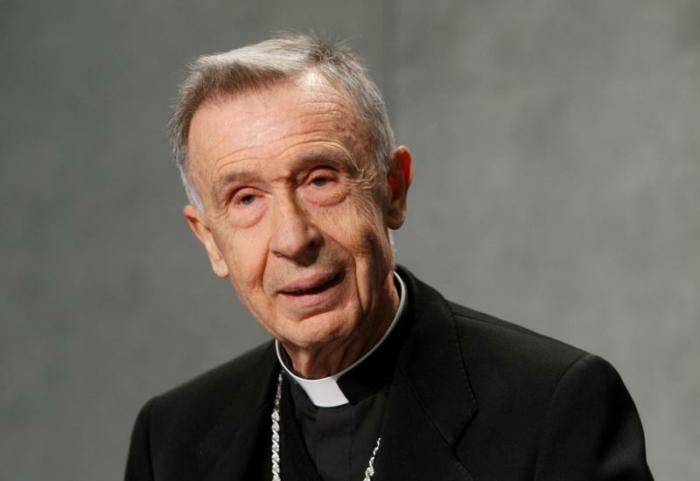
 

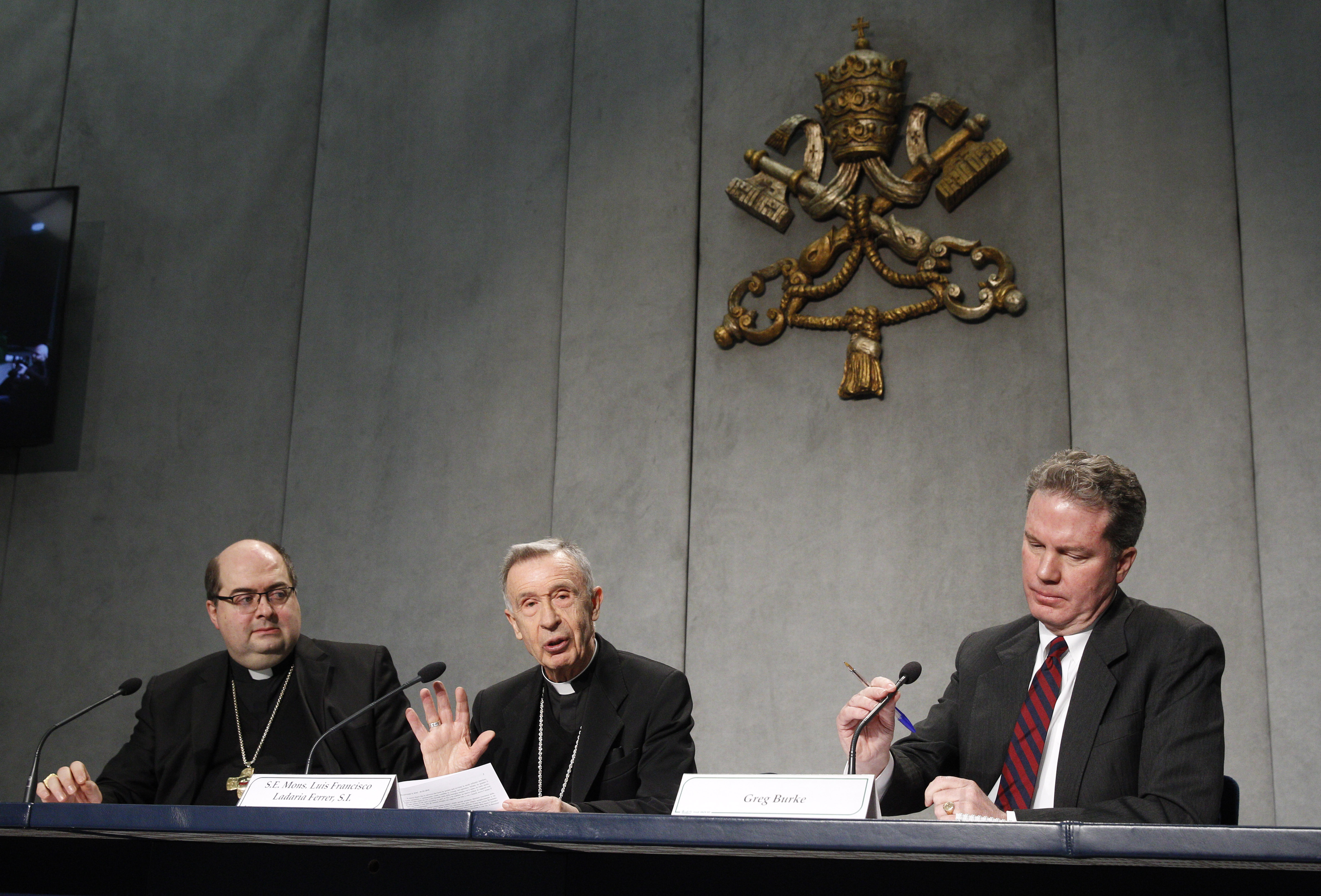
Archbishop Luis Ladaria, prefect of the Congregation for the Doctrine of the Faith, speaks at a news conference to present the document, "Placuit Deo," at the Vatican March 1. Archbishop Ladaria was one of 14 new cardinals named by Pope Francis May 20. (CNS photo/Paul Haring)


VATICAN CITY (CNS) -- When he was named secretary of the Vatican's doctrinal congregation, Cardinal-designate Luis F. Ladaria Ferrer marveled at being unexpectedly thrust into the limelight.

"That was very surprising. I would never have thought of ending up here. And I'm not the only one, seeing that my name was never mentioned in the newspapers," he said in August 2008 in an interview with the Italian Catholic magazine "30 Giorni."

Since then, the Jesuit prelate has had his share of surprises, which culminated in his appointment as prefect of the Congregation for the Doctrine of the Faith and now as a cardinal.

Born in Manacor, Mallorca, April 19, 1944, Cardinal-designate Ladaria earned a law degree at the University of Madrid. After obtaining his degree, however, he "realized that was not what I wanted."

"I wanted to become a priest, and I liked the Society of Jesus, which I knew. And so, it was a path open before me that I set out on almost naturally," he told "30 Giorni."

He entered the Jesuits in 1966 and, after studying theology and philosophy in Spain and Germany, he was ordained to the priesthood July 29, 1973.

As someone who "liked studying," the Spanish prelate went on to earn a doctorate in theology from the Pontifical Gregorian University in Rome in 1975 and began teaching dogmatic theology at the Pontifical University Comillas in Madrid. Nine years later, he returned to the Gregorian to teach, and he served as vice rector of the university from 1986 to 1994.

But, Cardinal-designate told "30 Giorni" that his time as vice-rector was "not very important."

"The Gregorian taught me to live in an international environment with students from over 100 countries, of different languages, races and cultures. All united by the love of study, but above all, of the Lord and his church. In a real university, students not only learn from professors, but also the reverse occurs. And I learned a lot from my students," he said.

Cardinal-designate Ladaria also said his time in Rome as a professor shaped his view on handling church issues that often can be used to advance extremist agendas, both on the left and the right.

"I must say that I don't like extremisms; either progressive or traditionalist ones," he said. "I believe that there is a middle path, which is taken by most professors of theology in Rome and in the church in general, which I think is the correct path to take."


Tuesday, June 05, 2018

Pope Francis Rejects German Proposal for Intercommunion


Posted by Elise Harris/CNA/EWTN News on Monday Jun 4th, 2018 at 9:46 AM

Cardinal-elect Luis Ladaria said the Holy Father ‘came to the conclusion that the document is not mature enough to be published.’


VATICAN CITY — One month after Vatican and German delegates met in Rome to discuss a proposal put forward by German bishops to allow Protestant spouses in interdenominational marriages to receive the Eucharist in certain circumstances, Pope Francis has rejected it.

In a letter dated May 25 and addressed to Cardinal Reinhard Marx, archbishop of Munich and president of the German bishops’ conference, Jesuit Cardinal-elect Luis Ladaria, the Vatican’s top authority on matters of doctrine, said the text of the German proposal “raises a series of problems of considerable importance.”

The letter was published June 4 on the blog of veteran Vatican journalist Sandro Magister.

The Holy See Press Office has confirmed the authenticity of the letter, which was also sent to members of the German delegation who attended a May 3 meeting between German prelates and Vatican officials on the topic in Rome, including Cardinal Rainer Maria Woelki, archbishop of Cologne; Bishop Felix Genn of Münster; Bishop Karl-Heinz Wieseman of Speyer; Bishop Rudolf Voderholzer of Regensburg; and Bishop Gerhard Feige of Magdeburg.


After speaking with Pope Francis about the matter in light of the May 3 discussion, Cardinal-elect Ladaria said the Pope “came to the conclusion that the document is not mature enough to be published” and cited three main reasons for the decision.

First, Cardinal-elect Ladaria stressed that admission to Communion of Protestant spouses in interconfessional marriages “is a topic that touches the faith of the Church and has relevance for the universal Church.”

Allowing non-Catholics to receive the Eucharist, even in certain limited conditions, would also have an impact on ecumenical relations with other churches and ecclesial communities, “which should not be underestimated.”

Finally, he said the question of Communion is a matter of Church law and cited Canon 844 of the Code of Canon Law, which deals with access to the sacraments of the Catholic Church.

Specifically, Canon 844 states that “Catholic ministers administer the sacraments licitly to Catholic members of the Christian faithful alone, who likewise receive them licitly from Catholic ministers alone,” apart from a number of exceptions spelled out in the canon.

Thursday, March 01, 2018

Vatican congregation rejects modern forms of old heresies


Newsletter


FAITHVATICAN DISPATCH


Gerard O’Connell

March 01, 2018


Archbishop Luis Ladaria, prefect of the Congregation for the Doctrine of the Faith, speaks at a news conference to present the document "Placuit Deo" at the Vatican March 1 (CNS photo/Paul Haring).


The Congregation for the Doctrine of the Faith has sent a letter to some 5,000 Catholic bishops that reaffirms the traditional teaching of the Christian faith in the face of new versions of ancient heresies—Pelagianism and Gnosticism. These heresies claim one can attain salvation by one’s own efforts and strengths or through an inward personal union with God that ignores the community of believers in Jesus, that is, the church.*

“Both neo-Pelagian individualism and the neo-Gnostic disregard of the body deface the confession of faith in Christ, the one, universal Savior,” according to the 4,000-word letter, which was released by the Vatican in Italian, French, English, German, Spanish and Portuguese.


The letter bears the title “Placuit Deo” (“it pleased God”) and deals with “Certain Aspects of Christian Salvation.” It was signed by the prefect and secretary of the congregation that Pope Francis appointed last year, Archbishop Luis Ladaria Ferrer, a Spanish Jesuit, and the Italian diocesan priest Giacomo Morandi. They presented the letter at a Vatican press conference on March 1. The pope approved the letter before publication.

Explaining the genesis of the letter, Archbishop Ladaria recalled that after the publication in 2000 of the declaration “Dominus Iesus,” several theologians asked the C.D.F. “to deepen some aspects already enunciated in that declaration” and “suggested a new document about Christian salvation.” Though he did not say so, the historical record shows that “Dominus Iesus” caused much controversy not only within the Catholic Church but also within the other Christian churches and to some degree with the followers of other religions. It was accompanied shortly after by a C.D.F. notification on a key work of the pioneering Belgian theologian, Jacques Dupuis, S.J., Toward a Christian Theology of Religious Pluralism.


Today’s letter reflects a somewhat different style and spirit than Benedict XVI’s “Dominus Iesus.”

Sunday, July 02, 2017

Pope Francis Appoints Spanish Jesuit Ladaria to Succeed Cardinal Müller


Pope Francis Appoints Spanish Jesuit Ladaria to Succeed Cardinal Müller:

Archbishop Luis Ladaria Ferrer, currently Secretary to the Congregation for the Doctrine of the Faith, takes over as prefect of the important dicastery, replacing Cardinal Gerhard Müller whose five-year mandate was unusually not renewed.