Showing posts with label vatican II. Show all posts

Friday, September 18, 2026

Vatican document affirms interreligious dialogue as 'journey of hope' for humanity


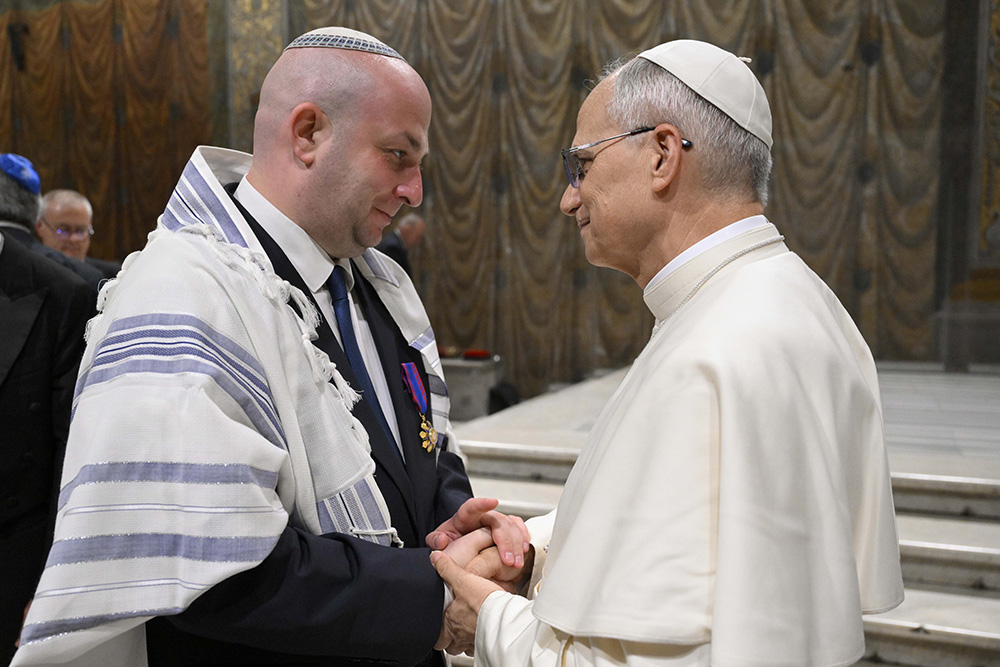
Pope Leo XIV greets Silviu Vexler, president of the Federation of Jewish Communities in Romania, during a ceremony honoring Blessed Iuliu Hossu in the Sistine Chapel at the Vatican June 2, 2025. (CNS/Vatican Media)

Gina Christian
View Author Profile


OSV News

September 17, 2026

A new Vatican document affirms the Second Vatican Council's landmark teaching on the church's relationship with the Jewish people and those of other faiths, while inviting humanity to enter upon a common "journey of hope."

That journey requires "courage" and "a genuine shift in mindset" to seek "peaceful coexistence" amid "unprecedented challenges," including conflicts, persecution, the weaponization of religion, secularization and polarization, said the document.

And rather than looking to found "one great world religion," authentic interreligious dialogue aims to build "a fraternal society capable of accepting differences," said the text.

On Sept. 16, the Vatican released "A Journey of Hope: Sixty Years of Interreligious Dialogue and Fraternity in the Light of the Conciliar Declaration Nostra Aetate."

The 8,600-word note was the result of a collaboration among the Vatican's Dicastery for the Doctrine of the Faith, the Dicastery for Promoting Christian Unity — which also oversees religious relations with Judaism — and the Dicastery for Interreligious Dialogue.

Pope Leo XIV had granted approval of the text on June 22, with official publication taking place Sept. 16.

The five-part "Journey of Hope" began by retracing the "essential stages" in the Church's interreligious dialogue since the 1965 promulgation of Nostra Aetate, including the contributions of Pope Leo XIV and his four predecessors.

The note then examined the "visible" and "silent" fruits of Nostra Aetate, as well as the "persistent resistance and misunderstandings" that surround the conciliar document.

In their note, the three dicasteries called for a renewed "pedagogy of dialogue," one that puts into practice an informed encounter between Catholic and those of other beliefs.

Wednesday, September 09, 2026

Why is JD Vance talking about the Antichrist?


In a podcast episode, the vice president implied that the ‘End Times’ might be near


JD Vance kneels to pray during the inauguration of Pope Leo XIV Photo by Getty Images


By Mira FoxSeptember 4, 2026


Never miss a story! The Forward's daily newsletter gives you the most essential Jewish news you need to start your day. Sign up for Forwarding the News here.

JD Vance said he might be bringing about the End Times, adding that he would not be “shocked if the Antichrist was walking among us.”

Vance was speaking on the Christian YouTube show The Bryce Crawford Podcast about his memoir, Communion, which covers his conversion to Catholicism from Protestantism.

Numerous Catholics online reacted to his statements with confusion and frustration, saying that the ideas about the apocalypse Vance voiced are not central parts of Catholicism. While Catholicism does discuss the idea of the Second Coming, a time in which Christians believe Jesus will return to Earth, the Catholic Church Catechism — the Vatican’s official statements and teachings about the fundamentals of the religion — says that “we are already at ‘the last hour’” ever since Jesus died; the Antichrist is mentioned only briefly as a “a pseudo-messianism by which man glorifies himself in place of God,” not as a specific person who will come to the world.

The Antichrist and Armageddon, however, take center stage in many Evangelical churches, where these concepts often drive other extremist ideas, such as labeling politicians the Antichrist — at one point during the Obama administration, a poll found that one in four Americans thought the president might be the Antichrist — as well as Christian Zionism, an attempt to get all Jews to return to Jerusalem to hasten the apocalypse, when many believe Jews will be sent to Hell.

As one snarky Catholic commenter put it, Vance’s apocalypse-heavy discussion of his Catholicism sounded like “three evangelicals in a trench coat.”

It also sounded a lot like Peter Thiel, the billionaire Palantir founder and Vance’s mentor, donor and former employer. Thiel has a famed obsession with the Antichrist; earlier this year, several Catholic institutions distanced themselves from a series of lectures Thiel gave in Rome on the topic. Vance cited Thiel as an influence on his conversion in an essay about why he chose Catholicism, despite the fact that Thiel is not Catholic.

Tuesday, May 26, 2026

David Bass: Christian J. Pinto Interview | Vatican II Spiritual Evolution & Luciferian New Age

The Real Reveal

May 25, 2026

What is the connection between Vatican II and the New Age Movement?

Tonights guest is Christian J. Pinto, director and producer of American Jesuits: A History of Jesuitism in the United States.

We draw on his expertise in research about the Jesuit order to determine why Jesuit author Teilhard de Chardin was known as the “Father of the New Age”. How did his alleged involvement with the “missing link” hoax in 1912 (known as The Piltdown Man) relate to the overarching agenda to connect science with spirituality and push the gnostic belief in Spiritual Evolution beyond the Creator.

This episode also covers:

Vatican II

Globalisation

Ecumenism

Adam Weishaupt (Enlightenment beliefs)

Jesuit Theatre and Tactics

Transhumanism (Evolutionary Materialism meets Mysticism)

And more…

You can watch Chris Pintos documentary’s on DVD or online streaming services. Here is a full list of the in-depth films he’s made:

https://www.imdb.com/name/nm2281033/

Noise of Thunder Radio: 

http://www.noiseofthunderradio.com/

Wednesday, December 24, 2025

A look at highlights of Vatican II on 60th anniversary of its wrap


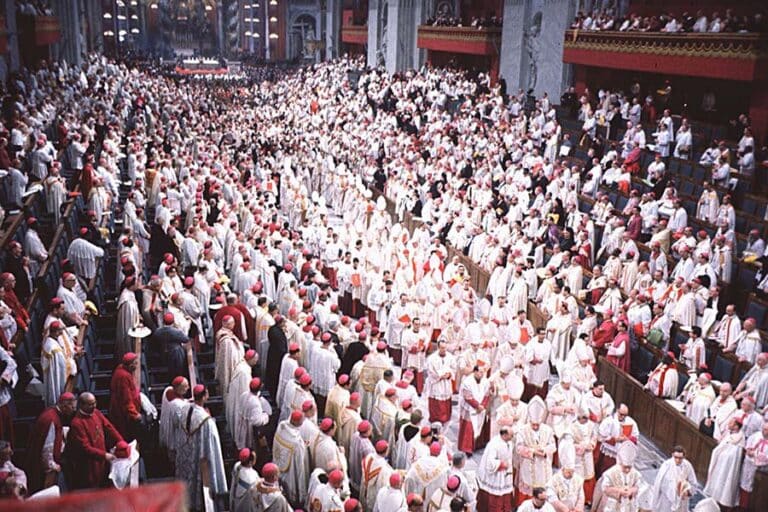
An undated photo shows prelates during the Council Hall in St. Peter's Basilica at the Vatican during the third session of the Second Vatican Council. (OSV News photo/Ernst Herb, KNA)


December 7, 2025
By Alexander Brüggemann


The Second Vatican Council, which after three years of dialogue and document drafting closed on Dec. 8, 1965, changed the face of the church, and opened it to the modern world. The council, opened under Pope John XXIII and closed under his successor, Pope Paul VI, initiated a comprehensive renewal, with major council texts released on hot-button church issues. As the church commemorates 60 years since the closing of Vatican II, here are seven key issues and documents that serve as its legacy for future generations.


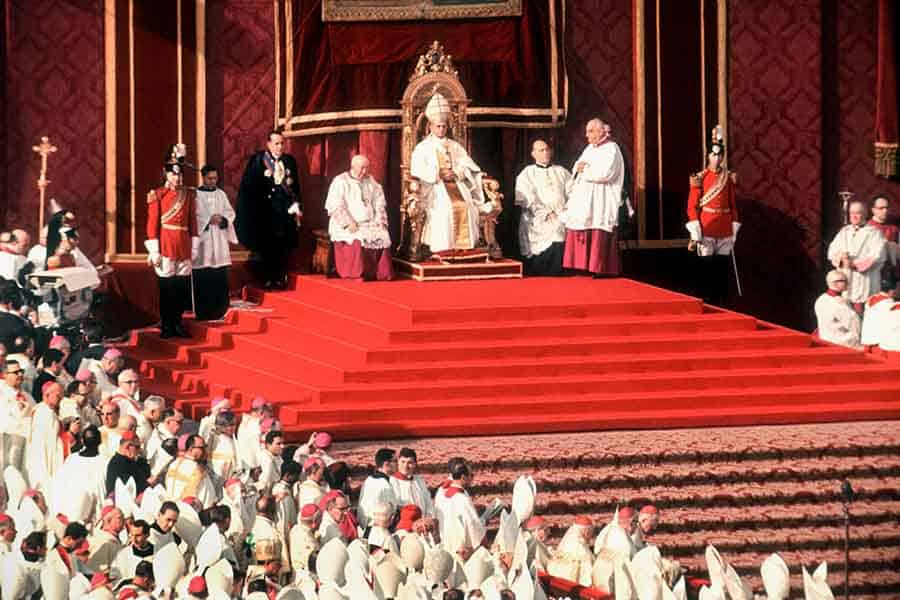
Pope Paul VI sits in the “cathedra” or bishop’s chair during the Second Vatican Council in July 1965 in St. Peter’s Square at the Vatican. (OSV News photo/Ernst Herb, KNA)

Understanding of the church: “Lumen gentium” (1964), one of the four primary constitutions of the council, sets out the new self-understanding of the Roman Catholic Church. It defines the church as a community of believers, as the “people of God” on their journey through time. In this constantly reforming church, a “common priesthood” of all believers is emphasized — something realized in different forms with clergy and laity. The constitution emphasizes the role of the college of bishops who lead the church “with Peter and under Peter,” as Cardinal Joseph Ratzinger, later Pope Benedict XVI, reminded years later. In several decrees, the council drafted guidelines for a contemporary form of Christian life and service in spiritual vocations for priests, religious and laity. The importance of the vocation of the laity is emphasized by the council fathers and the training of priests was reorganized. The church’s missionary activity was given a new theological foundation in the decree “Ad gentes.” In the decree “Christus dominus” (1965), on the episcopal pastoral office in the church, the leadership function of the bishop in his diocese was strengthened.

Tuesday, February 27, 2024

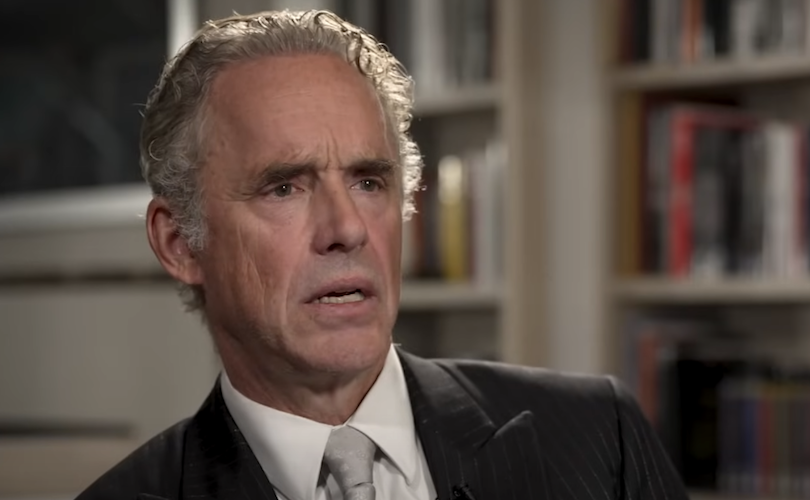
Jordan Peterson slams Pope Francis’ fixation on ‘climate change’: ‘He should be saving souls’

Saving souls is ‘how you save the planet, not by worshipping Gaia,’ Jordan Peterson said, criticizing ‘contemptible’ efforts to make the Church ‘more relevant’ since the ‘60s and Vatican II.


Jordan Peterson
EWTN/YouTube screenshot


Clare Marie Merkowsky

Fri Feb 16, 2024 - 4:17 pm EST

BeyondWords

TORONTO (LifeSiteNews) — Prominent Canadian anti-woke psychologist Jordan Peterson blasted Pope Francis for neglecting the salvation of souls and focusing on “climate change” and criticized attempts to make the Catholic Church “relevant” since the 1960s and the Second Vatican Council.
 
On February 11, Peterson joined Eternal Word Television Network (EWTN) reporter Colm Flynn to discuss a sundry of topics, including his wife Tammy’s miraculous recovery from cancer, the widespread loss of faith in the Catholic Church since the 1960s, and Pope Francis’ fixation on “climate change.”

“That’s not working. It’s shallow,” he said, slamming the “guitar and hippies” that proliferated in the Church following the ’60s and Vatican II.

Peterson explained that religion is “supposed to be an invitation to the great adventure of life.”

“What’s the great adventure of life?” he questioned.

“Pick up your cross and follow me,” Peterson responded, quoting Jesus in the Gospel of Matthew.

“That’s a h-ll of an invitation,” he admitted, “but that’s the invitation, and the Church lost faith in that.”

Peterson explained that efforts in the Catholic Church to make the Gospel message more “relevant” have clouded the Gospel’s true calling.

“As soon as you say that you need to be more relevant than that what you’re doing, technically it is putting something else above that,” he said.

“Well, that’s not going to work not if the original proposition was correct,” Peterson warned, adding, “and obviously the original proposition is correct.”


Peterson explained that just as “Christ faced and triumphed over death and hell,” each person must likewise triumph over death and hell in their own lives. According to Peterson, the Catholic Church is currently not challenging Her members to take the difficult path.

“The gateway to Paradise is barred by the cherubs who have swords that flame,” he said. “It means it’s hard to get into the club, man.”

“Anything that isn’t worthy gets cut and burned away,” he warned, adding, “well of course that’s hell.”

“There’s no sugar-coating that and that isn’t what people want anyways. Young people want an adventure,” Peterson said.

He stated that the desire for adventure is the reason that young people feel called to “save the planet” from “climate change,” which “Pope Francis seems to be on about constantly when you should be saving souls.”

“That’s how you save the planet, not by worshiping Gaia,” Peterson stated, referring to the pagan name for “Mother Earth.”

“I don’t see for the life of me what the Catholic Church has to do with the ‘climate crisis,'” he continued. “Just the formulation is wrong; the priority is wrong; you save the world one person at a time.”

“It lacks faith in its own mission,” he added.

While his wife Tammy is set to enter the Catholic Church this Easter, Peterson has yet to publicly affiliate himself with one specific religion but says he remains dedicated to searching for the truth.

However, he admitted that “there’s plenty of things the Catholic Church got right,” for which he has an “appreciation.”


Saturday, December 08, 2018

Gaudium et spes, the Pastoral Constitution on the Roman Catholic Church in the Modern World


PASTORAL CONSTITUTION
ON THE CHURCH IN THE 
MODERN WORLD
GAUDIUM ET SPES
PROMULGATED BY
HIS HOLINESS, POPE PAUL VI
ON DECEMBER 7, 1965 


PREFACE

1. The joys and the hopes, the griefs and the anxieties of the men of this age, especially those who are poor or in any way afflicted, these are the joys and hopes, the griefs and anxieties of the followers of Christ. Indeed, nothing genuinely human fails to raise an echo in their hearts. For theirs is a community composed of men. United in Christ, they are led by the Holy Spirit in their journey to the Kingdom of their Father and they have welcomed the news of salvation which is meant for every man. That is why this community realizes that it is truly linked with mankind and its history by the deepest of bonds.

2. Hence this Second Vatican Council, having probed more profoundly into the mystery of the Church, now addresses itself without hesitation, not only to the sons of the Church and to all who invoke the name of Christ, but to the whole of humanity. For the council yearns to explain to everyone how it conceives of the presence and activity of the Church in the world of today.

Therefore, the council focuses its attention on the world of men, the whole human family along with the sum of those realities in the midst of which it lives; that world which is the theater of man's history, and the heir of his energies, his tragedies and his triumphs; that world which the Christian sees as created and sustained by its Maker's love, fallen indeed into the bondage of sin, yet emancipated now by Christ, Who was crucified and rose again to break the strangle hold of personified evil, so that the world might be fashioned anew according to God's design and reach its fulfillment.

3. Though mankind is stricken with wonder at its own discoveries and its power, it often raises anxious questions about the current trend of the world, about the place and role of man in the universe, about the meaning of its individual and collective strivings, and about the ultimate destiny of reality and of humanity. Hence, giving witness and voice to the faith of the whole people of God gathered together by Christ, this council can provide no more eloquent proof of its solidarity with, as well as its respect and love for the entire human family with which it is bound up, than by engaging with it in conversation about these various problems. The council brings to mankind light kindled from the Gospel, and puts at its disposal those saving resources which the Church herself, under the guidance of the Holy Spirit, receives from her Founder. For the human person deserves to be preserved; human society deserves to be renewed. Hence the focal point of our total presentation will be man himself, whole and entire, body and soul, heart and conscience, mind and will.

Therefore, this sacred synod, proclaiming the noble destiny of man and championing the Godlike seed which has been sown in him, offers to mankind the honest assistance of the Church in fostering that brotherhood of all men which corresponds to this destiny of theirs. Inspired by no earthly ambition, the Church seeks but a solitary goal: to carry forward the work of Christ under the lead of the befriending Spirit. And Christ entered this world to give witness to the truth, to rescue and not to sit in judgment, to serve and not to be served.

(2)INTRODUCTORY STATEMENT THE SITUATION OF MEN IN THE MODERN WORLD

4. To carry out such a task, the Church has always had the duty of scrutinizing the signs of the times and of interpreting them in the light of the Gospel. Thus, in language intelligible to each generation, she can respond to the perennial questions which men ask about this present life and the life to come, and about the relationship of the one to the other. We must therefore recognize and understand the world in which we live, its explanations, its longings, and its often dramatic characteristics. Some of the main features of the modern world can be sketched as follows.


Saturday, October 27, 2018

Building up the body of Christ through ecumenism


Posted October 26, 2018

Ecumenism, or the movement to develop unity among various Christian denominations, has its historical roots in the early twentieth century. Its theological roots extend much further back, as St. Paul noted in his Letter to the Ephesians: “There is one body and one Spirit, just as you were called to the one hope of your calling; one Lord, one faith, one Baptism” (Eph 4:4-5).

The Second Vatican Council summarized the case for Christian unity, a call taken up by St. John Paul II, Pope Francis and countless Christians who have labored in service of the Holy Spirit.

In this set of articles from our partner Catholic News Service, we survey ecumenism over the past century, and look at pastoral strategies for gathering the body of Christ into one.

The long, steady journey to Christian unity
Many Catholics and Protestants may be surprised at how far ecumenical relations have developed, and over how many decades. The search for unity among Christian denominations began decades before the Second Vatican Council, and has gained new momentum in recent years.

Ecumenism puts the body of Christ to work for the world
Catholics are not alone in responding to the divine call of building up the kingdom of God, and working with other Christians to serve those in need provides a powerful witness to the love of God.


Tuesday, November 15, 2016

Archbishop Welby: ‘The Year of Mercy inspired all Christians’


by Staff Reporter

posted Tuesday, 15 Nov 2016


Cardinal Nichols and Archbishop Welby at Vespers (Mazur/catholicnews.org.uk)


The Archbishop of Canterbury joined Cardinal Vincent Nichols for the closing of the Door of Mercy at Westminster Cathedral

The Archbishop of Canterbury has said that the Year of Mercy has “caught the imagination” of all Christians in a homily at Westminster Cathedral for the closing of the Door of Mercy.

Archbishop Justin Welby joined Cardinal Vincent Nichols at Vespers on Sunday. It was the first time the Anglican leader had preached at the Cathedral. Also present were bishops from throughout England and Wales, members of the Chapter of Canons, and other ecumenical guests.

“The Year of Mercy has caught the imagination not only in the Catholic Church but in all churches,” Archbishop Welby said. He cited Blessed John XXIII’s “visionary address” to the Second Vatican Council, in which the pope spoke of the Holy Spirit helping the Church move away from “acting in severity against error and sin to acting in mercy”.

“This great Year of Mercy 50 years after the end of the Council has been received as water in the desert for global churches sadly lacking mercy, and must be offered as the way of living to a world which sees mercy only in terms of exchange, and never as the excess of abundant love,” the archbishop said.


Cardinal Nichols follows Archbishop Welby to the Holy Door (Mazur/catholicnews.org.uk)

Mercy was a “word of immense beauty”, he said, and “when we walk through the Door of Mercy and allow its meaning to enter our hearts we become different people . . . It works in us like a benevolent acid, dissolving the hardness of our hearts and the selfishness of our lives.”

The archbishop added: “The Door of Mercy calls us through, but like the doors into Narnia in the CS Lewis series, what we find on the other side of the door is another world, where the deep magic of the Kingdom of God is what prevails.”

Archbishop Welby also described the frequent absence of mercy in everyday life.

“Whether it is in elections and referendums, or in the international politics of refugees, of trade and commerce, and even in our own lives and expressions through social media, mercy is often absent,” he said.

The Door of Mercy at Westminster Cathedral was opened by Cardinal Nichols last December and has stayed open throughout the Year of Mercy, receiving pilgrims from around the country.

The Jubilee Year will conclude on Sunday when Pope Francis will close the Holy Door at St Peter’s Basilica.

Meanwhile, in a separate address to head teachers last week, Archbishop Welby said Government officials knew so little about religion that
conservative Evangelicals would be counted as extremists by the officials’ own definition.


Cardinal Nichols and Archbishop Welby pray at the Holy Door (Mazur/catholicnews.org.uk)

The Government, he said, could see no difference between Muslim extremists and traditionalist Christians, so both groups were dismissed as “a bit bonkers”. He made the remarks to headteachers of Church of England schools in the Anglican Diocese of Bath and Wells.

The Telegraph quoted Archbishop Welby as saying: “Our Government generally is desperately trying to catch up, to understand a world in which they have no grip on what it is to be religious at all; where religious illiteracy is prevalent and extremely destructive of understanding and where they can’t really see the difference between an extremist Muslim group like the Muslim Brotherhood and a sort of conservative Evangelical group in a Church of England church.”

He added: “It’s fine to reject many of the things done in the name of religion, but you still need to understand what it is that can so catch hold of someone that they think life itself is not worth living if that contradicts what they believe.”


Saturday, May 17, 2014

Charismatic Movement -- Vatican Promotion


dntemp·

Uploaded on Apr 21, 2008

Also (on iTunes): Dr. Peter Kreeft on Charisms (Visions, Tongues, Healing, etc.) feat. Dave Nevins
https://itunes.apple.com/us/album/cha...

48 years of dramatic worldwide growth of the Catholic Charismatic Renewal (visions, tongues, prophecy, healing, etc.).

The film is excerpted from the International Catholic Charismatic Renewal Services (ICCRS) DVD "A New Pentecost" featuring a brief history, papal promotion, endorsement and testimonies. The full DVD is available at: http://www.iccrs.org

Posted with permission by:
http://www.davenevins.com
.
.

Tuesday, March 11, 2014

The emergence of radical Catholic social philosophy


Catholic Progressives in England after Vatican II -- By Jay P. Corrin

In his latest book, Jay P. Corrin examines a significant and little-known subject: the post-Vatican II Catholic progressive movement in Britain, its leaders, and the political and cultural context of the time. He focuses on the emergence of reformist thinking as represented by the Council, and the corresponding revolutionary response triggered by the church’s failure to expand the promises of reform to the satisfaction of Catholics on the political left. The resistance of the Roman Curia, the clerical hierarchy, and many conservative lay men and women to reform was challenged in 1960s England by a cohort of young Catholic intellectuals; in response, they launched a path-breaking journal of ideas called Slant.

What made Slant revolutionary was its success in developing a coherent philosophy of revolution based on a synthesis of the “New theology” fueling Vatican II and the New Left’s Marxist critique of capitalism. Called “a fascinating story” by The Tablet, Corrin’s account of the Slant movement draws “copiously on conversations and correspondence with participants, notably Terry Eagleton, Bernard Sharratt, Martin Shaw, Adrian and Angela Cunningham and Christopher Calnan” Their bold and imaginative efforts inspired many younger Catholics who had despaired of connecting their faith to contemporary social, political, and economic issues.

“In Catholic Progressives in England after Vatican II, Jay P. Corrin situates the journal Slant within the broad sweep of reformist Catholic thinkers and actors across the twentieth century and into the twenty-first. Drawing upon an impressive range of primary and secondary sources, both scholarly and journalistic, Corrin illuminates the journal’s pivotal role in English Catholic liberal thought and action and the impact its contributors’ ideas continue to exert across the decades.” —Steve Rosswurm, Lake Forest College

Jay P. Corrin is professor of social sciences at Boston University. His book Catholic Intellectuals and the Challenge of Democracy (University of Notre Dame Press, 2002) won the American Catholic Historical Association’s John Gilmary Shea Prize in 2003.


Catholic Progressives in England after Vatican II


Jay P. Corrin

Publication Date: November 29, 2013

ISBN: 978-0-268-02310-2 / Paperback $49.00

ISBN: 978-0-268-07700-6 / Ebook Perpetual Ownership, $34.30; Ebook 30-day Ownership, $7.00

To order: http://undpress.nd.edu/book/P03079

The University of Notre Dame Press is one of the leading American university presses publishing in the areas of religion and theology. For our complete list, visit us at http://undpress.nd.edu


Contact

Emily McKnight

emcknigh@nd.edu

574.631.4909
 
Source
.

Saturday, March 08, 2014

The Two Kingdoms: The Ecumenical Movement


EvenAtTheDoors

Published on Mar 6, 2014

The Ecumenical Movement is a strategy masterminded by the Papacy in the early 1960s to strengthen so-called Christian Unity, to bring every Christian in every denomination and church under the control of the Pope. Protestant North America is leading out in this Christian apostasy and only those who learn to totally depend on God will be able to resist. The build up is getting closer and closer and while many Christians in theWest complain of persecution by the secular powers, they are unaware that there biggest resistance will be among their own fellow Christians.
.
.

Thursday, June 27, 2013

Buoyed by a new pope, priests gather to urge church reform


David Gibson | Jun 14, 2013

(RNS) The death of liberal Catholicism has been proclaimed so often in recent decades that few even bother to check to see if the body still has a pulse.


Father Ernie Davis blesses the communion during Catholic mass at St. Therese Little Flower parish in Kansas City, Mo. RNS file photo by Sally Morrow.

This image available for Web and print publication. For questions, contact Sally Morrow.


But a fledgling organization of priests believes the obituaries are premature, and as the Association of U.S. Catholic Priests gathers this month to discuss an agenda for church reform, its leaders are pointing to support from the laity as well as inspiration from the top: Pope Francis.

“For me, his papacy so far has been a lifesaver,” said the Rev. Dave Cooper, a priest from Milwaukee who is head of the AUSCP, which will hold its second annual assembly at Seattle University from June 24-27.

Not that Francis is a starry-eyed liberal who is about to ordain women priests or turn the church into a representative democracy. He’s not. Rather, it is the new pope’s repeated exhortations for the church to engage the world, to be humble and open to dialogue, and above all to show people – including Catholics – a welcoming face that has buoyed Cooper and others in the AUSCP.

“The pastoral style is most encouraging to me personally,” Cooper said. “I hope it will grow and deepen and continue.”

The AUSCP was started in August 2011 by about two dozen priests from 11 states who met at a seminary near Chicago with the goal of trying “to keep the best of Vatican II alive,” referring to the landmark church council of the 1960s that opened Catholicism to the modern world.

Like similar groups of reform-minded clergy in Ireland, Austria and elsewhere, these priests were, as one put it, “more than mildly distressed by the ecclesial turn of events” in the past 30 years that has seen the Vatican and local bishops take strong measures to enforce orthodoxy and curb anything that smacks of dissent.

From that modest start two years ago, the AUSCP has grown to nearly 1,000 members from about 120 of the 195 dioceses in the country.

This month’s meeting is expected to draw about 250 of those priests, who will listen to church experts and debate 15 proposals that focus on promoting collaboration and transparency in the church. Proposals include a call for lay people and priests to have a say in selecting bishops, who are now chosen solely by the pope through a secret process.

But one proposal bumps up against the third rail of orthodoxy by calling for a study of ordaining women and married men to the priesthood. Just raising the ordination topic publicly raises the hackles of conservatives — especially younger clergy who entered the priesthood under Popes John Paul II and Benedict XVI and tend to be more orthodox.

One of the critics is the Rev. Martin Fox, who wrote a long blog post ripping the AUSCP as the “swan song” of aging liberal Catholics who were enamored with a “spirit of Vatican II” that has been quashed by a younger, more tradition-minded generation of clergy and laity. “Utterly pointless,” Fox said of the AUSCP’s agenda.

What’s telling is that Fox is not just any priest, but heads the Office of Priestly Formation for the Archdiocese of Cincinnati. After a few of his fellow clerics objected to the broadside, Fox later apologized for some of his remarks and amended his original post.

But the thrust of his objections – which have been standard fare among church leaders for years – remained, and underscored a division that may not be overcome anytime soon. “If we keep inviting them, that’s all we can do,” Cooper said of his conservative brethren.

Another AUSCP leader, the Rev. Bob Bonnot of Youngstown, Ohio, rejected the idea that the association is a rallying point for disaffected older priests. “There is no question of dissent,” Bonnot said. “These are open questions in the life of the church and various priests want us, as priests, to discuss them.”

What’s more, he said, almost all of the proposals – the calls for collegiality, ordaining women as deacons, and allowing use of the previous translations of the Mass – are ones that have been debated and sometimes supported by top church leaders.

“Are all the cardinals dissenters because they discuss these items?” he added.

Bonnot noted that the “vast majority” of his members are workaday parish priests rather than clerics who work in academia or church bureaucracies, and their proposals reflect the concerns of parishioners that they serve.

“Regardless of the ages of the priests that might be involved, the issues are enduring issues that are very much in play,” he said.


And discussing those issues openly is vital to the future of the church, said Cooper.

“The Catholic Church is a living organism and all living organisms change and adapt. As the Catholic Church continues to grow and expand, the genius of Vatican II would say that it must take root and grow among the people,”
he said.

“We have to be where the people are. That is our passion.”


.

Wednesday, January 30, 2013

Christians ask for one church during Week of Prayer


Hundreds gather to seek unity among churches


By Lois K. Solomon, Sun Sentinel

5:20 a.m. EST, January 29, 2013


Can Christians shed their denominational loyalties to become one church? Hundreds of South Florida congregants who have high hopes for unity gathered in Palm Beach County churches last week to pray for a single Christian faith.

Catholics, Episcopalians, Presbyterians, Lutherans, Baptists: All asked for guidance, respectful dialogue, cooperation and an emphasis on what the denominations have in common.

"The differences between us are not that great," said Kenneth Vianale, a parishioner at St. John the Evangelist Catholic Church west of Boca Raton who is studying to become a deacon. "There has been foolishness on all sides, and we are ready for a thaw."


Each denomination believes in the Trinity and Jesus Christ as their savior, and reads the same 27 books of the New Testament, Vianale said. But differences persist on issues such as the primacy of the Pope and the sacraments.

Vianale, an attorney, reached out to a former colleague, the Rev. Russell Silverglate, a former attorney and pastor of Hammock Street Church, a Presbyterian congregation west of Boca Raton. Silverglate attended a Week of Prayer ceremony at Vianale's church and said he was thrilled to speak at a Catholic church for the first time.

"Our differences are more like a family squabble," Silverglate said. "We are all supposed to be one. We're not supposed to be divided."

Although a Great Schism in 1054 split the Latin-speaking church based in Rome from the Greek-speaking Eastern churches, the 16th-century Reformation initiated by Martin Luther spurred the separation of Catholics and Protestants. That split led to wars, family divisions, new churches and new Christian religions.

In 1965, the Second Vatican Council urged Catholics to embrace fellow baptized Christians without sacrificing their own beliefs. They were encouraged to pray together and learn from each other. The council's Decree on Ecumenism listed Christian unity as a primary goal.

Although many say the ecumenical enthusiasm of the 1960s and 1970s has waned, many Catholics still seek to find common ground with Christians and non-Christians. The Week of Prayer for Christian Unity, begun in 1908 by the Graymoor Franciscan Friars, has become the focus of interfaith activities at many churches.

Still, the week is not the only outreach program in the Diocese of Palm Beach. Year-round activities include monthly meetings among pastors and rabbis, social justice events and holiday gatherings such as an interfaith Thanksgiving service.

"We are building relationships," said Dennis Demes, a deacon and chair of the Diocesan Committee on Ecumenical and Interreligious Affairs. "Hearts are moved through these relationships. I just keep learning."

The Rev. Steven Thomas, of St. David's in the Pines Episcopal Church in Wellington, said the interfaith services he has attended for the past few years have taught him to be patient about the goal of unity.

Thomas said he was hopeful after the Second Vatican Council but thinks Christians have entered an "ecumenical autumn," with less enthusiasm and hope for a single church.

"It may not happen in our lifetime," Thomas said, "but you don't give up."

Lsolomon@tribune.com or 561-243-6536


.

Sunday, December 16, 2012

Gaudium et Spes


Vatican II: Gaudium et Spes

A Summary Article by Gerald Darring


The Council expresses a desire to engage in conversation with the entire human family (a. 3) so that the Church can help shed light on the human mystery and cooperate in solving contemporary problems (a. 10). It addresses this Constitution to Catholics, to all Christians, and to the whole of humanity (a. 2).

The Church has the duty of scrutinizing the signs of the times and of interpreting them in the light of the Gospel (a. 4), and in line with this the Council expresses its own view of contemporary society. It says that we are in a new age of human history, since the social and cultural circumstances of life have profoundly changed (a. 54). The human race has passed from a rather static concept of reality to a more dynamic, evolutionary one (a. 5). We are undergoing a cultural and social transformation (a. 4) resulting in rapid changes in industrialization, urbanization, communication, and socialization (a. 6) as well as changes in attitudes, values, and norms of behavior (a. 7). We are witnessing a healthy evolution toward unity and a process of wholesome socialization (a. 42). Increasing socialization can cause problems but it also offers opportunities for the positive development of the human person (a. 25). Modern technical advances are promoting a growing interdependence among people (a. 23), which tightens and spreads by degrees over the whole world (a. 26).

We are on the road to a more thorough development of human personality and to a growing discovery and vindication of our rights (a. 41). There is growing awareness of human dignity, of rights and duties that belong to everyone and cannot be taken away (a. 26). People are claiming the rights deprived them through injustice or unequal distribution (a. 9); they thirst for a full and free life worthy of humans (a. 9). A keener sense of human dignity is leading to a political environment more protective of human rights (a. 73).

There is a mounting increase in the sense of autonomy as well as of responsibility: we are witnessing the birth of a new humanism in which humanity is defined in terms of social and historical responsibility (a. 55). Under these circumstances it is now possible to free most of humanity from the misery of ignorance (a. 60).

These positive signs noted by the Council are countered by several negative signs. Splits have developed within individuals, families, races, and nations (a. 8). Many find it difficult to identify permanent values and apply them to changing circumstances (a. 4), and one of the more serious errors of our age is the split between people's faith and their daily lives (a. 43).

Social disturbances take place, resulting in part from natural economic, political and social tensions, but at a deeper level they result from pride and selfishness (a. 25). The magnified power of humanity threatens to destroy the race itself (a. 37). Wars continue their devastation, and the fierce character of warfare threatens to result in unsurpassed savagery (a. 79). Even when no war is being waged, the world is constantly beset by strife and violence (a. 83).

The Council concludes that the modern world shows itself at once powerful and weak, capable of the noblest deeds or the foulest; before it lies the path to freedom or to slavery, to progress or retreat, to community or hatred (a. 9).

The Council sets out to establish a working relationship with the world in which it finds itself, for the Church goes forward together with humanity and experiences the same earthly lot which the world does (a. 40). The followers of Christ share the joys and hopes, the griefs and anxieties of today's people, especially those who are poor (a. 1), and Christians are joined with the rest of society in the search for truth (a. 16).

The People of God and the human race render service to each other (a. 11). The Church serves as a leaven and as a kind of soul for human society (a. 40). It can contribute to making people and history more human (a. 40), opening up to people the meaning of their own existence (a. 41). The Church can inject into modern society the force of its faith and love put into vital practice (a. 42). The universality of the Church enables it to serve as a bond between diverse human communities (a. 42). The Church respects all the true, good, and just elements found in human institutions (a. 42), and Christians living and working in the world are bound to penetrate the world with a Christian spirit (a. 43). The Church can and ought to be enriched by the development of human social life, and indeed the Church has profited richly by the history and development of humanity (a. 44). Whoever works to better the world contributes to the Church as well (a. 44).

While defining the Church's relationship to the world, the Council restates as well the mission of the church. The Church has a saving and an eschatological purpose which can be fully attained only in the future world (a. 40). The Church's mission is religious and not in the political, economic or social order, but this religious mission can help the human community structure itself properly (a. 42).

The mission of the Church includes these religious and less specifically religious goals: to reveal the mystery of God (a. 41); to make God present and in a sense visible (a. 21); to communicate God's life to people and cast the reflected light of that life over the entire earth (a. 40); to carry forward the work of Christ under the lead of the Spirit (a. 3); to preach the Gospel to everyone and dispense the treasures of grace (a. 89); to guard the heritage of God's Word and draw from it moral and religious principles (a. 33); to work that God's Kingdom may come, and that the salvation of the whole human race may come to pass (a. 45); to scrutinize the signs of the times and interpret them in the light of the Gospel (a. 4); to hear, distinguish and interpret the many voices of our age, and judge them in the light of God's Word (a. 44); to promote unity (a. 42); to stimulate and advance human and civic culture (a. 58); to foster and elevate all that is found to be true, good and beautiful in the human community (a. 76); to shed on the whole world the radiance of the Gospel message, and to unify under one Spirit all people of whatever nation, race or culture (a. 92).

Asserting that the Church can open up to people the meaning of their own existence (a. 41), the Council addresses the human person and human activity and experience. It says that people are more precious for what they are than for what they have (a. 35). The dignity of the human person applies to the human body, good and honorable, which God created and will raise up on the last day (a. 14); the human intellect, which shares in the light of the divine mind (a. 15); and the human conscience, the most secret core and sanctuary of a person where one is alone with God (a. 16). Human dignity demands the freedom to direct oneself toward goodness (a. 17).

Human work constitutes an unfolding of God's creation, and human accomplishments are a sign of God's grace (a. 34). Human progress is good, but it tempts us to seek our own interests and not those of others (a. 37). We find ourselves fully only in giving ourselves sincerely to others (a. 24)

Human experience includes both the call to grandeur and the depths of misery (a. 13). All human activity is threatened by pride and must be purified by the power of Christ's cross and resurrection (a. 37). The human mystery takes on light only in the mystery of the Word made flesh, whose Spirit offers to every person the possibility of being associated with the saving events of Jesus (a. 22). The riddle of human existence grows most acute in the face of death, yet revelation tells us that God created us for life beyond death and Christ has freed us from death (a. 18).

The Council acknowledges that people want to know the meaning of life and death, and they can never be altogether indifferent to the problems of religion (a. 41). The recognition of God is not hostile to human dignity (a. 21), and indeed the basic source of human dignity lies in our call to communion with God (a. 19). There is not a mutual opposition between faith and science (a. 36), nor is there an opposition between professional and social activities on the one hand, and religious life on the other (a. 43). Religion is being purified of superstition at the same time that growing numbers of people are abandoning religion in practice (a. 7).

The Council argues against a concept of religion which includes only worship and moral living: it asserts that religion also includes involvement in earthly affairs (a. 43). It also argues against discriminatory attitudes involving religion. All discrimination based on religion is contrary to God's intent and must be overcome and eradicated (a. 29), and we ought to respect and love those who think or act differently from us in religious matters (a. 28).

Noting with approval that there is a steadily growing respect for people of other religions (a. 73), the Council attempts to conduct a respectful dialogue with atheists. Atheism is one of the most serious problems of our age (a. 19). The word atheism is used to cover a number of different attitudes and approaches (a. 19). Atheism arises from different causes, and believers themselves frequently bear some responsibility for the atheism of others, concealing rather than revealing the authentic face of God (a. 19). Atheism often reflects a desire to be totally independent of God, so that humans can be an end unto themselves (a. 20). Atheism can also result from the anticipation of human liberation solely through economic and social efforts, while viewing religion as an obstacle because it arouses hope for a deceptive future life (a. 20). Atheism raises weighty questions, which should be examined seriously (a. 21). The remedy to atheism is a proper presentation and living out of our faith (a. 21). There must be dialogue so that believers and unbelievers can work together for a better world (a. 21).

In line with the mission of the Church to guard the heritage of God's Word and draw from it moral and religious principles (a. 33), the Constitution includes some general moral statements which the Council wants us to reflect on before proceeding on to the concrete problems of today's world: --All human activity must harmonize with the genuine good of the human race (a. 35); --We cannot, through laziness or lack of concern, be satisfied with a merely individualistic morality (a. 30), for God created us not for life in isolation but for the formation of social unity (a. 32); --Serving and living and working with others strengthens our freedom (a. 31); --Only in freedom can we direct ourselves toward goodness (a. 17); --One must obey one's conscience, for according to it one will be judged (a. 16); --An improper hierarchy of values results in self-centeredness (a. 37); --The acknowledgment of personal rights does not imply exemption from every requirement of divine law (a. 41); --What divine revelation makes known to us conforms with experience (a. 13); --We often experience an imbalance between a concern for practicality and efficiency, and the demands of moral conscience (a. 8); --We can love and respect others who think or act differently from us without becoming indifferent to truth or goodness (a. 28); --We must distinguish between error and the person in error: the error must always be rejected while the person never loses the dignity of being a human person (a. 28).

In addition to these general moral statements, the Council also offers a number of guidelines for social justice intended to help humanity establish a political, social and economic order which will serve people and affirm and develop their dignity (a. 9).

The Council promotes respect for both individuals and the community. It asserts that the beginning, the subject and the goal of all social institutions is and must be the human person (a. 25). Respect for human dignity means that everyone must have what they need to lead a truly human life: food, clothing, shelter, the freedom to choose a state of life and found a family, the right to education, employment, a good reputation, respect, appropriate information, action in good conscience, protection of privacy, and religious freedom (a. 26). God made us into one family, and we should treat one another in a spirit of community (a. 24). Every social group must respect the needs and aspirations of other groups as well as the general welfare of the entire human family (a. 26). We must make ourselves the neighbor of every person without exception, and each of us must consider every neighbor without exception as another self (a. 27).

The dignity of the individual and the community demands respect for life: whatever is opposed to life poisons human society, harms its practitioner, and dishonors the Creator (a. 27). It also demands respect and love for those who think or act differently from us in social, political, and religious matters (a. 28). We must recognize the basic equality of all people: all discrimination is contrary to God's intent and must be overcome and eradicated (a. 29).

Both the individual and the community have obligations to each other: human institutions must work to safeguard basic human rights (a. 29), while at the same time each person must contribute to the common good and must support the private and public institutions which work for a better world, and one of our primary duties is the observance of social laws and precepts (a. 30)

The Council teaches that we have a mandate to govern the world with justice and holiness (a. 34), so that we have a duty imposed upon us to build a better world based upon truth and justice (a. 55). Believers and unbelievers alike must work for a better world (a. 21); we must work together without violence and deceit to build up the world in genuine peace (a. 92). This task demands that we recognize that technical advances are worth less than the work we do for justice, community, and social order (a. 35), and that the effort to establish a universal community is not a hopeless one (a. 38).

The Council has some messages directed primarily to members of the Church. It says that our hope related to the end of time does not diminish in any way our duty to address contemporary problems (a. 21); the expectation of a new earth must not weaken but rather stimulate our concern for cultivating this one (a. 39). Christians should seek and think of those things which are above, but this duty should increase their obligation to work with others for a better world (a. 57) and those Christians are mistaken who think they can shirk their earthly responsibilities just because we seek a life to come (a. 43). The Christian message holds us bound to build up the world and be concerned for the welfare of others (a. 34), and the teaching of Christ requires that we forgive injuries and love our enemies (a. 28). We must foster within the Church itself mutual esteem, reverence and harmony, through the full recognition of lawful diversity (a. 92).

After laying out its theoretical program, the Council turns its attention to several problems which it says are of special urgency (a. 46). The first topic is marriage and family. The companionship of male and female produces the primary form of interpersonal communion (a. 12). The Council notes that modern economic conditions are causing serious disturbances in families (a. 47), and this is important because the condition of families has a decisive bearing on the dignity, stability, peace and prosperity of human society as a whole (a. 48). Everyone should work for the welfare of marriage and the family: parents, children, those who exercise influence in society, Christians, researchers, pastors, and various organizations (a. 52).

The second topic taken up in the Constitution is culture. People arrive at full humanity only through culture, those things by which people develop and perfect their bodily and spiritual qualities (a. 53). A more universal form of human culture is developing, one which promotes and expresses the unity of the human race (a. 54). For the first time in human history all people are convinced that the benefits of culture ought to be and actually can be extended to everyone (a. 9).

The Church is not bound to any particular form of human culture (a. 42), to any particular way of life or any customary pattern of life (a. 58). Because there are many ties between the message of salvation and human culture (a. 58), the Church is involved in a living exchange with diverse cultures of people (a. 44), although sometimes it is difficult to harmonize culture with Christian teaching (a. 62).

The Council lays down the following guidelines for evaluating the role of culture in society.

Culture needs freedom and autonomy, and it demands respect (a. 59). We ought to respect and love those who think or act differently from us in social, political, and religious matters (a. 28).

Culture should be subordinated to the integral perfection of the human person and the common good of society (a. 59).

Individuals should be educated to a higher degree of culture (a. 31).

All cultural discrimination is contrary to God's intent and must be overcome and eradicated (a. 29). There should be no discrimination in the satisfaction of the right to culture because everyone has the right to culture and the duty to develop themselves culturally (a. 60).

Women must be affirmed as participants in cultural life (a. 60), and they ought not to be denied the right to cultural benefits equal to those recognized for men (a. 29).

Increased exchanges among cultures cannot be allowed to disturb the life of communities or destroy ancestral wisdom and the peculiar character of each people (a. 56).

The refinement of the culturally competent cannot stand in the way of others' participating in the cultural values of the world (a. 56).

The recognition of the autonomy of culture cannot give rise to an a-religious or anti-religious humanism (a. 56).

The arts and disciplines should be free to use their own principles and methodologies, and people must be free to search for the truth, express opinions, and practice art (a. 59).

Culture cannot be made to serve as an instrument of political or economic power (a. 59).

The third topic taken up by the Council is socio-economic life. It teaches that people are the source, center, and purpose of all economic and social life (a. 63), and that the purpose of economic production is to serve people in their material needs as well as in the demands of their intellectual, moral, spiritual, and religious lives (a. 64). The Church is not bound to any particular economic system (a. 42), but it is critical of the excessive economic and social differences among people or groups of people which violate social justice, equity, human dignity, and social and international peace (29). It is also critical of the dangerous lack of balance between developed and other countries, and also between agriculture, industry, and the services (a. 63).

Of special concern to the Church is poverty and the poor. The followers of Christ share the joys and hopes, the griefs and anxieties of all people, but especially of those who are poor (a. 1). The Council notes with sadness that even with unprecedented wealth, resources and economic power, we are still tormented by hunger and poverty (a. 4); the greater part of the world is still suffering from so much poverty that it is as if Christ himself were crying out in these poor to beg the charity of the disciples (a. 88).

Subhuman living conditions are opposed to life, thereby poisoning human society and dishonoring God (a. 27). Moreover, human freedom is often crippled when a person encounters extreme poverty (a. 31). Economic development sometimes results in contempt for the poor (a. 63), but the Council calls on us to react differently: love of neighbor means that we cannot imitate the rich man who had no concern for the poor man Lazarus (a. 27). People must help the poor, and not merely out of their superfluous goods (a. 68). At the same time, those in extreme necessity have the right to procure what they need from the riches of others (a. 68). The Council condemns the arms race, which it says ensnares the poor to an intolerable degree (a. 81), and it proposes the establishment of an organism of the universal Church which would be set up to cultivate both the justice and love of Christ toward the poor (a. 90).

The Council offers a vision of a just socio-economic order. This vision is based on the principle that the right to have a sufficient share of earthly goods belongs to everyone (a. 68). Based on this principle, the Council asserts that everyone has the right to work and the duty to work faithfully (a. 67), and that wages should be such that people and their dependents can live worthy lives (a. 67). Workers have the right to form unions and to take part in them without fear of reprisal (a. 68). Disputes should be settled by negotiation, but if necessary by strikes (a. 68).

Private property is an extension of human freedom, and access to ownership should be fostered, keeping mind the social obligations attached to private ownership (a. 71). Investments should be based on concern for the common good (a. 70). Everyone involved in an economic enterprise should share in its administration and profits (a. 68), and the largest possible number of people and nations must have an active share in directing economic development (a. 65).

Economic growth cannot be controlled exclusively by market forces or government authority (a. 65). Special attention must be given farmers, immigrants, the sick and the elderly (a. 66). All discrimination based on social condition is contrary to God's intent and must be overcome and eradicated (a. 29).

More international cooperation is needed in the economic field (a. 84). The international economy demands an end to profiteering, national ambition, appetite for political supremacy, militarism, and ideological propaganda (a. 85).

The next topic taken up by the Council is political life. Political community exists for the common good--the sum of social conditions within which people attain their perfection (a. 74). The Council welcomes the fact that more and more people are becoming politically active (a. 73), and it teaches that the Church is not bound to any particular political system (a. 42, 76), and can work under any kind of government which recognizes basic human rights, the demands of the common good, and the freedom of the Church to exercise its own mission (a. 42).

People should be free to choose their political system and their rulers (a. 74). Political authority must be based on appeals to people's freedom and sense of responsibility. It must always be exercised within the limits of the moral order and directed towards the common good (a. 74). It can never be based on dictatorial systems or totalitarian methods which violate human rights (a. 75). Political systems should not hamper civic or religious freedom, victimize people through avarice and political crimes, or serve special interests (a. 73). People have the right to defend human rights from abuse by public authority (a. 74).

Citizens and governments have duties to each other which must be carried out for the common good. People have the right and the duty to use their free vote to further the common good. Political parties can never give their interests priority over the common good (a. 75). We ought to respect and love those who think or act differently from us in political matters (a. 28).

The final topic taken up by the Council is peace. Peace is an enterprise of justice and the fruit of love: it is not merely the absence of war, or the maintenance of a balance of power, or the calm enforced by dictatorship (a. 78). It must be born of mutual trust among nations and not be imposed through fear of available weapons (a. 82). Excessive economic and social differences among people or groups of people violate social and international peace (29), and building up peace involves rooting out the causes of discord, especially injustice (a. 83).

Governments have the right to legitimate defense when peaceful means of settlement have been exhausted. Those in military service who fulfill this role properly contribute to the establishment of peace, but conscientious objectors should be protected by law. Orders should not be obeyed which are immoral, such as those designed for the methodical extermination of an entire people (a. 79).

The new circumstances surrounding war force us to evaluate war with an entirely new attitude (a. 80). In its own evaluation of war, the Council declares that any act of war aimed indiscriminately at the destruction of cities and populations merits condemnation (a. 80). It teaches that the arms race is not a safe way to preserve peace, and may even aggravate the causes of war. It is a trap for humanity, ensnaring the poor to an intolerable degree (a. 81). Our goal should be a time when all war is outlawed by international consent (a. 82). Christians should work with all true peacemakers, and especially praiseworthy are those who renounce the use of violence in the vindication of their rights (a. 78).

Throughout its Pastoral Constitution, the Council returns time and again to Christ because, it says, God provides a full answer to human questions in Christ, so that whoever follows after Christ, the perfect human, becomes more human (a. 41). Christ is the model and guide for all that we seek in social justice. He is the perfect human being, providing us with an example for our imitation (a. 22). He taught us by his example to share in human community, revealing the human vocation in terms of the most common of social realities (a. 32).

Christ entered the world to rescue and not to sit in judgment, to serve and not to be served (a. 3). Christ through his Spirit can offer us the light and the strength to measure up to our supreme destiny (a. 10). The Father wants everyone to recognize Christ our brother and love him in word and deed (a. 93). Marriage is a reflection of the loving covenant uniting Christ with the Church, manifesting to everyone Christ's living presence in the world (a. 48)

The Council bases its hopeful perspective on the saving acts of Christ. Christ won the victory for humans when he rose to life, for by his death he freed us from death (a. 18). People are equal because they have all been redeemed by Christ (a. 29). All human activity is threatened by pride and must be purified by the power of Christ's cross and resurrection (a. 37). Christ is now at work in human hearts through the energy of his Spirit (a. 38).

Christ is himself the cause of the justice and peace we seek. He is the author of peace, the Prince of Peace reconciling all people with God (a. 78). In Christ can be found the key, the focal point and the goal of humanity and of all human history (a. 10); he is the goal of human history, the focal point of the longings of history and of civilization, the center of the human race, the joy of every heart and the answer to all its yearnings (a. 45). Only in Christ can the human mystery take on light (a. 22). He entered the world's history as a perfect human, taking that history up into himself and summarizing it (a. 38).


Source
.
Friday, October 12, 2012

Vatican II Changed The Catholic Church -- And The world

Religion News Service | By John Pope Posted: 10/11/2012 8:53 am EDT Updated: 10/11/2012 8:53 am EDT


Tourists arrive on Saint Peter's Square on September 19, 2012 before Pope Benedict XVI's weekly general audience in the Paul VI hall at the Vatican. AFP PHOTO / GABRIEL BOUYS


(RNS) Fifty years ago on Thursday (Oct. 11), hundreds of elaborately robed leaders strode into St. Peter's Basilica in a massive display of solemn ecclesiastical pomp. It signaled the start of a historic three-year assembly that would change the way members of the world's largest Christian denomination viewed themselves, their church and the rest of the world.

It was the first day of the Second Vatican Council, more popularly known as Vatican II, which was designed to assess the church's role in a rapidly changing world. Leading the prelates was Pope John XXIII, who said frequently that he convened the council because he thought it was time to open the windows and let in some fresh air.

For many Catholics, the air came in at gale force.

As a result of Vatican II, priests started celebrating Mass in the language of the countries in which they lived, and they faced the congregation, not only to be heard and seen but also to signal to worshippers that they were being included because they were a vital component of the service.

"It called for people not to have passive participation but active participation," said New Orleans Archbishop Gregory Aymond, who chairs the Committee on Divine Worship for the U.S. Conference of Catholic Bishops. "Prayer is not supposed to be a performance. We're supposed to be actively participating."

The changes didn't stop when Mass ended. As time went by, many nuns shucked their voluminous habits in favor of clothes similar to those worn by the people they served. And men and women in religious orders started taking on causes, even risking arrest, when they spoke out in favor of civil rights and workers' rights and against the war in Vietnam.

Such changes represented an about-face from the church's defensive approach to the world before Vatican II, said Christopher Baglow, a theology professor at Notre Dame Seminary in New Orleans.


"It wasn't that the church wasn't committed to human dignity before Vatican II," he said. "With Vatican II, the church began to look closely at the ways with which modern thinkers tended to promote human dignity and showed how they and the Gospels are complementary."

With Vatican II, the Catholic Church sent out the message that it was part of the modern world, said Thomas Ryan, director of the Loyola Institute for Ministry. "Not against, not above, not apart, but in the modern world," he said. "The church sought to engage, not condemn."

The council documents say there must be a conversation between the church and the world, Aymond said. "The church, by its teaching and by its discipleship, has something to say to the world. At the same time, the world is saying something to the church."

"We can't just say we're not going to be involved in these conversations," he said. "As the church, we have to be in conversation with others who agree and disagree with us."

This shift included the Catholic Church's attitude toward other religions. Before Vatican II, Catholics weren't supposed to visit other denominations' houses of worship. "Catholics looked down on other religions and thought of them as condemned to hell," Ryan said.

But one document from the council acknowledged that these disparate faiths had a common belief in God, said Ryan, who described it as nothing less than "a revolutionary approach."

Perhaps the biggest of these changes came in the church's approach to Judaism. Before Vatican II, Jews were stigmatized as the people who killed Jesus Christ. That changed with the council, when the Catholic Church acknowledged its Jewish roots and Jews' covenant with God, Ryan said.

"It had the effect that the sun has when it comes up and interrupts the night," said Rabbi Edward Cohn of New Orleans' Temple Sinai, whose best friend as a child had to get permission from the archbishop to attend Cohn's bar mitzvah. "It was no less dramatic than that. It provided an entirely new day. It changed everything."

Not all the changes brought about by Vatican II have been welcomed, and many would say there haven't been enough changes regarding the status of women. This spring, the Vatican orthodoxy watchdog launched a full-scale overhaul of the largest umbrella group of American nuns, accusing the group of taking positions that undermine church teaching and promoting several "radical feminist themes" that are incompatible with Catholic teachings.

Although Vatican II was a catalyst for a great deal of change, it didn't happen in a bubble, Aymond said. The 1960s was a decade of change, with protests against racism, war, sexual behavior, the status quo and authority in general.

"If that's going on in the world and in society, that's bound to affect the church because we're both a divine and a human institution," Aymond said.

"Vatican II isn't about replacing what the church is," said Baglow, the theologian at Notre Dame Seminary. "It's about helping it be more vitally what God intended it to be in the first place."

(John Pope writes for The Times-Picayune in New Orleans.)

Source
.
.

Thursday, October 11, 2012

Pope warns lapsed Catholics of "spiritual desertification"

Pope Benedict XVI (C) walks to the altar as he leads a mass to open the year of faith at the Vatican October 11, 2012. REUTERS/Stefano Rellandini
VATICAN CITY | Thu Oct 11, 2012 8:17am EDT

(Reuters) - Pope Benedict urged lapsed and lukewarm Roman Catholics on Thursday to rediscover their Church and stop the advance of "spiritual desertification".

The pope made his comments in the homily of a Mass before tens of thousands in St Peter's Square on the 50th anniversary of the opening of the Second Vatican Council, a far-reaching event in the Church's 2,000-year history.

"Recent decades have seen the advance of a spiritual desertification," he said, opening a worldwide "Year of Faith". "We see it all around us ... the void has spread."

The mass was attended by hundreds of Roman Catholic bishops as well as representatives of other Christian churches, such as Archbishop of Canterbury Rowan Williams. The bishops are in Rome for a synod, or conference, at the Vatican aimed at building a strategy to bring lapsed Catholics back to the faith.

The Vatican has termed this effort the "new evangelization" of the developed world and it has asked Catholics, particularly those who have left the Church, to look deep into their hearts and either rekindle their relationship with God or deepen it.

Local Catholic parishes around the world will hold events such as Bible studies, retreats, special Masses, community service events and discussion groups about the sacraments.

The pope urged Catholics to use these opportunities to rediscover "the thirst for God, the ultimate meaning of life".

The Church is suffering desertions from its practicing flock in former strongholds in Europe, North America and Latin America due to sex abuse scandals, increasing secularism, rival faiths and open dissent against Church teachings on homosexuality and its ban on a female priesthood.

"NEW EVANGELISATION"

The synod's working document speaks of the need to address the divergence between Catholic values and the reality of modern life in Europe and North America, and an "educational emergency" of children no longer being taught the faith.

Pope John XXIII convened the Second Vatican Council 50 years ago to bring the Church up to date with the modern world.

During the Council, which ended in 1965, nearly 3,000 bishops from more than 100 countries wrote 16 documents on various aspects of Church life and mission and urged more "collegiality," or sharing of responsibility, between the pope and bishops.

Among its innovations was the introduction of the Mass in local languages after centuries of it being said in Latin.

The Council also encouraged dialogue with, and respect for, other religions and repudiated the concept of collective Jewish guilt for Jesus' death, revolutionizing Catholic-Jewish relations after 2,000 years of mistrust.

But 50 years on, the Council is divisive. Liberals in the Church say Benedict, who attended the Council as a young priest, has turned back the clock on some Council reforms and moved to centralize power in the Vatican again.

Conservatives praise him for correcting what they regard as errors in applying its ideas. For example, conservatives assert that the Council's push for dialogue with other religions went too far and weakened the traditional teaching that Catholicism is the one true faith.

(Reporting by Philip Pullella; Editing by Robert Woodward)

.

Friday, November 25, 2011

New Catholic Mass Already Causing A Stir

by Barbara Bradley Hagerty


November 25, 2011

iStockphoto.com
This weekend, the words and music of the English-language Mass will be different.

This weekend, Catholics may experience a little surprise when they attend Mass. The words and music are different, thanks to the first major change of the English-language Mass in more than 40 years.

For many practicing Catholics, this will be a major adjustment.

So on a recent Sunday, the Rev. Chester Snyder of St. Joseph's church in Mechanicsburg, Pa., did a trial run through the new liturgy with his parishioners.

"Let's practice it. The Lord be with you," he said. And — eyes fixed on laminated cheat sheets — the several hundred faithful responded, "And with your spirit."

"You're pretty good at this," the priest observed.

As of Nov. 26, the liturgy has a new vocabulary — not an overhaul but enough to trip people up, especially those who have the old one memorized.

For example, in the Nicene Creed, the old version said Jesus is "one in being" with the Father. The new version has a $5 word: Jesus is "consubstantial" with the Father. In the old Mass, people confessed they "sinned through my own fault." Now people say they have "greatly sinned ... through my fault, through my fault, through my most grievous fault," as they strike their chests.

Snyder was shocked at the changes at first. But then he considered what the Mass celebrates: the sacrifice of Jesus on the cross.

"And that's not everyday stuff," he says. "That's profound, it's mystery, it's beyond our comprehension. So when we enter into the realm of mystery, we try to have a language that is a little different from what we use in the marketplace, or the football stadium, or even in our everyday conversation."

Mixed Reception

That is precisely what the Vatican is trying to achieve. When the Latin Mass was translated into English some 40 years ago, it was a bit of a rush job. Everyone knew it would be revised. The new translation is closer to the Latin, both in words and in sentence structure.

St. Joseph's, like many other parishes, has offered adult education classes to explain the changes and delve into the theology of the Mass. Some churchgoers were skeptical, even annoyed, at the changes.

"Of course change is always going to be a little rough, especially with a group this large," says Karen Messinger, who attended one of the classes. "But I figure if there are no changes, we'd still have a Mass in Latin, so we have to have some changes."

Janet Beveridge adds that this is nothing compared with the shift from Latin to English. "It's good because it makes you be on your feet and pay attention to what you're doing and not take it for granted," she says. "And I never want to take my faith for granted."

We're dealing with a power play on the part of certain people in Rome who wanted to make changes in order, I think, to bring under greater control people in the English speaking world.

- The Rev. Michael Ryan, pastor of St. James Cathedral in Seattle


But Monica Malpezzi thinks the new language is stilted and confusing and will only create a barrier between people and God. "If we have to scramble for understanding in what our prayer life is, I think that will make it harder for us to feel that God is right there with us."

Malpezzi echoes the sentiment of many priests across the country. They say if the people's new prayers are awkward, the priests' prayers are sometimes unintelligible. Bishop Donald Trautman, former chairman of the bishops' committee for the liturgy, says the priests now have to recite some sentences that are 90 words long. He also dislikes the formal tone. For example, in one funeral Mass, the priest implores God to give the departed "kind admittance to Your kingdom."

"If your mother or father or brother or sister died," Trautman says, "would we want one of us to say, 'Welcome into Your kingdom?' Or do we want to say, 'Give kind admittance into Your kingdom?' I have [an image] of someone being a ticket-taker at the door giving out tickets to enter, giving kind admittance."

A Power Play?

Trautman says sometimes the new translation is not faithful to the Bible. For example, it has Jesus, a poor carpenter, sipping from a precious chalice during the Last Supper.

"Any Greek dictionary will tell you, it's a drinking cup," Trautman says, "It's a vessel. It's not a chalice."

Trautman says even Indiana Jones got that one right; the rugged historian selected a rough cup as the Holy Grail.

But Trautman's concerns also go beyond vocabulary to theology. He cites where the new translation says Jesus died "for you and for many."


Bryan Buckalew


The Rev. Michael Ryan, the pastor of St. James Cathedral in Seattle, has reservations about the newly revamped English-language Catholic Mass.

"In preaching, we will hear that Jesus died for all people, but at the altar we will hear it Jesus died for many," he notes. "For whom did he not die?"

The Rev. Michael Ryan, the pastor of St. James Cathedral in Seattle, has similar reservations. "It seems that the Latin is more important than the theology; that's a pity," Ryan says.

"The Second Vatican Council talked about language that would exhibit 'noble simplicity,' " Ryan says. "This is anything but that. No, it's a total move away from the teaching of the Second Vatican Council."

"We're dealing with a power play on the part of certain people in Rome who wanted to make changes in order, I think, to bring under greater control people in the English-speaking world."

Jeffrey Tucker, a musical director in Auburn, Ala., and managing editor of the magazine Sacred Music, thinks the changes are for the better.

"There's a kind of paranoia about all of this," Tucker says. " 'Oh, look! We don't want to go back to pre-Vatican II days with nuns that hit us with rulers and priests [who] are fussing at us for our sins all the time or whatever.' All we're really saying here is that we want church to feel and sound like church."

Tucker says the new words and music are an overdue adjustment from a liturgy that is too "chatty."

Monsignor Rick Hilgartner, who is overseeing the change in liturgy for the U.S. Conference of Catholic Bishops, agrees. And he asks: Just how accessible does the liturgy have to be? "People might say, 'Well, what about children?' So do we then say that the whole liturgy has to be at a third-grade reading level? How long would that sustain adults in the faith?"

Hilgartner says the new words simply reflect the maturing of the American faith, and he asks people to be patient.

All we're really saying here is that we want church to feel and sound like church.

- Jeffrey Tucker of the magazine Sacred Music

"I would hope people wouldn't Monday morning quarterback this on Nov. 28," he says. "We all need to give each other some time to learn our parts so that we cannot just be focused on words, but ultimately get to a point that the words start to speak to our hearts."

No doubt, the regulars at parishes across the country are already committing the new words, music and rhythms to heart. But this weekend may be disorienting for the millions of Catholics who reserve their worship for the holiday season — which begins, yes, this weekend.


Source