Showing posts with label atheists. Show all posts
Showing posts with label atheists. Show all posts
Tuesday, January 27, 2026


Wednesday, January 21, 2026
Catholicism shrinks in Latin America while more are religiously unaffiliated, Pew surveys find
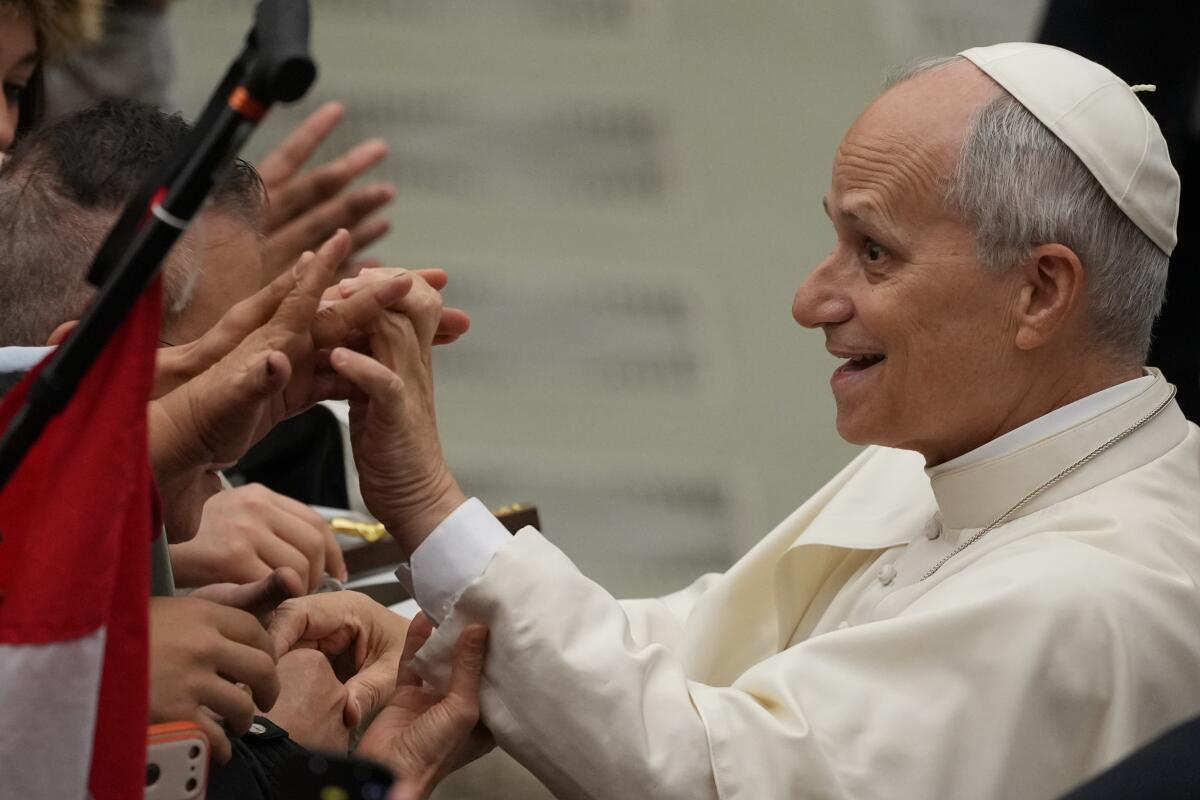
Pope Leo XIV greets people during his weekly general audience in the Pope Paul VI hall at the Vatican, Wednesday, Jan. 14, 2026.
(Andrew Medichini / Associated Press)
By Luis Andres HenaoJan. 21, 2026 7:44 AM PT
- Catholic affiliation has plummeted across six major Latin American countries over the past decade, while the religiously unaffiliated population has surged dramatically.
- The share of unaffiliated adults now exceeds that of Protestants in Argentina, Chile, Colombia and Mexico, marking a historic shift in the region’s religious landscape.
- Despite declining church affiliation, Latin Americans remain deeply religious, with about 90% believing in God and majorities praying daily.
Those are among the key findings in a report released Wednesday by the Pew Research Center based on surveys conducted in early 2024 of adults in six of the region’s most populous countries: Argentina, Brazil, Chile, Colombia, Mexico and Peru.
“Our analysis found that the Catholic share of the population in Argentina, Brazil, Chile, Colombia, Mexico and Peru — which collectively make up about 75% of Latin America’s population — has significantly declined since 2013-14, while a growing share of adults in the region are religiously unaffiliated,” said Kirsten Lesage, a Pew research associate and the lead author of the report.
Thursday, March 15, 2018
‘I’m not afraid:’ What Stephen Hawking said about God, his atheism and his own death
By Lori Johnston
March 14 at 11:02 AM
1:48
World-renowned physicist Stephen Hawking dies at 76

Theoretical physicist Stephen W. Hawking died on March 14 at age 76. Hawking was considered to have one of the greatest minds of this generation. (Amber Ferguson/The Washington Post)
British theoretical physicist Stephen Hawking schmoozed with popes during his lifetime, even though he was an avowed atheist. The famous scientist, who died Wednesday in England at 76, was often asked to explain his views on faith and God. During interviews, he explained his belief that there was no need for a creator.
He said during an interview with El Mundo in 2014: “Before we understand science, it is natural to believe that God created the universe. But now science offers a more convincing explanation. What I meant by ‘we would know the mind of God’ is, we would know everything that God would know, if there were a God, which there isn’t. I’m an atheist.”
That followed comments made to Reuters in 2007 in which Hawking, who had a condition much like amyotrophic lateral sclerosis (also known as Lou Gehrig’s disease or ALS) since 1963, described himself as “not religious in the normal sense.”
1:48
World-renowned physicist Stephen Hawking dies at 76

Theoretical physicist Stephen W. Hawking died on March 14 at age 76. Hawking was considered to have one of the greatest minds of this generation. (Amber Ferguson/The Washington Post)
British theoretical physicist Stephen Hawking schmoozed with popes during his lifetime, even though he was an avowed atheist. The famous scientist, who died Wednesday in England at 76, was often asked to explain his views on faith and God. During interviews, he explained his belief that there was no need for a creator.
He said during an interview with El Mundo in 2014: “Before we understand science, it is natural to believe that God created the universe. But now science offers a more convincing explanation. What I meant by ‘we would know the mind of God’ is, we would know everything that God would know, if there were a God, which there isn’t. I’m an atheist.”
That followed comments made to Reuters in 2007 in which Hawking, who had a condition much like amyotrophic lateral sclerosis (also known as Lou Gehrig’s disease or ALS) since 1963, described himself as “not religious in the normal sense.”
Sunday, April 24, 2016
Atheist pastor sparks debate by 'irritating the church into the 21st century'

Ashifa Kassam in Toronto
3 hrs ago

© Michael Stuparyk/Toronto Star/Getty Images
Rev Gretta Vosper at West Hill United Church sitting in the pews in Toronto.
Rev Gretta Vosper at West Hill United Church sitting in the pews in Toronto.
There is not one mention of God during the 70-minute service at Toronto’s West Hill United church. Bibles are nowhere to be seen. The large, steel cross – one of the few remaining religious symbols in this church – is hidden behind a cascade of rainbow streamers.
But that is perhaps to be expected in a church led by an avowed atheist.
“I do not believe in a theistic, supernatural being called God,” says Gretta Vosper, the United Church of Canada minister who has led West Hill since 1997. “I don’t believe in what I think 99.99% of the world thinks you mean when you use that word.” Tor her, God is instead a metaphor for goodness and a life lived with compassion and justice.
Related: 'Good without God': Nebraska atheists take over nativity to promote tolerance
Vosper’s outspoken commitment to a seemingly clashing set of beliefs has prompted turmoil in the open-minded United Church of Canada. A progressive Christian denomination that began ordaining women in Canada 80 years ago and for decades has allowed openly gay men and women to lead ministries, the church has been left questioning its boundaries.
In the coming weeks, an unprecedented review will be carried out to determine whether Vosper can stay on as a minister. At its most basic level, the review will ask a simple question that’s likely to yield a complicated answer: can the United church of Canada have an atheist minister?
For the 100-strong congregation at West Hill, the answer is an unabashed yes. Stripped of God and the Bible, services here are light on religious doctrine and instead emphasise moral teachings. The service begins with a nod to the First Nations land on which the church stands and goes on to mention human rights in Saudi Arabia, Syria and Palestine. Global concern is coupled with community-building, with members invited to share significant moments of the past week.
“I’ve lost 25 pounds in the past five months,” announces one man shyly – and each revelation meets with applause. A tall totem pole graces the front of the church and more than half the pews have been changed out for more comfortable chairs. The median age of the congregation is around 60 years, but members range from toddlers and teenagers to Jack, the four-year-old mutt who sniffs around in the back row.
Vosper was ordained in 1993, during which she was asked if she believed in God, Father, Son and Holy Spirit. She said yes, speaking metaphorically.
Some eight years later, vexed by the archaic language, imagery and stories of the Bible, she delivered an off-the-cuff sermon in which she deconstructed the idea of God. “Our hymns and our prayers and the way that we did things, they all reinforced this idea of a supernatural divine being who intervened in human affairs,” she says. “I just took it apart – I was not willing to continue to let (my congregation) think that I believed in that kind of God.”
She braced herself for a negative reaction. To her surprise, church leaders said they were intrigued by the direction she was heading and encouraged her to push forward.
What followed was years of Vosper and her congregation retooling the service at West Hill. References to God and Jesus became talk of love and compassion and prayer was replaced with community sharing time. The removal of the Lord’s Prayer in 2008 proved to be a critical test, sending attendance plunging from 120 people to 40 and leaving the church’s financial strength in tatters. “The Lord’s Prayer was the last thing in the service that still held them to previous generations of church,” says Vosper. “So it became the lightning rod for all of that loss.”
Throughout this time Vosper couched her strong beliefs in linguistic gymnastics, describing herself as a non-theist and, later, a theological non-realist. In 2013, moved by the case of Bangladeshi bloggers facing persecution over their reportedly atheist views, Vosper began calling herself an atheist. “I felt it was an act of solidarity,” she says, likening it to the use of the word feminist to in the 1970s. “If I shelter myself by not using that term, that’s unfair to everyone who is being maligned by the use of that term.”
As news of her stance spread, so did the concerns about the provocateur among the ranks of the church. In January of last year, David Ewart, a United church minister in British Columbia, suggested in an open lettert that Vosper should just leave the church. Months later, a talk radio host in southern Ontario took aim at Vosper. “What’s an atheist doing in the pulpit of a Christian church? You don’t have a Christian minister preaching in a synagogue. You don’t have a rabbi preaching in a Christian church,” Andy Oudman asked his listeners. “Does the United church have any credibility left if they leave the likes of Gretta Vosper in the pulpit?”
The Toronto conference of the United church responded to the concerns last year, saying it would carry out a review to determine whether Vosper was being faithful to her ordination vows and whether she could stay on as minister. “There are very strong opinions from those who support Ms Vosper, and from those who reject her statements absolutely,” said the Rev David Allen of the Toronto conference.
The decision to carry out the review upsets many at West Hill. “It’s disgusting,” says Wendy Hyland. Her husband, Jim Hyland, calls it hypocritical, given that the congregation is one of the few in the area that has managed to buck the wider trend of declining attendance. “West Hill is the future of what religion will be like,” says the 65-year-old, highlighting its metaphorical interpretation of religious symbols and emphasis on environmental and social justice. “We’re thinking and saying what the rest of the world is scared to, but moving towards.”
The controversy has fostered an us-against-the-world sentiment in this small congregation. “She’s way off the beaten track, that’s for sure,” laughs Jeanne Hamel, a 95-year-old who was raised in the United church. “Those of us who are here are willing to follow her. A lot of people took the other road and to me, they chickened out.”
Some, such as Eve Casavant, 44, recently started attending West Hill after hearing about Vosper among atheist circles. She was delighted to find the same sort of church she had been raised in, save the burden of belief. “It’s like that sense of community without the barriers,” she says. “It’s a beautiful thing and it is too bad it’s not being as embraced as it should be.”
Related: Why don’t all the religions gang up on faithless heathens like me? Because we want the same thing | Sara Pascoe
In the coming weeks, Vosper will have to defend her beliefs for a panel of five people, made up of ministry personnel and laypeople. “When they came knocking on the door, it was kind of like, ‘Really?,”’ says Vosper. “We’ve been doing this for 15 years and I’ve been really public about my beliefs.”
She sees the review as a betrayal, as the path she has forged is a logical one in a church that has always prioritised moral teachings over doctrinal beliefs. “I’m a product of the United church. It taught me to critique the Bible as a human construction … This means everything that it says is up for grabs, including God.”
Many in the clergy privately share her view on God, she says, turning her into a sort of standard-bearer for a conversation that is already happening in the wider world. Her push to bring that conversation within the walls of the church – a role she describes as “irritating the church into the 21st century” – has already cost her some $60,000 in legal fees spent on an appeal to halt the upcoming review.
Her appeal was denied last month. It was a moment that forced Vosper – for the first time since she came out as an atheist – to confront the fact that she may not be able to find a balance between her beliefs and her career. “I don’t have a lot of hope at this point in time. Before the appeal was denied, I still very much felt that this was my church,” she says. “But that ruling is really a signal that maybe this is not the church that I advocated for, that I’ve championed.”
Source
.
Friday, April 22, 2016
Colorado School Distributes Satanist and Atheist Materials - World Religion News

Colorado school district has approved the distribution of Atheist and Satanic material to students.
Tuesday, May 12, 2015
Christianity faces sharp decline as Americans are becoming even less affiliated with religion
By Sarah Pulliam Bailey May 12 at 12:20 AM

The Memorial Peace Cross is a well-known landmark in Bladensburg, Md. (Mark Gail for The Washington Post)
Christianity is on the decline in America, not just among younger generations or in certain regions of the country but across race, gender, education and geographic barriers. The percentage of adults who describe themselves as Christians dropped by nearly eight percentage points in just seven years to about 71 percent, according to a survey conducted by the Pew Research Center.
“It’s remarkably widespread,” said Alan Cooperman, director of religion research for the Pew Research Center. “The country is becoming less religious as a whole, and it’s happening across the board.”
At the same time, the share of those who are not affiliated with a religion has jumped from 16 percent to about 23 percent in the same time period. The trend follows a pattern found earlier in the American Religious Identification Survey, which found that in 1990, 86 percent of American adults identified as Christians, compared with 76 percent in 2008.
Here are three key takeaways from Pew’s new survey.
1. Millennials are growing even less affiliated with religion as they get older
The older generation of millennials (those who were born from 1981 to 1989) are becoming even less affiliated with religion than they were about a decade ago, the survey suggests. In 2007, when the Pew Research Center did their last Religious Landscape Survey and these adults were just entering adulthood, 25 percent of them did not affiliate with a religion, but this grew to 34 percent in the latest survey.
The trends among the aging millennials is especially significant, said Greg Smith, associate director of research at the Pew Research Center. In 2010, 13 percent of baby boomers were religiously unaffiliated as they were entering retirement, the same percentage in 1972.
“Some have asked, ‘Might they become more religiously affiliated as they get older?’ There’s nothing in this data to suggest that’s what’s happening,” he said. Millennials get married later than older generations, but they are not necessarily more likely to become religiously affiliated, he said.
2. There are more religiously unaffiliated Americans than Catholic Americans or mainline Protestant Americans
The numbers of Catholics and Protestants have each shrunk between three and five percentage points since 2007. The evangelical share of the American population has dropped by one percentage point since 2007.
There are more religiously unaffiliated Americans (23 percent) than Catholics (21 percent) and mainline Protestants (15 percent). “That’s a striking and important note,” Smith said.


The groups experience their losses through what’s called “religious switching,” when someone switches from one faith to another. Thirteen percent of Americans were raised Catholic but are no longer Catholic, compared with just 2 percent of Americans who are converts to Catholicism.
“That means that there are more than six former Catholics for every convert to Catholicism,” Smith said. “There’s no other group in the survey that has that ratio of loss due to religious switching.”
There are 3 million fewer Catholics today than there were in 2007. While the percentage of Catholics in the United States has remained relatively steady, Smith said we might be observing the beginning of the decline of the Catholic share of the population.
Pew estimates there are about 5 million fewer mainline Protestants than there were in 2007. About 10 percent of the U.S. population say they were raised in the mainline Protestant tradition, while 6 percent have converted to mainline Protestantism.
Evangelical Protestants have experienced less decline, due to their net positive retention rate. For every person who has left evangelical Protestantism after growing up, 1.2 have switched to join an evangelical denomination.
3. Those who are unaffiliated are becoming more secular
The “nones,” or religiously unaffiliated, include atheists, agnostics and those who say they believe in “nothing in particular.” Of those who are unaffiliated, 31 percent describe themselves as atheists or agnostics, up six points from 2007.
“What we’re seeing now is that the share of people who say religion is important to them is declining,” Smith said. “The religiously unaffiliated are not just growing, but as they grow, they are becoming more secular.”
And people in older generations are increasingly disavowing organized religion. Among baby boomers, 17 percent identify as a religious “none,” up from 14 percent in 2007.
“There’s a continuing religious disaffiliation among older cohorts. That is really striking,” Smith said. “I continue to be struck by the pace at which the unaffiliated are growing.”
White Americans (24 percent) are more likely to say they have no religion, compared with 20 percent of Hispanic Americans and 18 percent of black Americans. The retention rates of the “nones” who say they were raised as religiously affiliated has grown by seven points since 2007 to 53 percent.
The Pew survey was conducted between June and September of 2014.
.
.
.
Monday, January 05, 2015
Former Seventh-day Adventist pastor takes a yearlong timeout from God
“Uh, I’m not exactly sure about all this,” Ryan Bell said as he scanned the scene inside a darkened Las Vegas convention hall.
TRIBUNE NEWS SERVICE
JAN 4, 2015

A stripper whirled her hips. A rock band pumped out a song about cannibalism. A man’s shouting hung briefly over the packed crowd: “God is dead!”
For nearly two decades, Bell had been pastor of congregations of Seventh-day Adventists, among the most conservative denominations in Christianity. How had he ended up at a gathering of atheists and skeptics in Sin City?
It had been a long time coming. For years now, it felt as if his prayers weren’t being answered. He secretly wondered whether a higher power existed at all.
So, last Dec. 31, he published a blog post that went viral.
“For the next 12 months I will live as if there is no God,” he wrote. “I will not pray, read the Bible for inspiration, refer to God as the cause of things or hope that God might intervene and change my own or someone else’s circumstances. (I trust that if there really is a God that God will not be too flummoxed by my foolish experiment and allow others to suffer as a result).”
Now it was July, just over midway in his journey. Bell had spent as much time as he could reading about science and philosophy, interviewing agnostics and atheists, working to decide what he would believe when the year was done.
He’d come to Las Vegas to attend the convention of skeptics — an ardent subculture devoted to lambasting everything from believers in Bigfoot to claims that Jesus Christ was anything more than a charismatic human being.
The band, the stripper, the boisterous crowd? All were part of a night of reverie hosted by magician and atheist Penn Jillette. But shortly after the show began, Bell left, shaking his head, feeling caught between worlds.
“Not so long ago I was pastoring a church, and here I am, surrounded by all these atheists singing for shock value about how terrible God is,” he said. “It doesn’t feel like these are my people. Then again, most of this year, it’s been hard to say who exactly my people are.”
Bell, 43, was born in Ohio but grew up mostly near Loma Linda, a Southern California suburb populated largely by Seventh-day Adventists.
In his teens, he didn’t drink, smoke or swear. Eating meat was forbidden. “I didn’t believe in evolution because my grandparents didn’t believe,” he said.
He would come to develop a guilty pleasure: listening to the Beatles, Bob Dylan and U2. But when he headed off to the church’s deeply observant Pacific Union College, in Northern California, he left behind his music and vowed to live an even stricter life.
“He was unusually conservative, even for this school,” remembered one of his English professors, Nancy Lecourt. She recalled asking her class to read 18th century philosopher Voltaire — and a young Bell refusing on the grounds that writing such as Voltaire’s defiles the soul.
It was hardly surprising when, after graduation, Bell became a pastor, assigned to a clutch of churches in the suburbs of Philadelphia. His new parishioners, though still conservative, didn’t fit the mold he’d known before. Some wore makeup and jewelry. A few smoked, cursed or spent money on Saturdays, the Adventist day of worship.
“It all hit me at once,” Bell said. “I mean, the messiness of the journeys of my congregants. I was meeting people who were living with a goodness I’d always hoped for, yet they did things that the church didn’t approve of.”
In 2005, he moved with his wife and two young daughters to California, taking over the ministry at the Adventist church in Hollywood.
“People who had been at the fringes of the church, who were not sure they wanted to go back to organized religion, he gave them space to feel they were part of this,” said Leslie Foster, a filmmaker who was part of a swell of new members flocking to the church once Bell arrived. “He created a home.”
This new version of Pastor Bell focused less on individual salvation than social justice. It wasn’t long before he was speaking out against Bank of America for what he considered predatory lending practices. Or demonstrating during the Occupy takeover of the lawns at City Hall. Or advocating for gay rights and marriage equality.
All along, his doubts grew. The more he prayed, the more prayer felt useless. The more he tried to reconcile the Bible with science, the more it seemed he was putting together a puzzle with parts that didn’t fit. The more he thought about the unceasing suffering in the world, the more he doubted God’s existence.
By early last year, pressure was mounting. Part of it was personal. After 17 years of marriage, he and his wife were headed for a divorce. Part of it was his calling. In March, after a long battle with regional Adventist officials on almost every major point of theology, he agreed to resign.
Without a church, living alone, Bell felt dazed.
Recalled Randall Frederick, a close friend and theology student at Fuller Seminary: “He’d just lost so much faith, he did not know what to believe in.”
On a rain-swept afternoon at a Pasadena restaurant, Bell and Frederick met for lunch. They joked about a popular book by an evangelical author who had vowed to live biblically for 12 months. An idea came. Maybe, to give his life focus again, Bell should take his doubts to their full conclusion, at least for a while.
The storm of attention after he turned his back on God took Bell by surprise. Within a week, he was explaining himself on CNN, NPR and the BBC.
His blog posts were jammed with hundreds of comments, then thousands. There were supportive notes. And plenty calling him a charlatan, an opportunist, a fraud who was courting hellfire while influencing others to follow along the way.
Soon Bell spun into depression, and not just because of the criticism.
He was jobless. The announcement had cost him teaching positions at Fuller Seminary and the evangelical Azusa Pacific University, because he could no longer adhere to rules stipulating that faculty members believe in Christ.
In his old life, he would have prayed. He beat back the temptation.
“I just have to weather the storm,” he said, sitting in a Los Angeles cafe. It was March. His shoulders slumped. Bags sat heavy under his eyes. “Just make it through all this.”
By April, his views on faith were starting to become clearer. “I could very easily say there is no God,” he said. “I feel that way a lot of the time.”
There was a hesitancy in his voice. Yes, great beauty and meaning could be found if one focused solely on the material world. But seeing things that way posed problems.
“It takes this beautiful world and reduces it to atoms and electrons. Where did it all come from? Are we just the sum of our parts?”
Such questions kept him up at night, reading in the small Pasadena apartment he’d rented, surrounded by his books. He’d searched for answers before, but never with this intensity, or from the starting place that there was no God.
He felt ostracized by those in organized religion. But nonbelievers were thrilled to have him at their events or speaking on their panels, and an advocate for atheists had started an online fund to help pay his bills.
“It feels like I am now a pastor to the irreligious,” he said, walking through the Las Vegas hotel at the convention. “Not that I want that role, but the way people are responding to me, it’s pretty revealing. It feels like I’ve touched some sort of cultural nerve. There’s just a lot of people questioning everything these days.”
Life started to feel good again. He’d gotten a job teaching life skills at PATH, a nonprofit helping the homeless. He’d also started dating Rebecca Pratt, a devoted Christian— open-minded and unafraid to stop him when he’d lapse into negative generalizations about religion.
The year pushed on. He became more and more comfortable in this new, questioning life.
He described himself, temporarily at least, as a “weak atheist.” Fine with not having all the answers about life’s origins, its meaning, its end.
“Either God has responsibility or he does not,” Bell said. He recalled the South Korean ferry that sank in April, killing 304 people, most of them students. “If he does, it seems like he is doing a pretty bad job. If he does not, if he just wound the thing up and walked away, I don’t see any point in worshiping a God like that.”
Bell grimaced. A moment passed. Then he smiled. He was finally free to speak such thoughts.
The journey will be over Jan. 1.
Skeptics and nonbelievers are ready to officially welcome him to the fold. Bell has heard from Christians who pray he’ll return to their side. “I am hoping he will come around, back to some form of Christianity, hopefully to Adventism,” said Lecourt, his college English teacher.
There will be an announcement on where he stands, most likely on his blog.
It’s hard to imagine him going back to the God of organized faith. It’s also hard to imagine him joining the crowd contending that God is imaginary and that belief is the source of most of the world’s ills.
“I do think I’ve now seen both sides of the coin,” he said recently. “Being with the atheists, they can have the same sort of obnoxious certainty that some Christians have, and I don’t want to be a part of that. It feels like I’m stuck in the middle. I want to be for something good, but I don’t want boundaries, and religion just feels like a very bounded thing.
“The question I am asking right now: Why do I need religion to love?”
———
©2014 Los Angeles Times
.
Monday, August 18, 2014
Navy Caves In to Atheists, Removes Bibles From Guest Rooms
Written by Dave Bohon

The U.S. Navy has caved in to the demands of an atheist group that it remove Bibles from guests rooms on naval bases.
In March, attorneys from the atheist group Freedom From Religion Foundation (FFRF) sent a letter to the Navy Exchange Service Command (NEXCOM) claiming that two “concerned service members” had independently contacted FFRF to complain that “every Navy lodging room that they have stayed in during decades of service has contained a Bible” — most of them provided by the Christian group Gideons International, which appears to be a particular target of the FFRF.
The FFRF was deeply worried, as noted in the letter, that materials from other faiths were “rarely” seen in the Navy guest rooms. “One complainant noted that he 'never saw a Book of Mormon or Koran' in any Navy-run lodge and that he had 'been in varied Navy Bachelor Officer Quarters (BOQs) with Bibles,” wrote troubled FFRF staff attorney Andrew Seidel with a note of righteous concern.
Insisting that under the Establishment Clause of the First Amendment, “a government entity cannot in any way promote, advance, or otherwise endorse religion,” Seidel charged that the Navy's longtime tradition of allowing Bibles in its guest rooms “amounts to a government endorsement of that religious text. Including Bibles sends the message to non-Christian ... guests that they should read the Bible.... The military should not promote certain religious beliefs by placing Bibles in guest rooms.”
Arguing that “government-run entities have a constitutional obligation to remain neutral toward religion,” Seidel and the FFRF demanded that the Navy remove the offensive Bibles from its guest rooms, and “provide us with a written response outlining the actions that your office is taking to remedy this constitutional violation.”
In June, NEXCOM responded to the demand with a directive that Bibles were to be removed from all Navy guest rooms until further review of Navy policy on religious materials. “The Navy Lodge General Manager should advise the Installation Commanding Officer of our intention to work through the chaplain’s office to determine what [the] installation policy is,” read the directive, “and the method to remove religious material currently in the guest rooms.” According to the order, all Bibles currently in Navy guest rooms were to be removed by September 1.
The directive does not say that Bibles will be prohibited from rooms in the future, but that in the future the commanding officer of a naval base will determine, “in accordance with personnel readiness and military regulations, whether [religious materials] will be accepted and how they will be handled and distributed.”
Addressing the FFRF's issue, NEXCOM spokeswoman Kathleen Martin told reporters that “we looked at our policy and realized there wasn’t a consistent policy regarding Navy Lodges. We decided we needed to have some consistency.”
According to a report by the American Family Association (AFA), a Navy lodging housekeeper wrote in an e-mail to the AFA: “We were told today, June 23, 2014, that due to a new policy by the CEO of NEXCOM, Rear Admiral Robert J. Bianchi, we were to remove the Bibles from the rooms. They told us to put them in boxes, where they would be taken to a donation center somewhere.”
The AFA reported that a NEXCOM directive ordered the removal of Bibles from 34 Navy Lodge locations and 24,000 Navy Gateway Inns and Suites guest rooms on Navy bases around the world. Lodge managers were ordered to contact base commanders and chaplains and facilitate removing the Bibles and other 'religious material currently in the guest rooms.'”
While it is probable, based on the published directive, that Bibles may again be available in some Navy guest rooms in the future, the FFRF trumpeted the NEXCOM action as a victory for atheists, with FFRF spokesman Sam Grover announcing, “We’re pleased that NEXCOM has taken seriously its constitutional obligation to remain neutral toward religion as a representative of our federal government.... By removing Bibles from Navy-run lodges, the Navy has taken a step to ensure that it is not sending the impermissible message that Christians are favored over guests with other religious beliefs or over those guests with no religion.”
Among the conservative Christian leaders sounding off against the Navy's preliminary cave-in to the atheist attack was Ron Crews, a retired military chaplain and head of the Chaplain Alliance for Religious Liberty. “A Bible in a hotel room is no more illegal than a chaplain in the military,” said Crews of the FFRF's charge that the presence of the Bibles in Navy guest rooms was somehow unconstitutional. “They are there for those who want them.”
He added that “there is nothing wrong with allowing the Gideons to place Bibles in Navy lodges, which it has done for decades at no cost to the Navy. Our service men and women are often away from home, sometimes for long periods of time. It’s perfectly constitutional and legal to allow the Gideons to provide, at their own expense, this source of comfort for service men and women of faith.”
As for the ease with which Navy superiors surrendered to the atheist advance, Crews said that “it’s tiresome to see senior military leaders needlessly cave in to activist groups offended by anything Christian. We sincerely hope that the Navy will reverse its decision as the Air Force did in 2012 after the public spoke loudly and clearly against this sort of censorship.”
Crews was referring to the decision in 2012 by Air Force higher-ups to reverse their cave-in to the demands of another atheist group, the Military Association of Atheists and Freethinkers (MAAF). As reported at the time by The New American, following demands from MAAF, the Air Force dropped a policy that directed housekeepers to make certain there were Bibles in guest rooms on Air Force bases. “While the atheist group had wanted the Air Force to ban the Bibles, placed there for free by the Gideons, from the room altogether,” reported The New American, after deliberation the Air Force Services Agency decided instead to simply remove the question, 'Is a Bible provided?' from the lodging check list housekeepers go through in making up the rooms.”
An Air Force spokesman, Mike Dickerson, said at the time that while the checklist was being dropped, the Air Force was not prepared to sanitize Scripture from rooms entirely, as the atheist group had desired. “The Air Force has not directed the removal of Bibles from Air Force Inns lodging rooms at this time,” Dickerson said. “We continue to review the situation and weigh our multiple First Amendment responsibilities and obligations.”
Speaking of the present Navy actions, Mike Berry, director of military affairs at Liberty Institute, noted that “many of our military's religious traditions and observances pre-date America's founding, but groups like the Freedom From Religion Foundation want to erase that history. We've seen Bibles temporarily banned from military hospitals, demands that veterans' memorials be torn down, and crosses removed from military chapels. This is just the latest in a well-documented pattern of hostility against religion in our military.”
Tuesday, April 22, 2014
New Jersey school district sued for using ‘under God’ in Pledge of Allegiance
The American Humanist Association is suing Matawan-Aberdeen Regional School District on behalf of an anonymous family from Monmouth County. The family claims the school is discriminating against non-believers.
BY Carol Kuruvilla
NEW YORK DAILY NEWS
Tuesday, April 22, 2014, 2:44 PM

Fuse/Getty Images/Fuse
The words 'under God' were added to the Pledge of Allegiance in 1954, as part of a McCarthy-era tactic to combat communism.
A New Jersey school district is under fire for pledging allegiance “under God.”
A family in Monmouth County lashed out against the Matawan-Aberdeen Regional School District with a lawsuit on Monday, claiming that asking children to recite the words “under God” during the Pledge of Allegiance is tantamount to discrimination.
“The exercise instills in children the idea that true patriots are god-believers and those who don’t believe are a second-class of citizens,” David Niose, legal director for the American Humanist Association, told The News.
The Washington, D.C.-based organization filed the lawsuit on behalf of a family, who wished to remain anonymous. Niose said the student involved in the case attends Matawan-Aberdeen schools. But he refused to reveal the student’s gender or grade, claiming that atheists who speak out in this manner are often “subjected to great hostility.”
New Jersey state law requires students to recite the Pledge of Allegiance every school day. The phrase “under God” is in the full text mandated by state law, but it wasn’t a part of the original Pledge of Allegiance. The religious reference is in fact a relic of the McCarthy era. The words were added to the Pledge in 1954 to combat the threat of godless Communism.
Students who have “conscientious scruples” do not have to salute or say the Pledge, but they are required to show respect for the flag by standing.
Niose says the option of not participating is not the right solution.
“If the pledge said, ‘One nation under Jesus,’ I imagine that Jews, Muslims and Hindus would feel quite excluded,” he said. “There is an element of stigmatization when the school is conducting an exercise that defines patriotism in a way that excludes your particular worldview.”
If the pledge said, ‘One nation under Jesus,’ I imagine that Jews, Muslims and Hindus would feel quite excluded.
The AHA is hoping that the courts will find that the current form of the Pledge of Allegiance violates New Jersey's constitution because it discriminates against people of no faith. After that first step, the organization suggests that the school can revert to the original Pledge or find another way for students to show patriotism.
A similar AHA-sponsored lawsuit is currently before the Massachusetts Supreme Judicial Court.
In a statement released to The News, Matawan-Aberdeen schools accused the national organization of unfairly targeting their district for following a state mandate.
“Instead of directing their arguments to the State, which has imposed this statutory requirement on all 590 school districts throughout New Jersey, they are forcing one district to divert time, energy and resources from the education of its students to defend this case,” the statement said.
In the past, opponents have attempted to attack the Pledge on the basis of the First Amendment, which forbids Congress from making laws that establish a state religion. But this recent lawsuit suggests a shift in tactics and a move toward the equal protection clause of the Fourteenth Amendment.
It’s the same constitutional right that allowed African-Americans and women to make important strides toward equality during the 20th century.
“For some reason, instead of looking at the pool that everyone else uses to defend their rights, atheists and humanists have resorted to the establishment clause,” Niose said. “But whenever any minority has asserted rights, they’ve done so through equal protection. It’s time to use it — in fact, it’s long overdue.”
Source
.
Monday, March 03, 2014
Is the Religious Right responsible for America’s fading allegiance to religion?
Posted: Wed, 26 Feb 2014 13:26 by Terry Sanderson

Terry Sanderson on the Religious Right's baneful attempts to desecularize the United States with a raft of "religious freedom" bills.
There seems to be something of a disconnect in America between the rising number of people who profess to have no religion and the state legislatures that are falling over themselves to enact legislation that is little short of theocratic.
Research is repeatedly showing a sharp rise in the number of Americans who have no religion - the "nones" as they are known to academics who study the changing dynamics of religion.
Many evangelical Christians have been comforting themselves with the idea that even though these "nones" don't associate themselves with a particular church, they are still Christians at heart who worship in their own way.
But David Voas, a sociologist at Essex University, begs to differ. He has found from his own research that the "fuzzy faithful" – those who claim to believe in some kind of unidentified higher power and perhaps go to church at Christmas – are really drifting towards complete indifference to religion and all its trappings.
In his 2008 paper The Rise and Fall of Fuzzy Fidelity in Europe, Professor Voas concluded that those who sometimes define themselves as "spiritual but not religious" are actually more likely to be entirely indifferent to religion – a state of affairs that he says is much more dangerous for the future of religion than outright scepticism.
If the same pattern is repeating in America – and it seems to be – then the hope among evangelicals that the "nones" are really just non-practising, but faithful, Christians is little more than wishful thinking.
But despite this rapid secularisation of American culture, there are bills being brought forward in state legislatures that give mighty privilege to religious believers.
So-called "religious freedom" bills have been proposed in several states, but so far have only succeeded in completing the legislative process in Arizona. And even there the Governor still hasn't signed it into law. [Note: Since this blog was originally published, the Governor of Arizona has vetoed the bill].
But there are other battles over supposed "religious freedom" (which usually translates into religious privilege or the right to discriminate against gay people). The Catholic Church and its acolytes are fighting hard to destroy President Obama's flagship Affordable Healthcare legislation because they object to having to supply contraceptives.
Obama gave them an opt out that would relieve them of that duty, then he gave another one, but still they are not satisfied and continue to attack the Affordable Care Act in the courts. At present, a ruling on the matter is awaited from the Supreme Court.
And this is the problem with religious accommodation. Once one concession is made, another demand quickly follows. Religious hierarchies will never stop until they have complete control.
In Arizona the new law seeks to make it legal for businesses and individuals to deny services to gay people if doing so would offend their religious conscience. There could be all kinds of unintended consequences from this legislation (as well as it likely being unconstitutional).
So why is it happening? Why this sudden surge of bills seeking to give religion special privileges in American society? To get religion back into schools, to control what books can be read in colleges (if they are deemed anti-religious) and to promote creationism over evolution in schools?
The answer is that the Republican Party – fused as it now is with the Religious Right – is seeking revenge for the success of gay marriage campaigns around the nation.
As it realises it has lost the war against gay marriage, the Religious Right seeks compensation in the form of "religious freedom" bills, the ultimate aim of which is to make sure gay marriage becomes impractical, despite being legalised.
By putting more and more barriers up against gay people achieving equal rights before the law, the Religious Right and its Republican representation in politics now seeks to make life almost impossible for gay couples in some parts of the country.
But this may end up being a case of making the same mistake twice.
During the last election campaign, the Republicans/Religious Right came to realise that the tide of history had turned against their opposition to gay marriage, and they pragmatically toned down the poisonous anti-gay rhetoric that had been so prominent on their previous electoral platform.
After being trounced again at the ballot box by Obama, they have regrouped and their new plan is to derail gay marriage wherever and however they can with these supposed "religious freedom" bills. But hiding behind the high-falutin' claims of "protecting the liberty of believers to practice their faith" lies rank bigotry.
If they imagine this is going to revive their fortunes they are sadly mistaken. Much of America was repelled by their vile homophobia last time, and it is unlikely it will be impressed with it this time.
The fanatic evangelicals with their hysterical televangelists and lying propagandists are turning off young people, not just from Republicanism, but from religion in general.
The "nones" are growing, but the Religious Right does not seem yet to have made the connection between that trend and their hate-mongering. They have made religion toxic and Americans are fleeing it in their thousands.
Terry Sanderson is the President of the National Secular Society. The views expressed are those of the author and do not necessarily represent the views of the NSS.
Source
.
Wednesday, February 26, 2014
San Diego Atheist Group Looks To Spread Non-Belief

KPBSSanDiego
Published on Nov 21, 2013
The number of people in the United States who identify themselves as atheists has been rising steadily, according to a recent Pew study. And a growing group of atheists in San Diego is mirroring that trend. A few thousand people are part of the San Diego Coalition of Reason, which supports the local atheist community and works to teach others about their non-beliefs. KPBS reporter Claire Trageser has more.
Read more: http://www.kpbs.org/news/2013/nov/22/...
P.S.
Why do they congregate on the Sabbath?
.
.
.
.
Monday, January 13, 2014
Former Pastor Decides To Spend A Year Without God
by NPR Staff
January 12, 2014 4:00 PM
Listen to Story
Morning Edition
5 min 1 sec

Minister Ryan Bell has decided to "try on" atheism for a year. The former Seventh-day Adventist pastor was asked to leave his congregation in March.
Natalie Gee
Former Seventh-day Adventist Pastor Ryan Bell made an unusual New Year's resolution: .
He used to lead a congregation in Southern California, but in March, he was asked to step down after voicing some of the doubts that led to this decision to "try on" atheism.
Just a few days into the new year, after announcing his resolution, Bell was asked to leave the teaching positions he held at the Christian Azusa Pacific University and Fuller Theological Seminary.
Bell spoke with NPR's Arun Rath about his flirtation with atheism and how he arrived at the decision to put his work as a religious leader — and follower — on hold.
Interview Highlights
On the expectations of belief for church leaders
My entire adult life, I've been a leader in the Seventh-day Adventist Church. And I think the expectation of church leaders is that they would have fewer questions and more answers, and that the members or seekers or people that come to the church are the ones with the questions. And I can't remember a time that I wasn't wrestling with my faith. I think faith is one of those things that people wrestle with.
On experiencing doubt
When things start to come unwound, sometimes they unwind all the way. And then, you know, perhaps you can wind it up a little bit again later — who knows? But I feel like I lost my church leadership position and then I really didn't have any compulsion to go to church internally, like I just didn't feel like participating in church. I tried a number of times.
And it woke me up to the kinds of things people had been saying to me all these years, like, "I love what you're doing at the church, but church just isn't for me." ...
So I just decided not to fight it. I just decided to say, "Well, let me just give church a rest." And as I did that, I just began to wonder about the very existence of God.
On how members of his congregation have responded
Some people have been encouraging, some people have just been silently watching. Some are a little heartbroken. It's almost like people respond as though I've lost a loved one and I'm going through a deep grieving process and doing strange things as a result. Some people have just tried to talk me off the ledge.
Others have said, "I have these same questions. I'm really glad that you're doing this, and I'll be following along. Maybe I'll figure some things out along the way, too."
I'm not saying to my former members, "Follow me out the door." Nothing like that. I don't want them to do that. I want them to be on their own journey authentically.
On the reaction of the atheist community
Some people are, in a way, gloating. They're like, "Congratulations on coming to the other side" ... But other people are skeptical. There are a lot of atheists who are really not sure what I'm doing. So they say, "You are either an atheist or you're not. You can't be 'a little atheist,' like you're 'a little bit pregnant.' "
In a way, what I hear them saying is, "You're not authentically atheist" ... And my internal reaction to some of that is to say, oh, I was a Christian leader for a long time. I heard that argument on the other side, as well: "You're not properly Christian. You're not a Christian in our way of being a Christian, so you don't really fit here." And my response to that is, I'm used to not fitting places. So that's fine with me.
Source
.
Tuesday, January 07, 2014
Christians, Atheists Say Keep Capitol a Free Speech Zone
By: Jim Turner News Service of Florida | Posted: January 7, 2014 3:55 AM

Florida Capitol Rotunda
Christians and atheists may have found a little common patch of ground, the rotunda of the Florida Capitol, as a space to express themselves.
The threat of a lawsuit is hovering over the state's rejection of a satanic display, and the rotunda exhibit policy is set to undergo a staff review. But the prevailing view among those who have recently jumped at the chance to use the public floor space to express their beliefs is to simply let everyone have their say.
"They designated a free speech zone for everyone to express their religious and nonreligious beliefs," said Austin Aycock, spokesman for the Tallahassee Atheists. "If they're going to do it, they can't have limits."
The Tallahassee Atheists, The American Atheists Florida Regional Directors and the Madison, Wis.-based Freedom From Religion Foundation all put up seasonal banners this year to counter a Christian Nativity scene.
"I hope the state can find a way to make all voices heard and to keep everyone's freedom of speech alive here in the Capitol rotunda," said Randall Smith, Knights of Columbus grand knight of the Good Shepherd Church parish in Tallahassee. "All capitols should be like the state of Florida, and I hope they can find a way to make room for everybody."
Department of Management Services spokesman Ben Wolf said in an email that the department appreciates "the input we receive from all groups across the state" regarding the display policy, but added there is no timetable on the review.
"We will take as much time as needed," Wolf said.
DMS limits the height of displays based on where they are located in the rotunda and prohibits displays from blocking permanent memorials such as the Civil Rights and Veterans halls of fame. Also, the department will allow displays as long as there is available space, but does have rules against noise and impeding official business.
The Knights of Columbus on Monday put up a decorated wooden cross in the Capitol for the group called Reclaim Christmas for Christ to mark Three Kings Day and the Christian feast of the Epiphany.
The cross display follows diverse exhibits that have dotted the rotunda this holiday season, including a pole made of empty beer cans to mark the sitcom-created Festivus holiday and a shredded pile of paper that is supposed to resemble the deity of the Church of the Flying Spaghetti Monster.
"When you see a Nativity scene, and right beside it you see a pole with beer cans on it, we think it makes our point," Smith said. "We think it further shows the seriousness of the Nativity scene" versus other presentations that are not as serious.
The free speech issue exploded this year after the Florida Prayer Network put up the first Nativity display in modern history in the Capitol on Dec. 3.
The Nativity scene joined a menorah that has been displayed in prior years. But the Christian display went up with a lot of media fanfare.
The policy review will be undertaken as the ACLU of Florida continues to warn the Department of Management Services that a lawsuit remains an option over the department's rejection of an exhibition proposed by the New York-based Satanic Temple.
“What we hope happens is that the department will realize you can’t pick and choose which messages or organizations get represented if you create an open forum -- or that they make the determination after all that’s happened that maybe creating a venue for religious messages isn’t the best use of a government building in the first place," said ACLU of Florida spokesman Baylor Johnson.
Johnson added that the ACLU is not formally representing the temple.
The Department of Management Services rejected the temple's proposal on grounds that it was "grossly offensive."
Department officials have not defined what they have considered offensive about the temple's proposal that would have bannered the phrase "Happy holidays from the Satanic Temple" atop a diorama of an angel falling into hell. A sign on one side of the display referenced Luke 10:18 including the line, "I saw Satan fall like lightning from heaven."
The temple's display was the only proposal denied by the state agency.
Pam Olsen, president of the Florida Prayer Network, said that while the Satanists' proposal was "amateurish," she didn't think it should have been rejected.
"I would have been OK with it because I'm not afraid of what they're saying," Olsen said.
Olsen added she hoped the Department of Management Services doesn't use the Satanists' application as a reason to keep her and others out in the future.
"That was the whole reason they did this, to shut us down," Olsen said.
Chaz Stevens, a Deerfield Beach resident behind the Festivus pole of beer cans, said when his display went up that the intent of his admittedly "ridiculous" effort was to make a political statement on the need for the separation of church and state.
Source
.
Tuesday, November 26, 2013
Atheists Take On The IRS
By Victoria Bekiempis / November 22 2013 4:17 PM

Top American secularists allege the tax agency discriminates against them. Reuters
IRS policies on church tax exemptions aren’t just potentially making America poorer – they also illegally discriminate against atheists, a lawsuit alleges.
American Atheists and several other secularist groups claim that the Internal Revenue Service gives preferential treatment to churches and religious organizations who seek or have 501(c)(3) non-profit status compared to secular non-profit organizations. The groups say this violates non-believers’ Constitutional rights because it treats churches differently than non-churches and equates to government support of religion.
Under current IRS policy, churches automatically qualify for 501(c)(3) status, though nonreligious 501(c)(3)s must go through an extensive application process to get the same tax benefits. In addition, religious organizations do not have to fill out annual Form 990 returns reports, which detail charities’ finances so the IRS or nonprofit watchdogs can identify possible fiscal wrongdoing and law-breaking. Critics, who have recently renewed their calls for religious exemption reform, say that these filing differences cost the U.S. government from some $17 to $71 billion annually.
Though American Atheists’ first filed their federal lawsuit in December 2012, oral arguments in the case began late this week.
“We find it discriminatory, so we’re suing,” American Atheists spokesman Dave Muscato tells Newsweek. “The way that this is set up, we all pay for it. We’re all supporting churches for what they do.”
In court filings, the advocacy group argues that a 1961 U.S. Supreme Court opinion that “neither the federal government nor state governments can ‘constitutionally pass laws or impose requirements which aid all religions as against non-believers, and neither can aid those religions based on a belief in the existence of God, as against those religions founded on different beliefs’” supports their claims. American Atheists is also arguing that church-only tax breaks, such as the “parsonage exemption,” which lets clergy members write off housing expenses from their taxable income, aren’t constitutionally kosher, since “non-religious entities may not take any deductions for the housing or living expenses of their employees or volunteers.”
IRS policies also discriminate against donors to non-religious organizations, American Atheists alleges. Non-religious nonprofits must identify, on Form 990, contributors who give more than $5,000, or 2 percent of the organization’s total contributions and grants. But religious non-profits don’t have to disclose mega donors, because they don’t have to fill out a 990. These policies, plus the expense and labor required to meet 501(c)(3) filing requirements, gives churches a “fundraising advantage” and put atheists at risk. “Because there’s a lot of stigma about atheism, many people talk to us and say they would donate more but don’t want their name publicized in that way,” Muscato says.
Court proceedings are set to continue in the coming weeks.
The IRS did not immediately reply to requests for comment, though the agency often does not comment on pending litigation.
When asked previously about the issue, an IRS spokesman sent Newsweek an e-mail linking to a tax guide for religious nonprofits.
Source
.
Thursday, November 07, 2013
Sunday Assembly founders launch 'atheist church' in Nashville
Heidi Hall, The Tennessean 4:11 p.m. EST November 6, 2013

(Photo: LEON NEAL AFP/Getty Images)
A fast-growing, worldwide congregation for atheists called Sunday Assembly picked an unlikely spot to try and launch a new group.
It's Nashville. Where the Southern Baptist Convention is headquartered. Where Christian authors go to avail themselves of a vast publishing network. Where the faithful drive past several churches in their denomination on Sunday to attend just the right one.
But the founders of Sunday Assembly, British comedians Sanderson Jones and Pippa Evans, say they're looking forward to visiting the fledgling group personally Thursday night. In fact, Jones said, he'd even like to learn something about church planting – and there are plenty of experts in Nashville.
"What happened is, we had about three or four people signed up, in fact, in Nashville, and we got a miscommunication and thought there were a lot more people signed up than there were," Jones said. "We thought we'd go for it anyway. Taking cues from the Southern Baptist Convention, we thought we'd have faith and give it a go. Sometimes it's just about getting it started. We don't know how many people will be there, but however many there are, that will be the perfect number."
It's a philosophy that's worked well for Evans and Jones, who launched the first Sunday Assembly — frequently shorthanded in media to "atheist church" — in London less than a year ago and, within weeks, were drawing a capacity crowd. They now head up 30 congregations around the world, with major U.S. locations in New York, Boston and Washington, D.C.
On Oct. 20, Jones and Evans launched an Indiegogo.com campaign aimed at raising 500,000 British pounds, or about $805,000, to reach even more people. It was up to about $42,500 Wednesday morning.
All are welcome at the services, Jones said, but people looking for theological arguments will be disappointed. Sunday Assembly doesn't try to talk people out of their religious notions, just capture the best social parts of church without providing religious doctrine. Members celebrate life with poetry, lectures and songs such as Journey's "Don't Stop Believin'."
Source
.
Wednesday, November 06, 2013
1st Amendment Says Nothing About "State" Religion!

CRUClEFICTION
Published on Nov 3, 2013
New Day Sunday, CNN, 11-3-2013, Amanda Knief, Managing Director and In-House Counsel of American Atheists, Inc..
About the word "thereof":
An overlooked aspect of the free exercise clause is that it looks back to the establishment clause for its definition of "religion". The establishment clause says that Congress may make no law respecting the establishment of religion, while the free exercise clause says that Congress cannot prohibit the free exercise "thereof". Logically, the word "thereof" must have the same content as the object to which it refers. Accordingly, what counts as religion for one clause MUST count as religion for the other. The free exercise clause makes no sense unless the word "religion" is read to encompass more than a church, denomination, or sect. As the free exercise clause pertains to religion generically, the word 'thereof', being placed where it is, clearly signifies that the establishment clause does likewise.
.
.
Friday, June 28, 2013
Atheists to Unveil Florida Courthouse Monument
Press Release: Atheists to Unveil Florida Courthouse Monument
Posted on: May 29, 2013
Cranford, NJ—Following a settlement with Bradford County, Florida, American Atheists will unveil a new monument in front of the Bradford County Courthouse: a 1,500-pound granite bench engraved with quotations from Thomas Jefferson, Madalyn Murray O’Hair, Benjamin Franklin, and others. The bench will sit adjacent to an existing monument featuring the Ten Commandments.
The unveiling is scheduled for June 29 at noon. It is the first atheist-sponsored monument on government property in the United States. American Atheists President David Silverman will deliver the dedication.
The monument features an excerpt from the Treaty of Tripoli, signed by President John Adams, which declares “The United States is in no sense founded on the Christian religion”; and excerpts from the Bible, quoting the biblical punishments for breaking each of the Ten Commandments–many command death.
American Atheists, along with plaintiff Daniel Cooney of Starke, filed suit in May 2012 for the removal of the Ten Commandments monument, citing separation of religion and government because the monument is on government land.
“We have maintained from the beginning that the Ten Commandments doesn’t belong on government property,” said Silverman. “There is no secular purpose for the monument whatsoever and it makes atheists feel like second-class citizens. But if keeping it there means we have the right to install our own monument, then installing our own is exactly what we’ll do.”
“The monument emphasizes the role secularism has played in American history,” said Public Relations Director Dave Muscato. “And the Bible quotes make it clear that the Ten Commandments are not the ‘great moral code’ they’re often portrayed to be. Don’t kill, don’t steal? Of course. But worship only the Judeo-Christian god? That conflicts overtly with the very first right in the Bill of Rights, freedom of religion.”
“When it comes to government and religion, there are only two ways to show equality: all or none,” said Ken Loukinen, Regional Operations Director. “I am glad that Bradford County has chosen to show equality and will be a great example for other cities in Florida and the United States.”
The monument is being furnished by American Atheists via a grant from the Stiefel Freethought Foundation.
Immediately following the unveiling, a public celebration sponsored by the Tallahassee Atheists, the Humanists of Florida, and the Florida Atheists and Secular Humanists (FLASH) is scheduled to take place at the Days Inn by the courthouse on Temple Avenue in Starke, Florida.
RSVP for the unveiling & celebration on Facebook here.
AMERICAN ATHEISTS is a national 501(c)(3) organization that defends civil rights for atheists, freethinkers, and other nonbelievers; works for the total separation of religion and government; and addresses issues of First Amendment public policy. American Atheists celebrates its 50th anniversary this year.
American Atheists, Inc.
P.O. Box 158
Cranford, NJ 07016
Tel: (908) 276-7300
Fax: (908) 276-7402
Cranford, NJ—Following a settlement with Bradford County, Florida, American Atheists will unveil a new monument in front of the Bradford County Courthouse: a 1,500-pound granite bench engraved with quotations from Thomas Jefferson, Madalyn Murray O’Hair, Benjamin Franklin, and others. The bench will sit adjacent to an existing monument featuring the Ten Commandments.
The unveiling is scheduled for June 29 at noon. It is the first atheist-sponsored monument on government property in the United States. American Atheists President David Silverman will deliver the dedication.
The monument features an excerpt from the Treaty of Tripoli, signed by President John Adams, which declares “The United States is in no sense founded on the Christian religion”; and excerpts from the Bible, quoting the biblical punishments for breaking each of the Ten Commandments–many command death.
American Atheists, along with plaintiff Daniel Cooney of Starke, filed suit in May 2012 for the removal of the Ten Commandments monument, citing separation of religion and government because the monument is on government land.
“We have maintained from the beginning that the Ten Commandments doesn’t belong on government property,” said Silverman. “There is no secular purpose for the monument whatsoever and it makes atheists feel like second-class citizens. But if keeping it there means we have the right to install our own monument, then installing our own is exactly what we’ll do.”
“The monument emphasizes the role secularism has played in American history,” said Public Relations Director Dave Muscato. “And the Bible quotes make it clear that the Ten Commandments are not the ‘great moral code’ they’re often portrayed to be. Don’t kill, don’t steal? Of course. But worship only the Judeo-Christian god? That conflicts overtly with the very first right in the Bill of Rights, freedom of religion.”
“When it comes to government and religion, there are only two ways to show equality: all or none,” said Ken Loukinen, Regional Operations Director. “I am glad that Bradford County has chosen to show equality and will be a great example for other cities in Florida and the United States.”
The monument is being furnished by American Atheists via a grant from the Stiefel Freethought Foundation.
Immediately following the unveiling, a public celebration sponsored by the Tallahassee Atheists, the Humanists of Florida, and the Florida Atheists and Secular Humanists (FLASH) is scheduled to take place at the Days Inn by the courthouse on Temple Avenue in Starke, Florida.
RSVP for the unveiling & celebration on Facebook here.
AMERICAN ATHEISTS is a national 501(c)(3) organization that defends civil rights for atheists, freethinkers, and other nonbelievers; works for the total separation of religion and government; and addresses issues of First Amendment public policy. American Atheists celebrates its 50th anniversary this year.
American Atheists, Inc.
P.O. Box 158
Cranford, NJ 07016
Tel: (908) 276-7300
Fax: (908) 276-7402
.
Friday, May 31, 2013
POPE says "ATHEISTS are going to HEAVEN"?

TheForerunner777
Published on May 28, 2013
**THE POPE says that ATHEIST are going to HEAVEN?***
There is a much BIGGER PLOT behind his statements!!!
MUST WATCH PARTS 2
Twitter @4runner777
Facebook @ 4runner777
Text @ (417) 693-6995
Published on May 28, 2013
**THE POPE says that ATHEIST are going to HEAVEN?***
There is a much BIGGER PLOT behind his statements!!!
MUST WATCH PARTS 2
Twitter @4runner777
Facebook @ 4runner777
Text @ (417) 693-6995
.
Thursday, May 23, 2013
Pope Francis to Atheists: 'Just Do Good'
Thursday, 23 May 2013 09:17 AM
By Courtney Coren
Pope Francis says that atheists should be embraced as good people if they do good, and that all people, whether religious or not, should be able to work together.
The papal leader made the comments during the homily of his daily morning Mass Wednesday, during which he spoke without prepared remarks, according to The Guardian newspaper in London.
The comments came in the context of a story he told about a Catholic who asked if Jesus had redeemed atheists.
"Even them, everyone," the Pope explained on Vatican Radio. "We all have the duty to do good. ... Just do good, and we'll find a meeting point."
Pope Francis' remarks run contrary to those of Pope Benedict, who was often criticized by non-Catholics for giving the impression that he saw them as second-class believers, the Guardian noted.
.
Wednesday, April 17, 2013
Atheists find a Sunday-morning connection with other nonbelievers
Kimberly Winston | Apr 16, 2013
HOUSTON (RNS) Sunday mornings at Houston Oasis may have the look and feel of a church, but there’s no cross, Bible, hymnal or stained glass depictions of Jesus. There’s also nary a trace of doctrine, dogma or theology.
HOUSTON (RNS) Sunday mornings at Houston Oasis may have the look and feel of a church, but there’s no cross, Bible, hymnal or stained glass depictions of Jesus. There’s also nary a trace of doctrine, dogma or theology.
But the 80 or so attendees at this new weekly gathering for nonbelievers come for many of the same reasons that others pack churches in this heavily Christian corner of the Bible Belt — a sense of community and an uplifting message that will help them tackle the challenges of the coming week, and, maybe, the rest of their lives.
“Just because you don’t believe in God does not mean you do not need to get together in community and draw strength from that,” said Mike Aus, a onetime Lutheran pastor who is now an atheist and founder of Houston Oasis.
“We are open to any message about life as long as no dogmatic claims are made.”
.
.
Subscribe to:
Posts (Atom)