Showing posts with label Chrislam. Show all posts

Monday, May 18, 2026

Pope: Christians and Muslims must work together to ‘revive humanity'


Pope Leo greets participants in the colloquium (@Vatican Media)


In a meeting with participants in an interfaith colloquium, Pope Leo calls on Christians and Muslims to “revive humanity where it has grown cold” and "transform indifference into solidarity”.


By Joseph Tulloch

Pope Leo met on Monday morning with members of Jordan’s Royal Institute for Inter-Faith Studies and of the Holy See’s Dicastery for Interreligious Dialogue.

The members of the Royal Institute, which was founded under the patronage of Jordan’s Prince Hasan bin Talal, were in Rome for a colloquium on “Human Compassion and Empathy in Modern Times”.

READ THE FULL TEXT OF THE POPE'S ADDRESS HERE


Pope Leo with Cardinal Koovakad, Prefect of the Dicastery for Interreligious Dialogue (@Vatican Media)

Friday, August 22, 2025

Ayaan Hirsi Ali: Britain is turning into Somalia


GBNews

Aug 13, 2025

Ayaan Hirsi Ali, author of Infidel, shares her journey from Somalia to the West, exposing the deep cultural divides between Somali clans and Western societies. She discusses the challenges of assimilation, the influence of the Muslim Brotherhood, and the impact of migration on Western values. Ayaan reveals the stark realities of clan loyalty, welfare exploitation, and the growing safety concerns for women in Europe.

Saturday, May 11, 2019

Vatican Wishes Happy Ramadan to ‘Muslim Brothers and Sisters’


10 May 2019

The Vatican has sent a special message to all the world’s Muslims, wishing them “a peaceful and fruitful celebration of Ramadan.”

The month of Ramadan, which began this year on May 5, is “a month for strengthening the spiritual bonds we share in Muslim-Christian friendship,” reads the message from the Vatican’s office of interreligious dialogue bearing the title “Christians and Muslims: Promoting Universal Fraternity.”

“We Muslims and Christians are called to open ourselves to others, knowing and recognizing them as brothers and sisters,” the text states. “In this way, we can tear down walls raised out of fear and ignorance and seek together to build bridges of friendship that are fundamental for the good of all humanity.”

“We thus cultivate in our families and in our political, civil and religious institutions, a new way of life where violence is rejected, and the human person respected,” reads the message, which bears the signature of Bishop Miguel Ángel Ayuso Guixot, secretary of the Pontifical Council for Interreligious Dialogue.

Our religions invite us to “remain rooted in the values of peace; to defend the values of mutual understanding, human fraternity and harmonious coexistence; to re-establish wisdom, justice and love,” the text says, citing a joint declaration signed by Pope Francis and the Grand Imam Ahmed a-Tayyeb in Abu Dhabi this past February.

That same declaration brought down heavy criticism on the pope particularly due to the assertion that the plurality and diversity of religions “are willed by God in His wisdom,” just as God wills a plurality of colors, sexes, races, and languages.

A number of Catholic theologians raised objections to the statement, insisting that it seemed to suggest that either God actively wills error, or that all religions are equally valid paths to God. The existence of a variety of colors, races, and languages in humanity is very different from a variety of contradictory claims about God’s identity and way of acting, they said.

In early April, Francis walked back the earlier statement, clarifying that in reality God only permits the existence of many religions without actively willing it.

The Vatican’s Ramadan message steers clear of such theological swampland.

“We are encouraged, therefore, to continue advancing the culture of dialogue as a means of cooperation and as a method of growing in knowledge of one another,” the message says.

The text also reaffirms the importance of religious liberty and the right of all people to worship God in freedom.

“In order to respect diversity, dialogue must seek to promote every person’s right to life, to physical integrity, and to fundamental freedoms, such as freedom of conscience, of thought, of expression and of religion,” it states. “This includes the freedom to live according to one’s beliefs in both the private and public spheres. In this way, Christians and Muslims – as brothers and sisters – can work together for the common good.”


Monday, October 17, 2016

Pope Says Not Right to Identify Islam with Violence


Posted by Dr Sircus on October 6, 2016


Pope Francis said he would not label Islam as “terrorist” because that would be unfair and not true, but in a church in Poland, he implored God to protect people from the “devastating wave” of terrorism in many parts of the world. Francis said, "We must think about what Pope Benedict said — ‘It’s the epoch of sin against God the Creator,’" declaring present conflicts and massacres add up to WWIII.

When asked why he did not describe a priest’s murder and other attacks as Islamic terrorism, Francis replied, “It’s not right to identify Islam with violence. If I speak of Islamic violence, then I have to speak of Catholic violence.” Francis also said recently that, "Killing in God’s name is satanic," which is what most Islamic terrorists seem to do.

One has to read George Friedman’s ‘Europe’s Long War with Islam’ to get some perspective on whether Islam is a religion of peace or war. “Any discussion of Islamist terrorism in Europe and the refugee crisis has to be placed in a broader historical context.” It would seem that a brief review of Islamic history would show that whenever Islam is dominating there is little peace.

“Islam is not a peaceful religion. No religion is, but Islam is especially not. It is certainly not, as some ill-informed people say, solely a religion of war. There are many peaceful verses in the Quran which — luckily for us — most Muslims live by. But it is by no means only a religion of peace… this is the verifiable truth based on the texts,” writes The Spectator.

“Not too many people are losing their heads to fanatics screaming praises to Jesus or Moses (or Buddha and the many Hindu gods either) as they are to shouts of “Allah Akbar!” That there are so many Islamic terrorist groups composed of fundamentalists of the Muslim faith is reasonable proof that there is something different and dangerous about Islam,” writes The Religion of Peace.

Sorry to hear that the Pope is not interested in speaking about Catholic violence, which there has been no shortage of in the Church’s 2000-year history. Today the concern is with Islamic violence after the centuries it took for the Church to turn to a less violent path. However, the Pope is right to say it inappropriate to talk about one without the other.
Church has a Nasty History

An event I remember from the Church’s nasty history had to do with the genocide of the Cathars. There is still violence in the Church but it has subsided considerably. However, some people feel that, “Organized religion is nothing less than organized crime – aided and abetted by the gods of the day.”


On 21 July 1209, under the command of the papal legate, Arnaud-Amaury, the Pope’s soldiers started to besiege a city, calling on the Catholics within to come out, and demanding that the Cathars surrender. Both groups refused. The entire population was slaughtered and the city burned to the ground. Contemporary sources give estimates of the number of dead ranging between 15,000 and 20,000.

Another Inquisition was established in 1234 to uproot the remaining Cathars. Operating in the south at Toulouse, it succeeded in crushing Catharism as a popular movement and driving its remaining adherents underground. Punishments for Cathars who refused to recant ranged from cross wearing and pilgrimage to imprisonment and burning.

I hope this makes the Pope happy meaning that it is now fair to talk about Islam as a religion of war and conquest. However, before we do that it is a good time to talk directly about the Pope and what he is doing. This does not depend on whether you agree or disagree about Islam’s peaceful intent. In fact, I think it best to leave that discussion to another essay but have already published significantly about this.


What is the Pope Doing?

One has to wonder why the Pope has not commented on the rape epidemic in Europe. Why has the Pope not become alarmed that as women were being molested in mass last New Year’s Eve that it was taking place in front of a great cathedral?

And why has he not said anything about the fact that the cathedral itself was under attack for hours by fireworks on that same night, disturbing all inside. “If you want to humble an empire it makes sense to maim its cathedrals. They are symbols of its faith, and when they crumple and burn, it tells us we are not so powerful and we can’t be safe.”

The Catholic Church is an integral part of Western Civilization yet it now seems to be committed to the destruction of the West. Islam has invaded the West before and is doing so again but this time Rome is asleep at the switch. So the right has to wake itself up and what will come will not be pretty. It already is ugly because of present political forces and an elite hell bent on shaping the world to their designs.

It is not too difficult to see that the Pope is working for the global agenda, for one world government and even one world religion. I first detected this when he joined the global warming banner when the truth is that we are living in a world that is about to turn radically colder. This is an elite run operation to try to fool the world about the weather with pro-Islamic Obama and Clinton all aboard.

For the Russians, they would be happy for it to warm. It would be wonderful news for it would vastly increase their agriculture but neither Putin nor Russian astrophysics believe in the farce, but the Pope does. Neither do Americans for nearly three-quarters of them don’t trust that there is a large “scientific consensus” amongst climate scientists on human behavior being the cause of climate change, according to an in-depth survey on “the politics of climate” released by Pew Research Center in early October.
Driving a Move to the Right

The globalization agenda is enough to make any person into a card carrying right wing nationalist whose first agenda is to protect the women and children and the rights of people within the context of a national instead of international background.

We have a liberal correct political posture that does not allow the public or media to become alarmed even when women are attacked in mass. All one has to do is look at the new form of Christianity forming in Sweden to see how religion and politics is playing itself out. Or see how far society is deteriorating in the United States when we read that teenagers in America resorting to sex work because they cannot afford food.

"Today Christians in particular, perhaps even more than at the time of the first martyrs, in some places experience discrimination and persecution for the mere fact of professing their faith," said Pope Francis. At the same time, he denounced the Islamic Turks in the mass killing of Armenians a century ago by Ottoman forces as "genocide."

Francis has made clear that the refugee crisis facing Europe, the Middle East and the Americas is the priority of his pontificate and has vowed to fight what he calls today’s "globalization of indifference."

The rising right wing nationalist parties in Europe and the United States are rising exactly because they are not indifferent. They are standing up for what the Pope is failing to care about and that is the rape of their women and the invasion (by invitation) of people with an alien religion, culture and law that is totally incompatible with Western culture or law.

The former Pope badly soured the relationship between the Church and Islam when the now-retired Benedict made a September 2006 speech in which he was perceived to have linked Islam to violence, sparking deadly protests in several countries and reprisal attacks on Christians thus sustaining Benedict’s views.
Conclusion

The questions asked here are important. The Pope is at the center of huge forces that are playing themselves out on the world scene. History is already watching but few have an eye for the truth. The Pope is not alone. President Francois Hollande just said that Islam could co-exist with secularism. The Dalai Lama disagrees saying, ‘Germany cannot become an Arab country’. He says Europe risks losing its identity by taking in too many migrants.

"They said that non-Muslims deserve to die; we should have no pity for them. They will burn in hell, anyway." — M., a 16-year-old Tunisian boy.

"I hate Christians and Jews. I don’t know why. I don’t have any apparent reason to hate them but I always hear my mom talking badly about them. She hates them too, and this is why I hate them, I guess. Mom has always told me that Muslims are Allah’s favorite people," — F., a 15-year-old Tunisian girl.

"The long-term goal of the Jihad Generation is to destroy Europe through civil war and then build an Islamic society from the ashes…" warns Professor Gilles Kepel, who is a specialist on Islamic and contemporary Arab world. Kepel claims a growing number of Muslims with poor job prospects are forming a “Jihad Generation” to continue to commit acts of terror across Europe and create the conditions that would see Europe enter into full-blown civil war.

The price of being wrong, mistaking one`s enemy for a peaceful friend is extraordinary in terms of the suffering that is invited to visit the women. If the Pope was reasonable what would he be expecting from peaceful Islam? Typically, Islam will suppress freedom of expression for artists, journalists and writers; it will drive Christians from their homes; will stone to death homosexuals; will torture inmates in prisons, will put to death innocents simply for wishing to convert to Christianity; will sentence anyone to flogging, prison or death who is even alleged to have said something that might offend Islam.

Liberals seem to love Islam no matter that it obliges women to wear veils and live apart; that it glorifies terrorists; that it will ban alcohol and arrest people for expressing unpopular opinions. Why would liberals be so tolerant of the intolerance of Islam? There is no sanity in the answer. Do we really want to see what happens if the west does not rally itself against invasion and war?

The Catholic Church will not defend the West from Islam but in the end Christians, Jews and Hindus are going to have to stand up or face the continued slaughter and mass rape of their women, cultures and laws. Even atheists will have to stand because in the eyes of Islam non-believers are an abomination before Allah. Homosexuals can cross themselves off the list if Islam has its way so they too will have to rise up.


Saturday, July 30, 2016

Muslim Blasts Extremists at Friday Prayer With Christians


By ALEX TURNBULL AND ELAINE GANLEY, ASSOCIATED PRESSSAINT-ETIENNE-DU-ROUVRAY, France — Jul 29, 2016, 3:28 PM ET


The Associated Press
Muslim worshippers walk out after the friday prayer at the Yahya Mosque, in Saint-Etienne-du-Rouvray, Normandy, France, Friday, July 29, 2016. Four days after the hostage taking in Saint-Etienne-du-Rouvray, officials and worshippers of the muslim community paid tribute to Priest Jacques Hamel and Christian community. (AP Photo/Francois Mori)


Muslims and Catholics joined in Friday prayers at the mosque in the Normandy town where an elderly priest was slain this week, with one imam chastising the extremists as non-Muslims who are "not part of civilization."

Muslims came from other parts of France for the service shared with Christians.

The killing Tuesday of 85-year-old Rev. Jacques Hamel as he celebrated morning Mass sent shockwaves around France and deeply touched many among the nation's 5 million Muslims. The Islamic State group claimed responsibility for the attack, as well as the July 14 truck attack in Nice, where 84 people were killed by a man who plowed his truck down a seaside promenade.

The head of the main Muslim umbrella group, Anouar Kbibech, who attended Friday's gathering, reiterated a call for Muslims to visit churches on Sunday to show solidarity with Christians as they pray. But one imam made a rare direct strike at the killers who claimed to act in the name of Allah.

"You have the wrong civilization, because you are not a part of civilization. You have the wrong humanity, because you are not a part of humanity," said Abdelatif Hmitou. "You have the wrong idea about us (Muslims), and we won't forgive you for this."

"How," he asked, addressing the extremists, "did the idea reach your mind that we might loathe those who helped us ... to pray to Allah in this town? How could you think that, Mr. killer? Mr. criminal?"

He was referring to the help by the Sainte Therese church, which is adjacent to the mosque in the northwestern town of Saint-Etienne-du-Rouvray. The church sold the plot to Muslims for a symbolic sum so they could build a house of worship.

The two 19-year-old attackers were killed Tuesday by police as they left St. Etienne church, where they had held two nuns and an elderly couple hostage as they slit the priest's throat. A third nun escaped and gave the alert. That church has now been sealed shut.

Another 19-year-old was handed preliminary charges on Friday for "criminal terrorist association" after investigators found a video at his home showing one of the slain teens — Abdel Malik Nabil Petitjean — warning of a "violent action" to come, a judicial official said. The discovery was made a day before the church attack when the man was arrested.

While investigators are seeking information on the July 26 church attack, they were also making arrests in the Nov. 13 Paris attacks that killed 130 victims. An Algerian and a Pakistani transferred recently to France from Austria were also handed preliminary charges Friday of "criminal terrorist association," the official said.

Investigators were reaching across France to unravel the church attack plot. A Syrian refugee was detained on Thursday in the Allier region of central France because a photocopy of his passport was found at the home of one of the attackers killed by police, Adel Kermiche, the official said.

Also being held was a cousin of Kermiche's accomplice, Petitjean, on suspicion he was aware of the attack plan based on information culled from social networks, the judicial official said, speaking on customary condition of anonymity.

A 16-year-old arrested just after the attack remained in custody.

How Kermiche, from northwest Normandy, concocted the attack plot with Petitjean, from Aix-les-Bain in the Alps of eastern France, remained unclear. What is known is that Petitjean arrived in Kermiche's town just three days earlier, apparently staying at his home, according to the judicial official.

Kermiche wore a tracking bracelet after arrests with false ID's trying to go to Syria but had four hours a day of freedom. Petitjean had no criminal record.

Petitjean's identity was made public Thursday based on DNA tests. Anti-terrorist officials came close twice before the attack to identifying him as a threat. Four days before the attack, an alert with a photo of him went out to French police with a note he may be planning an attack — but the photo had no name. He was spotted in Turkey in June, but French authorities were alerted too late and he quickly returned to France.

Outside the mosque a sign read: "Mosque in mourning."

The Rev. Pierre Belhache, in charge of relations with the Muslim community, affirmed to the Muslim and Christian faithful that "we won't let anyone divide us. It is so rich to have these differences but still be together."

———

Elaine Ganley reported from Paris.


Thursday, May 19, 2016

Pope Francis to receive Sunni Muslim leader at Vatican


By Afp


Published: 11:57 EST, 19 May 2016 | Updated: 11:57 EST, 19 May 2016


Pope Francis is to meet the grand imam of Cairo's Al-Azhar at the Vatican on Monday in an unprecedented encounter between the leader of the world's Catholics and the highest authority in Sunni Islam.

Sheikh Ahmed al-Tayeb, who heads the mosque and seat of learning considered the most prestigious institution in the main branch of Islam, will have an audience with the leader of the world's 1.2 billion Catholics, Vatican spokesman Federico Lombardi told AFP.

"This audience is being prepared and has been scheduled for Monday," he said. "It will be a first".


Pope Francis (left) is to receive the spiritual leader of the world's Sunni Muslims, Sheikh Ahmed al-Tayeb (right), at the Vatican ©Kenzo Tribouillard, Filippo Monteforte (AFP/File)


The hugely symbolic visit comes against the backdrop of a recent improvement in relations between the two faiths after serious tensions during the time of Francis's predecessor, Benedict XVI.

Ties were badly soured when the now-retired Benedict made a September 2006 speech in which he was perceived to have linked Islam to violence, sparking deadly protests in several countries and reprisal attacks on Christians.

Dialogue resumed in 2009 but was suspended again by Al-Azhar in 2011 when Benedict called for the protection of Christian minorities after a bomb attack on a church in Alexandria, an intervention that was perceived as meddling in Egypt's internal affairs.

Relations have steadily improved since Francis became pope in 2013 with inter-faith dialogue near the top of his agenda, something he underlined with a personal message to the Muslim world to mark the end of the first month of Ramadan of his pontificate.

A representative of the Al-Azhar mosque, Mahmoud Azab, took part in an inter-faith conference at the Vatican in March 2014 aimed at fostering cooperation on combating modern slavery and people trafficking.

"The dialogue was never cut, it was just suspended," Azab said at the time, adding that the idea was not "dialogue for its own sake. There has to be a clear agenda."

On a trip to Jordan and Israel in May 2014, Francis was accompanied by two old friends from his days in Buenos Aires, the Rabbi Abraham Skorka and Islamic studies professor Omar Abboud.

- Pope hosts Muslim families -

He has also pursued a historic rapprochement with the Orthodox Church, meeting the Russian patriarch in Cuba last year, and overseen the finessing of Catholic thinking on the need for Jews to convert, easing long-standing tensions with Judaism.

The 79-year-old pope made headlines in April when he returned from a trip to the migrant crisis island of Lesbos with three Syrian Muslim families who are now being put up by the Vatican as they apply for asylum in Italy.

Church officials say the choice of families was random but the gesture was nevertheless highlighted by media throughout the Islamic world and Francis came under fire from some on his own turf for not picking some of the Christians asylum-seekers in limbo on Lesbos.

The pope has however shown himself willing to speak out about aspects of Islam he has issues with, most notably in December 2014 when he said it would wonderful if some Muslim leaders "spoke up clearly and condemned" extremist violence carried out in the name of their religion.

Those remarks were seen at the time as reflecting mounting concern over the plight of Christians in the Middle East against the backdrop of the civil war in Syria and the rise of the Islamic State (IS) group.

The Vatican sees IS as determined to drive Christian and other non-Muslim minorities out of Iraq and Syria, and that has helped to accelerate the push for dialogue with Muslim leaders willing to try and stop that happening, experts say.

There is also a view in the Holy See that there is a struggle for the soul of Islam going on and that Vatican diplomacy should focus energetically on ensuring the right side comes out on top.


Source

.

Pope Francis Weighs in on Pedophilia, Same-Sex Marriage and the Refugee Crisis


05/18/2016 06:42 pm ET | Updated 20 hours ago


Sébastien Maillard Vatican Correspondant for La Croix, Rome


Alessandro Bianchi / Reuters


Guillaume Goubert and Sébastien Maillard of La Croix recently interviewed Pope Francis at the Vatican. Maillard writes The WorldPost’s monthly column, “Following Francis.” The following interview appeared in La Croix on May 17.


* * *


Pope Francis sat down with “La Croix” for an interview of over an hour at the Vatican, at the Santa Marta residence, on Monday, May 9. A number of themes were discussed, including: the Christian roots of Europe, migration, Islam, secularism, his idea of France and the pedophilia scandals.

In your speeches in Europe, you refer to the “roots” of the continent without ever describing them as Christian. Rather, you define “European identity” as “dynamic and multicultural.” In your view, is the expression “Christian roots” inappropriate for Europe ?

We need to speak of roots in the plural because there are so many. In this sense, when I hear talk of the Christian roots of Europe, I sometimes dread the tone, which can seem triumphalist or even vengeful. It then takes on colonialist overtones. John Paul II, however, spoke about it in a tranquil manner.


‘Europe has Christian roots and it is Christianity’s responsibility to water those roots.’


Yes, Europe has Christian roots and it is Christianity’s responsibility to water those roots. But this must be done in a spirit of service as in the washing of the feet. Christianity’s duty to Europe is one of service. As Erich Przywara, the great master of Romano Guardini and Hans Urs von Balthasar, teaches us, Christianity’s contribution to a culture is that of Christ in the washing of the feet. In other words, service and the gift of life. It must not become a colonial enterprise.

On April 16, you made a powerful gesture by bringing back the refugees from Lesbos to Rome. However, does Europe have the capacity to accept so many migrants ?

That is a fair and responsible question because one cannot open the gates wide unreasonably. However, the deeper question is why there are so many migrants now. When I went to Lampedusa three years ago, this phenomenon had already started.

The initial problems are the wars in the Middle East and in Africa as well as the underdevelopment of the African continent, which causes hunger. If there are wars, it is because there exist arms manufacturers — which can be justified for defensive purposes — and above all arms traffickers. If there is so much unemployment, it is because of a lack of investment capable of providing employment, of which Africa has such a great need.


Pope Francis, during a visit at the Moria refugee camp on the island of Lesbos, Greece. (Andrea Bonetti/Greek Prime Minister’s Office via AP)


More generally, this raises the question of a world economic system that has descended into the idolatry of money. The great majority of humanity’s wealth has fallen into the hands of a minority of the population.

A completely free market does not work. Markets in themselves are good but they also require a fulcrum, a third party, or a state to monitor and balance them. In other words, [what is needed is] a social market economy.

Coming back to the migrant issue, the worst form of welcome is to ‘ghettoize’ them. On the contrary, it’s necessary to integrate them. In Brussels, the terrorists were Belgians, children of migrants, but they grew up in a ghetto. In London, the new mayor (Editor: Sadiq Khan, the son of Muslim Pakistanis) took his oath of office in a cathedral and will undoubtedly meet the queen. This illustrates the need for Europe to rediscover its capacity to integrate.

I am thinking here of Pope Gregory the Great (Editor: Pope from 590 - 604), who negotiated with the people known as barbarians, who were subsequently integrated. This integration is all the more necessary today since, as a result of a selfish search for well-being, Europe is experiencing the grave problem of a declining birth rate. A demographic emptiness is developing. In France, at least, this trend is less marked because of family-oriented policies.


‘The great majority of humanity’s wealth has fallen into the hands of a minority of the population.’


The fear of accepting migrants is partly based on a fear of Islam. In your view, is the fear that this religion sparks in Europe justified?

Today, I don’t think that there is a fear of Islam as such but of ISIS and its war of conquest, which is partly drawn from Islam. It is true that the idea of conquest is inherent in the soul of Islam. However, it is also possible to interpret the objective in Matthew’s Gospel, where Jesus sends his disciples to all nations, in terms of the same idea of conquest.

In the face of Islamic terrorism, it would therefore be better to question ourselves about the way in [which] an overly Western model of democracy has been exported to countries such as Iraq, where a strong government previously existed. Or in Libya, where a tribal structure exists. We cannot advance without taking these cultures into account. As a Libyan said recently, “We used to have one Gaddafi, now we have fifty.”

Ultimately, co-existence between Christians and Muslims is still possible. I come from a country where they co-habit on good terms. Muslims come to venerate the Virgin Mary and St George. Similarly, they tell me that for the Jubilee Year Muslims in one African country formed a long queue at the cathedral to enter through the holy door and pray to the Virgin Mary. In Central Africa, before the war, Christians and Muslims used to live together and must learn to do so again. Lebanon also shows that this is possible.


London Mayor Sadiq Khan attends his swearing-in ceremony at Southwark Cathedral in central London on May 7, 2016. (YUI MOK/AFP/Getty Images)


The significance of Islam in France today, like the nation’s Christian historical foundation, raises recurring questions concerning the place of religion in the public arena. How would you characterize a positive form of laicity (Editor: ‘laicity’ refers to the French system of separation of Church and state)?

States must be secular. Confessional states end badly. That goes against the grain of history. I believe that a version of laicity accompanied by a solid law guaranteeing religious freedom offers a framework for going forward. We are all equal as sons (and daughters) of God and with our personal dignity. However, everyone must have the freedom to externalize his or her own faith. If a Muslim woman wishes to wear a veil, she must be able to do so. Similarly, if a Catholic wishes to wear a cross. People must be free to profess their faith at the heart of their own culture not merely at its margins.

The modest critique that I would address to France in this regard is that it exaggerates laicity. This arises from a way of considering religions as sub-cultures rather than as fully-fledged cultures in their own right. I fear that this approach, which is understandable as part of the heritage of the Enlightenment, continues to exist. France needs to take a step forward on this issue in order to accept that openness to transcendence is a right for everyone.

In a secular setting, how should Catholics defend their concerns on societal issues such as euthanasia or same-sex marriage?

It is up to Parliament to discuss, argue, explain, reason [these issues]. That is how a society grows.


‘The right to conscientious objection must be recognized within each legal structure because it is a human right.’

However, once a law has been adopted, the state must also respect [people’s] consciences. The right to conscientious objection must be recognized within each legal structure because it is a human right. Including for a government official, who is a human person. The state must also take criticism into account. That would be a genuine form of laicity.

You cannot sweep aside the arguments of Catholics by simply telling them that they “speak like a priest.” No, they base themselves on the kind of Christian thinking that France has so remarkably developed.

What does France mean to you?

It is the eldest daughter of the Church, but not the most faithful! (Laughs) However, during the 1950s, they also spoke of “France, the mission country.” In that sense, it remains a periphery to be evangelized. However, to be fair to France, the Church there does have a real creative capacity.


View of Saint Therese mosaic by artist Pierre Gaudin in the crypt of St Therese basilic in Lisieux, northwestern France. (MYCHELE DANIAU/AFP/Getty Images)


France is also a land of great saints, great thinkers such as [Jean] Guitton, [Maurice] Blondel, [Emmanuel] Levinas, who was not Catholic, and [Jacques] Maritain. I am also thinking of the depth of its literature.

I also appreciate how French culture is impregnated with Jesuit spirituality compared to the more ascetic Spanish current. The French current, which began with Pierre Favre, gave it another flavor, while continuing to emphasize discernment of spirits.

There have also been great French spiritual figures such as (Louis) Lallemant, or (Jean-Pierre) de Caussade. And the great French theologians who helped the Society of Jesus so much, namely Henri de Lubac and Michel de Certeau. I really like the last two. Two Jesuits who are creative.

Overall, that’s what fascinates me about France. On one hand, that exaggerated laicity, the heritage of the French Revolution, and on the other hand, so many great saints.

‘In the face of Islamic terrorism, it would be better to question ourselves about the way in [which] an overly Western model of democracy has been exported to countries such as Iraq.’

Who is your favorite?

Saint Therese of Lisieux.

You have promised to come to France. When might such a trip be possible?

I recently received an invitation from President François Hollande. The episcopal conference has also invited me. But I don’t know when the trip will take place because next year is an election year in France, and in general, the policy of the Holy See is not to organize such trips during these periods.

Last year a few hypotheses emerged regarding such a trip, including a visit to Paris and its suburbs, to Lourdes and to a city that no pope has yet visited, such as Marseille, which represents an open door to the world.


Two women posing during a demonstration in Paris backing the government project to legalize same-sex marriage in Paris. (AP Photo/Benjamin Girette, File)


As elsewhere, the Church in France is experiencing a serious crisis of priestly vocations. How is it possible to manage today with so few priests?

Korea provides a historical example. That country was evangelized by missionaries from China who later left. Then, for two hundred years, Korea was evangelized by lay people. It is a land of saints and martyrs that now has a strong Church.

So there is not necessarily a need for priests in order to evangelize. Baptism provides the strength to evangelize. And the Holy Spirit, received at baptism, prompts one to go out, to take the Christian message with courage and patience. The Holy Spirit is the protagonist of whatever happens in the Church, its motor. Too many Christians are ignorant of this.

On the other hand, the opposite danger for the Church is clericalism. This is a sin committed by two parties, like the tango! The priest wants to clericalize lay people and lay people request to be clericalized because it’s easier.

In Buenos Aires, I knew many good priests who, whenever they saw a capable lay person, immediately exclaimed “let’s make him a deacon!” No, let him remain a lay person.


‘People must be free to profess their faith at the heart of their own culture not merely at its margins.’


Clericalism is particularly significant in Latin America. If popular piety is strong, it is precisely because it is the only lay initiative that has not been clericalized. This is not understood by the clergy.

The Church in France, particularly in Lyon, has been shattered recently by historical pedophilia scandals. What should be done about this situation?

It is true that it is not easy to judge the facts decades later in a different context. Reality is not always so clear. Nevertheless, there can be no statute of limitations for the Church in this field. As a result of these abuses, a priest, whose vocation is to lead a child to God, destroys him. He disseminates evil, resentment, distress. As Benedict XVI said, there must be zero tolerance.

Based on the information that I have, I believe that Cardinal Barbarin in Lyon took the necessary measures and that he has matters under control. He is courageous, creative, a missionary. We now need to await the outcome of the civil judicial proceedings (Editor: As opposed to canon law proceedings).


Roman Catholic Cardinal, Archbishop of Lyon, Philippe Barbarin leads a mass, on April 3, 2016. (JEFF PACHOUD/AFP/Getty Images)


So Cardinal Barbarin does not need to resign?

No, that would be a contradiction, imprudent. We will see after the conclusion of the case. At the moment, however, that would amount to an admission of guilt.

On April 1, you received Bishop Bernard Fellay, superior-general of the Priestly Fraternity of St Pius X. Is the re-integration of the Lefebvrists into the Church again under consideration?

In Buenos Aires, I often spoke with them. They greeted me, asked me on their knees for a blessing. They say they are Catholic. They love the Church.

Bishop Fellay is a man with whom one can dialogue. That is not the case for other elements who are a little strange, such as Bishop Williamson or others who have been radicalized. Leaving this aside, I believe, as I said in Argentina, that they are Catholics on the way to full communion.

During this year of mercy, I felt that I needed to authorize their confessors to pardon the sin of abortion. They thanked me for this gesture. Previously, Benedict XVI, whom they greatly respect, had liberalized the use of the Tridentine rite mass. So good dialogue and good work are taking place.


‘As a result of these abuses, a priest, whose vocation is to lead a child to God, destroys him.’


Would you be ready to grant them the status of a personal prelature?

That would be a possible solution but beforehand it will be necessary to establish a fundamental agreement with them. The Second Vatican Council has its value. We will advance slowly and patiently.

You have already convoked two synods on the family. In your view, has this long process changed the Church?

This process was started by the consistory (Editor: The consistory of February 2014) where it was introduced by Cardinal Kasper, prior to an Extraordinary Synod in October the same year which was followed by a year of reflection and an Ordinary Synod.

I think that we all came out of the various processes different from the way that we entered. Including me.


Pope Francis leads a mass for the opening of the Synod on the themes of family at St. Peter’s Basilica on October 4, 2015 in Vatican City, Vatican. (Franco Origlia/Getty Images)


In the post-synodal exhortation (Editor:Amoris Laetitia, April 2016), I sought to respect the Synod to the maximum. You won’t find canonical prescriptions there about what one may or may not do.

It is a serene, peaceful reflection on the beauty of love, how to educate the children, to prepare for marriage... It emphasizes responsibilities that could be developed by the Pontifical Council for the Laity in the form of guidelines.

Beyond this process, we need to think about genuine synodality, or at least the meaning of Catholic synodality. The bishops are cum Petro, sub Petro (Editor: with Peter and under Peter). This differs from Orthodox synodality or that of the Greek Catholic Churches, where the Patriarch only counts as a single voice.


The Second Vatican Council set out an ideal of synodal and episcopal communion. This still needs to be developed, including at parish level, with respect to what is required. There are parishes that still do not have a pastoral council, nor a council for economic affairs, even though these are obligations under canon law. Synodality is also relevant at this level.


Source

.

Monday, December 21, 2015

Counterterrorism Cops Try To Build Bridges With Muslim Communities


NATIONAL SECURITY


Updated December 21, 20151:54 PM ETPublished December 21, 20155:15 AM ET


MARTIN KASTE


5:02


Shawn Alexander and Ashley Jimenez visit a madrassa in the Los Angeles area. The two police officers are part of the Los Angeles Police Department's counterterrorism bureau, which is focused on fostering community engagement.Martin Kaste/NPR


The attack that killed 14 people in San Bernardino, Calif., earlier this month raised the alarm over so-called homegrown terrorism, attacks that aren't necessarily coordinated from overseas.

A few days after the massacre, FBI Director James Comey described the challenges of detecting those threats in a hearing of the Senate Judiciary Committee.

"Critical to our finding those people who are radicalizing in their homes is tips from the community," Comey said. "We have worked very, very hard to develop good relationships in communities all across the country — especially in Muslim communities."

But the FBI is regarded by many American Muslims with suspicion, in part because of misgivings about a legacy of federal sting operations that are perceived by some as efforts to entrap Muslims into planning theoretical terrorist attacks.

Local law enforcement, on the other hand, says it is well-positioned to develop relationships with Muslim communities.

"It's no different than how we work with young people who want to join gangs," says Sheriff Rich Stanek of Hennepin County in Minnesota, where local law enforcement has been struggling with the question of how to dissuade the youth of recent Somali immigrants from becoming radicalized. "We want to know what's happening in the communities, and that's all based on trust. Local law enforcement has to trust them, and in order for that to happen, they have to be able to trust us."

In a sense, it's an adaptation for counterradicalization purposes of good old-fashioned community policing methods.

Anders Strindberg of the Naval Postgraduate School's Center for Homeland Defense and Security

This approach is often called countering violent extremism, or CVE, a philosophy built on the idea that law enforcement can help isolated communities such as recent immigrants to feel more invested in society and, as a result, make them more likely to detect threats such as self-radicalization.

"In a sense, it's an adaptation for counterradicalization purposes of good old-fashioned community policing methods," says Anders Strindberg of the Naval Postgraduate School's Center for Homeland Defense and Security. Local police are ideally situated to bring marginalized immigrant communities into the mainstream, he says — and make them more likely to report threats.

"I know this sounds kind of crunchy," he says, "but what you really need are communities that feel a level of trust and integration that allows them to reach out."

This philosophy is officially part of the federal government's anti-terrorism strategy, but Strindberg says it's been hampered by an internal struggle over whether the FBI or Homeland Security should take the lead and over what the role of local police should be. Strindberg says that debate has been "vitriolic" and has wasted valuable time.

There's been skepticism among Muslims. "If there is such a program — which I don't believe there is in the United States — it's an idea, it's a framework," says Salam Al-Marayati, president of the Muslim Public Affairs Council. Marayati says CVE suffers from being too vague about its goals. He wants to make sure these friendly, relationship-building cops don't start asking questions about religion or social customs. And, he says, people need to be clear about what should be reported to police and what shouldn't.

"I mean, if it's stockpiling ammunition in somebody's apartment and buying explosives, of course they should report that kind of behavior. But if it's just about how a person is dressed, or how a person is religious, then no," Marayati says.

While some local police have embraced the CVE concept with community engagement officers, Strindberg says those efforts are often hard to maintain, in part because they're hard to quantify.

"The problem with community policing is the metrics are terrible," he says. "The metrics are not about tangible achievements in the sense that a lot of bureaucracies want to have available to them, but rather it's about things that didn't happen."


Alexander (at left), a practicing Muslim, prays during a visit to a Los Angeles-area madrassa, part of his unit's outreach to the Muslim community.Martin Kaste/NPR


Still, some cities are pressing forward with this approach. The Los Angeles Police Department's counterterrorism bureau has officers who are dedicated primarily to building relationships with what they call the city's "diaspora" communities. Shawn Alexander, one of those officers, makes a point of telling the people he works with that he's not focused on investigations — even though he's part of counterterrorism. He and his partner, Officer Ashley Jimenez, work in community engagement.

"We're totally separated from our investigators. The hunters and pursuers, we don't engage with them, they don't engage with us," he says. A practicing Muslim, Alexander says that when he visits a mosque or a madrassa in the LA area, he wants to make it clear that he's not there to spy.

"If we're there for information-gathering or investigation purposes or we're trying to get information on the community, it's kind of a slap in the face of the community," Alexander says. "It's like telling the community we're here because we think something is going to happen here. But that's not why we're there."

Does he believe this approach has prevented radicalization or violence? It's impossible to know, Alexander says, but he is convinced of the value of approaching these communities in the role of a public servant and not an investigator.


Source
.

Thursday, December 17, 2015

Evangelical Christian college suspends professor for posting that Christians and Muslims “worship the same God”

The Volokh Conspiracy
Opinion


By Eugene Volokh 

December 16 at 8:37 PM 


In this Dec. 13, 2015 photo, Larycia Hawkins, a Christian, and an associate professor of political science at Wheaton College, a private evangelical school in Wheaton, Ill., wears a hijab at a church service in Chicago. The school said in a statement Tuesday Dec. 16, 2015, it has Hawkins placed on administrative leave because of statements she made on social media about similarities between Islam and Christianity. (Stacey Wescott/Chicago Tribune via AP)

A professor at Wheaton College — an evangelical Christian school — postedthis on Facebook, together with a photo of herself wearing a headscarf (see also Kirkland An’s post on this at the Post’s Acts of Faith blog):


I don’t love my Muslim neighbor because s/he is American.

I love my Muslim neighbor because s/he deserves love by virtue of her/his human dignity.

I stand in human solidarity with my Muslim neighbor because we are formed of the same primordial clay, descendants of the same cradle of humankind — a cave in Sterkfontein, South Africa that I had the privilege to descend into to plumb the depths of our common humanity in 2014.

I stand in religious solidarity with Muslims because they, like me, a Christian, are people of the book. And as Pope Francis stated last week, we worship the same God.

But as I tell my students, theoretical solidarity is not solidarity at all. Thus, beginning tonight, my solidarity has become embodied solidarity.

As part of my Advent Worship, I will wear the hijab to work at Wheaton College, to play in Chi-town, in the airport and on the airplane to my home state that initiated one of the first anti-Sharia laws (read: unconstitutional and Islamophobic), and at church.

I invite all women into the narrative that is embodied, hijab-wearing solidarity with our Muslim sisters–for whatever reason. A large scale movement of Women in Solidarity with Hijabs is my Christmas ‪#‎wish‬ this year.

Perhaps you are a Muslim who does not wear the veil normally. Perhaps you are an atheist or agnostic who finds religion silly or inexplicable. Perhaps you are a Catholic or Protestant Christian like me. Perhaps you already cover your head as part of your religious worship, but not a hijab.

***I would like to add that I have sought the advice and blessing of one of the preeminent Muslim organizations in the United States, the Council on American Islamic Relations, ‪#‎CAIR‬, where I have a friend and Board colleague on staff. I asked whether a non-Muslim wearing the hijab was haram (forbidden), patronizing, or otherwise offensive to Muslims. I was assured by my friends at CAIR-Chicago that they welcomed the gesture. So please do not fear joining this embodied narrative of actual as opposed to theoretical unity; human solidarity as opposed to mere nationalistic, sentimentality.

Document your own experiences of Women in Solidarity with Hijabs #wish.

Shalom friends.

She has now been suspended; Wheaton College explained the suspension this way:


In response to significant questions regarding the theological implications of statements that Associate Professor of Political Science Dr. Larycia Hawkins has made about the relationship of Christianity to Islam, Wheaton College has placed her on administrative leave, pending the full review to which she is entitled as a tenured faculty member.

Wheaton College faculty and staff make a commitment to accept and model our institution’s faith foundations with integrity, compassion and theological clarity. As they participate in various causes, it is essential that faculty and staff engage in and speak about public issues in ways that faithfully represent the College’s evangelical Statement of Faith.

I’m no theologian, but I would have thought that the professor’s statement — that Christians and Muslims “worship the same God” — is at least defensible even from an evangelical Christian perspective, and likely even correct. They both believe that they are worshiping the Creator of the universe, though of course they have different understandings of who his prophets are, different beliefs about the Trinity, and different understandings of the law that God wants us to follow.

And even if the statement is viewed less literally, I would think that Prof. Hawkins’ point, which is that Christians should love Muslims, and that they should stand together with them in “human solidarity,” would also be unobjectionable. The brotherhood of man, saved and unsaved, orthodox and heretical seems to me to be fairly standard Christian theology. I can certainly see why Wheaton might object to claims that Islam is theologically sound — but I don’t think that would be the “theological implication” of Prof. Hawkins’ statement.

But I’m happy to be enlightened, by those who are more familiar with Wheaton’s brand of Christianity; please let me know what you think.

My view is that people who teach at religious colleges, which have as their mission to “serve Jesus Christ and advance His Kingdom” — rather than to pursue knowledge, wherever it might lead — can rightly be expected to follow religious orthodoxy. Such requirements of orthodoxy strike me as bad for the pursuit of knowledge, but I presume that faculty members and students go into such institutions aware of the requirements, and able to evaluate the costs and benefits of those requirements. (I’m much more bothered when institutions that claim to be all about untrammeled inquiry and challenges to orthodoxies try to constrain faculty and student views; that strikes me as a sort of bait-and-switch.) I’m just surprised that Wheaton’s religious orthodoxy would condemn Prof. Hawkins’ position.

UPDATE: Some people suggested that Muslims don’t worship the same God as Christians because they don’t believe in the Trinity, and in Jesus as the son of God. But I take it that this would mean that Jews and Christians don’t worship the same God, either. Yet I had thought that Christians generally believed that Jews and Christians do worship the same God, though maybe I’m mistaken. Or is there an important theological distinction between Jews’ rejection of the divinity of Jesus and Muslims’? (I realize that there are other distinctions between Christians and Muslims that aren’t focused on the rejection of the Trinity and the divinity of Jesus; here, I’m just focusing on “they don’t believe in Jesus as the son of God, so they don’t believe in the same God” argument.)


.

Saturday, June 13, 2015

Feasting or Fasting?


June 10, 2015 Lee Folkman


On Oct. 22, 1844, Jesus Christ, our High Priest, entered once into the Most Holy Place of the Heavenly Sanctuary. Then began the process of cleansing of the sanctuary, of which every tenth day of every seventh month of every year was a type. The day of atonement was a day of solemnity when all in the camp of Israel were to “afflict [their] souls and do no work at all,” (King James Version, Leviticus 16:29), neither an Israelite nor a sojourner. “For on that day shall the priest make an atonement for you, to cleanse you, that ye may be clean from all your sins before the LORD” (vs. 30). It was a day when all who were not found afflicting their souls on that day would be separated, or cut off, from among God’s people. This day was also known as “the fast” (Acts 27:9) because it was a day of fasting and prayer in connection with the work of the high priest.

During the last few decades, a movement to promote the moral obligation to keep the feast days recorded in Leviticus has been making inroads among reform-minded Seventh-day Adventists. Why so much emphasis on the feasts in the great antitypical day of the fast? Is this new light that needs to be proclaimed before Jesus can return? Or is it a scheme of the enemy of souls to divert sincere followers of Jesus Christ from the true latter rain message? 

HOW SHALL WE KNOW?

When studying either the Scriptures or the Spirit of Prophecy, it is important to allow plain statements to guide our understanding of more difficult passages. Regarding her own writings, Ellen White wrote:

“The testimonies themselves will be the key that will explain the messages given, as scripture is explained by scripture” (1 Selected Messages, 42).

“...the key to the testimonies is the testimonies themselves... (15 Manuscript Releases, 295).

A key is a simple instrument used to unlock a complicated mechanism. In like manner, simple statements, in context, help us to understand or unlock more difficult passages. When one utilizes complex reasoning to explain a simple passage of scripture or testimony, one is missing the key. Here are some simple passages that help us to understand the feast day question.

THE TWO-FOLD SYSTEM OF LAW

Most Adventists agree that the Bible and the Spirit of Prophecy present a two-fold system of law: the ceremonial and the moral. What makes up the ceremonial and the moral laws? Consider the following passages from Ellen White:

“There are two distinct laws brought to view. One is the law of types and shadows, which reached to the time of Christ, and ceased when type met antitype in his death. The other is the law of Jehovah, and is as abiding and changeless as his eternal throne. After the crucifixion, it was a denial of Christ for the Jews to continue to offer the burnt offerings and sacrifices which were typical of his death. It was saying to the world that they looked for a Redeemer to come, and had no faith in Him who had given his life for the sins of the world. Hence the ceremonial law ceased to be of force at the death of Christ” (Signs of the Times, July 29, 1886), emphasis mine.

“While the death of Christ, as we have seen, brought the law of types and shadows, or the ceremonial law, to an end, it did not in the least detract from the dignity of the moral law, or make it void. On the contrary, the very fact that Christ died to satisfy the claims of that law, shows the immutability of its character” (Signs of the Times, July 15, 1880).

“The moral law was never a type or a shadow...” (Review and Herald, April 22, 1902)

These passages, and others like them, clearly point out the difference between the two systems of law. A law that is a type or shadow would fall under the ceremonial law, while the moral law was never a type or shadow, but existed from eternity. One is typical; the other is eternal.


FEASTS – MORAL OR CEREMONIAL?

Because the ceremonial law came to an end by the death of Christ, while the moral continues to this day, any moral obligations we have to God are solely those that fall under the moral law. Under which law do the feast days fall?

“The Passover was to be both commemorative and typical, not only pointing back to the deliverance from Egypt, but forward to the greater deliverance which Christ was to accomplish in freeing His people from the bondage of sin. The sacrificial lamb represents ‘the Lamb of God,’ in whom is our only hope of salvation. Says the apostle, ‘Christ our Passover is sacrificed for us.’ 1 Corinthians 5:7...” (Patriarchs and Prophets, 277).

“The Feast of Tabernacles was not only commemorative but typical. It not only pointed back to the wilderness sojourn, but, as the feast of harvest, it celebrated the ingathering of the fruits of the earth, and pointed forward to the great day of final ingathering, when the Lord of the harvest shall send forth His reapers to gather the tares together in bundles for the fire, and to gather the wheat into His garner...” (Ibid, 541).

Paul said, “Christ our Passover is sacrificed for us” (1 Corinthians 5:7). The sheaf of first-fruits, which at the time of the Passover was waved before the Lord, was typical of the resurrection of Christ.

“Christ the first-fruits; afterward they that are Christ’s at his coming” (1 Corinthians 15:23). Like the wave-sheaf, which was the first ripe grain gathered before the harvest, Christ is the first-fruits of the harvest of redeemed ones when He returns.

Jesus’ birth, death and resurrection, explained in the OT types were fulfilled, not only as to the event, but also as to the time.

“In like manner, the types which relate to the second advent must be fulfilled at the time pointed out in the symbolic service. Under the Mosaic system, the cleansing of the sanctuary, or the great Day of Atonement, occurred on the tenth day of the seventh Jewish month, [Leviticus 16:29-34.] when the high priest, having made an atonement for all Israel, and thus removed their sins from the sanctuary, came forth and blessed the people. So it was believed that Christ, our great High Priest, would appear to purify the earth by the destruction of sin and sinners, and to bless his waiting people with immortality...” (The Great Controversy, 398, 399).

Just as it is clear that there are two systems of law, it is also clear that the feast days fall under the ceremonial law. The moral law, existing from creation, was never a type or shadow. The feasts, on the other hand, were commemorative of events relating to the Hebrew nation and fulfilled in Jesus Christ. Both the ceremonies and the appointed times were typical of the life, death, and high priestly ministry of Jesus. This places the feast days under that law which the death of Christ abolished. This is why the apostle Paul plainly stated,

“Let no man therefore judge you in meat, or in drink, or in respect of an holyday, or of the new moon, or of the sabbaths: which are a shadow of things to come; but the body is of Christ” (Colossians 2:16-17).

Indeed, they “are a shadow of things to come.” They taught and continue to teach us the work of Jesus Christ in the heavenly temple, that temple made without hands, which the Lord built and not man. This our pioneers, including the messenger of the Lord, clearly understood, as evidenced by the following quote from Ellen White:

“One day as Elder Corliss stepped out of a train, the guard [conductor] stopped him with the request that he explain Colossians 2:16. They stopped, and as the crowd rushed by, the explanation was given, and from Leviticus 23:37, 38 it was shown that there were sabbaths besides the Sabbath of the Lord…” (Review and Herald, January 7, 1896)

The explanation given is that these sabbaths are shadows and are not the Sabbath of the Lord. It is only recently that a movement has arisen which seeks to complicate that which the Lord had already made plain.

So, are we feasting or fasting? Do we teach the observance of the shadows that pointed forward to the reality, or do we accept the fact that the reality has come in the person of Jesus Christ? Even now He stands in this great antitypical day of fasting, performing a work that will prepare His people to stand before a holy God without an intercessor and to be translated without seeing death. Afflict your souls, dear brothers and sisters, and prepare to meet your God.


.

Wednesday, July 10, 2013

Chrislam Starts To Spread In America


RELATED WEBSITE: Exposing Chrislam

“And unto the angel of the church of the Laodiceans write; These things saith the Amen, the faithful and true witness, the beginning of the creation of God; I know thy works, that thou art neither cold nor hot: I would thou wert cold or hot. So then because thou art lukewarm, and neither cold nor hot, I will spue thee out of my mouth.” Revelation 3:14-16

Pastors that are really wolves in sheep’s clothing

You knew this day was going to come, when the liberal “love gospel” preachers who, desiring to fill their seats and bank accounts, would find a way to merge apostate christianity with the Devil’s religion of Islam. That day is here.


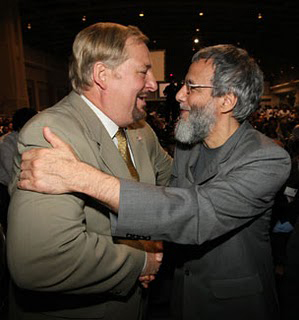
Rick Warren with his new best friend, Christ rejector Cat Stevens*, who changed his name to Yusef Isalm

Just recently, Rick Warren, founder and pastor of Saddleback Community Church in Orange County California, addressed the convention of the Islamic Society of North America. Warren stated that Muslims and Christians must work together to combat stereotypes, promote peace and freedom, and solve global problems. Christians and Moslems – faith mates, soul mates and now work mates! Chrislam!

Quote of the Day: “Before we “shake your hand” in responding to your letter, we ask forgiveness of the All-Merciful One and of the Muslim community around the world.” – Rick Warren in a speech to Muslims.

This weekend, the Memorial Drive Presbyterian Church in Houston along with Christian communities in Atlanta, Seattle, and Detroit will initiate a series of sermons that have been designed to produce an ecumenical reconciliation between Christianity and Islam. In addition to the sermons, the Sunday school lessons will center on the inspired teachings of the Prophet Mohammad. Qurans will be placed in the pews next to the Bibles. (NOTE: Due to the overwhelming response that this article has generated, the Pastor of Memorial Church has issued a semi-denial of the events we reported. They do not, however, deny supporting and teaching a doctrine called “Jesus in the Koran. Click here to read their semi-denial. So until other information is made available to NTEB, we will run the story as is, along with their side, and you the reader can decide what’s going on. But people, ask yourself…would any real, bible believing church try and teach it’s members about “Jesus in the Koran”? That’s blasphemy.)


The sign may be Photoshop, but the message it carries is all too real. Chrislam must be stopped now. If your church teaches this heresy – run!

The concept of Chrislam, now embraced by such preachers as Rick Warren and Robert Schuller, appears to have emerged from a program on the meaning of “love your neighbor” at Grace Fellowship Church in Atlanta, Georgia “In 2001, like most Americans, we were pretty awakened to the true Islamic presence in the world and in the United States,” says Jon Stallsmith, the outreach minister at Grace Fellowship. “Jesus says we should love our neighbors. We can’t do that without having a relationship with them.”

Stallsmith maintains that a rapprochement between Muslims and Christians can be achieved by the fact that Jesus is mentioned twenty-five times in the Quran.

The Chrislam movement has gained impetus by statements from President George W. Bush and that Christians, Jews, and Muslims all worship the same God and by Rick Warren’s reference to Isa (the Muslim name for Jesus) in his prayer at the inauguration of President Barack Obama. Only 30 percent of Americans have a favorable view of Muslims, according to a Pew Forum poll. At the same time, more than half the country says they know “not very much” or “nothing at all” about the Islamic faith. “The recent political developments and the fact that we’re fighting two wars in Muslim countries should sharpen that need to know how to talk to these guys,” Stallsmith insists “We want to find peace, reconciliation around a scriptural understanding of Jesus.”

Jesus in the Quran is neither the only-begotten Son of God nor the Messiah who was divinely appointed to restore the House of David. He is rather viewed as a prophet who was appointed by Allah to prepare mankind for the coming of Mohammad.”


* Steven Demetre Georgiou

...
.
*