Monday, March 10, 2025
Thursday, September 29, 2011
Concordat between Pope Pius IX and the Republic of Ecuador (1862)
26 September 1862
In the Name of the Most Holy and Indivisible Trinity.
His Holiness, the Supreme Pontiff, Pius IX, and the President of the Republic of Ecuador have nominated as their respetive plenipotentiaries:
― For His Holiness: His Eminence, Monsignor Giacomo Anonelli, Cardinal of the Holy Roman Church, Deacon of S. Agatha in Suburra, his Secretary of State and External Relations;
― For the President of the Republic: His Excellency, Monsignor Ignaçio Ordoñez, Archdeacon of the Cathedral Church of Cuenca in the same Republic, etc., etc., and Minister Plenipotentiary to the Holy See.
These persons, having exchanged their respective full powers, have agreed on the following Articles:
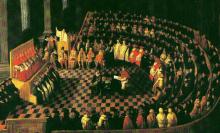 This concordat refers often to the Council of Trent (1545-1563) whose “main object was the definitive determination of the doctrines of the Church in answer to the heresies of the Protestants.”* The laws or “canons” enacted by Church Councils, together with papal pronouncements, were organised into the first Code of Canon Law in 1917. Subsequent concordats often refer to this “Canon Law”, but the Ecuadorian concordat, predating this, still cites specific enactments like those from the Council of Trent.
Article 1
The Catholic Apostolic Roman religion shall continue to be the sole religion of the Republic of Ecuador, and shall always be preserved there together with all the rights and privileges which it ought to enjoy according to the law of God and canonical enactments. In consequence, no other dissident form of worship or any society condemned by the Church shall at any time be allowed within the Republic of Ecuador.
Article 2
In every diocese which exists at present or which shall be created in the future, there should be a diocesan seminary, the supervision, curriculum and administration of which shall belong freely and exclusively to the diocesan Ordinary [bishop] according to the rules prescribed by the Council of Trent and other canonical laws. The Rectors, Professors and others taking part in teaching and administering such establishments shall be freely appointed and removed by the Ordinaries.
Article 3
The education of young people in Universities, Colleges, Faculties, public and private schools shall be in full conformity with the Catholic religion. The Bishops shall enjoy in the exclusive right of indicating books or texts for the teaching of religious knowledge, and also for religious and moral instruction. Furthermore, the Bishops and Ordinaries shall exercise with full freedom the right which belongs to them of prohibiting books contrary to religion and good morals; the Government also will keep close watch and will take the necessary measures to prevent the entrance into and diffusion of such books in the Republic.
Article 4
The Bishops shall attend to the duty of their pastoral ministry which is to prevent the teaching of any theory contrary to the Catholic religion and moral virtue. For this purpose, no one shall be permitted to teach in any educational establishment, whether public or private, Theology, Catechism, or Religious Doctrine without having first obtained authorisation from the diocesan Ordinary, who can revoke it when it shall seem opportune to him. For the examination of teachers in primary schools, the diocesan Ordinary shall always appoint a deputy for the purpose of enquiring into the religious knowledge and moral conduct of the candidates for examination, who shall not be able to enter upon the performance of their duties without the approval of the same diocesan Ordinary.
Article 5
Since the primacy of honour and of jurisdiction in the Universal Church belongs by Divine Law to the Roman Pontiff, the bishops, clergy and laity shall have free communication with the Holy See. Therefore, no secular authority shall have the right to place obstacles to the full and free exercise of the aforesaid communication by forcing the bishops, clergy and laity to act through the agency of the Government in order to approach the Roman See if occasion arises, or by subjecting Bulls, Briefs or Rescripts of the Apostolic See to the Government’s exequatur.
Article 6
The ecclesiastical Ordinaries of the Republic shall have full freedom be free to govern their dioceses with full liberty, to assemble and hold Provincial and Diocesan Councils, and to exercise the rights which belong to them by virtue of their sacred ministry and of the canonical arrangements valid and approved by the Holy See, without anyone being allowed to hinder them in carrying out their decisions. Furthermore, the Government of Ecuador will provide the Bishops with its utmost assistance and support, whenever it shall be required, principally when it shall be necessary to oppose the wickedness of those men who endeavour to pervert the minds of the faithful and to corrupt their morals.
Article 7
Appeals from sentences of the Ordinaries to the secular authority (commonly called recursos de fuerza) shall be abolished. As regards the execution of sentences pronounced by the usual ecclesiastical tribunals, it shall be possible to make appeal only to the superior ecclesiastical tribunals or to the Holy See according to the procedure laid down in the Brief Exposcit (May 15, 1572) of the Supreme Pontiff, Gregory XIII, and in conformity with the canonical requirements, particularly those laid down concerning matrimonial cases by Benedict XIV in the Constitution Dei miseratione or, alternatively, it shall be possible to bring a case of nullity or of complaint before the aforesaid superior instances. The ecclesiastical judicial authorities shall pronounce their judgements without previously submitting them to the scrutiny of the lay assessors whom, however, they may consult, when they believe it necessary. Ecclesiastical Advocates shall be able to exercise the office of assessor in this class of judicial cases.
Article 8
All ecclesiastical cases, especially those concerning the Faith, the Sacraments (including matrimonial cases), morals, sacred functions, sacred rights and duties, whether by reason of person or of matter, except more important cases reserved to the Supreme Pontiff according to the decision of the Holy Council of Trent (Sess. 24, Cap. V, de Reformatione) shall be brought before the ecclesiastical tribunals. The same rule shall be observed in civil cases concerning ecclesiastics and in others regarding crimes included in the Penal Code of the Republic. In all judicial cases which may be within ecclesiastical competence, the civil authority shall furnish all help and assistance to enable the sentences and punishments pronounced by the ecclesiastical judges to be observed and put into effect.
Article 9
The Holy See permits ecclesiastical persons and property to be subjected to public taxation in the same way as the persons and property of the other citizens of Ecuador are subject to it, provided, however, that the civil authority consults the Church to obtain its consent whenever coercion shall be necessary. Seminaries, property and objects directly destined for Divine worship, and charitable institutions shall be exempted from such taxes.
Article 10
Out of respect for the majesty of God, who is the King of kings and Lord of lords, the immunity of religious places shall be respected so far as is compatible with public security and the requirements of justice. When necessary, the Holy See consents that the ecclesiastical authority, parish priests and superiors of the religious houses may, at the request of the civil authority, give permission for refugees to be taken out.
Article 11
As the proceeds of the tithes are destined for the upkeep of Divine worship and of its ministers, the Government of Ecuador binds itself to preserve this Catholic institution in the Republic and His Holiness consents that the Government should continue to receive a third part of the proceeds of tithes. The two authorities (civil and ecclesiastical) shall come to an agreement about the collection and administration of tithes.
Article 12
By virtue of the right of patronage, which the Supreme Pontiff concedes to the President of Ecuador, the latter shall be able to propose suitable priests for the archbishoprics and bishoprics according to sacred canonical procedure. To this end, when a vacancy in an episcopal See falls vacant, the archbishop shall ask for the votes and opinions of the other bishops about filling the vacancy; if the archepiscopal See falls vacant, the senior bishop in that region shall collect the votes and shall present a list of three candidates at least to the President, who may choose one of them and present him to the Supreme Pontiff for the conferring of canonical institution according to the form and procedure prescribed by the sacred Canons. In a case where presentation by the bishops is not made within six months, for whatever reason, the president of Ecuador shall have the authority to act by himself and if he has taken no action within three months, the election shall be reserved to the Holy See, as the President himself has requested. To this effect, the Government or, failing that, the ecclesiastical authority shall report to the Holy See as soon as those periods have expired. The persons presented, however, shall not be able to engage in any way with the discipline and administration of the churches without previously receiving Bulls of canonical institution. In the creation of new bishoprics, the President of the Republic shall, on the first occasion, present the new bishops directly to the Holy See.
Article 13
Similarly, His Holiness concedes to the President of the Republic the right of naming suitable ecclesiastics to benefices of a Cathedral Chapter or to offices, canonries or functions therein with the exception, however, of the highest dignity which shall be at free disposal of the Holy See, and with the exception also of prebends which are not part of the concursus, namely those falling vacant in the months of March, June, September and December; these shall be at the free disposal of the bishops. The offices of Doctor, Penitentiary, Professor and the rest of the concursus shall similarly be provided for by the bishops only, after they have made examinations according to canonical requirements. Finally, if in any Chapter does not contain the number of Chapter members fixed in the Bulls of creation of the respective dioceses, the bishop shall be entitled, immediately or when funds shall be sufficient, to create the benefices which are lacking, and provision for them shall be made in conformity with the procedure set forth in the present Article.
Article 14
With respect to the provision for parochial benefices the Ordinaries, in compliance with the rules laid down by the Council of Trent, shall present to the Government a list of three suitable ecclesiastics, on one of whom the parish may be conferred; the President, whether directly or by the agency of his delegates in the provinces, shall choose one of these three. In a case where the Government for special reasons should demand a further three candidates to be proposed, the Ordinary shall have the authority to provide such a list, on condition that it shall in no way be possible to reject this second list. If it becomes necessary to make territorial divisions of parishes, this can be done by the bishops in consultation with the local civil authority.
Article 15
During the vacancy of an episcopal church, its Chapter shall freely elect a Vicar Capitular, within the time and according to the form prescribed by the Council of Trent, without it being possible for anyone to reverse this election, once it has been made, or to proceed to another one; any custom, however ancient it may be, and of whatever kind it may be, which would be contrary in this respect to the enactments of the sacred Canons is hereby completely over-ruled and utterly abolished.
Article 16
The Holy See, in exercise of its particular prerogative, shall create new dioceses and shall make new delimitations in those at present existing; and taking into account the present extent of the dioceses among which the Republic is at present divided, the Holy See will, immediately on ratification of the present Concordat, confer on its own special delegate the necessary powers to proceed in consultation with the Government and the respective bishops to the territorial demarcation of the dioceses which can be conveniently created and to fix the endowments and salaries of churches, bishops, chapters and seminaries.
Article 17
The executive decree of May 28, 1836, on the abolition of taxes imposed in favour of the Church, shall be itself abolished; and the Holy See in view of the usefulness which will result from the present Concordat, and desiring to provide for public tranquillity and to remedy the evils caused in the country by the transfer of these taxes to the National Treasury, and acceding to the repeated requests of the President, decrees and declares that those persons who, during the period which has elapsed from the year 1836 until the present, shall have made or promoted such trasfers, as also owners of the funds which have been acquired in this way and those who have in any way succeeded to the possession of the same, shall not receive, at any time or in any manner, the slightest molestation on the part of His Holiness or of his successors as Roman Pontiffs.
Article 18
With regard to the obligations contracted by the Government with its creditors because of the taxes transferred, the Holy See allows the Government to be free of all responsibility through payment of a tenth part (or less if the ecclesiastical Ordinary agrees) of both the capital transferred to the public treasury and also of the interest gained. To secure the payment of this amount, the Government shall assign to it a fourth part of the third which it shall receive from tithes; this shall be placed in the hands of the Ordinaries in order that it may be divided by them in proportional parts among their bona fidecreditors, care being taken that the principal is capitalised in a secure and productive manner. In the future it will not be permissible for any possessor of taxable goods to transfer to the public Treasury the required capital, and those who shall try to free their assets from the taxes imposed on them, shall not be allowed to do so in any way without the previous consent of the respective Ordinary and by handing the required capital to the Ordinary by whose permission it may be submitted in case of necessity to a wise and equitable reduction; it being understood however, that in every case due regard must be paid to the interests of the Church.
Article 19
The Church shall enjoy the right of acquiring freely and by any legitimate title both the properties which it now possesses and those which it may possess in the future, which shall be guaranteed to it by the law. The administration of ecclesiastical goods shall be entrusted to persons designated by the sacred Canons, who alone shall examine the accounts and economic regulations. Goods of ecclesiastical foundations, of whatever type they may be, which belong to hospitals and other charitable institutions and which are at present not administered by ecclesiastical authority, shall be restored to it, so that without delay it can assign those goods to their rightful purpose. With regard to both old and new ecclesiastical foundations, no suppression or union shall be possible without the intervention of the authority of the Holy See, except for the powers belonging to the bishops according to the Council of Trent.
Article 20
In addition to the religious Orders and Congregations at present in existence in the Republic of Ecuador, the diocesan Ordinaries shall be able, freely and without any exception, to admit and establish in their respective dioceses new Orders or Institutes approved by the Church in conformity with the needs of their people; to this end the Government will lend its support.
Article 21
After the Divine Office in all churches of the Republic of Ecuador, the following prayer shall be said: “O Lord, save the Republic. O Lord, save its President.”
Article 22
The Government of the Republic of Ecuador binds itself to provide all possible means for the propagation of the Faith by the conversion of pagans living in its territory; and to supply every assistance and help to the establishment and progress of the holy missions, which have been sent by the authority of the sacred Congregation for the Propagation of the Faith for this praiseworthy purpose.
Article 23
Other matters pertaining to ecclesiastical property or persons, of which no mention has been made in the Articles of the present Concordat, shall be regulated and administered according to the Canonical discipline existent in the Church and approved by the Holy See.
Article 24
By virtue of this Concordat all laws and decrees published hitherto in whatever manner and form in Ecuador are revoked in the respects in which they are contrary (to the Concordat); and the aforesaid Concordat is always to be considered as a perpetual law of the State. Therefore, each of the Contracting Parties binds itself, on behalf of their respective heads and their successors, to loyal observance of all and sundry of the component Articles. If in the future, any difficulty should arise, the Holy Father and the President of Ecuador shall confer with each other to obtain an amicable settlement.
Article 25
The ratifications of the present Concordat shall be exchanged within a period of one year, or sooner if possible.
In witness whereof the above-mentioned Plenipotentiaries have signed and sealed the present agreement with their respective seals.
Given at Rome on the 26th day of September, 1862.
Giacomo Cardinal Antonelli. Ignaçio Ordoñez.
Source
.
Friday, August 27, 2010
Vatican smokescreen on human rights
“Human rights language is being co-opted by those with an anti-human rights agenda, among governments but also armed groups and even within civil society.” — Claudio Cordone, Secretary General, Amnesty International, 2010 [1]
...
♦ Diplomatic recognition sought worldwide, bringing diplomatic immunity from charges of human rights abuse
Ratzinger's church lawyers have already assembled an elaborate defense strategy.
They argue that the pope, as the Vatican's head of state, enjoys immunity against lawsuits in US courts. They also point out that the American bishops who covered up abuse cases are not employees subject to directives from Vatican City. [7]
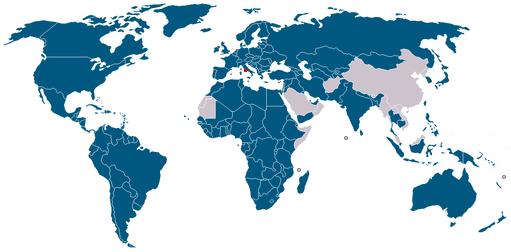
In U.S. courts foreign countries are generally immune from civil actions. This means that unless a case can be brought in under an exemption (as below), the only recourse may be to try to sue the Vatican in a country which does not have diplomatic relations with it. However, as the map shows, most of the world's countries (coloured blue) already recognise the statehood of the Holy See, as the Vatican is called officially.
There are very few (gray) countries left which don't yet have diplomatic relations with the Holy See. These amount to just three island nations (the Comoros, north of Madagascar, the Maldives, southwest of India, and Tuvalu, north of New Zealand) — two African nations (Mauritania and Somalia) — three from the Middle East (Saudi Arabia, Oman and Afghanistan) — and the eight from Asia (Bhutan, People's Republic of China, North Korea, Myanmar, Laos, Vietnam, Brunei and Malaysia). [8] The logistics of suing the Vatican from some of these countries could be daunting. Furthermore, due to the Vatican's persistent diplomatic efforts, the number of countries which don't recognise the Vatican is declining every year (and one of the few left, Tuvalu, is gradually disappearing beneath the rising seas).
Read 'whole' article @
http://www.concordatwatch.eu/showtopic.php?org_id=871&kb_header_id=40301
.
Friday, May 28, 2010
The secret costs of papal visits
• Security hysteria on the Pope's trip to Bavaria
• Gay Catholic youth not wanted
• Vatican's “World Youth Day 2005” funded by European Union

“Make the Pope's visit a pastoral rather than a state one. After all, its main focus ― the beatification of John Henry Newman ― is primarily a Catholic event; and one could argue that, by offering his pastoral guidance to an embattled Church, the Holy Father will achieve far more than by taking part in a state-funded public relations exercise.” ― Catholic Herald, 28 April 2010
.
.
When it comes to papal trips the pope gets the best of both worlds. He claims the diplomatic perks of a head of state to have his visit paid for by the country that has officially invited him [1], yet as a religious leader he doesn’t hesitate to make politically-charged statements about the policies of his hosts [2], which no real visiting head of state could get away with.
The host country is responsible for [the pope’s] travel expenses, room and board, and, most important, [his] large security needs. In order for this arrangement to work in any country that has separation of church and state, the papacy must be recognised as both a religious and political organisation. The host country is often responsible not just for the basic travel expenses, but also for all the street closures, traffic rerouting and police overtime. [3]
Security, the costliest item, was carefully left out of the British Government’s estimates for the cost of the papal visit. [4] However, this includes measures such as closed circuit TV cameras (for public events such as a Pontifical masses), additional police presence on the streets, the assignment of temporary security personnel to the Pope’s entourage, increased intelligence surveillance and the temporary adoption of certain anti-terror measures, such as heightened airport security. [5]
The Pope’s trip to Portugal in May 2010 featured the customary open-air mass with half a million worshippers. [6] Yet, the British state visit in September is shaping up as a tightly-controlled tickets-only event, where even Catholics with tickets will be turned away unless they arrive on buses chartered by their diocese. “Tens of thousands of Catholics will be unable to attend papal events” and thus be denied the chance to see the Pope. [7] If it were a pastoral visit, as recommended by the Catholic Herald, there would be no possibility of protests and one would hope that the faithful could be given better access. Is the Pope’s insistence on being treated as a sovereign interfering with his role as shepherd to his flock?
The popemobile, shipped abroad by air cargo before each papal trip, is a modified Mercedes-Benz M-Class off-road vehicle. It is rugged, powerful and weighs four tons. The Pope sits in a high seat in the back within a cube made of advanced, bulletproof plastic. ...Shortly before the Pope's 2010 tour of Malta in his armoured vehicle, a Maltese enquired if anyone could lend the His Holiness a donkey so that he could use the same transport as Jesus did.
Malta, April 2010: The Government claimed that the papal visit would cost €200,000, but this has been called by one of the country’s leading newspapers “not even enough to pay for the overtime of police officers”, let alone the other security costs. [8]
Furthermore, it is understood that the pope’s personal security costs will be “considerably higher” than when the trip was planned because of an incident during the Christmas Eve Mass at in Rome. As the Pope walked in procession down the aisle of St. Peter’s an unarmed woman scrambled over the barricade and ran towards him. When the black-suited security guards tackled her, she clung to the pope’s robes, pulling him down with her. His mitre and staff clattered to the marble floor, but he was unhurt. [9]
Any government inviting the Pope is responsible for protecting him, even within a church and even from unarmed admirers. In the Vatican the Swiss Guards cope with what they call “religious fanatics” by using pepper spray, however, host governments must take everything very seriously. This is an expensive task and politicians are reluctant to reveal its costs, the British Government going so far as to claim that it could omit security from the estimates because it was covered by “existing budgets”. [10]
Also not acknowledged as associated with the papal visit is the “extensive work being carried out on the country’s roads, the quality of which has already been questioned.” [11] In addition, thousands of flowers have been planted along the papal route. And at the end of his visit, the Maltese taxpayers will pay to fly him out, just as they paid to bring him there. Air Malta flight KM1950 has been chosen to mark the 1,950th anniversary of St. Paul’s visit to the island. [12]
However, the arrival of St. Paul, which this event commemorates, was somewhat different. His ship struck a reef, the hull broke up and the Saint swam ashore. [13] That apostolic visit was accomplished at no cost to the Maltese taxpayers.
Australia, July 2008: The price tag that the Church got an Australian premier to hide has finally been revealed by the Auditor General. On the heels of embarrassing figures showing that the papal youth jamboree scared off tourists, the government of New South Wales has belatedly released figures on the budget shortfall of World Youth Day, July 2008. As a visiting head of state, Benedict XVI had his accommodation and (massive) security paid for by his hosts and now the taxpayers will have to come up with 100 million Australian dollars more.
In preparation for the Pope’s visit to Sydney, Australia, the premier of New South Wales had a financial statement drawn up which he said showed the papal jamboree would bring in $150 million Australian. Then the Catholic Church got the Government of Premier Morris Iemma, who happens to be Catholic, to exempt this report from the Freedom of Information Act, claiming it would be against the public interest to allow anyone to check the figures. [14] All that could be gleaned was that $41 million in public funds was paid to the race track where the event was held and it's been estimated that at least another $20 million was spent on security. Not included here is the cost of providing emergency services and of billeting pilgrims in state schools. [15]
Until late November Premier Iemma's government was still resolutely refusing to reveal the price tag for "the joy it brought to our city". Later, however, Tourism Australia released figures suggesting that far fewer attended the World Youth Day than the Church had estimated. And most of the “pilgrims” who did turn up, quite naturally took the free accommodation provided by the state and didn't use hotels. [16] Furthermore, the tourism department's figures indicate that the event actually ended up costing Sydney some 63,000 visitors who preferred not to spend their holiday in a city full of fervent teenagers. Yet even long after the event the information on the government's expenses is still being treated like a state secret. [17]
In the wake of news of the tourist shortfall, the financial shortfall was made public when the Auditor General was finally allowed to release his “top secret” report. According to this, the Australian taxpayers will have to pay an additional $100 million AUD (about £42.3 million British pounds). [18]
France, September 2008: The costs to the taxpayer of the papal visit to Paris and Lourdes from 12-15 September, are still being held secret. However, from the security measures alone it's clear that also this papal visit didn't come cheap. [19] A few highlights:
Two “popemobiles”, each weighing 4 tons, were flown in by military Hercules C-130 transport planes to Paris 10 days in advance so that the police could become proficient in driving them.
In Paris 2000 police formed a network through the capital, the river brigade was mobilised to watch the banks of the Seine, and sharpshooters were posted on high points.
Glass bottles, large flags, banners, posters or signs were forbidden.
About 72 hours before the pope's arrival in Lourdes, the holy site was “decontaminated” by mine detectors.
Company Number One of motorcyclists from France's élite riot police controlled the entrance to the football stadium where the pope would hold the rally. The local airport of Tarbes-Lourdes-Pyrénées was guarded by police, while the hills which overlook the town were patrolled by the mounted brigade.
And finally, Lourdes was blanketed with an aerial security cordon extending for 20 kilometres in all directions, where radar, planes and missiles would be prevented from attacking the pope.
What all this security cost the French taxpayers has never been revealed.
However, for the 2006 papal trip the government took stronger measures: it banned outright the sale of spirits in the cities visited by the Pope — but not, of course, in the duty-free shops for tourists. Thus in Kraków the only place where you could buy vodka during the Pope's visit was at the John Paul II Airport.Brazil, May 2007: Nor do we know the true cost to the Brazilian taxpayers of the papal visit estimated at 50 million Brazilian reais [20] (about 28 million US dollars or 18 million British pounds) — a trip which the Pope used to urge the signing of a concordat.
A massive security operation — the greatest ever adopted in Brazil — was launched to protect the Pope, with some 10,000 police agents as well as helicopters, cameras and two bulletproof popemobiles. [21] However, at least they didn't have to pay as much as the Vatican was expecting. “Reportedly, the Vatican was quite ‘upset’ that Brazil was unable to organise (and pay for) the Pope’s return air trip to Rome.” [22]
Germany, September 2006: Also not revealed are the expenses footed by the German taxpayers from Benedict XVI's first papal trip, (9-14 September 2006). However, in the course of the preparations for it, the president of the Bavarian Police Union, Harald Schneider got a look at the cost of the Pope’s security. This led Schneider to remark that it would have been cheaper if the German taxpayers had given every Catholic pilgrim who wanted it, a round-trip ticket to go and see the Pope in Rome. [23]
Of course, in the end both the Australian and the German taxpayers can afford to subsidise the pope. But unfortunately, papal trips are not confined to lands like these. The much-travelled John Paul II visited 129 different countries, few of them as wealthy as Australia and Germany.
Angola, March 2009: In addition to the cost of the 10,000 police officers, there was security in the form of anti-terrorism measures such as sharpshooters to protect the route taken by the Popemobile. [24] One wonders who protected the poor Angolans from police who are noted for practicing with complete impunity “arbitrary arrests and unlawful detention, torture and ill-treatment, deaths in police custody and extrajudicial executions”. [25]
Tanzania, September 1990: At that time the former nun, Maria Lauda/Majella Lenzen, was working in a Tanzanian hospital. (She was later expelled from the Sisters of the Precious Blood for distributing condoms to fight the epidemic there of AIDS. [26]) As she relates, “Suddenly the order came for every villager to pay 1000 Tanzanian shillings for the necessary security measures. That’s a month’s wages for a family. But, in order to save face, almost everyone paid up. Even when they had to incur large debts”. [27]
.
See also: Papal trips: both “pilgrimages” and “state visits”
Further reading about the Pope’s Australian trip: Max Wallace, “World Youth Day wash up”, Online Opinion, 5 February 2009.
Notes
.
http://www.onlineopinion.com.au/view.asp?article=8475
.
Source: http://www.concordatwatch.eu/showtopic.php?org_id=872&kb_header_id=28331
..
Sunday, July 05, 2009
Trinidad and Tobago - The Concordat of 1960
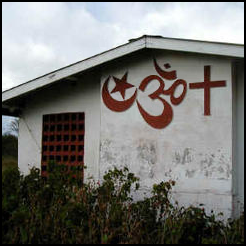
This ecumenical building is from western Trinidad. Due to its history, Trinidad, (Spanish for "Trinity"), has a Catholic population of almost, 30%, followed by Hindus, Protestants (mostly of the exhuberant varieties) and Muslims. To try to compete with Pentacostalism, orthodoxy has been relaxed in favour of a "Catholic Charismatic Renewal".
"Clause 2 states that materials or books to which the denominational authority formally objects will not be introduced or imposed in their schools. In a multi-religious democracy such as ours this is an untenable imposition in schools that receive public funding and which cater for students of all faiths." -- Senator Professor John Spence
Assurances for the Preservation and Character of Denominational Schools
As approved by Cabinet
The Minister of Education and Culture wishes to clarify for general information some of the proposals on Education with reference to the re-organization of Education so far as those proposals affect the Denominational Boards of Management, the Governing Bodies and Principals of Assisted Secondary Schools.
1. In relation to property, the ownership and right of direct control and management of all denominational primary and secondary schools will be assured to the denominations in whatever modifications of the existing system that may subsequently be introduced in the New Education Ordinance, and all existing rights, so far as property is concerned, will be respected.
2. In denominational schools, no books or apparatus to which the denominational authority formally objects, will be introduced or imposed.
3. In denominational schools (unless the Denomination concerned otherwise gives its consent) the religion of the particular denomination which owns the school will be taught exclusively and by teachers professing to belong to that Denomination. In Government Schools all recognized religious denominations will have access through their accredited representatives during the times specified in the time-table for the teaching of Religion to the pupils belonging to their faith. Pupils attending the schools of a denomination not of their own faith will not be compelled to take part in the religious exercises or lessons of that denomination.
4. The right of appointment, retention, promotion, transfer and dismissal of teachers in Primary Schools will rest with the Public Service Commission. A teacher shall not be appointed to a school if the denominational board objects to such an appointment on moral or religious grounds. Similarly, if a teacher be found unsatisfactory on these very grounds, moral or religious, the denominational authority shall have the right to request his removal to another school after due investigation. For these reasons it is proposed (provided the legal and constitutional arrangements allow) "that vacancies as they occur in all schools should be advertised and applications submitted in the first instance to the respective Board of management which will examine them and forward them all, with their recommendations, to the Public Service Commission for final action."
Secondary Schools
5. The existing relationship between Government and the Governing Bodies and teachers in Assisted Secondary Schools will remain subject however, to negotiated changes inevitable with the introduction of Free Secondary Education and to a system of inspection of these schools by persons authorized to do so by the Ministry of Education and Culture. The Governing Bodies of these schools will continue to be responsible for the administration of these schools and for their maintenance, repair and furnishing. Those schools will continue to qualify for Government Aid. The Principals of Assisted Secondary Schools will make available a minimum of 80 per centum of the First Form entry places to those who, by passing the test, qualify on the results of the Common Entrance Examination for free secondary education. The Principals will be represented on the panel of examiners to be set up to administer the test. The Principals will be free to allocate up to 20 per centum, the remaining places as they see fit provided normally that the pass list of the Common Entrance Examination serves to provide the pupils. Entry above the First Form will be under the control of the Ministry of Education and Culture and will require the approval of the Minister.
6. Where the need arises for disciplinary reasons or unsatisfactory progress to remove a pupil from the school, the right to request such removal will remain with the Principal who may for the same reasons suspend a pupil pending investigation. Authority to expel a pupil is vested solely in the Cabinet. For disciplinary reasons the same principle will apply to Primary Schools.
7. All new Central Schools may be established only by Government for the simple reason that these schools are to be fed from the Primary Schools of all Denominations, as well as Government Schools, which may be in the area served by the Central School. Where, however, the need arises for converting an existing denominational school into a secondary school, the denominational character of that school will be allowed to remain.
8. The selection of teachers for training at the teachers' college is to remain solely with the Ministry of Education and Culture. Selection of teachers for training in the existing denominational training colleges may be made by the Denominational Boards, but such selection must be approved by the Ministry of Education and Culture.
9. It is the desire of the Government that all teachers be trained at the teachers' college under Government supervision and administration. Government will however respect the rights of the existing training colleges conducted by the denominations; but no expansion of those facilities will be allowed without the expressed permission of Government.
Signed by Hon. J.S. Donaldson,
Minister of Education & Culture,
on behalf of Cabinet on 22 December 1960,
and published on 25 December, 1960


Wednesday, December 31, 2008
New Nations From Old Ones

--------------------------------------------------------------------------------
NEW NATIONS FROM OLD ONES
When in 1917, during the First World War, the Papal Nuncio in Munich, E. Pacelli, secretly negotiated with the Central Powers to accomplish the Pope's Peace without Victory, in order to save both Germany and Austria-Hungary from defeat, he had already made his first attempt to strangle a nation as yet unborn; Yugoslavia. If the Vatican's attempt was directed at preserving its most useful Hapsburg lay partner, it simultaneously had another no less important goal: to prevent a motley of nationalities from springing out of the Empire's ruins as sovereign States in their own right. In such States, Poland excepted, Catholicism would have sunk to the level of a minority. Worse, it would have been dominated by heretical churches and their political Allies: i.e. by the Protestant and Liberal in Czechoslovakia, by the Orthodox in Yugoslavia. With its last attempt to save the Austro-Hungarian Empire, the Vatican therefore struck a final blow against the yet unborn "Hussite" Czechs and the Catholic Slovaks on one side, and the Orthodox Serbs and Catholic Croats and Slovenes on the other, the fulfillment of their dreams lying as it did in the disintegration of the Austro-Hungarian colossus.
The Emperor Charles was advised to transform the Empire into a Federation. The idea, which originated at the Vatican, was repellent to both, as it meant, besides the loosening of Imperial control, the loosening of Catholic control over the various races of the tottering Empire. But in the circumstances the alternative was total collapse. In October Charles announced the transformation of the Hapsburg Monarchy into a Federal State. The offer—which, significantly, was made only at the last moment—although accompanied by secret papal moves, left the Allies determined to end for good the rule of the double-headed Austrian eagle. President Wilson's reply to Charles, and thus to the Pope, was firmly hostile. The USA, said Wilson, admitted "the justice of the national aspirations of the Southern Slavs." It was for these people, he added, to decide what they would accept.
As far as the USA was concerned, he concluded, it had already recognized Czechoslovakia as a belligerent independent State. The American reply had sealed the fate of Austria-Hungary. On October 28, 1918, the Czechoslovaks declared their independence. On the 29th the Yugoslavs proclaimed theirs. On December 1 the Yugoslav Council invited the Regent, Alexander, in Belgrade, to proclaim the Union. The new independent kingdom of the Serbs, Croats, and Slovenes—Yugoslavia—had come into being.
The birth was welcomed in certain quarters—e.g. by the Allies—and was unwelcome in others—e.g. the Vatican—to which the new nation, besides being the unnatural creature of the Allies' political blindness, was a religious aberration not to be tolerated. Orthodoxy, swept away in Russia, where it had seemed unassailable, with the birth of Yugoslavia had now become paramount in a country the population of which was more than one-third Catholic. Worse still, in addition to permitting Orthodoxy to rule Catholics, Yugoslavia was preventing the latter from setting up a wholly independent Catholic community. When to the above was added the fact that Yugoslavia, by her mere existence, represented the greatest obstacle to the long-range Catholic strategy, the Vatican's feeling, more than one of hostility, become one of implacable hatred, a wind which boded no good to the young nation. This hatred became the main inspirer of the Vatican's anti-Yugoslav strategy, the objective of which was the destruction of Yugoslavia. Having embarked on such a course, the Vatican began a vigorous campaign, the fulfillment of which to some extent depended on another factor: the collapse of Bolshevik Russia, the early disappearance of which was, at that period, taken almost for granted by everyone, particularly by the Allies, who had dispatched sundry armies to hasten her collapse. The Vatican counted, then, on a Russian collapse in order to execute its policy of a forced Catholic domination of the Balkan peninsula through the sword of Pilsudski. The creation of the Catholic Danzig-Odessa Polish Empire would have meant one thing: the death of Yugoslavia and other Balkan Orthodox and Protestant countries. When, however, Pilsudski's bloody adventure terminated and the Allies' efforts to destroy Bolshevik Russia relaxed, the Vatican changed its tactics and embarked on a new policy: destruction of Orthodoxy by penetration, instead of by force. Consequently, when in 1920 Pilsudski's Catholic Empire vanished, and the Pope set out to convert Russia, a parallel policy was pursued in connection with Yugoslavia. Although the keynote of this new anti-Orthodox strategy was penetration, its tactics were different in each country. Thus, whereas in Russia they were meant to penetrate in order, in the long run, to dominate her religious life, in Yugoslavia they consisted of penetrating Yugoslav political life in order, once Catholics had come to control it, to enhance the power of Catholicism, and thus ultimately stultify, and indeed paralyze, the Orthodox Church throughout Yugoslavia.
Such a policy, vigorously promoted, mostly by ambitious, clerically-dominated Catholic politicians in Croatia, yielded no little success. In no time Catholic clericalism became a power behind the scenes, with the result that, within a few years, the Hierarchy began to exert undue weight in the administration, not only of Croat affairs, but also of those of Yugoslavia as a whole. This alarmed several honest Catholic Croats, notably Radich, leader of the powerful Croat Peasant Party, aware of the danger that such tactics were creating both for Yugoslavia and for Croats. Defying the Hierarchy—and thus indirectly the Vatican—he began to combat the Catholic Trojan-horse tactics, warning Croatia that, by permitting their politicians to be led by the Hierarchy in political matters, they were bound, sooner or later, to lead all Croats to disaster. Radich's counsel was followed; and for almost a decade Catholic strategy, weakened where it should have been at its strongest, was far less successful than if Radich had acted otherwise.
But in 1928 Radich was assassinated. The assassination coincided with the general overhaul of Vatican European strategy towards Communism. In that same year the Curia finally broke off its negotiations with Soviet Russia. The Papal Nuncio in Germany, E. Pacelli, led the powerful Catholic Centre Party sharply to the extreme Right, thus allying it with the forces which were to sky-rocket Hitler to power. In Italy the Vatican strengthened Fascism by signing a pact with Mussolini (1929). Fascist Catholic movements rose everywhere. An era of Catholic policy had ended, and a new one had begun. The policy of penetration had been replaced by one of active agitation and the swift mobilization of all the religious and political forces of Europe against
Strip of photographs from the Album of Terrorists, maintained by the Yugoslav Secret Police, as early as 1933. Bottom row, first left, Ante Pavelic, the future Leader of the Independent Catholic State of Croatia. Prior to the latter's establishment, all the men above, as sworn Ustashi were engaged upon the promotion of a policy of terrorism, within and outside Yugoslavia. This they did by murdering singly or collectively, political enemies or innocent people alike. They placed explosives in public places, ships or trains. For instance, a train compartment was blown up by an Ustashi bomb at Zemum, killing the family of Professor Bruneti.
Before the Second World War these men were active all over Europe. Their most spectacular success was the simultaneous assassination of the King of Yugoslavia and of Mr. Barthou, the French Foreign Minister, during a State visit to France, 9 October 1934. The double murder was the forerunner of a series of many others which were to contribute to the birth of the Independent Catholic State of Croatia.
The Ustashi and Ante Pavelic were "protected" by Mussolini, and tacitly but effectively by the Vatican. Both supported them financially.
Bolshevik Russia. Thus, while in the West the Vatican had launched upon a global hate campaign against Communism, in the Balkans, after Radich's death, it embarked upon a policy directed at the disintegration of Yugoslavia.
Radich's successor, Dr. Macek, reorientated the Croatian Peasant Party into a rabid nationalist movement which, by becoming increasingly bold, became an active factor for the growing political tension inside Yugoslavia. From this period onward, Separatism became the keyword of Croat Nationalism, with the result that the latter began increasingly to play into the hands of the Catholic Hierarchy and thus into those of the Vatican. The Vatican's policy in the first decade implied Yugoslavia's existence as a united nation; in the second—i.e. since the emergence of a naked Separatism—it overtly aimed at Yugoslavia disintegration. In the promotion of the Vatican's new grand strategy, Yugoslavia was reckoned a major obstacle even more than in the past, in that now it was impeding the swift Fascistization of Europe and the eventual Fascist attack on Soviet Russia, with all the ensuing Balkan commotion which, it was hoped, would cause the tumbling of Yugoslavia itself. In connection with the latter, the Vatican laid down a three-fold policy:
(a) The detachment of Catholic Croatia from the rule of Orthodox Serbia,
(b) the setting up of Croatia as an independent Catholic State, and, last but not least,
(c) the possible creation of a Catholic Kingdom in the Balkans.
For such goals to be attained, one thing was necessary: the partial or total disintegration of Yugoslavia.
To assert that Yugoslavia succumbed thanks only to Vatican machinations would be to falsify history. On the other hand, to minimize its role would be a crude historical distortion. Factors alien to religion played into its hands. These could be summarized as: the animosities of the Croats and the Serbs in the domestic field, the political ambitions of Fascist Italy and Nazi Germany in the international. Croat Separatism became an increasingly important factor as the internal and external tension grew. Its identification with Catholicism made it almost a blind tool of the Catholic Hierarchy, and thus of the Vatican, which unhesitatingly used it to further not only its local interests, but also its vaster Balkan schemes of religio-political domination.
Typical portraits of Ustashi leaders. Men like the above were the brains behind the numberless acts of terrorism carried out by the Ustashi in Yugoslavia, Austria, Hungary, Germany, France and in other countries, chiefly from their headquarters in Fascist Italy.
(Left) Mijo Bzik, known as "Miko," was chief of the Ustashi camps in Italy, and the recruiter of the assassins who came from Yanka-Pusta. One of his main tasks was the placing of internal machines in public buildings, or crowded places.
(Centre) Eugen Kvaternik, one of Ante Pavelic's principal accomplices. He personally accompanied from Italy to France, the assassins, who went to murder the King of Yugoslavia. Pavelic created him Minister of Police when Catholic Croatia became independent.
(Right) Zvonimir Pospishil, one of the most brutal of terrorists. He belonged to a special group of Catholic Ustashi charged with the assassination of eminent personalities. He was given the task of killing King Alexander, by blowing him up in Paris had the Marseille plot failed in 1934.
The Croat leader, Radich, never tired of warning the Croats against following the Vatican in political matters; in this he echoed the voice of another great Catholic patriot, the leader of the Polish Nationalists, Roman Dmowski, whose slogan became a by-word of certain Catholic Polish Nationalists: "Never rely upon the Vatican in political affairs."
Hostility to Vatican political directives by Catholic political leaders was born out of bitter experience: e.g. during the First World War, when Roman Dmowski, having gone to Rome to ask for help to establish Polish independence, was greeted with open disfavour, such Vatican hostility being inspired by political interests identified with those of Austria and other great European Powers who had worked against Polish aspirations for centuries. The extraordinary result of this was that the Poles never got any support from the Vatican, even when they rose against the Czars—an attitude which incensed them to such a degree that one of their great national poets, Julius Slowacki, coined the famous warning: "Poland, thy doom comes from Rome." Which subsequent events proved was more than prophetic.
Radich adopted the same slogan, although with more tact. When, however, his Party was taken over by Macek, the original ideal of Ante Starcevic was swiftly injected with a new overdose of undiluted extremism, which made it turn sharply to the extreme Right. The main exponent of this new trend was one Ante Pavelic, an individual obsessed by the idea of an independent Croatia, inspired by racialism, erected upon Fascism, wholly impregnated with Catholicism, a formidably compact miniature totalitarianism. A movement sprang out of this weird conception; its backbone a ruthless core of terrorist bands, led by Pavelic himself, whose policy consisted of blackmail, murder, plots, and assassinations. The shadow of powerful protectors from across the sea descended swiftly upon them, thus enabling them to carry on their activities in defiance of national or international procedure—e.g. from Italy and Germany, both of whom saw in Pavelic's Croatia a useful instrument for Fascist and Nazi expansion in the Balkans.
The expansionist policies of these nations often ran parallel with that of the Vatican, which, by skillfully manipulating them, could frequently promote its own interests. It did that, not by remaining only an aloof spectator of various Fascist and Nazi activities, but by promoting a most vigorous anti-Yugoslav policy of its own.
The Vatican and Fascism helped each other from the beginning. Pope Pius XI (1922-1939) ordered the Leader of the Catholic Party to disband it (1926), the better to consolidate the regime of Mussolini. The latter negotiated the Lateran Treaty and Concordat with the Church (1926-1929).
By virtue of the first, the Vatican became a sovereign state within Rome. While with the second, the Church was granted immense privileges and Catholicism was declared the only religion of Fascist Italy, which it wholeheartedly supported.
Bishops took an oath of allegiance to the Fascist Dictatorship, and the clergy were ordered never to oppose it or incite their flock to harm it. Prayers were said in Churches for Mussolini and for Fascism. Priests became members of the Fascist Party and were even its officers.
One of the main supporters of the Fascist-Vatican pact was Mgr. E. Pacelli (the future Pope Pius XII), then in Germany. His brother, a lawyer, became one of the chief secret negotiators. He is seen in this photograph standing behind Cardinal ...... Later, the Papal Nuncio to Germany, Mgr. E. Pacelli saw to it that his brother was made a Prince.
This yielded a rich harvest sooner than was expected. While the Vatican's Fascist associates were busy engineering political or terrorist activities, Catholic diplomacy—as previously in Spain, Austria, Czechoslovakia, Belgium, and France—came to the fore with the promotion of a powerful Catholic fifth column. This, which had already gnawed at the internal structure of Yugoslav unity, consisted of all those Croats infected with national-religious fanaticism, of the Catholic Hierarchy of Croatia, and of an illegal Nationalist Army composed of bands of Catholic terrorists, called the Ustashi, the last led by Ante Pavelic, supported by Vladimir Macek, leader of the Croat Peasant Party, who in 1939 arranged for Mussolini to finance him with 20 million diners for the Croat Separatist Movement, and by [1] Archbishop A. Stepinac, leader of the Catholic Hierarchy in Croatia.
The specific role played by the Vatican followed the familiar pattern: use of the Hierarchy to help political and military plotters engaged in undermining or overthrowing the legal Government. Unlike its practice in other countries, however—e.g. Petain's France or Franco's Spain—here the Catholic Church attempted to erect, and indeed did erect, a State in complete accord with all her tenets. The result was a monster standing upon the armed might of twin totalitarianism: the totalitarianism of a ruthless Fascist State and the totalitarianism of Catholicism—the most bloodthirsty hybrid yet produced by contemporary society. What gives to such a creature of Vatican diplomacy its peculiar importance is that here we have an example of the Catholic Church's implementing all her principles, unhampered by opposition, or by fear of world opinion. The uniqueness of the Independent Catholic State of Croatia lies precisely in this: that it provided a model, in miniature, of what the Catholic Church, had she the power, would like to see in the West and, indeed, everywhere. As such it should be carefully scrutinized. For its significance, by transcending its local background, is of the greatest import to all the freedom-loving peoples of the world.
--------------------------------------------------------------------------------
Footnotes
1 See The Ciano Diaries, 1946, pp. 46,48,50-60. [Back]
The sensational account of the most horrifying religious massacre of the 20th century