Showing posts with label filibuster. Show all posts

Friday, February 09, 2018

What If They Held a Faux-Filibuster and Nobody Came?


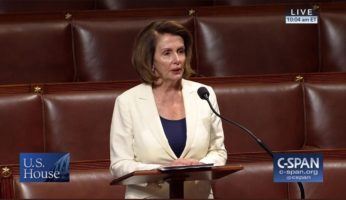
Minority Leader Pelosi talks (and talks) DACA


By Andrew R. Arthur on February 8, 2018


Minority Leader Nancy Pelosi took (D-Calif.) to the floor of the House of Representatives yesterday and spoke for more than eight hoursto argue for regularization of the status of aliens granted Deferred Action for Childhood Arrivals (DACA). According to the Washington Post:


The 77-year-old Pelosi stood for more than eight hours, reading multiple personal stories from "dreamers" and citing Bible passages. Her speech ranked as the longest given by a member of the House of Representatives in at least a century, possibly ever, focusing on an issue that has vexed Democrats for months.

...

At one point, she lamented that she didn't have a rosary, so Rep. Rosa L. DeLauro (D-Conn.) gave her one. Pelosi read passages from the Gospel of Matthew found for her by Rep. Juan Vargas (D-Calif.), a former Jesuit missionary.


Technically, it was not a filibuster, which is strictly a Senate procedure. As the Washington Examiner explains, however:


[B]oth Pelosi and House Speaker Paul Ryan, R-Wis., are both permitted to talk at length on the floor because of their leadership status. Both of them often request one minute to speak, but go on for several minutes, a privilege afforded to them because of their status.

The triggering factor for this unusual act was the passage by the Senate of a two-year budget agreement that did not include a provision for DACA beneficiaries.

Thursday, February 18, 2016

With the tables turned, Obama now 'regrets' his 2006 Alito filibuster


Gregory Korte, USA TODAY
5:18 p.m. EST February 17, 2016


(Photo: Susan Walsh, AP)


WASHINGTON — President Obama has come to regret his decade-old filibuster of Justice Samuel Alito, the White House said Wednesday as Senate Republicans threatened to block his nominee to replace Antonin Scalia on the Supreme Court.

The Alito nomination has become one of many historical footnotes that have taken on new relevance as Obama and the Republican-controlled Senate jockey for high ground in their battle over the election-year Supreme Court nomination. White House Press Secretary Josh Earnest called Obama's decision to join in the filibuster of Alito in 2006 a "symbolic vote" based on specific objections to Alito's rulings as a lower court judge.

"What the president regrets is that Senate Democrats didn't focus more on making an effective public case about those substantive objections," Earnest said. "Instead, some Democrats engaged in a process of throwing sand in the gears of the confirmation process. And that's an approach that the president regrets."

At the time, Obama told ABC News that he supported the filibuster "because I think Judge Alito, in fact, is somebody who is contrary to core American values, not just liberal values." Obama said the court needed to "provide some check on the executive branch, and he has not shown himself willing to do that repeatedly."

But during his nomination of Sonia Sotomayor in 2009, now-President Obama already appeared to have misgivings, saying "last-minute efforts using procedural maneuvers inside the Beltway, I think, has been the wrong way of going about it."

And at a news conference on Tuesday, Obama said both parties bear some responsibility for the broken nomination process.

"I think what’s fair to say is that how judicial nominations have evolved over time is not historically the fault of any single party. This has become just one more extension of politics," he said. "What is also true is Justice Alito is on the bench right now."

Alito was confirmed by a vote of 58 to 42, one week after his confirmation cleared the Judiciary Committee.


USA TODAY

10 years after, Supreme Court Justice Samuel Alito makes his case

Obama also acknowledged a well-known secret of legislating: The opposition party often allows some senators to vote against a nominee, while also counting votes to ensure the confirmation goes forward. "And my expectation is, is that the same should happen here," Obama said Tuesday.

The issue of Obama's 2006 opposition to Bush's last Supreme Court nominee has re-emerged in the wake of Obama's intent to nominate a justice to replace the conservative Scalia. Senate Majority Leader Mitch McConnell has suggested that the Senate won't even consider any nomination, saying it should be left to the next president to decide.

"There is a difference between the president's symbolic vote against President Bush's Supreme Court nominee and Republicans' reflexive opposition to the idea of President Obama even nominating anybody to the Supreme Court," Earnest said. "What Republicans are advocating is wrong and is inconsistent with the requirements of the Constitution, primarily because the wording of the Constitution is unambiguous and does not provide an exception for election years."

It's unclear how long it will take for Obama to put forward a name. Previous vacancies have taken about a month, although Obama already has a short list from his two previous nominations and appears anxious to move quickly once Scalia's funeral is over and the Senate returns from recess next week.


USA TODAY

Obama to visit Supreme Court Friday to pay respects to Scalia


The White House would not rule in or out any candidate for the nomination, except one: Obama himself.

"The president himself has said in the past that, while he obviously holds in high esteem those who dedicate their lives to serving the country on the Supreme Court, he envisions something different for himself once he leaves the presidency," Earnest said. "So I haven't asked him that direct question, but I think all the available evidence indicates that that option is highly unlikely."


.

Sunday, April 11, 2010

Top Republican Says Filibuster of Supreme Court Nominee 'Unlikely'

Posted: 04/11/10


Senate Minority Whip Jon Kyl said Sunday he would not take the possibility of using a filibuster to try and block confirmation of whoever President Obama nominates to the Supreme Court "off the table," but he said the chances of Republicans using that tactic was "unlikely."

"I am going to abide by what became known as the rule of the gang of 14," Kyl said on ABC's This Week. "It is unlikely that there would be a filibuster, except if there is an extraordinary circumstance."

Kyl was referring to the group of seven Democratic and seven Republican senators who joined together to avert a major partisan clash in 2005 when the Republican leadership, angered by the Democrats' blocking of votes on former President Bush's judicial nominees, threatened to use the "nuclear option" of changing the rules to curtail the minority's ability to filibuster. Under the agreement fashioned by the "gang," the seven Democrats agreed not to resort to the filibuster except under "extreme circumstances." That exception was never defined and its interpretation was left up to individual senators.


"President Obama himself attempted to filibuster Justice (Samuel) Alito, who now sits on the Supreme Court," Kyl said. "So if the president isn't going to take it off the table, I'm not going to take it off the table. But I think it can easily be avoided by appointing ... someone who is mainstream enough that with intellect and the application of good law can persuade colleagues to support his position or her position."

On Fox News Sunday, Sen. Lamar Alexander (R-Tenn.) also said he'd abide by the "Gang of 14" precedent. "Except in cases of judicial extraordinary cases, we're going to allow up-or-down vote," he said. "I still believe in that. That's my view. There was no even discussion of a filibuster of Justice (Sonia) Sotomayor. And I was one of the Republicans who voted to confirm her."


Obama will get his chance to choose a second justice for the high court -- his first was Sotomayor -- due to the retirement of John Paul Stevens, who evolved in his 35 years on the bench into the leader of the court's liberal wing. Some of the most-mentioned possibilities are Solicitor General Elena Kagan, U.S. Court of Appeals Judge Merrick Garland and Diana Wood, also a Court of Appeals judge.

Kyl called that group "all nominally qualified" and said "the question I think to present is, do judges like this or candidates like this approach judging on the basis of each case presenting its unique facts and law and being decided strictly on that basis, rather than with a judge coming to the bench with an ideological position."

Sen. Patrick Leahy (D-Vermont), chairman of the Judiciary Committee, said on NBC's Meet the Press that he expected Obama to make his nomination "very soon because we'd like to get this wrapped up this summer."

Also speaking on ABC, Sen. Charles Schumer (D-N.Y.), a member of the Senate Judiciary Committee, said he hoped Obama's choice would be someone who would be able to swing votes from the court's conservative majority.

"Justice Roberts has tried to move the court very far to the right, much further than we ever envisioned," Schumer said. "I think Justice Stevens felt that in some of the opinions, dissents that he rendered. And he's been able to get Justice (Anthony) Kennedy to go along with some of those."

"I'd like the new nominee to be ... somebody who would be quite persuasive in terms of influencing other justices, I guess particularly Justice Kennedy, to his or her point of view," Schumer said. "And that would matter to me more than any particular ideology."

On Fox, Sen. Joseph Lieberman (I-Conn.) said "I'm also encouraged ... by the mention by some people of the possibility that President Obama may choose someone who is not a sitting judge at this time ... The remaining eight justices on the Supreme Court have all come to the court from appellate judgeships. Maybe we need somebody who's been a law professor, or a lawyer, a practicing lawyer, or a person in public office like a governor or a senator."

Leahy, speaking on NBC, echoed Lieberman's sentiments: "I've often said I wish we could have some more people outside the judicial monastery. I think Justice Sotomayor came the closest to that having been in prosecutor and in private practice and a trial judge.

Some of the non-judicial possibilities that have been mentioned include Massachusetts Gov. Deval Patrick, Michigan Gov. Jennifer Granholm, Homeland Security Secretary Janet Napolitano who was a former governor, and senators Amy Klobuchar of Minnesota and Sheldon Whitehouse of Rhode Island.
.
.
.