Showing posts with label Azerbaijan. Show all posts
Showing posts with label Azerbaijan. Show all posts
Monday, November 25, 2024


Sunday, November 24, 2024
Recriminations after COP29 agrees deal on $300bn for poorer nations
Georgina Rannard and Esme Stallard
BBC climate reporters
Reporting fromIn Baku
Getty Images
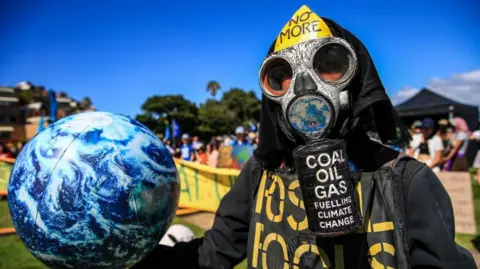
Richer countries have pledged a record $300bn (£238bn) to help the developing world fight climate change, but the deal is facing recriminations that it comes nowhere near addressing poorer countries' challenges from global warming
The talks at the UN climate summit COP29 in Azerbaijan ran 33 hours late, and came within inches of collapse.
The head of the UN climate body, Simon Stiell, said it had “been a difficult journey, but we've delivered a deal.”
But the talks also failed to build on an agreement passed last year calling for nations to “transition away from fossil fuels”.
Developing nations, as well as countries that are particularly vulnerable to climate change, dramatically walked out of the talks on Saturday afternoon.
“I am not exaggerating when I say our islands are sinking! How can you expect us to go back to the women, men, and children of our countries with a poor deal?” said the chair of the Alliance of Small Island States, Cedric Schuster.
But at 03:00 local time on Sunday (23:00 GMT on Saturday), and after some changes to the agreement, nations finally passed the deal. It was met with cheers and applause, but a furious speech from India showed that intense frustration remained.
“We cannot accept it… the proposed goal will not solve anything for us. [It is] not conducive to climate action that is necessary to the survival of our country,” Leela Nandan told the conference, calling the sum too small.
Richer countries have pledged a record $300bn (£238bn) to help the developing world fight climate change, but the deal is facing recriminations that it comes nowhere near addressing poorer countries' challenges from global warming
The talks at the UN climate summit COP29 in Azerbaijan ran 33 hours late, and came within inches of collapse.
The head of the UN climate body, Simon Stiell, said it had “been a difficult journey, but we've delivered a deal.”
But the talks also failed to build on an agreement passed last year calling for nations to “transition away from fossil fuels”.
Developing nations, as well as countries that are particularly vulnerable to climate change, dramatically walked out of the talks on Saturday afternoon.
“I am not exaggerating when I say our islands are sinking! How can you expect us to go back to the women, men, and children of our countries with a poor deal?” said the chair of the Alliance of Small Island States, Cedric Schuster.
But at 03:00 local time on Sunday (23:00 GMT on Saturday), and after some changes to the agreement, nations finally passed the deal. It was met with cheers and applause, but a furious speech from India showed that intense frustration remained.
“We cannot accept it… the proposed goal will not solve anything for us. [It is] not conducive to climate action that is necessary to the survival of our country,” Leela Nandan told the conference, calling the sum too small.
Tuesday, November 12, 2024
Monday, November 11, 2024
COP29 Opens in Azerbaijan With Climate Finance at Top of Agenda

Mukhtar Babayev, president of COP29, during the opening ceremony of the climate conference in Baku, Azerbaijan, on Monday, Nov. 11, 2024. Hollie Adams—Bloomberg/Getty Images
November 11, 2024 6:53 AM EST
BAKU, Azerbaijan — Soaring rhetoric, urgent pleas and pledges of cooperation contrasted with a backdrop of seismic political changes, global wars and economic hardships as United Nations annual climate talks began Monday and got right to the hard part: money.
In Baku, Azerbaijan, where the world's first oil well was drilled and the smell of the fuel was noticeable outdoors, the two-week session, called COP29, got right to the major focus of striking a new deal on how many hundreds of billions — or even trillions — of dollars a year will flow from rich nations to poor to try to curb and adapt to climate change.
The money is to help the developing world transition their energy systems away from planet-warming fossil fuels and toward clean energy, compensate for climate disasters mostly triggered by carbon pollution from rich nations and adapt to future extreme weather.
Saturday, November 09, 2024
Sunday, May 19, 2024
Sunday, October 02, 2016
Civil society must guarantee religious freedom, Pope says in Azerbaijan

Pope Francis speaks to authorities in Azerbaijan Oct. 2, 2016. Credit: Alan Holdren/CNA.

by Elise Harris
Baku, Azerbaijan, Oct 2, 2016 / 08:21 am (CNA/EWTN News).- In his final speech in Azerbaijan, Pope Francis spoke at length praising the good interreligious relations in the country, but also cautioned that religion must always be respected in civil society, and can never be used as a tool to justify violence.
“Society must always overcome the temptation to take advantage of religious factors,” the Pope said Oct. 2. Religions, he said, “must never be instrumentalized, nor can they ever lend support to, or approve of, conflicts and disagreements.”
To illustrate his point, the Pope referred to the traditional artistic windows of Azerbaijan made solely out of wood and tinted glass, with no glue or nails used in the process.
With the traditional means of crafting, the wood and the glass are set together through “time-consuming and meticulous effort,” leading the wood to support the glass, which in turn lets the light in, he observed.
Using this method as a metaphor, he said it is “the task of every civil society to support religion, which allows a light to shine through, indispensable for living.”
In order for this to happen, “an effective and authentic freedom must be guaranteed,” and artificial forms of “glue” that “bind people to believe, imposing on them a determined belief system and depriving them of the freedom to choose,” cannot be used.
The Pope also condemned the use of “external nails” such as worldliness and the yearning for power and money. God, he said, “cannot be used for personal interests and selfish ends; he cannot be used to justify any form of fundamentalism, imperialism or colonialism.”
He then made a heartfelt appeal for “no more violence in the name of God! May his most holy Name be adored, not profaned or bartered as a commodity through forms of hatred and human opposition.”
Pope Francis traveled to Azerbaijan as the last stop of his three-day trip there and to Georgia, both of which have a small minority of Catholics. Azerbaijan marks the first time the Pope has ever traveled to a majority Shi’ite nation.
The last encounter of the day was an ecumenical meeting that brought together Allahshükür Hummat Pashazade, who as Sheikh and Grand Mufti of the Caucasus is one of the most influential Muslim voices in the world, as well as the local religious leaders of the Russian Orthodox Church and those of the Jewish communities.
In his speech, Francis highlighted the good relations Catholics enjoy with Muslims in the area, pointing to “the tangible help” that the Islamic leader has offered to the Catholic community on several occasions.
He also pointed to the positive relationship between Catholics and Orthodox in the area, as well as the friendship they enjoy with the Jews.
There is a desire within Azerbaijan to protect the religious heritage of each and to pursue greater openness, he said, adding that “it is not opposition but cooperation that helps to build better and more peaceful societies.”
The fraternity sought by the various religions in the area directly opposes those who wish to focus on division or reawaken tensions that come from opposition and differences, he said.
Opening oneself to others “does not lead to impoverishment but rather enrichment, because it enables us to be more human,” he said, adding that it helps all parties to act “with neither abstract idealism nor with interventionism, not by harmful interference or forceful actions, but rather out of respect for the dynamics of history, cultures and religious traditions.”
Religions, he said, have the key task of accompanying people through life, helping them to understand that “the center of each person is outside of himself, that we are oriented toward the Most High and toward the other who is our neighbor.”
Part of this task involves providing authentic answers to those who often find themselves lost among “the swirling contradictions of our time.”
Among these contradictions is a seemingly dominant attitude of nihilism on the part of those who don't believe in anything “except their own well-being, advantage and profit,” he said.
On the other hand, there is a growing presence of “rigid and fundamentalist” attitudes from “those who, through violent words and deeds, seek to impose extreme and radical attitudes which are furthest from the living God.”
Contrary to these attitudes, religions are called to build and foster “a culture of encounter and peace,” based on mutual understanding and humility. True peace, achieved through prayer and dialogue, is a duty for both Christians and other religious communities, he said.
To be open and hope for the good of others is not a type of “accommodating facile syncretism, nor a diplomatic openness which says yes to everything in order to avoid problems,” the Pope said.
Rather, it is “a path of dialogue with others and a path of prayer for all,” allowing love to rise “where there is hatred, and forgiveness where there is offence, of never growing weary of imploring and tracing the ways of peace.”
“The blood of far too many people cries out to God from the earth,” he said, stressing that in the current global context, “we are challenged to give a response that can no longer be put off: to build together a future of peace.”
“Now is not the time for violent or abrupt solutions, but rather an urgent moment to engage in patient processes of reconciliation,” he said, praying that amid the ongoing “night of conflict” overshadowing the global community, religions would be a sign of peace amid “the devastation of death.”
The Pope prayed that religions, particularly in the Caucasus region, would be “active agents” in overcoming the tragedies and tensions of the past and present.
“The treasures old and ever new of the wisdom, culture and religious sensibility of the people of the Caucasus, are a tremendous resource for the future of the region and especially for European culture,” he said, and prayed that they would always be known and valued.
Baku, Azerbaijan, Oct 2, 2016 / 08:21 am (CNA/EWTN News).- In his final speech in Azerbaijan, Pope Francis spoke at length praising the good interreligious relations in the country, but also cautioned that religion must always be respected in civil society, and can never be used as a tool to justify violence.
“Society must always overcome the temptation to take advantage of religious factors,” the Pope said Oct. 2. Religions, he said, “must never be instrumentalized, nor can they ever lend support to, or approve of, conflicts and disagreements.”
To illustrate his point, the Pope referred to the traditional artistic windows of Azerbaijan made solely out of wood and tinted glass, with no glue or nails used in the process.
With the traditional means of crafting, the wood and the glass are set together through “time-consuming and meticulous effort,” leading the wood to support the glass, which in turn lets the light in, he observed.
Using this method as a metaphor, he said it is “the task of every civil society to support religion, which allows a light to shine through, indispensable for living.”
In order for this to happen, “an effective and authentic freedom must be guaranteed,” and artificial forms of “glue” that “bind people to believe, imposing on them a determined belief system and depriving them of the freedom to choose,” cannot be used.
The Pope also condemned the use of “external nails” such as worldliness and the yearning for power and money. God, he said, “cannot be used for personal interests and selfish ends; he cannot be used to justify any form of fundamentalism, imperialism or colonialism.”
He then made a heartfelt appeal for “no more violence in the name of God! May his most holy Name be adored, not profaned or bartered as a commodity through forms of hatred and human opposition.”
Pope Francis traveled to Azerbaijan as the last stop of his three-day trip there and to Georgia, both of which have a small minority of Catholics. Azerbaijan marks the first time the Pope has ever traveled to a majority Shi’ite nation.
The last encounter of the day was an ecumenical meeting that brought together Allahshükür Hummat Pashazade, who as Sheikh and Grand Mufti of the Caucasus is one of the most influential Muslim voices in the world, as well as the local religious leaders of the Russian Orthodox Church and those of the Jewish communities.
In his speech, Francis highlighted the good relations Catholics enjoy with Muslims in the area, pointing to “the tangible help” that the Islamic leader has offered to the Catholic community on several occasions.
He also pointed to the positive relationship between Catholics and Orthodox in the area, as well as the friendship they enjoy with the Jews.
There is a desire within Azerbaijan to protect the religious heritage of each and to pursue greater openness, he said, adding that “it is not opposition but cooperation that helps to build better and more peaceful societies.”
The fraternity sought by the various religions in the area directly opposes those who wish to focus on division or reawaken tensions that come from opposition and differences, he said.
Opening oneself to others “does not lead to impoverishment but rather enrichment, because it enables us to be more human,” he said, adding that it helps all parties to act “with neither abstract idealism nor with interventionism, not by harmful interference or forceful actions, but rather out of respect for the dynamics of history, cultures and religious traditions.”
Religions, he said, have the key task of accompanying people through life, helping them to understand that “the center of each person is outside of himself, that we are oriented toward the Most High and toward the other who is our neighbor.”
Part of this task involves providing authentic answers to those who often find themselves lost among “the swirling contradictions of our time.”
Among these contradictions is a seemingly dominant attitude of nihilism on the part of those who don't believe in anything “except their own well-being, advantage and profit,” he said.
On the other hand, there is a growing presence of “rigid and fundamentalist” attitudes from “those who, through violent words and deeds, seek to impose extreme and radical attitudes which are furthest from the living God.”
Contrary to these attitudes, religions are called to build and foster “a culture of encounter and peace,” based on mutual understanding and humility. True peace, achieved through prayer and dialogue, is a duty for both Christians and other religious communities, he said.
To be open and hope for the good of others is not a type of “accommodating facile syncretism, nor a diplomatic openness which says yes to everything in order to avoid problems,” the Pope said.
Rather, it is “a path of dialogue with others and a path of prayer for all,” allowing love to rise “where there is hatred, and forgiveness where there is offence, of never growing weary of imploring and tracing the ways of peace.”
“The blood of far too many people cries out to God from the earth,” he said, stressing that in the current global context, “we are challenged to give a response that can no longer be put off: to build together a future of peace.”
“Now is not the time for violent or abrupt solutions, but rather an urgent moment to engage in patient processes of reconciliation,” he said, praying that amid the ongoing “night of conflict” overshadowing the global community, religions would be a sign of peace amid “the devastation of death.”
The Pope prayed that religions, particularly in the Caucasus region, would be “active agents” in overcoming the tragedies and tensions of the past and present.
“The treasures old and ever new of the wisdom, culture and religious sensibility of the people of the Caucasus, are a tremendous resource for the future of the region and especially for European culture,” he said, and prayed that they would always be known and valued.
Subscribe to:
Posts (Atom)