Showing posts with label Parks. Show all posts
Showing posts with label Parks. Show all posts
Friday, February 13, 2026
Monday, July 14, 2014
The Wilderness Act Is Facing a Midlife Crisis
Rethinking the Wild
By CHRISTOPHER SOLOMON
JULY 5, 2014

Credit
Jon McNaught
YOU won’t hear it on your summer hike above the bird song and the soft applause of aspen leaves, but there’s a heresy echoing through America’s woods and wild places. It’s a debate about how we should think about, and treat, our wilderness in the 21st century, one with real implications for the nearly 110 million acres of wild lands that we’ve set aside across the United States.
Fifty years ago this September, Congress passed the Wilderness Act, which created a national system of wilderness areas. Wilderness has been called the “hard green line” for the act’s uncompromising language: Man will leave these places alone. As the law’s drafter and spiritual father, Howard Zahniser, put it, “we should be guardians, not gardeners.”
At 50, however, the Wilderness Act faces a midlife crisis.
We now know that, thanks to climate change, we’ve left no place unmolested and inadvertently put our fingerprints on even the most unpeopled corners of the planet. This reality has pushed respected scientists to advocate what many wilderness partisans past and present would consider blasphemy: We need to rethink the Wilderness Act. We need to toss out the “hands-off” philosophy that has guided our stewardship for 50 years. We must replace it with a more nuanced, flexible approach — including a willingness to put our hands on America’s wildest places more, not less, if we’re going to help them to adapt and thrive in the diminished future we’ve thrust upon them.
YOU won’t hear it on your summer hike above the bird song and the soft applause of aspen leaves, but there’s a heresy echoing through America’s woods and wild places. It’s a debate about how we should think about, and treat, our wilderness in the 21st century, one with real implications for the nearly 110 million acres of wild lands that we’ve set aside across the United States.
Fifty years ago this September, Congress passed the Wilderness Act, which created a national system of wilderness areas. Wilderness has been called the “hard green line” for the act’s uncompromising language: Man will leave these places alone. As the law’s drafter and spiritual father, Howard Zahniser, put it, “we should be guardians, not gardeners.”
At 50, however, the Wilderness Act faces a midlife crisis.
We now know that, thanks to climate change, we’ve left no place unmolested and inadvertently put our fingerprints on even the most unpeopled corners of the planet. This reality has pushed respected scientists to advocate what many wilderness partisans past and present would consider blasphemy: We need to rethink the Wilderness Act. We need to toss out the “hands-off” philosophy that has guided our stewardship for 50 years. We must replace it with a more nuanced, flexible approach — including a willingness to put our hands on America’s wildest places more, not less, if we’re going to help them to adapt and thrive in the diminished future we’ve thrust upon them.

Credit
Jon McNaught
A great example is Joshua Tree National Park in Southern California, most of which lies within the 595,000-acre Joshua Tree Wilderness. Up to 90 percent of the park’s namesake trees could disappear by century’s end, according to models that factor in expected warming. Should we let that happen as nature’s atonement for our mistake? Or should park managers instead intervene in some way — relocating trees to higher elevations to promote their survival, for instance, or finding or creating a hybrid species that can withstand the hotter temperatures and combating exotic grasses that increase the threat of fires?
Such questions didn’t exist in 1964 when President Lyndon B. Johnson signed the Wilderness Act. Then, the nemesis of wilderness was America’s unchecked appetite — for land, roads, mines, timber — that gnawed away even at the boundaries of government-sanctioned “primitive areas.” Wilderness advocates craved permanence, in the form of legislation that took decision making away from capricious bureaucrats and political appointees.
What was at stake was nothing less than the wellspring of the American experiment itself. The historian Frederick Jackson Turner had pinned American democracy to wilderness; hacking a life from the wild made settlers ruggedly individual, self-assured and unwilling to suffer the yoke of any monarch. Wilderness, wrote the naturalist Aldo Leopold, is “the very stuff America is made of.”
The law’s definition of wilderness (maybe you’ve read it on a trailhead sign as you shouldered an overheavy backpack) reflects the idea of these places as a bulwark against humankind and its thirst for domination: “where the earth and its community of life are untrammeled by man, where man himself is a visitor who does not remain.” These places of “primeval character” should be maintained, the law says, to preserve their “natural conditions.” For the last half-century that let-it-be philosophy has carried the day, with few exceptions.
In recent decades, however, several pillars upon which the act was built have eroded. One is the idea of “naturalness,” that nature exists in some unadulterated state apart from humans. Work in paleoecology and other fields has shown that humans have shaped many of the ecosystems on the planet for thousands of years (and not always to their detriment). Research has also dismantled ideas about a stable, primeval world. Nature is always in flux.
Now comes our jarring latest contribution: climate change, with all its rippling effects, as the planet continues to heat up.
Faced with such change, “there’s increased recognition that the paradigm has to change,” said Cat Hawkins Hoffman, the national climate change adaptation coordinator for the National Park Service, which manages 40 percent of American’s wilderness acreage.
“The real conundrum is, how much manipulation in wilderness is acceptable in order to protect the values for which the wilderness was established,” she added.
In short, we need to accept our role as reluctant gardeners.
THE 1964 law does provide some exceptions to its prohibitions against human interference, including in instances in which an area’s managers consider intervention necessary to protect the wild lands or its creatures.
In that context, intervention could take many forms. One strategy is simply to resist or forestall effects of climate change.
Tuolumne Meadows in Yosemite National Park is one of the most arresting places in the West, and it’s important as the largest subalpine meadow in the Sierra Nevada.
But as the climate changes, the meadows, some of which lie in the Yosemite Wilderness, are being invaded by lodgepole pine. Keeping the meadows intact will require regular tree-cutting and possibly irrigation for species intolerant of drier conditions, according to David Cole, an emeritus scientist with the Forest Service’s Aldo Leopold Wilderness Research Institute and co-editor of “Beyond Naturalness,” a 2010 book of scholarly essays about wilderness and climate change.
Another example: watering groves of California’s giant sequoias to keep them alive if a future climate grows too dry for their survival.
While hardly long-term solutions, “those can help buy us some time, and by buying time they can help us have that broader societal discussion” and form policies so that what land managers do reflects what society wants, said Nate Stephenson, a research ecologist for the United States Geological Survey who works on the future of forests.
A second approach is to intervene in a way that will make the landscape more resilient.
At Bandelier National Monument in New Mexico, the past century of livestock grazing and fire suppression had turned much of the savanna-like landscape into one crowded with dense juniper and pinyon trees, with bare earth below. “The rates of soil erosion had accelerated to damaging levels,” as rains chewed away at the almost 3,000 archaeological sites that the monument was established to protect, said Craig Allen, a research ecologist with the survey’s Jemez Mountains Field Station.
After 15 years of study, in 2007 the park started taking chain saws to about 5,000 acres of land — mostly in the monument’s 23,000-acre Bandelier Wilderness — cutting small trees and mulching the ground with their branches. The scale of the action “was and remains unprecedented” in wilderness, where engines aren’t usually permitted, he said.
It’s worked. Rates of erosion have fallen by at least an order of magnitude, while native grasses and shrubs have increased threefold.
“I think we improved the resilience of the system going forward,” Brian Jacobs, a Bandelier botanist, said. “The healthier a system is going into these changes, the more likely it is to be able to respond favorably.”
Thinning select wilderness forests could help in many places around the American Southwest where forest density has increased to more than 1,000 trees per acre from roughly 100 trees, Dr. Allen said. The remaining trees would be more likely to survive the hotter, thirstier future, while thinning could also reduce the likelihood of extremely destructive fires from which these landscapes struggle to recover, he said.
Yet another approach is to help nature adapt by giving it a hand in this strange new world — accommodating the changes we want more than fighting those we don’t.
Gnarled by wind and weather, the whitebark pine grips the high slopes of the Pacific Northwest and the northern Rockies in such locations as the Bob Marshall Wilderness in Montana. Its fatty pine nuts are a staple of the threatened grizzly bear. Whitebark pine is rapidly declining in many places, however, because of invasive blister rust; the lack of fire in this ecosystem to promote the growth of new trees; and infestations by mountain pine beetles, probably aided by mellower winters. To help both beast and tree, some have proposed planting high slopes in places like “the Bob” with seeds from trees that show a resistance to the rust.
Still more controversial is assisted migration. Some species like the American pika, a small rodent-like mammal that lives among the rocks on high, cold mountains, can’t do much to escape a warming world. It’s been suggested that pikas — or marmots, or certain butterflies whose narrow habitats are shrinking — could be relocated to a more hospitable setting where they can, with luck, thrive.
Critics of intervention argue that the best thing we can do for wilderness is leave it alone. Opening up the Wilderness Act, they fear, will invite an attack on wild lands by the usual suspects: mining companies, give-back-the-land groups, Western red-state pols who pander to both. Then there are concerns like those of one Bureau of Land Management wilderness expert, who quoted to me the ecologist Frank Egler: “Ecosystems are not only more complex than we think, they are more complex than we can think.” Or to paraphrase the ecologist Peter Landres: Isn’t it a fool’s errand to try to manage what we don’t fully understand, at a time when the context is changing and the precise future is uncertain?
A great example is Joshua Tree National Park in Southern California, most of which lies within the 595,000-acre Joshua Tree Wilderness. Up to 90 percent of the park’s namesake trees could disappear by century’s end, according to models that factor in expected warming. Should we let that happen as nature’s atonement for our mistake? Or should park managers instead intervene in some way — relocating trees to higher elevations to promote their survival, for instance, or finding or creating a hybrid species that can withstand the hotter temperatures and combating exotic grasses that increase the threat of fires?
Such questions didn’t exist in 1964 when President Lyndon B. Johnson signed the Wilderness Act. Then, the nemesis of wilderness was America’s unchecked appetite — for land, roads, mines, timber — that gnawed away even at the boundaries of government-sanctioned “primitive areas.” Wilderness advocates craved permanence, in the form of legislation that took decision making away from capricious bureaucrats and political appointees.
What was at stake was nothing less than the wellspring of the American experiment itself. The historian Frederick Jackson Turner had pinned American democracy to wilderness; hacking a life from the wild made settlers ruggedly individual, self-assured and unwilling to suffer the yoke of any monarch. Wilderness, wrote the naturalist Aldo Leopold, is “the very stuff America is made of.”
The law’s definition of wilderness (maybe you’ve read it on a trailhead sign as you shouldered an overheavy backpack) reflects the idea of these places as a bulwark against humankind and its thirst for domination: “where the earth and its community of life are untrammeled by man, where man himself is a visitor who does not remain.” These places of “primeval character” should be maintained, the law says, to preserve their “natural conditions.” For the last half-century that let-it-be philosophy has carried the day, with few exceptions.
In recent decades, however, several pillars upon which the act was built have eroded. One is the idea of “naturalness,” that nature exists in some unadulterated state apart from humans. Work in paleoecology and other fields has shown that humans have shaped many of the ecosystems on the planet for thousands of years (and not always to their detriment). Research has also dismantled ideas about a stable, primeval world. Nature is always in flux.
Now comes our jarring latest contribution: climate change, with all its rippling effects, as the planet continues to heat up.
Faced with such change, “there’s increased recognition that the paradigm has to change,” said Cat Hawkins Hoffman, the national climate change adaptation coordinator for the National Park Service, which manages 40 percent of American’s wilderness acreage.
“The real conundrum is, how much manipulation in wilderness is acceptable in order to protect the values for which the wilderness was established,” she added.
In short, we need to accept our role as reluctant gardeners.
THE 1964 law does provide some exceptions to its prohibitions against human interference, including in instances in which an area’s managers consider intervention necessary to protect the wild lands or its creatures.
In that context, intervention could take many forms. One strategy is simply to resist or forestall effects of climate change.
Tuolumne Meadows in Yosemite National Park is one of the most arresting places in the West, and it’s important as the largest subalpine meadow in the Sierra Nevada.
But as the climate changes, the meadows, some of which lie in the Yosemite Wilderness, are being invaded by lodgepole pine. Keeping the meadows intact will require regular tree-cutting and possibly irrigation for species intolerant of drier conditions, according to David Cole, an emeritus scientist with the Forest Service’s Aldo Leopold Wilderness Research Institute and co-editor of “Beyond Naturalness,” a 2010 book of scholarly essays about wilderness and climate change.
Another example: watering groves of California’s giant sequoias to keep them alive if a future climate grows too dry for their survival.
While hardly long-term solutions, “those can help buy us some time, and by buying time they can help us have that broader societal discussion” and form policies so that what land managers do reflects what society wants, said Nate Stephenson, a research ecologist for the United States Geological Survey who works on the future of forests.
A second approach is to intervene in a way that will make the landscape more resilient.
At Bandelier National Monument in New Mexico, the past century of livestock grazing and fire suppression had turned much of the savanna-like landscape into one crowded with dense juniper and pinyon trees, with bare earth below. “The rates of soil erosion had accelerated to damaging levels,” as rains chewed away at the almost 3,000 archaeological sites that the monument was established to protect, said Craig Allen, a research ecologist with the survey’s Jemez Mountains Field Station.
After 15 years of study, in 2007 the park started taking chain saws to about 5,000 acres of land — mostly in the monument’s 23,000-acre Bandelier Wilderness — cutting small trees and mulching the ground with their branches. The scale of the action “was and remains unprecedented” in wilderness, where engines aren’t usually permitted, he said.
It’s worked. Rates of erosion have fallen by at least an order of magnitude, while native grasses and shrubs have increased threefold.
“I think we improved the resilience of the system going forward,” Brian Jacobs, a Bandelier botanist, said. “The healthier a system is going into these changes, the more likely it is to be able to respond favorably.”
Thinning select wilderness forests could help in many places around the American Southwest where forest density has increased to more than 1,000 trees per acre from roughly 100 trees, Dr. Allen said. The remaining trees would be more likely to survive the hotter, thirstier future, while thinning could also reduce the likelihood of extremely destructive fires from which these landscapes struggle to recover, he said.
Yet another approach is to help nature adapt by giving it a hand in this strange new world — accommodating the changes we want more than fighting those we don’t.
Gnarled by wind and weather, the whitebark pine grips the high slopes of the Pacific Northwest and the northern Rockies in such locations as the Bob Marshall Wilderness in Montana. Its fatty pine nuts are a staple of the threatened grizzly bear. Whitebark pine is rapidly declining in many places, however, because of invasive blister rust; the lack of fire in this ecosystem to promote the growth of new trees; and infestations by mountain pine beetles, probably aided by mellower winters. To help both beast and tree, some have proposed planting high slopes in places like “the Bob” with seeds from trees that show a resistance to the rust.
Still more controversial is assisted migration. Some species like the American pika, a small rodent-like mammal that lives among the rocks on high, cold mountains, can’t do much to escape a warming world. It’s been suggested that pikas — or marmots, or certain butterflies whose narrow habitats are shrinking — could be relocated to a more hospitable setting where they can, with luck, thrive.
Critics of intervention argue that the best thing we can do for wilderness is leave it alone. Opening up the Wilderness Act, they fear, will invite an attack on wild lands by the usual suspects: mining companies, give-back-the-land groups, Western red-state pols who pander to both. Then there are concerns like those of one Bureau of Land Management wilderness expert, who quoted to me the ecologist Frank Egler: “Ecosystems are not only more complex than we think, they are more complex than we can think.” Or to paraphrase the ecologist Peter Landres: Isn’t it a fool’s errand to try to manage what we don’t fully understand, at a time when the context is changing and the precise future is uncertain?
I share those concerns. And I cling to the romantic idea that, when I step into wilderness, I’m heading somewhere better than us — that there are some places where we can still walk a few miles into red rock desert and when we get there, we’ll find not a fracking pad or a Burger King but instead (Insert Your Deity Here). And it’s true that if science has taught us one thing it’s how little we know about nature. Yet as Dr. Stephenson counters, “Ecosystems may be more complex than we can understand, but that doesn’t mean that we don’t have any understanding.”
Why not intervene — carefully, selectively, with humility — in the places that need help the most, with an eye toward giving nature, and us, options? Perhaps we have different levels of wilderness, with different levels of human involvement, something even the founders of the Wilderness Society discussed, Dr. Cole told me, adding, “What we need is a system with more diverse goals.” Fears that we’ll turn wilderness into a 110-million-acre garden miss the mark. If nothing else, lack of time, money and manpower will always constrain our efforts.
When it comes to our most precious wild places, we need to flip the conversation from cause, to effect — focusing on whether the change to the ecological system is “acceptable or desirable” and not whether humans helped nudge it there, according to Richard Hobbs, former editor of the journal Restoration Ecology.
The environmental titans of the 20th century — John Muir, Marshall, Leopold, Zahniser — handed us an awesome responsibility in America’s wilderness legacy. Ironically, it may take us committing a necessary apostasy to show how much we truly revere these wild places.
Christopher Solomon is a journalist who writes about the outdoors and the environment.
Why not intervene — carefully, selectively, with humility — in the places that need help the most, with an eye toward giving nature, and us, options? Perhaps we have different levels of wilderness, with different levels of human involvement, something even the founders of the Wilderness Society discussed, Dr. Cole told me, adding, “What we need is a system with more diverse goals.” Fears that we’ll turn wilderness into a 110-million-acre garden miss the mark. If nothing else, lack of time, money and manpower will always constrain our efforts.
When it comes to our most precious wild places, we need to flip the conversation from cause, to effect — focusing on whether the change to the ecological system is “acceptable or desirable” and not whether humans helped nudge it there, according to Richard Hobbs, former editor of the journal Restoration Ecology.
The environmental titans of the 20th century — John Muir, Marshall, Leopold, Zahniser — handed us an awesome responsibility in America’s wilderness legacy. Ironically, it may take us committing a necessary apostasy to show how much we truly revere these wild places.
Christopher Solomon is a journalist who writes about the outdoors and the environment.
A version of this op-ed appears in print on July 6, 2014, on page SR1 of the New York edition with the headline: Rethinking the Wild.
.
.
.
Saturday, November 09, 2013
North American National Parks - Visions of Majesty
National Parks of North America - IMAX Travel Documentary

ExploreTravelWorld
Published on Aug 31, 2013
National Parks of North America - IMAX Travel Documentary
By using special cameras and techniques, David Fortney has captured the beauty of these parks in ways never seen before. Fluid, masterful camera work and aerial photography gives you the sensation of soaring over and through the landscape. Join us as we visit some of the most beautiful and majestic places in the world on this tribute to America's Treasure: Our National Parks. Banff - Bryce Canyon - Canadian Rockies - Cascade Range - Colorado Plateau - Death Valley - Denali - Grand Canyon - Grand Teton - Olympic - Yosemite
.
.
P.S. (You might want to turn down the volume because there is a disproportionate amount of perscussion in some segments.) ..
.
Friday, October 04, 2013
Lawyers: Private parks should sue Obama administration for forcing them to close

4:22 PM 10/03/2013
Michael Bastasch
During the government shutdown, the Obama administration has forced the closure of privately owned parks, stoking calls from lawyers for park owners to take legal action against the federal government.
“As a lawyer who once worked for the government, I assume there is no legal authority for this because these private tourist attractions were not shut down in prior ‘government shutdowns,’ even under Bill Clinton, who understood how to play political hardball,” Hans Bader, senior attorney at the Competitive Enterprise Institute wrote in an email.
A lawyer with the conservative Heritage Foundation said that the Obama administration’s actions were likely illegal and that business owners forced to close shop should sue.
“They should immediately file a lawsuit and seek a temporary injunction against the government,” said Former Justice Department lawyer Hans Von Spakovsky.
Terry Pell, of the Center for Individual Rights and former Deputy Assistant Secretary of Education for Civil Rights, said that the government had only “a sliver of a justification in each case,” but that a judge could rule against the government under the Administrative Procedure Act.
Pell added that newspaper could sue under the Freedom of Information Act to get “WH [White House] emails to [the] park agency.”
It was reported that the parking lot of the privately-owned Mount Vernon, the home of George Washington, was blocked off by National Park Service officials, but the barricades were removed after numerous complaints.
Also, Virginia’s historic Claude Moore Colonial Farm was also closed by the National Park Service, despite not being financially supported by the Service or using any agency personnel. And despite the fact that the park remained open during the Clinton era government shutdown.
“For the first time in 40 years, the National Park Service (NPS) has finally succeeded in closing the Farm down to the public. In previous budget dramas, the Farm has always been exempted since the NPS provides no staff or resources to operate the Farm,” the farm’s managing director Anna Eberly said in an email to the park’s mailing list.
“The first casualty of this arbitrary action was the McLean Chamber of Commerce who were having a large annual event at the Pavilion on Tuesday evening,” Eberly added. “The NPS sent the Park Police over to remove the Pavilion’s staff and Chamber volunteers from the property while they were trying to set up for their event. Fortunately, the Chamber has friends and they were able to move to another location and salvage what was left of their party. You do have to wonder about the wisdom of an organization that would use staff they don’t have the money to pay to evict visitors from a park site that operates without costing them any money.”
The Washington Times reports that privately operated businesses on federal lands outside of the Washington, DC area have also been forced to close their doors.
Arizona businessman Warren Meyer wrote to his congressman that the campground he runs on federal lands was ordered to close despite receiving no federal funding.
“Yesterday, as in all past government shutdowns, the Department of Agriculture and US Forest Service confirmed we would stay open during the government shutdown… However, today, we have been told by senior member of the US Forest Service and Department of Agriculture that people ‘above the department’, which I presume means the White House, plan to order the Forest Service to needlessly and illegally close all private operations,” Meyer wrote on Wednesday.
“In the ‘government shutdown,’ the government is apparently shutting down many privately-run facilities that have never been shut down in any previous government shut-down, just to inflict political pain — privately-run tourist operations that cost the government nothing to allow open, but cost a lot to shut down,” Bader wrote.
“Private tourist attractions that do not need to be shut down in any government shutdown (and generate tax revenue for the federal government, as well as jobs for the public). This is grotesque political theater,” he added.
Content created by The Daily Caller News Foundation is available without charge to any eligible news publisher that can provide a large audience. For licensing opportunities of our original content, please contact licensing@dailycallernewsfoundation.org.
.
.
Source: http://dailycaller.com/2013/10/03/lawyers-private-parks-should-sue-obama-admin-for-forcing-them-to-close/#ixzz2glSsImhv
.
Sunday, April 08, 2012
Obama says we have 100's of National Parks, except we only have 58.
Read the full text of Obama's speech on the GOP budget
5:00 p.m. CDT, April 3, 2012
"If this budget becomes law and the cuts were applied evenly, starting in 2014, over 200,000 children would lose their chance to get an early education in the Head Start program. Two million mothers and young children would be cut from a program that gives them access to healthy food. There would be 4,500 fewer federal grants at the Department of Justice and the FBI to combat violent crime, financial crime, and help secure our borders. Hundreds of
national parks would be forced to close for part or all of the year. We wouldn't have the capacity to enforce the laws that protect the air we breathe, the water we drink, or the food that we eat.
"Cuts to the FAA would likely result in more flight cancellations, delays, and the complete elimination of air traffic control services in parts of the country. Over time, our weather forecasts would become less accurate because we wouldn't be able to afford to launch new satellites. And that means governors and mayors would have to wait longer to order evacuations in the event of a hurricane.
Read more
.
5:00 p.m. CDT, April 3, 2012
"If this budget becomes law and the cuts were applied evenly, starting in 2014, over 200,000 children would lose their chance to get an early education in the Head Start program. Two million mothers and young children would be cut from a program that gives them access to healthy food. There would be 4,500 fewer federal grants at the Department of Justice and the FBI to combat violent crime, financial crime, and help secure our borders. Hundreds of
national parks would be forced to close for part or all of the year. We wouldn't have the capacity to enforce the laws that protect the air we breathe, the water we drink, or the food that we eat.
"Cuts to the FAA would likely result in more flight cancellations, delays, and the complete elimination of air traffic control services in parts of the country. Over time, our weather forecasts would become less accurate because we wouldn't be able to afford to launch new satellites. And that means governors and mayors would have to wait longer to order evacuations in the event of a hurricane.
Read more
.
Monday, October 31, 2011
In Central Park, Snow That Collected on Still-Leafy Branches Fells Even Hardy Trees
By MATT FLEGENHEIMER
Published: October 30, 2011
Published: October 30, 2011
The storm struck trees of all ages and sizes in Central Park: oaks and elms outside the boathouse, birches and dogwoods near Belvedere Castle, magnolias and mulberries beside the obelisk.

The damage was spread across about half of Central Park’s 840 acres, making it the worst devastation that Douglas Blonsky, president of the Central Park Conservancy, had seen in his 27 years there.
In all, as many as 1,000 of the park’s trees may be lost to the freak October snowstorm; in contrast, Tropical Storm Irene — which work crews only recently finished cleaning up after — cost the park 125 trees.
“It’s like a bomb blew off,” Mr. Blonsky said, as he conducted a site survey of the park on Sunday. He looked out his car window at a 70-foot oak tree, near the park’s southeast entrance. Only a jagged stump remained.
“Boom,” Mr. Blonsky said softly.
Though the snowfall in the city might have been considered mild by winter standards, a confluence of factors contributed to what Mr. Blonsky called unprecedented damage. Snow became suspended on leaves that had not yet fallen for winter, tugging at limbs and, in some cases, felling entire trees. And because temperatures hovered near freezing, and not well below, the snow was often damp and heavy, creating additional pressure on fragile branches.
A new round of restorations could take months, though workers are already scrambling to ensure that the New York City Marathon can proceed as planned on Sunday.
“Couldn’t have been rain, huh?” Neil Calvanese, vice president for operations of the conservancy, said from the back seat of Mr. Blonsky’s car.
“Couple degrees,” Mr. Blonsky said.
Mr. Calvanese sighed. “Fall colors were just starting to kick in,” he said.
Even the most durable trees struggled to cope. The broad, rough leaves of a London plane tree, Mr. Calvanese said, made it particularly vulnerable to snow accumulation and, consequently, branch fractures.
“It’s a resilient tree,” Mr. Calvanese said, sounding like a coach defending his players after a difficult loss. “They really do hold up well.”
Most of the damage occurred in the area south of 86th Street, where the park receives its highest concentration of visitors. Though the park was open on Sunday — and quite busy, given the improved weather and curiosity about the damage — Mr. Blonsky expressed concern that “hangers,” limbs detached from their trees but still suspended overhead, could prove dangerous if visitors ignored the conservancy’s caution tape. “You’ve got people pushing strollers underneath trees,” he said.
The city’s storm damage was not confined to the park. By 4 p.m. on Sunday, the city had received more than 2,000 calls reporting tree damage. About half had come from Staten Island, and a quarter from the Bronx, said Adrian Benepe, commissioner of the city’s parks department. “We’ve never seen a storm like this in October, when the trees are still mostly in full leaf,” Mr. Benepe said. “I’ve never seen such widespread damage.”
Christine Cea, from Emerson Hill, Staten Island, said a quick drive through surrounding neighborhoods revealed the storm’s leafy detritus, strewn along the roadways. “It was disappointing for a green borough,” she said.
For Central Park, the only comparable episode in recent years was a brief but powerful thunderstorm in August 2009, which resulted in the loss of 500 trees. In that case, as in this one, the damage did present a silver lining: the opportunity to improve park aesthetics by examining whether affected areas look better without so many trees. On Sunday, Mr. Blonsky noted that a reduction in trees in the southwest corner of the park, near Columbus Circle, was allowing more sunlight to the area.
But optimism dissipated quickly as Mr. Blonsky approached a contracting crew near Fifth Avenue, where fallen limbs were being loaded into a wood chipper. “You’re going right to the core of what Central Park is about,” he said of the park’s more than 23,000 trees.
Mr. Calvanese dropped his head, as the crew hauled another branch toward the machine.
“I’m not ready for this,” he said
.
Wednesday, February 24, 2010
1 killed in whale attack at SeaWorld Orlando’s Shamu Stadium

Orange County Fire Rescue responded to the theme park.
A SeaWorld employee died this afternoon during an incident at SeaWorld's Shamu Stadium, an Orange County Sheriff's Office official confirmed.
SeaWorld, rescue personnel and the Sheriff's Office are not revealing the identity of the victim, although a local TV station is reporting that it was a female employee who was killed after she was grabbed by one of the theme park's whales at the start of a public show.
Park guest Victoria Biniak told Local 6 that the trainer was a veteran of SeaWorld and had just finished explaining to the audience what they would see during the performance.
At that point, Biniak said, the whale came up from the water and grabbed the woman.
"He was thrashing her around pretty good. It was violent,'" Biniak told Local 6.
The whale "took off really fast in the tank, and then he came back, shot up in the air, grabbed the trainer by the waist and started thrashing around, and one of her shoes flew off."
She said sirens went off and everyone was forced to leave the stadium.
Guests were evacuated from the area, and the whale show was cancelled. The park is not shut down.
Orange County Fire Rescue personnel arrived on scene within five minutes of receiving a 911 call for an unknown medical condition just prior to 2 p.m., a spokesman said. The woman was dead when rescue officials arrived.
The Sheriff's Office is on the scene.
The Occupational Safety and Health Administration dispatched an investigator from Tampa to investigate, an OSHA spokesman said.
Local 6 is reporting that the whale involved in the incident is named Tillikum, and that whale has been involved in at least one other incident at the park.
Tillikum, nicknamed "Tilly," has a controversial past. The large whale was blamed for the drowning of one of his trainers in 1991 while he was performing at Sealand of the Pacific in British Columbia.
Sold to SeaWorld as a stud in 1992, the whale was involved in a second incident when authorities discovered the body of a naked man lying across his back in July 1999.
Authorities later concluded the man, who had either snuck into SeaWorld after hours or hidden in the park until it closed, most likely drowned after suffering hypothermia in the 55-degree water.
But they also said it appeared Tillikum had bit the man and tore of his swimming trunks, likely believing he was a toy to play with.
SeaWorld has had incidents with its killer whales in the past. In 2005, a trainer was injured by what park officials called an "overly excited" whale that bumped the trainer during a live performance. The injuries were minor.
Many animal-rights activists have long criticized SeaWorld and other marine parks for keeping orcas and other wildlife in captivity. Russ Rector, a former dolphin trainer in Fort Lauderdale, said keeping the animals captive makes them dangerous.
"Captivity is abusive to these animals. And the abuse mounts up. And when these animals snap -- just for a minute -- they're so big and can be so dangerous that it's like a shotgun," Rector said. "It does an incredible amount of damage in just a moment."
Source: http://www.latimes.com/news/nationworld/nation/wire/os-seaworld-orlando-shamu-injury-20100224,0,5560011.story
Saturday, August 22, 2009
Storm Toppled Scores of Trees in Central Park
August 19, 2009, 12:14 pm — Updated: 5:05 pm -->
Storm Toppled Scores of Trees in Central Park
By Sewell Chan AND Sarah Maslin Nir
 Monika Graff for The New York Times
Storm Toppled Scores of Trees in Central Park
By Sewell Chan AND Sarah Maslin Nir
 Monika Graff for The New York Times
Updated, 4:15 p.m. More than 100 trees were toppled and hundreds more were damaged in Central Park during the fierce thunderstorm that moved over New York City on Tuesday night.
It was the most severe destruction that the park’s trees had sustained in at least 30 years, according to officials at the city’s Department of Parks and Recreation and the Central Park Conservancy, which manages the park.
“Central Park has been devastated,” Adrian Benepe, the city parks commissioner, said in an interview on Wednesday morning. “It created more damage than I’ve seen in 30 years of working in the parks.”
Mr. Benepe added: “Some areas have had an almost total loss of trees. The Great Hill, the area around West 106th Street, has very large American elm trees. In that one area, several dozen trees went down.”
As work crews fanned out across the park, officials said they were still evaluating the destruction wrought by the storm, which brought wind gusts of 70 miles an hour and dumped up to three-quarters of an inch of rain over parts of the city.
“The damage was so severe and so widespread that we are simultaneously cleaning up and assessing the damage and trying to cordon off areas so that people aren’t hit by falling limbs,” Mr. Benepe said.
The storm was part of a weather system that formed over New Jersey and quickly moved eastward.
“It seems like Central Park was essentially the ground zero,” said David Wally, a meteorologist at the National Weather Service’s office in Upton, N.Y., on Long Island. “Manhattan, the Bronx and the northern part of Queens were the primary recipients of the severe weather.”
Remarkably, despite the physical damage, including the closing of several roads that were blocked by fallen trees, there were no reports of anyone injured around the city.
At the height of the storm, shortly after 10 p.m., the city’s Office of Emergency Management reported that more than 100 trees had been felled, with the damage concentrated on the west side of the park near streets in the 90s.
The storm caused damage elsewhere in the region. Large tree limbs fell onto the Cross Island Parkway in Queens, blocking a lane of the Utopia Parkway Exit, and onto Pelham Parkway, near Co-op City in the Bronx. Penny-sized hail was reported in the East Tremont section of the Bronx and in Hoboken, N.J.
In Central Park, most of the trees fell in one direction — east — having been knocked over by winds coming from the west. The damage could be seen across a broad swath of the park.
A large London Plane tree blocked the East Drive, near 95th Street. Fallen limbs and branches forced the temporary closings of the Tennis Center, between 94th and 96th Streets on the West Drive; the North Meadow ball fields; and the Conservatory Garden, at Fifth Avenue and 105th Street.
Several other parks — Riverside Park on the Upper West Side, Thomas Jefferson Park in East Harlem and Randall’s Island among them — also experienced major tree damage.
Forestry crews from the Parks Department began doing damage assessment at 2 a.m. Wednesday. The conservancy is bringing in privately contracted crews on an emergency basis, and by Thursday, the Parks Department expects to have 10 crews from private tree companies working in Central Park.
Despite the intense damage, the storm, which lasted between about 9:55 and 10:30, was not a tornado, Mr. Wally said. The damage in Central Park, he said, was caused by strong, damaging, straight-line winds, also known as downbursts or microbursts, not the violently rotating columns of air characteristic of tornadoes.
The whipping wind and driving rain also forced the early closing, around 10 p.m. Tuesday, of the inaugural night of the seventh annual Central Park Film Festival, said Kate Sheleg, a spokeswoman of the Central Park Conservancy. Ms. Sheleg, along with more than 2,400 other people attending the film screening, beat a hasty retreat as the storm clouds opened up over them.
“When I went out last night, there was a very distinct odor of shredded fresh trees, and it’s not a good smell,” Mr. Benepe, who went out to Riverside Park after the storm, said on Wednesday. “It’s a smell of living trees that had been blown apart. To me it looked like pictures I had seen of war zones, of trees I had seen that had been hit with artillery shells. Some were split in half, halfway up their trunk, others completely uprooted. If you love trees, as we do, it’s emotionally upsetting. You have personal relationships with certain trees and now they are gone.”
Though the storm has passed, there is still a danger to park-goers from falling limbs — a problem that already caused critical injury to a man walking through the park last month.
Ms. Sheleg said that work crews were canvassing the area on Wednesday and inspecting the condition of the park’s more than 24,000 trees for loose and dangerous branches.
Neil Calvanese, vice president for operations at the Central Park Conservancy, said on Wednesday that he had been out since 5:30 a.m., surveying the damage.
Some of the trees — pin oaks, red elms, tulip trees — dated as far back as the turn of the last century.
“We had a wonderful chestnut at 100th Street and Central Park West,” Mr. Calvanese said. “That’s been devastated; that will have to come down.”
He added, “I’ve been here since 1981, and we lived through Hurricane Gloria, ice storms and noreasters.” None of those events, he said, had caused this much destruction.
“We had some magnificent beech trees in the North Meadow,” he said. “Two of them that are going to come down — a pair of lindens that are going to have to come down. I want to put a positive note on that. A park is always evolving, that’s the nature of the park. We’ll get another generation of trees ready to come on, the park does evolve.”
“Central Park has been devastated,” Adrian Benepe, the city parks commissioner, said in an interview on Wednesday morning. “It created more damage than I’ve seen in 30 years of working in the parks.”
Mr. Benepe added: “Some areas have had an almost total loss of trees. The Great Hill, the area around West 106th Street, has very large American elm trees. In that one area, several dozen trees went down.”
As work crews fanned out across the park, officials said they were still evaluating the destruction wrought by the storm, which brought wind gusts of 70 miles an hour and dumped up to three-quarters of an inch of rain over parts of the city.
“The damage was so severe and so widespread that we are simultaneously cleaning up and assessing the damage and trying to cordon off areas so that people aren’t hit by falling limbs,” Mr. Benepe said.
The storm was part of a weather system that formed over New Jersey and quickly moved eastward.
“It seems like Central Park was essentially the ground zero,” said David Wally, a meteorologist at the National Weather Service’s office in Upton, N.Y., on Long Island. “Manhattan, the Bronx and the northern part of Queens were the primary recipients of the severe weather.”
Remarkably, despite the physical damage, including the closing of several roads that were blocked by fallen trees, there were no reports of anyone injured around the city.
At the height of the storm, shortly after 10 p.m., the city’s Office of Emergency Management reported that more than 100 trees had been felled, with the damage concentrated on the west side of the park near streets in the 90s.
The storm caused damage elsewhere in the region. Large tree limbs fell onto the Cross Island Parkway in Queens, blocking a lane of the Utopia Parkway Exit, and onto Pelham Parkway, near Co-op City in the Bronx. Penny-sized hail was reported in the East Tremont section of the Bronx and in Hoboken, N.J.
In Central Park, most of the trees fell in one direction — east — having been knocked over by winds coming from the west. The damage could be seen across a broad swath of the park.
A large London Plane tree blocked the East Drive, near 95th Street. Fallen limbs and branches forced the temporary closings of the Tennis Center, between 94th and 96th Streets on the West Drive; the North Meadow ball fields; and the Conservatory Garden, at Fifth Avenue and 105th Street.
Several other parks — Riverside Park on the Upper West Side, Thomas Jefferson Park in East Harlem and Randall’s Island among them — also experienced major tree damage.
Forestry crews from the Parks Department began doing damage assessment at 2 a.m. Wednesday. The conservancy is bringing in privately contracted crews on an emergency basis, and by Thursday, the Parks Department expects to have 10 crews from private tree companies working in Central Park.
Despite the intense damage, the storm, which lasted between about 9:55 and 10:30, was not a tornado, Mr. Wally said. The damage in Central Park, he said, was caused by strong, damaging, straight-line winds, also known as downbursts or microbursts, not the violently rotating columns of air characteristic of tornadoes.
The whipping wind and driving rain also forced the early closing, around 10 p.m. Tuesday, of the inaugural night of the seventh annual Central Park Film Festival, said Kate Sheleg, a spokeswoman of the Central Park Conservancy. Ms. Sheleg, along with more than 2,400 other people attending the film screening, beat a hasty retreat as the storm clouds opened up over them.
“When I went out last night, there was a very distinct odor of shredded fresh trees, and it’s not a good smell,” Mr. Benepe, who went out to Riverside Park after the storm, said on Wednesday. “It’s a smell of living trees that had been blown apart. To me it looked like pictures I had seen of war zones, of trees I had seen that had been hit with artillery shells. Some were split in half, halfway up their trunk, others completely uprooted. If you love trees, as we do, it’s emotionally upsetting. You have personal relationships with certain trees and now they are gone.”
Though the storm has passed, there is still a danger to park-goers from falling limbs — a problem that already caused critical injury to a man walking through the park last month.
Ms. Sheleg said that work crews were canvassing the area on Wednesday and inspecting the condition of the park’s more than 24,000 trees for loose and dangerous branches.
Neil Calvanese, vice president for operations at the Central Park Conservancy, said on Wednesday that he had been out since 5:30 a.m., surveying the damage.
Some of the trees — pin oaks, red elms, tulip trees — dated as far back as the turn of the last century.
“We had a wonderful chestnut at 100th Street and Central Park West,” Mr. Calvanese said. “That’s been devastated; that will have to come down.”
He added, “I’ve been here since 1981, and we lived through Hurricane Gloria, ice storms and noreasters.” None of those events, he said, had caused this much destruction.
“We had some magnificent beech trees in the North Meadow,” he said. “Two of them that are going to come down — a pair of lindens that are going to have to come down. I want to put a positive note on that. A park is always evolving, that’s the nature of the park. We’ll get another generation of trees ready to come on, the park does evolve.”
.
.
Source: http://cityroom.blogs.nytimes.com/2009/08/19/storm-topples-scores-of-trees-in-central-park/?hp
.


Tuesday, June 02, 2009
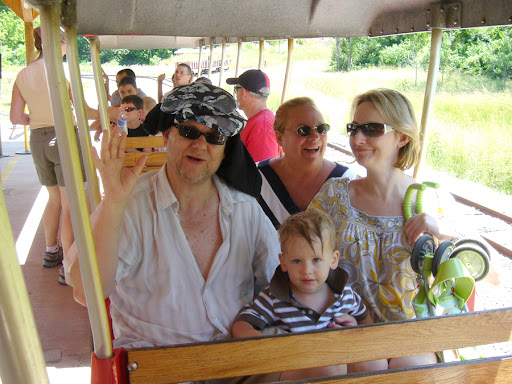
Zoo Train Derails, Injuring 22 People
By BRETT BARROUQUERE,
AP
posted: 5 HOURS 8 MINUTES AGO
AP
posted: 5 HOURS 8 MINUTES AGO
LOUISVILLE, Ky. (June 2) - A small train carrying visitors to the Louisville Zoo fell off the tracks Monday, sending 22 people to hospitals including one child who was critically injured, officials said.
The train of open-air cars is pulled by a small engine and circles the zoo along a two-mile track. It was carrying about 30 passengers when three cars and the engine fell off the rails near the gorilla exhibit. A person briefly trapped
Seventeen children were taken to Kosair Children's Hospital for treatment, including one in critical condition and another in serious, said spokesman Brian Rublein. Five adults were taken to University of Louisville Hospital, and spokesman David McArthur said all were in fair or better condition and that one might be admitted.
Dr. Neal Richmond, CEO and medical director of Louisville Metro EMS, said one adult had a possible head injury and was "a little confused initially" but was communicating and walking.
Those injured were from 2 months old to senior citizens, he said.
Rublein said besides the two children admitted to Kosair, three others were still being evaluated, with the rest treated and released.
The derailment happened about 1 1/2 hours before the zoo's 6 p.m. closing, Bussabarger said. The train wasn't in a public area but behind the gorilla exhibit, she said.
Zoo officials planned to reopen as scheduled Tuesday, but the ride will be closed until further notice. Bussabarger said three Kentucky Department of Agriculture ride inspectors are investigating. The cause was not yet known, Bussabarger said.
The train ride opened 40 years ago, Bussabarger said in a statement. The one that derailed was bought in 2000, holds 40 to 50 passengers and averages 12 miles per hour, she said.
Associated Press writer Beth Campbell contributed to this report.
.
.
Subscribe to:
Posts (Atom)