Showing posts with label Globalization. Show all posts

Sunday, August 30, 2026

The UN’s 2000 “Replacement Migration” Report Reveals the REAL Global Plan | Bernadette Spofforth


The UN’s 2000 “Replacement Migration” Report Reveals the REAL Global Plan | Bernadette Spofforth

Winston Marshall Clips

Aug 28, 2026

Bernadette Spofforth joins The Winston Marshall Show to discuss mass immigration, falling birth rates, the UN’s Replacement Migration paper, Agenda 2030 and the economics behind Net Zero. Spofforth, a British businesswoman and social commentator who co-founded digital radio company Intempo, examines how demographic decline and ageing populations have shaped government thinking on migration and welfare. She argues that Britain’s immigration policy, multiculturalism and social cohesion must be understood alongside UN population forecasts, the welfare state and the economic pressures created by shrinking working-age populations. The discussion also covers the Club of Rome, The Limits to Growth, Sustainable Development Goals, climate change policy, renewable energy, Africa’s development and the financial incentives surrounding environmental regulation. Spofforth also addresses how political short-termism and fears over cultural integration have influenced successive governments’ responses to immigration and demographic change.


Tuesday, May 12, 2026

WHO Conducts Global Pandemic Simulation Exercise Polaris II

 WHO Conducts Global Pandemic Simulation Exercise Polaris II


Global Health Emergency Preparedness Exercise Completed

The World Health Organization (WHO) concluded Exercise Polaris II on April 23, 2026—a comprehensive 2-day simulation designed to test international pandemic response capabilities. The exercise brought together 26 countries and territories, 600 health emergency experts, and over 25 partner organizations to practice coordinated responses to a fictional emerging pathogen outbreak.

Exercise Scope and Participation

Participating nations spanned all WHO regions, including Bangladesh, Brazil, Colombia, France, India, Indonesia, Kenya, Philippines, Thailand, and others. The simulation activated real emergency coordination structures across participating countries, allowing health officials to practice information sharing, policy alignment, and workforce surge deployment under realistic conditions.

Key Frameworks Tested

The exercise operationalized two WHO frameworks:

  1. Global Health Emergency Corps (GHEC) – Guides countries in strengthening emergency health workforce capacity based on sovereignty, equity, and solidarity
  2.  National Health Emergency Alert and Response Framework – Outlines essential coordination systems and response functions at local, sub-national, and national levels

The simulation also explored AI-enabled tools for workforce organization and planning.

Wednesday, November 19, 2025

The Keys of This Blood: The Struggle for World Dominion Between Pope John Paul II, Mikhail Gorbachev & the Capitalist West


No. 4: Malachi Martin, The Keys of This Blood: The Struggle for World Dominion Between Pope John Paul II, Mikhail Gorbachev & the Capitalist West

by Peter J. Leithart
July, 1991

Open Book: Views & Reviews, No. 4
July, 1991
Copyright (c) 1991 Biblical Horizons

Malachi Martin, The Keys of This Blood: The Struggle for World Dominion Between Pope John Paul II, Mikhail Gorbachev & the Capitalist West (New York: Simon and Schuster, 1990). Reviewed by Peter J. Leithart.

The subtitle of this massive volume gives a good idea of its major theme. Martin, the hard-hitting former Jesuit, examines the three major players involved in the "millennial end game" to determine the future geopolitical shape of the world. Gorbachev, Martin argues, is seeking the "Marxification" of Western Europe and America; the most powerful of the various Western globalists have a democratic-capitalist globe as their aim; John Paul II, whom Martin insists is a figure of immense geopolitical significance, has a vision that is "religious and specifically Christian from a Roman Catholic perspective" (p. 492), and hence John Paul specifically rejects the secularisms of East and West.

So much could, of course, be surmised from the book’s subtitle. No subtitle — nor a brief review, for that matter — could begin to capture the impressive range of issues and figures that Martin discusses. Several important themes emerge.

Martin stresses that, for all his global significance, the current Pope has no control over his Church. In a provocatively titled chapter, "The Judas Complex," he bluntly charges that many Roman Catholic officials are guilty of malfeasance. The abuse of office involves generally the refusal to teach and enforce Roman Catholic doctrines and practices, and centers on four specific issues: the Eucharist, the uniqueness of the Roman Church, the supremacy of the Pope, and a range of reproductive issues. Martin is a hyper-traditionalist Roman Catholic; he launches an attack on Vatican II’s emphasis on the Church as the "people of God," and summarizes the Catholic teaching that the Mass "presents the real live Sacrifice of the body and the blood and physical life of Jesus consummated on Calvary" (p. 667), a formulation that even Aquinas would be hesitant to endorse. For all his admiration of John Paul, Martin chides him, as he did in his earlier book, The Jesuits, for not weeding his own garden.

Saturday, November 08, 2025

Tuesday, October 28, 2025

Multiculturalism Is A Globalist Weapon And You’re Not Allowed To Protect Yourself


October 23, 2025 


By Brandon Smith

If you were alive to witness the events of 9/11, you probably remember the sudden emergence of the “Coexist” bumper stickers and t-shirts across the US after the tragedy. The intended message being that different cultures must be “tolerant” of each other and live in harmony. If you caught yourself with a twinge of visible pain in your face every time you saw this slogan, you were not alone.

Maybe it’s a subconscious aversion to hippies and their body odor, but I think the distaste for the message goes much deeper. It’s built into the DNA of every human being – It’s a part of our genetic memory. Every culture has an inherent drive to protect itself from competing cultures and ideologies.

We have learned over thousands of generations that culture is not just social expression, it is a carefully crafted fortress protecting us from being invaded and destroyed by hostile forces seeking to take what we have created. Homogeneous culture helps to maintain the values that keep our societies safe, industrious and stable.

Interestingly, the person who first created the “Coexist” artwork, a Polish man named Piotr Młodożeniec, was a staunch proponent of Polish Independence from the Soviet Union. The guy promoted Coexistence, but even he couldn’t tolerate the communists. It would seem that some ideals are mutually exclusive. Some spaces cannot be shared by certain beliefs.

Wednesday, October 02, 2024

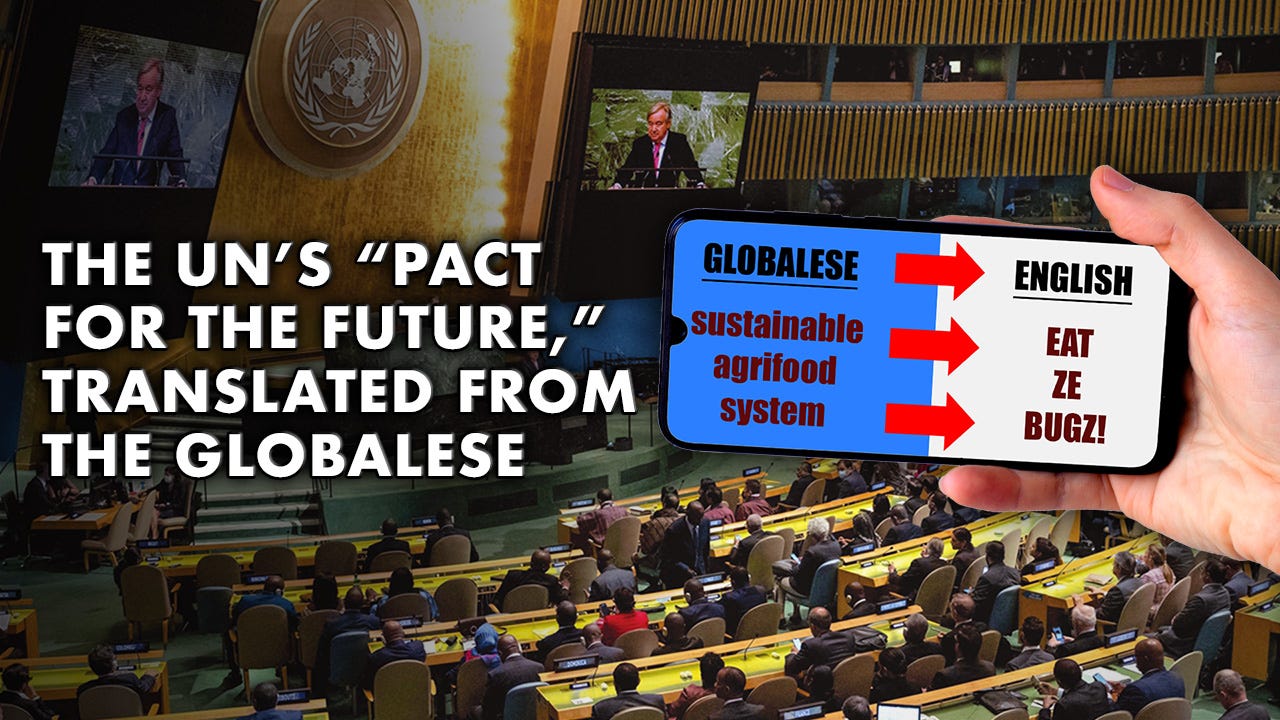
The UN's “Pact for the Future,” Translated From the Globalese


The Corbett Report
Sep 22, 2024


by James Corbett
corbettreport.com
September 22, 2024

Have you ever heard an establishment mouthpiece, a political puppet or a globalist gopher say something like: "Out of these troubled times, our fifth objective—a new world order—can emerge. A new era, freer from the threat of terror, stronger in the pursuit of justice, and more secure in the quest for peace"?

Or: "As our world becomes more complex, more uncertain, and more dangerous, we have an even greater responsibility to strengthen the multilateral system"?

Or: "The constructive contributions by INB relevant stakeholders were incredibly valuable. Together, we must sustain this progress during the coming months to realize our shared goal to forge a pandemic agreement that guides future global responses to pandemics"?

Yes, those are English words coming out of their mouths. But they're not speaking English. They're speaking Globalese.

You see, Globalese sounds like English and it employs English words, but it has its own dictionary, in which certain words have a completely different meaning. If you think you can understand terms like "sustainable development" or "international law" by looking them up in your standard English dictionary (or, even worse, Wikipedia), you're sadly mistaken.

Thankfully, after decades of listening to these globalists speak, I have a fairly good grasp of Globalese. Today I offer my services to help you translate the Globalese gobbledygook in the United Nation's new "Pact for the Future" into plain English.

Sorry, and you're welcome!

Friday, May 17, 2024

The Trouble With World Government


The World Health Organization logo is seen at the entrance of its headquarters in Geneva, Switzerland, on March 9, 2020. (Fabrice Coffrini/AFP via Getty Images)


By Jeffrey A. Tucker
5/14/2024Updated:
5/15/2024


Commentary

Well, at least that’s one setback for world government.

A court in Australia has told the government’s own eSafety Commission that Elon Musk is correct: One country cannot impose censorship on the world. The company X, formerly known as Twitter, must obey national law but not global law.

Mr. Musk seems to have won a very similar fight in Brazil, where a judge demanded not just a national but global takedown. X refused and won. For now.

This really does raise a serious issue: How big of a threat are these global government institutions?

Dreamy, dopey, and often scary intellectuals have dreamed of global government for centuries. If you are rich enough and smart enough, the idea seems to be the perennial temptation. The list of advocates includes people who otherwise have made notable contributions: Albert Einstein, Isaac Asimov, Walter Cronkite, Buckminster Fuller, and many others.

Often the dream comes alive following huge upheavals such as war and depression. Or a pandemic period such as the one we’ve just gone through. The use of “disinformation” as a cross-border test case of global government power is designed to deploy a new strategy of governance in general, one that disregards national control in favor of global control.

That has always been the dream. In history, for example, following the Great War, we saw the creation of the League of Nations, which was a forerunner to the United Nations, at the urging of President Woodrow Wilson. Both were seen by the intellectual class as necessary building blocks for what they really wanted, which was a binding world state.

This is not a conspiracy theory. It’s what they said and what they wanted.
In 1919, H.G. Wells, inspired by the League, became so excited about the idea that he wrote a sweeping reinterpretation of world history that extended from the ninth century B.C. until that present moment. It was called “The Outline of History.”

The goal of the book was to turn on its head the popular Whig theory from the previous century, which saw history as the story of ever more freedom for individuals and away from powerful states. Wells told a story of tribes turning to nations and then to regions, with ever less power to the people and ever more to dictators and planners. His purpose was to chronicle and defend exactly this.

It was a huge bestseller at a time when the appetite for books was voracious because they were becoming affordable and there was a burning passion in the population for universal education. The thesis of his book, however valuable in some historical respects, was genuinely bizarre. He imagined a future world state ruled by a tiny elite of the smartest people who would plan all economies, information flows, migration patterns, and governance systems while crushing national ambitions, free enterprise, traditions, and constitutions.

It was crazy stuff and didn’t really happen. But the efforts never stopped among a certain class of intellectuals. Following World War II, we saw similar efforts, the U.N. being only one. In the agreement hammered out at Bretton Woods in 1944, we had forged the World Bank and International Monetary Fund (IMF), which were seen as the basis of a global planning apparatus, together with a new world monetary system.

None of this worked out either. The IMF and World Bank ended up being well-funded sinecures for elite academics but not really the financial basis of a world state. The U.N. turned into a disappointment for many. The efforts at global management of trade finally came to fruition with the World Trade Organization, but that machinery has proven mostly toothless and unable to stop the sweeping turning back on free trade that has taken place over the past five years. Today, no nation really fears that entity.

The drive to unite Europe was advertised as a liberal move to inspire cooperation on trade and travel and to make economic cooperation possible. But that was just the pitch. The reality of the European Union was the creation of a mean bureaucracy in Brussels that would override the sovereignty of nations and force deference to a new central state in Europe that actually had no historical precedent. It was an experiment in region-wide government planning.

Britain was always a reluctant member, but when its worst fears were realized, the people voted to leave the whole thing. The result was Brexit, a political movement that panicked elites all over the world. They saw the plans of decades going up in smoke. Boris Johnson became prime minister with the task of making Brexit happen, but his rule was confounded at every step. Finally, the COVID-19 pandemic came along to upend his entire tenure.

One way to understand the COVID-19 pandemic response is as a further experiment in world government, a way for the elites to broadcast to the entire planet that they can achieve global cooperation when they want to.

In most every nation, the response was the same in terms of timing and protocol. Social distancing was everywhere, and masks, too. The breakup of gatherings including worship, along with idiotic schemes such as one-way grocery aisles, were imposed everywhere. The slogans (“We are all in this together”) and signage (wash hands, keep distance, mask up) were also the same.

It was creepy in the extreme, especially when you consider the way it all happened at once, even though we knew for sure that there are huge hemispheric differences in the way respiratory pathogens spread. Something can be a problem in New York but not in Sydney. Why did this happen all at once? The message seemed to be: This is just what we do in a global pandemic.

What they did not tell anyone is that none of this constituted “common sense public health measures” but rather amounted to an experiment without any precedent in the history of humanity. Nowhere had all this cockamamie stuff ever been implemented. Only crazy people had recommended them in the past, but the crazies somehow carried the day. There was a message behind the entire effort: We are the government, and we rule the world, populists’ resentment be damned.

In the aftermath, the World Health Organization (WHO) has picked up the mantle to goad the nations of the world to give up their sovereignty and agree to implement the same protocols anytime that the WHO demands it. They have this treaty or agreement that they have been shopping around the planet for signers. At first, it seemed to be in the bag. But with the calamity of the COVID-19 pandemic response in the rearview mirror, it turned out to not be so easy.

The group REPPARE started looking carefully at this agreement and the amendments and saw that the entire thing rested on faulty premises, twisted thinking, and fiscal profligacy. Governments around the world are now flat-out rejecting the offer to give up their control over nations. It appears now that the World Health Organization’s agreement is in trouble. We are even starting to see movements in the direction of leaving the WHO completely, just as President Donald Trump attempted to do back in 2017.

No question that a nascent world government is in operation today. It is hugely influential over media, technology, and the operation of the internet. It is managing global money flows and asset prices. It aims to reduce national sovereignty to mere brand names of the same thing and make it impossible for the will of the voters to prevail in any policy outcomes. It consists of large and well-funded elites that swim between the public and private sectors and operate through foundations and nongovernmental organizations. It is utterly detached from democratic processes.

“Nothing more disastrous could happen in the field of international economic relations than the realization of such plans,” Ludwig von Mises wrote in 1944. “It would divide the nations into two groups—the exploiting and the exploited; those restricting output and charging monopoly prices, and those forced to pay monopoly prices. It would engender insoluble conflicts of interests and inevitably result in new wars.”

In other words, like all government actions, the results of a world government would end in the opposite of the promise: not peace but war, not prosperity but poverty, not health but sickness, not a better environment but a worse one. It would be a prison for the world and utterly unworkable. People of the world need to be on the lookout for what is happening and reject it whenever the opportunity presents itself to do so.

For this reason, we should cheer anytime global government impositions such as censorship experience a setback. Government in one country causes enough trouble. A unitary government ruling all countries would doom what’s left of civilization.

Views expressed in this article are opinions of the author and do not necessarily reflect the views of The Epoch Times.