Showing posts with label carbon tax. Show all posts

Monday, November 11, 2024

First day of COP29 climate summit in Azerbaijan

COP29 Opens in Azerbaijan With Climate Finance at Top of Agenda


Mukhtar Babayev, president of COP29, during the opening ceremony of the climate conference in Baku, Azerbaijan, on Monday, Nov. 11, 2024. Hollie Adams—Bloomberg/Getty Images


November 11, 2024 6:53 AM EST

BAKU, Azerbaijan — Soaring rhetoric, urgent pleas and pledges of cooperation contrasted with a backdrop of seismic political changes, global wars and economic hardships as United Nations annual climate talks began Monday and got right to the hard part: money.

In Baku, Azerbaijan, where the world's first oil well was drilled and the smell of the fuel was noticeable outdoors, the two-week session, called COP29, got right to the major focus of striking a new deal on how many hundreds of billions — or even trillions — of dollars a year will flow from rich nations to poor to try to curb and adapt to climate change.

The money is to help the developing world transition their energy systems away from planet-warming fossil fuels and toward clean energy, compensate for climate disasters mostly triggered by carbon pollution from rich nations and adapt to future extreme weather.

Saturday, October 19, 2019

Climate emergency: City mayors are 'world's first responders', says UN chief


World Bank/Franz Mahr
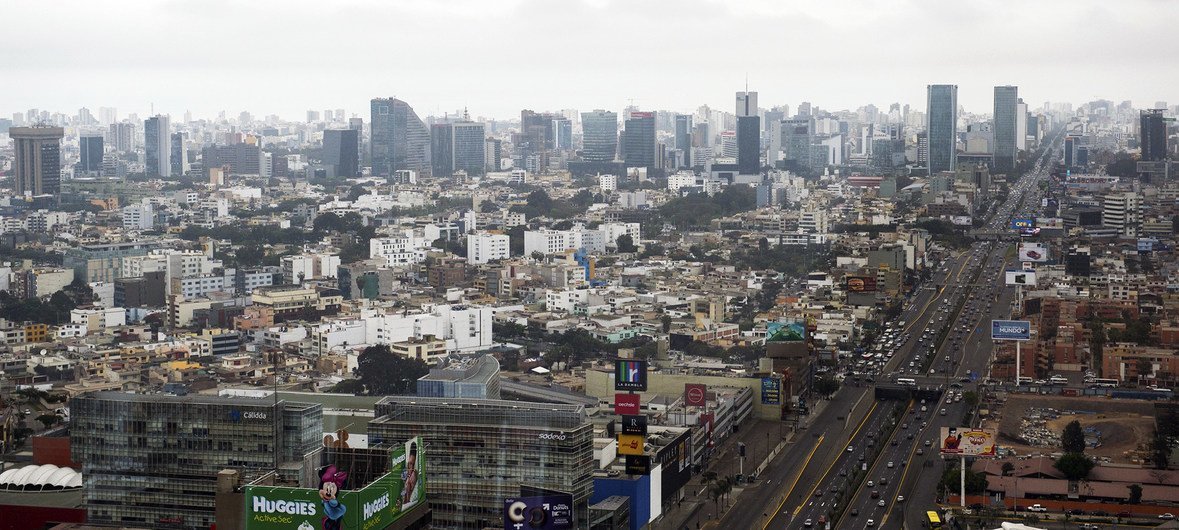
Lima, the capital of Peru, a South American megacity. (file)


11 October 2019
Climate Change


City bosses are “the world’s first responders to the climate emergency” UN chief António Guterres declared on Friday, at an international mayors’ summit in Copenhagen.

In his opening remarks to the C40 World Mayors Summit – a forum for member cities to present innovative actions to slow global warming – the Secretary-General noted that cities, which contain more than half the world’s population, and have an “enormous climate footprint”, are “on the frontlines of sustainable and inclusive development”.

Urban citizens, he continued, look to mayors to make cities havens for diversity, social cohesion and job creation.

Reminding delegates of the existential threat to humanity posed by the climate emergency, and the need to dramatically boost climate action at all levels, Mr. Guterres said that, at the UN Climate Action Summit in September, some 70 countries, and around 100 cities, announced plans to enhance their national plans to cut harmful emissions by 2020.

Saturday, June 15, 2019

Critics Call ‘A Large Tax Increase’ Pope Francis, Big Oil Back Climate Change Policy


2:43 PM 06/14/2019 | Energy


Michael Bastasch | Energy Editor


The Vatican joined oil companies, investors and environmentalists in signing a statement endorsing “carbon pricing” and so-called “climate disclosures” to shareholders.

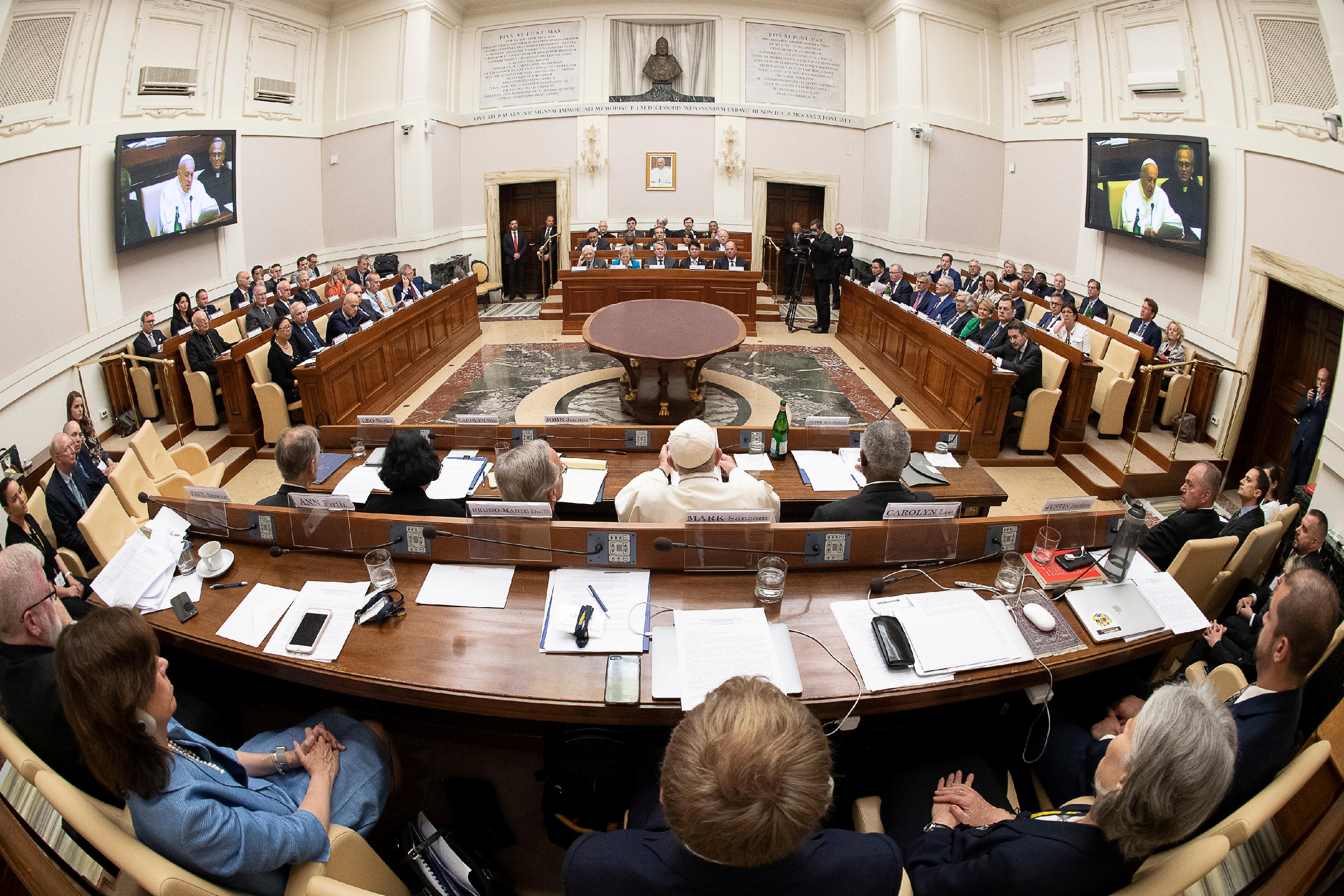
Pope Francis, oil giants and others endorsed carbon pricing — usually in the form of taxes or cap-and-trade schemes — Friday at the end of a closed-door meeting at the Pontifical Academy of Sciences.

Addressing the meeting Friday, the pope called for a “radical energy transition” to lower carbon dioxide emissions and fight global warming. He met with oil companies in 2018 over climate change.

“Undeniably, the Earth is a single system and humanity is a single whole,” reads the joint statement signed by oil and gas executives, activist investors and environmentalists, which was obtained by Axios.

The letter calls for “large-scale action” and technological innovation to keep global warming below 2 degrees Celsius, which is the goal of the Paris climate accord. Signatories agreed any carbon price should be high enough to change business and consumer behavior, but also assist “those who are least able to pay.”


Pope Francis addresses energy representatives at the end of a two-day meeting at the Academy of Sciences, at the Vatican, June 14, 2019. Vatican Media/Handout via REUTERS.

Pope Tells Oil Execs: The World Needs A “Radical Energy Transition”


Published 1 hour ago

on June 15, 2019


By Sean Louis Salazar


 Photo by Ashwin Vaswani on Unsplash


Pope Francis has declared a global “climate emergency” and preach to oil companies executives, pointing out that specific measures are needed to alleviate the problem with rising global temperatures. “The climate crisis requires our decisive action, here and now and the Church is fully committed to playing her part.”

“Time is running out!” Francis said. “Deliberations must go beyond mere exploration of what can be done, and concentrate on what needs to be done. We do not have the luxury of waiting for others to step forward, or of prioritizing short-term economic benefits.”

This is the second year that oil executives have gathered in Rome at the invitation of the Vatican’s Dicastery for Integral Human Development and Notre Dame University’s Mendoza College of Business. The theme of this year’s meeting is “The Energy Transition and Care for our Common Home.”

Attendees of the said event were the CEOs of Royal Dutch Shell, Eni, BP, Repsol, Conoco Phillips, Chevron, ExxonMobil, and executives of investment funds.

The Pope took the opportunity to urge oil executives to find solutions to address the rapidly rising global temperatures. “Faced with a climate emergency, we must take action accordingly, in order to avoid [perpetuating] a brutal act of injustice towards the poor and future generations,” he said. “We must take responsible actions bearing in mind their impact in the short and in the long term,” the Pope added.

Particularly, Pope Francis called for “open, transparent, science-based and standardized” reporting of climate risk and a “radical energy transition.” Furthermore, Francis encouraged the idea of carbon pricing.

“Such a transition involves managing the social and employment impact of the move to a low-carbon society,” Francis said. “If managed well, this transition can generate new jobs, reduce inequality and improve the quality of life for those affected by climate change.”

Carbon pricing is a way for governments to encourage innovations in low-carbon technology by implementing higher taxes or emissions trading schemes. It directly applies the costs of using fossil fuels that cause global warming to consumers. The signatories called for a “combination of policies and carbon pricing mechanisms … designed in a way that simultaneously delivers innovation and investment in low-carbon solutions while assisting those least able to pay”.

Thursday, February 14, 2019

Pope Francis’ climatologist visits New Orleans


Updated 14 hrs ago; Posted 14 hrs ago


Pope Francis greets The Rev. Eduardo Scarel, a Carmelite priest known as the pope's climatologist.


By Sara Sneath


The Rev. Eduardo Scarel is best known for his role in advising Pope Francis on climate change. As such, he’s been dubbed the Pope’s climatologist. A Carmelite priest and atmospheric scientist, Scarel was in New Orleans earlier this week speaking with high school students and to an audience at the Notre Dame Seminary Tuesday evening.

Why does the Pope need a climatologist? “Because the care for environment, for nature requires to see the state of the planet,” Scarel said. “And the tools of science provide the best way to see.”

Scarel helped advise Pope Francis on the Pope’s 2015 encyclical about climate change. An encyclical is a letter to Catholic leadership clarifying the church’s stance on an issue. The 2015 encyclical argued that humans have a moral imperative to address climate change.


Saturday, December 15, 2018

Climate change conference runs into overtime as delegates struggle to re...

Catholics ask for more 'heart and soul' at UN environmental conference


Protesters march outside the venue of the UN climate change conference in Katowice, Poland. 
CNS photo/Kacper Pempel, Reuters


By Michael Swan, The Catholic Register


December 14, 2018


Standing on the outside looking in as the world’s environment ministers and their armies of technocrats hammered out the rulebook for Paris Agreement on climate change, Canadian Josianne Gauthier wished there was an injection of urgency onto the agenda.


Top Stories


“We need more emotion in all of this, more heart and soul,” she told The Catholic Register on a call from Poland. “Get out of your head, get out of your numbers and do what’s right. This is a moral issue.”

Gauthier is the secretary general of CIDSE, the Brussels-based alliance of 18 Catholic development agencies in North America and Europe. CIDSE is just one small part of a sprawling gathering of civil society organizations which showed up in the coal-mining town of Katowice, Poland. There, between Dec. 3 and 14, negotiating teams from 197 nations convened for the UN conference which some are calling Paris 2.0.

Along with hundreds of other organizations, CIDSE was outside the official conference trying to influence what is said and done by official national delegations on the inside.

In 2015, Pope Francis played a similar role. That year he released his encyclical Laudato Si’, in part to influence the outcome of the United Nations climate negotiations in Paris. The Paris Agreement set a goal of keeping the rise in the planetary temperature well below 2.0 degrees by 2050, and if possible below 1.5 degrees. Last month the Intergovernmental Panel on Climate Change warned that Earth will hit the critical 1.5 degrees above pre-industrial temperatures by 2030.

“Yes, we still have time. We can do this,” said Gauthier. “But it’s serious…. We need to imagine another way to live.”

While the Paris Agreement set a global goal, it didn’t lay out a roadmap for how to get there. The roadmap is what is supposed to come out of this year’s meetings. But the ecologically minded NGOs in Katowice are aware the politics of climate change are complicated.

Catholic development agencies in the rich countries of the West are taking on a new role, educating Catholics at home about their responsibility for climate change, said Gauthier.

“We have to work a lot more on the ground with communities in our own countries. Some of our members, like Development and Peace, have campaigns on the ground and have worked with people in their own countries. It’s no longer about working with people in the north to support people in the south. It’s working with people in the north so that they change their own lives,” Gauthier said.

Development and Peace has tried to open a dialogue that’s a little more nuanced than the cartoon image of latte-drinking downtown elites trying to order rural Canadians to give up their pick-up trucks and their jobs in the oil patch.

“We have asked Canadians to change their behaviour, to question how they eat and how they move around,” said Development and Peace advocacy and research officer Elana Wright. “Let’s make a radical change. Our planet is at stake.”

But that shouldn’t be perceived as a threat to people’s livelihoods, she said. “We always talk about a just transition. It is possible to ensure that workers, families, are still able to make a living as we transition to different energy sources.”

Development and Peace heard from its rural members in 2014 when it launched its “Create a Climate of Change” campaign.

“We told people, ‘Do what you can do and let’s go further than we think we can go,” said Wright. “We have to change our individual behaviours, but also at the community level, the municipal level. And we’ve seen some cities really take leadership.”

Rather than forcing change on people, the Pope’s vision is based on conversion to the Gospel, said Gauthier.

“The Pope is a very bold person. I mean, he’s doing some really incredible risk-taking, questioning how we live, challenging us,” she said.

“It is scary for a lot of people, because it’s questioning what we think is the truth. But I think it brings us back to the core message. What the Pope is just trying to do is say, ‘Look, we’ve got to look to the poor and look to the excluded and listen to them.’”


Saturday, July 05, 2014

Respect climate science: Anglicans urge Tony Abbott to change tack on climate change policies


DateJuly 4, 2014


Tom Arup
Environment editor, The Age


Environment Minister Greg Hunt is congratulated by colleagues after Carbon Tax Repeal Bills pass the Lower House. The Anglican Church has called on the Abbott government to change its policies on climate change. Photo: Alex Ellinghausen

The Anglican Church has told the Abbott government to change its approach to climate change, urging it to respect and base its policy on scientific evidence.

At a meeting in Adelaide, the church's Australian general synod passed a unanimous motion calling on the government to "respect and act upon relevant independent evidence-based scientific advice’’ on climate change.

The 23 dioceses of the church said they were gravely concerned that Australia’s target to cut carbon dioxide emissions - five per cent below 2000 levels by 2020 - was well short of what was needed.

They said they deeply regretted that it was "future generations and other forms of life" that would "bear the real cost of our heavy dependence on carbon-based energy”.

Perth Bishop Tom Wilmot, a church leader on environmental issues, told Fairfax Media that the environment was such an important issue it should not be left just to politicians and economists to discuss it.

‘‘My concern is the Abbott government seems to be deconstructing almost everything that was put in place over the last decade or so to protect the environment,’’ he said.

‘‘It seems to be neutering any scientific voice and, in fact, any voice that seeks to speak on environmental matters.’

He said the appointment of businessman and self-described climate sceptic Dick Warburton to head a review of the renewable energy target was a cynical way of pre-determining its outcome.

And he accused Environment Minister Greg Hunt of being dishonest about the effectiveness of the carbon price, which is expected to be repealed next week with support of new crossbench senators.

Bishop Wilmot said he was concerned about the government's attitude to environmental policy generally, including handing approval powers for big developments to state governments.

He said the governments unsuccessful attempt to undo world heritage protection of some Tasmanian wilderness left Australia looking like a ‘‘vandal’’ and a ‘‘pariah’’.

He said he could not say that all bishops shared his views on the ‘‘cavalier attitude of the federal government to environmental protection’’, but the majority did privately.

Bishop Wilmot said the church had a unique voice to add to the environmental debate, adding a theological, moral and ethical dimension.

He said there was a long tradition in Christianity of respect and care for the environment, from the theology of the old testament to the parables of nature used by Jesus ‘‘to demonstrate straight truths about the kingdom of heaven’’.

‘‘My own theology is such that Christ isn’t just the redeemer of people, but the redeemer of the world,’’ he said.

‘‘We say in the Lord’s Prayer every Sunday in church ‘thy kingdom come, thy will be done in Earth as it is in heaven'. Well, I take that literally.’’

In response to the church's motion, Mr Hunt's spokesman said the government fully accepted the science of climate change.

''The problem with the carbon tax is that it has an adverse impact on families, whilst failing to significantly reduce emissions,'' he said.

''We therefore hope the Anglican Church will agree that the Coalition’s approach of taking pressure off electricity prices and actually achieving a significant reduction in emissions is a far better policy.''


Source
.

Tuesday, June 24, 2014

Hank Paulson: We Need Carbon Tax to Protect Economy


Tuesday, 24 Jun 2014 07:55 AM

By Dan Weil

Many Republicans oppose a tax on carbon dioxide emissions to combat climate change. But former Treasury Secretary Henry Paulson isn't one of them.

In a New York Times opinion piece, he compares the government's current handling of climate change to its handling of the financial system prior to the 2008 crisis.

"For too many years, we failed to rein in the excesses building up in the nation's financial markets," writes Paulson, now chairman of the Paulson Institute at the University of Chicago.

Editor's Note: 5 Signs Stock Market Will Collapse in 2013

"We're making the same mistake today with climate change. We're staring down a climate bubble that poses enormous risks to both our environment and economy."

And Paulson isn't shy about chiding members of his own party. "We need to act now, even though there is much disagreement, including from members of my own Republican Party, on how to address this issue while remaining economically competitive."

So what's the best way to do that?

"The solution can be a fundamentally conservative one that will empower the marketplace to find the most efficient response. We can do this by putting a price on emissions of carbon dioxide — a carbon tax," he argues

"A tax on carbon emissions will unleash a wave of innovation to develop technologies, lower the costs of clean energy and create jobs as we and other nations develop new energy products and infrastructure. This would strengthen national security by reducing the world's dependence on governments like Russia and Iran."

Meanwhile, the Obama administration's plan to control carbon emissions, announced earlier this month, "more or less orders states to adopt cap and trade or a carbon tax," according to a Wall Street Journal editorial.

The paper's editors aren't impressed. "The EPA [Environmental Protection Agency] claims that by some miracle the costs of this will be negligible, or even raise GDP," they write. "But it is impossible to raise the price of carbon energy without also raising costs across the economy."


Source
.

Climate Crisis Looming: Hank Paulson


Risky Business Co-Chair Henry M. Paulson

Next Generation

Published on Jun 23, 2014

http://riskybusiness.org
.
.
Note:

PAULSON'S BACK WITH ANOTHER "MANUFACTURED CRISIS"

On September 19, 2008, Paulson called for the U.S. government to use hundreds of billions of Treasury dollars to help financial firms clean up nonperforming mortgages threatening the liquidity of those firms.[34] Because of his leadership and public appearances on this issue, the press labeled these measures the "Paulson financial rescue plan" or simply the Paulson Plan.[35]

With the passage of H.R. 1424, Paulson became the manager of the United States Emergency Economic Stabilization fund.

As Treasury Secretary, he also sat on the newly established Financial Stability Oversight Board that oversaw the Troubled Assets Relief Program.


.
.

Sunday, June 08, 2014

A Christian Climate Scientist's Mission To Convert Non-Believers


by NPR STAFF
June 08, 2014 9:10 AM ET


7 min 31 sec

Playlist


Katharine Hayhoe is an atmospheric scientist and the director of the Climate Science Center at Texas Tech University. She is also a devout Christian.Courtesy of Katharine Hayhoe


“God gave us the brains to make good choices and there's consequences to the choices that we make.
- Katharine Hayhoe

Each week, Weekend Edition Sunday brings listeners an unexpected side of the news by talking with someone personally affected by the stories making headlines.

Last week, the Obama administration announced historic regulations to limit carbon dioxide emissions. Policies to address climate change have been a tough sell among some Republicans on Capitol Hill, but also in many Christian congregations around the country.

Katharine Hayhoe is an atmospheric scientist and the director of the Climate Science Center at Texas Tech University. She is also a devout Christian.

Hayhoe has spent the last few years trying to convince other Christians that climate change is real, and that caring about the issue is one of the most Christian things you can do. She told NPR's Rachel Martin of the difficulties of spreading that message among Christian congregations.

"The people we trust, the people we respect, the people whose values we share, in the conservative community, in the Christian community, those people are telling us, many of them, that this isn't a real problem — that it's a hoax," Heyhoe says. "Even worse, that you can't be a Christian and think that climate change is real. You can't be a conservative and agree with the science."

Heyhoe says what Christians often question about climate change is if God is in control, how could this happen? Another argument she hears is the idea that humans could change climate threatens the sovereignty of God.

"The answer to that is pretty simple: It's free will," she says. "God gave us the brains to make good choices and there's consequences to the choices that we make."

And that's what climate change is, she says, a consequence of an industrialized society that depends on coal, oil and gas for many of our resources.

Heyhoe says that once people can get past the stage where they're bashing each other over the head with facts and political opinions, and get to point of sharing what they truly care about, at that point, she says, we can make some progress forward. She also says that to care about green issues you don't have to be a liberal or what people call "tree huggers."

"I think the most important message for people is that each of us already has the values in our hearts that we need to care about this issue," she says.

In her presentations, Heyhoe says she finds it effective to address the questions people have: How do we know that climate change is even real? How could I care about climate change as a Christian/Conservative/Republican?  For some people, she says, it can feel like giving up their identity in order to care about climate change.

But lately she is also seeing a shift in the questions she's being asked. They've moved away from the specifics of climate change or what's heard on the news. Instead, people are asking what they can do about the problem.

"That's where I want to go," she says.


.
.
.

Monday, June 02, 2014

Obama administration targets coal with controversial emissions regulation


White House


Published June 02, 2014
FoxNews.com


The Obama administration took aim at the coal industry on Monday by mandating a 30 percent cut in carbon emissions at fossil fuel-burning power plants by 2030 -- despite claims the regulation will cost nearly a quarter-million jobs a year and force plants across the country to close.

The controversial regulation, which some lawmakers already are trying to block, is one of the most sweeping efforts to tackle global warming by this or any other administration.

The 645-page plan, expected to be finalized next year, is a centerpiece of President Obama's climate change agenda, and a step that the administration hopes will get other countries to act when negotiations on a new international treaty resume next year.

"We have a moral obligation to act," EPA Administrator Gina McCarthy said, in announcing the plan Monday morning.

While the proposed regulation drew praise from environmental groups, the coal industry and coal-state lawmakers were immediately wary. Democratic West Virginia Rep. Nick Rahall announced he would introduce legislation, along with Rep. David McKinley, R-W.Va., to stop the EPA plan.

"We will introduce bipartisan legislation that will prevent these disastrous new rules from wreaking havoc on our economy in West Virginia," Rahall said in a statement.

Bill Bissett, president of the Kentucky Coal Association, said he's "certain that it will be very bad news for states like Kentucky who mine and use coal to create electricity."

Senate Republican Leader Mitch McConnell, who represents Kentucky, called it a "dagger in the heart of the American middle class" -- and predicted higher power costs and less reliable energy as a result. McConnell's general election opponent, Democrat Alison Lundergan Grimes, also spoke out against the plan.

The draft regulation sidesteps Congress, where Obama's Democratic allies have failed to pass a so-called "cap-and-trade" plan to limit such emissions.

Under the plan, carbon emissions would be reduced 30 percent by 2030, compared with 2005 levels. The proposal sets off a complex regulatory process in which the 50 states will each determine how to meet customized targets set by the EPA.

States could have until 2017 to submit a plan to cut power plant pollution, and 2018 if they join with other states to tackle the problem, according to the EPA's proposal.

EPA data shows that the nation's power plants have reduced carbon dioxide emissions by nearly 13 percent since 2005. But with coal-fired power plants already beleaguered by cheap natural gas prices and other environmental regulations, experts said reaching the targets won't be easy. The EPA is expected to offer a range of options to states to meet targets that will be based on where they get their electricity and how much carbon dioxide they emit in the process.

While some states will be allowed to emit more and others less, overall the reduction will be 30 percent nationwide.

The options include making power plants more efficient, reducing the frequency at which coal-fired power plants supply power to the grid, and investing in more renewable, low-carbon sources of energy. They also can set up pollution-trading markets as some states already have done to offer more flexibility in how plants cut emissions.

If a state refuses to create a plan, the EPA can make its own.

The Obama administration claimed the changes would produce jobs, cut electricity bills and save thousands of lives thanks to cleaner air.

But critics disputed the estimates.

"Throughout his presidency, Barack Obama has adopted a 'my way or the highway' approach, and that explains why he's shoving these EPA regulations down our throat," Republican Party Chairman Reince Priebus said in a statement. "The U.S. Chamber of Commerce has found that each year this regulation will kill 224,000 jobs and force energy rates to skyrocket, so it's no wonder President Obama is circumventing Congress to implement his latest job-killing regulation."

Hundreds of coal-burning plants will have to comply, which has resulted in strong opposition from the energy industry, big business and coal-state Democrats and Republicans, who argue Obama’s green-energy agenda is tantamount to a “war on coal.”

The U.S. Chamber of Commerce argues that the rule will kill jobs and close power plants across the country.

The group released a study that finds the rule will result in the loss of 224,000 jobs every year through 2030 and impose $50 billion in annual costs.

Without waiting to see what Obama proposes, governors in Kansas, Kentucky, Virginia and West Virginia have already signed laws directing their environmental agencies to develop their own carbon-emission plans. Similar measures recently passed in Missouri and are pending in the Louisiana and Ohio legislatures.

On Saturday, Obama tried to bolster public support for the new rule by arguing that carbon-dioxide emissions are a national health crisis -- beyond hurting the economy and causing global warming.

“We don’t have to choose between the health of our economy and the health of our children,” Obama said in his weekly address. “As president and as a parent, I refuse to condemn our children to a planet that’s beyond fixing.”

Many anticipate the rule change will increase electricity prices, considering the United States relies on coal for 40 percent of its electricity. However, the plants also are the country’s second-largest emitter of greenhouse gases.

Many of the Democrats who are raising concerns represent coal-producing states and face tough 2014 reelection bids.

Among them is West Virginia Democratic Rep. Nick Rahall, whose state gets 96 percent of its power from coal. Rahall said Thursday that he didn't have specific details about the rule, but "from everything we know we can be sure of this: It will be bad for jobs."

Obama is being forced to use the 1970s-era old Clean Air Act, after failing during his first term to get Congress to pass a law. The law has long been used to regulate pollutants like soot, mercury and lead, but has only recently been applied to greenhouse gases.

"There are no national limits to the amount of carbon pollution that existing plants can pump into the air we breathe. None," Obama said Saturday in his weekly radio and Internet address. "We limit the amount of toxic chemicals like mercury, sulfur, and arsenic that power plants put in our air and water. But they can dump unlimited amounts of carbon pollution into the air. It's not smart, it's not safe, and it doesn't make sense."

The rule also will prescribe technological fixes or equipment to be placed on existing plants and require new ones to capture some of their carbon dioxide and bury it underground.

The Associated Press contributed to this report.
.
.
.

Tuesday, November 26, 2013

UN Climate Change Conference in Warsaw keeps governments on a track towards 2015 climate agreement


23 / 11 / 2013


(Warsaw, 23 November 2013) The UN Climate Change Conference in Warsaw ended on Saturday, keeping governments on a track towards a universal climate agreement in 2015 and including significant new decisions that will cut emissions from deforestation.

“Warsaw has set a pathway for governments to work on a draft text of a new universal climate agreement. So it appears on the table at the next UN Climate change conference in Peru. This is an essential step to reach a final agreement in Paris, in 2015, said Marcin Korolec, President of the COP19 conference.”

In the context of 2015, countries decided to initiate or intensify domestic preparation for their intended national contributions towards that agreement, which will come into force from 2020. Parties ready to do this will submit clear and transparent plans well in advance of COP 21, in Paris, and by the first quarter of 2015.

Countries also resolved to close the pre-2020 ambition gap by intensifying technical work, including through workshops, and increased opportunities for information sharing. Work will also be intensified through the more frequent engagement of Ministers by means of Ministerial Dialogues.

“We have seen essential progress. But let us again be clear that we are witnessing ever more frequent, extreme weather events, and the poor and vulnerable are already paying the price,” said Christiana Figueres, Executive Secretary of the UN Framework Convention on Climate Change (UNFCCC).

“Now governments, and especially developed nations, must go back to do their homework so they can put their plans on the table ahead of the Paris conference,” she said.

In addition, governments provided more clarity on mobilizing finance to support developing country actions to curb emissions and adapt to climate change. This includes requesting developed countries to prepare biennial submissions on their updated strategies and approaches for scaling up finance between 2014 and 2020, complemented by a decision to hold a similar schedule of high-level ministerial dialogues on finance.

The Warsaw meeting also resulted in concrete announcements of forthcoming contributions of public climate finance to support developing nation action, including from Norway, the UK, EU, US, Republic of Korea, Japan, Sweden, Germany and Finland.

Meanwhile, the Green Climate Fund Board is to commence its initial resource mobilization process as soon as possible and developed countries were asked for ambitious, timely contributions by COP 20, in December, next year, to enable an effective operationalization.

The conference also decided to establish an international mechanism to provide most vulnerable populations with better protection against loss and damage caused by extreme weather events and slow onset events such as rising sea levels. Detailed work on the so-called “Warsaw mechanism” will begin next year.


Cutting emissions from deforestation

Today’s agreements included a significant set of decisions on ways to help developing countries reduce greenhouse gas emissions from deforestation and the degradation of forests, which account for around one fifth of all human-generated emissions. The agreement on REDD+ is backed by pledges of 280 million dollars financing from the US, Norway and the UK.

President Korolec said: “I am proud of this concrete accomplishment. We are all aware of the central role that forests play as carbon sinks, climate stabilizers and biodiversity havens. Through our negotiations we have made a significant contribution to forest preservation and sustainable use which will benefit the people who live in and around them and humanity and the planet as a whole. I am proud that this instrument was named Warsaw Framework for REDD.”


Further progress in help for developing nations


In Warsaw, a landmark was passed after 48 of the poorest countries of the world finalized a comprehensive set of plans to deal with the inevitable impacts of climate change. With these plans, the countries can better assess the immediate impacts of climate change and what they need in the way of support to become more resilient. Developed countries, including Austria, Belgium, Finland, France, Germany, Norway, Sweden, Switzerland have also paid or pledged over 100 million dollars to add to the Adaptation Fund, which has now started to fund national projects.

Governments completed work on the Climate Technology Centre and Network (CTCN) so that it can immediately respond to requests from developing countries for advice and assistance on the transfer of technology.

The CTCN is open for business and is encouraging developing countries to set up focal points to accelerate the transfer of technology.


Climate action at all levels

COP19 has been a showcase for climate action by business, cities, regions and civil society.

The UNFCCC secretariat also celebrated its annual Momentum for Change lighthouse activity awards for climate actions that demonstrate positive results through innovative finance, by women and the urban poor. In addition, Momentum for Change launched a new initiative focusing on contributions by information and technology sector to curb emissions and increase adaption capacity.

“A groundswell of action is happening at all levels of society. All major players came to COP19 to show not only what they have done but to think what more they can do. Next year is also the time for them to turn ideas into further concrete pledges,” Ms. Figueres said.


2014 New York Summit


In Warsaw, UN Secretary General Ban Ki-moon reiterated his invitation to all governments, and leaders from finance, business, local government and civil society, to a climate summit in New York on 23 September 2014. This will be a solutions summit, complementing the UNFCCC negotiations. “I ask all who come to bring bold and new announcements and action.  By early 2015, we need those promises to add up to enough real action to keep us below the internationally agreed two degree temperature rise,” he said.

The next UNFCCC meeting of the Ad Hoc Working Group on the Durban Platform is to take place in Bonn from 10 to 14, March, 2014.


Source

.

Wednesday, July 10, 2013

UN released Millennium Development Goals Report 2013


Published on: 08-JUL-2013


United Nations on 1 July 2013 released the Millennium Development Goals (MDG) Report with more targets to be achieved by 2015. The report that seeks urgent address to several important challenges being faced by the world and its people was launched by UN Secretary-General Ban Ki-moon.

The 2013 MDG Report looks forward to areas that requires urgent attention such as, one of every eight people of world remain hungry, death of women during childbirth, although facilities to protect them are available, lack of improved sanitation facilities for more than 2.5 billion people, of which one billion continue to practice open defecation, a major health and environmental hazard. Our resource base is in serious decline, with continuing losses of forests, species and fish stocks, in a world already experiencing the impacts of climate change. The report highlights major eight goals to be worked upon.


The eight major Goals set by United Nations under the Millennium Development Program were: Eradication of Extreme Poverty and Hunger, Achieve Universal Primary Education, Promote Gender Equality and Empower Women, Reduce Child Mortality, Improve Maternal Health, Combat HIV/AIDS, Malaria and other diseases, Ensure Environmental Sustainability, Develop Global Partnership for Development. These goals were set for the first time at the time of Project inception in July 2002.

Progress Report of the major Eight Goals:

• Goal 1: Eradication of Extreme Poverty and Hunger – Halve, between 1990 and 2015, the proportion of people whose income is less than $1 a day. Some of the quick facts about improvement:
a) With about less than 700 million people, who live in extreme poverty conditions in 2010 than in 1990, the Poverty rates have been halved
b) Widening of the global jobs gap by 67 million people due to the economic and financial crisis One in eight people still go to bed hungry, despite major progress
c) Globally, nearly one in six children under age five are underweight; one in four are stunted
d) An estimated 7 per cent of children under age five worldwide are now overweight, another aspect of malnutrition; one quarter of these children live in sub-Saharan Africa


• Goal 2: Achieve Universal Primary Education – If current trends continue, the world will not meet the goal of universal primary education by 2015. Quick Facts:
a) By 2011, 57 million children of primary school age were out of school, down from 102 million in 2000
b) More than half of these out-of-school children live in sub-Saharan Africa
c) Globally, 123 million youth (aged 15 to 24) lack basic reading and writing skills; 61 per cent of them are young women


• Goal 3: Promote Gender Equality and Empower Women – Steady progress has been made towards equal access of girls and boys to education, but more targeted action is needed in many regions. The quick Overview:
a) Gender parity is closest to being achieved at the primary level; however, only 2 out of 130 countries have achieved that target at all levels of education
b) Globally, 40 out of 100 wage-earning jobs in the non-agricultural sector are held by women
c) As of 31 January 2013, the average share of women members in parliaments worldwide was just over 20 per cent


• Goal 4: Reduce Child Mortality – Reduce by two thirds, between 1990 and 2015, the under-five mortality rate. The Quick Overview:
a) Since 1990, the child mortality rate has dropped by 41 per cent; 14,000 fewer children are dying each day
b) Still, 6.9 million children under age five died in 2011—mostly from preventable diseases

c) In sub-Saharan Africa, one in nine children die before age five, more than 16 times the average for developed regions


• Goal 5: Improve Maternal Health – Maternal mortality has declined by nearly half since 1990, but falls far short of the MDG target. Quick Overview:
a) In Eastern Asia, Northern Africa and Southern Asia, maternal mortality has declined by around two thirds.
b) Only half of pregnant women in developing regions receive the recommended minimum of four antenatal care visits.
c) Some 140 million women worldwide who are married or in union say they would like to delay or avoid pregnancy, but are not using contraception

• Goal 6: Combat HIV/AIDS, Malaria and other diseases – The incidence of HIV is declining steadily in most regions; still, 2.5 million people are newly infected each year. The Quick Overview of the Facts:
a) In 2011, 230,000 fewer children under age 15 were infected with HIV than in 2001.
b) Eight million people were receiving antiretroviral therapy for HIV at the end of 2011.
c) In the decade since 2000, 1.1 million deaths from malaria were averted.
d) Treatment for tuberculosis has saved some 20 million lives between 1995 and 2011

• Goal 7: Ensure Environmental Sustainability – Forests are a safety net for the poor, but they continue to disappear at an alarming rate. The Quick Overview of the Facts:
a) Global emissions of carbon dioxide (CO2) have increased by more than 46 per cent since 1990.
b) Nearly one third of marine fish stocks have been overexploited.
c) Many species are at risk of extinction, despite an increase in protected areas.
d) More than 2.1 billion people and almost 1.9 billon people, respectively, have gained access to improved water sources and sanitation facilities since 1990.
e) An estimated 863 million people reside in slums in the developing world

• Goal 8: Develop Global Partnership for Development – The global financial crisis and euro zone turmoil continue to take a toll on official development assistance. The Overview of the Facts:
a) Official development assistance stood at $126 billion in 2012.
b) Eighty-three per cent of least developed country exports enter developed countries duty free.
c) The debt service of developing countries consumes only 3 per cent of their export revenues.
d) In the developing world, 31 percent of the population uses the Internet, compared to 77 percent of the developed world


MDG targets have already been met or are within close reach

The proportion of people living in extreme poverty has been halved at the global level
• Over 2 billion people gained access to improved sources of drinking water
• Remarkable gains have been made in the fight against malaria and tuberculosis
• The proportion of slum dwellers in the cities and metropolises of the developing world is declining
• A low debt burden and an improved climate for trade are levelling the playing field for developing countries
• The hunger reduction target is within reach

MDG targets, for which accelerated Progress and bolder actions needs to be taken

• Environmental sustainability is under severe threat, demanding a new level of global cooperation
• Big gains have been made in child survival, but more must be done to meet our obligations to the youngest generation
• Most maternal deaths are preventable, but progress in this area is falling short
• Access to antiretroviral therapy and knowledge about HIV prevention must expand
• Too many children are still denied their right to primary education
• Gains in sanitation are impressive—but not good enough
• There is less aid money overall, with the poorest countries most adversely affected

Areas with disparities, where attention needs to be focused as these often stand in the way of further improvements:

Rural-urban gaps persist—access to reproductive health services and to clean drinking water is only two examples: In 2011, only 53 per cent of deliveries in rural areas were attended by skilled health personnel, versus 84 per cent of them in urban areas. Eighty-three percent of the population without access to an improved drinking water source lives in rural communities.

The poorest children are most likely to be out of School:Children and adolescents from the poorest households are at least three times more likely to be out of school than children from the richest households. Girls are more likely to be out of school than boys among both primary and lower secondary age groups, even for girls living in the richest households Gender-based inequalities in decision-making power persist: Whether in the public or private sphere, from the highest levels of government decision-making to households, women continue to be denied equal opportunity with men to participate in decisions that affect their lives

Measuring progress towards the MDGs: Progress towards the eight Millennium Development Goals is measured through 21 targets and 60 official indicators. This report presents an accounting to date of how far the world has come in meeting the goals using data available as of June 2013. Most of the MDG targets have a deadline of 2015, using 1990 as the baseline against which progress is gauged.

The basis for this Analysis: Regional and sub-regional figures presented in this report are compiled by members of the United Nations Inter-Agency and Expert Group on MDG Indicators (IAEG). In general, the figures are weighted averages of country data, using the population of reference as a weight. For each indicator, individual agencies were designated as official providers of data and as leaders in developing methodologies for data collection and analysis. The team that prepared the report was headed by the Department of Economic and Social affairs of the United Nations Secretariat, in response to the wishes of the General Assembly for periodic assessment of progress towards the MDGs.

UN Millennium Project: The Millennium Project was commissioned by the United Nations Secretary-General in 2002 to develop a concrete action plan for the world to achieve the Millennium Development Goals and to reverse the grinding poverty, hunger and disease affecting billions of people. In 2005, the independent advisory body headed by Professor Jeffrey Sachs, presented its final recommendations to the Secretary-General in a synthesis volume investing in Development: A Practical Plan to Achieve the Millennium Development Goals.

UN Millennium Campaign: The United Nations Millennium Campaign, started in 2002, supports and inspires people from around the world to take action in support of the Millennium Development Goals.


.

Thursday, November 08, 2012

News bites: Carbon tax could be in Obama's toolbox


By Zack Colman - 11/08/12 08:39 AM ET


Multinational bank HSBC says President Obama could consider a carbon tax to tackle greenhouse gas emissions and raise new revenues, notes Bloomberg.

While Obama will likely continue to push for clean energy and emissions reductions, The Washington Post says congressional opposition might limit his ability to do so.

Bloomberg Businessweek says analysts expect Obama to approve the northern portion of the Keystone XL pipeline, which would bring Canadian oil sands to Texas refineries.

A dip in U.S. ethanol fuel production for the first time in 16 years looks likely, according to Bloomberg.

Climate change activist Bill McKibben’s anti-fossil fuel national tour began Wednesday in Seattle, reports The Seattle Times.

,